Godzilla (2014)

godzilla-2014-poster

The stench which emanated from the sheer awfulness of Roland Emmerich’s “Godzilla” has haunted me ever since I saw it on the big screen in 1998. For a time, it dampened my spirits in terms of where movies were headed as I was afraid many more of them would be dumbed down like Emmerich’s movie was. Had it been an even bigger hit, I feared more summer blockbusters would look exactly like it; filled with lame one-dimensional characters and special effects which look no different from the video games we play at home. But in the end, it was so critically reviled that even Toho, the company that owns Godzilla, looked at Emmerich’s version of the monster as a separate, stand-alone character whom they renamed Zilla. It was if they were saying, “Oh no, that was so not Godzilla. That was a cousin or a step child or maybe the product of a one-night stand.”

But now that stench has vanished as Gareth Edwards has given us his version of “Godzilla,” and it makes for one of the most entertaining movies of the 2014 summer movie season. Instead of having this enormous Japanese monster chase after characters who look like they were part of a rejected sitcom pilot, he stays true to the style of the Toho series of Godzilla films and manages to weave in some commentary about nuclear power. Just as the original “Godzilla” served as a metaphor for Hiroshima, this one doesn’t dare hide away from what happened in Fukushima where nuclear accidents occurred after the massive earthquake and tsunami which occurred there.

The movie starts off with the terrifying destruction of a nuclear power plant, one which ends up dividing a father and his son. We then move to several years later when Ford Brody (Aaron Taylor-Johnson), an explosive ordnance disposal technician in the US Navy, comes home to his wife Elle (Elizabeth Olsen) and their son after a long tour of duty. Their reunion, however, is cut short as Ford gets word his father, nuclear physicist Joe Brody (Bryan Cranston), has once again been arrested in Japan for trespassing into areas blocked off to the general public as the area surrounding the power plant isn’t all that different from Chernobyl when it suffered a meltdown.

Joe is still convinced the power plant accident was really a cover up for something, and he and Ford come to discover what’s left of it has been converted into a laboratory of sorts. Scientists led by Dr. Ishiro Serizawa (Ken Watanabe) and Dr. Vivienne Graham (Sally Hawkins) reveal they have been housing a MUTO (Massive Unidentified Terrestrial Organism) and are trying to keep it contained by giving it doses of radiation. But, of course, all hell breaks loose when the MUTO breaks free of its captivity and heads out to sea, and it is then we learn another MUTO (this one a female) has been held in the United States and has also escaped and quickly laid waste to Las Vegas. Like Natasha Henstridge’s character in “Species,” she is looking to start a big family with offspring which will surely destroy all of humanity, and it’s only a matter of time before she finds her MUTO mate. Clearly, safe sex is not on their agenda.

This is where the iconic Godzilla comes in. Now in the past, this gigantic creature has been portrayed as an enemy to all of humanity and as an antihero who looks to take down any other monster who foolishly thinks it can defeat him. But in Edwards’ movie, Godzilla is really the good guy who, as Dr. Serizawa puts it, is here to “restore balance” to the world, and he doesn’t even bother the battleships which sail alongside him as he swims from one country to the next. We all know Godzilla will end up destroying a lot of expensive real estate which will cause many insurance companies to go bankrupt, but we’re still on the monster’s side as we know the military won’t have enough firepower to bring down the MUTOs.

Edwards takes his sweet time in revealing Godzilla to the audience, and we don’t really get a good look at him until almost an hour into the movie. When he does finally appear onscreen and let out the biggest of roars anyone has ever heard, the audience I saw this movie with broke into a tremendous applause. This is the fiercest Godzilla has looked in many years, and the way he towers over the tallest of buildings had me in awe. This is the way Godzilla should look and feel.

One of the many problems I had with the 1998 “Godzilla” is it never felt like I was watching a real monster on the big screen. It felt more like I was watching a big special effect to where the creature didn’t even fill the least bit threatening. But in 2014’s “Godzilla,” the creature looks and feels real to where I kept praying the human characters would keep themselves from standing underneath its feet. The thought of being crushed by a creature that big is horrifying.

As for “Godzilla’s” human element, it’s not altogether strong, but I still liked how the characters came across as relatable even if they were at times clichéd. I also have to give the screenwriters credit as the movie starts as one thing but surprisingly turns into something else. Just when I thought I knew what kind of movie this “Godzilla” was going to be, it continued to surprise me as it went along. Yes, we all know how things will end, but getting there proved to be more fun than I expected.

It also helps there is a terrific cast of actors to keep us emotionally involved in the characters before and after Godzilla makes his grand entrance. You can never go wrong with Bryan Cranston whether it’s “Breaking Bad” or anything else, and he makes his character very empathetic when he could have been easily laughable. As for Aaron Taylor-Johnson, I almost didn’t recognize him after getting so used to how he looked in those “Kick Ass” movies, and he does good work portraying the typical heroic military character we always see in “Godzilla” movies. Ken Watanabe remains a tremendously gifted actor, and even though I thought stared in horror one too many times in this movie, he is a very welcome addition to this cast. And then there’s David Strathairn who plays Admiral William Stenz, and he can always be counted on to give the military leader the gravitas and humanity a character like this deserves.

As for the female characters, their roles are a bit underwritten and I didn’t get to see as much of them as I would have liked. Still, you have actresses like Elizabeth Olsen, Juliette Binoche and Sally Hawkins making them into memorable characters when they could have been ones who were easily forgettable.

This “Godzilla” does have its problems, and there are times I wished Edwards and company had injected just a little more humor into the proceedings. Also, the big fight between Godzilla and the MUTOs never seems to come soon enough. There’s a moment where it looks like the fight will begin, but then a door closes on the characters and on our view of the monsters, and that was really frustrating. The human characters may have wanted the door shut, but everyone in the audience was clamoring for it stay open so we could see one enormous mutated creature beat the crap out of another. And yes, there probably are some plot holes and gaps in logic in the story, but I really didn’t care. You don’t always go to these movies expecting a whole lot of logic anyway.

What makes this “Godzilla” work is how it is clearly made by filmmakers who have a great love of monster movies. Edwards, whose previous directorial effort was British science fiction film “Monsters,” has talked about just how much he loves those kinds of movies, and he does an excellent job of making Godzilla a truly terrifying force of nature. After being absent from the big screen for over a decade, it is great to see this iconic monster make such a tremendous comeback.

I also got to say watching “Godzilla” makes me really happy that I do not work for an insurance company. Seeing all those destroyed buildings and roads, I can see claim adjustors going nuts as they field one phone call after another regarding totaled Hondas, decimated condos and bridges which now really lead to nowhere because they’ve been destroyed. You can bet no one’s going to take any guff from someone who tells them their insurance policy doesn’t cover attacks from giant mutated monsters!

* * * out of * * * *

Save

The People vs. George Lucas

the-people-vs-george-lucas-poster

It’s fascinating to see the trajectory George Lucas’ career has taken in the arena of public opinion. Here is a man who for years was beloved by everyone on the planet for creating “Star Wars,” who beat the Hollywood studios at their own game and opened us up to a world of tremendous and endless imagination. Then came the “special editions” of the original “Star Wars” trilogy which served to fund the prequels, and then the prequels followed shortly afterward, and he went from being seen as a demigod to being treated like a pariah of the worst kind. Our love for Lucas has long since turned into a vicious hatred which had us out for blood, but has he really become just another greedy CEO, or are we all just being a bunch of ungrateful bastards?

Those issues are examined in Alexandre O. Philippe’s highly entertaining documentary, “The People vs. George Lucas.” After all these years we finally get to see the filmmaker have his day in court. Granted, he only appears in past footage of interviews and behind the scenes stuff, but Philippe does make it seem like he’s giving his side of the story here.

This could have been just a one-sided portrait of Lucas and the venom he has inadvertently inspired in the most devoted fans, but what’s great about this documentary is how it gives us a multi-faceted view of him. We see Lucas’ humble beginnings and how he developed a love for film and a deep hatred for the corporations which took over Hollywood. We feel for him when he talks about how upset he was at film executives who re-cut “THX-1138” and “American Graffiti,” and we find ourselves rooting for him to gain his independence from the studio system forever. The fact he accomplished this through getting exclusive merchandise rights on “Star Wars” was a kick because no studio will ever let another filmmaker get away with such a thing ever again.

Then we see how Lucas, through gaining his independence, became the very thing he fought against. There’s a great interview with Francis Ford Coppola who talks about the filmmaker Lucas could have been and of how many great films he had inside of him, but the success of “Star Wars” ended up enslaving him for life. Lucas has said, with the conclusion of the prequel trilogy, he was going to make the smaller and more experimental films he always wanted to make, but he soon found himself drawn back to the galaxy far, far away when it became possible to do 3D versions of each “Star Wars” movie.

Philippe also shows us how Lucas is full of contradictions. On one hand, this is a filmmaker who fought against the colorization of black-and-white movies, and yet he will do nothing to save the original versions of the first “Star Wars” trilogy. Many feel like he totally ignored the fans who helped build “Star Wars” into a mighty franchise by giving them “The Phantom Menace” and Jar Jar Binks, but even he agreed with them that “The Star Wars Christmas Special” was a huge mistake.

By presenting all the different sides of Lucas, we don’t come out of this documentary loving or hating him. In the end, he’s human like the rest of us, prone to making inescapable mistakes like anybody else. While many despise him for how the “Star Wars” prequels turned out or for what he did to “Indiana Jones and the Kingdom of the Crystal Skull,” his never-ending imagination has created splendid worlds we would all love to be a part of.

One of the great things about “The People vs. George Lucas” is watching the fan made films and parodies which “Star Wars” inspired. Seeing filmmakers use stop motion animation, anime and other methods is a lot of fun to take in. Among the best bits were “Troops” which is a spoof of the TV show “Cops” but with Storm Troopers, and the “Misery” parody which has Annie Wilkes making the injured George Lucas rewrite “Revenge of the Sith” the way she wants to see it. Why she didn’t make him rewrite “The Phantom Menace” remains a mystery.

In many ways, the “Star Wars” prequels and even the last “Indiana Jones” movie were victims of our intense anticipation for them. They represented a way to once again experience the things in our childhood which made us so happy to be alive, and we would give anything to feel like a kid again when it comes to movies. But in the end, our excitement for these movies was undone not because we expected more from them, but because our anticipation proved to be more exciting than the finished product. To put it in another way, here’s a quote from Lewis Black:

“There is no better moment than this moment when we’re anticipating the actual moment itself. All of the moments that lead up to the actual moment are truly the best moments. Those are the moments that are filled with good times. Those are the moments in which you are able to think that it is going to be perfect when the moment actually happens. But, the moment is reality and reality always kind of sucks!”

The anticipation for “The Phantom Menace” was higher than any other movie before it, and there was no way it could have completely satisfied everyone. In retrospect, our excitement for the prequels proved to be far more enthralling than what ended up on the silver screen because we wanted them to be one thing, and Lucas ended up going against our expectations whether he intended to or not.

What “The People vs. George Lucas” seems to suggest in the end is that we should be thankful he continued with “Star Wars” at all. It also suggests that, despite our utter disappointment at the prequels, he still gave us a wealth of imagination we can still be deeply inspired by. Had this been just a documentary dedicated to bashing Lucas to within an inch of his life, it would have become tiresome and boring very quickly. But “The People vs. George Lucas” is great because it gives us the different dimensions of the man and shows us how the ways he fought the system ended up working against him in later years. This is a great documentary that will appeal to fans and non-fans of “Star Wars,” and that’s assuming there are any non-“Star Wars” fans on this planet or others.

* * * * out of * * * *


<p><a href=”https://vimeo.com/14623364″>The People vs. George Lucas – Trailer #3</a> from <a href=”https://vimeo.com/user2655015″>The People vs. George Lucas</a> on <a href=”https://vimeo.com”>Vimeo</a&gt;.</p>

Elstree 1976

elstree-1976-poster

There have been countless documentaries on the “Star Wars” movies, most of which feature interviews with actors who will forever be associated with the famous characters they first brought to the screen many years ago in a galaxy far, far away. But with Jon Spira’s documentary, “Elstree 1976,” we finally get to meet the supporting actors who were either hiding behind a stormtrooper mask or were on the screen for only mere seconds. Regardless of how small their roles were, they got to be part of a movie phenomenon which remains as popular as ever, and this documentary allows them to tell their stories and get out of the shadows for a change.

The documentary’s title refers to Elstree Studios where “Star Wars Episode IV: A New Hope” was filmed back in 1976. Spira takes his time to talk with 10 actors who were cast in various roles in the classic movie, and any fan of George Lucas’ space opera will find their conversations fascinating. Some of these actors played characters who are fan favorites, but we never got to see them with their masks off. Others played roles where, if you blinked, you will miss them, but Spira does take the time to capture their moments in a near-freeze frame to show their big moments for everyone to see.

Perhaps the best way to approach “Elstree 1976” is to not go in expecting a “Star Wars” documentary. Yes, “Star Wars” plays a big part here, but it’s not really the point. It’s about working class actors who don’t have the same name recognition as Harrison Ford, Carrie Fisher or Mark Hamill, and of how they managed to carve a career for themselves in a business where only a tiny few can possibly make a living. The fact they were in a “Star Wars” movie, however, has come to define their careers in more ways than one. There are scenes from “A New Hope” here as well as ones from other movies, but John Williams’ classic music is never heard.

One of the most fascinating moments comes early on as each actor discusses how they got cast in “A New Hope” and of how none of them had any idea of what they were about to be a part of. For all they knew, they were acting in some TV film or Grade Z science fiction movie which would be lucky to get any kind of distribution. While any of us would have killed to be on the set of this movie like these actors were, their reactions are easy to understand as they had yet to see the impact this one movie would have on generations of moviegoers. David Prowse, who inhabited the costume of Darth Vader, even remarked, “Maybe it won’t be as terrible as it promised to be.”

Prowse is one of the better-known actors featured here, and we learn of how he started off his career as a bodybuilder but was told he wouldn’t win any competitions because of his “ugly feet.” He would later go on to work with filmmakers like Stanley Kubrick who cast him as a bodyguard in “A Clockwork Orange,” and he played the Black Knight in Terry Gilliam’s “Jabberwocky.” But the role he is proudest of, even more so than Darth Vader, is that of the Green Cross Code man, a character used in British road safety television commercials. At least you got to see his face in those.

If there’s anything disappointing about “Elstree 1976,” it’s that I came out of it wanting to know more about what went on during the making of “A New Hope.” Again, this is not meant to be a “Star Wars” documentary, but the fan inside of me was eager to hear more behind the scenes stories of what went on. Indeed, there are a few told here such as from one actor who didn’t realize he had just asked Lucas to get him a cup of coffee, and of how the stormtroopers kept falling over one another on the set. In terms of introducing the actors to us, their names are shown next to the action figures of the characters they played, but it is hard to keep up with who is who after a while.

The last half deals with these actors’ lives after “Star Wars” as some went on to act in other movies while others found another career path for themselves. Whatever the case, many of them have gone on the convention circuit to talk with fans who want to know every single detail about the making of one of their all-time favorite movies. Just being in any “Star Wars” movie has had a major impact on their lives, but while some fans love meeting these people, others see them as nothing more than “bit part actors” which is a bit dispiriting.

But the real strength of “Elstree 1976” comes in how Spira shows us what the life of a working-class actor is like, and it’s a nice gesture how he brings these 10 people out of the shadows to give them the recognition they have long deserved. Whether they had big scenes, small scenes or scenes which sadly got left on the cutting room floor, “Star Wars” impacted their lives and for the better in many ways. They may never get the fanfare of the bigger name actors, but they still get to put this movie on their resumes which must have made a big difference.

Coming out of “Elstree 1976,” I felt like the documentary could have gone deeper in certain areas and revealed more, but we have here is still entertaining and a must for “Star Wars” fans as they will want to know about everything connected to this cinematic universe. And this is regardless of the fact it does commit the one unforgivable sin no “Star Wars” related movie has any right to make: it shows Greedo shooting first. Damn you Lucas!

* * * out of * * * *


Rogue One: A Star Wars Story

rogue-one-a-star-wars-story-poster

I went into “Rogue One: A Star Wars Story” with the hope it would be a true spinoff and not just a “Star Wars” sequel in disguise. This is the first in a series of “Star Wars” anthology movies which are meant to exist outside the main saga we have all grown up on. While “The Force Awakens” was heavy with nostalgia, this can’t be the case with “Rogue One.” Otherwise, what would be the point of making this one other than to make a gazillion dollars and sell a lot of toys?

Well, “Rogue One” proves to be an excellent “Star Wars” movie as it breaks new ground in the infinitely popular franchise. Set before the events of “Episode IV: A New Hope,” it follows a band of rebels as they attempt to steal the design plans for the just-completed Death Star, something which might be mistaken for a moon but is actually a space station capable of destroying planets. While we go into this movie knowing they will succeed in getting these plans to the Rebel Alliance, we have yet to see how they will pull this off and how bad the odds are, something our heroes never want to be told about.

The main character of “Rogue One” is Jyn Erso (Felicity Jones), and we meet her as a child when she is separated from her mother and father. Her father, research scientist Galen Erso (Mads Mikkelsen), is one of the main designers of the Death Star, and as we catch up with Jyn years later when this deadly space station has finally reached its final stage of completion. Along with a ragged platoon which includes intelligence officer Cassian Andor (Diego Luna), blind warrior and die hard believer in the Force Chirrut Îmwe (Donnie Yen), warrior and mercenary Baze Malbus (Jiang Wen), and a Rebel-owned Imperial enforcer droid named K-2SO (voiced by Alan Tudyk) whose sarcasm knows no bounds.

One thing which really struck me about this “Star Wars” spin-off is how many Jedis it has in its character roster, which is just one. Darth Vader shows up for a spell, but he is too enamored with the dark side to help our heroes in any way, shape or form. Essentially, this group of rebels are on their own. The force is strong with them, but they are not as desirable to the Rebel Alliance as Luke Skywalker or Princess Leia. For the Rebels, they are basically a means to an end.

I liked how “Rogue One” focused on the power struggles which take place within the Empire and the Rebel Alliance. Both factions deal with inner turmoil as they do what is necessary to gain the upper hand in a galactic war bound to have many casualties. Even the Rebels come across as dubious as they are willing to sacrifice their own to achieve victory. With the Empire, the power struggle is all the more intense as Director of Advanced Weapons Research Orson Krennic (Ben Mendelsohn) looks to claim all the credit for the Death Star even as Grand Moff Tarkin (Peter Cushing, brought back to life through some incredible CGI) is not about to let that happen.

The movie also deals strongly with the themes of sacrifice and courage as our main characters fight for a cause so much bigger than themselves. Seeing them do what is necessary to achieve peace in the galaxy actually hit me harder on an emotional level than I expected, and it made “Rogue One” all the more exciting and invigorating to sit through. Granted, seeing what happens to these characters might make it seem like an emotional endurance test for the youngest audience members, but many “Star Wars” fans will be quick to appreciate what Jyn Erso and company are willing to do for the sake of so many others.

Directing “Rogue One” is Gareth Edwards who previously gave us “Godzilla,” the good one, a few years back. His direction of this spin-off feels very confident as he gives fans a good dose of what they expect from a “Star Wars” movie, but he also gives it a gritty feel none of the other episodes had. There are many sweeping shots of grandeur throughout “Rogue One,” thanks to Director of Photography Greig Fraser, as we go from one planet to the next, but this feels a lot more down and dirty as these characters do not live in a world of glamour and never will.

It’s also refreshing to see a “Star Wars” movie with a female lead as comic book movies have yet to offer the same thing. Felicity Jones, so good in “The Theory of Everything,” turns in a strong performance as Jyn Erso, and she makes the character a formidable warrior even as she sneaks around dozens of stormtroopers who would be quick to take her down if they ever discover her true identity. There are also some nice supporting turns by Diego Luna whose Cassian Andor finds his conscience getting in the way of his orders, Mads Mikkelsen who plays a scientist caught between duty and family, Ben Mendelsohn whose villainous character is ever so ruthless and eager to climb up the Empire food chain of power, and Donnie Yen is especially good as a blind warrior whose faith in the force is never misplaced.

It’s also great to see Forest Whitaker on board here as Saw Gerrera, a Clone Wars veteran who raised Jyn from a girl into a fighter. I do have to say, however, that watching him breathe through his oxygen mask quickly reminded me of Dennis Hopper’s character from “Blue Velvet.” I don’t know if it was the intention of the director or screenwriters to draw inspiration from Frank Booth, but it definitely crossed my mind every time I saw Whitaker onscreen.

“Rogue One” also contains some eerily effective CGI which allowed the filmmakers to bring actors like Peter Cushing back to life in a way which feels all too real. Cushing has been dead for two decades, but here he looks like he just rose from the grave. On top of Jon Favreau’s “The Jungle Book” which also contained a number of photorealistic characters, it makes me worry how soon actors could be replaced with CGI creations. Here’s hoping it’s not for a very, very, very long time.

“Rogue One” is by no means perfect as the movie rushes us from one planet to the next to where we have a hard time keeping up with all the places we have been to, but I admired what the filmmakers were able to accomplish. They have succeeded in giving us a fresh take on a franchise which has lived on from one decade to the next, and it bodes well for future installments like “Episode VIII” and the Han Solo movie as well. I very much enjoyed it, and I have no doubt the fans will as well as there are many easter eggs to discover. Plus, with us all living in such a volatile political climate which begs for a rebellion of some sort, this movie could not have come out at a better time. Timing is everything, and the time to rebel against our oppressors is at hand.

“Rogue One” definitely ensures that the “Star Wars” franchise will live long and prosper. Yes, that’s a saying from “Star Trek,” but it feels very appropriate to use here.

* * * ½ out of * * * *

The Meddler

the-meddler-movie-poster

When reading the plot synopsis of “The Meddler,” I walked into it expecting a formulaic comedy dealing in stereotypes like “My Big Fat Greek Wedding” did. Not that working with stereotypes is always a bad thing, but it can get old very quickly and leave audiences with not much that is worth remembering when they leave the theater. Plus, the movie’s story deals with a parent interfering in the life of their offspring at the most inconvenient time in their life, and how many times have we seen that before? We all know it will build up to that moment where the offspring will say, “Mom, I love you but will you PLEASE GET THE HELL OUT OF MY LIFE??!!” But despite this inescapable confrontation, we know everything will work out in the end.

Well, “The Meddler” turned out to be a pleasant surprise as it is a movie made from the heart more than anything else. A lot of it has to do with the fact writer and director Lorene Scafaria (“Seeking a Friend for the End of the World”) based the story on her own mother and the relationship she had with her. But while this might sound like a buddy comedy, it’s really more about the mother and it gives Susan Sarandon one of the best roles she has had in recent years.

Sarandon plays Marnie Minervini who, as “The Meddler” begins, is staring listlessly at the ceiling fan in her bedroom. We learn Marnie was recently widowed and has since moved from the east coast to Los Angeles to be closer to her daughter Lori (Rose Byrne). As the title suggests, she endlessly interferes in Lori’s life and then goes on to help others whom she feels need her assistance. But deep down she is still struggling with the loss of her husband, someone she was with for decades and who has now vanished from her life. While she looks very pleasant on the outside, Marnie is still struggling to come to terms with her husband’s death and is trying to find new meaning in her life.

What I loved about Sarandon’s performance is how she avoids the easy trap of turning Minnie into a simple caricature and instead turns this character into this wonderful human who is infinitely generous to a fault. Even as Minnie gets a little too involved in her daughter’s life, Sarandon never makes her seem the slightest bit aggravating. It’s also great fun to see her roam around The Grove as if it were Disneyland because it shows just how new to Los Angeles Minnie really is.

Sarandon also has a great foil to work with in Rose Byrne who plays Minnie’s daughter Lori. Byrne also could have made Lori, a writer for television, into a caricature, but she makes her into someone with work problems we can all relate to regardless of whatever industry we work in. Lori is enduring a lot of problems in her life other than her mother such as being dumped by her celebrity boyfriend Jacob (Jason Ritter) which still weighs heavily on her, and she is not sure how she can move on past her heartbreak. Ever since the scene in “Neighbors” where she succeeded in getting two college students to seduce one another, she has remained a terrific actress and one with very sharp comedic skills.

During “The Meddler,” Minnie is met by a couple of men who are eager to get to know her better. One is Michael McKean’s overly earnest Mark whose idea of a date is to take Minnie to the Holocaust Museum, but it’s hard to imagine anyone getting romantic over there. McKean is always fun to watch no matter what movie he’s in, and he makes the most of his limited screen time as a guy who can’t quite take a hint.

The other suitor is a retired cop turned movie set security guard who goes by the name of Zipper, and he is played in a scene-stealing performance by J.K. Simmons. While being upstaged somewhat by an awesome looking mustache, Simmons makes Zipper into a uniquely lovable guy, and he is wonderful to watch as he introduces Sarandon to his nest of chickens. We’ve seen this Oscar-winning actor go from playing a warm-hearted father in “Juno” to an insanely brutal music instructor in “Whiplash,” and this is not to mention his terrific work in the first three “Spider-Man.” But in “The Meddler” Simmons gets to play a role many of us haven’t seen him play before, a romantic leading man, and he pulls it off beautifully.

What makes “The Meddler” an especially strong movie is how genuine it is in its emotions. Not once did its story feel the least bit manipulative, and its portrait of people trying to move past the loss of a loved one feels authentic in its portrayal. Nothing ever feels cloying or artificial, and it also helps that Sarandon, Byrne, and Simmons are surrounded by a wonderful cast which includes “SNL’s” Cecily Strong, Lucy Punch (the moment where she tosses a baby shower gift aside is priceless), Jason Ritter, Casey Wilson and Jerrod Carmichael. Each actor succeeds in creating unique characters who are fun to hang out with, and watching them is a reminder of how there is never a role too small for an actor to play.

Although it deals with the heavy subjects of grief, heartbreak and losing a loved one, “The Meddler” proves to be a very positive movie which is optimistic in its view of life. In a time where many movies feature infinitely cynical characters, here’s one with a woman of a certain age (and lord knows there’s not enough of those) who is very giving and generous. Even when she appears to be more generous than anyone should be, we keep watching the movie with the hope her spirit will stay strong during even the toughest of times.

“The Meddler” was made on a low budget and on a very shooting schedule, and everyone involved succeeded in giving us something much better than we could have expected. Please don’t let the fact it is not a superhero movie keep you from checking it out.

* * * ½ out of * * * *

Save

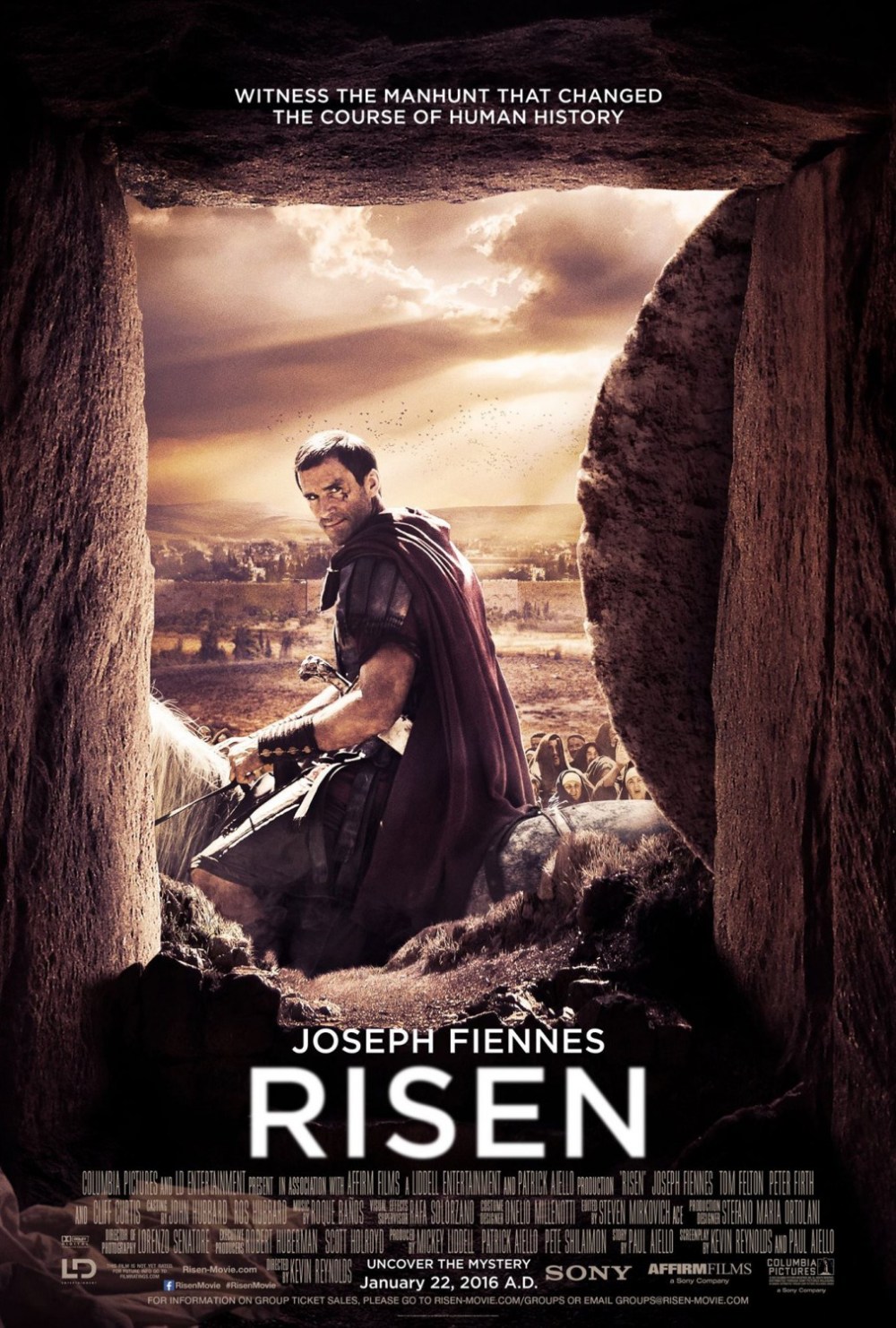
Risen

risen-movie-poster

The story of Jesus Christ’s crucifixion and resurrection has been told countless times, but “Risen” looks to tell it from a different perspective. This movie follows powerful the Roman Centurion Clavius (Joseph Fiennes) as he is ordered by Pontius Pilate (Peter Firth) to investigate the disappearance of Yeshua’s (a.k.a. Jesus of Nazareth) body which has vanished from its resting place. What results is a motion picture which proves to be anti-climactic more than anything else, and this is regardless of the fact it is better produced than other faith-based films out there today.

Things start out with Clavius leading his troops out into battle in a fight scene which looks like something out of “300.” Then we see him as he helps to close off Yeshua’s final resting place which is sealed off with an enormous stone wall. Somehow this wall is breached and Clavius is left with his aide Lucius (Tom Felton) to figure out who absconded with Yeshua’s body, and the answer will forever change what he has been led to believe.

“Risen” was directed by Kevin Reynolds who may be best known for directing “Robin Hood: Prince of Thieves” and the infamous “Waterworld” with his friend and, at times, worst enemy Kevin Costner. He approaches this movie as a detective story as we watch Clavius interrogate many people about who might have made off with Yeshua’s body when the guards were not looking. This is where things are at their most interesting as it seems like Reynolds is testing us in regards to what we have been taught to believe about Jesus Christ among other things. Witnesses say one thing, but we are skeptical as to what we should accept as truth.

But then Clavius discovers Yeshua has somehow come back to the land of the living, and this is where the movie fell apart. Perhaps I should mention “Risen” starts with Clavius roaming the barren landscape, having been deeply affected by an experience we have yet to see him discover for himself. As a result, any tension or suspense this movie hoped to offer its audience is thrown out the window because we already have a pretty good idea of what’s going to happen.

Dramas of any kind suffer tremendously when conflict is absent, and “Risen” quickly renders any potential conflict as null even when the movie could have benefited from more of it. Clavius’ association with the Roman Army quickly becomes non-existent when he sees with his own eyes how Yeshua has somehow come back from the dead. His loyal aide Lucius (Tom “Draco Malfoy” Felton) sees him as a betrayer of the Romans, but any confrontation that could come between the two of them is rendered moot in no time at all. By the time the movie reaches its conclusion, I couldn’t help but wonder what Reynolds was trying to get across. Was it belief helps you overcome being a Roman Centurion who helped pin Christ to the crucifix and then leave all those years of training behind upon discovering Christ has been resurrected? Look, I’m a big believer of anything being possible, but Clavius’ sudden conversion feels very far-fetched.

Fiennes is a fine actor (no pun intended) and he does give Clavius a stoicism which would make the common criminal buckle under an especially intense interrogation. At the same time, he makes Clavius a little too stoic to where his face seems far more frozen than it has any right to be. Clavius is supposed to be a very serious dude, but some moments of levity could have helped to at least remind audiences that Fiennes’ range as an actor is much broader than is presented here.

I do, however, have to give credit to Cliff Curtis for giving us a powerfully mesmerizing interpretation of Yeshua/Jesus of Nazareth. Whenever he appears on screen, the actor exudes a sereneness and calm which is not as easy to pull off as he makes it look. This is the same actor who played FBI Deputy Director Miguel Bowman in “Live Free or Die Hard,” and here he digs into this role internally to where you are desperate to follow him no matter where he goes. His performance makes this movie more watchable than it would have been otherwise.

Aside from that, “Risen” is beautiful to look at thanks to director of photography Lorenzo Senatore, but there’s not much about the movie to recommend. The story of the death and resurrection of Jesus Christ has been told in more compelling ways than what is presented here. But being this is a Kevin Reynolds movie, it won’t matter what audiences think of it because Kevin Costner will watch it and say he could have made it better.

* * out of * * * *

Save

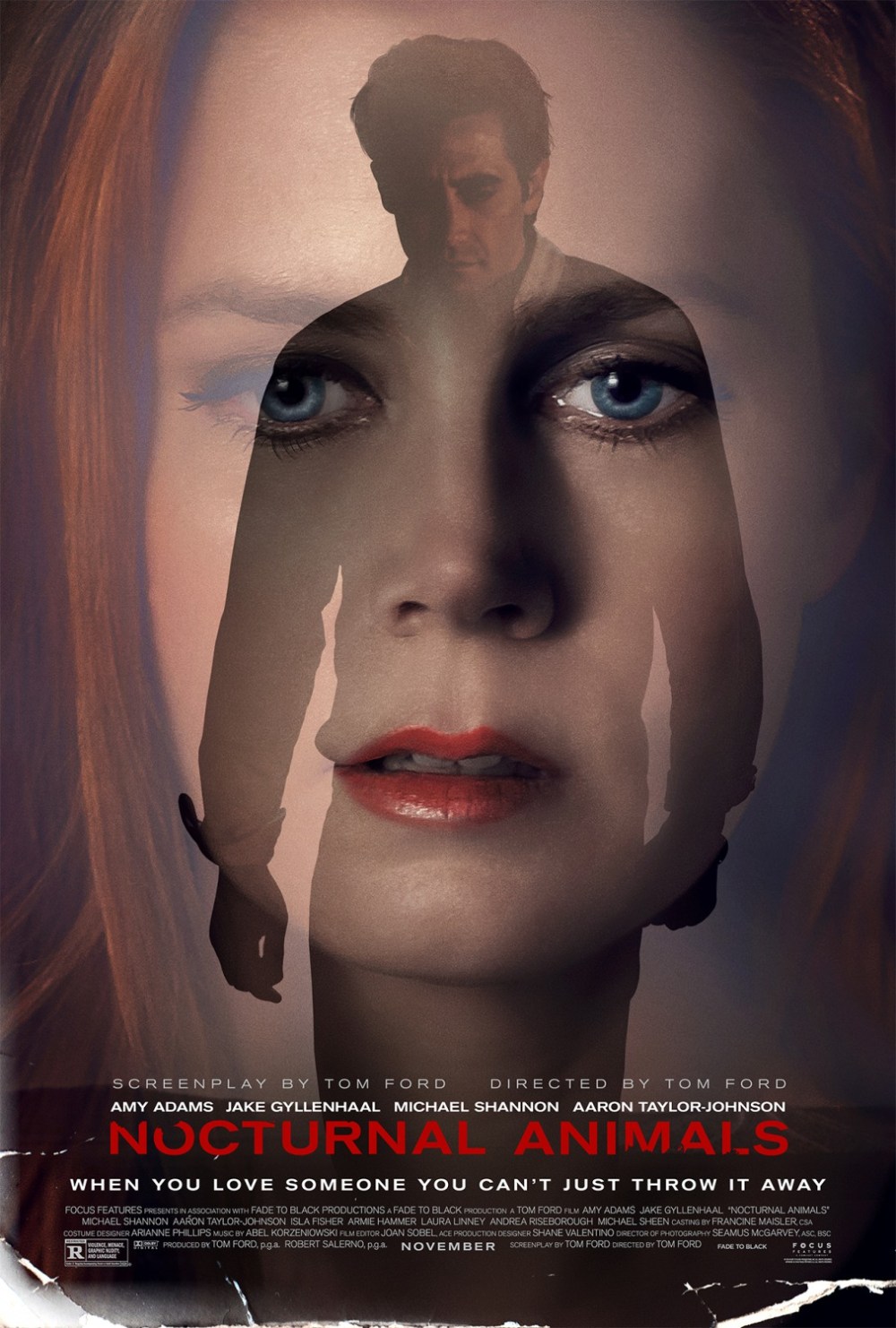
Nocturnal Animals

nocturnal-animals-poster

Nocturnal Animals” is a movie which will stay with me long after I have seen it. Based on Austin Wright’s novel “Tony and Susan,” it follows a non-linear path and combines stories which deal with the real world and a fictional one to where, after a while, it’s almost hard to tell the two apart. Either that or you will leave wondering which story is the most emotionally exhausting. Judging from the movie’s first images of an art exhibit created to challenge our perceptions of what is beautiful or acceptable, director Tom Ford is quick to take us on a cinematic ride, and the kind we are not often accustomed to taking.

We meet Los Angeles art gallery owner Susan Morrow (Amy Adams) who appears to have it all: a handsome husband, a fabulous house and an income we would all envy. But we can tell from the start she is a lonely soul wandering through the superficial world she inhabits, and it doesn’t help that her husband Hutton (Armie Hammer) has been distant and may very well be cheating on her. Clearly, we are about to see why she is the damaged individual she is, and it will not be a pleasant trip whether it’s through reality or fiction.

One day, Susan receives a manuscript of a novel written by her ex-husband Edward Sheffield (Jake Gyllenhaal) named “Nocturnal Animals,” a nickname he gave her upon realizing she stays up late at night because she has trouble sleeping. Edward has dedicated his novel to her, and it tells a very bleak tale of love and tragedy as we watch Tony Hastings (also Gyllenhaal) suffer the utter humiliation of seeing his wife and daughter kidnapped by three troublemakers who later kill them. From there, Tony teams up with Texas Detective Bobby Andes (Michael Shannon) to bring the three men to justice, but the justice these two seek may not be one which is altogether legal.

Ford has the movie weaving in and out of its real world and fictional storylines to where you can’t quite tell where things are heading, and he does it in a way which is quite inspired. A story like this can be tricky to pull off as you can jump from one storyline to another at the worst possible moment to where we are desperate to see the movie get back to where it once was. But Ford has managed to weave all these storylines seamlessly to where everything feels in balance and not out of place.

At its heart, I think “Nocturnal Animals” is about the transformative power of art more than anything else. Whether it’s Susan’s art gallery or Edward’s novel, both of these characters use their individual artistry to channel emotions they couldn’t quite get to the surface in their relationship. The fact it takes Edwards years to reach this artistic jump in his writing abilities through his tragic novel shows how artists are not so much born as they are molded through years of life experiences.

Amy Adams gives her second great performance in 2016, her other being in Denis Villeneuve’s “Arrival.” She makes Susan a sympathetically tragic character as we watch her go from youthful promise to insomniac surrender as her life has become defined by isolation from everyone and anyone around her. Even when she has too much eyeliner makeup on, and her makeup is a distraction at times, Adams delves deep into her character’s complexity to deliver a performance of piercing sensitivity.

Gyllenhaal is riveting as both Edward and Tony, characters who suffer the indignities of life and love to where all that’s left is revenge. While the actor still seems a bit young to play the father of a teenage daughter, he is fearless in exploring a character who suffers a fate worse than death. Kudos also goes out to Isla Fisher who plays Tony’s wife, Laura, as she has to reach an emotional fever pitch and keep it high whenever she appears onscreen.

This movie is also proof of how there are no small roles, only small actors, and no actor here should be mistaken as small. Andrea Riseborough, completely unrecognizable here, steals some scenes as Alessia Holt, a person who has found happiness in a space filled with obliviousness and fake promises. Michael Sheen also shows up as Alessia’s husband, Carlos, who is actually gay, and she gives Susan some advice worth following. Ellie Bamber gives us a convincingly down to earth teenager in India Hastings who ends up coming face to face with her worse fears. Laura Linney has some strong moments as Susan’s mother, Anne, whose words hang over Susan throughout the rest of the movie. Karl Glusman and Robert Aramayo portray two gang members whose intimidation knows no bounds, and even the audience has yet to see how far they will go. And it’s always great to see Jena Malone, and she gives a wonderfully quirky performance as art gallery worker and new mother Sage Ross.

But there are two performances in “Nocturnal Animals” which stood out to me in particular. The first is Michael Shannon’s as Bobby Andes, a man of the law who looks to play it by the book, but who is slowly losing his moral bearings along with his body to the cancer eating away at it. Shannon doesn’t act but instead inhabits his character to where we don’t see him performing but becoming this sheriff, and he becomes increasingly frightening to where the anticipation of him letting go of a bullet is almost too much to bear. Seeing him bear down on a suspect with his piercing eyes and gruff voice makes him even scarier, and you have to admire the person who doesn’t need to do much to instill dread into another with such relative ease.

Then there’s Aaron Taylor-Johnson, a long way from his “Kick-Ass” days, as Ray Marcus, a lethal and disgusting bully of a character who revels in emasculating and humiliating Tony in front of his wife and daughter. Johnson’s performance reminds of you of those people in life who robbed you of your worth and self-respect and didn’t show the least bit of remorse about it. You want to smack Johnson in the face after watching him in “Nocturnal Animals,” and that is a compliment.

This is only Ford’s second movie as a director, his first being “A Single Man” with Colin Firth, a movie my parents are still begging me to watch. He is primarily known as a fashion designer whose clothes have made some of the most beautiful celebrities look even more beautiful. With “Nocturnal Animals,” he proves to be as gifted behind the camera as he is with clothes, and he gives this movie a striking look with the help of cinematographer Seamus McGarvey. This could have been a movie dominated by style more than anything else, but Ford gets terrific performances out of his infinitely talented cast, showing his attention is on the story and characters more than anything else.

It should also be noted how Ford has not put anything from his own clothing line on display here, so this movie should in no way be mistaken as a commercial for his fashions. He wisely removed this conflict of interest from “Nocturnal Animals,” so those hoping for a glimpse at his latest fashion line will have to look elsewhere.

“Nocturnal Animals” ends on an ambiguous note regarding Susan and Edward. This will probably annoy some viewers who demand concrete answers to their relationship or the state of their lives and where they will go from here. But Ford is wise to know this is a question he cannot answer himself as the fate of these characters has to be open up to interpretation. Some relationships are meant to be repaired, others are better left broken. When it comes to Susan and Edward, we can only wonder if they can or even should rediscover what made their love spark so passionately.

“Nocturnal Animals” is a movie meant to stay with you for a long time after the end credits have finished, and boy does it ever.

* * * * out of * * * *

Star Wars: The Force Awakens

star-wars-the-force-awakens-poster

We’ve been down this road before. A new “Star Wars” movie is announced and it quickly becomes the most eagerly anticipated motion picture of all time. I’ve lived through this phenomenon many times before and have always been desperate to keep my expectations in check. While I didn’t hate the prequels and enjoyed them for what they were, many fans despised them where they looked at George Lucas as some heartless bastard who utterly destroyed what was most cherished to them. So, with “Star Wars: The Force Awakens,” I tried to keep my anticipation to a bare minimum as I felt any expectations I could ever have for this installment could easily be undone.

Well, now having seen it, I can safely say J.J. Abrams has not only awakened the force with this “Star Wars” movie, he has also reignited our childhood innocence by bringing the franchise back to its basics. Like “Creed,” the “Rocky” spin-off, it takes the story of its famous predecessor, in this movie’s case “Episode IV: A New Hope,” and spins a new take on it with old and new characters joining forces to keep the dark side from destroying the light. Even if you feel like you’ve seen this story before, what results is a highly entertaining and exhilarating motion picture which gets many of the things the prequels messed up right and reminds us why we love going to the movies in the first place.

No one wants to spoil “The Force Awakens” for anybody as doing so would be like Homer Simpson ruining the big reveal of “The Empire Strikes Back” for those waiting in line to see it, so don’t expect this reviewer make this mistake as everyone should come to this movie fresh and experience it all firsthand instead of being forced to read the entire plot synopsis on Wikipedia.

What can be said is it takes place 30 years after the events of “Return of the Jedi.” The Galactic Empire had been vanquished, but just like John Carpenter once said, evil never dies. What’s left of it has come to form the First Order which is once again hell bent on crushing every single part of the Rebel Alliance. As for the Rebel Alliance, it is now known as the Resistance which is backed by the Republic and features many veterans including Princess, now General, Leia Organa. Whatever peace was achieved in the 1983 movie has long since been undone by some Darth Vader wannabes, and those wannabes are now more ruthless than ever.

Into the mix comes Rey (Daisy Ridley), a scavenger struggling to survive on the Tatooine-like planet Jakku who comes across a droid named BB-8 which has, you guessed it, secret information the First Order is desperate to get their hands on. From there she joins forces with Finn (John Boyega), a stormtrooper who suffers a crisis of conscience and abandons the First Order without hesitation, and heroic fighter pilot Poe Dameron (Oscar Isaac) to get the droid to the Resistance before the First Order finds and destroys them without mercy.

Revealing any more of the story from there would be hazardous to one’s health, but many characters from previous installments like Han Solo, Chewbacca, C-3PO, R2-D2 and Luke Skywalker are back to once again fight the good fight against an enemy hopelessly drunk with power.

The first thing I have to point out is how good the acting is. This surprised me a lot as the cast had to be acting opposite a number of things they couldn’t see, and the prequels were notorious for the wooden performances which came out of them. But each actor cast in “The Force Awakens” gives us characters who are not just mere archetypes the science fiction genre calls for, but interesting people we want to follow right from the start. Many “Star Wars” fans get edgy when it comes to new characters being brought into the franchise (R.I.P. Jar Jar Binks), but the ones introduced in “The Force Awakens” are very welcome additions.

One major standout is Daisy Ridley who, before starring in “The Force Awakens,” was largely unknown outside of her native England. As Rey, she gives us a new female action hero for the ages who is self-sufficient and needs nobody to rely on, and she infuses her performance with tremendous heart and passion to where this character is not just another token female. Ridley makes Rey stand on her own from so many other female sci-fi heroes who came before her, and that’s quite an accomplishment.

Matching Ridley from one scene to the next is John Boyega who left a strong impression on audiences in the highly entertaining “Attack the Block.” As Finn, he spends a good portion of this movie in panic mode to where his performance could have been irritating, but Boyega gives this reformed stormtrooper a cutting sense of humor and an energetic personality which makes him very entertaining to spend your time with.

Oscar Isaac proves to be a combination of both Han Solo and Luke Skywalker as X-wing fighter pilot Poe Dameron, making him into one of the most charismatic characters you could ever hope to find in the “Star Wars” universe. At first it seems like a weird career move for him to do a “Star Wars” movie after giving unforgettable performances in movies like “Inside Llewyn Davis,” “A Most Violent Year” and “Ex Machina,” but he makes Poe a wonderfully heroic character you want to travel all over the galaxy with, and he looks right at home in this franchise as a result.

Adam Driver provides “The Force Awakens” with its most fearsome antagonist, Kylo Ren. Some will dismiss the character as a Darth Vader wannabe, but that’s kind of the point. Kylo seeks to finish what Vader started as we saw in the trailer, and even he sees he has big shoes to fill. What Driver does is not make Kylo into a simple villain, but instead someone with some serious issues to sort out and who is dedicated to a struggle he has essentially been manipulated into. As a result, Driver makes the character into an unpredictable menace and one who is far more dangerous than anyone realizes.

Then there are the veteran actors who return to this franchise with more enthusiasm than they would have 10 years ago. It’s great to see Carrie Fisher back as Leia Organa, and that’s even though Leia’s accent has changed yet again. Peter Mayhew hasn’t missed a beat as Chewbacca, Anthony Daniels reprises his C-3PO role as though time never passed, and all Mark Hamill has to do is give us a look to remind audiences there is no Jedi better than Luke Skywalker.

But the biggest thrill is seeing Harrison Ford back as Han Solo. It’s no secret Ford has had a lot of edgy feelings about his involvement with the “Star Wars” franchise to where he distanced himself from all the fandom which came with it. But thanks to an unforeseen miracle, Ford is back and he actually looks happy to be reprising one of his most iconic characters. While Han Solo has only changed so much, Ford still imbues the character with a humanity which made him such an integral part of the original trilogy.

For a time, it looked like it was not worth the trouble to do another “Star Wars” movie as what was once fresh had long since become the model for just about every science fiction film out there. That’s what makes Abrams’ accomplishment with “The Force Awakens” all the more commendable because he makes us feel like kids again as we watch the action unfold. And just as he did with his “Star Trek” reboot, he puts as much attention on the characters as he does on the spectacle, and this makes us fully engaged in the way we should be when we go to the movies. “Jurassic World” may have been entertaining, but it can only dream of being as good as this.

Does “The Force Awakens” get a little too nostalgic at times? Sure, and the movie’s ending doesn’t quite give us the same elation as “A New Hope” did when the Death Star blew up. But Abrams and company have managed to pull off the impossible here; they made “Star Wars” seem truly exciting again. While we can’t resist picking away at the flaws inherent in the prequels, we couldn’t care less about any of the flaws in this one because watching it is just too damn much fun.

* * * * out of * * * *

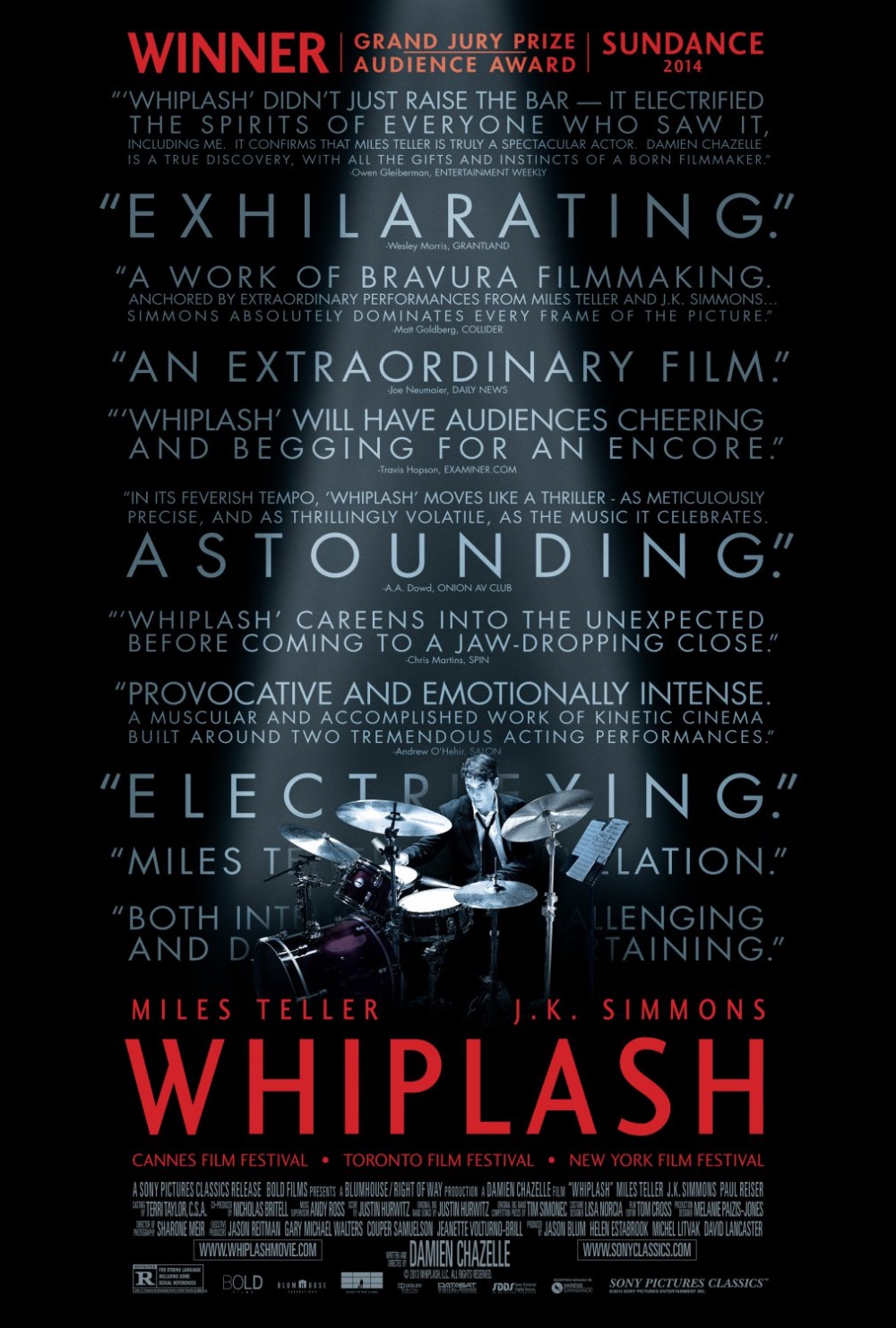
Whiplash

whiplash-movie-poster

Yes, I have had teachers in the past who succeeded in shattering my ego to where it took me an incredibly long time to build my confidence back up to where it once was. I think it’s safe to say we all have had at least one vindictive instructor at one time or another who made our lives a living hell and robbed us of our morale to where the emotional scars we received never fully vanished. But the experience does leave us with an important question; did we improve as students under that teacher’s tutelage, or were they just determined to make us feel infinitely miserable to satisfy their own ego? I’d like to think I got something from the most brutally honest teachers I have studied with because it will, at the very least, keep me from spitting in their faces with a bitter vengeance.

I think it’s likely you will be reminded of those teachers when you watch “Whiplash,” a perfectly titled movie which features the anti-Glenn Holland of music instructors, Terrence Fletcher. Played by J.K. Simmons in an utterly brilliant performance, Terrence is as talented a teacher as he is a terrifying one, and hopefully you have never had to deal with someone like him. But if you have, you have my deepest sympathies and I hope you have found a way to move past such a traumatizing experience.

Miles Teller stars as Andrew Neiman, a 19-year-old jazz drummer who is more than intent on becoming one of the greatest drummers who ever lived. Andrew studies at an elite music conservatory in New York and is working his way up through the ranks when Terrence comes upon him playing one day. Terrence says very little to Andrew and seems eager to see what the young man has to offer. But soon after, Terrence invites him to join his class which has the top jazz ensemble in the conservatory, and this gives Andrew’s ego a major boost to where he finds the courage to ask out Nicole (Melissa Benoist), the girl who works at the concession stand at his favorite movie theater.

Before the start of class, Terrence encourages Andrew to enjoy the process of playing and not to worry too much. But after class begins, Terrence quickly turns into a nasty SOB as he hurls insults as well as furniture at his students if they’re even the slightest bit out of tune. It takes almost no time for Andrew to incur his wrath, and Terrence shows no limit as to how far he will go in verbally abusing a student. He is determined to push Andrew beyond his limits and then some, and this leads to nights when the aspiring drummer becomes a water fountain of sweat and leaves with some nasty cuts on his hands to where band aids cannot stop the bleeding.

The effect Terrence has on Andrew is incredibly profound on him not just as a musician, but as a person as well. While he may be improving as a drummer, Andrew becomes an increasingly difficult person to get along with. At family gatherings, he comes to insult others who look down on his drumming aspirations, and he coldly dumps Nicole when he feels their relationship will get in the way of his mission to become the greatest drummer who ever lived. By the time “Whiplash” reaches its thunderous climax, you’ll be wondering who the victor of this tumultuous teacher/student relationship truly is. When you look at it closely, it could be either of them.

It doesn’t take much to see that “Whiplash” is a very personal story for Chazelle as he himself was a drummer in a high school music conservatory who lived in fear of his teacher and of screwing up a single note. Right from the start, he does an excellent job of setting up just how feared Terrence Fletcher is long before we see him viciously berating his students as if they have no reason to exist. Students stand rigidly at attention whenever he enters the room, fellow teachers don’t even hesitate to step out of his way when he bursts into their classrooms to find new musicians, and heaven forbid if you misplace your music or your drum sticks as you will suffer the man’s wrath in a way which makes you feel like you had it coming.

Now any actor can play a screaming jerk, but it takes a great one to make a jerk of a character into a fascinating and complex human being. This is what makes Simmons’ performance as Terrence Fletcher so damn good; he lets you know what he’s thinking without having to spell it out for the audience. Despite his brutally draconian ways, you can see he is searching for someone truly great and will do anything to get it. Seriously, he will do anything.

This all leads to the “good job” story Terrence tells Andrew, and I’m still thinking about what Terrence said long after the movie ended. On one hand, we cannot condone the way Terrence treats his students, but “Whiplash” has you wondering if being too nice to an aspiring student does them more harm than good. Sometimes brutal honesty is called for to get someone to learn, especially one who is determined to be the best at what they do. Still, there’s got to be a limit to how harshly you can treat a student before they suffer a horrific nervous breakdown.

Miles Teller’s star has been on the rise for a while now, and he’s turned in fantastic performances in the “Footloose” remake and “The Spectacular Now.” Teller was also in “21 & Over,” but the less said about that one the better. As Andrew Neiman, he gives one of the most exhausting performances any actor could have given in 2014, and there is absolutely no doubt he put his entire heart and soul into this character. Teller keeps pounding at those drums as if his life depended on it, and that really is his blood spattered all over the drum set (imagine how much money the studio saved on makeup and special effects). Teller shows a true fearlessness as he takes Andrew from being an easy-going guy to one who reaches his breaking point and then goes beyond it to where Terrence’s intimidating ways will not hold him at bay.

Writer/director Chazelle takes us on a journey which is as cathartic for him as it is for the rest of us, and “Whiplash” stirred up emotions in me I haven’t felt in a long time. It’s an amazing achievement especially when you take into account he had only 19 days to shoot this movie in. Few movies these days take you on such an emotionally pulverizing ride, and this is one of them.

* * * * out of * * * *

Please feel free to check out the interviews I did with Simmons, Teller and Chazelle on “Whiplash” on behalf of We Got This Covered down below.

Thanksgiving is Gone, but the Calories Linger On

snoopy-and-woodstock-thanksgiving

Hey everybody. I am really struggling with fundraising right now and could use your help. As in the past, I am running the 2017 Los Angeles Marathon on behalf of AIDS Project Los Angeles, and I have been tasked with raising $1,100. If all my Facebook friends donated just $5 dollars, I would not only meet that goal but surpass it by a wide margin. Before reading on, click here to find out how you can make a tax-deductible donation and stick to the tax man before the year’s end.

I’m finally back in Los Angeles after the Thanksgiving holiday, a time that knows no diet plan. It certainly was a calorie-laden holiday, and my father and brother put together quite the feast. The fact I didn’t suffer much in the way of heartburn was extraordinary as second and third helpings were inescapable. But while on vacation, I wasn’t about to skimp on my marathon training, and running was of the upmost necessity after gobbling down turkey, creamed corn, apple and pecan pie, stuffing and the occasional serving of vegetables. I actually did my recovery run on a treadmill, but I increased the grade to 3% to make it more challenging for myself. My family and I were staying at a house by the ocean, and I did a lot of walking on the beaches and grassy paths which left my heart beating faster than just about anything else, maybe even sex.

This past week had me catching up on making money to pay the kind of bills Donald Trump has avoided paying for years, and this kept me from doing my maintenance runs. So, coming into this 14-mile run, I felt like I was going to fall behind everyone else in an embarrassing way. But at least this time I made it to Griffith Park before everyone else ran off without me.

On my way over to Griffith Park, I had my soundtrack and film score iPod playing on shuffle mode as I was trying to find the right piece of music to get myself pumped up. The best I could come up with was the “Helicopter Chase” theme from James Newtown Howard’s score to “The Fugitive.” Listening to this piece of music quickly reminded of Harrison Ford’s role of Richard Kimble, a doctor wrongfully accused of murdering his wife who ends up escaping police custody and going on the run in an effort to clear his name. Being someone afflicted with an infinite persecution complex, I relate to what Kimble went through even though I am not a vascular surgeon and did not kill my wife (for the record, I am not married).

Today I was planning to run at a 3:2 pace as running at a 3:1 pace was not the same as it used to be for me. But upon learning the rest of the 15-minute group was going to run at a 2:2 pace, I decided to adjust accordingly as I felt it would be nice to run with the group for a change instead of by myself.

Well, it turns out running at a 2:2 pace was the best thing for me as I never struggled for energy or “hit the wall” at any point during this 14-miler. The extra minute of walking allowed me more time to recover, and it felt good to keep up with my fellow pace group runners instead of falling behind which I have found myself doing these last couple of years.

Another notable presence on our running route was the Burbank Police Department, and a motorcycle cop did not hesitate to stop us in our tracks when he found us running on the street instead of the sidewalk. He was quick to inform us that the walking path which runs down the middle of Chandler Boulevard was built for people like us. We never got the opportunity to tell him about how running on asphalt is easier on our joints than concrete, but it probably wouldn’t have made a difference.

Following this, we saw a number of Burbank cop cars pulling one driver after another over to the curb, so clearly they were trying to meet some sort of quota. Not that I don’t support the police, but making an unscheduled and forced donation to them always feels like thievery to me. It doesn’t matter if you deserved to get a ticket or not because, who wants to pay it? A lot of people go 80 miles per hour in a 25-mph zone. Not me, but a lot of people.

One thing my pace group did get to do on this run, and it is something I always hoped we would do, was sing a marching song. One of the runners serves in the military, and he got us to sing along with him. Here’s my favorite part:

“If my chute don’t open wide,

If my chute don’t open wide,

I got another one by my side,

I got another one by my side.

If that chute don’t open round,

If that chute don’t open round,

I’ll be the first one on the ground,

I’ll be the first one on the ground.”

Hey, it was either that or something from “Full Metal Jacket,” and some of the marching songs in Stanley Kubrick’s film are not exactly appropriate for the ears of Burbank citizens.

It took long enough, but the weather is finally getting colder, at least in the morning. It was seriously frigid when we arrived in Griffith Park, but the temperature did rise as the sun came up. I think we managed to beat the heat for the most part, and we arrived back where we started just before it became unseasonably warm.

I am in the slowest pace group now as several other runners have since dropped out of the program for one reason or another, so only the coaches were still around when we returned to Griffith Park. Part of me feels a little disappointed in myself as I kept thinking I would be in a faster pace group after running so many marathons, but instead I have slowed down to where I wonder if I will ever be the svelte individual I was back in my high school days. Hey, I can dream, can’t I?

But seriously, I felt really good about changing the pace on this run. I came through it without feeling hopelessly exhausted, and I felt satisfied in a way I haven’t in some time. There was plenty of chocolate milk left over to cure me of my runner’s hangover, and I drove back to my apartment for a well-deserved nap which lasted much longer than it should have (not that I’m complaining or anything). Next week we have a recovery run, and we will need it after this one. Coach James encouraged us to do our maintenance runs on Tuesday and Thursday so we would have time to recover and to keep increasing our mileage on them. I’ll do my best, but like Boy George once said, time won’t give me time dammit.

Thanks for reading.