Bruno Orlandi and Nihey Takizawa of Kassel Labs have done it again. After finding much success with their Star Wars Intro Creator, they have now done the same with the opening titles of the incredibly popular Netflix series “Stranger Things” which debuted its third season this summer. These titles were created by Imaginary Forces and scored by Michael Stein and Kyle Dixon of the electronic band Survive, and they have since become some of the most memorable titles of any television show released in the past decade. With the intro creator, you can take these titles and make them your own, and you can download the video you create for your own use.
Please keep in mind, downloading an intro creator from Kassel Labs will take time, a lot of time. Since their “Star Wars” intro creator debuted, many people have flocked to their site to make their own, and the waiting time threatens to be infinite. However, you can make a donation of $7 dollars to Kassel Labs which will allow you to move to the front of the line. I did this when I created my own “Strangers Things” intro, but it took five months for me to get my download. Just saying.
I ended up creating a thank you video for those who donated to The Pablove Foundation on my behalf. It is a non-profit organization which is dedicated to finding a cure for pediatric cancer, and I ran the 2019 Los Angeles Marathon in support of it. I put this video together just before the marathon commenced this past March, but it is only now that I have gotten a download of my work. Still, I really want to give thanks to those who still took the time to give even if it is coming a little late.
WRITER’S NOTE: This article was written back in 2011.
With his birthday falling on March 27th, actor, writer and director Quentin Tarantino plans to celebrate the month of his birth at New Beverly Cinema in Los Angeles, the same theater he saved from becoming just another Supercuts. The theater’s calendar for March includes a number of exploitation classics, some animated movies that Walt Disney would never have even thought of making, and several other films which are not currently available on DVD. Many of these cinematic experiences are very rare, and it is highly unlikely you will see them anywhere else.
Tarantino ended up making a surprise appearance at the New Beverly on March 1st, 2011 to introduce the first double feature of his month of programming: “Crack House” and “Redneck Miller.” Now “Crack House” was one of the myriad releases from Cannon Films during the 1980’s, and it follows young lovers Rick and Melissa whose relationship gets torn apart when Rick’s brother gets shot to death by a rival gang, and Rick quickly rejoins the gang he left for a better life to avenge his brother’s senseless murder. Of course, this all goes awry when Rick gets sent to prison while Melissa falls in with a drug dealer and gets hooked on crack cocaine.
Tarantino described “Crack House” as being very, very special to him as it came out in 1989, the very last year in which exploitation movies played in movie houses. From when he was young, he talked about making a list each year of the ten best exploitation movies that came out, and among his top picks was George A. Romero’s “Day of The Dead.” “Crack House” got the very last exploitation movie of the year award from Tarantino before these lists were rendered obsolete.
With exploitation movies, Tarantino said we were all attracted to them through their “50’s-ness of juvenile delinquentness.” Basically, these films were the bad boys of cinema, the ones which didn’t follow the rules nor did they ever apologize for being trashy entertainment. From the 1950’s onward, exploitation cinema succeeded in reflecting the juvenile delinquents of each passing decade. But when it came to the 1980’s, these same movies suddenly became unwatchable because, as Tarantino correctly pointed out:
“The 80’s were one fucked up decade!”
But “Crack House” is one of those rare 80’s exploitation flicks which does get better as it goes along. Even Tarantino admitted how shocked he was to find he actually “gave a fuck” about these characters who might seem like stereotypical bad boys to everyone else. The “Pulp Fiction” director also acknowledged the terrific “guest star” cast which included Richard Roundtree (the original Shaft) as a no-nonsense cop, and all-time football great Jim Brown as a vicious drug kingpin.
Tarantino’s brand of March Madness at the New Beverly will culminate in a week long showing of “Kill Bill: The Whole Bloody Affair.” This is the combined version of both films into one single movie which screened at the Cannes Film Festival and has never been seen before in the United States. At four hours long, there was no way New Beverly was just going to show it two nights of the week! However, as I write this, all advance tickets for each night are now sold out (NOOOOO!!!). Your best bet is to get to the theater really early in the hopes you can get in through the standby line.
In any event, here’s to a month of great, unabashed entertainment at the New Beverly Cinema!
We have been hearing so much about the 25th film in the 007 franchise to where it threatens to feel like we have watched it in full long before it arrives in theaters everywhere. Daniel Craig confirmed to Stephen Colbert he would return to do a fifth movie as James Bond, Danny Boyle was originally set to direct but later dropped out and was replaced by Cary Joji Fukunaga, and there were rumors Adele would return to compose this film’s theme song. Other than that, we were left with an endless set of questions: Would Christoph Waltz return as Blofeld? Who will compose the score for this one? Can they possibly get “Skyfall” cinematographer Roger Deakins to return? What kind of Bond villain is Oscar winner Rami Malek going to play? Who will be the latest Bond woman?
As fans posed these questions and several others, many including myself had one which we desperately wanted an answer to: WHAT WAS THIS BOND FILM GOING TO BE TITLED??!! In the wake of a press conference featuring the cast of Bond 25 and various behind the scenes images from the set, it seemed no one thought to give this one a name. Did longtime Bond screenwriters Neal Purvis and Robert Wade start writing it without a title in mind? Did fellow scribes Fukunaga, Scott Z. Burns or Phoebe Waller-Bridge get a chance to add their two cents to this issue? Seriously, it cannot be this difficult to generate a title for this or any other motion picture, right?
Well, after what feels like an eternity, MGM has finally given us the title of the 25th James Bond film: “No Time to Die.” My opinion regarding this title is quite mixed. A title like this one sounds like something out of an easily disposable paperback novel, while fun to read, won’t stay in the mind for too long. Granted, “Die Another Day” was already taken, but after the titles of the previous Craig Bond movies (“Casino Royale,” “Quantum of Solace,” “Skyfall” and “Spectre”) which implied quite a bit without saying so much, this one feels surprisingly ordinary. Couldn’t they have come up with something infinitely more inspired?
At the same time, perhaps it is not a bad title for this installment, likely the last to feature Craig as 007. In terms of years, Craig has now held onto this iconic role longer than any of his predecessors, and we have grown with him as we watched him make this role his own from “Casino Royale” to “Spectre.” In this installment, Bond is said to have retired from active duty and is now enjoying a leisurely life with Dr. Madeleine Swan (Lea Seydoux) in Jamaica. But the vacation quickly ends when his CIA pal, Felix Leiter (Jeffrey Wright), arrives in town and asks for Bond’s help in rescuing a kidnapped scientist. Suffice to say, retirement does not last long for Bond, and the only way for him to escape any sort of responsibility from this situation would be death. However, death would be the easy way out, and Bond is not about to go down that route.
Craig’s interpretation of James Bond reminds me a lot of Jack Bauer from “24” as both characters have sworn a loyalty to their countries of origin, and this is a loyalty which, whether they admit it or not, proves to be far more important than anything else in their lives. Still, their actions come with consequences and an inescapable case of karma which will never let them rest easy. How does one live with being someone who willingly kills if the situation calls for it and not go through life with one form of guilt or another? Craig’s Bond has numbed his consciousness more often than not with alcohol, and this is regardless of whether it is shaken or not stirred. The only way a character like this can possibly find peace is in the realm of death, and Bond is not about to choose this realm as he eventually returns to his call of duty when the circumstances call for it, and this installment makes it clear he is not about to die even if it will cease his suffering.
“No Time to Die” will arrive in theaters in April of 2020. Check out the title announcement below.
WRITER’S NOTE: This article is about a screening which took place in 2013.
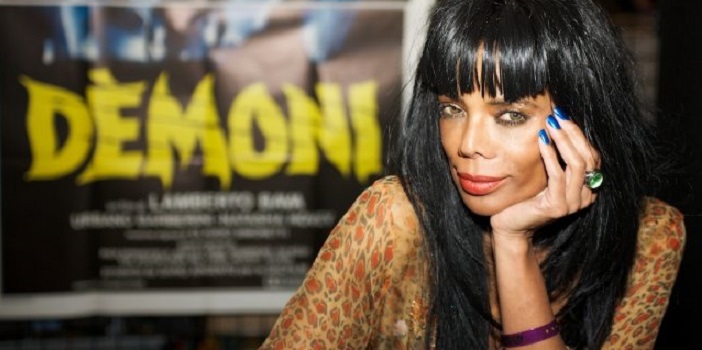
Actress Geretta Geretta (a.k.a. Geretta Giancarlo) was at New Beverly Cinema to talk about her role in Lamberto Bava’s Italian horror movie “Demons.” It turns out that movie was one of ten she made while living in Italy for several years, and her time there also had her working with a couple of other Italian filmmakers: Lucio Fulci and Bruno Mattei. Both have long since gained a large cult following for their cinematic work, and Geretta took the time to tell the audience what it was like working with them.
Fulci has been called the “Godfather of Gore” by many, and he is best known for his films “Zombie” and “The Beyond.” Geretta worked with Fulci on “Murder Rock: Dancing with Death” which was about the owner of a prestigious New York ballet school who teams up with a male model in an attempt to solve the murders of a few students. One male audience member told Geretta how the movie has one of his favorite death sequences ever, and she was thrilled to hear this and quickly responded, “kiss that man!” Her description of Fulci as a filmmaker and as a person surprised those who didn’t know him as well as she did.
Geretta Geretta: He was known to have a difficult personality, and that’s putting it lightly. He had a lot of tragedy in his life. A couple of his wives committed suicide, and his kids were on drugs. Everything was really bad for him, and he had to work. He had to keep working and get that job done. So, when you went to the audition your agent said, don’t talk back, don’t say anything, and don’t ask any questions. What’s your motivation? Your check. Just shut up and do whatever he says. For me, working with him was a dream. I have no problem following direction. But he literally would go into a shaking fit, start screaming, spit coming out of his face, rolling on the ground furious. That’s what it was like working with Fulci.
Mattei was another Italian filmmaker who had gained a significant cult following for his exploitation movies such as “SS Girls” and the zombie flick “Virus: Hell of the Living Dead.” In many circles he is considered to be the “Ed Wood of Italian filmmaking” as his films were filled with a lot of stock footage, bad acting and utterly ridiculous dialogue. Still, Mattei got to work with many noted filmmakers such as Fulci and Claudio Fragasso, and he was lucky enough to direct actors like Lou Ferrigno, Donald Pleasance and Richard Harris before they became famous.
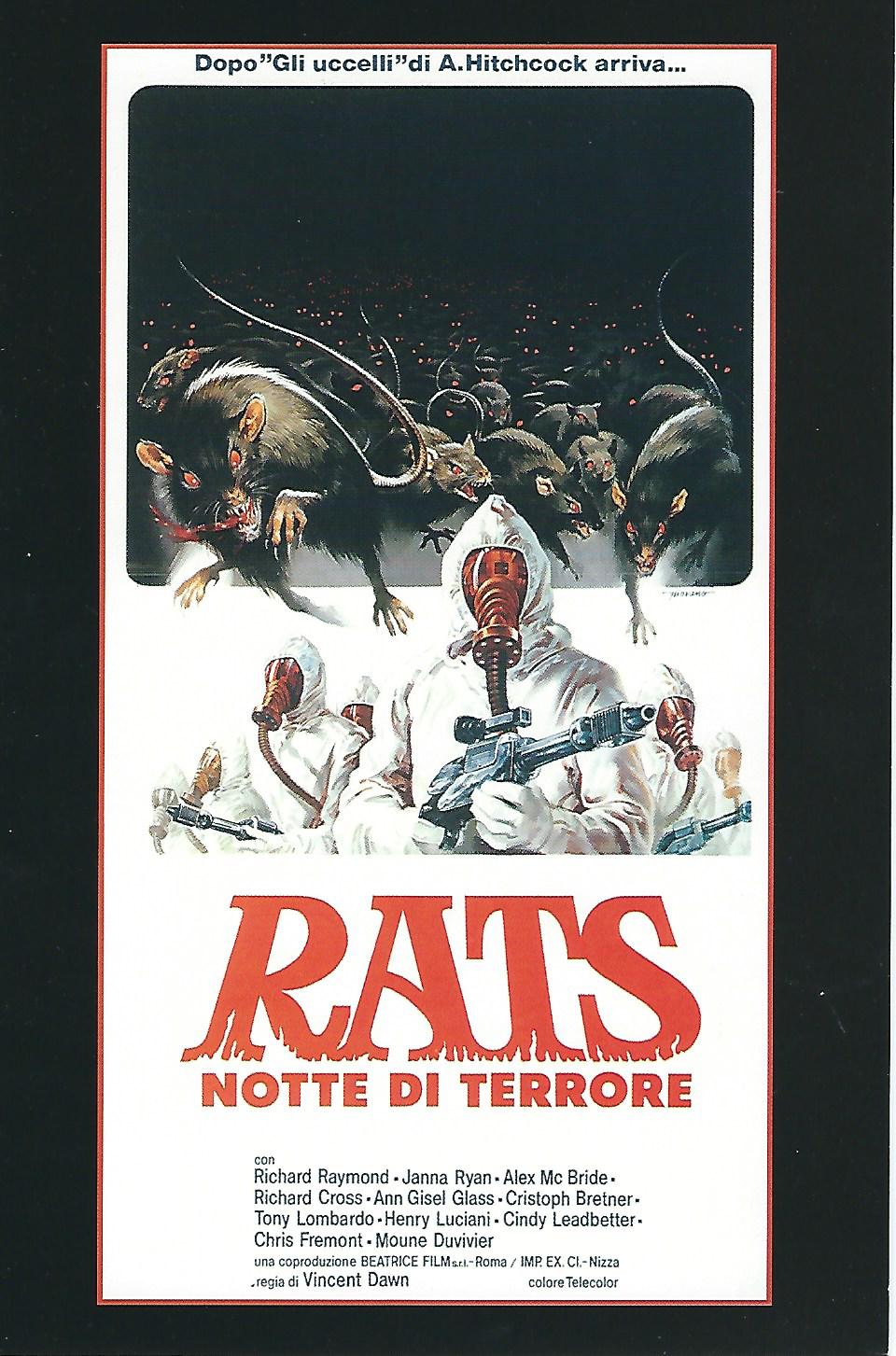
Of all the movies Mattei made, the one he was proudest of was “Rats: Night of Terror.” Inspired by the look of futuristic 1980’s movies, it takes place more than a century after a nuclear war has devastated Earth. What is left of society has been divided into two groups; those who live comfortably in underground cities, and the scavengers who are forced to live in the sunlight. But soon, these two groups are forced to work together to defend themselves against a horde of flesh-eating mutant rats which are prepared to devour everything and anything in their path.
Geretta played Chocolate in “Rats: Night of Terror,” and she gleefully shared what it was like auditioning for Mattei.
GG: With Bruno (Mattei) it was kind of different because with Dario (Argento) it’s all hushed in the halls and everything’s like yes sir, yes sir, and Bruno was like all excited about everything. He asked me, hey kid! You afraid of animals? And I go, no. He then asked, are you worried about furry things? I said no. And he’s all, great because it’s gonna be rats! And I won’t even tell you the things we used to do before the cameras started rolling because it was very scary.
Geretta then went on to say while Bava and Argento had a million dollars to make “Demons” with, Mattei’s budget on “Rats: Night of Terror” was so low to where the film crew kept the dead rats they threw at the actors so that they could reuse them (yikes!).
It was great to listen to Geretta Geretta talk about these two filmmakers, both of whom have since passed away. While some critics have long since dismissed the films of Lucio Fulci and Bruno Mattei, they both still have a strong legion of fans who are more than willing to see every single movie they created. Both Anchor Bay Entertainment and Blue Underground have gone out of their way to remaster their films for new generations of movie buffs to discover, so the stamp they left on the world of cinema is not about to disappear.
WRITER’S NOTE: This article was originally written back in 2013.
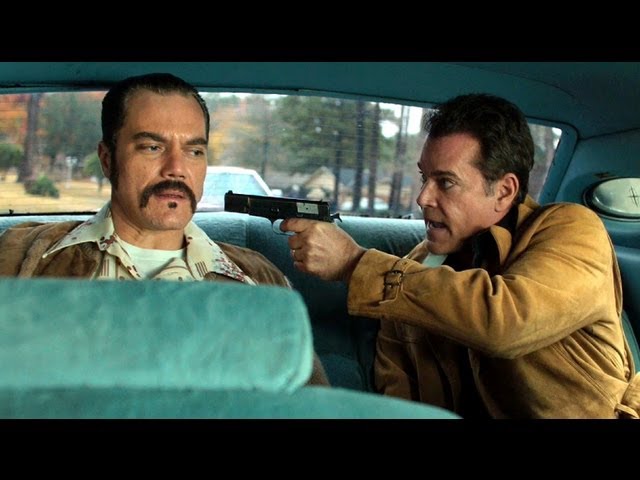
While Ray Liotta has played a wide variety of roles throughout his long career, he is still best known for playing bad guys or characters on the wrong side of the law. The perception of him being typecast as a bad guy may continue with “The Iceman” in which he plays real life mob boss Roy DeMeo, the man who hired Richard Kuklinski (played by Michael Shannon) to kill dozens upon dozens of people. But while at “The Iceman” press day held at the Four Seasons Hotel in Los Angeles, Liotta reminded us there is way more to him than just playing evil characters in movies.
Critics and audiences see Roy DeMeo as the latest in a long of mob characters Liotta has played throughout his career, but that’s actually not true. Liotta was quick to point out DeMeo is only the second mob character he has ever played, and that Henry Hill (his character from “Goodfellas”) wasn’t even in the mob but was associated with it. But whether he’s playing a good or bad guy in a movie, his decision to take on a role is always based on one thing.
Ray Liotta: (It’s) the script, the story, what they’re saying, how they’re saying it. Henry in “Goodfellas” just beat one person up and the character I played in this (“The Iceman”) whacked people left and right, wasn’t afraid of anybody, where Henry was a little more timid. So, the script just dictated it to be different. It’s really the script, whatever the script tells you, and that’s why you have to make the right choice. If it seems too similar to something else then it’s better to stay away from it, unless you want to do something that’s similar.
During the roundtable interview, one person mentioned how he loved the Liotta’s work on the television show “Just Shoot Me.” Liotta actually made guest appearances on two episodes as himself, and he ended up falling for Laura San Giacomo’s character of Maya. Truth be told, he has appeared in many comedies over the years such as “Date Night,” “Observe and Report,” “Wild Hogs” and “Bee Movie.” When asked if he would like to do more comedy in the future, Liotta replied he certainly would.
RL: Yeah, I would like to. It’s just getting people to see it. I’ve got different scripts that I’ve been trying to do for years and it’s just really hard to get money, and everybody’s a creature of habit. I just did a movie with the Muppets, me and Danny Trejo, and we’re just singing and dancing with the Muppets and it was so much fun. I’ve done it. It just has to come along. It takes a while to change people’s opinions. I’ve done over 80 movies and there’s been a few where I’m funny and nice, but you can’t expect people to see everything.
So far, Liotta has had the opportunity to work with a lot of great directors like Martin Scorsese, Jonathan Demme, Joe Carnahan and Ridley Scott. Working with them has left him with many great memories and given him a strong idea of what he wants from a director which is a great passion for the work of making movies.
RL: It’s much better that way. The best directors that I’ve worked with have the most passion about make-believe situations, and I mean obsessively so. I remember in “Goodfellas,” Marty (Scorsese) every day would have to tie my tie because he wanted it to look a certain way. The best directors know top to bottom what’s going on. I’ve always been taught by what Da Vinci said, that he saw the Statue of David in the marble and chipped away the excess. You know what you’re going to do going in.
“The Iceman” takes place in the late 1970’s and early 1980’s, and it is tempting to think doing a period piece like this is like time travel. We always hear about actors getting lost in the moment when they are on the set, and we like to think this happened here since the actors were all dressed in the clothes and driving the cars of that era. Liotta, however, was quick to shoot down this perception as he pointed out there was always something to remind everyone they were still existing in the present.
RL: You’re looking at that, you’re doing your scene, and then you turn around and there’s the crew with their beer bellies and shorts,” Liotta said. “So, you don’t get like that lost in it in terms of that.”
Liotta also made it clear he has no problem auditioning for a role, and that he is still asked to audition for parts from time to time. You would think an actor in his position wouldn’t have to audition anymore, but even he had to do so for the Brad Pitt movie “Killing Them Softly.” But like the smartest of actors, Liotta clearly sees the process of auditioning as a chance to perform.
RL: It didn’t bother me at all. If that’s what’s gonna take then fine. I don’t mind it all. I always liked it, and if I didn’t get something, I couldn’t wait for the next audition just to say, alright you’ll see! There are a few movies I have to do that for and I don’t care. If I want to be in that movie and if that’s what I have to do that then that’s what you’ve got to do… no matter how stupid it is.
Listening to Ray Liotta at “The Iceman” press day was a reminder of just how much he has accomplished as an actor after several decades in show business. His career continues to have a longevity many would love to have themselves, and while many may still yearn to see him play the bad guy in the next movie he does, Liotta is clearly not limited to playing just those kinds of roles. His range extends far beyond what he did in “Goodfellas” and “Unlawful Entry,” and this is something we should not have to be reminded of.
WRITER’S NOTE: This article was originally written in 2013.
It almost shouldn’t work. James Franco as a Florida-based rapper in Harmony Korine’s “Spring Breakers?” Just the thought of it sounds utterly laughable as we are so used to him playing such clean-cut characters in the “Spider-Man” trilogy, “Rise of the Planet of the Apes” and “Oz the Great and Powerful.” But then again, he did play the ultimate stoner in “Pineapple Express,” so there is that. In the end, while Franco does have some laughable moments as the crazy rapper Alien, the role allows him to give his best performance in a movie ever since his Oscar nominated turn in “127 Hours.” There’s no doubt as to how much research Franco did, and this is one of the first great actor transformations of 2013.
After watching “Spring Breakers,” you desperately want to find out what made Franco take on this role as it is so very different from any he has played previously. Clearly, he was drawn to working with Korine who is best known for writing the screenplay to the highly controversial “Kids,” and maybe he has a thing for rap music which we did or did not know about. But in a conversation with Roger Moore of RedeyeChicago.com, Franco discussed one of the main reasons why he chose this particular project.
“None of us had ever experienced spring break, really,” Franco said of himself, Korine and the rest of the cast. “Actors who start their careers early miss some key experiences in life. I didn’t go to prom. Well, I was dating a theater nerd so we went to a theater festival back in Aspen, Oregon instead. I experienced prom, for the first time, on film. Same with spring break. This is my spring break. And I was over 30 when I got around to it.”
Many have said Franco based Alien on the rapper Riff Raff (and this includes Riff Raff himself), but the actor said his main inspiration for the character was another rapper named Dangeruss. Dangeruss is a local Florida rapper who is still relatively unknown, but he lived in the same area of Florida which Alien lives in and has the same kind of lifestyle. Franco ended up writing a long essay which was featured on the MTV website, and in it he explains how big of an influence Dangeruss was on him.
“I met Dangeruss through Harmony,” Franco wrote. “Before I went down to St. Pete to play Alien in ‘Spring Breakers,’ Harmony sent me innumerable videos and photos as references for my character. He drowned me in them. Harmony is a master of online research. Once he chooses a location to shoot, it turns out he is also a master at finding the most interesting and odd local places and characters. One of the last videos Harmony sent me was of a white guy in dreads, sitting in his car, rapping about Dope Boyz. This turned out to be Dangeruss, a local rapper who Harm had met at an audition and knew immediately that he was the real deal.”
“The same day I arrived, Harmony had me visit Danger at his apartment,” Franco continued. “I was surprised when we pulled into a rather nice sprawling housing development, country-club style, with fountains and manicured grass. I think there was even a driving range. When I met Danger, he was tall, thin as a stick, covered in tats and humble as hell. He was willing to help in any way. He told me about growing up in the bad part of town and having poetry as his only recourse when things got ugly. His involvement with the street and his involvement with hip-hop developed simultaneously. ‘While Peter Piper was picking peppers, I was selling yola at the corner store.’ His lyrics are the highly autobiographical chronicle of surviving on the streets of St. Pete.”
Then there’s the question of where Franco got those cornrows done. Looking at someone with cornrows, it makes me think of how painful the process of getting them must be as it involves a lot of hair being twisted around in unusual directions. However, in an interview with GQ, Franco described to Matthew Serba what it was like having them done.
“We had a local artist down in St. Petersburg, Florida do it,” Franco told Serba. “I think it took about five hours total, only because we had to try different cornrow configurations. It doesn’t hurt that much, but it does get very itchy because you can’t get them wet.”
Korine himself has stated in an interview with Joel D. Amos of Movie Fanatic of how impressed he was with Franco’s transformation into Alien. It turns out that the two of them spent a lot of time working on the character even before the cameras began rolling, but once Franco arrived on set, Korine was stunned at what he was witnessing.
“I couldn’t believe it,” Korine told Amos. “I spent a year just sending him images and talking to him, designing the character. I never saw him do it. He didn’t want to rehearse. When he put in the cornrows and the gold teeth and I heard the accent… I was like ‘whoa.’ He was a maniac.”
James Franco’s performance as Alien in “Spring Breakers” is really just another reminder of what an amazing actor he can be when you give him the right material to work with. While he may be getting more attention for the box office blockbuster “Oz the Great and Powerful,” it’s this movie which is bringing him the critical raves he deserves. Watching here makes you excited for what he has in store for us next.
Anyone remember the RCA Victor release of the “Die Hard with a Vengeance” soundtrack back in 1995? That release was a joke and an unforgivable one as well. It did have some of Michael Kamen’s music score on it as well as a couple of rap songs which I’m not sure were in the movie, and some symphony pieces by Beethoven and Brahms which are not in this movie at all. It was as if RCA just wanted to throw any kind of soundtrack together so they could cash in on this sequel’s expected success, and what resulted was a travesty which any true soundtrack fan would be right to despise.
Well, it took over a decade, but La La Land Records has finally given “Die Hard with a Vengeance” not only the proper soundtrack release it deserves but an expanded one which contains two discs of music. In addition, it also comes with an informative booklet written by Jeff Bond who discusses how this “Die Hard” movie differs from the two which came before it, and it looks at how Kamen came to develop this particular score. But the great thing about this soundtrack release is it forces you to listen to Kamen’s music more closely in a way we didn’t previously.
When I first saw this sequel, I wondered if Kamen had actually bothered to create a new score for this “Die Hard” adventure. Many of the music cues sounded like they came from “Die Hard” and “Die Hard 2,” and it was hard to spot any new musical themes throughout. Listening to the La La Land Records release, however, makes you realize Kamen did not just simply throw something together. Much thought went into this particular score as it presents a somewhat darker John McClane (played by Bruce Willis) than what we have seen previously, and it also captures the joyful qualities of the heist movie that “Die Hard with a Vengeance” is meant to be.
Among the pieces of music I was thrilled to hear on this soundtrack is “Taxi Chase” which has McClane and Zeus Carver (played by Samuel L. Jackson) driving through a populated park in New York in an effort to catch a train before it explodes. “Taxi Chase” sounds unlike any music Kamen has previously composed for a movie with all its urban percussion. In the booklet, Bond quotes Kamen on this cue as it is one of the composer’s favorites which found its inspiration from his living in Manhattan.
“A lot of it (the movie) takes place on the streets I inhabited,” Kamen said. “I was trying to figure out what music to put there and I remembered that Needle Park is just up the street, and all you ever hear is bongo players and people driving past, and that’s why that cue is all native percussion. We’re using drums and drum loops and the normal accouterment of a modern recording studio – even a live drummer from time to time.”
This soundtrack not only contains music which was not on the original release, but also the music which was written for the movie but not included in it. Bond writes how director John McTiernan removed a number of Kamen’s cues from the movie, but Kamen wasn’t bothered by this too much because he was very collaborative and agreed with many of the changes McTiernan wanted to make.
And yes, The Lovin’ Spoonful’s “Summer in the City” which opens the movie is on this soundtrack as well, and it has never sounded better.
When it comes to these expanded soundtracks, I usually say how they have never looked or sounded better. With La La Land Records’ release of “Die Hard with a Vengeance” though, that’s a given as the original release was put together before Michael Kamen even had a chance to finish his score. While it may not have the same exhilarating or emotional sweep as his score for “Die Hard 2,” what Kamen has put together here is great and highly enjoyable to listen to. This release also forces you to realize Kamen was never out to just recycle his own work in the way the late James Horner was often accused of doing.
Sadly, this proved to be the last “Die Hard” movie Kamen scored before his death. Marco Beltrami later took over composing duties for “Live Free or Die Hard” and “A Good Day to Die Hard,” but the music Kamen created for these films will live on forever.
WRITER’S NOTE: This article was written in 2013 when this screening took place.
Actress Geretta Geretta (a.k.a. Geretta Giancarlo) was the Grindhouse Film Festival’s guest of honor at New Beverly Cinema where they were screening a very nice print of Lamberto Bava’s “Demons.” This Italian cult horror film from 1985 stars Geretta as Rosemary, one of several people attending a special screening of a horror film at a local theater. Before the screening starts, however, she ends up putting on this weird looking mask she finds in the lobby which ends up scratching her face. Eventually, the scratch infects the rest of her body and turns her into a bloodthirsty demon. In short, she is the character who dooms everybody else in this film. Way to go Rosemary!
Geretta was extremely excited to be seeing “Demons” with the sold-out audience at the New Beverly, and she even brought some bobblehead figures of her character Rosemary, created by Cult Collectibles, with her to sell. Before the film began, Geretta asked everyone if there were any “Demons” virgins (a.k.a. people who hadn’t seen the movie before), and it turns out there were quite a few. To this, she responded, “This is good! You guys are in for a treat!” She also rattled off in rapid succession a few things for everyone to keep in mind while watching this film.
Geretta Geretta: This is a movie, we did it in Italy. I’m American, I have an Italian name, my family is Italian, but I went there, I was a model, I made a bunch of Italian movies, this is one of them, I made ten. We sound funny and our lips are moving in funny directions but not mine because I am actually speaking English when we shot the movie.
Grindhouse Film Festival emcee, Brian J. Quinn, was quick to say how all the other movies Geretta did while she lived in Italy such as “Murder Rock: Dancing Death” and “Rats: Night of Terror” are all worth seeking out as they are “good and entertaining.”
After we finished watching “Demons,” Geretta came up front to talk about its making and took questions from the audience. She told Quinn that making this film wasn’t a lot of fun as there was a lot of work involved like on any other film, but the set was never unpleasant or difficult. She also pointed out while most horror movies made today with similar special effects are done on very low budgets, the budget for “Demons” was actually a million dollars. Only the great Italian filmmaker Federico Fellini could get a movie made for millions back then, so this made “Demons” a special picture in that regard.
Geretta talked about how she auditioned for Bava and Dario Argento who produced and co-wrote the movie, and she also described the differences between how movies are cast in Italy as opposed to in America.
GG: You don’t really go in and do something. First of all, they cast by picture because they go by look first. So if you look the part then that’s enough for them because they figure they can direct and can get you to do what they want you to do, and it’s very rare everyone would be speaking the same language on the set, so really what difference does it make your mumble?
Most of the exteriors in “Demons” were actually shot in Germany, and the movie theater where the majority of the action takes place was in the process of being destroyed. Geretta was working on a television series at the time, and it was a two-and-a-half-hour drive from that set to where “Demons” was being filmed.
Geretta also pointed out how you never see Rosemary die in “Demons” and, having seen the movie a couple of times, I can verify this to be true. She joked how she was plotting the whole time to make sure her character would not die so she could be cast in the sequel. But when the time came to make “Demons 2,” Geretta was unfortunately out of town.
One audience member asked about the vomit which comes out of the zombies’ mouths, and the vomit does look appropriately disgusting. Geretta described its ingredients in detail as well as what was in everybody’s hair.
GG: The vomit that comes out of any orifice or anybody’s mouth is food coloring, Alka-Seltzer, and some other liquid. The stuff that’s in our hair is yogurt, food coloring and milk, and these are serious folks (the filmmakers) so none of us could change any of our clothes the whole shoot.
The audience reacted loudly to this particular description and understandably so. You’re dealing with ingredients which not only have an expiration date, but which let you know when they have expired. Can you imagine how smelly the set became? Yuck! Geretta then went on to say the film crew had to redo her hair every single day so it would match with what she called “dead yogurt.”
“Demons” was shot in twenty days, and Geretta said she was on set for ten. But while many American actors have found shooting on Italian film sets to be very different and at times very distracting with the film crews yelling at each other back and forth, she said she had no problem adapting to the “Italian style.”
GG: I did come to like things that are done the Italian way. In the Italian way you have lunch on the set, and hey it’s Italy, so you’re gonna have your choice of red or white wine which would never happen on an American set. Things are very calm and it’s more like a family, so maybe if there is some yelling or something it’s just like a family in the background. You tend to work with the same people over and over and over, and it’s just great. I loved it. In America you’re as famous as your last picture, and in Italy you’re as famous as whatever made you famous. It doesn’t matter what you did and it doesn’t matter how long ago, you stay the same. There’s a real appreciation for what you did, so it’s nice.
Ever since she starred in “Demons,” Geretta Geretta has proven to the world just how multi-talented she is. In addition to acting, she has gone on to write, direct and produce her own movies, and her career has also taken her to many different countries such as Italy, Ireland, South Africa and Switzerland. She shows no sign of slowing down anytime soon, and it was great to see her at New Beverly Cinema. Many actors get sick of the movies they star in, but she made it clear how grateful she was that everyone showed up in droves to see “Demons” which she made so long ago. Just don’t ask her how long ago it was.
WRITER’S NOTE: This article was originally written back in 2012.
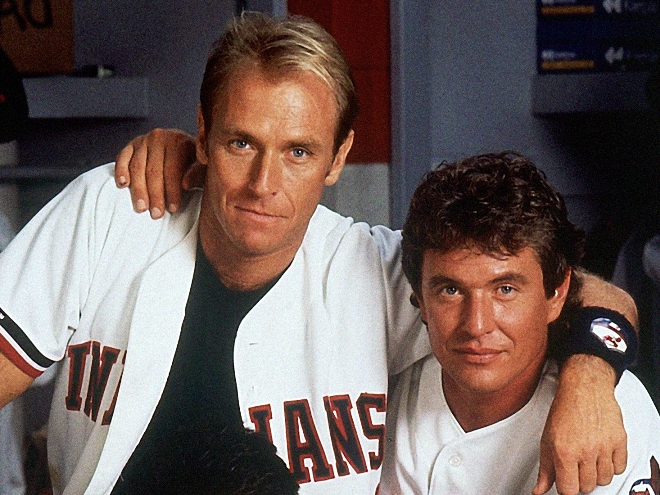
Corbin Bernsen’s role as Cleveland Indians third baseman Roger Dorn in “Major League” marked a big breakthrough for the actor who at that point was best known for playing divorce lawyer Arnie Becker on “L.A. Law.” The actor was one of the guests who attended a reunion screening of “Major League” at the Aero Theatre in Santa Monica which brought out fans who were excited to see it on the big screen.
“Major League’s” writer and director David S. Ward talked said he only casted people who could play baseball, and he talked about how Bernsen had been a ballplayer for a long time. Bernsen played with the Hollywood Stars baseball league, and he also played in many MTV celebrity “Rock N’ Jock” softball games as well.
The movie was shot in Milwaukee, Wisconsin, and one day had the filmmakers inviting 27,000 residents to portray Indians fans at the baseball stadium there. Grant Moninger, programmer for American Cinematheque and moderator of the “Major League” Q&A, asked Bernsen what it was like to play baseball in front of all those people.
Corbin Bernsen: The night that all those people were there was just one of the most exciting times in my life. You’re wearing the real uniform on a real field, and you’re playing it. I was a pretty good fielder in my day but I wasn’t much of a hitter. That last setup where I get the single and then Dennis (Haysbert) comes in and hits the home run to get me on base, I remember David saying, “I need you to hit the ball somewhere in left field preferably between shortstop and 2nd base.” And I’m thinking, you’re gonna be lucky if I just hit the ball man! I’m not a hitter. But he wants it directly there and it’s got to be a line drive at a certain height and all that. I kept thinking he’s going to fire me because I can’t do this, and the balls are coming in and I kept swinging and missing and swinging and missing and I finally, with all these people there, connect with one and the ball takes off and this fucker is flying to the wall! I’m standing there and I see David and he’s saying “RUN! RUN! RUN!”
Bernsen went on to say he still sees a lot of stuff on the internet about “Major League” which say “great movie, one of the best baseball movies, but Corbin Bernsen sucks and he can’t play baseball.” He ended up getting a hold of some guy from Philadelphia who had been dissing him and told the guy, “Hey! I’m not supposed to be able to play baseball in the movie you a-hole!” From there, Bernsen even challenged him to a throw off from centerfield every year and told the guy, “I will stand in Philadelphia on your field on the warning track and I will throw a fucking line drive to second base a-hole and then you shut up!” That guy from Philadelphia never took Bernsen up on this challenge.
To our surprise, it turns out Bernsen was actually not the original choice to play Roger Dorn in “Major League,” and he only got the part after the actor cast before him, whose name he couldn’t remember, ended up dropping out. Getting cast, Bernsen said, was one of the luckiest things which ever happened to him, and he was thrilled to be in it. He also made clear why he feels the movie holds up so well, and it is because of Ward’s excellent script.
CB: When you read a solid script, that’s like a blueprint that’s just gold. I would urge everyone, if you’re interested in film, to read the script for “Major League.” Everything that’s supposed to happen in a story happens on the exact page it’s supposed to happen on. Yeah, it’s a funny little comedy baseball movie, but I just think it’s one of the most solid scripts that I have ever read. Clean, lean and to the point. That’s all David Ward.
Okay, I get why people in general are being resistant to and are cynical about this particular movie. A story told from a dog’s point of view? Even I had trepidations as I entered the theater to check this inescapably sentimental feature which looks to have many visuals of an adorable dog or two. Was this dog going to have a “Mr. Ed” relationship with his owner? How many scenes would we get of the dog sniffing another dog’s butt? Trust me, I have been to dog parks and I have seen them do this endlessly. And considering how this dog’s owner is a race car driver, will the dog be able to advise him of how to keep sliding out of control on the track even if it isn’t raining? Indeed, it says a lot about a race car driver who can drive in the rain without skidding or getting into an accident, and only so many can pull this off.
Well, it should be noted how Garth Stein’s novel “The Art of Racing in the Rain,” upon which this movie is based, brought about a similar reaction as Stein’s literary agent laughed at its concept from the get go. As a result, Stein fired him and had the last laugh as the novel spent over 150 weeks on the New York Times best seller list. Now it has finally been turned into a motion picture, and I have to admit I was truly taken in by it. While it breaks no new ground, “The Art of Racing in the Rain” moved me in a way I did not expect, and it is not at all an exercise in emotional manipulation or filled with an endless supply of cringe-inducing moments.
We meet Denny Swift (Milo Ventimiglia), a race car driver, as he stops by a farm to see the puppies on display. One of them is quick to capture his attention, and we can see how quickly the two form a bond which we know will never be broken. It’s a sweet moment as even the most jaded viewer has to admit how cute puppies are, and no Sarah McLachlan song is utilized at any time to sell us on this connection (for the record, I love Sarah McLachlan).
Denny comes to name his new dog Enzo after Enzo Ferrari, the Italian motor racing driver and entrepreneur who made the kind of car I keep asking my parents for at Christmas time. Enzo completes the bond between him and Denny by taking a piss on his apartment floor, and this is after Denny hurriedly takes him outside to pee on the grass. Still, like Jack Nicholson in “Wolf,” he had to mark his territory before being properly potty trained.
Throughout “The Art of Racing in the Rain,” we are privy to Enzo’s inner thoughts as he spends his days watching races on television with Denny, and he even goes with him to races to where he realizes how racing serves as a metaphor for life. Moreover, Enzo becomes infinitely keen on being reincarnated as human in the next life after watching a documentary about a particular Mongolian legend. Can he make this happen? Does the answer really matter?
The filmmakers prove to be very knowledgeable about dogs, and this made the movie especially interesting to me. A dog’s sense of smell really comes to the forefront as Enzo eventually realizes a certain character is very ill, and it breaks the heart to see the concern on his face which cannot be verbalized to this person. It was at this point I wished dogs could talk because this particular character could have gotten medical attention a heck of a lot sooner. Imagine what Enzo would say, “Hey buddy! You’re sick! See a doctor now or I’ll chase you up a tree!”
But while the characters cannot hear Enzo’s inner thoughts, we can thanks to Kevin Costner. Upon learning he would be voicing Enzo, I was concerned Costner would give Enzo’s narration the same monotone delivery he gave John Dunbar in “Dances with Wolves,” and that movie is a bona fide classic. However, he captures Enzo’s wise nature which is not easily corrupted by money, greed or an inescapable addiction to cellphones, and not once does he overplay a single moment which is much appreciated. Even as Enzo groans about Eve (the ever so radiant Amanda Seyfried) coming into Denny’s life as a certain line of dialogue from “Killing Zoe” flashed through my mind (“never let a woman come between two men”), Costner shows how Enzo evolves through each new person who comes into his life and of the challenges thrown in his way.
Directing “The Art of Racing in the Rain” is Simon Curtis, the filmmaker who first introduced us to Daniel Radcliffe in his version of “David Copperfield,” and who also directed one of the most underappreciated movies of 2017 with “Goodbye Christopher Robin.” This could have been an emotionally overwrought cinematic experience, but Curtis keeps things grounded in a certain reality we can all relate to, and he is very careful to not milk our emotions too much throughout. Just when I thought things would start getting overly sentimental, Curtis succeeds in keeping everything in check to where any cynical thoughts we had about this movie were completely done away with.
I should also add I saw this movie with my parents who have in fact read Stein’s novel, and they both confirmed Mark Bomback’s screenplay is very faithful to the source material. Yes, there are predictable moments such as when a character dies prematurely or when the grandparents (played by Kathy Baker and Martin Donovan) sue Denny for custody of his and Eve’s daughter, Zoe (the delightful Ryan Kiera Armstrong), believing Denny’s career will leave him little time to be at home. My parents, however, reminded me how people with money often do this in life more often than I realize, so this is clearly not so shallow plot device to get us all miffed at the grandparents.
And yes, this movie starts out with the inevitable, with Enzo in his last days lying on the floor and waiting for Denny to come home. Curtis eventually circles back to this moment as we are reminded of the unbreakable bond between humans and dogs, and it leads to a lovely moment where Enzo gets one last spin in a classic car. Few movies in 2019 have gotten me choked up, but this one did.
“The Art of Racing in the Rain” is not a masterpiece of cinema, but it does its job and gives us an emotionally fulfilling time at the movies. Its take on dogs is very thoughtful, and if you were never keen on owning an animal before, this movie may change your mind. It’s a shame this project has proven to be a hard sell for audiences as its storyline seems too ridiculous on paper to be taken seriously. I cannot really blame people for having a cynical attitude to this material as I certainly did, but what results is a very good movie which will check your cynicism at the door if you give it a chance. And if you never thought about owning a dog before, seeing this movie just might change your mind.
As for myself, I am in no hurry to own any pets as stuffed animals, especially Eeyores, are more than enough for me. And to Curtis’ and Bomback’s credit, there is a scene where Denny has to take Enzo to the vet, and we are reminded of just how much caring for a pet can cost. The love of a pet can be a great thing, but it can also be seriously expensive. Still, there is no doubt in mind we can get more love from a dog than Chevy Chase did in “Funny Farm.”






 The Ultimate Rabbit