The following review was written by Ultimate Rabbit correspondent Tony Farinella.
“Tenet,” written and directed by acclaimed filmmaker Christopher Nolan, is one of the rare films to get a big release in theaters when it came out in early September during the COVID pandemic. While watching it on Blu-ray was an enjoyable experience, I can only imagine what it was like to see it on IMAX. It probably enhanced the experience quite a bit for moviegoers. That being said, I’ve always subscribed to the idea that a good movie is good on any platform be it Blu-ray, 4K or the big screen. I understand why this was released on the big screen, though, as it is a big screen movie with big ambitions. Nolan has always been a filmmaker with a specific vision, and he likes to give his audience a lot to chew on when they watch his films. He also likes to let them come up with their own interpretations of them as well.
“Tenet” is a film I watched for the most part on my own with my wife checking in with me near the end of it. She asked me what was happening and if I liked the movie. While the idea of trying to explain the film to her was daunting, and I was still processing the film as it was happening, I realized Nolan had me exactly where he wanted me. Even though “Tenet” has a running time of two hours and thirty minutes, it’s pretty damn exciting when you take in all that is happening on the screen, the details, both big and little. As far as trying to describe the plot and what happens to her or to anyone reading this review, I will do my best without spoiling the film or making it sound too convoluted.
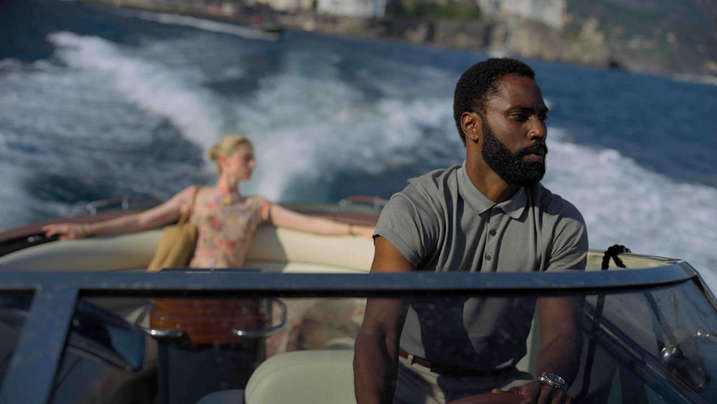
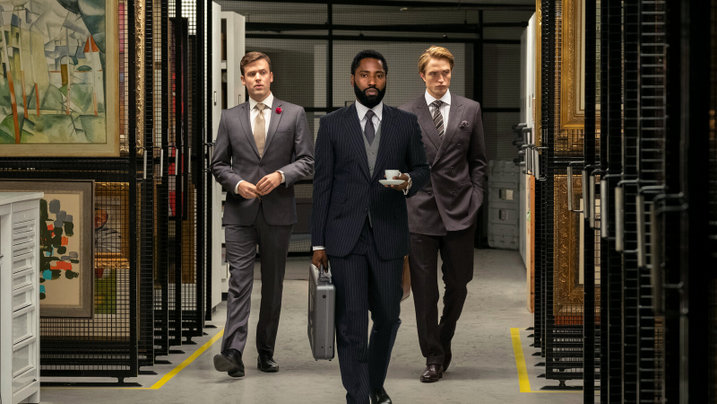
John David Washington, who has quickly turned into one of our finest working actors today, is simply known as Protagonist. He is a secret agent who is put through a number of grueling tasks in order to see if he’s up for the task of trying to stop World War III through influencing time. We don’t know much about him, his backstory, or why he’s decided to take on this mission in the first place. Washington, however, comes across as calm, cool and collected in each and every scene, whether he’s negotiating or in battle. His natural charisma is evident throughout.
He’s part of an organization called Tenet, and this is a word which comes up a lot in the film as it is “inverted” and deals with the concept of moving backwards in time. This is put on display a number of times with simply stunning visuals which will leave your jaw hanging on the floor. If you are looking for an emotional core, it comes in the form of Kat (Elizabeth Debicki) and her working relationship with the Protagonist. While we clearly root for and spend a great deal of time with the Protagonist, Kat’s story is the emotional core of the film. There is also great work here from Kenneth Branagh as the villain. He’s very easy to dislike, and his performance is menacing and a little over-the-top, but it works in the world of this film.
The world of the film created by Nolan is not always easy to follow. There were times where I was lost even as Robert Pattinson’s character was explaining things to me with his Master’s degree in physics. I understand Nolan wants to keep us guessing and to question what is happening. I also know there are a ton of fan theories out there. It is always a good thing when a film can create discussion and debate among movie buffs. As a hardcore movie lover myself, I’m always looking to talk shop with individuals that look at movies as more than just movies. They live, breathe and sleep with the movie long after the credits have rolled. With “Tenet,” it is a film I look forward to revisiting a few more times to fully grasp and comprehend all it is about.
Let’s focus on the positives, first. Even though the film was not scored by Nolan’s usual composer, Hans Zimmer, the use of sound and music to enhance the movie is truly awe-inspiring. As a matter of fact, I didn’t even realize Zimmer didn’t compose the score until I saw the name Ludwig Göransson in the end credits. This is not to discredit the fantastic work by Göransson, it is just to say it is clear there is a certain style of sound and music Nolan is looking for with his movies, and he picked a great composer with a very impressive resume. I talked about the performances earlier, and they are universally good across the board with the standouts being Washington and Debicki. A few Nolan favorites pop up as well in cameos. Visually, Nolan takes his work to a whole new level with “Tenet.” It is a big screen movie all the way.
As far as the negatives, even though it is a good movie and doesn’t feel like two hours and thirty minutes, I don’t know if it necessarily had to be this long. I think they could have shaved fifteen to twenty minutes, and it wouldn’t have harmed the overall film. We all know Nolan likes to do everything big with his movies from the sound to the visual effects to the running time, but sometimes things can be scaled back a little bit. Another issue with the film is the fact it can be a little cold and distant at times. His films would be even more powerful with all of the sound and fury if they came with a bit more emotion, heart and more fleshed out characters. If you have great actors, you should use them more within the framework instead of letting the plot take center stage.
In the end, there is quite a bit to like about “Tenet.” I’m going to recommend you buy the film, and I know it will be one I’ll be watching a few more times in the future. However, my favorite Nolan film is still “Insomnia.” As mentioned in the previous paragraph, Nolan sometimes completely abandons character development and the heart of his films which can sometimes leave me feeling like I’m watching robots in the story. He also needs to understand that sometimes less is more. While I don’t necessarily see him changing his ways, there is always the hope of him evolving with his next project. “Tenet” is a good yet flawed flick.
* * * out of * * * *
Blu-Ray Info: “Tenet” is released on a three-disc Blu-ray/DVD/Digital Combo Pack from Warner Brothers Home Entertainment. One disc is the Blu-ray, another disc is the Blu-ray special features, and the final disc is a DVD version of the film. The film has a running time of 151 minutes. It is rated PG-13 for intense sequences of violence and action, some suggestive references and brief strong language.
Video Info: “Tenet” is shown on 1080p High-Definition 16×9 Variable 2.2:1 and 1.78:1 (IMAX sequences). The film is gorgeous looking with a transfer that is impossible to beat! I couldn’t take my eyes off the visuals of this film.
Audio Info: The Blu-ray comes on the following audio tracks: DTS-HD MA: English 5.1, English Descriptive Audio and Dolby Digital: French and Spanish. Subtitles are in English, Spanish and French.
Special Features:
Looking at the World in A New Way: The Making of Tenet: This special feature is broken up into thirteen featurettes which go into great detail on the filmmaking process. This is why I love physical media. It is for the special features and the amount of behind the scenes details we get here. This special feature is over an hour long!
Should You Buy It?
Considering the fact that you are going to want to watch this film a few times and that it is directed by Christopher Nolan, I think this is most certainly a film worth adding to your collection. There is also the fact it comes with over an hour of special features on a separate disc. There was a lot of time, thought and effort put into this film as well as its Blu-ray release. While this is far from a perfect film, there is enough really good stuff in here to make it a wise investment. As I’ve said a few times in this review now, I want to watch it again and piece together even more of this elaborate puzzle.
**Disclaimer** I received a Blu-Ray copy of this film from Warner Brothers to review for free. The opinions and statements in the review are mine and mine alone.
The following review was written by Ultimate Rabbit correspondent Tony Farinella.
Good horror is hard to find these days in Hollywood. Between the endless number of sequels, remakes and jump scare flicks, it can be quite difficult to find a horror flick truly worth of your time. However, the beauty with cinema are the little gems like “The Wolf of Snow Hollow.” This film is also notable for being one of the last to feature the late, great Robert Forster. It was written and directed by its star Jim Cummings. Thankfully for the audience, he’s up to the task of being the lead, and he has terrific comedic timing. He knows how to balance the quirky tone of the flick, which is why it’s such a beauty to watch from beginning to end. The film is 80 minutes when you take out the credits, but it makes the most of each and every scene and character.
“The Wolf of Snow Hollow” is set in Snow Hollow, Utah where not much of anything happens on a day-to-day basis for local police officer John Marshall (Jim Cummings). In John’s personal life, there is a lot going on as he’s trying to raise a 17-year-old daughter on her way to college despite the fact he and his ex-wife don’t get along at all. There is also the fact his father, played by the late Robert Forster, is having health issues and struggling to stay retired from his job as Sheriff. It also doesn’t help that some of the individuals working with him aren’t the brightest and most ambitious bunch of police officers out there. However, there is one bright spot in Officer Julia Robson (Riki Lindhome) as she takes her job seriously and is there to help out John Marshall whenever he needs her.
In addition to these issues, John is also struggling to stay sober. He’s three years sober after being in AA for six years, but the urge to drink starts to increase when local women are showing up dead left and right in Snow Hollow. He’s having a hard time solving the case, which is causing increased stress and an inability to sleep until he finds the killer. He also wants to prove to himself, his daughter, his father, and everyone else that he is Sheriff material. The longer this case goes on, the more blame he is facing from the locals. There are theories out there that it’s a werewolf because of the work of the killer, and he’s not sure if he believes in werewolves or if his mind is playing tricks on him.
However, with each full moon another woman is gruesomely torn to shreds. The stress and anxiety of the job and John’s day-to-day life is getting to him. On paper, this might not sound like the type of material which would produce a comedy or a solid horror film. It’s all in the tone and delivery by the actors and what I would imagine was a very specific script. The deadpan comedic moments are executed flawlessly. The beauty comes in the little moments of the film where the characters are interacting with each other. John also has an anger problem, which produces some clever and offbeat moments. It reminded me a lot of “Fargo” if it had werewolves.
“The Wolf of Snow Hollow” is gorgeously shot as well, and this really stands out when taking the film in as an audience member. There are a number of overhead shots which are breathtaking. Near the end, Cummings decides to switch tones a bit, and this is a smart move because he transitions to a heartfelt conclusion that is satisfying on many levels. This is a prime example of a film with a $2 million dollar which makes the most of its script, actors and scenery. It was a film I was not familiar with until its Blu-ray release, but I was pleasantly surprised with it.
This is the perfect cult movie which is going to find an audience as it ages and more people check it out. With its Blu-ray release, now is the perfect time for you to discover and enjoy it. I enjoyed the hell out of it, and I look forward to more projects from Cummings in the future. He has shown a lot of talent and ability here as a writer, director and actor. I had never seen anything from him before, but I’m very curious to check out his feature film debut from 2018, “Thunder Road.” He’s the kind of talent who likes to do things on his own, but he has proven it is a task not too big for him. I highly recommend you seek out “The Wolf of Snow Hollow.” You will not be disappointed.
* * * ½ out of * * * * __________________________________________________
Blu-Ray Info: “The Wolf of Snow Hollow” is released on a single-disc Blu-ray with a digital code from Warner Brothers Home Entertainment. It has a running time of 85 minutes and is rated R for violence, bloody images, language throughoutand some drug use.
Video Info: The film is presented in 1080p high definition. It looks outstanding, and I loved the snowy overhead shots. For a $2 million dollar budget, as mentioned, it surely stands out on screen and there is a lot to enjoy from a visual perspective.
Audio Info: The Blu-Ray comes with a DTS-HD MA: English 5.1 audio track along with an English Descriptive Audio track. Subtitles are in English and Spanish.
Special Features:
· The Story and the Genre
· The Impetus
· Working with Jim Cummings
· The Design of the Werewolf
· The Story and The Genre
Should You Buy It?
Yes! You need to support independent cinema which is daring, takes risks and has something unique to offer to the film world. I have a feeling I’m going to be hearing a lot about Jim Cummings in the future. The film also comes with some solid special features as well. The Blu-ray looks outstanding and really adds to the atmosphere of the movie. The more removed I was from this film and the more I thought about it, the more I liked it. It’s also only $14.99 at most major retailers. If you know someone who is a horror fan, this is the perfect Christmas gift to surprise them with this upcoming holiday season. “The Wolf of Snow Hollow” is a delightful surprise. I really enjoyed every minute of this film.
**Disclaimer** I received a Blu-ray copy of this film from Warner Brothers to review for free. The opinions and statements in the review are mine and mine alone.
WRITER’S NOTE: This interview was conducted back in 2015.
Dominik Garcia-Lorido is an actress on the rise. So far, she has turned in memorable performances in movies like “The Lost City” and “City Island” which had her co-starring with her father, Andy Garcia. On television she co-starred on the Starz television series “Magic City” (sense a trend here?) as Mercedes Lazaro, a housekeeper training to become a stewardess for Pan Am Airlines. Now she co-stars opposite Jason Statham in “Wild Card” which was directed by Simon West and written by the great William Goldman who adapted it from his novel “Heat.” It is also a remake of the 1986 film “Heat” which starred Burt Reynolds and is better known for the behind-the-scenes troubles which resulted in six directors coming and going from the production.
Garcia-Lorido plays Holly, a young woman living in Las Vegas who gets brutally assaulted and calls on her friend Nick Wild (Statham), a lethal bodyguard with a gambling problem, to help her get revenge on those who did her wrong. I got to speak with Garcia-Lorido on the phone while she was doing press for “Wild Card,” and she helped fill me in on the kind of character Holly is. In addition, she also discussed how she approaches each character she plays and described what it was like being a student at UCLA’s School of Theatre, Film and Television.
Ben Kenber: Could you tell me more about your character of Holly? We only get to know so much about her in the movie.
Dominik Garcia-Lorido: The backstory for her was just that she was a teenage runaway who came to Vegas. Nick always knew her and he says it in the movie. I think it’s still in the movie, when he says, “When I first met you, you are this kid with braces” and all that stuff. I think she’s like the love of his life and they just couldn’t make it work, but he’s still very close to her. She’s an escort in Vegas and does very well for herself, and she seen a lot and has grown up really fast and can really take care of herself. This isn’t the first time she’s probably been disrespected on the job, but to this extent was really the first time that she’s been this disrespected.
BK: I definitely get the sense that she’s grown up a lot faster than anyone should have to.
DGL: Exactly. I just never thought she was this young girl. When we went to shoot my first scene where he (Nick Wild) comes in and sees me, we shot at that location at this big house, we see that she lives a good life. She lives very well and does very well for herself. She’s not this broken down hooker doing drugs. She’s got her shit together and this is her job.
BK: Holly does get very disrespected in some scenes which I’m sure were not the least bit easy to shoot. What was it like shooting those scenes?
DGL: You know, those kinds of scenes are those kinds of scenes. Whether it’s a love scene about two people in love or whether it’s like this, they are so choreographed. That’s just like the perfect word for it; they are so choreographed. Milo (Ventimiglia) was such a nice guy and I felt really comfortable with him and he made me feel very comfortable. I felt very safe doing those scenes, but yeah that’s sort of how they are. We shot so much more than what you see of this flashback scene. And then being hauled into the hospital and on a gurney there were a couple of actors that were medics around me, but one was a real nurse and I was asking her questions before we shot in between takes about how would my breathing really be. That’s really scary. That’s a lot of acting you have to do when you’re shooting really fast. You have to show pain and that’s where you do the most acting. I was just asking her; how would I be breathing if I just experienced trauma? How would I be speaking? Would I be crying? She was very helpful with that. So that’s like always a little hard to do. You want to get that right.
BK: “Wild Card” was based on the novel “Heat” by William Goldman, which in turn was adapted into the movie “Heat” back in 1986 which starred Burt Reynolds. Were you aware of that movie before you started making this one?
DGL: Well, I wasn’t aware before I read the script, but then I knew it was a remake when I got it. But I never watched it.
BK: Did you ever get the chance to talk to William Goldman?
DGL: I never did. I don’t know if any of the actors really did unless Jason did. I don’t think any of us really have that opportunity.
BK: The making of “Heat” was said to be a very messy affair.
DGL: Yeah, that’s what I heard.
BK: I imagine the making of this movie went a lot more smoothly.
DGL: This wasn’t messy at all. I think there were a lot of difficulties with the director on the first film. I think Burt Reynolds punched him or something, I don’t know. We were really taken care of with Simon (West) and the producers. It was smooth sailing.
BK: Did you base Holly on any people you knew, and what were your influences on the role?
DGL: I didn’t base her on anyone I knew. I tried to personalize it in some way I can. With anything I play, I try to be as honest as I can. I wear my heart on my face more than Holly, but Holly wasn’t that to me. Her vulnerability is like creeping through the cracks, and she has poker face. She has to.
BK: Absolutely, she can’t let everybody see what’s going on inside her.
DGL: she still fresh from the night before, I think was important to me to show that a little bit because Nick needs to see the pain in this.
BK: I saw that you attended the UCLA School of Theatre, Film and Television. What did you learn there that really helped you the most as an actress?
DGL: UCLA was such a strenuous program. We did so much. In our first year we were constantly working. Every weekend we were seeing a play and writing a paper on some aspect of the play whether it was the lighting, the production design, the costumes, the acting or whatever. During the week we had so much work. UCLA just taught me to be a hard worker, number one. It really just has you focusing on the craft and all aspects of it. I never had done that much work before. I cruised through high school before that. So I think that’s just the training because acting is a lot of work. I had a good acting teacher there that I continued to work with for a little bit when I left named Marilyn Fox. I’ve seen her act and she’s the kind of actress you want to be. She’s so grounded and so honest. She’s just always brought that out of me. I learned a lot and I grew a lot there.
Thank you to Dominik Garcia-Lorido for taking the time to talk with me. “Wild Card” is now available to own and rent on DVD, Blu-ray and Digital.
Sacha Baron Cohen has long since proven to have balls of steel in doing the things he does, and you have to admire the fearlessness he exhibits from one crazy moment to the next. But when it comes to him bringing back his most famous character, Kazakh news reporter Borat Margaret Sagdiyev, there is a special daring on display here as Cohen has every reason not to. He announced his decision to retire the Borat persona some time ago as the character had become too recognizable for him to prank others successfully, but now he’s back 14 years later in “Borat Subsequent Movefilm,” a sequel which lays waste to the most ignorant parts of America, and one which proves to be almost as good as the original.
As the film begins, we discover Borat was sentenced a life of hard labor after embarrassing his home country of Kazakhstan all those years ago. In addition to failing to marry Pamela Anderson and, in his own words, “make love explosion on her stomach,” the townspeople in his village now infinitely despise him. He even discovers one his sons, Huey Lewis, now hates him so much to where he has legally changed his name to Jeffrey Epstein. If this is not spitting in a father’s face, I don’t know what is.
One day, however, he is released from the gulag by the country’s Premier Nursultan Nazarbayev (Dani Popescu, playing a fictionalized version of the leader) to deliver a gift to Donald Trump in an effort to redeem himself in his nation’s eyes. Along with him for the ride is the daughter he never knew he had, Tutar (Maria Bakalova), whom he eventually decides to gift to Vice-President Mike Pence even if Pence’s mother or wife does not approve.
“Borat Subsequent Movefilm” makes it clear as soon as it can of how its title character can no longer prey on unsuspecting targets without being recognized. As he tries to walk down the street like any other person, onlookers are quick to greet him despite his best attempts to remain invisible to them. To deal with this inescapable situation, he retreats to a nearby costume shop where he acquires as many disguises as Inspector Clouseau did in all those “Pink Panther” motion pictures, and it is amazing to see what he gets away with.
I would like to believe it is easier to spot Cohen these days as few actors have his height (he is 6 feet, 3 inches tall), and those eyes of his have a unique look to them. Nevertheless, he still manages to trick those who were so unsuspecting to where we wonder if they have any contact with social media or the rest of the world in the slightest. While watching this “Borat” sequel, I kept thinking about “In the Line of Fire” in which John Malkovich played a government-trained assassin who employs a number of different disguises during his attempt to assassinate the President of the United States. Like Malkovich’s character, Cohen manages to fool so many into believing he is the real deal when they should know better. Like Clint Eastwood, I wanted to tell everyone here to look at the eyes as they reveal more than anything else on the surface can.
But as brilliant as Cohen is here, special credit needs to be given to Maria Bakalova as she proves to be as equally fearless in exposing the prejudices of others as Cohen is. Right from the start, she dives right into the deep end as Tutar and appears unafraid to place herself in embarrassing situations others would never be caught dead in. Her commitment to her performance is equal to Cohen’s, and the two make quite the team as they skewer the most unsuspecting people in America. Many of my friends believe Bakalova should be considered for an Oscar nomination for her work here, and I am in complete agreement.
As I watched “Borat Subsequent Film,” I wondered if certain people in America were ignorant either in a willful way or due to a poor education they were subjected to. Borat and Tutar come across those citizens who are not quite up to date on what is going in the world. When Borat asks a tanning salon employee what is the best color for a racist, the employee quickly answers without batting an eye. When Tutar swallows a plastic baby on top of the cupcake she vicariously eats, she and Borat head to a nearby crisis pregnancy center (not to be mistaken for a Planned Parenthood) to have it removed, but Pastor Jonathan Bright thinks these two are involved in an incestuous relationship. Still, he is not eager to terminate what he believes to be an actual pregnancy even if it was conceived in an unsubtle way. As for the debutante ball, I am amazed at those who choose to participate in such a bizarre event, especially the adults who prove to be far too admiring of the teenage girls being put out on display.
But of course, the most talked about moment in this “Borat” sequel comes when Tutar gets to interview Rudy Giuliani, the one-time mayor of New York City. Much has been said about how Rudy acted following the interview, but it does look like he was simply straightening out his pants. Then again, some might describe what he did as being the equivalent of “the Picard Maneuver.” Regardless, when Giuliani asked Tutar for her address and phone number, the average viewer had to be disturbed.
One of the few people who comes off unscathed here and rightfully so is Tutar’s babysitter, Jeanise Jones. Granted, she is being duped like the others, but at least she is able to offer Tutar some much needed advice such as women do not need to be put in cages, and she also convinces her not to get that breast enhancement surgery because, of course, she does not need it. It’s nice to see that, even when an individual is being pranked, they still can seem intelligent simply because they are more in touch with the world than anybody else here.
“Borat Subsequent Film” is in many ways a hit-and-miss affair. Not all the jokes work, but the ones which do work had me laughing harder than at any other movie I watched this year. That it is not the equal of “Borat” should not be a surprise as the first film came at us out of nowhere, and we did not see its comedic firestorm coming at us. With this sequel, we have an idea of what to expect, but this still did not deter Cohen or director Jason Woliner from taking another stab at American culture. In the end, we got a sequel which defied heightened expectations and delivered some much-needed hysterics during the clusterfuck of a year which has been 2020.
As politically incorrect as Borat and Tutar are, it is fun to watch them evolve throughout as they reach a new place of understanding. Of course, as the ending shows, and to quote a lyric from a Paula Abdul song, they have taken two steps forward and two steps back.
As for Giuliani, his career was circling the drain even before he represented Trump. If he ends up getting a Presidential pardon, it will not be for his work here.
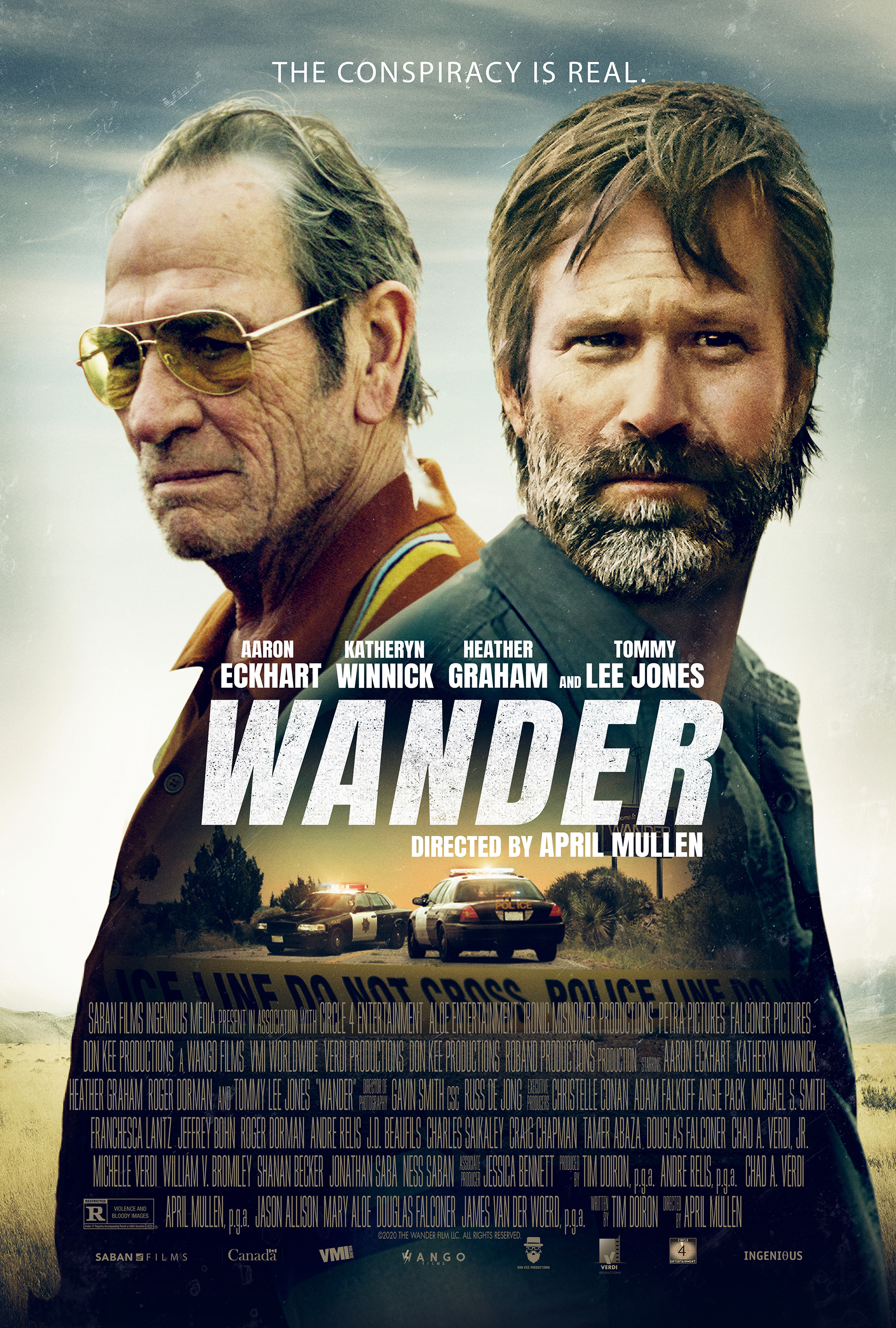
Even though we are still in the grips of the coronavirus pandemic, there are still new movies arriving to us in theaters (those which are open anyway) and/or to our own television screens thanks to On Demand and various digital platforms. One such movie is “Wander,” a thriller starring Aaron Eckhart (“The Dark Knight”) as Arthur Bretnik, a private investigator who live in a rusty old trailer out in the middle of nowhere. We soon learn he is still grieving the loss of his daughter who was killed in a horrific car accident which left his wife completely catatonic. The perpetrators of this accident were never found, and he remains determined to find them.
One day, he is met by a woman who pays him to look into the death of her daughter who also looks to have been killed in a car accident, but the mother is not convinced this was the case. In the process, he uncovers a conspiracy which links to other cases of people killed in a similar fashion as well as to his daughter’s death, and he becomes infinitely determined to uncover it for all to see. But with his troubled past and a history of mental illness, one has to wonder if Arthur is really seeing the truth out there, or if his mind is playing tricks on him. “Wander” also stars Tommy Lee Jones, Heather Graham and Katheryn Winnick.
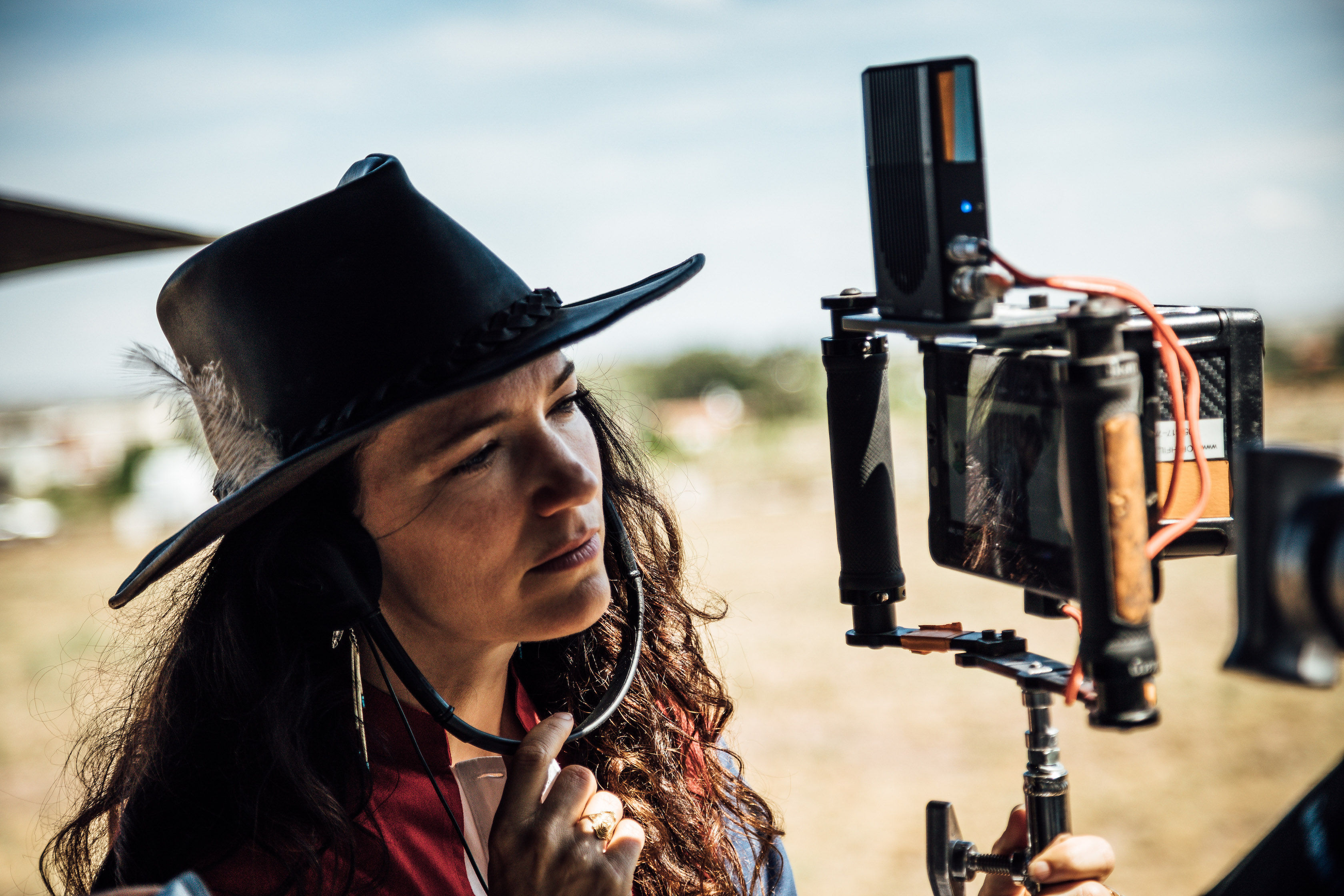
Directing “Wander” is April Mullen, a highly creative Anishinaabe Algonquin (Indigenous) filmmaker who is known for her passion, her bold visuals, and an ambitious shooting style which is truly amazing. With “Dead Before Dawn 3D,” she became the first woman and the youngest person to direct a live action stereoscopic 3D feature film, and it was awarded the Perron Award for its technological achievement. Her other directorial efforts include the erotic romantic drama “Below Her Mouth” which she filmed with an all-female production crew, and the action thriller “88” which stars Katharine Isabelle and Christopher Lloyd.
I was lucky enough to get a chance to talk with April Mullen about “Wander” recently, and in her director’s statement, she described the film as being a journey towards a truth unseen by most, and one hard to face. In addition, she also sees it as a critique of sanctioned government surveillance which has led to the displacement of many indigenous people through no fault of their own. We talked about this and more in our interview below.
April Mullen: Are you the marathoner runner himself, or did somebody else run a marathon?
Ben Kenber: (Laughs) I am indeed the marathon runner. I have run the full Los Angeles Marathon (26.2 miles) eight years in a row.
AM: Awesome! I just had to ask. I just looked at the (website) byline (“Cinematic Musings from a Movie Lover and Marathon Runner”) and I loved it. I looked at your website and I was like, this is wicked!
BK: I did not run the LA Marathon this year, but I am hoping to come back to it once this coronavirus pandemic has finally ended.
AM: You better because it pumps me up.
BK: Thank you. “Wander” really held my attention to the very end. This is always tricky to pull off especially with one like this which deliberately messes with your mind. When were you first introduced to the screenplay by Tim Doiron?
AM: Tim Doiron and I go way back. We started working and making independent films together 20 years ago. We come together and we’re like, what do we want to make next? That’s a very messy and exciting day. Five years ago, we wanted to create something with a main character who was really dealing with grief, loss, mental health issues and a huge amount of paranoia when it comes to conspiracies and government surveillance and anxiety, and of how to over come that. And then we thought, how are we going to bring that truth and that character to a world that’s commercial and viable for the entertainment industry (laughs). The backdrop was the conspiracy, the podcast, the chip technology, border control and my inner side of the truth; that indigenous women, 2Spirited warriors, BIPOC and displaced people have always been a continual target and victim of governmental subjugation and violent practices. (We went about) exposing that in a tight narrative through the eyes of one single character which is an unreliable narrator like Arthur. So, all of those themes became our mixing pot and then the rest is history, but it wasn’t as easy or smooth as we originally thought. We were like, this movie is going to be very straight forward, but of course it is so much more complex than we had hoped. But hey, we made a movie and that’s what it’s about (laughs).
“Wander” film by Wango Films
BK: Exactly. Aaron Eckhart is terrific here. He has to run a gamut of being in a state of grief, but he is also a bit crazy as well. Did you and Aaron had to measure out crazy and grief-stricken he had to look throughout shooting?
AM: We had an unbelievable working relationship. We were attached at the hip. We could communicate through our eyes and even our physicality on set. I was never far away. I was maybe three feet away from him. He was on set every day, every second and in every frame of the movie. He brought 150% and was beyond dedicated. I think this role was so different and far removed from anything else he has ever played. When he read the script, he completely resonated with Arthur. Aaron himself is totally into conspiracies, podcasts and the dark web. He always said, if you’re not paranoid, you should be. We were riffing on conspiracies and chem trails. It was unbelievable how much material resonated with him. He came from a really strong place of truth, and then Tim’s experience with mental health issues also rang from a place of truth. So, my job was just to make all of those things come together and make Aaron feel really comfortable to take major leaps and capture that lightning in a bottle that he has. We went off script and we went off locations. Sometimes it would just be him and I. He would be in a car and I would be operating the camera. We were able to do that because the film was so small, but I knew Aaron Eckhart if that makes sense.
BK: “Wander” is kind of a mind-bending movie in the same the way movies like “Jacob’s Ladder,” “Memento” and “The Sixth Sense” were.
AM: Very much. It’s very much like a current version of “Jacob’s Ladder.” I feel like it is the 2020 version of “Jacob’s Ladder” (laughs). At least, I hope it is. We really hope it is.
BK: You have said “Wander” was created in honor of all Indigenous, black and other people who are targeted and have been displaced through border control on stolen land. Do you this is what helps to set the film apart from others of its kind like “Jacob’s Ladder?”
AM: I’m not sure. I hope so. In the statement (at the film’s beginning), there is so much truth to that. We did a lot of research with MK-Ultra and who were the victims of that and of who did the government use to test different technologies on people, and it was mortifying. In our history, what we have done to people made a huge impact on us, and we had to say something at the beginning of the film because it’s not just a fictional world although we both wish it was different. This is the world that has happened in the past and we didn’t want to ignore it, but we didn’t want to heavy-hand it either. But we just thought it was so important to recognize the truth of what has happened, and it is terrifying to think we are constantly being tested and watched. Chip technology is right around the corner (laughs). Five years ago, it felt a little bit further away, but today… What we assumed five years ago, “Wander” is way more current than we ever dreamt it would be.
BK: In the film’s opening statement, it says “Wander” was filmed on the homelands of the Pueblo Navajo and Apache peoples. What effect would you say this had on the entire production?
AM: It had a huge effect. Our very first day, we opened with a ceremony recognizing the land with an indigenous family and clan from New Mexico, very close to Carrizozo, and that set the tone of what we were about to embark on. And as a creative person, and I’m also Anishinaabe Algonquin, I just thought that to start off with the recognition of the land that is not our own and that’s where we began, I really hoped to allow for truth, vulnerability and a humbling of everyone to know our goal as a creative group of being a silent warrior; shedding a light on these subject matters whatever they might be. This one in particular was Arthur’s journey, but at the end of the day we are all creating something that we hope makes an impact and propels change. Whether you’re a grip or costumes, I just thought coming together as a group and really allowing that to begin on the right foot was important, and then every day afterwards was the same. And then on a personal note, I don’t know if you noticed, but the music throughout the film was really specific and really original and different I think than any normal psychological thriller. That was a very strong intention to collaborate with an indigenous artist out of Canada whose name is Jeremy Dutcher, and I really wanted to put indigenous language in the film to bring medicine and healing through the Ancestors’ songs on the harsh reality of what our past and our history was. Just hearing that and feeling that, whether we understand it or not, I think our spirits are ideally healing through song and language, and that was a personal goal as well in making the film.
BK: The opening shot of “Wander” is brilliantly shot in how the camera comes up to the scene of a car accident and then pulls away from it to suddenly go up into a crane shot. How did you pull this off?
AM: You are the first person to mention this, and I have to say I loved that you did because no one has! That shot was so, so ambitious. There was only four of us. It was a (camera) operator who I have worked with on three films on the Steadicam who was rigged on the back of one of our production vans. My father was driving backwards (laughs) along a deserted road which we had full safety on each side which then came to a stop. The camera operator came up to and circled that space that you saw. He designed, which we brought from Canada to Carrizozo, a walk on/off platform which I am obsessed with. It’s used in the film a dozen times. He was able to take the Steadicam and do a walk on crane shot. It’s independent film so we have to do these things. He at the end walks backward onto a platform after which a crane lifts him up. He’s actually standing on the crane that he made a platform for, and it is all in one shot. I wanted it to be at sunrise so our window was very small. We practiced about three runs to get the timing of the lines of the road correct, and I really wanted it to be shot in one shot and not digitally faked. We shot it four times and then we got it on the second take. I’m really proud of that because it is an amazing achievement for a small crew with a small budget and being innovative together out in Carrizozo, New Mexico. We had very little resources. We built that shot with a hammer and screws (laughs).
BK: I imagine the budget on this production was very tight.
AM: Super tight. Too tight.
BK: How much time to shoot “Wander” in?
AM: 20 days, but our below the line budget was very puny because we had these incredible stars in the film, which is okay because that’s what we need for people to be able to see the film. But it really tightens the clasps on everything else. It was puny, very puny (laughs).
BK: Speaking of the cast, you have a great set of actors on display here. In addition to Aaron Eckhart, you also have Tommy Lee Jones, Heather Graham and Katheryn Winnick among others. How much direction did you have to give these actors, or did you simply leave them to their own talents?
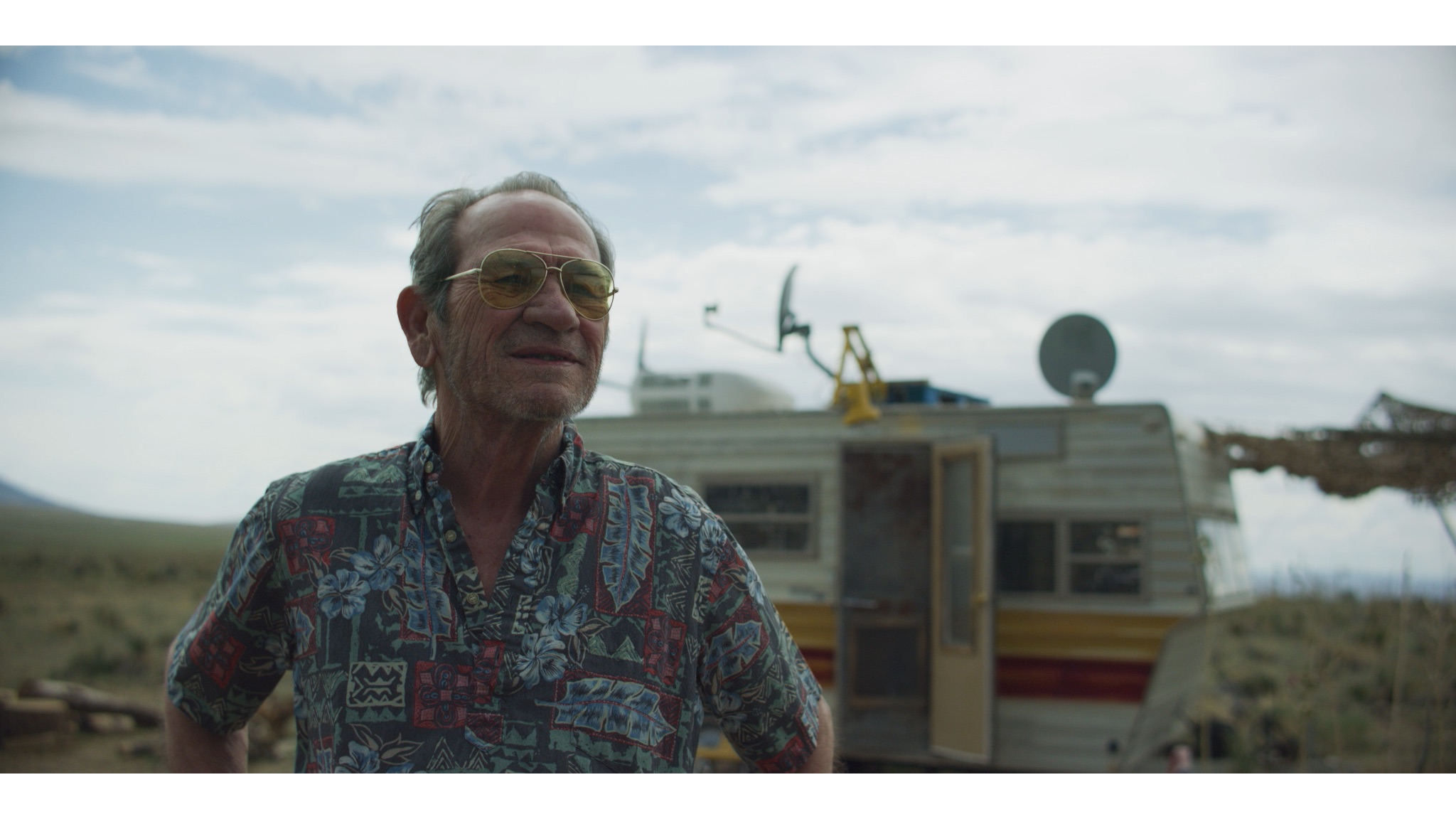
AM: As a director I am very, very hands on, so I am always within arm’s length of them and am trying to challenge them and steer them in new directions. I think Aaron, Tommy, Heather and Kathryn are all playing roles that they are not stereotypically cast for. Heather Graham was the grounded best friend and the tether to reality for Arthur. She was not a romantic love interest. She was the voice of reason for the audience. That is something very challenging and new for her, coming up with ways in making sure she was really grounded. She loved it, I loved it and we were both up for the challenge. Tommy Lee, he doesn’t usually doesn’t get to play an eccentric, fun loving (at least on the surface), Hawaiian shirt wearing, whatever goes kind of guy. It is very different for him. There were a lot of questions and bod language and how to say certain things. We were always, always communicating and it was unbelievable work because it was such a small set and a small cast in a lot of ways. There was a lot of one on one time which was fortunate and really wonderful.
BK: Katheryn Winnick’s character always stands out in an interesting way in this film, and this is especially apparent in the first shot. Was that by your design or Katheryn’s?
AM: It was written in the script, but we also worked on the script months before she got to Carrizozo. I love that she comes prepared. We were revamping and reworking the script to cater to her and her strengths, and what she thought was more intelligent or higher stakes for her character which was fantastic. That was really unique how she brought that as a performer. When she got there, she was unbelievable. She came onto set, it was her first day, and it was the shot where she has to jump out of a window and Aaron catches her and they start running, and it is the intro where she takes off her mask. As she was coming out of the trailer, I was like, Katheryn, we have 20 minutes, the sun is setting, it’s a one-take wonder because it has to happen at magic hour. Once again, trying to way too ambitious for what I have (laughs). So I said, Kathryn, I have your stunt double here, but then I would have to cut for the lines. What do you feel? And she was like, “I’m down, I’m ready, let’s get dirty!” As big and as Hollywood as she is, she was ready to get dirty and gritty for the role because that role is undone in a lot of ways because her character carries with her a lot of weight. She is manipulating all of the puzzle pieces which is pretty cool to find out at the end. She was just such a team player and she didn’t even practice. She was like, let’s do it. I was like, are you sure about the window? Are you sure you’re gonna go through it? Are you okay? She says, “done. I’m ready.” We did it twice, she nailed it twice, Aaron caught her twice doing somersaults out of a window, both of them did their own stunts and it was unreal (laughs), and that was day one on set! They trusted each other, they trusted us, they trusted me and it was an awesome moment of just jumping off a platform and creating magic together. It was awesome.
BK: That’s one hell of a first day.
AM: Can you believe that? I know! Unbelievable.
BK: The look of this film is fantastic. How much of it is due to you, and how much of it is the result of your cinematographers, Gavin Smith and Russ De Jong?
AM: It was a huge collaboration from the beginning. Tim Doiron, the producing partner and I landed in New Mexico six months prior to shooting. We lived in Carrizozo, that little town, in those tiny motels for four months. We were isolated from reality just like Arthur which was super inspiring, and Gavin and I were coming up with that beautiful projection and trying to be innovative with the small budget and small locations we had and really branching out to try and make the film feel much bigger than what it was. I’m obsessed with every detail, every moment and every little piece of color, light, production value and design that you see onscreen. Every little detail, I wish I could say it happened by accident and that we sneezed and there it was, but it is meticulously planned (laughs). I hope it feels real. I just wanted it to feel like real life, but it was definitely very much planned including the times of day when we shot. I really wanted to take advantage of those gorgeous landscape shots and the sun setting shots. That required teamwork with the DP and also out first assistant director and our production designer, my sister Faye Mullen, and me and everybody coming together to really try and achieve what we needed to on a tight timeframe. But the look was heavily established beforehand. I started taking pictures and photographs the minute we started writing. Five years ago, I was collecting a look book for “Wander” that I brought to the DPs who I have worked with before on several projects so we had a shorthand. We just wanted to make it our best work, so we challenged each other every day than we ever made it before which is a good thing.
BK: That lightning bolt in one shot, that was real?
AM: Oh yeah it was. Nothing is effects except for the little chip. Everything is real. Every sunset, every lightning bolt, all of that is just real and I’m so proud of that.
BK: Thank you for your time April.
AM: Thank you for supporting “Wander.” Have a great day and keep running!
“Wander” will be released in theaters (whichever ones are open), On Demand and on Digital starting December 4, 2020. Please be sure to check out the trailer below.Poster and photos courtesy of Saban Films.
WRITER’S NOTE: This review was written back in 2008 when I was way behind on my 007 watchlist. RIP Sean Connery.
I keep hearing over and over telling me Sean Connery was the best James Bond and still is. And yet after all these years and so many 007 movies later, I have only seen a few of the ones starring Connery. Until yesterday, the only ones I had seen all the way through were “From Russia With Love” which remains one of my favorite Bond movies ever, and the rogue Bond “Never Say Never Again” which brought Connery back to the role for the first time since “Diamonds Are Forever.” The James Bond I really got weaned on as a kid was Roger Moore who played the character like a flamboyant playboy who got caught up in events he looked as though he had no business getting caught in. Nevertheless, Moore managed to get the job done even as the franchise started to descend into parody.
Yesterday, New Beverly Cinema, my favorite movie theater in Los Angeles, had a double feature of the first two Bond movies ever made: “Dr. No” & “From Russia With Love.” I had seen bits and pieces of “Dr. No” previously, but never the whole way through. Watching it today, this 007 adventure seems like an average Bond with the megalomaniac villain bent on world domination. I was starting to get sick of this in the last few films which starred Pierce Brosnan as Ian Fleming’s famous spy. Every once in a while, I like to see Bond go head to head with a villain who is not looking for an infinite level of power, but instead one whom he just wants revenge over like in “License to Kill.”
It helps, however, to keep in mind what action movies were like before James Bond came along. Compared to “Dr. No,” they were nowhere as gritty. Shooting female characters in a film was not allowed back in 1962, and this Bond quickly did away with this unwritten law. There was a lot more going on than just your average good guy here. While it might appear to be something of an average film for those seeing it today, “Dr. No” was in many ways a groundbreaking film which led to a franchise which has lasted longer than so many others.
OK, I am in agreement, nobody played James Bond better than Connery, and this is even though I consider Daniel Craig to be a very close second. His very first appearance as 007 in “Dr. No” was truly brilliant as you could see him at the card playing table, but you did not see his face until he uttered one of the most famous lines in cinematic history:
“Bond. James Bond.”
My dad is always telling me what made Connery so great in playing Bond is that he was so believable in how he could romance a woman one second, and then slap her when she was holding back information from him. There was a raw danger which Connery brought to this iconic character, and he set the bar almost impossibly high for the others who inhabited Bond after him. When he lets a driver take him to his destination, even though he knows this driver is up to no good, shows how quickly Bond can change from being suave and debonair to lethal and dangerous in a heartbeat. Connery’s Bond kept his cool and managed to get his way in the end. The bad guys think they have him cornered, but this is what he wants them to think.
It is endlessly interesting to see how the Bond movies have evolved since “Dr. No.” It remains the only 007 film to not have a pre-titles scene which the others are famous for having. It just goes right into the gun barrel opening in which Bond shoots right at us. The titles look cheesy today as “Dr. No” and “007” are put everywhere on the silver screen. It was the first of many opening credits sequences designed by Maurice Binder, and this one remains the most disjointed of the bunch. It goes from the unforgettable Monty Norman theme we all know to three men superimposed over the credits to the tune of “Three Blind Mice.” The audience at the New Beverly laughed at this part, and I couldn’t help but laugh myself. Things have changed a lot since “Dr. No” came out.
Seeing Bond flirt for the first time with Miss Moneypenny (the late Lois Maxwell) here makes me miss the banter these two characters have had from one film to the next. Miss Moneypenny was not in “Casino Royale,” and I have no idea if we will ever see her again in the future. But seeing these characters here for the first time reminded me of how great and fun their banter was until M made her buzz Bond in for his next assignment. Just when things got interesting between the two, business comes to obliterate pleasure.
In “Dr. No,” Bond actually gets to bed several different ladies instead of just one. Connery makes seduction look so easy to pull off. The fact such seduction is not this easy in real life is utterly frustrating. This lucky bastard of an Oscar winning actor had quite a selection before he came to meet the first Bond woman ever, Honey Rider (Ursula Andress), whose entrance in a flesh colored bikini is still one for the ages. This also marked the first time Bond actually sang, and he has not sung since. I can’t help but wonder if this was a good or bad thing. Then again, I can’t quite picture Timothy Dalton singing “Thunderball.” As for Brosnan, I never want to hear him sing again after “Mamma Mia.”
One of Bond’s first death-defying moments involved a tarantula, and just typing out this particular spider’s description sends shivers down my spine! UGGH! This may have been why I never bothered to watch “Dr. No” earlier in my life. Those damn things creep me out like nothing else. Seriously, get that creature away from me! Easily one of the scariest moments in any Bond movie, the tension escalates so quickly to where the rest of this movie can never quite match it. Still, it wouldn’t be the last time we saw spiders in a Bond movie. My brother covered my eyes during one scene in “Octopussy” which included them. I think it is just as well that he did.
Watching “Dr. No” was fun, and it is an excellent Bond movie in many ways. Time has not been exactly kind to it though. We can see the green screen being used, so we have to snicker some. The pace is a lot more leisurely, and no Bond movie can move so slowly these days. Norman’s Bond theme is played endlessly here to where we threaten to get sick of it. But decades later, it is impossible to tire of this theme as it is to tire of John Carpenter’s theme to “Halloween.”
The print New Beverly Cinema had of “Dr. No” was in peak condition, and it was a recent printing down for the occasion of United Artists’ 90th anniversary. It was great to see it on the big screen all the way through instead of just on television. From here, the Bond series had nowhere to go but up. The formula was more or less perfected with “From Russia With Love,” and the producers did not mess with this formula until after “Die Another Day.” I enjoyed “Dr. No,” and I love how it paved the way for many more exciting adventures with this British spy. May there be many more in the years to come.
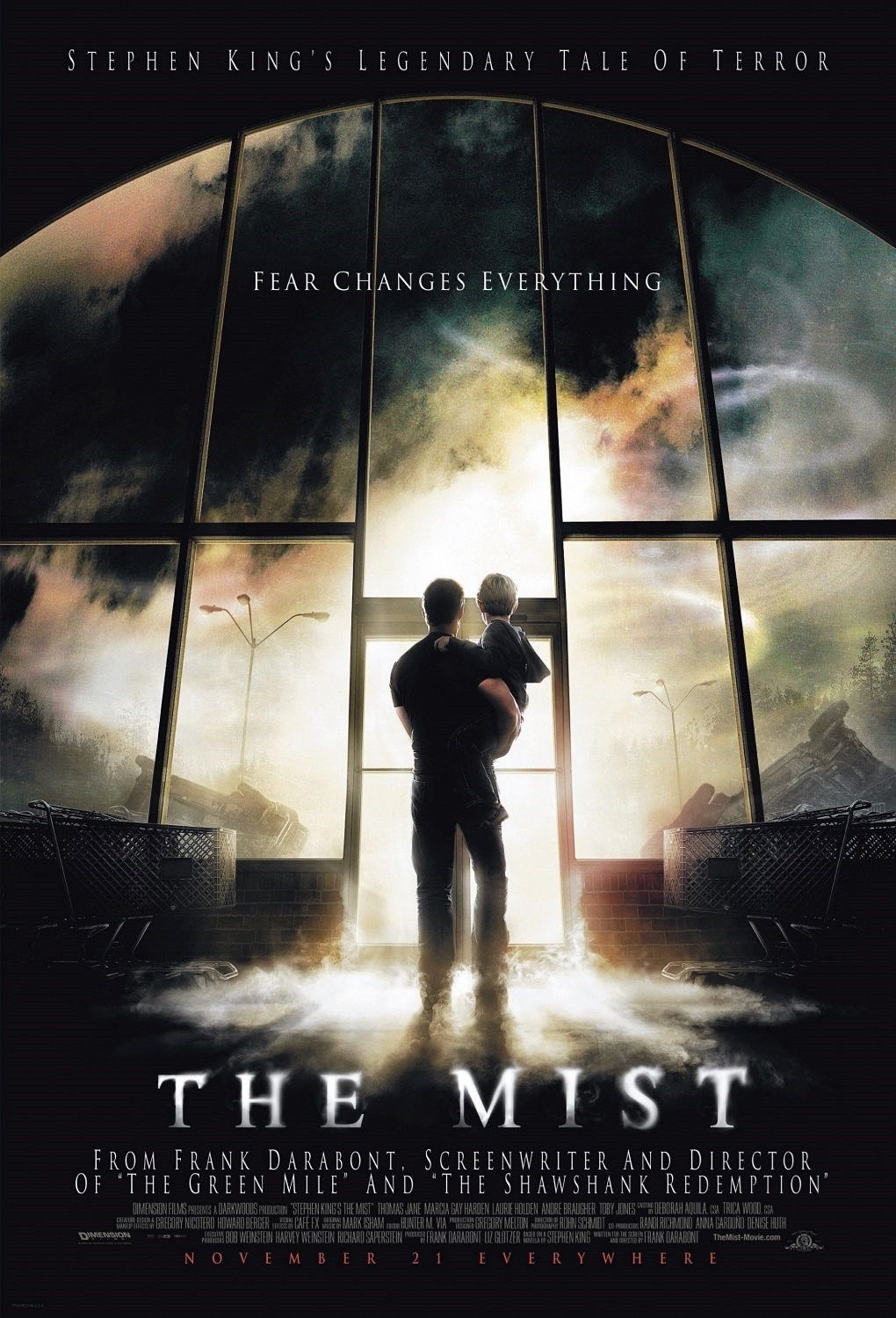
There was a time when Frank Darabont created the most effective cinematic adaptations of Stephen King’s novels. He gave us one of the all-time great adaptations of King’s works with “The Shawshank Redemption,” a classic which you can still catch it on TBS or TNT every other week. Darabont also directed “The Green Mile” which was very good and left its audience in tears at its humbling conclusion. These days, Mike Flanagan has become the King adaptation master of choice with his takes on “Gerald’s Game” and “Doctor Sleep,” both of which proved to be wonderfully unnerving. Before this, however, was Darabont’s adaptation of King’s “The Mist,” and it represented his first time dealing with one of King’s full out horror stories. Having said this, he still brings this particular King horror tale to life in way few other filmmakers ever could.
“The Mist” takes place, as many of King’s works do, in the state of Maine. We see our main character, David Drayton (Thomas Jane), doing his work as a graphic artist on something which appears to be right out of “The Dark Tower,” and it establishes what David does while simultaneously establishing the kind of movie we are about to see. It is a motion picture which deals with people whom we recognize from the real world we inhabit and the small towns we grew up in. This is not often the case as many horror films deal with stock characters we cannot wait to see done away with.
One day, there is a storm which hurls a tree into David’s work studio, and he ends up going into town with his son the next day to pick up supplies. In the process, he also ends up taking along his next-door neighbor Brent Norton (Andre Braugher) regardless of the fact Brent’s tree fell down on David’s boathouse and completely destroyed it. But while at the market, a mist starts to blanket the town to where there is zero visibility. A local townsman named Dan ends up rushing into the store crying out, “There’s something in the mist!”
From there, everyone is trapped in the supermarket as the thought of stepping outside its doors is far too fearful an action. This is largely the result of there being something in the mist which quickly proves to be anything but human, and this creates divisions between everyone trapped in the store. This division is primarily brought about by Mrs. Carmody (Marcia Gay Haden), a fervent believer in the word of the bible who believes judgment day is upon us and that the end is indeed very near.
Watching “The Mist,” you can recognize the familiar types of characters which occupy the average Stephen King story; the man who doesn’t want to be the hero but ends up being one even if it is not by his own doing, the religious fanatic who will not allow themself be torn away from they believe to be the truth, and townspeople who appear to be brave on the outside but terrified on the inside. What I really liked about this film is how Darabont never lets them become just mere stereotypical characters. While these characters may appear to be just that, it is a credit to the writing and acting that everyone involved in this film’s production rose above the genre’s conventions to give us something more human than we typically expect.
What interests Darabont here is not so much the monsters on the outside, but instead the monsters which lurk deep in our psyches. How we would possibly react when all the things we depend on in our life are suddenly taken away from us? No easy answer is given, but it is clear we are left with our instincts for survival at any cost. Darabont does excellent work in creating an inescapably claustrophobic environment where escape is easier said than done and trust can easily become a disposable commodity.
Leading the cast is Thomas Jane who first has made an unforgettable impression when he co-starred in “Boogie Nights.” He then went on to do “Deep Blue Sea” which more or less typecast him as the hardened hero who shows more courage than anyone around him. But here, he is simply an ordinary man caught up in an unimaginable situation, and he is struggling to maintain his sanity in an increasingly desperate situation.
“The Mist” is filled with many fine actors who fully humanize their roles and succeed in avoiding the mistake of making these characters seem stereotypical and easily disposable. It is great to see Andre Braugher here as the disbelieving neighbor/lawyer who makes the idiotic assumption he is being setup for a practical joke. In any other movie, we would simply just hate his character Brent for not believing the protagonists, but Braugher succeeds in making us believe why he might see how Brent could not see the inherent danger everyone is caught up in. As an audience, we of course know better of what is really going on, but it makes you think of how people would normally react in a horrifying situation like this. Could we easily believe in such things? Wouldn’t we be skeptical of what others tell us? Aren’t some us sick and tired of being the butt of everyone’s jokes?
Also in the cast is Toby Jones who is a wonderful presence here as Ollie, a supermarket employee who turns out to be very handy with a gun. Then we have other character actors like Jeffrey DeMunn who plays Dan Miller, and William Sadler who plays Jim Grondin. Frances Sternhagen is also on board as a friendly schoolteacher named Irene and has some of the best and most memorable of moments in this movie. You also have Lauren Holden as Amanda Dunprey, a new school teacher who befriends David and his son Billy (Nathan Gamble).
All of these actors do a great job of making the characters all the more real to us so that we don’t simply laugh them off the screen for doing stupid things that horror movie characters usually do. You get the sense that if this were written and directed by anyone other than Darabont, it would look like just about any other horror movie we have seem hundreds of times already. But there is going with the story of this movie that makes it more than your typical horror movie.
But the best performance comes from Marcia Gay Harden who plays the seemingly crazed Mrs. Carmody. A religious zealot if there ever was one, Carmody can be easily compared to Carrie Wright’s mother from “Carrie” as both are hopelessly devoted to God and the Bible even though their belief structure has long since been corrupted. Harden is a brilliant actress, and she makes Mrs. Carmody far scarier than the monsters which constantly threaten to infiltrate the overcrowded supermarket everyone is stuck in. She also makes you believe how people would end up following her when the fate of the world continues to descend down on them all. Her crazy beliefs end up making believers out of others, and a mob mentality quickly forms a sharp division between the characters stuck in the store which threatens to bring out the worst in everyone. Harden’s portrayal of such a frightening individual has long since stayed with me after watching this film when it came out in 2007.
Not everything about “The Mist” is perfect. The monsters, when they do appear, are effectively creepy and eerie, but they are also clearly CGI, and this takes away from what we are shown. Darabont ends up creating more of an intense effect when we don’t see the monsters up close, but instead from a distance. When they are shrouded by weather they inhabit, they seem infinitely more terrifying as a result. If you have a fear of creepy crawlers like spiders, you may want to think twice about checking this movie out.
The ending of “The Mist” is different from King’s book, and King himself was quick to point this out to everyone who bothered to listen. What I can tell you about the ending is that it is both uncompromising and devastating in its impact. It makes you look back at everything which happened to where you realize the line between good people and bad people, protagonists and antagonists, heroes and villains can be ever so easily blurred. The people we end up fearing the most are ourselves and of what we are capable of. We can easily descend into craziness and insanity when all the things we need most in life are suddenly taken away from us. The moment we give up on life and accept its horrifying fate is the moment when we all become less than human, and considering the times we are currently living through, this seems more pertinent than ever before.
I walked out of “The Mist” completely shaken and unable to speak. It contains a shattering ending which is unlike any we usually from any film we typically watch. What makes it all the more unsettling is that we cannot help but think of what we would do in the same situation. There are many who cannot bear to think of the answer such a question, but there are those whose drive to survive is impossible to ignore.
“The Mist” may not as good as “The Shawshank Redemption,” but it is still an effectively made motion picture with excellent performances and an ever-growing intensity. It is also one of the better adaptations of a Stephen King novel in years, and it keeps itself from sinking into the clichés of the average horror movie.
Whether or not you believe in extra-terrestrials is beside the point. We end up fearing ourselves more than anything else, and this fear can easily cripple us from doing what we want to do in our lives.
The tagline of “The Mist” was right: Fear changes everything…
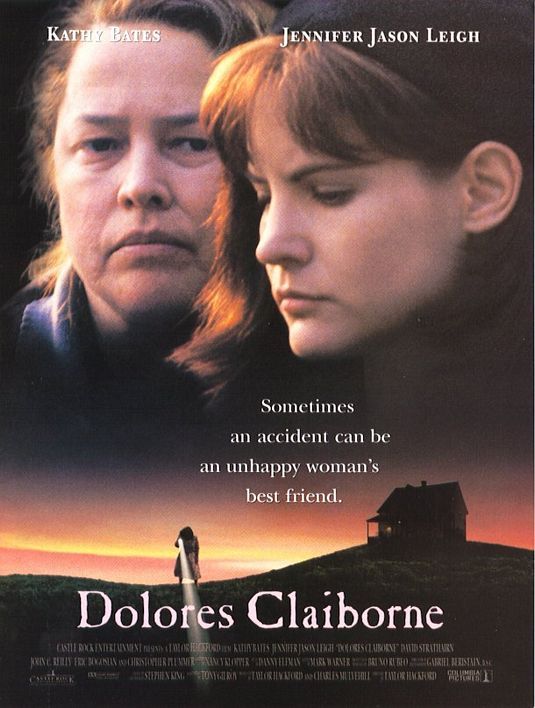
“Dolores Claiborne” is, on the surface, not your typical Stephen King novel, and this is important to note before you begin watching this particular adaptation of his work. This cinematic treatment reunites him with the great Kathy Bates who won an Oscar for playing Annie Wilkes in “Misery,” but she’s not playing a deranged psycho this time around. Also, while much of King’s writings deal with terrifying supernatural powers and unspeakable terrors, the horror generated here comes from real life horrors no one should ever have to endure. In some ways, this makes it one of his more terrifying tales because it deals with the kind of horrible crimes we hope and pray never to experience first-hand. Having said this, it is clear how many of us can never be so lucky as to avoid the worst traumas humanity has to offer.
Bates plays the title character who, as “Dolores Claiborne” opens, is believed to have killed her rich employer Vera Donovan (Judy Parfitt). This crime immediately reminds the town of Little Tall Island in Maine when Dolores’ husband, Joe (David Strathairn), died twenty years ago under mysterious circumstances, and the general consensus was that Dolores killed him. Detective John Mackey (Christopher Plummer), who had pursued the case against her back then is determined to put her behind bars this time and for good. Into this mix comes Dolores’ daughter, Selena St. George (Jennifer Jason Leigh), a big-time reporter who arrives to defend her mother despite the two of them having been estranged for over a decade.
The novel “Dolores Claiborne” was essentially one long monologue as the story was written entirely from the title character’s point of view. This makes the work director Taylor Hackford and screenwriter Tony Gilroy have done here all the more impressive. They have taken Dolores’ unsettling story and have stretched it out into a character driven motion picture filled with various characters who have been fleshed out in unforgettably compelling ways. None of these characters, even that drunken lout of a husband and father, are one-dimensional or throwaway caricatures. Each one is complex, and they take unexpected directions which might seem jarring at first, but eventually make sense in the large scheme of things.
The plot shifts back and forth in time as we flashback to when Dolores lived with her drunk and abusive husband and of the vicious abuse she took from him in his endlessly drunken state. Director of photography Gabriel Beristain shoots this hideous past with such vivid colors to where he gives the scenes an innocent look which is soon contrasted with horrible violence. It almost acts as a façade for how the past was seen as if it were some sort of Norman Rockwell painting, the kind made to cover up the severe family dysfunction many would like to pretend does not exist.
For the record, King said he wrote the character of Dolores Claiborne with Kathy Bates in mind, and it is very hard to think of another actress who could have inhabited this role. Stripped of any false glamour, Bates takes her character from being a victim to one who understandably takes matters into her own hands. Her acting here is flawless and compelling, and we root for her even though her actions have devastating moral implications.
When you look at her overall body of work, this movie almost seems like a walk in the park for Leigh. She has gone to great physical and emotional lengths to portray a character throughout her long career, but here it looks like she is taking it easy. However, her character of Selena is no less challenging to portray than the others listed on her vast resume. Selena is not easily likable, but she has to be empathetic because the viewer slowly starts to see how her innocence was irrevocably and unforgivably destroyed. Leigh matches Bates’ performance scene for scene by showing how much Selena wants to forget the past, but she comes to see how her most repressed memories cannot stay below the surface forever.
Special attention also needs to be paid to Ellen Muth who portrays Selena as a little girl. This is not the kind of role parents want their children to portray to as it deals with abuse and molestation among other things, but Muth proves to be utterly convincing in making the young Selena deeply distraught and confused by actions no child should ever have to be put through.
There’s also a bevy of excellent performances from the rest of the cast as well. Christopher Plummer, who is never bad in anything, is memorable as the relentless Detective John Mackey. This could have been a throwaway role, but Plummer makes Mackey a complex character to where you question whether his determination is based more on personal revenge than justice. Judy Parfitt is unbearably domineering as Dolores’ wealthy employer, Vera Donovan, and their relationship runs much deeper than we see at first glance. And David Strathairn manages to flesh out his despicable character of Joe St. George to where he’s just slightly more than your average mean drunk.
Most of King’s novels deal with the horror of supernatural elements or ghosts and demons which haunt our nightmares. But “Dolores Claiborne,” much like “Stand by Me,” deals with the horrors of real life which we are never quick to confront unless we are put in a position where the awful truth can no longer be ignored. Perhaps the unsettling nature of this particular work by King is what kept many from checking out this motion picture when it arrived in movie theatres back in 1995, but those of us who were willing to dive into the dark side of things like myself did not deny ourselves a journey to the horrors this film has to offer. But now, 25 years later, this film fits in perfectly with a time which includes the Time’s Up movement as we are forced to realize we have thoughtlessly ignored the worst abuses made against other human beings for far too long. As a result, this particular King cinematic adaption plays even better than it did back when it was released.
Sooner or later, every standup comedian gets their own comedy special captured on film, digital or whatever else people are using these days. Richard Pryor performed one of his most famous standup specials on the Sunset Strip at the Comedy Store, George Carlin performed many unforgettable specials on HBO, Kevin Hart got to perform to a sold-out crowd at Madison Square Garden, and Dave Chapelle has remained a comedic force to be reckoned with on Netflix along with others like Amy Schumer and John Mulaney.
And then there is Eddie Pence. You haven’t heard of him? Well, you clearly have not been paying attention like you should. Eddie has been a stand-up comic for many years in Southern California, has appeared on many different shows, and he is also the vice host of “The Ralph Report” with Ralph Garman. Still, he has not achieved the crazy level of fame others in his field have. But like many in this day and age, he has been busy fundraising in an effort to create his own comedy special, and it has finally arrived and been given the unique title, “Eddie Pence: The (Un)special Comedy Special.” What results is a solid hour of hysterics from a self-deprecating individual who is better at performing than he thinks.
With this comedy special, which Pence filmed in his hometown of Washington, D.C., he wisely sets himself up as an underdog. When rushing towards the camera in the opening moments, he is knocked over by a pedestrian who will not even allow him to say the title of this special which Comedy Dynamics took a little too long to release. As he attempts to give out free tickets to his show, he is greeted by one who mistakenly believes he is a blood relative to a certain Vice President who was recently upstaged by a housefly during a debate. Upon arriving at his appointed venue, the D.C. Comedy Loft, he is informed that the main room is hosting a comedy class on how to tell a joke, and it costs only $10 to attend. As a result, he is forced to perform in the venue’s Cellar room which I imagine is the equivalent of the Belly Room at the Comedy Store in Los Angeles. Nevertheless, Pence is so determined to jump onto the stage to give us what he has got, and he is so pumped up to where he doesn’t realize his comedy set will not start for another two hours.
The set of the Cellar is very simplistic as it features a red wallpapered wall with bland white Christmas lights adorning it. If those lights were blinking constantly, it may have looked more like the seedy bar Laura Palmer visited in “Twin Peaks: Fire Walk with Me.” But while Pence may not have the spectacular sets which adorned Carlin’s HBO specials, he is not about to let his sparse set affect his comedy set, and it quickly proves to be endlessly hilarious.
Right from the start, I could see Pence has had a lot of experience as a stand-up comedian, and he shows a lot of confidence as he goes from one joke to the next with what seems like relative ease. As he points out how strippers are doing the Lord’s work or how no one can half-ass streaking, it is clear he has long since found his own unique style of performing and trusts his own point of view implicitly. Even I have never taken into account how strippers are doing the Lord’s work.
What I also admired about Pence is how he goes from one topic to another with the understanding of not staying on the same subject for too long. He is also aided by his director, Dustin Jacobs, who keeps the proceedings moving at a steady pace. Stand-up comedy specials usually have spots where things begin to drag to where you find yourself checking your watch or looking how much time is left before the end, but this special is never undone by such problems. Everything feels smooth and I never felt my attention wavering throughout even when Pence talks about how hamsters make the worse pets.
And like all great comedians, Pence saves his best material for last. His jokes about “Star Wars” are more than welcome, and he comes up with stuff even Kevin Smith did not include in “Clerks.” Pence’s biggest jabs, however, are at “The Empire Strikes Back,” still the greatest “Star Wars” ever made. The penultimate scene in which Princess Leia tells Han Solo she loves him before he is frozen in carbonite, and he tells her “I know” remains one of the most memorable moments in a “Star Wars” film, let alone any other film in cinematic history. But in the process, Pence provides us with definitive proof of how a similar situation will never play out as well in real life. In fact, anyone with a DNR order will find their wishes completely voided if those two words are the last thing they say to their spouse.
Is “Eddie Pence: The (Un)special Comedy Special” one of the greatest stand-up comedy specials ever made? Oh please, do not go into this needlessly comparing this one to others. Simply let it stand on its own and enjoy for what it is. Besides, all these lists get everything in the wrong order. There was one which even dared to put “Bill Cosby Himself” at a much higher position than “Richard Pryor: Live in Concert.” Blasphemy! That’s like saying John Carpenter’s “Ghost of Mars” is a better motion picture than his remake of “The Thing!”
Anyway, I digress. Pence proves to be a durable stand up comedian who generates many laughs for the most enthusiastic of audiences, and his “(Un)special Comedy Special” will present viewers with a nice diversion from the apocalyptic world we have been forced to endure this past year. But by the end of 2020, I hope to have an answer as to which comedy is funnier: this or “Trump Card.”
The following review was written by Ultimate Rabbit correspondent Tony Farinella.
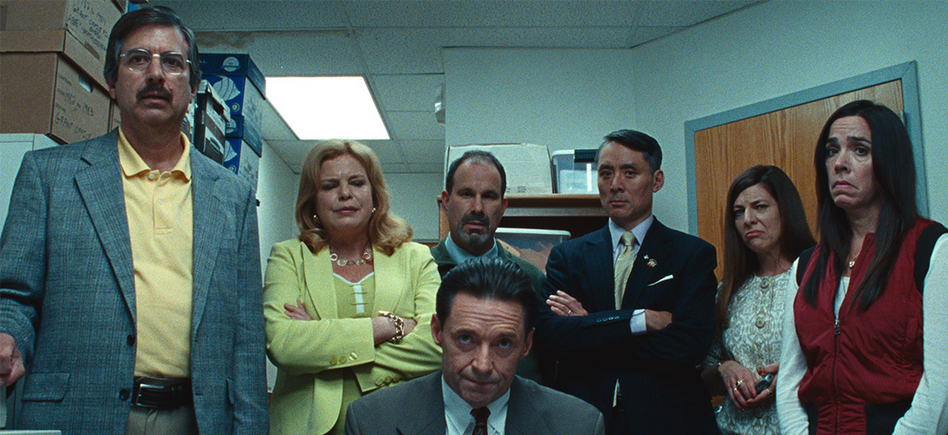
“Bad Education” is the kind of film that would have worked very well in theaters if not for the current Covid-19 pandemic based on the star power of its two leads, Hugh Jackman and Allison Janney. As a reviewer, however, I’m happy to watch it on any platform. As usual, HBO delivers quality programming which stands out from the pack. When it comes to delivering the goods, Jackman gives his best performance, in my opinion, as Dr. Frank Tassone.
When the audience first meets Dr. Tassone, he comes across as probably the nicest, most caring, and thoughtful superintendent known to mankind. He goes above and beyond for his students, the parents, and everyone who works for him. He is the definition of the first one in the building and the last one to leave. He’s also very particular about his weight, appearance, and presentation. But beneath all of this, there is a very dark side to him that is sociopathic, cunning, and very conniving. I can’t imagine too many actors would have been able to handle the juggling act of playing everyone’s favorite superintendent one minute and a conman behind closed doors the next as well as Jackman. Thanks to his hard work and the efforts of Pam Gluckin (Allison Janney), the Roslyn Union Free School District on Long Island is rapidly growing. The numbers are good, people are making money, and everyone is happy.
However, when it comes to handling success and money, all it takes is one slip up for everything to be exposed to the public. “Bad Education” is based on a true story, and it makes you, as an audience member, wonder how this could have happened and why it got so out of hand. I won’t spoil any of the details for you in terms of what happens to Pam Gluckin and Frank Tassone, but as they say, truth is stranger than fiction. This is a film I would have gladly paid money to watch on the big screen. There are moments of dark comedy in this adult drama, and they work perfectly. What makes it even more surreal is the fact their empire was brought down by a young journalism student played by promising young actress, Geraldine Viswanathan (“Blockers,” “Miracle Workers”). There is also great supporting work from Alex Wolff, Rafael Casal and Ray Romano.
However, there are two major reasons this film is such a success. One of the reasons is the performances from Janney and Jackman. Let’s focus on Janney first here, as she delivers a tough, no-nonsense performance. Pam is unapologetic about what she is doing, and Janney portrays this perfectly. Even when Pam is at her worst and it seems like the cards are stacked against her, Janney shows off a side of her that is not going to go down without a fight. Jackman gives a meticulous and detailed performance which does not have a single false note. Much like his character, every single aspect of his performance is well-thought out and serves a purpose. As mentioned earlier, it is the best Jackman performance I’ve ever seen. He can really do it all as an actor.
It was mentioned in the review that, as an audience member, you wonder how this successful school district allowed themselves to get so over-the-top with their own personal needs and financial gain. As noted on the back of the Blu-ray, it was the largest public-school embezzlement in U.S. history. The fact the characters are so fleshed out, and the story is told in such a smart, entertaining, and unique way just adds to your enjoyment level of this film. If you don’t have HBO, or even if you do, this is a film that is worth owning on Blu-Ray. It’s dramatic, sad, funny, and shocking.
Blu-Ray Info: “Bad Education” comes to Blu-ray courtesy of Warner Brothers Home Entertainment. It is also available on DVD as well. “Bad Education” has a running time of 109 minutes and is not rated.
Video Info: The film is released on 1080p High Definition 16×9 2.4:1. While I was very happy to be able to watch and review this film on Blu-Ray, I must admit it is not a perfect Blu-Ray. During random scenes, there are moments of splotches and grainy images. While it is disappointing, Blu-ray is always my preferred method of viewing a film as opposed to DVD, so I was able to overlook it. For the most part, it is a stellar looking Blu-ray with minor flaws.
Audio Info: “Bad Education” comes on a DTS-HD Master Audio: English 5.1 soundtrack with subtitles in English. The audio is superb on this release.
Special Features: The Blu-ray comes with three special features: “Based on a True Story,” “The Perception of Perfect,” and “Hugh Jackman & Allison Janney – Virtual Conversation.” My only problem with these special features is they are all under five minutes. I would have liked if they were a little bit longer as this is such a unique and compelling true story.
Should You Buy It?
“Bad Education” is a film I’ve been telling friends to see ever since I watched its debut on HBO a few months back. On a second viewing, I received even more enjoyment out of this film. As they say, the devil is the details, and this film touches on something that was completely unknown to me before watching it. After watching the film, it made me want to learn more about the true story behind it. If you are looking for a smart, funny and well-crafted adult drama with a lot of bite to it, you will enjoy the hell out of “Bad Education.” This is the type of smart entertainment HBO is known for, and they deliver the goods with this movie. I can’t say enough great things about the performances by the two leads, especially Jackman. At times, I felt sorry for Dr. Tassone, even though he is selfish, as Jackman brings a humanity to this character. This film is definitely worth owning and picking up on Blu-ray.
**Disclaimer** I received a Blu-Ray copy of this film from Warner Archive to review for free. The opinions and statements in the review are mine and mine alone.








 The Ultimate Rabbit