Warren Beatty Searches for the Truth in ‘The Parallax View’

The Parallax View movie poster

par·al·lax

–noun

  1. The apparent displacement of an observed object due to a change in the position of the observer.
  2. Astronomy. The apparent angular displacement of a celestial body due to its being observed from the surface instead of from the center of the earth (diurnal parallax or geocentric parallax) or due to its being observed from the earth instead of from the sun (annual parallax or heliocentric parallax). Compare parallactic ellipse.
  3. The difference between the view of an object as seen through the picture-taking lens of a camera and the view as seen through a separate viewfinder.
  4. An apparent change in the position of cross hairs as viewed through a telescope, when the focusing is imperfect.

American Psychological Association (APA):

parallax. (n.d.). Dictionary.com Unabridged (v 1.1). Retrieved March 04, 2008, from Dictionary.com website: http://dictionary.reference.com/browse/parallax

I always wondered what the word parallax meant, let alone in relation to this movie. This would have come in handy during those damn SAT’s I took so many years ago. It would have brought my scores up a bit. As for what my scores were…Well, you can just figure it out on your own.

The Parallax View” is a thriller from 1974 directed by Alan J. Pakula and starring Warren Beatty. I saw it as a double feature with another Pakula thriller, “Klute.” I even remember my mom asking me to record this particular movie on the family VCR back in the 1980’s. I did succeed in getting the whole movie on tape as opposed to all those car races my dad and my brother asked me to record for them from time to time. Anyway, it’s a good thing I didn’t see this movie right away when I recorded it for my mom. They probably edited it down and cut all the good parts out.

The movie starts with an assassination of an assassination of a U.S. Senator on the Space Needle in Seattle, Washington. The movie then jumps ahead three years later to see the far-reaching circumstances this assassination has on those closely involved in it. Warren Beatty plays Joseph Frady, a reporter eager to get at the truth surrounding the assassination, and to find out why so many who were in the vicinity of the assassination have been dying. Many have been reported as dying from an embolism of some kind, but there are too many coincidences between all those dead which makes it impossible to believe they simply just died. Beatty’s character may not be able to prove it, but they were murdered. But by whom?

The movie opens with Frady getting a visit from a female friend who is convinced she will be murdered. She comes up with newspaper clippings of others present at the senator’s murder and how they died. But Frady dismisses her concerns as mere superstition, and that she cannot possibly be in danger. A couple of minutes later, we see her in the morgue, dead from an apparent overdose. This gets Frady up and running to finding out the truth as to why these people are being killed off. This drives his boss Bill Rintels (Hume Cronyn) to a lot of anxiety and irritation as he cannot get himself to believe all that is going on. Meanwhile, Frady risks life and limb literally to discover the truth behind everything. But like everything else, the truth will have a big cost.

Turns out all roads lead to The Parallax Corporation, a business which hires highly anti-social people and trains them to be assassins, and their targets usually tend to be politicians and government figures that stand in the way of making policy or a good profit. The movie escalates the tension to a high level as Beatty’s character puts himself in the most dangerous of positions. One of the most tension filled scenes comes when he realizes one of the Parallax assassins has put a bomb on board a plane with yet another politician, and Beatty boards the plane in an effort to find a way to get everyone off the plane before it detonates.

What I have come to discover about the late Alan J. Pakula is how he brought a lot of intelligence and reality to the movies he made, and there was never anything overly exaggerated in his direction. This seemed to ground the majority of his films in a world so real to where they come across as highly subversive. There is no hyper kinetic editing here, nor is there an overpowering score or adrenaline inducing sound effects. There is only the state of the world and of what’s really happening around us instead of what we are led to believe.

This movie is now over thirty years old, and yet its themes are not out of place in today’s society. The scenario of one man against the system, or of a person getting to the truth regardless of the consequences has been done over and over again. We have had “Michael Clayton” which starred George Clooney as a fixer at a law firm who suddenly develops a crisis of conscience that forces him to go against all the corruption which has engulfed the later part of his life. It’s thrillers like “The Parallax View” which gave movies like “Michael Clayton” a reason for being.

Beatty is perfectly cast here as this downtrodden reporter who is eager to not be as selfish as he has been for most of his life. The movie does not ride on his good looks to sell itself, but on the intelligence of Beatty’s performance as well of those around him. If you can’t believe Beatty in this role, then the movie is not going to work. I’m not sure of how many people today can recognize what a great actor Beatty can be if you give him the right material.

These days, we know that our government and the corporations are up to something which goes completely against what we were originally taught to believe in. What’s scary is when “The Parallax View” was first released, nothing much was different. It just keeps going on and on, and it’s almost like we are in denial about it. The question is, can we get at the truth of the matter and prove it to everyone who bothers to listen? Furthermore, can we do it in a way which doesn’t suck us into a trap that makes us look like a bad person to the rest of the world? This movie seems to say this is not really possible, but it doesn’t mean we shouldn’t try, and we can’t simply give up.

“The Parallax View” is an excellent thriller which is definitely worth a watch. Coming out of one of the truly golden ages of cinema, the 1970’s, it is an underrated work which didn’t get the same-sized audience of Pakula’s other movies like “All the President’s Men.” If you like his work as a director, you should check this out.

Just remember, the truth is out there…
* * * ½ out of * * * *

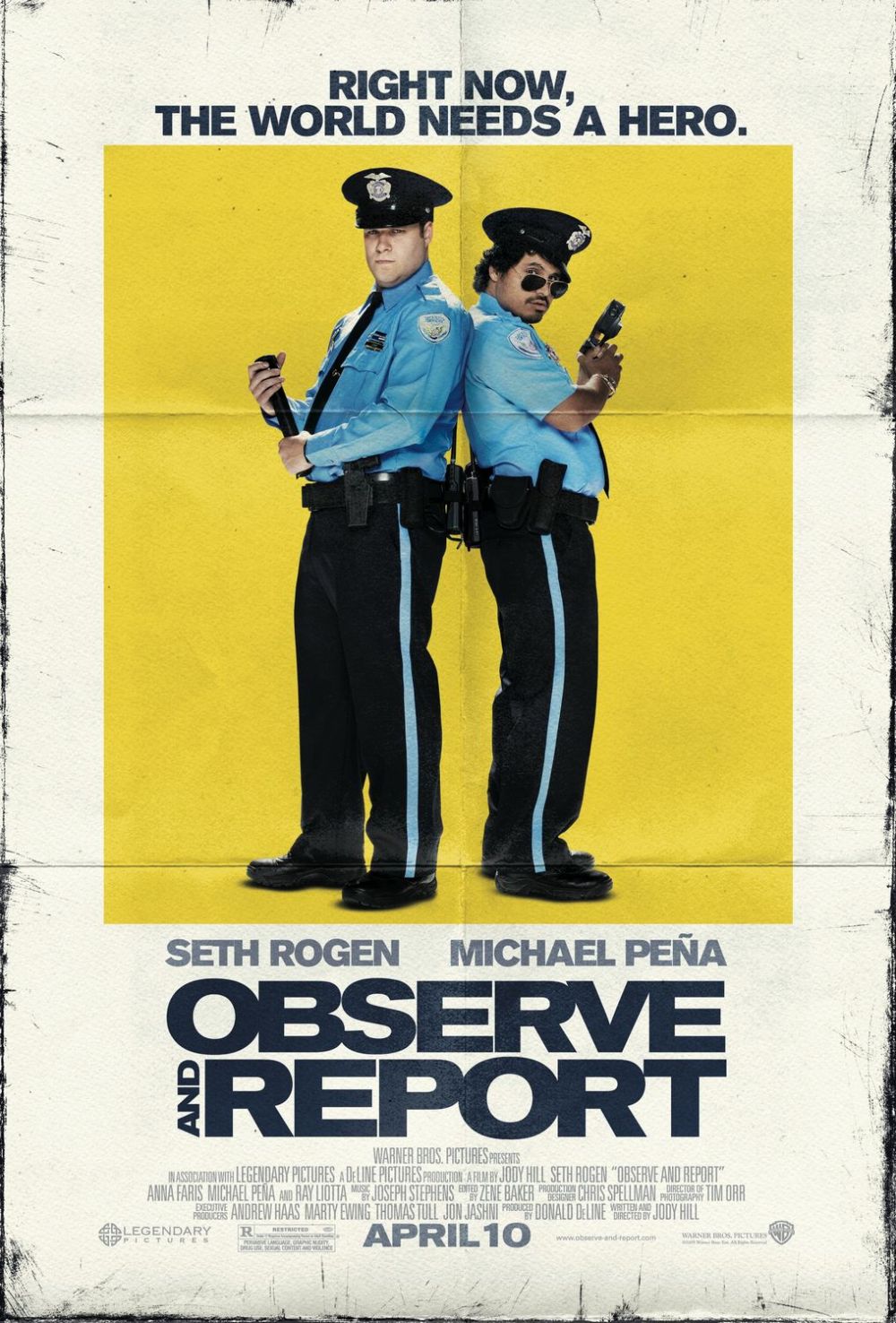
‘Observe and Report’ is the Blackest of Black Comedies

Observe and Report movie poster

I read an article in the Los Angeles Times which had an interview with Jody Hill, the writer/director of “Observe and Report.” Reading it was the best preparation I got for watching the movie as the trailers made it look like the typical Judd Apatow produced, Seth Rogen starring comedy. However, director Hill didn’t really see it as a comedy, and he said the term “dark comedy” didn’t really apply to the film the way he envisioned it. Hell, even Rogen went out of his way to call the film a “dangerous comedy.” I never would have guessed from the trailers which made the film seem like the average formulaic comedy I was more or less interested in seeing. I should have seen it coming it was not going to be what I expected it to be when I realized that Apatow had nothing to do with this.

If you’re thinking “Paul Blart: Mall Cop” redux, you’re dead wrong. With “Observe and Report,” you need to go in expecting “Taxi Driver” or “One Hour Photo” as if they were comedies. This is a very black comedy. We’re talking Martin Scorsese’s “After Hours” black. It touches on several ever so touchy subjects such as drug abuse, date rape, alcoholism, delusional, and racial stereotypes among others. It is also proof of how comedy can be mined out of places and subjects you would never expect to find it in. Hill and Rogen prove to have a large pair of cojones on them as they take big risks with their subject matter and come out of it with many moments which are frickin’ hilarious. It says a lot about this movie how it can break taboos, many of which will easily offend people, and still have you laughing your ass off at the same time.

Rogen stars as Ronnie Barnhardt, the head of Forest Ridge mall security. From the start, we can see this is a guy with a few screws loose. Along with his fellow mall cops, he laments at the fact none of them are allowed guns on the job. Ronnie is a hero in his own mind, and no one takes the job of what is essentially a “rent a cop” position as seriously as him. Ronnie also longs to join the police force, but he is kept from being accepted due to his bi-polar illness which he treats with the typical medication Scientologists rally against. This is not your typical Rogen character where you wonder if and when he will get the girl. Instead, you wonder if this guy is going to have a psychotic break and end up killing someone before it is too late.

Ronnie’s mission in life, however, becomes crystal clear to him when a flasher exposes himself to the girl of his dreams, makeup counter employee Brandi (Anna Faris). So distraught she is after this attack, Ronnie makes it his mission to catch the flasher before he can attack her again. But then the local police department gets involved in the form of Detective Harrison (Ray Liotta at his overplaying best), and Ronnie sees this as a threat to his mission. The way Ronnie sees it, this is his case and no one else’s. To let the local police take over would be the same as giving up control of the mall. Paul Blart may have taken his job as a mall cop seriously, but he has got nothing on Ronnie Barnhardt.

For Rogen, this movie represents a sharp change of pace. Through movies like “Knocked Up” and “Zack & Miri Make a Porno,” he has perfected the role of lovable loser to the point where you could not see him in any other role. This usually results in a career which starts big and then crashes in record time. I was hoping to see him play some other role because I found him to be one of the funniest actors in quite some time, and I was in no mood to see him crash and burn. With his role in “Observe and Report,” Rogen finally breaks out of his comfort zone to play someone who is anything but lovable. He also never plays the role just for laughs which is a major plus. As Ronnie Barnhardt, he manages to find the heart of this delusional character, and he keeps the audience up with him even as Ronnie’s mental state continues to get worse.

Among the supporting cast in “Observe and Report” is Michael Pena. As Dennis, Ronnie’s second in command and best friend, Pena also goes against type to play a role we have never see him in before. He has proven to be the most dependable of supporting actors in movies like “Crash,” “Shooter,” and “World Trade Center” to name a few. As Dennis, he steals scenes from Rogen as his character ends up taking directions you never expect him to take. This is an inspired performance by Pena, and he serves, however briefly, as Ronnie’s conscience when he sees Ronnie is taking himself WAY too seriously. Dennis’ methods of loosening up Ronnie, however, are anything but safe and legal.

Another inspired performance in “Observe and Report” is from Celia Weston who plays Ronnie’s alcoholic mother who still lets her son live under her roof even though he is well into his 30’s. There is no doubt of how much Weston’s character loves her son even when she is hopelessly drunk, and it leads to where she tells one of Ronnie’s fellow mall cops of how she slept with his friends while he was in high school. This could have been a cruel and clichéd character, but Weston makes it a lot more.

You also have to give a lot of credit to Anna Faris who proves here she is not afraid of going to extreme lengths to get laughs. Throughout the movie, she never tries to sweeten her character of Brandi up like many actresses would. Brandi will easily remind you of all those spoiled rotten bitches you had the misfortune of going to high school with. Many may hate the way her character is treated in the movie, but to a large extent, Brandi brings a lot of it on herself. Like Rogen and Hill, Faris does not shy away from the unpleasant extremes of her role.

Then there is Ray Liotta, who will always be best remembered for playing Henry Hill in “Goodfellas.” As Detective Harrison, Liotta is the perfect counterpoint to Rogen’s mentally unhinged mall cop. His strait-laced character has his shit together, but it doesn’t necessarily make him much better. One of the movie’s best moments has him taking Ronnie on a ride along which ends with him stranding Ronnie on a bad corner with a bunch of crack head drug dealers. How Ronnie ends up handling these dealers is something I would prefer not to spoil for you. Just when you think you know where the scene is going, Hill and Rogen pull the rug right out from under you.

Another really nice performance comes from Collette Wolfe who plays Nell, an employee at the mall’s coffee shop who is somewhat hindered by her leg being in a cast. While Brandi really wants nothing to do with Ronnie, Nell pines for him every time he comes to get his free cup of coffee. She also has to deal with an unsympathetic boss (Patton Oswalt) who picks on her whenever given the opportunity. She is a sweet presence in an otherwise nasty movie which seeks to make you uncomfortable and laugh at the same time. For a moment, I thought this would turn into another tale of unrequited love a la “Rules of Attraction,” but Collette’s character gives Ronnie the emotional grounding he DESPERATLEY needs.

Hill’s biggest success with “Observe and Report” doesn’t lie in just the laughs he gets, but more in the fact he and the actors never just play everything just for laughs. There is no winking at the camera in this film. The actors don’t play it completely straight in this movie, but they take their roles seriously and never appear as if they all know they are in on the joke. If they did, the movie would not be anywhere as effective.

Hill’s breakthrough directorial effort was the movie “The Foot Fist Way” which served as the breakthrough for Danny McBride who went on to appear in “Pineapple Express” and “Tropic Thunder.” It is clear Hill revels in the portrait of people who live in their own world and are oblivious to what the world thinks of them. What Hill does here is ballsy to say the least.

“Observe and Report” also serves as a biting satire of the mall culture which serves as the movie’s setting. It ends up being symbolic of the melting pot which is the United States of America. Cultures of all kinds rub up against each other in the mall, and it unsettles our main character at times. Ronnie ends up having a tense moment with a character he thoughtlessly nicknames Sadamn (played by Aziz Ansari) who has filed a restraining order against Ronnie for past transgresses. This leads to one of the movie’s most insanely funniest moments as they say a barrage of “fuck you’s” to each other. The F-bomb is uttered almost endlessly in this scene to where you think they are going to give “Scarface” a run for its money in terms of how much the word is uttered.

This movie also continues the trend started with movies like “Forgetting Sarah Marshall” of showing the penis in all its tiny glory. The audience I saw it with seemed more shocked by the “throbbing python of love,” as Robin Williams once described it, than they were with Rogen’s character holding a gun in his hand. After all these years, American audiences still prove to be an unknowingly hypocritical bunch as they find themselves more comfortable with the sight of a gun than with the appearance of a sexual organ.

Suffice to say, not everything in the movie works perfectly. The ending where Ronnie defends his place in the mall falls a little flat despite the use of Queen’s music from “Flash Gordon.” And granted, the mix of comedy and action and violence is a tricky road, but it is a road bound to have some inescapable potholes.

Still, when all is said and done, “Observe and Report” is a comedy with big cojones which cannot be easily ignored. It is not a movie for all tastes, but for those who are willing to travel a darkly comic path, there is much to find in this crazy film which dares to imagine a Travis Bickle-like character as a funny person despite himself. Do not say you weren’t warned.

* * * ½ out of * * * *

‘Kill the Messenger’ Pays Tribute to a Martyr for the Truth

Kill the Messenger movie poster

“The widespread use of drugs is a symptom of a sick society. The war on drugs is bullshit. Especially since the CIA is one of the biggest dealers around.”

-David Byrne in 1992

I don’t think it’s any secret our government, let alone any government in the world, was at one time or another complicit in drug dealing. It’s not like we don’t treat as if it’s no big thing, it’s just that we have gotten so used to it to where many don’t bother to acknowledge or do anything about it. But one man, Gary Webb, did not hesitate to expose the CIA for its involvement in drug smuggling back in the 1980’s, and he ended up paying the ultimate price for telling the truth.

Kill the Messenger” is one of many movies which is “based on a true story” or “inspired by actual events,” but it deals with a story which needs to be told. Gary Webb was a reporter for the San Jose Mercury News, a newspaper not known for doing international stories until he came along. We watch as he stumbles across a story dealing with the shady origins of the crack epidemic which spread throughout the nation’s inner cities, particularly in South Central Los Angeles. His investigation into the matter led him to discover how, in order to raise money for the fight against the Nicaraguan Sandinista Government, the CIA supported the cocaine smuggling of top members of Nicaraguan Contra Rebel organizations. When Webb published his articles on this story, which later became the basis for his book “Dark Alliance,” he won a lot of praise for his work, but then the roof caved in.

It’s no surprise the CIA came down hard on Webb as they began to conduct a vicious smear campaign on him which included veiled threats against his life. But what really stunned me was how rival newspapers went after him with a vengeance as he broke the story before they ever had a chance to investigate it. The Washington Post in particular hated how Webb broke the story as they were known for being first to report stories on the United States government, and their attacks on his credibility became more about protecting their own integrity as opposed to pursuing the truth. Taking this into account, it gives the audience an idea of just how cutthroat the newspaper business can be. As for myself, it makes me wonder if there is any business on this planet which is not cutthroat.

Playing Webb in “Kill the Messenger” is Jeremy Renner, and his performance here ranks among his best. He doesn’t try to make Webb a heroic character but instead a regular, ordinary man who does the job he is hired to do, and he does it really well. Renner makes us revel in Webb’s victories and feel for him when the whole world, even his own newspaper, suddenly turns against him. Not once does the actor overplay his role, and that he is able to keep Webb so grounded here is one of the things which makes “Kill the Messenger” work as well as it does.

Rosemarie DeWitt also shines as Webb’s wife, Susan. This could have been a throwaway role with DeWitt being left with little to do other than beg her husband to stop pursuing this story, but the actress makes Susan into the conscience Gary desperately needs through the toughest of times. Like Renner, DeWitt keeps the character grounded in a reality we can all relate to as she tries to make sense of a situation spiraling out of her husband’s control.

Directing “Kill the Messenger” is Michael Cuesta who also directed the powerful “L.I.E.” which the MPAA just had to give an NC-17 rating to for the most inexplicable of reasons. Could he have gone deeper with the subject matter that inspired this movie? Perhaps, but he makes a very good case for why we should be infuriated over why people were more interested in burying Gary Webb than they were in confronting how our government knew about and participated in the drug dealing being conducted on American soil.

Is this movie historically accurate to what actually happened in real life? I don’t know and I don’t care. Most movies based on true stories take liberties with the truth for dramatic purposes, and I doubt “Kill the Messenger” is an exception to that. What matters to me is this movie tells a compelling story which keeps you involved from start to finish, and Cuesta has given us just that. For those interested in getting to the absolute truth, try reading Webb’s “Dark Alliance” and Nick Schou’s book of the same name. This movie was based on both of those books.

“Kill the Messenger” joins the company of movies like “The Insider” and “Good Night and Good Luck” which are about people who decide to tell the truth and get punished for it in varying degrees. These days it seems like there are larger numbers of people who are more interested in their own monetary gain than they are in exposing wrongdoings. Webb’s story is one which deserves to be told as it is about a man whose job was to get to the truth of things, and the fact he was dragged through the coals because of that is one of the many unnecessary reminders of how unfair life can be. But in the end, he was vindicated, and this movie stands as a strong tribute to what he accomplished.

* * * ½ out of * * * *

Check out the video below where I interviewed Jeremy Renner and Rosemarie DeWitt.

Jennifer Grey and Jason Reitman Revisit ‘Ferris Bueller’s Day Off’ at New Beverly Cinema

Ferris Bueller Jennifer Grey

On Friday, February 19, 2010, Jason Reitman began his program of movies at New Beverly Cinema in Los Angeles. The first double feature of his program was “Ferris Bueller’s Day Off” and “Election,” great movies dealing with high school and teenagers in an intelligent way and which starred Matthew Broderick. “Ferris Bueller’s Day Off” was one of John Hughes classic films from the 1980’s which everyone has seen at least nine times. Reitman remembered wanting to see it with his dad when it first came out, but his father, Ivan Reitman of “Ghostbusters” fame, was busy shooting “Legal Eagles” and couldn’t get away from the set. They ended up going to the movies later, but instead they watched “Big Trouble in Little China,” John Carpenter’s ode to martial arts movies which was not as successful, but later become a beloved cult film.

Ferris Bueller's Day Off poster

Reitman said he considers “Ferris Bueller’s Day Off” to be Hughes’ love letter to Chicago. Indeed, Chicago does look very beautiful as shown here. These days, it’s rare to see it without snow covering it. Richard Belzer has a brilliant quote when he played John Munch on “Homicide: Life on the Street,” “Chicago has two seasons, winter and St. Patrick’s Day.”

Reitman saw Ferris Bueller as the guy who knows everyone is dying from a terminal disease. Knowing this, he lived every day as if it were his last. He then went on to say “Ferris Bueller’s Day Off” is a movie about people dying, and the last moment of joy anyone has comes at the end of the parade when Broderick is out shaking his bod to The Beatles’ version of “Twist and Shout.” The acclaimed director was serious about this and even said, “If you came out of this movie happy, THEN YOU MISSED THE ENTIRE POINT!”

Before the movie began, Reitman brought out a special guest, Jennifer Grey. She played Jeanie Bueller, Ferris’ largely unpleasant and infinitely resentful little sister. Grey would go on to become a big star when she starred in “Dirty Dancing” opposite the late Patrick Swayze. Reitman said he asked Grey to come just this morning, and she was very gracious to appear at such short notice.

Grey warned Reitman upfront she smoked a lot of pot during the movie’s making, so she doesn’t remember a lot of it. However, during her brief time with Reitman, she did remember quite a bit, so maybe all the smoking helped.

One of the big revelations was that Grey admitted was never really a big fan of Hughes before she got cast. She had just seen “Pretty in Pink” which he wrote the screenplay for but didn’t direct, and she declared she didn’t get it. As a result, Grey went into the audition not really caring if she got the part or not. She didn’t even try to hide her attitude towards Hughes when talking to him about how she didn’t really care for his films. It was this attitude which got her cast as the bitchy little sister of Broderick’s iconic character.

Another big revelation we learned was Hughes and Broderick were always at odds with one another, and the tension between them was always high. Broderick found it very hard acting to the camera, one of the signature devices of this movie. Grey also said Broderick was “very slow” in putting a performance together, and this was certainly the case when he played Ferris. It got to where Hughes was constantly waiting for Broderick to start giving him what he wanted, and there were points where Grey said Hughes leaned over to her and said, “Is he ready now? Is he warmed up? Is he gonna give us ‘Brighton Beach Memoirs?!’”

Still, Grey recalled her experience of making “Ferris Bueller’s Day Off” as being “heaven on earth,” and she felt very safe with Hughes as a director to where she never felt self-conscious about anything she did. She admitted she loved every single experience she had making this classic, and she even developed a big crush on Hughes, describing him as being a “Baby Huey.”

Reitman asked how Charlie Sheen got cast as the drug addict who befriends Jeanie Bueller while waiting at the police station. Grey explained she was the one who got Sheen involved as she had just done “Red Dawn” with him. There was actually a lot of improvisation during the police station scene, and Grey said the moment where Jeanie says some people call her Shawna was born out of that.

One of the questions really burning on Reitman’s mind was what it was like for Grey when she worked with “her brother.” Broderick and Grey were actually dating for a time during this movie’s making, and she replied the only time you see her character and Ferris together in the same room is at the very beginning and right near the end.

Before the movie started, Grey finished by saying Hughes did such a great job in capturing the voice of the time and of teenagers in general. She pointed out what we all came to see, that Hughes very much understood the gravitas of being a teenager and of how difficult and frustrating those years can be.

It was great to see Grey come out for this special screening of one of the best and most entertaining movies of the 1980’s. Reitman went on to say we all must be wondering what became of Ferris Bueller after he graduated from high school. There was always talk of a sequel which would show Ferris as a burned-out executive of some corporation, and a day off from this kind of job is always welcome no matter what day of the week it is. What did Reitman think? For that, he said to check out Alexander Payne’s “Election.”

Exclusive Interview with Ira Sachs about ‘Love is Strange’

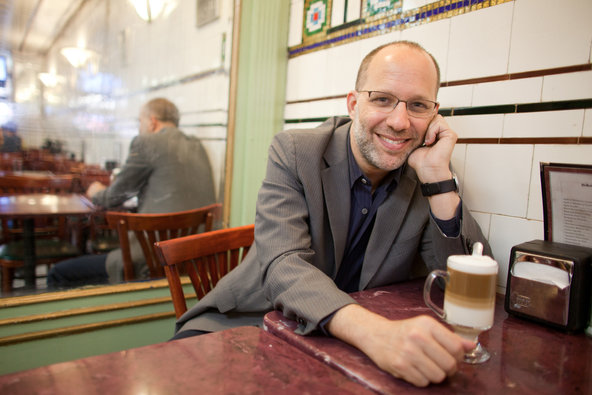
Ira Sachs photo

Ira Sachs’ previous films have dealt with the dangers of being in love and how it can feel like an illusion, but his latest film “Love is Strange” has him dealing with love in a more positive fashion. It focuses on a gay couple, George and Ben (played by Alfred Molina and John Lithgow), who have been together for over 30 years. When gay marriage is made legal in New York, they finally get married and are super excited about starting a new chapter in their lives together. But things quickly change for them quite drastically when the Catholic school where George teaches decides to terminate his employment upon discovering he married Ben, and this forces them to spend time apart for the first time in years as they search for cheaper housing.

I very much enjoyed talking with Sachs over the phone while he was doing press for “Love is Strange.” The movie not only chronicles the challenges these newlyweds face, but of the impact that their situation has on the family and friends closest to them. During our interview, I asked Sachs how he goes about keeping his characters in the movie down to earth, why he decided not to get political considering the issues involved, and why he decided this time to make a different movie about love than he had previously.

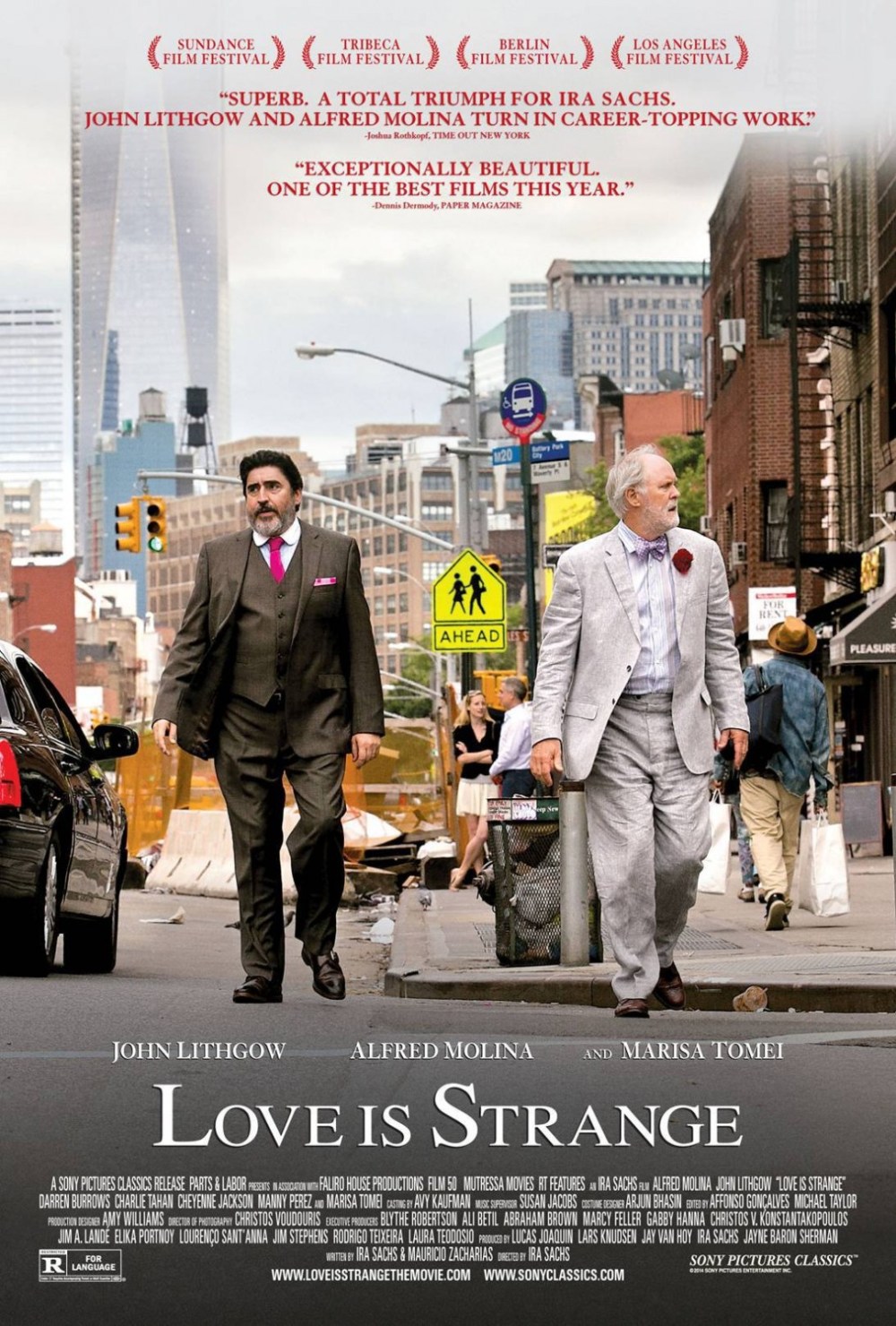
Love is Strange movie poster

Ben Kenber: This movie has such a wonderfully organic feel to it. How do you go about keeping the characters in the story feeling so down to earth?

Ira Sachs: That’s a nice question. I try to be as open as possible to my collaborators and to the city and to the situations that are in front of me. I think of directing as not so different to acting in a way in that my job is to listen and respond organically and authentically, and you have to do that 1000 times a day when you make a film. But if you situate yourself in a place which is most open and attentive, you have to be very observant as well. I think it creates something that has the organic feeling you’re describing.

BK: John Lithgow and Alfred Molina are both brilliant in this film, and they have been friends for a long time. The rapport they have together onscreen feels just wonderfully natural. Did you have to do a lot of directing with them, or did you just let them loose?

IS: We made a pact, the three of us, that we were going to create a certain kind of texture for their relationship that was going to be different than what either actor had been asked to do in a long time. There was a level of realism and naturalism and simplicity that the roles called for. These are really modest man, Ben and George, but they maintain a confidence as individuals that I felt was very much what I witnessed in John and Alfred, and I wanted the film to share that confidence. So we had this kind of agreement that everything would be kept to a very delicate tone, and both actors are known for their larger qualities in terms of performance. What I wanted to do was rein that in, and I think that allowed for some new things to appear.

BK: What I really admired about “Love is Strange” is it could have been a polemic about intolerance and that, even with gay marriage now a reality in many states like New York, we still have a way to go for achieving equality in life. But this movie is more humane and very objective in how it views the different forces which threaten to tear these two characters apart.

IS: My interest as a director is to depict the intricacies of relationships and of intimacy, and that includes romantic relationships as well as family and community. In this case it also includes the city of New York. I set out to make a romantic film about New York. I’m also as a director at bit of a historian meaning that my job is to be accurate about the time that I live as well as my characters, so the kind of pulled from the headlines quality just gives the film shape in a certain way. I like to think of myself as a neo realist, someone who is interested in making the ordinary of everyday lives extraordinary. For me that should in addition also include some amount of documentation of the details of these characters’ lives in a way that’s very specific.

BK: One performance in particular I really wanted to point out was Charlie Tahan’s who plays the temperamental teenager Joey. It’s always great when you get an exceptional performance from a child actor because they are not always easy to get, and the character has a nice arc throughout the movie. What was it like working with Charlie?

IS: Well, to me he is the revelation of the film because we don’t know him, and what we’re actually discovering is the birth of a great, great actor. I felt like there was conversation when we were shooting the film about Leonardo DiCaprio in (“What’s Eating) Gilbert Grape;” it’s that kind of performance. It’s so open and so honest and so raw and so easy. There’s just this ease and I think that was something that impressed all of us, more experienced filmmakers and actors on set, about Charlie was how naturally it came. He is an experienced child actor. He’d been in “Charlie St. Cloud” with Zac Efron. He was the voice of the kid in “Frankenweenie” so he worked with Tim Burton. He wasn’t plucked from nowhere, but he came in and gave an audition that was breathtaking.

BK: Charlie said you really knew how to write for kids and that you really understood them and what they went through. Did Charlie stay close to the script and was there anything specifically that he added to it during shooting?

IS: Well the script is a blueprint for the emotions you hope to reveal, so actors add everything. I’m quite specific about the script and it is a very written film and it’s constructed through the screenplay, and yet I search for a kind of emotional improvisation on set that has to be very, very fresh and real. So I don’t rehearse my actors before we start shooting. We talk, we spend some time with each other, but I’ve never heard the line said nor have the other actors. What it gives the movie is a kind of freshness. I think two words that should be banned from the set are “subtext” and “motivation” because when you’re speaking to those things, you’re trying to pin down the impossibly ineffable of any one moment.

BK: Another performance I really loved in this movie was Marisa Tomei’s. Not only does she bring a naturalness to her role, but she’s also able to communicate so much without saying a word. What was it like watching her pull that off?

IS: She’s like this quiet storm because she’s so focused as an actress. There’s a scene where she has no dialogue and she’s in bed with her husband and she’s got a lot on her mind, and as a director you just watch and you think, “She’s writing paragraphs for me.” She thinks so much while doing so little. I think what was exciting about this role for Marisa, and I think what makes people connect to it, is that she was allowed to play a woman of her experience and her intelligence, and she wasn’t asked to do anything other. In this case, Marisa is the fulcrum of the story; she’s the generation in the middle. The film is really about these multiple generations: the older couple, Marisa and her husband (played by) Darren Burrows who were very much in the middle of their lives, and Charlie Tahan who’s playing in adolescent learning about love for the first time. But it all kind of centers on Marisa and she is in a way a stand-in for me, the artist who is watching these things and trying to figure out how to act.

BK: Your previous films “Delta” and “Keep the Lights On” tend to deal with love as an impossibility or an illusion among other things, but “Love is Strange” sees it in a much different light. What made you decide to do a story on love in this particular way?

IS: I think I’ve changed a lot in the last 10 years. My previous films were all about characters trying to understand themselves, and they were films of self-discovery. I think it was very much what I personally was involved in, trying to understand who I am and become comfortable with who I am, and that took a long time. In my 40’s things have been different and I feel much more at ease, and I think that has created the possibility of new kinds of relationships. I’m married and my husband and I are raising children, but it’s not just the kind of signifiers that imply change. It’s something much more internal, and I think the film is about the internal qualities of love which are so distinct for each of us.

BK: Since this is a low budget independent movie, I imagine you had very little time in which to shoot it in. How did this affect you overall as a filmmaker?

IS: I’m a producer on all my films as well as the writer and director, and I always create the situation where I have the economic means to create the aesthetic objects that I need so my sets are very calm. I’ve made films that cost $200,000 and I’ve made ones that cost multi-million dollars, and the experience is not too different. If you’re doing your job right as a filmmaker, you have what you need.

BK: Regarding Alfred Molina’s character of George, it’s interesting because the Catholic school he teaches at doesn’t seem to mind his relationship with Ben much until the two of them get married. Later on in the movie, George has a great line where he says, “Life has its obstacles, but I’ve learned early on that they will always be lessened if faced with honesty.” What inspired that line?

IS: I think it speaks to the heart of the film. The film is in some ways about education with a small e. What do we teach each other? What is our responsibility? How as a culture do we carry on our values? What do we share in relationships and as parts of family? Also, the film speaks to how loss impacts individuals not just in terms of rights but in terms of experience. You can imagine George as a teacher being somewhat, to me, like what Alfred Molina is as a person which is you want to be your best self around him, and those are the kinds of people that I have known whether it be my parents or… I was very close to a sculptor who was 99 when he died, and at 98 he began his last work which was of a teenager with his backpack, and to me the idea that he was reaching for creative opportunities at that age was something I could learn a lot from. I feel that the film talks about those kinds of educations, and I think that when you’re young you don’t realize that your parents are people and that your grandparents are also. I think this film is about perspective and how we begin to recognize that people in our family are actually human beings with their own stories.

I want to thank Ira Sachs for taking the time to talk with me. “Love is Strange” is now available to own and rent on DVD, Blu-ray, and Digital.

Photo courtesy of the New York Times. Poster courtesy of Sony Pictures Classics.

Exclusive Interview with Alfred Molina about ‘Love is Strange’

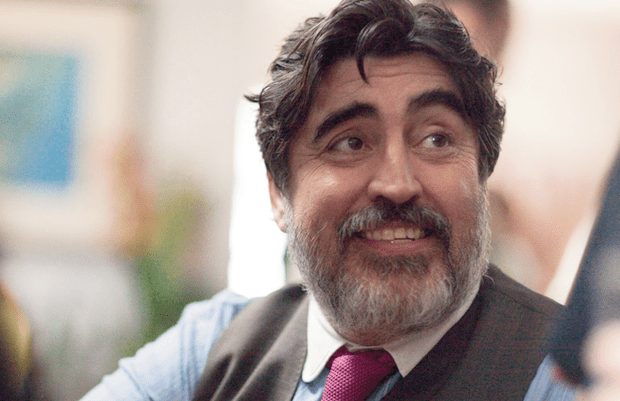
Alfred Molina Love is Strange

He has played a variety of characters in movies like “Raiders of the Lost Ark,” “Prick Up Your Ears,” “Boogie Nights,” “Spider-Man 2” and “Not Without My Daughter” to where it seems like he can play anybody (and he probably can). Now Alfred Molina takes on a more intimate role in Ira Sachs’ “Love Is Strange” where he plays George, a Catholic school music teacher who, as the movie starts, marries his lover of 39 years, Ben (played by John Lithgow). They have a joyous ceremony, but once word reaches the school of George’s wedding, they subsequently fire him. This leads to a great deal of upheaval in the newlyweds’ life as they are forced to sell their apartment and spend time apart for the first time in years as they search for more affordable housing. The situation weighs very heavily on George to where he feels like he’s failing Ben and everyone around him.

It was a great pleasure to speak with Molina while he was doing press for “Love Is Strange.” It turns out that he and Lithgow have been friends for many years, so the fact that they have great chemistry onscreen should be no surprise. In addition, I also asked Molina about how sees the world of independent filmmaking today, why Stanley Kubrick’s “Spartacus” inspired him to become an actor, and of what it was like to shoot this film without any rehearsals.

Love is Strange movie poster

Ben Kenber: Since you and John Lithgow have been friends for a long time, did the chemistry you two developed onscreen come easy to you?

Alfred Molina: Yes, it did. I think the advantage of being friends with John, having had a relationship as friends, helps us both in a way. For me, it just meant there was shorthand already in place. There was an ease and a rapport and a relaxation between us that was very easy and also very conducive and helpful for the roles we were playing. I think we would’ve still enjoyed the fact that we are friends if we had been playing adversaries in a movie or a good guy, bad guy. But the fact that we were playing a couple in a long-term relationship, I think our history as friends only helped and sort of aided that.

BK: What I really liked about this movie is that what the characters go through is quite ordinary, but it takes on a different feeling here. We don’t see enough movies these days about regular ordinary people, and the problems the characters go through here feel quite epic.

AM: Yeah. People lose their jobs, people lose their homes and it’s always bad news. But it happens very often for the most trivial of reasons, and I think the fact that Ira Sachs and (co-writer) Mauricio Zacharias created a couple who, by their very ordinariness, when this crisis happens to them, it takes on epic proportions. And like most crises that happen to ordinary people it becomes huge because normally in our own lives we don’t have the power or the means to overcome them quite so easily. It takes time and I think the fact that George and Ben are, for all intents and purposes, a very ordinary and a very anonymous couple adds to the strength of this story.

BK: I also wanted to congratulate you on receiving the Spotlight Award from the Creative Coalition at Sundance for your work in independent films. How do you think the world of independent films is faring today? Has it gotten easier to make them or harder?

AM: Well, I think it all depends on one’s perspective. Independent moviemaking is always a challenge. I think whenever you’re working on projects that don’t have immediate commercial appeal and you’re working outside of the studios, especially on low budget films where you’re really scrambling to raise $2 or $3 million to make a movie or however much it is, you’re working under all kinds of restrictions and challenges and the biggest one of course being time. You don’t have time. You very often don’t have time to absorb any mistakes or any accidents or anything that happens that kind of works against your schedule, so it’s always a challenge. But I think the fact that there are so many independent movies finding an eager audience means that there’s something being done right and well. There is an audience out there for good stories. There’s an audience out there for well-made, well-crafted, sincere movies about real people in real situations, and I think the reason why there’s an audience is because of the way cable TV, for instance, has welcomed movies. So many directors and writers and actors are now working on cable shows because that’s where some of the best movies are being made where young directors are getting the chance to make their films and tell their stories. The relationship between the product and the audience has changed a lot. There was a time when you were working on television that you were very much the guest in someone’s house. But now cable has changed all that because you’re paying for it. Also, our TVs have gotten bigger so it’s like watching a movie, and if you’ve got a 50-inch screen in your front room, the ratio is pretty typical of a small movie house. You can be watching movies at home and I think that changes the dynamic between the product and the audience, and there’s an audience out there for small films. The independent industry lurches from one crisis to another, and in those ups and downs there’s some great movies being made.

BK: I’ve talked with a lot of indie filmmakers recently and they usually get a shooting schedule that’s 30 days if they’re lucky, but those schedules keep getting shorter as time goes on.

AM: That’s right, yeah, because making movies gets more and more expensive. But there will always be an independent director, writer, actors who want to continue to work in that milieu because ultimately that’s where the most interesting stuff is happening. I can only speak for myself, but I think that’s where the best films are being made.

BK: Your character of George has a great line in this film where he says, “Life has its obstacles, but I’ve learned early on that they will always be lessened if faced with honesty.” I think it’s very interesting in that George teaches at a Catholic school and has for many years, but the school doesn’t always respect the individual that he is.

AM: Absolutely, and I think that’s a great shame for anyone who’s in the same position as George; losing your job or losing your home or being chastised by society in some way because of who you choose to love and who you choose to spend your life with. As a heterosexual that’s something I’ve taken completely for granted. I can take it for granted that I can love whoever the hell I want and no one can stop me, but my gay friends have only recently begun to enjoy that right. So I think that’s why lines like that in the movie are terribly important and very, very resonant not just for gay men and women but for everybody. I was talking today with John (Lithgow) about how… He’s only been to a few gay weddings in recent years, but we both found them incredibly moving. Weddings are moving anyway. Anybody who confidently stands up and says I want to spend the rest of my life with this other person is making a very dramatic and a very moving and emotional statement, but when it’s two gay people you know that it’s not just full of the romantic and emotional power of the moment. It’s full of years, sometimes decades, of struggle to reach that point, so it has even more significance.

BK: That’s a very good point. In recent years, we’ve had movies like this and “The Kids Are All Right” which are about gay couples, but the fact the couples are gay becomes irrelevant because they deal with the truth of what married life is like and the struggles which come with it.

AM: You ask anyone who’s active in any kind of human rights or equal rights campaign and I’m sure they would say that their ultimate goal is to no longer have to have conversations like this where one sexuality is no longer relevant. Whenever I come across any kind of vaguely homophobic sentiments I’ve gotten to ask people, “When did you first realize that you were straight?” It’s amazing the reaction that gets because they don’t know how to answer, and the truth is that no one should have to put up with being asked that.

BK: I once read that you said you have to believe in what you’re saying in the same way your character does. Whether it’s Mother Teresa or Adolf Hitler you’re playing, you have to portray them honestly and accurately regardless of whether they were good or bad. A lot of actors like to change material to where it suits them better, but I liked what you said because it goes the fact that the part is not about you, it’s about the character you’re playing.

AM: I’ve always regarded my job as being about serving the character regardless of who the character is. At a certain point taking on a job and then once you signed the contract and taken the money then saying “oh by the way I don’t think my character would say this” or “I don’t think my character would be like this,” that’s a conversation that one should have before you sign the contract and take the money. Once you have committed to something, you should be committing to the same things that everyone’s agreed on. Just as an act of creativity, you’ve got to give the same amount of dedication to whether you’re playing Adolf Hitler or Mother Teresa.

BK: I also read you were inspired to become an actor after watching the movie “Spartacus.” What was it specifically about the movie which inspired you so much?

AM: You know, I don’t know myself. It was so long ago and I must’ve been about nine years old when the film came out. I just remember coming out of that film just knowing that’s what I wanted to do. I don’t mean I wanted to be a gladiator, but I just wanted to be doing that; making films, being in films. I’m not quite sure what it was that prompted that, but it was a very powerful feeling.

BK: There were no rehearsals of scenes when it came to filming “Love is Strange.” How did this affect you as an actor?

AM: Well it was an interesting process really because normally you have rehearsals and work things out. I would hate for you to think that it was due to a lack of preparation; it wasn’t that. Ira Sachs, our director, came to the project impeccably prepared. What he didn’t do though was that he didn’t have us rehearse the scene and then play into the camera what we had rehearsed. He just wanted us to go into the take with the camera running and to just discover it in the moment. That was a very refreshing way to work, I loved it. I’m looking forward to doing it again. It’s very rare that directors give you that kind of freedom and also, given the fact that we were under the severe constraints in terms of time and money, it worked out well.

BK: “Love is Strange” seems to give the audience a very unique look at New York whereas other movies tend to portray it as a crime ridden place among others things. Would you say this movie gives a more accurate view of New York than other recent films have?

AM: Well, I think it’s as accurate a view of New York as any other movie. I don’t think the view of the city that the movie has is a negative one by any means. The city looks beautiful in this movie especially in that last sequence with that sunset and the two young characters on their skateboards. It’s a beautiful, beautiful ending to the film. Because it’s the most photogenic city in the world, any film that takes place in New York has to deal with New York as a character in the film. There’s nothing nondescript about New York. It’s a unique looking place. No other city in the world looks quite like it, so I think it’s something any filmmaker has to embrace.

BK: The interesting thing about the way Ira Sachs frames this movie is that it could’ve taken a huge political stance but he doesn’t which feels quite appropriate. He’s not taking issue with anybody, but he’s takes good observations of the Catholic doctrine and how it affects certain people.

AM: Yeah, absolutely. It’s not a political film; it’s not a diatribe on the state of gay culture or the Catholic Church. It’s a domestic story. It’s a love story set against some real events that happened to real people, and I think it makes some very wry observations about the city and about New York real estate and about the conditions a lot of people live under. It’s not a message movie. What drives the movie is a kind of deep humanity.

I want to thank Alfred Molina for taking the time to talk with me. “Love is Strange” is available to own and rent on DVD, Blu-ray, and Digital.


‘Captain Underpants: The First Epic Movie’ is Wonderfully Entertaining

Captain Underpants movie poster

Sooner or later, we were bound to have a superhero, animated or live action, wearing just underwear. The main characters of “Captain Underpants: The First Epic Movie” tell the audience how superheroes typically look like they are in their pajamas, so they have created one who is wearing little to nothing. Most of the time, superheroes are wearing things we would never wear to the office, and there are others who look like they are barely dressed as it is. With Captain Underpants, we now have a heroic character who wears underwear as well as a cape, and he shows no shame in his appearance. Why should he anyway? He’s a superhero, and one look at him will confirm whether he prefers boxers or briefs.

“Captain Underpants” is a series of children’s novels written by Dav Pilkey who channeled his class clown behavior and learning disabilities into them, and now it has been adapted to the big screen by Dreamworks Animation. I had no idea what to expect from this “First Epic Movie” as I am unfamiliar with these books, but I am delighted to say the filmmakers have created an animated film which appeals to both kids and adults. While kids can revel in the adventures these characters have, the adults will get a kick out of the subversive comic elements which remind us of the problems we Americans experience with our malfunctioning education system. Just keep in mind, a lot of these problems began occurring before Betsy DeVos became Secretary of Education.

Anyway, we are quickly introduced to the main characters, George Beard (Kevin Hart) and Harold Hutchins (Thomas Middleditch), a pair of fourth-graders and best friends who revel in entertaining their classmates with pranks and creating comic books in their treehouse which they have branded as the headquarters for their company, Treehouse Comix Inc. Their friendship, however, is threatened by the evil Mr. Krupp (Ed Helms), the elementary school principal. After one prank too many, Mr. Krupp, decides to tear them apart by putting them into separate classrooms. But our young heroes quickly turn the tables by hypnotizing him with a 3D Hypno Ring they got out of a cereal box, and this allows them to turn Mr. Krupp into their most popular comic book creation, Captain Underpants.

I loved how this movie touches on a child’s view of elementary school to where I was reminded of the years I spent there. The thought of being in a separate classroom from your best friend was a real fear as recess time never seemed long enough to hang out together. And yes, school did seem like a prison at times where the teachers, the bad ones anyway, look determined to suck the fun out of anything and everything while making us learn facts and dates, some of which will escape our minds in the distant future. Heck, the teachers need textbooks to be reminded of these same things.

But moreover, “Captain Underpants” reminds us of how powerful our imaginations were at that age. We had such vivid fantasy worlds playing in our heads, and we went to places and experienced adventures where we were always the hero. Seeing George and Harold bring these adventures to life in comic books should make you remember when your imaginary worlds were infinite in what they promised. While the forces of schoolwork and conformity loom large in their lives, and they will loom even larger as they get older, we root for these two kids to persevere as we are reminded of how children need time to play and create. I feels like, in this day and age, the fun of childhood has given way to preparing kids for those damned SATs even before they graduate from pre-school.

Okay, maybe I’m making “Captain Underpants: The First Epic Movie” sound more serious than it has any right to be. In the end, this movie is all about fun as George and Harold try their best to keep their hypnotized principal in check even as his alter-ego of the Captain keeps him bouncing all over the place as he attempts to save those who don’t necessarily need saving. Seeing these two kids switch Mr. Krupp into Captain Underpants and vice versa makes for one of this movie’s funniest moments.

Of course, there proves to be an even bigger threat than Mr. Krupp here as the movie’s main villain, Professor Poopypants (Nick Kroll), comes to the elementary school as the new science teacher. His plan? To eradicate laughter from the planet as he has long become impatient with everybody not taking him seriously. Then again, how can anyone be taken seriously with a name like Poopypants? Just wait until you hear his full name.

Directed David Soren (“Turbo”) and screenwriter Nicholas Stoller (“Forgetting Sarah Marshall”) have given us a tale of good versus evil which is largely predictable, but they keep throwing left turns at us which keeps this movie feeling less so even when the climax is never in doubt. Not all the jokes work, but there are some which are priceless, and Professor Poppypants statement on the state of education is dead on. And yes, there are some fart jokes, but the ones here are far more creative than any which begged for your laughter in the abysmal “Diary of a Wimpy Kid: The Long Haul.

Both Hart and Middleditch have loads of playing the two fourth graders, and they remind you of the benefits of doing voiceovers in animated movies: you can get away with playing children even when you’re in your 30’s! As for Helms, you can always count on him to make a superhero sound so confident even as said superhero has yet to learn of his limits, of which there are many. Kroll has fun playing around with supervillain clichés as Professor Poopypants as he exploits the bad guy conventions which come with crazy hair and an all too thick accent. Jordan Peele, riding high on the success of “Get Out,” has a blast voicing the tattle tale we all love to hate, Melvin Sneedly. Kristen Schaal also co-stars as Edith, the school lunch lady whose shyness and closeted affections for Mr. Krupp she makes all the more palpable.

“Captain Underpants: The First Epic Movie” may not go down as an animated classic, and its animation does pale in comparison to what Pixar typically comes up with, but it is filled with an abundance of imagination and cleverness which I did not expect to find. The filmmakers clearly have a great affection for the books of Dav Pilkey, and if this is to become Dreamworks’ next big animated franchise, it will be lots of fun to see where it goes from here.

By the way, does it really make sense that Principal Krupp would just turn right into the hero George and Harold created from their imaginations? Oh wait, it’s an animated movie. Who cares?

* * * out of * * * *

‘Big Eyes’ Marks a Return to Form for Tim Burton

Big Eyes movie poster

Tim Burton’s unique talents as a filmmaker have floundered in recent years with his abysmal remakes of “Planet of the Apes” and “Alice in Wonderland” which was lacking in wonder. But with “Big Eyes,” he gives us his best and most human movie in a long time as he examines the life of American artist Margaret Keane whose paintings of children with oversized, doe-like eyes became very popular in the 1950’s. It reunites Burton with his “Ed Wood” screenwriters Scott Alexander and Larry Karaszewski who have provided us with some of the most unique biopics in recent memory like “The People vs. Larry Flynt” and “Man on The Moon.” Yes, it is based on a true story, but for once it helps to know this as the movie is a tale which proves there are things much stranger than fiction.

“Big Eyes” starts with a narrator saying the 1950’s was a good time if you were a man. This certainly seems to be the case with Margaret Keane (Amy Adams) as she is in the process of leaving her husband and drive herself and her daughter Jane out to San Francisco to start all over again. This decade had women relegated to the role of housewife, and they could do very little else as feminism had yet to become a movement. Margaret has trouble finding work until she gets a job at a furniture company painting baby cribs. At the same time, she is quite the painter who paints pictures of children, most of which resemble her daughter, that stand out because of the big eyes she gives her subjects.

While at an art sale, Margaret meets Walter (Christoph Waltz), a fellow painter who quickly becomes enamored of her and her paintings, and he quickly begins to encourage her not to sell herself short. They soon fall for one another and get married, and they become determined to sell their art to the masses. When their attempts to get their work hung up at art houses fails, Walter resorts to renting the walls at The Hungry I club owned by Enrico Banducci (Jon Polito). It is there the paintings begin to gain notice, but patrons are far more interested in Margaret’s work than they are in Walter’s. In the process, Walter starts to take credit for his wife’s paintings, and this is where things take a rather interesting turn.

Margaret is repulsed at first by the idea of Walter taking credit for her work, but she finds herself giving in to him as he promises to give her everything she ever wanted in life like a big house to live in. But as the popularity of the paintings grows, a rift forms between them as Margaret ends up residing in the background while Walter takes center stage at various talk shows and public engagements. Soon, Margaret goes from being timid to becoming a very determined person as she aims to reclaim the art she created.

What happened between Margaret and Walter Keane became the story of one of the most epic art frauds in history, and I have to admit I was not aware of this piece of history before I saw “Big Eyes.” If this story were presented to me as fiction, I’m fairly certain I would not have bought it as this story would have been far too bizarre to be the least bit believable. But these events did happen, and Burton’s strong affection for Margaret’s work is definitely on display here.

I’m so glad Alexander and Karaszewski are still getting away with making these renegade biopics about individuals who might otherwise not get cinematic treatment. The fact they brought this particular story to the big screen is extraordinary as it involves an act of plagiarism which didn’t take place in Hollywood. It sounds like a typical good guy/bad guy story, but the way the story develops shows this to not be the case.

Adams is her usually remarkable self as she takes Margaret Keane from the depths of isolation and bitterness to the heights of confidence and self-assertion. She also presents Margaret to us with flaws and all to where we respect her deeply even if some say she put herself in the position of having her work stolen. The 1950’s may have not been the best time for women, but the victory Margaret achieved opened doors for them to where they would never ever be held back by the role society expected them to play.

Waltz won his two Oscars for good reasons as he portrayed his characters in Quentin Tarantino’s “Inglourious Basterds” and “Django Unchained” with such relish. His performance in “Big Eyes” proves to be equally wonderful as he makes Walter into such a charismatic figure to where it’s no wonder Margaret falls under his spell. While his character is essentially the bad guy of this piece, Waltz does give Walter some empathy as his actions result from a rather unconscious need for approval in a world which has deemed him a fair artist at best. While we can’t condone his actions, we can certainly understand where his motivations come from.

For Burton, “Big Eyes” is a return to the low budget roots he started out in. While it may not feel like the typical Burton movie along the lines of “Beetlejuice,” “Edward Scissorhands” or even “Batman,” it’s certainly his most heartfelt movie in a long time. He recreates the San Francisco many of us know from the 1950’s and 1960’s, and he shows us how Walter succeeded in commercializing art to where it became available at all the local supermarkets. But at the heart of it all, “Big Eyes” fits in with the kind of stories Burton loves to tell; of outsiders who are seen as far too different to succeed in popular culture.

“Big Eyes” falters a little towards the end as Walter starts to come across as less complex and more of a one-dimensional bad guy the audience understandably wants to see go down. Part of me wanted to see Burton delve a little deeper into his psychology as making him the typical bad guy in this movie seemed much too easy. Still, it makes for a very entertaining courtroom scene where both he and Margaret fight for the right to Margaret’s work like never before.

It’s heartening to see Burton give us such a heartfelt motion picture like “Big Eyes” as his last few movies kept taking away from his distinct talent as a director. Even with a lower budget than what he is used to working with, he still gives us a wondrous if roughened up look at an artist caught up in a real-life situation which threatens to rob her of the work she created. Here’s hoping we see more movies like this from Burton in the near future.

* * * ½ out of * * * *

Gregg Araki Grows as a Filmmaker with ‘White Bird in a Blizzard’

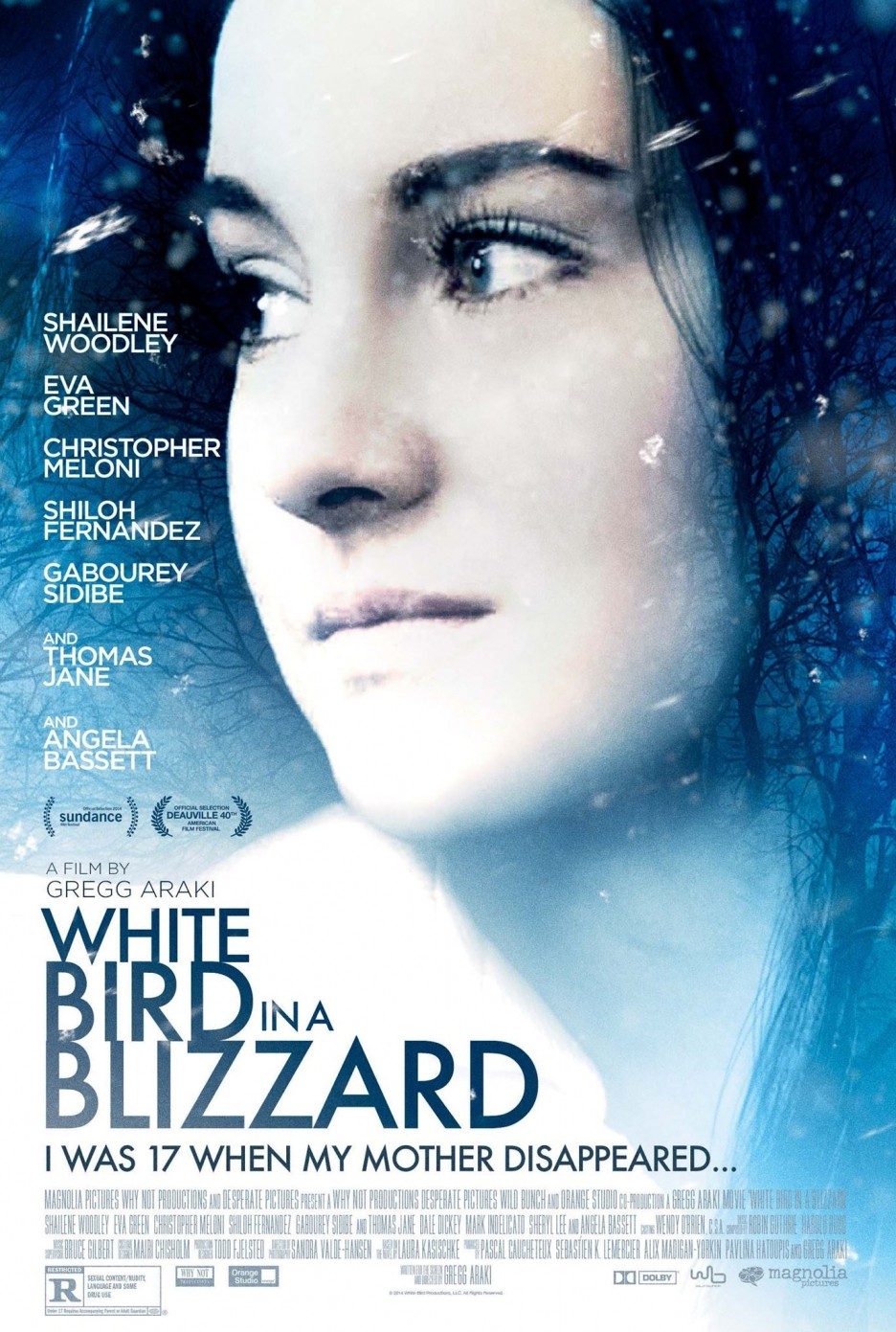
White Bird in a Blizzard movie poster

With “White Bird in a Blizzard,” Gregg Araki deals with the life of an adolescent once again. Based on the book of the same name by Laura Kasischke, it takes place in the 1980’s and stars Shailene Woodley as Kat Connor, a young woman whose mother ends up disappearing from her life. This happens at the same time she is discovering her sexuality with the next-door neighbor, Phil (Shiloh Fernandez), and she doesn’t seem too phased by her mother’s sudden absence. Her father, Brock (Christopher Meloni), has long since become a complete wimp, and his emotional repression prevents him from dealing with this situation in a rational manner. We follow Kat as she goes from high school to college, and eventually, she comes to see just how deeply affected she was by her mother’s disappearance and becomes determined to find out what happened to her.

Many of Araki’s films deal with the lives of teenagers, and he deals with them in a way which feels both honest and emotionally raw. “White Bird in a Blizzard” is the latest example of this, but while it deals with similar themes, it also feels somewhat unique to what Araki has given us before. He appeared at the Four Seasons Hotel in Los Angeles, California for the movie’s press conference, and I asked him if his view of adolescence has evolved much from one movie to the next. Araki replied it definitely has.

Gregg Araki: Back in the 90’s I did a series of three films (“Totally Fucked Up,” “The Doom Generation” and “Nowhere”) that I have become sort of famous or infamous for that were kind of a trilogy about being a teenager. It was called the “Teenage Apocalypse Trilogy” and they were very unhinged in a way and a little bit chaotic. I made those films 20 years ago and I definitely feel like in that time I’ve become older for sure and I think more mature and I’m more developed. I don’t really think I had a film like “White Bird” in me then. The analogy I make is that in this film I did called “The Doom Generation” which is also about young people, those kids have no parents. They have no house and they have no family; it’s just these kids doing crazy stuff. And in this movie Shailene does play somebody who is 18 and Shiloh (Fernandez’s) character is 18, and so they have their teenage moments and they meet in a Goth club and dance and they have that sort of carefree youth about them. But at the same time, this film is so much more about the family. Kat’s relationship with her mother or father, her parents’ marriage and just that whole world that, to me, like “American Beauty” or “The Ice Storm,” is about the world of the American dream and what is underneath the surface of it all. To me, that’s much more this film than my earlier movies about young people.

It’s always great to see a movie which takes adolescence seriously, and “White Bird in a Blizzard” does qualify as one. It also allows Woodley the opportunity to give another great and honest portrayal of a teenager just like she did in “The Descendants” and “The Spectacular Now,” and it shows how Araki, even at the age of 54, still truly understands what teenagers go through. But moreover, it shows how far Araki has come as a filmmaker, and it will be interesting to see where his career goes from here.

“White Bird in a Blizzard” is now available to own and rent on DVD, Blu-ray, and Digital.

Here is a video interview I did with Araki, Woodley and Chris Meloni which I did for the website We Got This Covered.

Pirates of the Caribbean: On Stranger Tides

Pirates of the Caribbean On Stranger Tides poster

I am happy to say “Pirates of The Caribbean: On Stranger Tides” is a big improvement over the previous entry, “At World’s End.” Whereas the latter had an incomprehensible story I gave up on following, “On Stranger Tides” has a plot which is a little more straightforward and easier to follow. Stars Orlando Bloom, Keira Knightley, and director Gore Verbinski have done left the building, and in their place are “Chicago” director Rob Marshall, Ian McShane and the alluring Penelope Cruz. With some of the dead weight removed and new elements thrown in, this showed promise. And of course, we have Johnny Depp back as Captain Jack Sparrow, whom without there would be no “Pirates” franchise.

This one has Jack sailing to the Fountain of Youth, and we’re not talking Beverly Hills. Along with him on the voyage is his former lover Angelica (Penelope Cruz) who proves to be every bit as trustworthy as Jack, which is to say not at all. Also onboard is legendary pirate Blackbeard (Ian McShane) whose giant sword wields a vicious power even with a simple wave of it. And just when you thought he was out of the way, Captain Hector Barbossa (Geoffrey Rush) is back as well, leaving Sparrow with the usual number of antagonists working against him, and there’s always plenty to go around considering Sparrow’s checkered history.

You would think by now this franchise would have bought the farm as it seems the only reason for it to continue is money. But even in this sequel, Depp still looks to be having a blast as this rock star of a pirate. Never easily upstaged, except by Keith Richards who has one of the movie’s best lines, he finds much to play around with and hasn’t lost a beat since the beginning. It could have been a movie where he could have just taken the money and run, but if he’s still having fun then so am I.

Personally, I’m glad Bloom and Knightley are gone as their romance ran its course, and to have them bitching and moaning at each other yet again would have been tiresome from the start. Instead we have Penelope Cruz who remains an actress as fantastic as she is beautiful. She more than holds her own opposite Depp as Angelica as her character threatens to be even more devious than Jack. Seeing these two play off each other kept me guessing as to who was the more honest of the two, and if they ever reached a point where they start believing their own lies.

I’m also glad to see Geoffrey Rush back as well and fresh off the Best Picture winner “The King’s Speech.” His character of Barbossa has had an interesting journey throughout these films as he’s been an antagonist and then a protagonist. By the time you reach him in “On Stranger Tides,” you’re not quite sure what to make of him which is part of the fun. Like Depp, Rush still has a joyous time playing this enigmatic character, and his gleeful delivery of dialogue is highly entertaining.

Ian McShane was an inspired choice to play Blackbeard, but in some ways his performance is a bit of a letdown. He’s very good, but after watching him portray one of the most cold-blooded bad guys ever in “Sexy Beast,” I expected a lot more menace from him which would have made “On Stranger Tides”’ all the more enthralling to watch. Still, he’s a great actor and could have done much worse.

The one character, however, I could have done without is the stubborn missionary Philip Swift. He’s a bland character who serves no real purpose in a movie which already has more then enough characters to juggle. This is no fault of the actor playing him as Sam Claflin does his best with an underwritten role, but it felt like the screenwriters were making up for the loss of Bloom and Knightley, and they really didn’t need to.

I do have to admit I really dug the mermaids and their natural beauty as much as I did the filmmakers’ take on them. Whereas they are as lovely as we remember them from stories and fairy tales, these mermaids here pack a vicious set of jaws and would sooner devour you than kiss you. There is some nudity here but no breasts (it’s a Disney movie folks), and you will find them unusual than the mermaids you grew up reading about. I guess you could say this is Disney’s subtle take on “Fatal Attraction.”

With Rob Marshall taking over directing duties on this one, I really admire how he streamlined this venture. Even though the movie stumbles a bit in the mid-section, Marshall keeps things moving at a swift pace and none of it gets overwhelming. “At World’s End” was so over bloated to where I wouldn’t be able to describe the plot or remember the name of the character Chow Yun Fat played to you. But here you have a good idea of who everyone is, and even if there are things which don’t make complete sense, it doesn’t matter too much.

In the end, all I really wanted out of “Pirates of The Caribbean: On Stranger Tides”’ was a good time. It’s not a movie I ask too much from, and I liked how Disney learned from the franchise’s previous mistakes. While the wonderfully entertaining “Curse of The Black Pearl” set the bar high, this one reaches up far enough towards it. Along with another thunderous Hans Zimmer score, I was pleased with this fourth “’Pirates” film, and I am open to seeing a part five, and you know there will be one at some point in the future.

* * * out of * * * *