Blue Collar

blue-collar-movie-poster

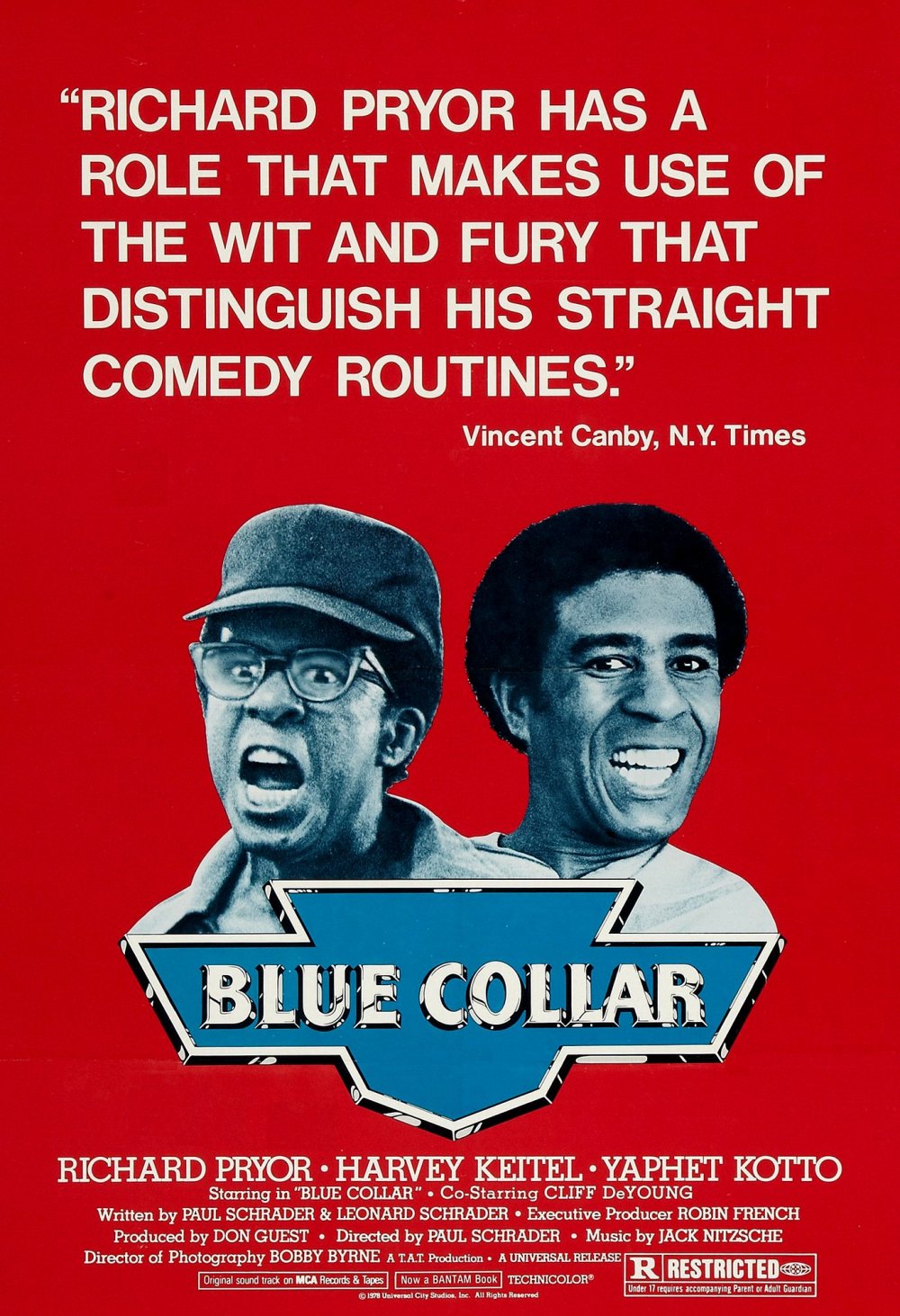
Even though it was made back in 1978, “Blue Collar” doesn’t feel at all dated thematically. Dealing with crooked unions and frustrations with a job that never pays you enough is something many of us still deal with in this day and age. Watching it more than 30 years after its initial release makes me wonder how much, if any, progress has been made for any American workers.

Richard Pryor, Harvey Keitel and Yaphet Kotto star as a trio of Detroit auto workers who work hard at their jobs but never get much respect for what they do. They get crap thrown at them by their superiors, and the union doesn’t seem all that interested in helping them. The divisions between the blue and white collar workers are heavily pronounced, and tensions and bitterness are always at an all-time high.

Pryor’s character of Zeke Brown feels especially disrespected and is never afraid to hide his frustrations from the union or anyone else who pisses him off. Even worse, Zeke gets a visit from the IRS informing him of back taxes he can’t even afford to pay. Keitel’s character of Jerry Bartowski works at a gas station as well as the auto factory, but barely make ends meet and can’t even afford braces for his daughter who desperately needs them. Then there’s Kotto’s character of Smokey James, a man who served time in prison and is well aware of how the class structure is designed to keep everyone where they are so the powerful people can stay powerful. But even he has his breaking point, and he’s finally reaching it after all this time.

Fed up with the union’s incompetence, the three men rob the union of the money they keep in their not very well hidden vault. The robbery is sloppily handled, but they make out with the safe which has only a few hundred dollars, but it also contains a ledger which shows how seriously corrupt the union is. On top of being involved in an illegal loan lending operation, the ledger also shows their ties with organized crime syndicates. With this information, they decide to blackmail the crooked union into giving them tons of cash which will take care of all their financial problems. Their plan, however, soon exposes their naïve nature as the union quickly resorts to methods which can never be mistaken as legal.

What will happen from there will tear friendships apart and leave them paranoid of one another and of those they can’t trust. “Blue Collar” works as a critique of those unions which poorly represent their workers, and it is also a brilliant character piece and a thriller where lives hang in the balance as the powers that be aren’t about to be comprised by anyone, especially those in the lower class.

“Blue Collar” was Schrader’s directorial debut, and it’s a remarkably impressive one. He vividly captures the hard-working atmosphere these men inhabit and is aided by a tough as nails blues song for the movie’s main title which was performed by the late Captain Beefheart. There are moments in the “Hard Workin’ Man” song where all the other instruments disappear except for a deep thundering metal boom which hints at the anger and frustration slowly boiling to the surface for these characters. The environment they work in is harsh and unforgiving, and while they value what they do, no one above them seems to as they are considered to be easily disposable.

This was one of Pryor’s few dramatic roles, but it’s not bereft of his humor. Considering his work as a comedian and a social satirist, he is perfectly cast here and infuses the Zeke with humor and a wounded soul which will never fully be mended. Pryor really shows an acting range most dramatic actors only dream of having.

In fact, that’s the sad thing about watching Pryor in this film; he really was one of the lost dramatic actors of our time as he never got to play many serious roles which were deserving of his talent. We all know him to be one of the best comedians ever, and he did star in some very funny movies. Still, he got stuck in a lot of crappy ones which never utilized his talents fully, and it is an enormous loss he never got to do more dramatic work.

Keitel gives another great performance in a career filled with them, and he always inhabits his characters more than play them. Jerry Bartowski is a strong guy on the surface, but seeing him become completely unraveled after the robbery allows Keitel to expose the character’s vulnerabilities of which there are plenty. There are moments where he doesn’t utter a word and yet you can see on his face what is racing through his anxiety-ridden mind. Bartowski may see himself as his own man who answers to no one, but he soon finds there is a limit to the choices he has when it comes to keeping his head above water.

Kotto, who has since become one of the most undervalued actors working today, has constantly been cast as an unforgettable imposing presence in every film he has appeared in. Whether it’s as Parker in “Alien,” Special Agent Mosley in “Midnight Run” or as Al Giardello on the brilliant “Homicide: Life on the Street,” he never fails in giving us a character who feels larger than life. “Blue Collar” is no exception as he portrays someone wise about the world around him, but not wise enough to know when he and his pals are digging a hole too deep for them to climb out of. His character’s fate feels the most tragic as a result, and the last scene he has is amazing in its power.

With Schrader’s movies, a common theme runs through them of the emasculated male wanting to make a difference in a society he sees as corrupt and in need of saving. Be it Robert De Niro as Travis Bickle in “Taxi Driver,” Willem Dafoe as John LeTour in “Light Sleeper” or even Nick Nolte as Wade Whitehouse from “Affliction,” Schrader deals fearlessly with characters whose hold on sanity we see constantly erode. Now with the three leads in “Blue Collar,” each of them are pushed to the limit as they slowly realize the trouble they have brought upon themselves. Watching it destroy their friendship, which brings about a strong mistrust between them, is as fascinating as it is painful to witness.

I’m not sure how many people out there are aware of “Blue Collar,” but it is one of those movies from the 70’s deserving of a big audience from one generation to the next. Watching it today is even more bittersweet as those auto factories in Michigan where the movie was shot no longer exist. It was tough for the people who worked there back then, but imagine what it must be like for them now. The movie ends in a freeze frame which brilliantly encapsulates how the union and those in power continue to stay on top of the working man. After all these years, it doesn’t feel like much has changed, but anyone and everyone out there is welcome to prove me wrong.
* * * * out of * * * *

Das Boot

das-boot-movie-poster

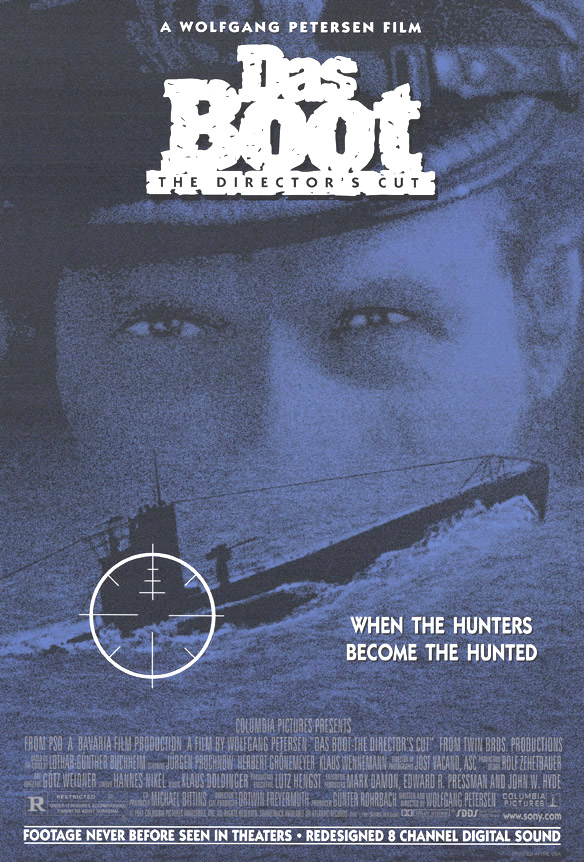
With it out on Blu-ray, viewers can once again see that “Das Boot” is still the greatest submarine movie ever made. Other underwater sea adventures like “Run Silent, Run Deep,” “Crimson Tide,” and “The Hunt for Red October” may come close, but none of them can capture or match its power in unbearable claustrophobic tension. It remains Wolfgang Petersen’s crowning achievement as a director, and it has lost none of its power in sucking us into the inescapable terror people face in the deep dark sea.

“Das Boot” takes place in World War II as Commander Willenbrock leads a group of boys to sea on a U-Boat, the German version of a submarine, and covers the tedium of life at sea when no battles are fought. You feel the sweat and body odor of the crew quite vividly to where you will want to take a cold shower afterward. But it’s when they face off against destroyer ships when the intensity really goes into serious high gear.

Petersen does a brilliant job of conveying the terror and claustrophobic nature everyone on the U-Boat is forced to endure. You are right there with the crew and experiencing their frenzied emotions as the destroyers sail over them dropping depth charges which threaten to sink their boat in a heartbeat. The “ping” noises make the suspenseful tension even worse as the position of the submarine becomes easier to determine, and this becomes a film you experience far more than watch.

The director also does a really good job of getting viewers to know various crew members and the important roles they have on the ship. There is Chief Engineer Fritz Grade (the wonderful Klaus Wennemann) who finds looking at pictures of his wife too painful. Then there’s Chief Mechanic Johann (Erwin Leder) who is in love with his engines the same way Scotty loved the Enterprise in “Star Trek.” And there is also Senior Cadet Ullmann (Martin May) who is constantly worried about his fiancée who is French and pregnant. The more viewers know about the crew, the more emotionally drawn they are to their predicament.

There may some people who object to seeing “Das Boot” on the grounds the crew members were Nazis. Truth be told, not all of them are big fans of Adolf Hitler, and they are never seen wearing a Nazi insignia on their uniforms while at sea. But regardless of this, take away the politics of what’s going on and you will realize just how universal this movie is in what it portrays. Had it been the “good guys” instead, they would have endured the same crippling terror and fatigue so this crew could have been of any nationality.

It is also a powerful anti-war movie as well in showing not just the horrors and destruction of war, but also of the victories which become empty ones when soldiers see what is left behind. This is especially the case in one scene when the crew members are on the surface and surveying a freighter they successfully destroyed. They revel in their victory, but then they see survivors jumping off the ship into the ocean. They swim to the submarine pleading for help, but while the German crew members want to assist them, the Captain concedes there is no room for them onboard, and they are left to drown. It’s an emotionally devastating moment which captures the senselessness and the price of war.

“Das Boot” is based on the novel by Lothar-Günther Buchheim which was inspired by his own wartime experiences as a war correspondent onboard submarines. The character most resembling him here is Lieutenant Werner, and he is our guide through the chaos as his lack of experience aboard a submarine mirrors our own. What he discovers about life at sea, viewers discover along with him. Playing him is German singer Herbert Grönemeyer, and he does great work in conveying his naivety while covering the goings on of a German crew.

The best performance, however, comes from the great Jürgen Prochnow who plays Commander Willenbrock, the hardened sea veteran who looks like he’s seen everything war has to offer. The other officers freak out easily during an attack, but he keeps his cool because he needs everyone to do their jobs. It’s when he starts losing it, however, when things get really bad, and then the audience has a reason to freak out. Prochnow creates a multi-dimensional character which feels very much lived in, and he gives the Commander a subtle vulnerability which looks and feels effortless.

Petersen has been known best for making movies about people who are stuck in small places where there’s not much room to hide. He enthralled us when the American President’s plane was hijacked in “Air Force One,” he had Clint Eastwood chasing after John Malkovich during “In the Line of Fire,” and he has George Clooney and company trapped in the rocky sea in “The Perfect Storm.” “Das Boot” is where it all started for him, and it is a seriously intense and emotionally exhausting experience which thrills and terrifies you in equal measure. The accuracy to detail is never in doubt, and the audience will come up gasping for air once the credits roll.

There may be another submarine movie or two coming to movie theaters in the future, but after watching “Das Boot,” you can bet they won’t come close to topping it. Movies don’t get much more thrilling than this one, and it is a must see for those who are fans of Petersen’s work or war movies in general. It is also more preferable to some of the director’s more recent work like “Poseidon” and “Troy.”

* * * * out of * * * *

Note: There are currently many different versions of “Das Boot” available. The original theatrical cut lasts about two and a half hours. The director’s cut of it added an hour of footage which gave more depth to each character. And before it made its way onto Blu-ray, there was the uncut miniseries version which runs for almost five hours. You may want to start off with the director’s cut and then move on to the miniseries which perfectly captures the infinite tedium of the crew that feels endless.

The Hunt For Red October

the-hunt-for-red-october-movie-poster

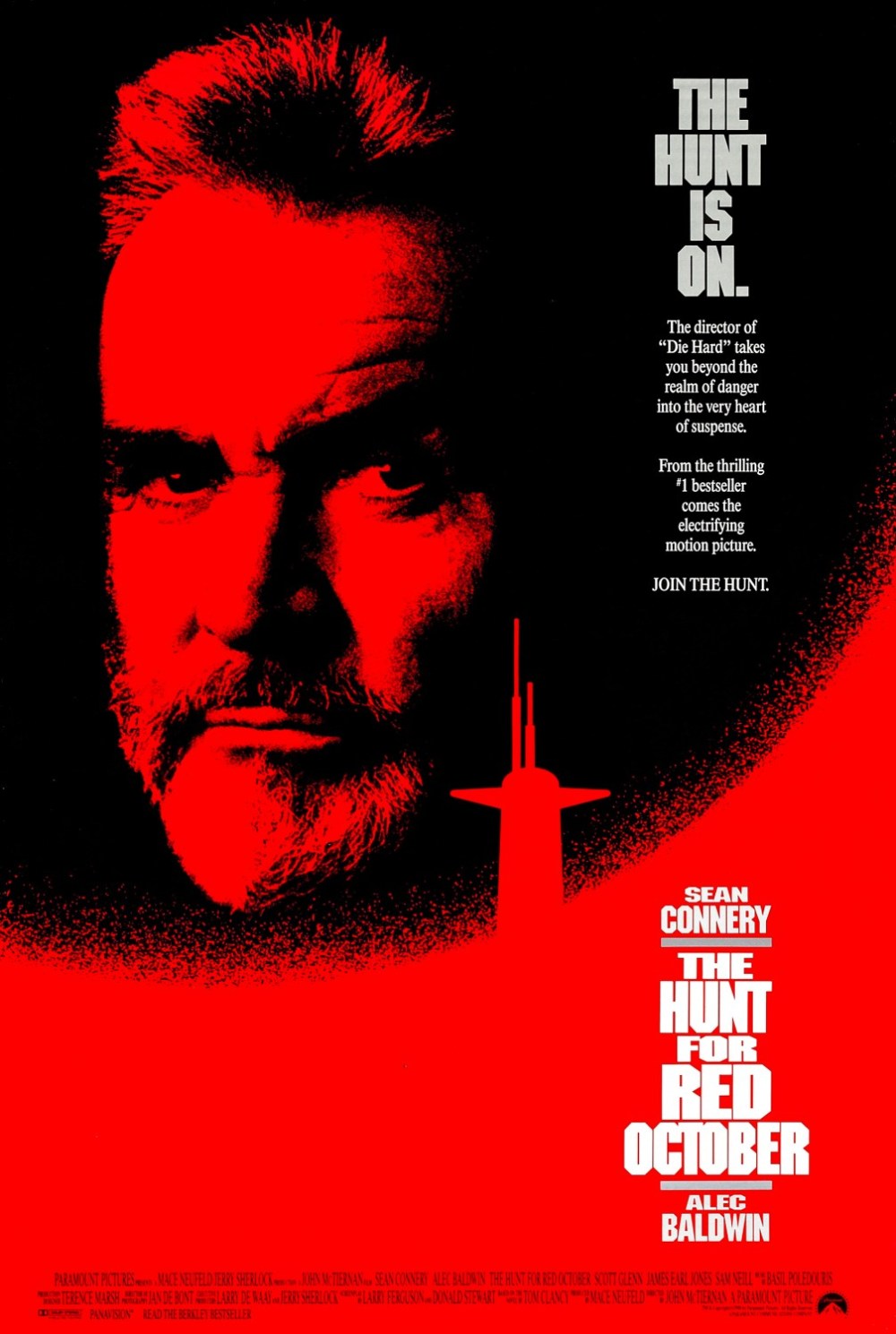
My dad just watched John McTiernan’s “The Hunt for Red October” for what seems like the 600th time. After all these years since it remains one of the few movies he never gets sick of watching. While I was at first annoyed with him wanting to watch it instead of something he hadn’t seen before, it didn’t take long for me to be reminded why this movie is so compulsively watchable. The cast is excellent, the direction is taut, and it is far more thrilling than the average PG-rated movie. I remember my friends not taking this movie very seriously when it came out as they were more interested in sneaking into the latest R-rated movie, but they didn’t know what they were missing.

This was the first cinematic adaptation of a Tom Clancy novel and, as a result, the first instance of him getting pissed at Hollywood for not faithfully adapting his work. I still have not read the book, so I have no idea how it differs from the movie. At this point, I’m not really sure if I care because book to film adaptations are not going to work if you’re going to be 100% faithful to the source material. Not everything transfers over to the big screen for a number of reasons, and if Clancy were still alive I’d tell him he should be happy this movie helped sell more copies of his books.

I’m not going to bore you with all the plot details. All you need to know is that it involves a new Russian submarine called the Red October which contains a propulsion system which allows it to run silently to where it cannot be detected by sonar. It is commanded by Captain Marko Ramius (Sean Connery) who lives a lonely life now that his wife has passed away, and many soon become convinced he is out to attack the United States before the country can even realize it’s under attack. CIA analyst Jack Ryan (Alec Baldwin), however, becomes convinced Ramius is actually trying to defect and becomes obsessed with proving his theory to where he’s willing to put himself in harm’s way.

On top of this being the first Clancy novel brought to the silver screen, it also served as an introduction to the hero of many of his books, Jack Ryan. Of all the actors who have played this CIA analyst to date, Baldwin remains my favorite as he makes Ryan into an accidental action hero, not a man out to save the day. But Ryan’s brilliantly analytic mind allows himself to see and understand things others cannot due to their mistrust and their Cold War obsessions, and this makes him a necessary part of the action whether he likes it or not. Unlike all the other military generals, Ryan has met Ramius and knows how his mind works.

Sean Connery is as legendary as his character of Marko Ramius is to the Russian military in this movie, and it should go without saying he is perfectly cast here. Seeing those eyes of his on the big screen at the start gives us an idea of how human Ramius is, and Connery renders him a fascinating individual whose life cannot be boiled down to one sentence. The former James Bond actor could have given a ridiculously over the top performance, but he instead underplays his role to where we truly accept him as a submarine commander and that there is more to him than we can see at first.

Seriously, McTiernan got the perfect cast for “The Hunt for Red October.” Back in the 1990’s when this movie came out, it was hard to think of another actor other than James Earl Jones who could play Ryan’s superior Vice Admiral James Greer. Jones gives each scene he’s in an immense gravity, and he makes it look like he doesn’t even have to try. Scott Glenn is coolness personified as Captain of the U.S.S. Dallas, Bart Mancuso, and watching him keep his emotions in check throughout the is fascinating. When Mancuso does lose his cool, you want to make sure you’re not the reason why he is.

Next, you have Sam Neil who plays Vasily Borodin, Ramius’ second in command. Neil has the captain’s back when others begin to doubt him, and I love the scene where he talks to Connery about the possibility of living in Montana. Neil is sublime in this role, and his last scene is a real heartbreaker.

Then you have actors like Tim Curry, Fred Dalton Thompson, Richard Jordan, Joss Ackland, Stellan Skarsgård and Jeffrey Jones inhabiting their roles to where you feel like you’re watching actual Washington officials and military personnel instead of just a bunch of performers. It’s impossible to imagine “The Hunt for Red October” without any of these actors in it. Furthermore, they are each blessed with a number of classic one-liners provided to them by screenwriters Larry Ferguson and Donald B. Stewart.

One actor I want to point out in particular is Courtney Vance who plays Sonar Technician Ronald “Jonesy” Jones. His performance ended up being this movie’s most underrated as we watch him listen to the noises he heard to where you cannot doubt the conclusion he comes to. While the computer tells Jonesy he’s listening to a “magma displacement,” he knows he really heard something which has got to be man-made. Watching Vance as Jonesy is a joy because he makes this character much more than the average petty officer aboard a ship.

McTiernan’s genius in directing “The Hunt for Red October” is in keeping things down to earth and not bombastic like you would expect to see in a Michael Bay movie. Right from the start, he’s intent on bringing us into these characters’ lives to where we don’t feel like we’re watching some ordinary film. Unlike “Die Hard” which he made before this, it is not an action-packed movie until the very end, and he has us getting far more invested in what the characters are up to. As a result, it seems unlikely this movie could be made in the same way today as studio heads would most likely expect something far more formulaic.

If there are any flaws to be found in “The Hunt for Red October,” it is with some of the special effects as the torpedoes look kind of fake. While McTiernan and his crew appear to have all the other details down perfectly, this one doesn’t work the way it should. Still, that’s just a minor thing that doesn’t do much to take away from one’s pleasure in watching this submarine classic. It really is one of those movies which is impossible to get sick of watching, and it holds up more than twenty years after its release. Outside of “Das Boot,” this remains one of the greatest submarine movies ever made.

* * * * out of * * * *

Toni Erdmann

toni-erdmann-poster

It’s hard to tell you how to go into “Toni Erdmann” as it works as both a comedy and a drama. Some moments are truly hysterical while others are deeply moving as German filmmaker Maren Ade draws us into a story which takes us in completely unexpected directions. These days, only a foreign film can get away with what “Toni Erdmann” does here as it balances out both its hilarious and moving scenes for a nearly 3-hour running time. Yes, it’s that long, but don’t let this and subtitles give you a reason not to sit through it because you will be missing out.

We meet Winfried Conradi (Peter Simonischek), a music teacher who thrives on playing pranks and practical jokes on unsuspecting victims with tremendous glee. Winifred is eager to reconnect with his daughter, Ines (Sandra Hüller), who is currently working in Bucharest, Romania as a business consultant in the oil industry. Ines is hopelessly addicted to her phone, as many of us are from one nation to the next, and she barely has any time at all to spend with her family as she is constantly called away to work. Following a sudden death, Winfried impulsively travels to Romania to spend time with Ines, but his unexpected visit cannot compete with her seemingly ambitious climb up the corporate ladder. Winfried at one point asks Ines what she enjoys most out of life, and she finds she cannot really answer the question as the term enjoyment is impossible for her to honestly define. These days, with everyone struggling to make a living, it’s very hard not to relate to how she feels.

After feeling quite alienated, Winfried decides to leave Romania and let Ines go about her hectic life. A few days later, however, Winfried reappears as Toni Erdmann, his alter-ego who presents himself as a life coach and consultant to Ines and her friends, and it doesn’t take long for him to draw a crowd with his effortless charisma. Ines is at first horrified by what her father has pulled off as she feels her career might be put in jeopardy as a result, but she eventually finds herself playing along as it gives her life a levity which constantly eludes it.

Watching “Toni Erdmann,” I kept thinking how a Hollywood studio would try to dumb down the material and force the director to cut the movie down to 90 minutes so they could maximize the number of screenings which can be shown in a day. I imagine producers were trying to do the same to Ade, but she apparently said deleting scenes would have hurt the movie’s pacing. Keep in mind, she spent over a year editing the movie and even gave birth to her second child in the process, so you cannot say she didn’t put a lot of thought into what she was doing here. The end result is a final cut which doesn’t have a single wasted shot in it as we watch Winfried and Ines struggle with this crazy thing called life.

Both Simonischek and Hüller are exemplary in portraying characters who could have been played far too broadly in any other movie, and the actors fully invest in the emotional natures of Winfried/Toni and Ines to where we are completely caught up in what’s going on in their minds. Just when you think each actor has given their best moment onscreen here, they come up with another one which has you in awe as well as in hysterics in regards to what they succeed in pulling off.

Winfried could have been a completely obnoxious and annoying father like many are in movies these days, but Simonischek makes him a wonderful presence even when Winfried, in his alter-ego of Toni, threatens to overstay his welcome. When he reveals who he really is to another person and why he is putting on such a disguise, it is a wonderfully moving moment as he is not greeted with disdain but instead with understanding and empathy. I imagine most parents are desperate to keep a strong connection with their children after they move away from home, so it shouldn’t be a big surprise when some resort to desperate measures.

Hüller gives us a character ever so serious in advancing her career in a male-dominated business, but she’s also not afraid of showing the bruises in Ines’ armor which come up when her world becomes too much to deal with emotionally. She also brilliantly takes her character in directions you couldn’t possibly anticipate, and this results in a musical scene and a birthday party, both of which need to be seen to be believed. She fearlessly dives into those moments with sheer enthusiasm as she soon finds herself battling against a lifestyle which has become far too suffocating to deal with.

“Toni Erdmann” is in many ways a comedy, but the comedy doesn’t just come out of its hysterical moments. It also comes out of the painful and awkward ones as humor at times becomes the only way to deal with the emotional hurdles life constantly throws in our direction. There is a seriousness to the subject matter as well as life and death are dealt with in equal measure. Taking this into account, it’s best to go in with an open mind as expectations will threaten your cinematic experience rather than inform it. What you can expect are a number of surprises you could never have expected, if that makes any sense.

Every once in a while, we need a movie which reminds us of the importance of living in the here and now as life becomes far too hectic for us to realize it. “Toni Erdmann” never tries to shameless manipulate its audience into feeling anything as we come to fully sympathize with Winfried and Ines to where we do see the importance of stopping to smell the flowers more often. Winfried’s last scene with Ines drives this point through as they come to realize how quickly time passes everyone by to where it is very hard to slow down for just a second. Please don’t try to convince me you don’t relate to this in the slightest.

I am still thinking about that last scene long after the movie ended, and of how Hollywood would never have let Ade get away with a nearly 3-hour running time. I’m convinced they would rather rush to get to the “live in the moment” scene in a mere 90 minutes because more screenings in a day means more money. Sometimes it is worth it to take the time to tell a really good story.

* * * * out of * * * *

The Ten Worst Movies of 2016

2016 was a huge clusterfuck of a year, and I was beyond thrilled when the clock struck midnight on December 31st. For me, it started off with a carjacking, left me with a totaled vehicle, far too many people were met by the Grim Reaper, and it all ended with the wrong person being elected President of the United States. Even when I tried to find solace and relief at the movie theater, I was let down way too many times. Granted, the year did make a comeback towards the very end with cinematic masterpieces like “Manchester by the Sea,” “La La Land” and “Silence,” but it did little to cover up just how much Hollywood let us down.

I did manage to skip seeing some of the bigger bombs of the year like “Warcraft” and “Alice Through the Looking Glass,” and others like “Batman vs. Superman: Dawn of Justice” look to have found some salvation through longer cuts on DVD and Blu-ray. Still, 2016 left some awful movies in its wake, and the stench of them gnaw at me months after I sat through them. So, let’s take another swing at these 10 films which had me staring at the screen in sheer disbelief.

  1. Now You See Me 2

Now You See Me 2 poster

“Now You See Me” was both fun and clever, but its sequel tries to outdo the original to such a ridiculous effect to where I came out of it with a massive headache. While it helps to suspend disbelief during movies like these, it quickly became impossible to do so as the magic tricks constantly defied all reasonable logic. By the end, I had long since given up trying to make sense of everything and anything, and not even a talented cast which includes Jesse Eisenberg, Mark Ruffalo, Woody Harrelson and Daniel Radcliffe among others could use their charisma to make “Now You See Me 2” seem cleverer than it could ever hope to be.

  1. Blair Witch

blair-witch-poster

Here’s another sequel, but this was one I really looked forward to seeing. With it being directed by Adam Wingard and written by Simon Barrett, the same two who gave us “You’re Next” and “The Guest,” I figured they would bring a freshness to this franchise which quickly took a nosedive after the abysmal “Book of Shadows: Blair Witch 2.” Alas, despite some strong reviews which were plastered all over the movie’s poster before its release, “Blair Witch” proved to be the same old thing and terribly unsatisfying. The characters were not the least bit memorable, and after a while it felt more like a bad “Paranormal Activity” sequel than anything else. By the time we reached the movie’s conclusion, I wondered why anyone bothered to make another sequel to “The Blair Witch Project” in the first place.

  1. The 5th Wave

the-5th-wave-poster

I am now officially burned out on young adult movies which yearn to be profitable franchises as they all look the same. “The 5th Wave” wants to be a “Hunger Games” for the next generation, but instead it feels like recycled material designed to appeal to a demographic which is now on the lookout for something more adult. Despite some strong turns from Chloe Grace Moretz and Maika Monroe, this young adult adventure feels very uninspired as it borrows elements from other movies far superior to it.

  1. Marauders

MARAUDERS final poster

Here’s another movie which tried to stay one step ahead of the audience, and it ended up losing me long before the halfway point. Steven C. Miller’s action thriller has some clever robbery sequences, but the story became so convoluted to where I was surprised I didn’t walk out of it when I had the chance. The plot involves a murder conspiracy which is ridiculously impossible to decipher, and it strands actors like Christopher Meloni, Dave Bautista and Adam Grenier in an infinitely grim motion picture which tried my patience all the way up to the last frame. But worst of all is Bruce Willis who looks like he doesn’t want to be there. While he gets top billing, he’s barely in “Marauders” to where I couldn’t help but think they paid him an obscene amount of money just to show up for a few days’ work. Is this really the kind of crap he has resigned himself to being in on a regular basis?

  1. The Whole Truth

the-whole-truth-poster

It is very depressing to realize this is Courtney Hunt’s first directorial effort since her excellent movie “Frozen River” as she gives us nothing more than a routine and banal courtroom drama which wastes the time and talent of Keanu Reeves, Renee Zellweger, Gugu Mbatha-Raw and Jim Belushi. As soon as we see the snake slithering across the highway at the movie’s start, we know exactly what to expect to where there nothing can surprise us in the slightest, and the case at hand takes turns which baffle even those audience members who never went to law school. Daniel Craig was originally set to play Reeves’ role but dropped out before filming began. Smart move.

  1. I Saw the Light

I Saw the Light movie poster

After a year which saw fantastic biopics like “Straight Outta Compton” and “Love & Mercy,” 2016 gave us this giant lump of coal which attempted to dramatize the life of country music legend Hank Williams. In all fairness, Tom Hiddleston does an impressive job of singing Williams’ songs which are not at all easy to pull off, and he got strong support from Elizabeth Olsen who portrayed his first wife, Audrey Williams. But writer and director Marc Abraham does such a poor job here as the movie goes in directions which leave us wondering as to what point we are at in Hank’s life, and he does little to nothing in terms of digging into the singer’s life to see what made his work so unforgettable. I came out of “I Saw the Light” feeling like I learned nothing about Hank Williams. He may have been a great singer, but the movie portrays him as nothing more than a jerk you wouldn’t want to spend time with.

  1. Cell

Cell movie poster

Far and away one of the worst adaptations ever of a Stephen King novel, and that’s saying a lot. What could have been a gleefully twisted satire on our obsession with cell phones turned out to be nothing more than a typical zombie movie, and the fact the studio dumped it in a few theaters upon its release should give you an idea of the confidence they had in it. Director Tod Williams gives us nothing more than a glum motion picture which reminds us of so many others like it which were so much better, and the cast which includes John Cusack and Samuel L. Jackson look so bored to where you wonder why they bothered to show up on set. It all culminates in a very badly lit finale which makes you wonder why no one bothered to reshoot it in the hopes it might save such a lifeless motion picture.

  1. Suicide Squad

Suicide Squad poster

For me, this was the single most disappointing movie of 2016. This should have salvaged a summer movie season where even the best offerings only left so much of an impression, but instead it proved to be the final nail in its beat-up coffin. This should have been a motion picture which exhilarated us with the exploits of villains and bad guys, but even with the talented David Ayer at the helm, “Suicide Squad” proved to be a real waste as the characters were largely defanged to where you want to yell at all those Warner Brothers executives, “THESE ARE BAD GUYS! LET THEM BE BAD GUYS!” This movie played it way too safe, suffers from bad cinematography, and Jared Leto’s Joker was a major letdown. Only Viola Davis seems alive onscreen as her character, who is one of the movie’s good guys, proves to be the most threatening one of all. Such a disappointment, I was expecting it to be one of the most entertaining movies of the year.

  1. Mother’s Day

mothers-day-movie-poster

Watching this movie made me feel physically ill. My body hurt all over as I endured the shameless manipulation and offensiveness of what sadly turned out to be Garry Marshall’s last film before his death. Yes, the man gave us a wealth of great entertainment which included the show “Happy Days” and the movie “Pretty Woman” which made a star out of Julia Roberts, but “Mother’s Day” shows him at his worst as he puts together a terribly contrived story involving a group of unconnected people who somehow come together on yet another holiday (remember, this is from the man who gave us “Valentine’s Day” and “New Year’s Eve”). Did Marshall even realize how insulting to the intelligence this motion picture would be? Everything about it felt so artificial to where I could never stop cringing from start to finish. Marshall may have been old-fashioned in his approach, but it doesn’t excuse the fact this movie was so incredibly awful.

And now for the worst of the worst, and this is a movie I just love to hate with a passion:

  1. Hillary’s America: The Secret History of the Democratic Party

Hillary's America poster

Look, Dinesh D’Souza can hate on Hillary Clinton and the Democratic Party all he wants; that’s his right. If I have to sit through one of his movies, I will. But his latest political screed proved to be one of the worst documentaries ever made, and that’s considering if you want to call this a documentary. D’Souza doesn’t even deal with Hillary until the movie’s last half hour, and he instead goes over the racist past of the Democratic Party in an attempt to link it to the Democratic Party of today. In the process, he gives an unintentionally hilarious film which treats all democrats as if they were one-dimensional villains from an 80’s slasher flick, and I eagerly await him to make one of his own called “Democrat the 13th.” Like many filmmakers, D’Souza cherry picks facts and presents them in a way which speaks more to his infinite paranoia and burning desire to rewrite history to his heart’s content. “Hillary’s America” presents us with an endless number of re-enactments, each one worse than the next, a look at D’Souza’s time spent in a halfway house which I’m convinced was co-directed by Tommy Wiseau, and acting which redefines the terms “flat” and “one-dimensional.” When D’Souza does finally get around to dealing with Hillary, my jaw just dropped as his portrayal of her as shrew needing to be tamed spoke more of his anti-feminist views than anything else. D’Souza still wants to prove to the world he was a political martyr, but instead he shows us how cut off from reality he is, and the realization of this is far more frightening than anything he shows us here.

So, those are my picks for the worst movies of 2016. Here’s hoping 2017 is a better year for us all on a personal and professional level.

Save

The Founder

the-founder-movie-poster

Watching Michael Keaton as Ray Kroc, the man who acquired McDonald’s and turned it into a billion-dollar franchise in “The Founder,” reminded me of his role as Hunt Stevenson in “Gung Ho.” Granted, there’s a number of fast-talking characters from Keaton’s long resume which could have come to mind, but “Gung Ho” proved to be one of my favorite Ron Howard films. Like Hunt, Ray is eager to convince everyone around him he knows what’s best for everyone, but while Hunt’s efforts are altruistic, Ray’s speak more to the kind of capitalism which is very unrestrained. Either way, you know you have the right actor portraying someone eager to get things his own way or no way at all.

“The Founder” is, yes, “based on a true story,” but we don’t even need to be told this because it is far too easy to invent a character like Ray Kroc these days. The movie opens up in the 1950’s when Ray, a salesman from Illinois, is trying to sell milkshake mixers to drive-in diners and failing to do so. While his face is filled with confidence, his mind is being subjected to countless scores of rejections as failure haunts him at every corner. As we watch Ray alone in his motel room, listening to a self-esteem record where a narrator talks about the importance of confidence, we see him desperate to outrun failure as he is now in his 50’s, a time where most men hang it up and enter retirement (back in that decade anyway).

Then one day, Ray comes across a little hamburger stand out in San Bernardino, California called McDonald’s. Immediately, he is stunned and amazed by the speedy system its owners have come up with which produces high quality food in a very short period of time. Upon taking the brothers who own the restaurant, Mac (John Carroll Lynch) and Dick McDonald (Nick Offerman), out to dinner, he soon offers to turn their restaurant into a bona fide franchise. From there, we know it’s going to be an interesting ride, albeit one filled with countless speed bumps and strong disagreements.

Now it would have been far too easy for the filmmakers to vilify Ray Kroc as he essentially stole the McDonald brothers’ business right out from under them, but director John Lee Hancock and screenwriter Robert Siegel have more on their minds than reducing this man to a mere villain. From the start, we see the desperation on Ray’s face as he is at the age where most men retire, but he still sees the potential of success waiting for him regardless of how many road blocks get put up in his path. His fear of failure becomes the driving force behind his business decisions, and while it eventually reveals him to be ruthless in his quest for dominance, we can certainly understand where the drive comes from.

The role of Ray was made for Keaton, and it’s impossible to think of another actor who could have played this businessman as effectively as the “Birdman” actor does here. It fits perfectly into his talents as a fast talker and as someone who can convince you he is on your side even when the character he plays is not. As portrayed here, Ray is a complex character whose motivations are controlled by desperation and fear of failure, and Keaton nails every complexity perfectly to where we are completely sucked into Ray’s realm of business dealing even as Ray begins to take credit for things he did not create.

I also admired the portrayal of the McDonald brothers as they are shown to be decent Americans who struggled with failure themselves until they found success with their little hamburger stand. It should be noted that the brothers were never uninterested in turning McDonald’s into a franchise (early attempts to do so did not work out for them), but were instead interested in a form of capitalism which allowed them firm control over the quality of food and service at each restaurant to where they could make a healthy profit and live comfortably without trying to overrun their competition.

It also helps that “The Founder” has two terrific actors portraying Mac and Dick McDonald in John Carroll Lynch and Nick Offerman. Lynch, in particular, has one incredible scene which involves him going into a five-page monologue where he vividly describes how the first McDonald’s restaurant came into existence. It’s an exhilarating moment to watch as the creation of this now globally dominant fast food chain reminds us of the greatness of America as it is a country where just about anyone can succeed in business if they try really hard enough and are persistent as well.

Laura Dern also shows up as Ray’s long-suffering wife, Ethel. Now this could have been a thankless role as we mostly see Ethel staying back at home while Ray is on the road trying to make a sale, but Dern makes the most of it as she shows how Ethel represents the kind of life anyone else would be satisfied with. Dern never portrays Ethel as a constant whiner, but instead as a sympathetic person who struggles to support and understand her husband, a man whose appetites extend far beyond the dining room table and evenings out at local social events.

There’s also strong support on hand from actors like Patrick Wilson, B.J. Novak, Ric Reitz, Justin Randell Brooke and Wilbur Fitzgerald who play characters that come to inform Ray’s business interests, interests which soon evolve into infinitely greedy ones. Another great stand out is Linda Cardellini as Joan Smith, the woman who would eventually become Ray’s second wife. Cardellini is fantastic as she sees in Ray a strong ambition which she wants to help advance, and she proves to have a strong chemistry with Keaton right from the first moment he spots her playing the piano.

Most of Hancock’s movies, “The Blind Side,” “The Rookie,” “The Alamo” and “Saving Mr. Banks,” have dealt with true-life stories, and like those movies, “The Founder” conveys these stories in a way which feels remarkably down to earth. No one involved in this motion picture gets overwhelmed by the iconography of McDonald’s or the people involved in its making and its dominance, and it makes for a deeply involving cinematic experience. Hancock gets all the period details down perfectly to where we are believably transported back to a time where it seemed unthinkable to eat any meal without the use of silverware.

In some ways, I wished “The Founder” had dug even deeper into its subject matter to where the McDonald brothers were included more in the story, but it is still a compelling motion picture which makes the term “based on a true story” feel like it means something for a change. I also love how it is a movie which cannot be boiled down to one sentence. It deals with many things like the American dream, business, greed and the cost of success to a fascinating degree. But looking back, it is primarily about capitalism and of how it can be both good and bad. And considering how capitalism has become such an unrestrained thing to the detriment of many, it makes this movie all the timelier as it shows where capitalism in its most dominant form was born, and Gordon Gekko isn’t even in it.

“The Founder” ends with footage of the real Ray Kroc as he explains how McDonald’s came into being, but in his own way. Many things can be said about Ray as the final image of him in front of a McDonald’s restaurant leaves us in silence as he clearly claimed something which wasn’t even his to begin with. Then again, would it have become such an enormous enterprise without him? It’s hard to say otherwise.

* * * ½ out of * * * *

Click here to read what Michael Keaton, Laura Dern, and John Carroll Lynch have to say about “The Founder.”

Save

Selma

selma-movie-poster

Had “Selma” been released a number of years ago, people would probably just see it as another movie which chronicles a historical moment which has long since passed us by. But with all the upheaval in places like Ferguson, Missouri where violence against people of color is increasing substantially and the Voting Rights Act having taken a very unnecessary hit, this movie could not be timelier. What we see in “Selma” now feels like prologue as the fight for equal rights continues on to this very day. By now we should very well know we’re not living in a post-racial society.

“Selma” takes us back to the year 1965 when Dr. Martin Luther King, Jr. (played by David Oyelowo) and several others led marches from Selma to Montgomery, Alabama in an effort to obtain equal voting rights for African Americans. It was tough times indeed as Dr. King faces an uphill battle with everyone including President Lyndon B. Johnson (Tom Wilkinson) who is not quick to pass a Voting Rights Act as he is still dealing with civil unrest in the South which he is desperately trying to get under control. But King knows this is not an issue that can wait much longer to be addressed.

I have got to start off by saying David Oyelowo is a powerhouse in his portrayal of Dr. King, and he holds our attention completely from the very first moment he appears onscreen. It should be noted how Oyelowo campaigned for this role for seven years and managed to keep it even after the original director, Lee Daniels, departed the project. I have seen Oyelowo do memorable work in movies like “Rise of the Planet of the Apes,” “Lincoln” and “A Most Violent Year,” but I couldn’t find a trace of him in “Selma.” It felt like I was really watching Martin Luther King Jr. resurrected and walking among us again. Not once does Oyelowo succumb to doing a mere impersonation of the man who had a dream we still want to see become a reality. There’s a saying that in the theater you play a character and in film you are the character, and Oyelowo is definitely the man here.

The other big star of “Selma” is its director Ava DuVernay who brings this ever so important story to life so vividly. Granted, in some ways her presentation of the 60’s feels a little routine, and some scenes feel one-sided when they shouldn’t. Her portrayal of the marches, however, is appropriately devastating as she makes you feel ever blow inflicted by those afraid of change. These scenes do not leave the mind easily. King and his supporters are determined to protest in a non-violent way, and it’s hard not to feel for them when their supporters are being beaten senselessly. Deep down you want to see them fight back against the brutality even though we’re aware to do so will be giving the opposition far more ammunition than they deserve.

“Selma” also features a wealth of great performances from actors like Oprah Winfrey who channels her inner Sofia (the character she played in “The Color Purple”) for her role as Annie Lee Cooper who, at the movie’s start, is cruelly denied the opportunity to register to vote. I also enjoyed Tom Wilkinson’s performance as Lyndon B. Johnson as he adds layers to the former President which the screenplay doesn’t always give him. Tim Roth also turns in a strong performance as George Wallace, the always welcome Wendell Pierce is excellent as Hosea Williams, and Dylan Baker is ever so effective as J. Edgar Hoover to where I ended up trying to remember the actor’s name while watching this film.

Another performance worth giving special note to is Carmen Ejogo’s as Coretta Scott King. Ejogo played this role previously in the 2011 movie “Boycott.” She and Oyelowo have a great scene together when she questions him about his alleged infidelity, and no music score is needed to empower it as DuVernay wisely focuses on the actors for all they are worth. Watching these actors here makes for one of the most compelling scenes I have seen in any 2014 movie.

Is “Selma” accurate to what actually happened in history? I don’t know, and I don’t really care. All that matters to me is that it is true to the spirit of the facts more than anything else. We are beyond the point where we should expect movies “based on a true story” to be completely accurate to what actually occurred because dramatic considerations have to be taken into effect. While some argue Johnson was more open to King’s request for voting rights than he was shown to be here, there’s no denying the one most passionate about this issue was King himself. Whether or not this movie fails on a historical accuracy level, it does succeed on a dramatic one.

Having said all this, I kind of wished “Selma” didn’t paint a number of its character in such broad strokes. I guess I was expecting something along the lines of Spike Lee’s “Do the Right Thing” which observed its characters, regardless of color or nationality, with a lot more thoughtfulness and dimension. The fact that “Selma” doesn’t quite succeed in doing this is a bit frustrating, but it doesn’t take away from the powerful effect the movie will have on those who take the time to see it.

“Selma” doesn’t just take us back to an important period in history; it reminds us of the things we as Americans should be fighting for. The movie shows many people of different races and religions joining Dr. King in this fight for an equality no one should have to fight for in this country. But here we are years later, and it turns out the fight is far from over. Once again, we have a lot to learn from history.

* * * ½ out of * * * *

Manchester By The Sea

manchester-by-the-sea-movie-poster

There are five stages of grief: denial, anger, bargaining, depression and acceptance. It’s never easy recovering from grief whether it involves loss of a loved one or dealing with the now inescapable fact that Donald Trump will be the next President of the United States. Watching Casey Affleck’s character in “Manchester by the Sea,” I wonder if he will ever get past the first stage. If he’s lucky, he just might make it to the second. While some are able to get past their grief, others are doomed to be stuck in it for an eternity.

Many movies about grief have been made over the years, but few feel as bitingly honest as “Manchester by the Sea” does. It is the latest work from writer and director Kenneth Lonergan who previously gave us “You Can Count on Me” and “Margaret,” and he really tops himself with this one. While this may, on the surface, seem like a depressing movie, it is one filled a surprising amount of laughter and a wealth of interesting characters whom we watch struggle with the steep hurdles life has thrown at them as well as the snowy weather which chills all those who live in Massachusetts during the winter months.

Affleck plays Lee Chandler who, as the movie starts, works as a janitor and lives in the tiniest of apartments in Quincy, Massachusetts. He is a quiet man and one who is not quick to make friends, especially with those who stare at him for a couple of seconds too long. His face seems as frozen as the snow he constantly shovels off his front porch, so we know the movie will be a journey into discovering how Lee ended up looking so bereft of life.

One day, Lee gets word his brother, Joe (Kyle Chandler), has passed away after suffering a heart attack. This forces Lee to drive to his hometown of Manchester-by-the-Sea to meet up with family members and relatives he has long since become estranged from, and his reaction to seeing them all seems strangely serene as if he has been preparing for this moment in a way no one else would bother to. But as the movie goes on, we come to see why Lee can never again be comfortable in his hometown as it is filled with memories and ghosts he may never ever put behind him.

Now in many ways this movie sounds like a typical one about someone reflecting on the memory of a friend who is no longer living, but Lonergan never tries to take the easy way out here. He presents us with characters who are ever so real, and their reactions to the tragedies thrown in their faces feels honest as one never responds to something so painful in the way you might expect. Everyone is far from perfect and no one here is easily likable, but the characters grow on you as they attempt to navigate past the wreckage of their lives.

Lonergan’s talent as a writer has never been in doubt, but what astounded me most about “Manchester by the Sea” is how confident his direction is. His cast ends up giving such naturalistic performances to where they inhabit their characters more than play them. I never felt like I was watching a movie, but instead it seemed like I was eavesdropping on people whose lives and problems feel more real than we ever could expect. Pulling something like this off requires major talent, and Lonergan has it in massive supply.

All eyes are on Affleck who gives what is far and away one of the best performances of 2016. His character of Lee Chandler reminded me of William Hurt in “The Accidental Tourist” and Nick Nolte in “Affliction” in that those actors played characters so damaged by horrific tragedies in life to where they could no longer process a wide range of emotions. Affleck has a tricky role here as Lee looks to be experiencing intense grief from start to finish, but at the same time he is constantly running away from circumstances which will cause those emotions to overwhelm him in a way he feels he can never handle. This must have been an exhausting role to play, but it’s no surprise to see Affleck rise to the challenge.

There is not a single weak link to be found in the cast here as each actor, no matter how small their role is, creates a multi-dimensional character worth following. Michelle Williams in particular has a show stopping moment as Lee’s ex-wife, Randi, as she tries to make peace with him after all they have been through. Williams has always been fearless in exploring emotions many of us have tried to numb ourselves to whether we realize it or not and, just like she did in “Blue Valentine,” she digs deep into the tragic nature of her character as Randi appears far more ready to deal with past than Lee is.

I also have to single out Lucas Hedges who gives an honest portrayal of a teenager as Lee’s nephew, Patrick. So many teenagers in movies these days seem designed to appeal to a popular demographic regardless of whether the target audience can relate to them or not. But Hedges gives us one who quickly reminds us of how we juggled a number of girlfriends (if we were lucky to, that is) while dealing with a tragedy no one that young should ever have to deal with. Hedges is a real find as he makes Patrick a far more mature character than his emotionally wounded uncle, and he is as unforgettable as Affleck is in this movie.

In a year which proved to be a mediocre one for motion pictures, “Manchester by the Sea” is easily one of the best for many reasons. If it has any flaws, they are hard to see on the first viewing. But even if you do spot any flaws, they are not enough to take away from how great a movie this is. Lonergan has given us a cinematic masterpiece which demands your attention as it deals with a subject that is never easy to grapple with. While the movie’s ending proves to be understandably ambiguous, he never leaves these characters without a sense of hope for the future.

Watching this movie reminded me of an episode of “Homicide: Life on the Street” entitled “Pit Bull Sessions” in which Frank Pembleton and Paul Falsone interrogate a man whose pit bulls have been trained for dogfighting have killed his grandfather. This man, who was played by Paul Giamatti by the way, cares for his dogs far more than he does for any member of his family to where he shows little, if any, remorse for what has happened to his grandfather. Falsone is incensed over how the son seems indifferent to what has happened to a member of his family, and it leads to a classic exchange between him and Pembleton.

“That bastard can feel,” Falsone says.

“He can’t, that’s the horror,” Pembleton replies.

Sad but very true.

* * * * out of * * * *

The 5th Wave

the-5th-wave-poster

The 5th Wave” comes to us not long after the conclusion of “The Hungers Games,” and it is the latest in a seemingly endless line of young adult book to film adaptations. As a result, I came into this movie feeling worn out even before it started. While the novel it is based on, written by Rick Yancey, might be an interesting read, what unfolds onscreen feels like the same old thing. Only the names and places have been changed to protect the filmmakers from potential lawsuits.

Chloe Grace Moretz stars as Cassie Sullivan, a young teenager (is there any other kind?) who lives a normal life with her family, attends high school where she’s a cheerleader and constantly deals with unrequited love like any other child held prisoner by adolescence. But suddenly an alien ship, which looks like something out of “District 9,” appears in the sky, and the Earth goes through four waves which leave it decimated and on the verge of extinction. All Cassie has left is her brother whom she ends up getting separated from, and from there she is determined to save him from a fate many others have suffered.

This movie does not get off to a good start as the visual effects used to convey the various waves are shoddy CGI, and some scenes end up looking like outtakes from “Independence Day” or any other Roland Emmerich production. When the plot finally gains momentum, Cassie finds herself on the run and forced to defend herself in ways she never planned. She’s also looking for her brother whom she is very close to. Doesn’t this sound like something we just saw?

It’s a shame because the movie does have Moretz who makes this mess more bearable than it should be. Her breakthrough performance in “Kick-Ass” was no fluke and she continues to do strong work in each film she appears in, regardless of whether they are good or bad. She makes Cassie a strong heroine and one whom kids around the same age will easily relate to as she fends for herself in the dangerous world everyone has been thrust into, and Moretz makes you root for her throughout. But even she can’t save this routine young adult movie which has come out way too late.

Actually, what’s especially interesting about “The 5th Wave” is how the female characters are far more interesting than the male ones. It also helps they have such terrific actresses inhabiting those characters, and each of them clearly relishes the opportunity to bring them to life. Maria Bello, sporting a very funky hairdo, makes Sergeant Reznik a slyly manipulative soldier as she forces the children to see the alien threat her way to where getting them to fight for the human race is easy as cake. Maika Monroe, so good in “The Guest” and “It Follows,” makes her character of Ringer a wonderfully tough warrior, and she also skillfully unveils the other layers of Ringer to show us a person who is deeply broken. Along with Moretz, they keep “The 5th Wave” from becoming a complete bore.

The male actors, however, don’t have much to work with and their performances suffer as a result. Nick Robinson plays Ben Parish, the high school football hero who, when he is forced to enlist in the military, is nicknamed Zombie. Zombie proves to be an appropriate name as Robinson has little choice but to give a one-note performance as much of the emotion Ben has experienced in life has long since been drained from his psyche. Then there’s Alex Roe who plays Evan Walker, a man who may not be all that he appears to be. It seems like the screenwriters had some trouble in trying to figure out what to do with this character, and that leaves Roe with little choice but to make Evan far more enigmatic than the character has any right to be.

And let’s not leave out the great Liev Schreiber, wonderfully understated in “Spotlight,” as the movie’s main antagonist Colonel Vosch. It’s no surprise Schreiber can give us such a menacing villain, but there really isn’t much of a character for him to play here. Vosch is merely here as an obstacle for Cassie to overcome, and as a result the actor is wasted in a role which is too unworthy of his talents.

Then there is the love triangle between Moretz, Robinson, and Roe, and after having been subjected to a very similar one between Jennifer Lawrence, Josh Hutcherson and Liam Hemsworth in “The Hunger Games,” I could have cared less about it. I imagine it will give audiences much to swoon over, but it’s a romance that is bland as the male characters in this movie.

“The 5th Wave” was directed by J Blakeson who previously gave us “The Disappearance of Alice Creed,” a neo-noir thriller about the kidnapping of a woman by two ex-convicts. His direction on that film was much lauded by the press, and it makes me wonder just how much control he had over this project. Clearly, the studio is setting this up to be another franchise of movies for young adults to become obsessed over as a sequel to “The 5th Wave” has already been published and a third book is on the way. But it all depends of course on how this one does at the box office and considering how we are all still getting over the end of “The Hunger Games” movies, I’m not sure everybody is in a rush for yet another franchise like it.

Perhaps the target audience for “The 5th Wave” will enjoy it the most, but even they have to be outgrowing these kinds of movies at this point. Sooner or later we have to realize kids grow up and become adults, and even adults can save the world and their little brothers too.

* ½ out of * * * *


Godzilla (1998)

godzilla-1998-poster

I originally wrote this review on May 20, 1998, not long after I watched this “summer blockbuster.”

The momentous day has finally arrived! Roland Emmerich’s “Godzilla” has finally hit the big screen in all of its reptilian glory. Trailers for this movie have been up and running for over a year now, and the past few weeks have had us bombarded with television commercials from Taco Bell with the Chihuahua, hoping to cash in on this film’s predicted box office success. But now the wait is over and the film has finally hit the big screen. Everyone is waiting to see if the movie will suck in the biggest opening in box office history and outdo “Titanic” as the highest-grossing movie of all time…

What can I tell you? “Godzilla” sucks! I even wrote it up on the dry erase board in the main hall of my college dorm for everyone to see:

GODZILLA SUCKS!!!

People need to be warned because, unlike “Titanic,” this was not worth the wait. For me, this was a very depressing cinematic experience and one of those movies where the trailers for coming attractions, in this case “X-Files – Fight the Future,” “Lethal Weapon 4” and “The Mask of Zorro,” were far more entering than the main event. I read a review somewhere which quoted one patron as saying it made “Jurassic Park: The Lost World” look like “Citizen Kane.” I couldn’t agree more, and I liked “Jurassic Park: The Lost World,” a movie many consider to be one of the worst Steven Spielberg has ever directed.

Where do I start? The characters were all clichés, barely registering as humans. Kevin Dunn plays the military commander who is always in a bad mood and barking out orders, Michael Lerner is your typically clueless mayor, and Matthew Broderick portrays the nerdy scientist who is the polar opposite of Ferris Bueller. Maria Pitillo, who looks a lot like Heather Graham, was cute, but her television reporter character really belongs in a sitcom instead of a movie like this.

I blame this all on the direction of Roland Emmerich, a director who never seems to understand just how cheesy his movies are. “Independence Day” tried to be the next “Star Wars,” but it ended up being an overproduced B-movie. Still, it’s a classic of American cinema when you compare it to this overhyped mess.

There’s a scene in the beginning of the movie where three fishing boats are pulled backward underwater into the water – a direct rip off of “Jaws.” Now on one hand, I liked how Emmerich was never quick to show the giant mutated lizard, but on the other the “Jaws” reference came to illustrate all the things that “Godzilla” unforgivably lacks: great actors, strong characters, and a good storyline. Special effects by themselves can’t save a movie, especially one as crappy as this one.

Furthermore, the music score by David Arnold was way too much, and less could have been a lot more. In fact, everything about this movie was overblown, robbing it of whatever suspense it could ever have hoped to generate. There were moments where things did quiet down, and that was a relief and also showed some promise this movie might actually become exciting to watch. But then the screen became overwhelmed with countless explosions and massive destruction which we have seen in far too many movies to keep track of. Heck, the special effects in those movies are infinitely better than any in “Godzilla.” Trust me; the money is not up there on the screen.

Producer Dean Devlin and Emmerich appear to be big New York haters as they again lay waste to the city’s most famous monuments just like they did in “Independence Day.” But then again, New York seems to be the target of destruction this summer judging from the trailers I have seen for “Deep Impact” and “Armageddon.”

Now for Godzilla himself (or herself if you are not sure). When we do finally get to see the big lizard, it really proves to be nothing more than a big special effect. The more you are aware of this, the less threatening Godzilla becomes, and the action sequences end up lacking a lot of friction. I really loathe digital imaging and effects because they are too obvious on the big screen. In retrospect, I would have preferred seeing a guy in a suit instead.

There’s one moment where Godzilla jumps into the ocean, and it looks like it was lifted directly from a scene in “Alien Resurrection.” Originality is not in existence in films these days, but what else is new? I did not go in expecting a great movie, but I was at least hoping it would be exciting and intense. It was neither.

Furthermore, the look of Godzilla was nothing particularly impressive or horrifying. It looked like a cross between a Tyrannosaurus Rex that had an amazing growth spurt and the kind of lizard I saw crawling all over the place in Ibiza. Once again, originality is nonexistent and we have “Jurassic Park” all over again.

The only part that really scared me some was when the main characters discovered all the eggs Godzilla had lain in Madison Square Garden. What could we expect to see when they hatched? But hatched they did, and they all came out looking like Velociraptors or Velociraptor wannabes.

You’d think after a film like “Independence Day,” which was a huge hit worldwide but not exactly a critical success, that the filmmakers would learn from their mistakes and make a better movie. But no! We get one which is even worse and yet is still bound to make tons of money. But having seen “Godzilla,” I am more than confident that it will not dethrone “Titanic” as the all-time box office champ. Hey Tri-Star Pictures! Don’t count your chickens before they hatch!

A lot of people say that James Cameron is a big egomaniac and a jerk to his cast and crew on each movie he has directed. Maybe he is, claiming he can make these kinds of movies better than everyone else. But after “Godzilla” ended, I think Cameron can brag all he wants until he makes a tremendously crappy movie like this one. I don’t care how bad you thought the dialogue was in “Titanic;” “Godzilla” is the bottom of the barrel in the screenplay department. How many writers did it take to come up with this script anyway?

And, of course, we have the obligatory ending where Madison Square Garden is destroyed, but for some bizarre and unexplained reason there’s an egg which was somehow undamaged (go figure). The baby burst out of the egg just as the movie faded to black, and I imagined a lot of audience members probably thought the following when they saw it:

“Oh no! It’s a baby!!!”

But I just stared at the screen and thought to myself:

“Oh no! It’s a set up for a sequel!! SAVE US NOW!!!”

Just how many times can you destroy New York in the movies anyway?

½* out of * * * *