Gene Hackman and Anne Archer Cannot Save ‘Narrow Margin’

Narrow Margin” was released in 1990, back when movie remakes were as rare as people owning cell phones. Yes, it is a remake of the 1952 film noir “The Narrow Margin,” and it tells the tale of a Los Angeles deputy district attorney tasked with keeping a witness to a murder safe from a pair of hitmen as they travel through Canada in a train. What we have here is a movie with a terrific cast, some great stunts and sharp cinematography, but it also doesn’t have much of a brain in its head as the characters make one ridiculously stupid decision after another.

The movie starts with Carol Hunnicut (Anne Archer) arriving at the Four Seasons Hotel in Los Angeles where she has been set up on a blind date with a lawyer named Michael Tarlow (the late and still missed J.T. Walsh). Things go fine between them until Michael has to take a phone call in his hotel room and invites Carol along with him, not wanting to leave her alone. But then well-known gangster Leo Watts (Harris Yulin) arrives along with his henchman Jack Wootton (Nigel Bennett) and doesn’t hesitate in accusing Michael of stealing money from him. Michael, overwhelmed by his guilt, confesses his crime to Leo who offers to forgive him, providing they never do business together again. But we all know that gangsters are not big on honesty, and Leo has Michael murdered right on the spot. But, of course, they have no idea Carol is hiding in the bathroom and has witnessed everything.

Like any person who knows how rich and crooked people get off too easy in the real world, Carol flees Los Angeles, and yet she is somehow easy to find as Deputy District Attorney Robert Caulfield (Gene Hackman) and Detective Sergeant Dominick Benti (M. Emmet Walsh) come to find her hiding out in a remote cabin in Canada. And as you might expect, it doesn’t take long for these three to realize the gangsters have followed them as they were dumb enough to leave a trail of breadcrumbs in their path. Dominick is killed, and Robert and Carol escape onto a train headed for Vancouver. But, surprise, surprise, they are trailed by a pair of ridiculously well-dressed hitmen determined to take them out, and the movie turns into a cat and mouse thriller as Robert tries to keep Carol alive despite their dire and claustrophobic circumstances.

Now “Narrow Margin” does take place in a time where technology was nowhere near what it is today, but it is hard to believe even back then that a person could easily disappear without much of a trace. The fact these gangsters have little trouble in following Robert to where Carol is hiding out shows what terrible preparation he and Dominick put into finding and keeping her safe, and these guys are public servants for crying out loud!

Then there are the two hitmen played by Bennett and James Sikking, the latter I remember fondly as the Captain of the Excelsior in “Star Trek III: The Search for Spock.” They come onto the scene dressed to the max in expensive suits and shiny ties which more than spell out to the audience they are bad guys on the prowl. I guess it is asking too much for these hitmen to dress like they are average passengers as doing so just might make them harder to detect. But no, these guys have to show to everyone just how rich and stylish assassins can be to where they are impossible to miss.

There is also the issue of those assassins failing to follow Hackman back to his cabin where they just might find Archer hiding. When you look closely at the screenplay, you will see it has plot holes Christopher Nolan could have flown that giant airplane from “Tenet” through. The characters keep making an endless number of idiotic mistakes, and it just drains much of the suspense and tension “Narrow Margin” hoped to have. There is also a character reveal towards the end, but you can see that one coming from a mile away.

It really is a shame because “Narrow Margin” has the benefit of two great actors headlining it. Gene Hackman is a lot of fun to watch in a role others would have played too broadly. He has a great scene where he faces off with the two hitmen and explains why he won’t accept a bribe to give up his witness. Hackman plays the scene in such a playfully devious way to where it serves as a reminder of why he is one of the best film actors ever. Put him in a bad movie, and he will still give a terrific performance in it no matter what.

Archer appeared in this movie not long after she co-starred in “Fatal Attraction,” a classic which had us all wondering why in the world would Michael Douglas cheat on her with Glenn Close. She makes Carol Hunnicut into a heroine who is both strong-willed and deeply vulnerable as she struggles to stay alive from one moment to the next. She also has strong chemistry with Hackman to where they make quite the team, and the fact they are unable to fully suspend your disbelief is not entirely their fault.

“Narrow Margin” was written, directed and photographer by Peter Hyams. One of his great strengths is in crafting action sequences which truly leave you on the edge of your seat. A car almost going over a cliff is a cliché used in many action movies, but Hyams makes it work to great effect here as watching it almost made my heart stop. There are also a number of great stunts performed on top of a moving train, many performed by the actors themselves. Hyams really knows how to keep audiences riveted to where it is almost worth watching this film just for the action sequences alone.

But in the end, “Narrow Margin” proves to be more laughable than exciting as the characters do far too many idiotic things we can all see right through. Its trailer made it look like a top-notch thriller you would be foolish to miss out on, but sadly this is not the case. When Hackman and Archer cannot save a movie with their strong performances, not much else can.

* * out of * * * *
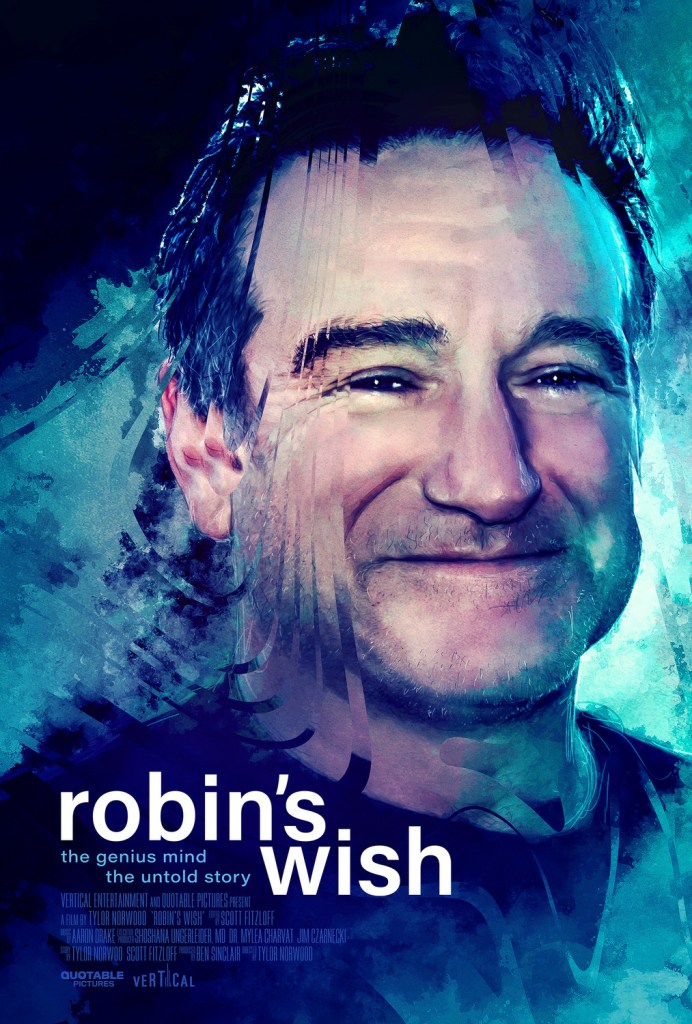
‘Robin’s Wish’ Sets The Record Straight About The Late Mr. Williams

As with the deaths of Jim Henson, River Phoenix and Phil Hartman, Robin Williams’ hit me like a punch in the gut and left me speechless for a time. Here is a man whose work I had followed ever since I first saw him in Robert Altman’s “Popeye,” and we have always known his brain to work at 100 miles a minute. He was an extraordinary talent who kept us laughing hard as he managed to improvise routines out of what seemed like thin air. The fact we were now living in a world without him seems unreal even today, and there are times when I think August 11, 2014 should be designated as the day the laughter died.

Among the striking images shown in the first few minutes of “Robin’s Wish,” other than the beautiful vistas of San Francisco and Marin County, are images of newspapers, magazines and tabloid rags which pondered over why the Oscar-winning comedian committed suicide. Was it because he suddenly left a 12-step program where he was dealing with alcoholism? Was he in dire financial straits? Was he upset the show which marked his return to television, “The Crazy Ones,” was cancelled after only one season? Did he really never get over the death of John Belushi? Did all those years of drug and alcohol abuse finally catch up with him? In the wake of his passing there were many questions, and they eventually became rumors which spread like wildfires. As many sought to get to the truth, the rest of us felt so far removed from it.

The documentary “Robin’s Wish” is filmmaker Tylor Norwood’s attempt to set the record straight about what really happened to Robin Williams and why he died. It also serves as a deep examination of disease Lewy Body dementia (LBD) which may sound new, but has actually been around for many, many years. We also get a close and personal look at Robin’s last days before his tragic death, and it proves to be both very sad and yet hopeful all at the same time.

Instead of a full-fledged biography, Norwood looks specifically at Robin’s evolution as an actor and comedian. We see Robin talk about how the brain is “an extraordinary three-and-a-half-pound gland” and that he does not have an act as much as he does a “cesspool of consciousness.” He discusses his time at Julliard in New York where he got heavy duty training as an actor, and of how he left before he could have graduated and moved back to San Francisco to find acting work. When he couldn’t find any, he started doing stand up comedy in which he succeeded in, as one close friend put it, in “demolishing” every single audience he performed in front of. Back then, everyone was in awe of his talents as his mind moved at lightning speed, and this was only the beginning. Like them, we were in awe of what he could do.

Throughout, the documentary moves back and forth from his life to the subject of the LBD which, while it may pale in comparison to Parkinson’s, Alzheimer’s or ALS, can be every bit as debilitating and deadly. UCSF Professor Bruce Miller is shown describing it as a devastating disease which is fast and progressive and a killer. It also increases mental disorders such as depression, anxiety and insomnia, and paranoia and delusions are also major symptoms. There is no none cure for this disease as of yet, and it usually ends in suicide. But even worse, is often misdiagnosed.

Robin’s widow, Susan Schneider, did not have a name for what killed her husband until she read his autopsy report. Initially, Robin was diagnosed with Parkinson’s, but this was not the case. Susan says had Robin known what he was suffering from while he was alive, then he would have at least had some peace. As for Professor Miller, he described Robin’s case as being the most devastating case of LBD he had ever seen, and he was amazed the “Good Will Hunting” actor could move or walk at all.

As “Robin’s Wish” goes on, we see how LBD came to affect the actor long before he died, and it is devastating to witness the effect it had on his comedic gifts. Whether it was on the set of “The Crazy One” or the third “Night at the Museum” movie, he started to have trouble memorizing his lines and coming up with stuff to improvise. At one point, he tells someone how he is not himself anymore, and you feel his disassociation around everyone to an infinite degree. To realize you are not who you once were has got to be horrifying.

Learning about this mental disintegration from friends and colleagues such as Rick Overton, David E. Kelley and Shawn Levy helps to shed light on what Robin was going through as LBD was already taking its toll on him. To see someone lose gifts few are ever endowed with is painful, and it also reminded me of the last time he was a presenter at the Oscars. Whereas in the past he would come up with some hilarious thing to say or take aim at Jimmy Swaggart (“Remember, there is no such word as audit in the Bible, okay?”), he simply just listed the nominees and read the winner. Many wondered why he seemed so listless, and now we know.

Schneider deserves a lot of credit for being so open about Robin’s struggles as she still feels the pain of his death from day to day. The love they had for one another was very real, and we see the two of them at their wedding and in many pictures which illustrated just how close they were to one another. She also shares why the two of them had to sleep in separate beds at one point as Robin’s insomnia worsened to where he woke up at early hours and accidentally injured her.

“Robin’s Wish” does make a solid case for how serious a disease LBD is, and after watching the documentary there is no doubt this is what killed him. It makes clear what a wonderful soul he was as he took the time to meet with soldiers who were wounded, children who were sick and others who needed a laugh during a dark time in their lives. It also makes clear of the fact Robin was clean and sober at the time of his death. Drugs and alcohol did not rob us of him.

If there is anything I feel is left out here, it is the thoughts and feelings of others close to Robin such as his children or his ex-wife Marsha Garces whom he was married to for 20 years. Their absence here makes me wonder how they feel about all of this. Perhaps they were not invited to participate or chose not to. Even though this is not meant to be a full out biography of Robin Williams, it feels like some pieces are missing which would have made this portrait more complete.

“Robin’s Wish” is not the easiest documentary or movie to sit through as we know how it ends. The void the famous comedian and actor left in his wake is still deeply felt all these years later, and it is impossible not to feel bad for his closest friends. This is especially the case for the one friend who was informed of Robin’s death over the phone by a reporter who said he died by suicide. This is not the way to inform someone of their friend’s passing.

Nevertheless, as sad as “Robin’s Wish” may seem, it also filled with hope. As debilitating as LBD was for him, he fought it like a warrior even if he did not know exactly what he was fighting. We are also reminded of his perspective on life which he earned through a lot of life experiences and mistakes he learned from. To him, life was always about other people, and he simply wanted to make everyone feel less afraid. Norwood definitely finds the right note to end this documentary on as, while Robin may be gone, he shows we can still carry on his legacy from one generation to the next. No one who knew Robin Williams will ever forget the impact he had on others, and no one ever should.

* * * ½ out of * * * *

Click here to find out how you can donate to the Lewy Body Dementia Fund of the American Brain Foundation.

‘Bill & Ted Face The Music’ Hits Just The Right Notes

After watching the trailers for “Bill & Ted Face The Music,” one question kept popping into my head: How can these two guys from San Dimas go from playing in front of the largest audience in the world to performing for a crowd of 40 in Barstow, most of whom were there for $2 taco night? At the end of “Bill & Ted’s Bogus Journey,” we saw news articles of them performing all over the place, and they even got to stage a concert on Mars of all places. Seriously, you cannot plummet from a height of fame like that, right?

Well, keep in mind that at the end of “Bogus Journey,” Bill and Ted did finally learn how to play their guitars, but they also performed a cover of “God Gave Rock and Roll to You” by KISS. We never did hear them play any original tunes. As “Face The Music” begins, we learn their debut song as writers opened big and then plummeted to the bottom of the charts in record time. Even worse, their follow up albums were ravaged by the critics, one who described their work as being “manure.” Taking this into account, it makes perfect sense they would end up performing in Barstow, a town in the middle of nowhere. Like Vanilla Ice, they shot up into the stratosphere and then saw their follow-up album being sold at a used record store for only 99 cents (and that’s on the day after it was released).

We first see Bill S. Preston (Alex Winter) and Ted Logan (Keanu Reeves) at the wedding of Missy (Amy Stoch). Yes, Missy is getting married, and just wait until you find out to who. The two use the occasion to present the world premiere of their latest work, and while they play instruments with more confidence than before, they are still unable to put together a cohesive song, and the response they get is much like the one Spinal Tap received when they told the audience they were going in a “new musical direction.”

Bill and Ted are still married to the princesses, Joanna (Jayma Mays) and Elizabeth (Erinn Hays), and they have two beautiful music-loving daughters in Theodora (Samara Weaving) and Wilhelmina (Brigette Lundy-Paine). Still, they have not yet written the song meant to unite the whole world, and it appears as if this destiny may have been misread. Furthermore, their daughters are in their 20’s and still living at home, and their wives are starting to tire of the lack of the direction in their husbands’ lives. Ted’s dad, Captain Jonathan Logan (Hal Landon Jr.), refuses to believe he and Bill could have traveled in time or gone to heaven and hell and begs them to get “real jobs.” Yes, middle age has hit Bill and Ted real hard to where they feel the need to reassess their goals.

Then into the picture comes Kelly (Kristen Schaal), daughter of the late Rufus, who takes Bill and Ted to the future to meet The Great Leader (played by Holland Taylor) who is not exactly happy with where they have ended up in life. From there, they are informed that the universe is unravelling and will be destroyed if they do not write the unifying song in the next 78 minutes. How about that? You are tasked with writing the song which will unite the world, and you have just over an hour to compose it. Talk about pressure! As we get older, 78 minutes doesn’t last as long as it used to.

Bill, however, comes up with a most excellent plan to travel with Ted into the future when they have already written the song and to take it from themselves. Ted considers this to be stealing, but Bill convinces him it isn’t as long as they are stealing from themselves. Hey, it worked for James Horner!

“Face the Music” comes to us more than 25 years after “Bogus Journey,” so it is hard to know what to expect. It reunites not only Reeves and Winter, but also screenwriters Chris Matheson and Ed Solomon who penned the previous two films as well. I am thankful to say this sequel is no “Blues Brothers 2000” which relied on an overabundance of nostalgia to where I found myself wanting to watch the original. Instead, it does come with some good laughs and a lot of heart as everyone involved has worked their damndest to bring this last chapter of Bill and Ted to the silver screen and digital streaming for dozens of years. Regardless of what you may think, no one is out to simply repeat themselves here.

Both Reeves and Winter are clearly having a blast as Bill and Ted keep traveling to different parts of the future in an effort to talk to themselves and get the song. This allows the actors to portray them in various ways to where we see them as has beens, a duo ever so in love with English culture, and hard-core prisoners who have bulked far more than you would ever have expected (nice makeup work by the way). Regardless of the many years which have passed them by, both actors slip back into their roles as if they never left them, and they keep these characters from becoming mere caricatures throughout.

Also, believe it or not, there is some evolution to Bill and Ted. Granted, they are still pretty dense when it comes to things like couple’s therapy, but they also realize how their famous sayings of “be excellent to each other” and “party on dudes” do not have the same resonance as they once did. Before they go on their latest excellent adventure, they have to realize they are at a crossroads as things cannot keep going the way they have been as things have got to change. Still, it is worth it to see them playing air guitar here and there even as they approach middle age with inescapable apprehension.

Both Weaving and Lundy-Paine are fun to watch as the daughters, and this is even though the section where they search for famous musicians to create a band is the film’s weakest. It’s a bit of an anemic retread of when Bill and Ted, on their “Excellent Adventure,” went back in time to gather historical figures for their final history exam. Regardless, it is cool to see Jimi Hendrix jam with a bewildered Mozart who has no idea what he is hearing.

It is also great to see William Sadler return as the Grim Reaper as he stole every scene he had in “Bogus Journey.” He too slips back into this hilarious character as if he just played him yesterday, and not once does he have to struggle to get a laugh out of any of us. Seeing the Reaper attempt to make peace with Bill and Ted over the fallout they had with all those 40-minute bass solos is not just one of “Face the Music’s” funniest moments, but also one of its most heartfelt.

Each of the “Bill & Ted” films have had a different director: Stephen Herek directed “Excellent Adventure,” Pete Hewitt helmed “Bogus Journey,” and behind the camera for this installment is Dean Parisot. As a result, each one has a different feel to it despite having most of the same cast and the same screenwriters. Parisot is a perfect fit for this entry as he is terrific at mining material for both laughs and heart, and he proved this with “Galaxy Quest,” one of the greatest cult movies ever made. “Face the Music” doesn’t reach the same heights as “Galaxy Quest,” but Parisot does show a lot of respect for these characters and gives this sequel the heart it deserves. More importantly, he gives it a fulfilling conclusion which truly put a big smile on my face.

Upon first watching “Bill & Ted Face the Music,” I have to admit my feelings on it were mixed as I hoped it would be funnier. But after watching it a second time, I found myself appreciating it more as speaks to the values of friendship and music, both of which we need in these crazy times. Whether or not this sequel is all you ever hoped for, it is clear everyone involved put everything they had into it, and I do hope the fans are satisfied with what they see.

Could a fourth “Bill & Ted” movie ever happen? I don’t know, and frankly this one serves as good conclusion. Seeing them rock out at the conclusion reminds me of what Neil Young once said:

“Rock and roll can never die.”

Damn right! Party on dudes!

* * * out of * * * *

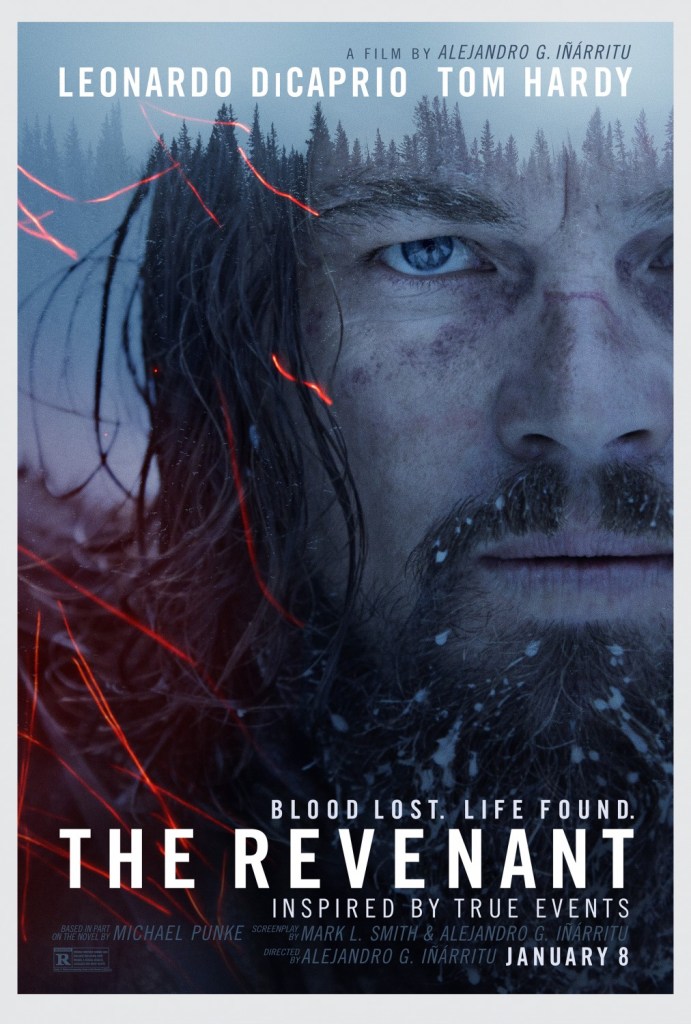
Alejandro Iñárritu Takes Us Through The Brutal Wilderness in ‘The Revenant’

Alejandro Inarritu pushed cinematic boundaries in 2014 with “Birdman,” and now he did it again in 2015 with “The Revenant.” Based on the novel by Michael Punke, the movie transports us back to 1823 when frontiersmen and fur trappers traveled the states of Montana and South Dakota, and some of them soon came to discover just how unforgiving nature could be.

Leonardo DiCaprio portrays Hugh Glass, a member of a hunting party searching the land for animal pelts. In a seriously intense scene, Hugh ends up getting mauled by a bear to where he looks to be on the verge of breathing his last breath. One party member, John Fitzgerald (Tom Hardy), becomes insistent on killing Hugh as dragging his seriously wounded body through the elements threatens to slow everyone down and put them all in the crosshairs of Indian tribes looking for revenge.

Fitzgerald ends up trying to smother Hugh to death, but he is interrupted by Hugh’s Native American son Hawk (Forrest Goodluck) who calls out for help. But Fitzgerald, overwhelmed by a fear of dying, ends up stabbing Hawk to death and gets the rest of the group to leave Hugh for dead and move on to safer grounds. But despite being so mortally wounded, Hugh rises up and pursues Fitzgerald over thousands of miles as he is driven by an unshakable force known as vengeance.

Inarritu, along with the brilliant cinematographer Emmanuel Lubezki, puts us right in the middle of the action to where we, like the characters, never feel safe for a second. Arrows are flying everywhere and we are in an environment which we are not as familiar with as we would like to think, so the specter of death is always just around the corner.

What’s especially brilliant about “The Revenant” is how it captures both the beauty and unforgiving nature of the wilderness. The vistas captured are incredible to take in but this is also a movie you will want to put on a heavy coat while watching what Inarritu has caught on camera. The weather is so fierce here to where you can’t help but wonder how anyone could possibly survive it. Heck, I cannot help but wonder what watching it would be like in a 4DX theater. Could theater owners bring the temperature to subzero levels and provide audience members with parkas?

With “The Revenant,” DiCaprio finally nabbed the Best Actor Oscar which had eluded him. While I wished he had gotten his first one for his go-for-broke performance in “The Wolf of Wall Street,” it seems very fitting he got it for a performance which has him suffering through the worst a human being could ever be forced to experience. In movies like “What’s Eating Gilbert Grape,” “The Aviator,” “The Departed” and even “The Basketball Diaries,” he has shown a fearlessness in delving into a character’s dark side or a part of them which can never be easily controlled.

DiCaprio makes you feel every ache, pain and broken bone Hugh experiences in his infinitely long journey. Much has been said about how incredibly difficult it was to make “The Revenant,” and it looks like few had it harder than this actor did. We watch DiCaprio traverse a viciously cold landscape while lacking the ability to talk, and he even resorts to an “Empire Strikes Back” form of survival by keeping warm in a dead animal’s carcass. DiCaprio has never been an actor to fake an emotion or deliver a moment less than truthfully, and he certainly doesn’t do that here.

Also excellent in “The Revenant” is Tom Hardy who, just like he did in “Mad Max: Fury Road,” portrays a character forced to survive in the harshest and most unforgiving of environments. Fitzgerald could have been just another one-dimensional villain in this movie, but Hardy imbues him with a wounded humanity that makes him far more lethal and frightening. Just watch the scene in which Hardy faces down the barrel of a gun and just try to think of another actor who could be as convincing as him in a moment like this.

Tremendous performances, amazing cinematography, the most vicious bear attack in recent cinematic history along with a haunting music score by Ryuichi Sakamoto, Bryce Dessner and Alva Noto help to make “The Revenant” one of the best and most unforgettable movies of 2015. Inarritu remains unwavering in his directorial vision and he has given us a movie that grabs you and never lets you go until the credits start rolling. While some motion pictures get overshadowed by their behind the scenes struggles, this one does not. Of course, this will not stop people from talking about the making of “The Revenant” for years to come.

Oh by the way, this movie is “inspired by true events.” This is much more honest and fitting than saying it is “based on a true story.”

* * * * out of * * * *

WRITER’S NOTE: When this movie was released, some were under the mistaken impression that Leonardo DiCaprio’s character got raped by a bear in one scene. This rumor ended up spreading like a wildfire, but anyone who has seen “The Revenant” can attest this is not what happened at all. DiCaprio gets attacked because he accidentally comes across some bear cubs, and this shows that you never ever mess with the mama bear.

‘Burn After Reading’ – Another Darkly Comedic Film From the Coen Brothers

WRITER’S NOTE: Ralph Garman selected this as his Video Vault pick on the August 14, 2020 episode of “The Ralph Report.” It was an excellent selection on his part.

WOW! That was quick! Following Joel and Ethan Coen’s Oscar-winning masterpiece “No Country for Old Men” in 2007, they gave us their follow-up of “Burn After Reading” a short later. Some filmmakers take their sweet time following up a cinematic triumph of theirs, but the Coens did not want to waste any time. This film follows the tradition of them making a movie which is the polar opposite of what they previously gave us. Most reviews at the time mentioned of how the Coens went from making “Fargo” to giving us “The Big Lebowski,” and how they went from “The Man Who Wasn’t There” to “Intolerable Cruelty.” With these brothers, it is always important to expect the unexpected because they are never out to do the same thing twice.

I’m not going to bother comparing “Burn After Reading” to “No Country for Old Men” because the only thing these two have in common is they were made by the same people. It’s like comparing the Marx Brothers’ “Duck Soup” to Lars Von Trier’s “Breaking the Waves,” and this threatens to say more about the critic than it does about the films themselves. This particular one is more of a lightweight effort you could ever expect from the Coens, and it is a reminder of how hysterically dark their comedy can get.

“Burn After Reading” is a crazy movie to say the least, and it does not really have a plot as much as it does a plethora of characters who are unleashed on us through a selfish act of utter stupidity. As a result, there is no rug of any kind which can tie this room of a movie together. The main drive of the action comes from Chad Feldheimer (Brad Pitt) who discovers a disk at the gym he works at which contains classified information from a former CIA operative, Osborne Cox (John Malkovich). Along with his fellow co-worker, Linda Litzke (the always fantastic Frances McDormand), they both connive to act as “good Samaritans” and give the disk back to Osborne, providing he pays them several thousands of dollars as a reward. Naturally, this plan, which was not given much thought to begin with, goes awry and involves many others in this scheme, all of whom are never entirely sure of what they have gotten themselves into, or of whom they can trust.

Let’s look at the characters, shall we? Chad is a personal trainer at the Hardbodies gym who is, to put it mildly, rather dense and not playing with a full deck. His manager, Ted Treffon (Richard Jenkins) doesn’t want to get involved in this blackmail plan, but he simultaneously has a huge unrequited crush on Linda, and she is upset because her insurance won’t cover the various forms of plastic surgery she wants to get. In the meantime, she is going through the motions of internet dating and ends up meeting Harry Pfarrer (George Clooney). Harry is actually married and in the midst of an affair with Osborne’s wife, Katie (Tilda Swinton), and she herself is planning to divorce her husband who is now in the midst of writing his memoirs. In the midst of all this, CIA Officer Palmer DeBakey Smith (David Rasche) reports to his superior (the priceless J.K. Simmons) of the goings on, and of the ways they are going to keep this all under wraps.

Are you with me so far? Clearly, this is a movie which will benefit from more than one viewing to keep up with everything. Like I said, there is no real plot to speak of, other than the blackmail of Osborne Cox. While in some movies this would be an Achilles heel, it works for the Coens as it allows you to keep guessing as to what will happen next. Just when you think you know where things are going, it has another surprise up its sleeve. There were moments both funny and shocking, and I was eager to see what would happen next.

“Burn After Reading” combines a lot of actors the Coen brothers have worked with over the years like George Clooney and Frances McDormand, and they also got to add newcomers to their strange cinematic universe like John Malkovich and Brad Pitt. It’s a kick to see all these actors let their hair down in a film which was never meant to be taken seriously by anyone.

The most inspired performance in this movie comes from Pitt. Clean shaven, thin, buff, and an avid bicycle rider, his character is a hilarious creation of a physically fit moron who has no clear idea of just how in over his head he is. It was funniest performance since his ultimate stoner of a character, Floyd, in “True Romance.”

Another one who is a huge kick to watch here is Clooney as he blows away just every bit of coolness in his system to play an increasingly neurotic philanderer who is always on the verge of anaphylactic shock as he keeps warning everyone he hangs out with about his life-threatening allergies. To see Clooney let loose here is a reminder of how he constantly tries in real life to not take himself too seriously. It also makes you wonder if he and Swinton will ever be in a movie together where they play characters who have a healthy relationship with one another. Keep in mind, they previously appeared together in “Michael Clayton.”

It’s actually a shock to realize this is the first time Malkovich has ever worked with the Coen brothers. He lets it all out here as a CIA operative who quits his job after being demoted in part because of his drinking problem. To see this actor go completely nuts at all the complete idiots he has to deal with is such a hoot. Not many actors can play a character who is quick to absorb the situation they are in and yet still remain in the dark when it comes to the truth of the matter. Malkovich may prefer the stage to the silver screen, but it is always great to see him do something like this.

Frances McDormand gives this movie one of its most lovable characters, in a manner of speaking, as she makes Linda into someone who wants to be free of the ravages of getting older. Seriously, give McDormand the smallest role in a movie, and she always succeeds in making it one of the most unforgettable. If you would like further proof of this, check her out in John Sayles’ “Lonestar.”

Richard Jenkins ends up giving us perhaps the saddest character here, and it is one we hope we don’t end up being. You know, that one person who is forever punished eternally with the pangs of unrequited love. Throughout, Jenkins shows you in his eyes of how much he wants to be with Linda, and he reminds us of how he remains one of the most dependable character actors working in movies.

And I loved the scenes between Rasche and Simmons in the offices of the CIA and how flippant they seemed about the situations which occurred here. I have yet to see another movie where you have CIA members seeming rather laid back in the decisions they make. It never comes down to doing what is best for their country, but of how to make this strange chain of events not get too overwhelming or hectic. Their inconvenience is the biggest problem because it involves secrets getting out, and of more responsibility and paperwork. Seriously, who wants that?

“Burn After Reading” may not be on the same comedic level of brilliance like “The Big Lebowski” or “Raising Arizona,” but it sure is a lot of fun and filled with more daring and originality than many movies which came out in 2008. Many have described it as a “trifle” from the Coens, but you have to admire what they accomplished here as it never fails to entertain from start to finish. We can also take comfort in the fact that these brothers continue to entertain and enthrall us from one film to the next, and their artistic brilliance never lets us down.

* * * ½ out of * * * *

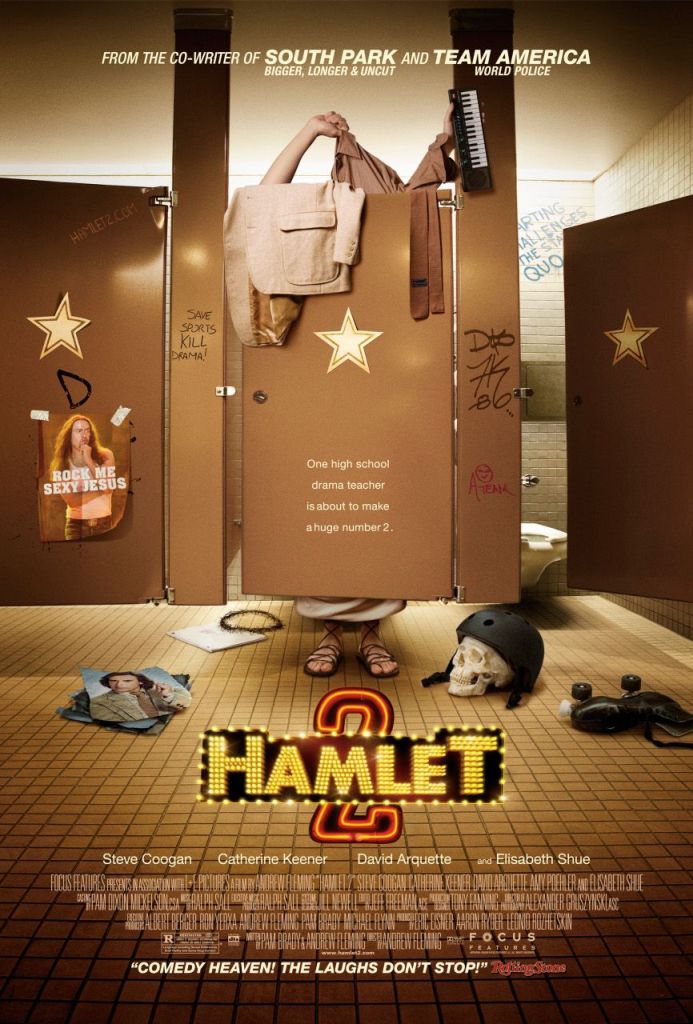
‘Hamlet 2,’ A Most Unusual and Unexpected Sequel

WRITER’S NOTE: Eddie Pence selected this as his Video Vault pick on the August 15, 2020 episode of “The Ralph Report.” But while the host of the podcast, Ralph Garman, was not particularly crazy about it, I think it is better than Garman gives it credit.

“Hamlet 2” starts off with an invisible voice telling us that to be an actor, you have to live in a dream. But dreams do die however, and the question posed here is this: Where dreams go when they die? Well, if you are Dana Marschz (played by Steve Coogan), then you go to Tucson, Arizona to spend the rest of your life teaching high school drama. Being an actor myself, there is something quite scary about the fate of this particular actor who is best known for his herpes medication commercials. Here in Arizona, he hopes to pass on his love of acting to high school students, and this is the thrust of the plot which powers up a motion picture dealing with one of the most unlikely sequels ever to be created.

“Hamlet 2” was a big hit at the Sundance Film Festival, and while it didn’t quite live up to the hype in my eyes, it was still a very clever movie which kept me entertained from beginning to end. It is a hilarious look at how art can never truly be suppressed, and this includes art which was never all that good to begin with.

We meet up with Dana Marschz sometime into his career as a high school teacher, and he only has two students, Rand Posin (Skylar Astin) and Epiphany Sellers (Phoebe Strole), who really seem to care about drama and acting. His latest class, he discovers, is largely populated by Latino students who are in attendance because their other electives have been cut, and drama is the only one left. It reminds me of all those high school kids with who were in drama class because was the only one they could get an easy A in other than physical education. Dana, however, is convinced this is being presented to him as a challenge he must face with no fear. While these students may seem unenthusiastic about drama, he is determined to change their minds.

Dana’s existence is a recovering alcoholic with a wife named Brie (played by the great Catherine Keener) who drinks a margarita from a gigantic martini glass. They also have a boarder, Gary, (David Arquette) who is sleeping with Brie while Dana rollerblades to school because he cannot afford a car. His gift to the high school is plays he wrote which are direct adaptations of the movies “Erin Brockovich” and “Dead Poets Society.” Still, they get ripped to pieces by a young critic who shows no mercy for Dana’s passion. Dana’s basic cry for all the negative criticism is, “He fisted us!”

Dana ends up conversing with this unsympathetic teenage critic to seek inspiration, and he suggests to Dana that he write something original and put everything into it. Thus, he comes up with what in many ways is a completely unnecessary sequel to one of William Shakespeare’s most famous plays, “Hamlet.” There is a rather large problem though as just about every character dies at the play’s end. But Dana, still up for an artistic challenge, remains undeterred by this, and he comes up with a device to solve this problem in the form of a time machine. Upon discovering the rather racy nature of the play, the most suburban students do everything they can to keep it from being performed, but Dana ends up proving to everyone that you cannot stop art.

It’s a little hard for me to critique “Hamlet 2” objectively because Dana’s fate is one I hope to avoid. It is made clear from the outset that he is not particularly talented, and we get a montage of scenes featuring him as an actor. The funniest one is a commercial he did for Herpes medication as he tells us, “Right now, I am having a herpes outbreak. But you wouldn’t know it!”

In the process of writing and directing his sequel play, it gets banned from being performed at the high school, and Dana ends up inspiring the Latino kids to put it on at another location. He even gets help from the ACLU to keep his play from being censored. Talk about free publicity!

“Hamlet 2” is a terrific star vehicle for Coogan, and he is never afraid to make himself look completely silly. He shows no fear in portraying Dana as a complete failure both as an actor and a drama teacher. That he somehow inspired these students who have grown up in a far different environment than his is pretty amazing. But in the end, it doesn’t matter if Dana is really bad or good because he gets the play up to the excitement and infuriation of everyone in Tucson, Arizona, the city where dreams come to die. Coogan proves to be a brilliant comic actor here, and he still is all these years later.

The director and co-writer of “Hamlet 2” is Andrew Fleming, and he does a good job of not taking things too seriously. Fleming started off his career as the writer and director of the “A Nightmare on Elm Street” wannabe, “Bad Dreams” (this title tells you all you need to know). From there, he went on to direct “Threesome,” “The Craft,” “Dick,” and “Nancy Drew.” Suffice to say, he has been around for a while, and this film proved to be one of his stronger efforts.

“Hamlet 2” also features a terrific performance from Elisabeth Shue who plays herself here. In this movie, she has given up on acting and appears to be much happier working as a nurse in a sperm bank. Dana goes gaga over Shue and invites her to speak with his class, but they have no idea who she is. We all remember her from “The Karate Kid,” and she earned a much-deserved Oscar nomination for her unforgettable performance in “Leaving Las Vegas,” but over the years her star has not ascended in the way we thought it would. Still, she works constantly and is always on the verge of giving us her next memorable performance. And, as “Hamlet 2” shows, she has a great sense of humor about herself.

Anybody who has ever been involved with community theater or in high school plays will get a kick out of this film. In retrospect, the high school students were the ones who manage to get the show up and running, and this is shown here. That Dana manages to inspire these kids through his embarrassing ways is astonishing. When you are already deep into the production of a show and your director flakes out or becomes useless, you can’t just give up. As Dana’s personal life hits rock bottom, it’s those kids who pull him up from the abyss.

I also like how “Hamlet 2” got into the conflicts Dana has with the school and parents because everyone in these situations always acts in an overly conservative way. As time goes on, I get more interested in what does not offend people because it seems like we are always looking to get mad about something. Granted, you can see why people might object to Jesus Christ kissing Satan or with a song entitled “Rock Me Sexy Jesus,” a song which was criminally robbed of an Oscar nomination. But everyone in the end is saved due to the protected freedom of the 1st amendment of the Constitution. That pisses a lot of people off, but that’s their problem.

The ACLU eventually gets involved when the show is threatened to be shut down, and a lawyer comes to visit Mr. Marschz to lend her help. She is played in a kick ass scene stealing performance by Amy Poehler. Her character of Cricket Feldstein is a ball buster about protecting the production, and she makes sure everyone involved gets to put it up. Her disinterest in whether or not the play is any good (“It’s irrelevant,” she says) is hilarious, and Poehler continues to show why she is one of the funniest actresses ever.

“Hamlet 2” is a lot of fun to watch, and the play which comes out of it is a hoot as it is a quasi-musical in which Hamlet and Jesus team up to change the past. Granted, they take all the drama and tragedy out of Shakespeare’s “Hamlet,” but it is a little hard at times to argue with Dana who calls the play “a real downer.” In addition to “Rock Me Sexy Jesus,” there is another song called “Raped in The Face” which is Dana’s stab at the critics who keep taking apart his plays based on movies. The song title alone demands your complete attention.

All the same, I wished the filmmakers had pushed the envelope a bit more. Seriously, you have to expect some envelope pushing when one of the writers, Pam Brady, is from “South Park.” I’m not saying “Hamlet 2” had to be insidiously evil, I just wished the satire in parts was a little sharper. Or perhaps I got a little depressed with Dana’s station in life because it is one I hope to avoid in my own life, and this made it hard for me to be more objective about what I saw. Still, this comedic film has stayed with me since I first saw it, and at some point, I need to watch it again.

Shakespeare once wrote about how all the world is a stage, and he was absolutely right. We are all merely players in this crazy thing called life, and “Hamlet 2” plays with this to such an enthusiastic extent to where I wonder if another “Hamlet” sequel is in our future. Or better yet, maybe we can get a “Romeo & Juliet” sequel as young love does not have to be so infinitely depressing. Seriously, everyone deserves a second chance.

* * * out of * * * *

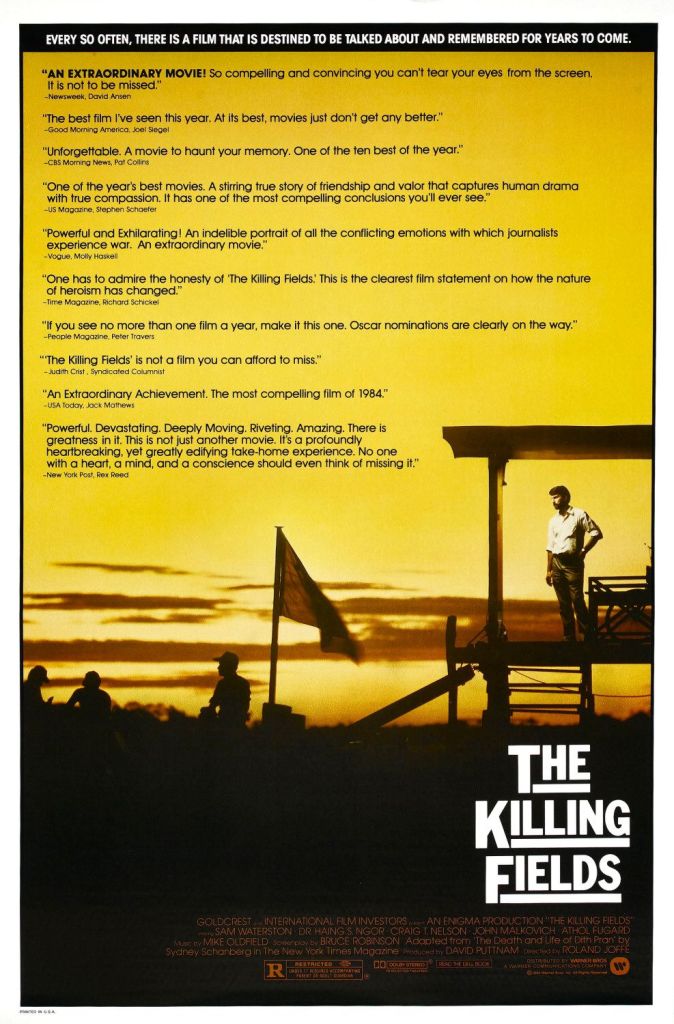
No, I Haven’t Seen It Until Now: ‘The Killing Fields’

I remember renting this film from Netflix a few years ago and telling my friends what I was about to watch. I got a good dose of jaws dropping open and many of the same responses:

“Oh, that’s a fun one!”

“Go into it with a strong stomach. There are scenes in it that will pulverize you!”

“Not a fun movie!”

I remember hearing a lot about “The Killing Fields” when it was first released back in 1984, but it took me until recently to finally sit down and watch it all the way through. From a distance, it looks like another in a long line of movies about the Vietnam War and of the terrible damage it left in its wake. But in actuality, it takes place in Cambodia when the country is in the midst of a civil war with the Khmer Rouge regime; a result of the Vietnam War spilling over the country’s borders. It is based on the memoirs of award-winning American journalist Sydney Schanberg who was a correspondent for The New York Times, and of how he spent years reporting the endless fighting and bombing which took place in Cambodia and Laos. Along with photographers Jon Swain (Julian Sands) and Al Rockoff (John Malkovich), he works to capture the reality of this horrific situation as it escalates into something far worse, and before the United States military can sanitize what is being presented for public consumption.

But as much as “The Killing Fields” is about what happened in this conflict, it is really at its heart a story of friendship between Sydney and his translator, Cambodian journalist Dith Pran. Together, they work to get to the unvarnished proof of the situation and risk their lives in many instances. In the process of escaping Southeast Asia with their lives, Schanberg helps Pran’s family escape, but as the Americans get ready to leave, they are forced to give up Pran as the new regime wants all Cambodian citizens to be returned to them. This leads to a guilt ridden Schanberg spending as much time as possible searching for Pran through humanitarian services and government officials. While he does so, we watch Pran being subjected to forced labor under the “Year Zero” policy the Khmer Rouge initiated to destroy the past and start a new future.

The scene where Dith Pran stumbles upon the corpses left to rot in the Cambodian fields is where the movie gets its name, and these images will never leave my mind. In that moment, director Roland Joffé captures the vicious and evil nature of Pol Pot, Cambodia’s answer to Adolf Hitler. What happened in these fields is no different from what the Nazi’s had done to the Jews during World War II. But what’s even worse is this same kind of ethnic cleansing is still being exacted in different parts of the world today. Some might foolishly think the events of “The Killing Fields” have no real relevance to what we are suffering through today, but nothing could be further from the truth. In fact, with this movie, we get depressing proof of how history repeats itself.

What gives “The Killing Fields” even more emotional heft is that Haing S. Ngor, who plays Dith Pran, went through the same ordeal as did his real-life counterpart. It is impossible to watch Ngor here without knowing he shared a horrifyingly similar experience as he had to convince the soldiers he was an uneducated peasant. Had they realized Dith was really an intellectual and a reporter, he would have been killed right on the spot. Ngor was not a professional actor when he got cast, so he doesn’t act as much as provide an undeniably human face of what Cambodians were forced to endure when the Khmer Rouge came to town, and he gives what is undoubtedly one of the bravest performances I have ever see. Forget the Oscar; Ngor should have received the Purple Heart!

But as great as Ngor is, let’s not leave out the other actors whose work is every bit as good. Sam Waterston plays Sidney Schanberg, and this was long before he got involved in that long-running show with the overbearing “chung CHUNG” sound. Waterston does exceptional work capturing Schanberg’s relentless quest for truth and presenting it for all the world to see. Throughout, we see him stubbornly pursue whatever sources are available to him regardless of how it puts his life and the lives of those close to him in constant mortal danger. This later leads to a deep sense of guilt as he encouraged Dith Pran to stay with him even though he was at greater risk than anyone else in his circle. Waterston captures the complexities of a reporter who sees the importance of getting at the heart of a story as well as the large cost which becomes all too difficult to deal with.

In addition, we have John Malkovich in one of his earliest roles, and we see the unrelenting intensity he brings to Al Rockoff as he quickly recovers from an explosion which goes off right next him. Almost immediately, Malkovich jumps right back up to take as many photos as possible. Julian Sands also has one of his earliest roles here as fellow photographer Jon Swain, and this was long before he got stuck in those “Warlock” movies. Plus, you have Craig T. Nelson on board as Major Reeves, the face of the military officials who work to cover up American mistakes while maintaining whatever control they have left over an increasingly chaotic situation.

And then there is the late Spalding Gray who co-stars as the U.S. Consul, and his experience of making “The Killing Fields” ended up inspiring his one-man monologue “Swimming to Cambodia.” Hence, another career was born thanks to this movie which led to many more immensely entertaining monologues performed by him until he left us ever so tragically.

Looking back, it’s surprising to see “The Killing Fields” marked the feature film directorial debut of Roland Joffé. From watching this, I figured he had been directing motion pictures already for decades. Nothing on display here ever feels like it was staged or overly rehearsed. Joffé makes you feel like you are watching a very in-depth documentary which no one else could have pulled off, and that is saying a lot.

Joffe was also aided greatly by Director of Photography Chris Menges, who won an Oscar for his work here, as he captures a land and a time which is anything but sentimental. Composer Mike Oldfield, best known for composing and performing “Tubular Bells,” also provides an original sounding film score which heightens the horror and unrelenting chaos consuming Cambodia and those unlucky enough to be stuck there.

All these years later, “The Killing Fields” remains an immensely powerful cinematic achievement, and I wonder if people still think about it as much as they did back in the 80’s. Ngor, who won the Best Supporting Actor Oscar (I was rooting for Pat Morita who was nominated for “The Karate Kid“), was murdered during a robbery in downtown Los Angeles outside his home in Chinatown. Knowing he survived the horrific fate which consumed and destroyed the lives of many Cambodians only to have his life cruelly ended in such an utterly senseless crime makes watching this film today seem all the more tragic.

As for Joffé, he went on to direct “The Mission” with Robert DeNiro and Jeremy Irons which received critical acclaim. But then he helmed the dreadfully miscalculated adaptation of “The Scarlet Letter” which changed the end of the book and added more sex to it for all the wrong reasons. Then he went on to direct “Captivity,” a movie so blatantly unwatchable I turned it off after less than 20 minutes. You look at “The Killing Fields” and then at “Captivity,” and you wonder what the heck happened to this guy.

I am really glad I finally took the time to watch “The Killing Fields” long after its original release in 1984. Even if its Best Picture montage give away the film’s ending, it did not take away from the experience of watching it. This proved to be not just a great directorial debut, but a great collaboration of artists who completely sucked you into the reality of a place and time many of us would never want to experience up close. So many years later, this is a cinematic masterpiece which forces you to experience what people go through. There’s no way to come out of “The Killing Fields” without being deeply affected by it.

I desperately tried to resist using this cliché, but I have to say it; they don’t make movies like this anymore. With Hollywood’s constant obsession with comic book and superhero movies, let alone the latest unnecessary remake, you have to wonder if we will ever see a movie like “The Killing Fields” ever again.

* * * * out of * * * *

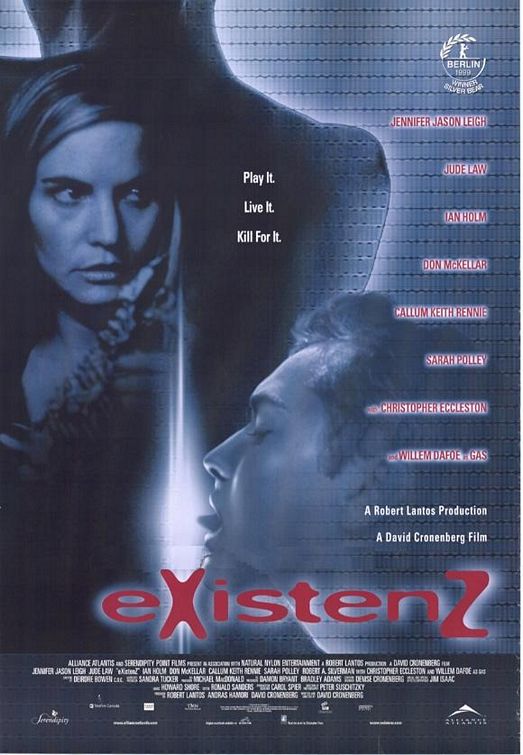
Underseen Movie: David Cronenberg’s ‘eXistenZ,’ a Cerebral Version of ‘The Matrix’

David Cronenberg’s “eXistenZ” is a film I like to describe as being the cerebral version of “The Matrix.” It gets you to question the reality the characters are in all throughout the movie, and it continues Cronenberg’s exploration of the blurring line between reality and fantasy. With “The Matrix,” it was clear what was real and what was not. But with “eXistenZ,” you can never be sure what is truly real, and its ending will leave you guessing for a very long time. But to quote the title of a certain U2 song, one has to wonder if everyone here has found something which is even better than the real thing.

“eXistenZ” stars the always awesome Jennifer Jason Leigh as Allegra Geller, a well-known game programmer who we first see about to try out her latest game which is said to be like no other. While most new game consoles come in these big metal boxes, Allegra’s box is more of an organic creation as it looks like a sizable piece of human skin which looks to be living and breathing when activated. To play the game, you have to hook a cord, one which looks eerily like an umbilical cord, into a port in your back which connects the game to your spine. Like many a Cronenberg movie, “eXistenZ” deals with the degradation of the human body as well as the human soul.

In the course of testing out the game to an excited crowd, Allegra is nearly assassinated by a man who is intent on eliminating what he sees as a threat to reality. From there, it becomes clear a war has begun between those who want to preserve reality by destroying the gaming industry, and those who want to preserve games and see them be taken to another level of advancement. Allegra is forced to go on the run, and coming along with her is a young marketing trainee, a shy nerd of a man named Ted Pikul. Pikul is played by Jude Law, and it is a role no one could probably see him playing these days. Ever since he showed off his tanned body on the sunny shores in “The Talented Mr. Ripley,” he has become a sexy god to so many. There’s nothing sexy to this character he plays here or, at least, not right away.

In the course of the attack, Allegra’s gaming pod is damaged, so she has to play the game to see what needs to be fixed. She encourages Ted to play it with her, but he is not terribly enthusiastic about doing so as he is a virgin to these kinds of games. He has never played them before, and he does not have a bioport in his back which is essential to playing the game. Moreover, he does not like things like bioports or needles being inserted into his body. But Allegra eventually encourages him to play along, and he does get a bioport jack hammered into his back courtesy of Gas (the always reliable Willem Dafoe). From there on out, Allegra’s and Ted’s voyage through the game will challenge their perceptions, and it has them wondering where they really are in all of this.

I remember seeing “eXistenZ” at an art house movie theater in Orange County when it was first released. Along with the characters, I was ever so eager to experience what they were experiencing when they played this game. While it felt like it took forever to get to their game experience, it turned out to be nothing like I could have ever expected.

With our infinite advancements in technology, the story is now far more frightening than ever before. Cronenberg is questioning how far we will go in our pursuit of the high which is virtual reality. Once we have experienced the game, will we even want to leave it? Will it make our “normal” reality feel more unreal? Everyone seems to be stuck in jobs they hate but have to work at, and they always dream of a better life for themselves which they constantly wait for instead of making it actually happen. Could this be accomplished through a game? Maybe not, but with the way technology continues to advance, anything is possible.

The other fascinating thing about “eXistenZ” is how it looks at the moral boundaries these characters cross. The games we play on the latest PlayStation or Xbox console seem to have this effect, but we can easily see we are indulging in a fantasy which makes everything okay. But as the line between reality and fantasy blurs all the more, the consequences seem all the more brutal and fiercer, and these characters end up crossing a line they can never undo. When we cannot tell reality from fantasy, how can we justify the horrible things we do to others?

Cronenberg’s movies have a look all their own, and “eXistenZ” has his signature touch throughout. What other director could come with an organic pod for game playing, or with a gun made out of animal bones with teeth used as bullets? Even in the game the characters are playing, the violence is still pretty vicious, and no death ever looks pretty. This is also typical with Cronenberg’s movies as we see faces blown off to where certain people look like Harvey “Two Face” Dent from “The Dark Knight.

Leigh and Law are always terrific in just about everything they do, and their work in “eXistenZ” is no exception. Leigh, who usually plays characters who are anything but pretty, is an alluring presence throughout as she not only manages to seduce Law, something which cannot be all that hard to do, but she also succeeds in seducing the audience into the world her character inhabits. This is what her performance needed to accomplish in order to make this film work, and it should make one admire her acting skills all the more.

If “eXistenZ” were made today, I’m not sure we would be seeing Law in this role as he would probably seem too cool to play such an awkwardly social character. People get used to seeing you in a certain way, and it can get to where no one wants to see you as anything else. It’s a shame because Law truly is a great actor, and seeing him go against type here as a man who has to overcome his phobias and aversions in order to play the game and help Allegra is endlessly enthralling. The effect it has on him is immense as it unlocks unconscious desires which quickly rise to the surface. Law portrays this evolution of his character very effectively, and he has great chemistry with Leigh from start to finish. Heck, is it possible for Law to not have good chemistry with any actress?

The ending of “eXistenZ” will leave you with more questions than answers. This may frustrate a lot of audiences, but Cronenberg has not always been one to give you conclusions which tell you all you need to know. You come out of his movies thinking about what you have just witnessed, and this makes his work stay with you long after the end credits have concluded. It is not an action-packed film like “The Matrix,” and you won’t see a lot of actors wearing skin clad leather costumes and wearing cool sunglasses here, but this movie stands on its own as an examination of where technology is taking us. Like “Videodrome,” it threatens to be a very prophetic film as we head further and further into the new millennium with technological discoveries which put us into the action and other realities more than ever before.

We are still all on a search for something which is even better than the real thing, and it’s never gonna stop. But after watching “eXistenZ,” I am reminded of the need for limits on things as many, especially in America, continue to act like children instead of being the adults they have been for some time. Facts should be indisputable, but a reality other than our own is always far more appealing than what our current existence resembles.

* * * ½ out of * * * *

Alan Parker’s ‘Angel Heart’ is a Devastating Descent Into Hell

Angel Heart” is a heavily atmospheric movie which makes you feel the coldness of New York and the never-ending heat of Louisiana in the summertime which makes you sweat like nothing else can. It is not a loud slam bang movie, and it does take its sweet time in setting up the story and the locations which the characters exist in. Each city proves to be an important character, and they reflect the nightmares and dreams of the main characters. If this movie were made today, I imagine the studios would want the actors cast in it to be younger and hipper and take away some of the dark stuff. I hope this is one Hollywood can leave off of the remake table.

Back when this was made, Mickey Rourke was a much bigger star, and this is one of the many movies he starred in without shampooing his hair beforehand. As Harry Angel, he does excellent work in making this New York City private investigator seem tough and sleazy, yet resourceful and vulnerable. Harry’s life unravels faster and faster as he digs deeper and deeper into the mystery which surrounds him. Watching Rourke here reminds me of what a strong and brave actor he can be when given the right material. Back then, he was not afraid to play someone whose dark side could often prove to be overpowering. His off-screen antics seemed to get the best of him over the years, but thanks to his performances in “Sin City” and “The Wrestler,” there is no forgetting who he is.

The movie credits itself for having “a special appearance” by Robert De Niro. Special appearance? This seems to imply you see him in the movie only once. On point of fact, we see him several times throughout as Louis Cyphre (pay close attention to this name). It is one of the few performances where De Niro never goes over the top and becomes a threatening force without ever having to put much effort into doing so. As Cyphre, De Niro gives a delicious performance of a man endlessly fascinated by the corruption and decay of the soul, and it appears he finds this as delicious as the hard-boiled eggs he always has on hand to eat. When he says the egg is the symbol of the soul and then slowly bites into it in front of Harry, it is a very chilling moment.

Lisa Bonet was deep into playing Denise Huxtable on “The Cosby Show” when she was cast in “Angel Heart.” I imagine the MPAA tricked themselves into giving this film an adults only rating because they got all hot and bothered at one Cosby’s television daughters showing her breasts. I can see them now:

“We can’t let kids see this movie! They will never look at one of television’s famous daughters the same again! This will destroy their innocence!! Won’t somebody think of the children?!”

Alan Parker, who directed “Angel Heart,” ended up cutting out ten seconds of the sex scene between Rourke and Bonet in order to secure an R rating. Upon its release on video and laserdisc, those ten seconds were restored. I first saw this film at New Beverly Cinema which prides itself on showing everything in 35mm, so I can only assume I was watching the theatrical version. But seriously, you cannot convince me this deserved to be an NC-17 movie even with those extra seconds. People can be so testy for all the wrong reasons.

A lot of the controversy surrounding “Angel Heart” almost hides the fact Bonet is actually really good here. A lot of people probably assumed she got the role of Epiphany Proudfoot because of her success on “The Cosby Show,” but Parker made it clear to everyone he picked her because he felt she was right for the part. Having seen this movie, I completely agree. I also have to admit it was fun seeing her naked, but anyway. Epiphany (perfectly named by the way) is a mysterious person who seems to say everything yet reveals nothing, and Bonet captures her character’s mystery very well to where she keeps us guessing.

Parker made many great movies over the years like “Birdy” and the cinematic experience which is “Midnight Express” to name a few. Like “Angel Heart,” they deal with lost souls trying desperately to free themselves of whatever is holding them back. There is a lot holding Harry Angel back, but when he finally gets to the truth, he will find that being held back was actually a blessing he could never see. Parker gives the movie a distinctive look as it takes place in the 1950’s, and he directs the actors very well and gives each a memorable moment which sticks with you long after the lights come up.

Trevor Jones composed the music score, and he does great work capturing the tension and atmosphere. Right from the start, he aids the filmmakers in realizing the horrifying truth Harry has spent the entire movie trying to find.

The first official trailer for “Angel Heart” goes out of its way to make it look like this is the second coming of horror by comparing it to “The Exorcist” and “Chinatown.” This proved to be a bit misleading as this film does not quite reach the heights of those two classics, and it really stands out as being from them. Still, it is a very good film which once against demonstrates Parker’s unique gifts as a filmmaker.

It did not receive much of an audience upon its release which almost led to me putting this in my “Underseen Movies” category, but it has since received a significant cult following throughout the years. Here is hoping that cult following will continue to grow, and that the remake train will leave this one off its passenger list. Seriously, Hollywood really needs to try more original stuff.

* * * ½ out of * * * *

Underseen Movie: Alan Parker’s ‘Birdy’ Starring Nicolas Cage and Matthew Modine

Birdy” is a great movie and a deeply felt character study about two young men who grow up together, and who are forever changed by the war they are drafted into. The movie is based on a book by William Wharton which chronicles two characters who are thrown into World War II. For the film, it was changed to Vietnam as the screenwriters, Sandy Kroopf and Jack Behr, wanted to work with their own youthful experiences. The story starts out with the two main characters who are now out of the Vietnam War, but who are forever scared by it permanently. In the end, they see all they have is each other.

Events move back and forth in time as we first see Nicolas Cage’s character of Alfonso “Al” Columbato coming out of the hospital following a bomb explosion which seriously disfigured his face. Bandaged like a Frankenstein creation, or like Michael Myers at the beginning of “Halloween 4,” he is no longer the ladies’ man we see getting to first base in scenes from his past. From there, Al travels to another army hospital where Birdy (Matthew Modine) is holed up in a cell not saying a word. After the damage the war has done to him, Birdy (we never learn his real name) has seemingly accomplished what he has set out to do – to become a bird in his own mind.

“Birdy” then shifts to their high school years in Philadelphia when Al and Birdy first met. While they initially seem like complete opposites, we come to see they want the same thing in life: to fly away from their problems. With Al, he has an abusive father to deal with who thinks nothing of smacking his son around when he screws up, and being on the high school wrestling team helps him deal with his utter frustration of not being able to stand up to him. With Birdy, he has a tough as nails father who is nowhere as sympathetic and understanding as his janitor father, and who is always taking away the baseballs that the kids unintentionally keep batting into her yard. Both Al and Birdy keep coming up with schemes to make money while hoping for an escape from their meager existence. But when it comes to flying away, Birdy is a far more literal about it.

Al really represents Birdy’s strongest link to the outside world as he falls deeper and deeper into his obsession with birds and in wanting to fly like one. He never shows much interest in anything you expect teenagers to indulge themselves in like girlfriends, making out, or being normal. One of the funniest expressions Birdy has is when he talks about how bad he feels for women as they have to have breasts which they just have to carry around and how they flop all over the place. I can’t think of anyone else who would make such a ridiculous argument, man or woman.

The scenes in which Birdy spends time with a beautiful yellow canary he gets and names Perta are some of the most memorable to found here. This is not just some National Geographic special you are watching as we see him studying birds ever so closely, almost making love to them. There is one amazing sequence where he dreams he is flying like a bird and director Alan Parker shoots the scene from a bird’s eye view as we go around people and fly over cars and then way up into the sky above. All this done to the instrumental version of Peter Gabriel’s “Not One of Us,” and this is one first movies to make use of the Skycam which is used to incredible effect.

While all this may make this movie sound like a nostalgic journey to the past, it is really a very hard-hitting movie which has its funny and nostalgic moments and also many awkward and painful ones. Seeing Birdy going to a prom, only because his mom threatens to get rid of his birds if he doesn’t, is painful in terms of how much we know he doesn’t want to be there, and you feel for his date who has the biggest crush on him. Hell, I would have killed to date the girl he goes out with! And seeing at the start how these guys are now at living in a time where they are forever changed, we know they are on an emotional descent which may permanently rob them of what is left of their humanity.

Seeing these two actors early on in their careers reminds you of just how talented they are. Cage’s role of Al is one of my favorites of his as we see him as a fun-loving guy, and then as a frightened war veteran who is terribly uncertain of what lies ahead for him. Having to spend so much of this movie in bandages could seem so limiting to many actors, but not to Mr. Cage. Before production began, it was said he had his wisdom teeth removed and without Novocaine. Learning this really made my mouth hurt! Talk about suffering for your art! Still, it did make his performance feel rawer and more genuine, and I still look forward to seeing more work from him like this even as he continues to dwell in the direct to video realm.

Modine has an especially hard role to play because he could have played it far too broadly, but he makes Birdy’s love for birds seem so real to where it is perfectly understandable why he has since withdrawn from reality. When we see him at the hospital, he is almost completely speechless and has to convey how he feels through his eyes, something actors need to learn if they want to be great at their job. This is one his best performances as well, and it led him to a career where he has played many different roles, and he continues to do so.

This is one of Parker’s best movies, and it stands alongside his strongest efforts including “Midnight Express” and “Mississippi Burning.” With “Birdy,” he has not just made some simple antiwar movie about how unnecessary and brutal war is, but of the bond of friendship and how it can never be completely broken, especially when you are in need. In essence, the scars, both physically and mentally, which have been inflicted on these two men bring them together because it seems like no one else can ever truly understand them. The heart of this movie is in the way these two men lean on each other, and how they recognize each other’s strengths. Parker gets this and makes it the main thrust of this excellent motion picture. In the end, most of his movies deal with people in a place which seems so alien and unwelcome to them, and of the rough and tumble journey to get back to the land of the living.

And, of course, I cannot complete this interview without mentioning Peter Gabriel’s film score as it has provided me with a soundtrack I never get sick of listening to. While it may seem weird to compose music to a period movie with electronic instruments, his music fits perfectly into the themes Parker deals with here. Like the characters, it is in its own world and dwells in both the beauty and pain of life. The music is cribbed from a lot of Gabriel’s other albums (which he has he freely admitted to many times), and it would have been interesting if he did include some of the lyrics to the songs used here like “Wallflower” as they illustrate the mental health obstacles these two men have to overcome.

Seriously, I love “Birdy,” and when the name Alan Parker comes up, this is one of the first movies of his I think of. It also contains one of the best endings of any movie I have ever seen, and you have to watch “Birdy” all the way through to the end in order to fully appreciate it. Trust me, it is worth the trouble, and it makes this Grand Prix Spécial du Jury prize winner from the Cannes Film Festival all the more unforgettable.

* * * * out of * * * *