‘The Maltese Falcon’ Movie and 4K Review

The following review was written by Ultimate Rabbit correspondent, Tony Farinella.

The Maltese Falcon” is a film I imagine I will enjoy a lot more on a second viewing, as this was my first time watching it. The reason I say this is because there are a lot of moving pieces in this film, and it is never boring.  However, at times, I found myself trying to follow the story and the plot instead of being as immersed in the story as I would have liked to have been.  Many people have called it the first-ever film noir.  Film noir is a genre that Humphrey Bogart excelled in throughout his career.  He had a rough look and a gruff voice.  He wasn’t going to take any nonsense from anyone, and no matter how dire a situation was, he always seemed to know what was going on, and he was not going to be rattled by the circumstances around him.

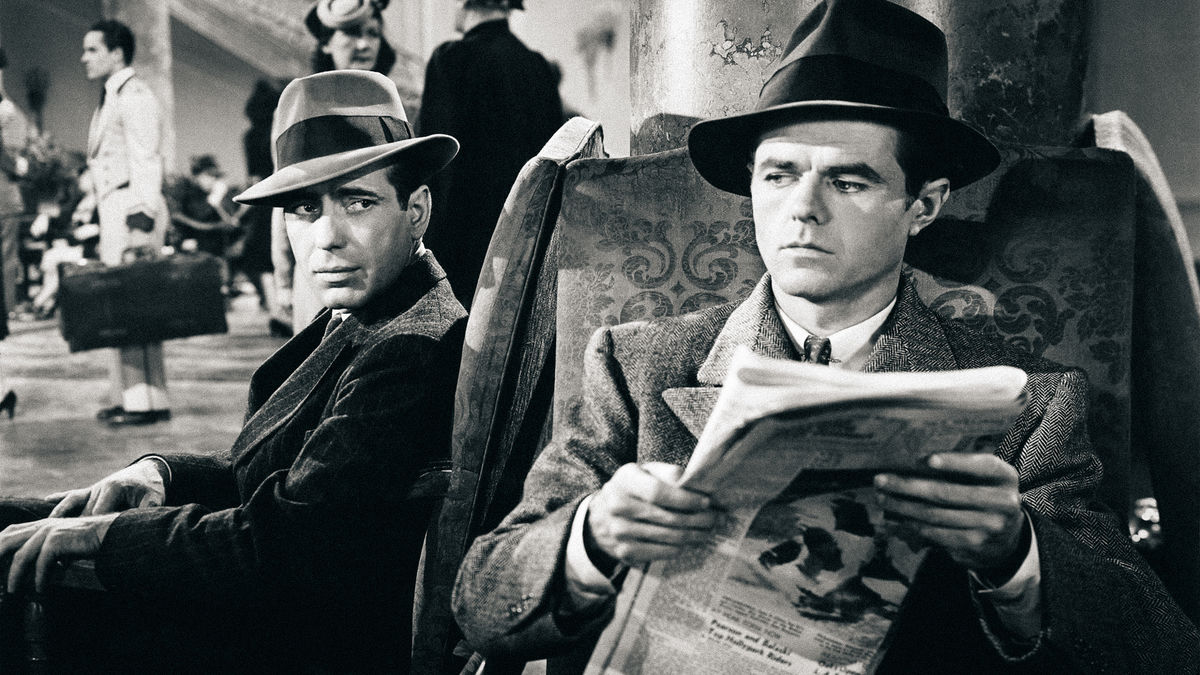
Humphrey Bogart plays a private investigator named Sam Spade.  He is in business with his partner, Miles Archer (Jerome Cowan).  One day, a woman walks into their office by the name of Ruth Wonderly (Mary Astor), claiming her sister ran off from New York to San Francisco with a man named Floyd Thursby.  She is hoping that Spade and Archer can help her find her sister.  Archer agrees to look into it, but he ends up dead along with Floyd Thursby.  This captures the attention of Sam Spade, who is beginning to wonder the validity of her story.  Before long, he discovers that her real name is actually Brigid O’Shaughnessy.

Throughout all of this mystery and intrigue, Sam finds himself in the crosshairs of Joel Cairo (Peter Lorre), who offers Sam some money for a highly valued falcon statue.  There is also a young man named Wilmer (Elisha Cook Jr.) who is keeping his eyes on Sam along with Kasper Gutman (Sydney Greenstreet), a rotund money man who will stop at nothing to get his hands on this bird. Throughout all of the twists and turns, Sam isn’t sure who to believe, who to trust, and who is telling the truth. He stays in control and makes smart decisions, even when people are pointing their guns at him or he’s suspected of murder by the police.

One of the strong points of “The Maltese Falcon” is the running time. At 100 minutes, there is not a dull moment in the film.  It is paced perfectly and directed with great skill by John Huston. It has the look and feel that one would expect from a film noir.  You have your femme fatale in Mary Astor.  She’s brilliant here, as she’s able to go from vulnerable and naïve to cunning and savvy in the blink of an eye. Of course, you have Bogart, who made a living in Hollywood playing this type of character.  Guys liked and respected him, and women were drawn to his tough exterior. As mentioned earlier, he is always able to stay level-headed, even in life-or-death circumstances.  He still seems to know what to do and what to say to get himself out of a jam.

In the end, I respected and admired “The Maltese Falcon” as a film.  I can’t say I enjoyed it a ton because of the storytelling.  It’s not an overly complicated film, but at times, there are too many twists and turns happening at once.  That being said, I think the more I watch this film, the more I will enjoy it and have a better understanding of everything.  Because of the deception happening on screen and characters coming and going, it’s not that it was hard to follow, it’s more that I was keeping up with the plot instead of getting lost in it. I look forward to watching this film many more times in the future, as I think I will gain an even greater appreciation for the skilled acting and directing on display.

* * * out of * * * *

4K Info: “The Maltese Falcon” is released on a two-disc 4K/Blu-ray combo pack from Warner Brothers Home Entertainment. The film has a running time of 100 minutes.  It also comes with a digital copy of the film. As far as the film’s rating, it is not rated, but that is not because it’s a raunchy film. It was released in 1941 and is very tame.

Video Info:  Ultra High Definition HDR always stands out on older films.  A lot of movie buffs like to talk about how older films are enhanced by a 4K transfer, and that is certainly the case here. From the swift movements of the characters to the deep blacks, this is a stunning transfer of a black and white film. Right now, 4K is doing some truly amazing work with classic Hollywood films.

Audio Info: The film is presented on the following audio formats: DTS-HD MA: English 2.0 Mono and Dolby Digital: Spanish. Subtitles are included in English and Spanish as well.  The audio is crisp, clear, and all of the great dialogue you would expect from a film noir is easy to digest while watching this film.

 Special Features:

 Commentary by Humphrey Bogart Biographer Eric Lax

“Warner Night at the Movies”

“Sergeant York” Trailer

“New Highlights of the Roosevelt Churchill Parley” (newsreel)

“The Gay Parisian” (1941 WB short)

“Meet John Doughboy” (1941 WB cartoon)

The Maltese Falcon: One Magnificent Bird

Becoming Attractions: The Trailers of Humphrey Bogart

Breakdowns of 1941 (WB short)

Make-up Tests

2/8/43 Lux Radio Theater Broadcast

9/20/43 Screen Guild Theater Broadcast

7/3/46 Academy Award Theater Broadcast

Trailers

1936 “Satan Met a Lady”

1941 “The Maltese Falcon”

Should You Buy It?

I don’t feel like I am really giving this film the credit it deserves, but keep in mind, this was my first time watching it.  I have always been a big believer that you need to watch a great film a few times in order to fully appreciate it.  It doesn’t always strike on the first chord.  There is a lot to like, especially the acting and the pacing of the plot, but the story took me out of it at times.  With all of that being said, if you are a fan of “The Maltese Falcon,” you owe it to yourself to buy it on 4K.  It looks fantastic here in black and white and in high dynamic range with its 4K transfer.  It’s such a moody film noir that truly gets a boost from 4K.  The special features are transferred over from the previously released Blu-ray, so if you are looking for anything new here, you are not going to find it, but I don’t expect anything new from a film that was released in 1941 as most, if not all, of the actors have passed away.  If you are a first-time viewer like myself, I still think you should buy it as you will get the slipcover and might enjoy it more than I did.  If you love the film and have seen it many times, you will enjoy it even more on 4K. I look forward to seeing what else Warner Brothers is going to be releasing throughout the year during their 100th year anniversary.

**Disclaimer** I received a copy of this film from Warner Brothers to review for free.  The opinions and statements in the review are mine and mine alone.

‘Cool Hand Luke’ Movie and 4K Review

WRITER’S NOTE: The following review was written by Ultimate Rabbit correspondent, Tony Farinella.

When I think of a movie star, I think of someone who possesses the “it factor” and stands above the rest of the pack.  Paul Newman was a movie star, and I would argue it was never more prevalent than in the film “Cool Hand Luke.”  Of course, many can talk about his mesmerizing performances in films such as “The Verdict,” “The Hustler,” “Slap Shot” or “The Sting.”  However, in “Cool Hand Luke,” he burns up the screen and you can’t take your eyes off of him.  It’s such a minimalistic performance, but it is captivating, spellbinding and intense.  There is no wasted moment or line of dialogue from this legendary actor here.  When I think of Newman, I think of this film.

After World War II, Luke (Paul Newman) finds himself knocking over parking meters while under the influence of alcohol, which lands him a two-year stay in prison.  Upon entering the chain gain of prison, Luke keeps to himself, but he has this unique and magnetic presence about him without even trying to do anything out of the ordinary. There is an aura about him which keeps people interested in him and talking about him.  There is a story behind the man, but the film allows those layers to unfold throughout.   Many of those working on the chain gang in this prison camp seem to fall in line and follow orders.  Luke, on the other hand, is not a fan of authority. He likes to ruffle their feathers, especially when it comes to Boss Godfrey (Morgan Woodward) and the Captain (Strother Martin).

He endears himself to his fellow prison mates by playing cards, trying to escape, and even having a contest where he says he can eat fifty eggs in an hour.  They start to see hope and light at the end of the tunnel, thanks to Luke.  As the title says, he is cool.  Every little thing about him is cool and laid-back.  Even when his attempts to escape don’t go as planned, he flashes that famous Paul Newman smile with those baby blue eyes and rolls with the punches.  He refuses to be defeated or get angry about his situation.  Instead, he is looking for solutions.  One of his closest friends there is Dragline, played by George Kennedy, in an Academy-Award winning performance.

Throughout the prison, we also see legendary actors such as Dennis Hopper and Harry Dean Stanton, which I really appreciated as I’m a huge fan of their careers. Director Stuart Rosenberg knows how to show the mundane of prison life without ever making it feel boring or uninteresting.  Much like Newman, he doesn’t waste a single scene or shot here.  Everything here has a rhyme and a reason to it. The film has a lot of outdoor scenes, and they look absolutely stunning in 4K.  This is truly one of the best-looking 4K films I’ve watched in a while.  The sunshine and the light symbolize what Luke brings to the prisoners.  He lets them know there is more to life than digging ditches.

I don’t think the anti-hero has ever been portrayed as well on screen as it is here by Newman.  The fact he’s not trying to be liked is what makes us, as an audience, like him even more.  It’s all natural.  This is a man who is in prison along with a host of prisoners that have done various crimes.  They admit that.  The film is able to make us like all of them, Dragline especially, and really root for them to get out from under the thumb of this rigid prison and its rules.  In many ways, I feel like “Cool Hand Luke” was a film in 1967 that was ahead of its time.

There are so many great quotes from the film that I could spend a good portion of my review reciting them. I’ll stick to the famous one, which is, “What we’ve got here is failure to communicate.” This quote was also used in the opening of the Guns N’ Roses song “Civil War”.  This film is a powerful masterpiece.  As someone who is a big believer in anti-establishment and someone who doesn’t always like to play by the rules, “Cool Hand Luke” is a film which resonated with me. You might knock Luke down and you might have him on the ropes, but he is not going to go down without a fight.  He is also going to smile in your face, no matter what happens to him or how much you push him.  He’s never going to lose that smile.

* * * * out of * * * *

4K Info: “Cool Hand Luke” is released on a two-disc 4K/Blu-ray combo pack from Warner Brothers Home Entertainment. The film has a running-time of 126 minutes and is rated PG.  Keep in mind, the ratings system was run much differently during this time.  It’s not an overly violent film, and I don’t recall a ton of curse words in it.  It also comes with a digital copy of the film.

Video Info: “Cool Hand Luke” never looked bad on Ultra HD, High Dynamic Range.  The film looks stunning and crystal clear.  As I mentioned, a good portion of the scenes take place outside, and it’s a colorful and bright looking film without being too bright where it’s going to hurt your eyes.  They did a tremendous job of cleaning this picture up, as I loved every second of this beautiful transfer.  I tip my cap to the fine folks over at Warner Brothers on this one.

Audio Info:  The same can be said for the audio which comes on DTS-HD MA: English 2.0 Mono and Dolby Digital: Spanish and French. Subtitles are also included in English, Spanish, and French.  The audio is crystal clear throughout, and all of the tremendous dialogue can be heard without any issues whatsoever.

Special Features:

Commentary by Historian/Paul Newman Biographer Eric Lax

A Natural-Born World-Shaker: Making Cool Hand Luke

Trailer

Should You Buy It?

You are buying this for the movie itself as well as the audio and visual aspects that Warner Brothers have put together for this tremendous release. You are not buying it for the special features, which I’ve talked about in previous reviews.  I’m a big believer in preserving film history, and I love that it is the 100th anniversary of Warner Brothers because they are digging deep into their archives with releases of some of the greatest films ever made.  They are also taking the time to make sure they are seen and heard in the highest video and audio quality possible.  They are not just upgrading these films to re-release them.  They are making sure, as a viewer, you are not only going to enjoy a classic film, but that you are going to enjoy it in 4K with a transfer worthy of the film itself.  Because of this, it is up to us, as film collectors and lovers, to support and purchase films like “Cool Hand Luke” on 4K.  It ensures us that we will get more great physical media releases in the future. I can’t recommend this film and this visual presentation any further. Buy it right now!

**Disclaimer** I received a copy of this film from Warner Brothers to review for free.  The opinions and statements in the review are mine and mine alone.

‘Bridesmaids’ – Do Not Mistake This Film for an Average ‘Chick Flick’

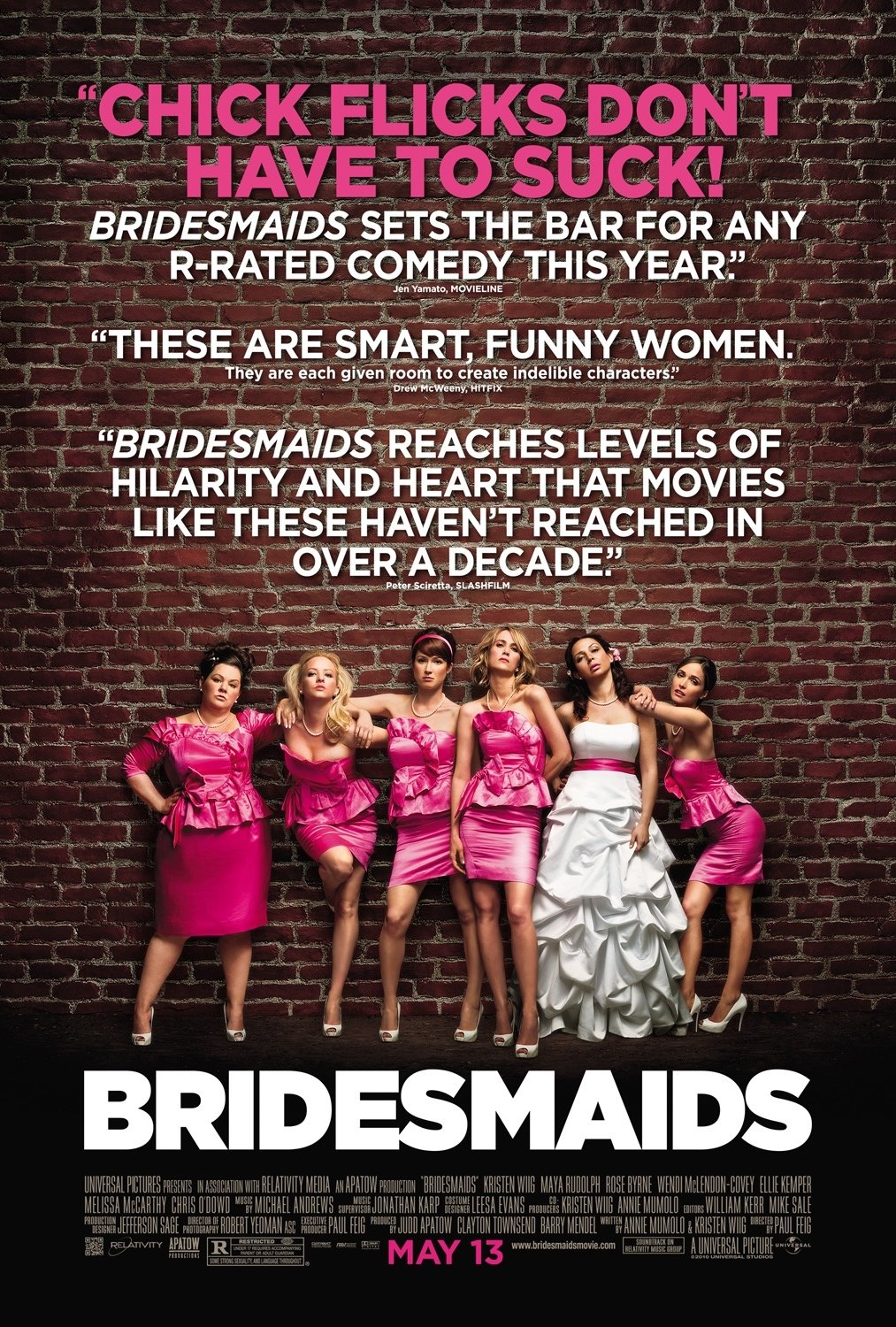
Bridesmaids” looks like it has “chick flick” written all over it to where many, including myself, were not quick to rush out and see this film when it arrived in movie theaters everywhere. But having since watched it, I can confirm this is not your average “chick flick” in the slightest. Moreover, it will appeal to a wider audience than its title might suggest. There is nothing groundbreaking about “Bridesmaids” as it initially comes across as a typical formulaic comedy, but the laughs do come at us fast, many of them gut busters. But seriously, it also has a lot of heart and makes you care about the characters very much to where we can easily relate to their struggles.

Kristen Wiig, one of the most acclaimed alums of “Saturday Night Live”  who co-wrote this film’s screenplay with Annie Mumolo, stars as Annie Walker, a single underachiever whose cake shop went bankrupt due to the recession, and who is currently having sex with Ted (an uncredited John Hamm), a man who sees her as nothing more than a fuck buddy. Then she finds out that her best friend since childhood, Lillian (Maya Rudolph, another “SNL” vet) has gotten engaged, and Lillian asks Annie to be her maid of honor. From there, we know things are going to go south between these two as the road to any marriage is filled with endless speed bumps which lead many to encourage others to elope instead.

Complications arise almost immediately when Annie meets Lillian’s other BFF, Helen Harris (Rose Byrne), a beautiful and wealthy woman who seems to have everything together in her life. The resentment and insecurity between these Annie and Helen are evident on their faces following their first encounter. This is made even clearer when both toast Lillian and then try to top each other in showering their love on her, attempting to prove who is the better best friend.

Things get even more complicated when Lillian selects the rest of her maids of honor. They include Becca (Ellie Kemper) who loves wedding and pities Annie because she is not currently engaged to anyone, Megan (Melissa McCarthy) who is as aggressive as they come, and Rita (Wendi McLendon-Covey) who may very well be the unhappiest wife and mother on the face of the Earth as well as the most consistently drunk of the bunch. With all these different personalities working together, will the road to this wedding be a happy one? Was Donald Trump always faithful to Melania?

What I really loved about “Bridesmaids” was the same thing I also loved about “Knocked Up;” the characters are very down to earth and easy to relate to. Being that Judd Apatow is a producer on both films, this should have been obvious from the start. These characters are real people with real problems which are not far removed from our own, and we come to care deeply about each and every character here. It does not matter if none of you have ever been a bridesmaid. As for you men, being groomsman is enough qualification to understand the headaches in planning matrimony.

“Bridesmaids” also a film where facial expressions at times speak more loudly than words. It certainly does have great dialogue, but the looks on these actresses’ faces is what really cracked me up. They say one thing, but their eyes tell us what is really on their mind. This goes for the men in as well, and they all seem to pale in comparison to the females in terms of inner strength. We see right through each character, and the tension resulting from a possible slip of the tongue is always in the air.

This film proved to be the true cinematic breakthrough for Wiig. When I have seen her in other films, she always seems to be doing a riff on her most deadpan characters from “SNL” whether she is appearing in “Knocked Up” or “MacGruber.” But as Annie Walker, Wiig really inhabits this character and gives her life in a way we did not get to see her do previously. She makes us embrace Annie as a kindred spirit because we have all felt the way she feels; lost in a world she feels betrayed by, and desperately trying to hold on to what means the most to her.

Maya Rudolph is equally wonderful here as the bride to be, Lillian. She previously showed us in Sam Mendes’ “Away We Go” what a great actress she can be, and she vividly reminds us of our best friends from childhood. Lillian runs through a gamut of emotions as her road towards marriage start off wonderfully and then eventually turn into an unmitigated disaster. In a pivotal scene in which Lillian about to leave her apartment for the last time, Rudolph shows us a worry and concern which we all see within ourselves from time to time. Not once does she portray Lillian as your usual clichéd character, and this says so much about what she is capable of.

Rose Byrne proves to be a delight as Helen, and her beautiful face and eyes cannot quite mask the growing resentment she has towards Annie. This character could have easily turned into your typical one-dimensional villainess, but by the end we discover tshe and Annie are not all that different. Byrne makes you like Helen despite her overly meddling ways, and she has since proven to be a strong presence in every motion picture she has appeared in.

But out of all the characters here, the one who stands out the most is Megan who is portrayed in a deservedly Oscar nominated performance by Melissa McCarthy. Overweight and raunchy whenever she wants to be, McCarthy is a trye comedic powerhouse when the camera focuses on her. Seducing airplane passengers and showing no shame in what she is, she makes Megan a strong character and never once digresses into making her a cloyingly sentimental one.

“Bridesmaids” was directed by Paul Feig, Mr. Eugene Pool from “Sabrina, The Teenage Witch” and the creator of “Freaks and Greeks;” a brilliant show that like many other brilliant shows which aired on network television lasted only one season. With this film, he manages to find humor even in the most painful of moments and never makes the comedy too overly broad. Sure, some scenes are broadly played, but Feig remembers comedy can only work if you truly care about the characters.

Looking back, “Bridesmaids” proved to be one of the best comedies to be released back in 2011, and no man out there should dismiss it as a film only women would be interested in. The audience for this one proved to be far more diverse than its promotion may have suggested. Plus, you have Wiig and Rudolph on display here, and they always kick ass! If you liked them on “Saturday Night Live,” you are bound to love them here.

* * * * out of * * * *

WRITER’S NOTE: This film marked the very last screen performance of actress Jill Clayburgh who passed away in November 2010 from leukemia. She is a wonderful presence here as Annie’s mother, Judy Walker. May she rest in peace.

Crap From the Past: ‘Safe Haven’ – Another Misbegotten Nicholas Sparks Adaptation

WRITER’S NOTE: THIS REVIEW WILL CONTAIN SPOILERS AS IT HAS BECOME IMPOSSIBLE TO TALK ABOUT THIS FILM WITHOUT GIVING CERTAIN THINGS AWAY. IF YOU DO NOT WANT IT RUINED FOR YOU, SEE IT BEFORE READING THIS REVIEW.

I must confess, I have not read any of Nicholas Sparks’ books nor have I seen any other cinematic adaptations of them before I sat down to watch “Safe Haven.” As a result, I am not sure whether to blame him or the screenwriters for ripping off the plot of “Sleeping with the Enemy” for this misbegotten effort. Those expecting this to equal the greatest of Sparks’ cinematic adaptations, “The Notebook,” will be severely disappointed as even those who have not seen that Julia Roberts starring vehicle will be confident in admitting this one falls way short. “Safe Haven” lacks any sense of originality, and it is completely undone by a couple of ludicrous plot twists which sink any legitimate reason for this film to exist at all. Furthermore, watching it reminded me of why I typically avoid romance movies in general.

Julianne Hough from the “Footloose” remake and “Dancing with the Stars” stars as Katie Feldman, and at the start we see Katie running for her life for reasons which are later made clear. Katie is ever so desperate to avoid police detective Kevin Tierney (David Lyons) to where she even makes herself look pregnant in the hopes it will throw him off. She ends up escaping his clutches and takes a bus out to the small town of Southport, North Carolina where she hopes to start a new life.

Look, I love how people want to escape a dark past by moving to a new town, but for some immensely stupid reason they move to one which is not all that far away from the place they used to live. Word to the wise: if you want to move away to where no one can find you, try moving to another state or country. Even with the advances in today’s technology which typically render anonymity a joke, you have a better chance of not being found out if you go to a place you cannot drive to in one day’s time.

Anyway, Katie gets a job as a waitress at a local restaurant and ends up leasing a beautiful apartment out in the woods. Of course, where she found the money for such a place is beyond me and every other audience member. We know she is looking to avoid any personal connections as the last one she was involved in caused her a lot of psychological damage, but someone as adorably cute as her is bound to find a suitor whether she wants one or not. That suitor comes in the form of Alex Wheatley (Josh Duhamel from the god awful “Transformers” movies), a widow with two kids. Alex lost his wife to cancer a few years ago, and he is having trouble relating to his kids, especially his son. Guess who fills the missing part of his life…

Okay, as much as I despised “Safe Haven,” I do have to admit that Hough and Duhamel have good chemistry together and make a cute couple here. Hough herself has a wonderful earthiness which makes her seem more down to earth than other actresses I could quickly think of while watching this film. Even if her range as an actress goes only so far, she has a very appealing presence here even if it might seem a bit too vanilla for some.

As for Duhamel, he does himself good by not giving an emotive performance as Alex. I expected him to be overdoing it for the whole film, but he doesn’t make his character a whiny little bitch or the typical self-pitying widow who often inhabits the romance genre. Alex has suffered a terrible tragedy in his life by losing his wife far too soon, but we see him moving on as well as he can, and he does not waste much time bemoaning what is missing in his life.

Now I mentioned at the start of this review how this film is essentially a rip off of “Sleeping with the Enemy,” and this proves to be the case even before the first big twist is revealed. We watch as the Kevin becomes increasingly obsessive in discovering where Katie is hiding out as it becomes implied that she is wanted for first degree murder. But it eventually becomes to light that Katie is actually Kevin’s husband, and from there I knew exactly where the story was heading which had me rolling my eyes endlessly as a result.

There is a flashback sequence in which we see what drove Katie and Kevin apart, and watching it made me wonder what Katie ever saw in this creep in the first place. In a lot of ways, I feel sorry for Lyons, best known for his work on the television series “ER” and “Revolution,” because I am sure he came into this project believing he was not just playing any ordinary villain, but this is essentially what Kevin Tierney is. The character is here to give us someone to despise, and he really serves no other purpose to this film beyond that.

I was also amazed at how Katie stabbed Kevin pretty hard with a kitchen knife. We do not see where he has been stabbed exactly as this is a PG-13 movie, and yet he somehow recovers from this knife wound in record time. Maybe the American health care system is slightly more effective than we think, but even the smallest of stab wounds still require an extended period of time to recover from. No one just jumps out of bed a day after a sharp object is inserted into their body as the word “ouch” takes on a very significant meaning when this happens.

Furthermore, Kevin spends a good portion of “Safe Haven” being drunk as a skunk. Now maybe this explains how he copes with the pain he is forced to endure from that knife wound, but seeing Kevin trying to outdrink Denzel Washington’s character in “Flight” renders him unintentionally hilarious as a result. While this character is meant to be a frightening presence in “Safe Haven,” all he really ends up being is an abysmal idiot who is lucky to have survived as long as he has. The fact he still has a pulse by this film’s midpoint is quite astonishing to say the least.

But then comes “Safe Haven’s” second big plot twist, and this one is ripped off from “The Sixth Sense.” At the end, we come to discover one of Katie’s friends whom she has confided in throughout is actually not alive and died some time ago. As a result, I kept waiting for Katie to say “I see dead people.” This ludicrous revelation calls into question everything we have seen up to this point. Are certain characters here meant to be delusional, or is it just circumstance that they are talking to a walking corpse? If the filmmakers wanted to make “Safe Haven” the romantic movie answer to “The Usual Suspects” or any of what my friends would call “mind fuck” motion pictures, they failed miserably.

Speaking of which, the director of “Safe Haven” is Lasse Hallström, and his career as a director has always fascinated me. He has gone from directing such great movies like “My Life as a Dog,” “The Cider House Rules” and “What’s Eating Gilbert Grape” to pure drivel like this and “Dear John.” You are never sure if his next film is going to be way too sentimental or not sentimental enough, but this time he outdoes him by being cloyingly manipulative. While he still does an admirable job of getting good performances from his cast, I came out of this film hating him for playing with the audience’s emotions so shamelessly.

I don’t know, maybe I should read Sparks’ novels to see if what did not work in a movie actually works better on the written page. I am sure there are a lot of reasons why he remains a best-selling author after so many years, but watching “Safe Haven” makes me wonder what those reasons are. This film is far too silly to be taken seriously, and the absurdity of its plot twists makes the whole endeavor feel like a pointless cinematic adventure.

Following this misbegotten motion picture, I did my best to avoid any kind of romantic movies. Granted, there have been some like “What If?” which surprised me, but there have been others such as “The Choice” which was also based on one of Sparks’ novels. If you do not see many reviews of romantic movies or romantic comedies on this website, I am sure you will understand why.

* ½ out of * * * *

‘John Wick Chapter 4’ – Still Trying to Kill the Unkillable

If there is to be a fifth “John Wick” film in our future, or perhaps this can be included in the upcoming spinoff entitled “Ballerina,” in which a father and son visit a memorial which stretches out for a couple of miles. Their dialogue would be comprised of the following:

“Daddy, what is the wall?”

“Well son, this is a memorial for all the people killed by John Wick, a professional hitman and assassin.”

“Wow, there are so many names up there!”

“I know son. Funny thing is, this memorial was opened up the public before those who constructed it realized they had another mile or two to add on. Just when everyone thought John could not kill another soul, he somehow found the strength to kill another human who was sent out to kill him.”

“Why did so many try to kill him dad?”

“Because there was a bounty on his head son, one to the tune of around $20 million dollars.”

“Daddy, are all these names up here to show they did not die in vain?”

“Actually son, it was quite the opposite. This memorial is proof of what happens when you put greed above everything else.”

Right from the start, the “John Wick” movies have shown how its title character is a human being somewhere in between the 1980’s action heroes portrayed by Arnold Schwarzenegger and Sylvester Stallone, and John McClane from “Die Hard.” On one hand, John looks to be super-human as he dishes out punishment while taking quite a large number of brutal hits in return, but thanks to Keanu Reeves, who continues to do some of his best work in these films, this character remains fully human as he is not without a soul and is looking to find peace in a world which appears very much devoid of it, particularly for him.

John Wick Chapter 4” starts not too long after the events of “John Wick Chapter 3: Parabellum” in which he found himself betrayed by the High Table. Since then, he has lived in an underground bunker with The Bowery King (Laurence Fishburne) who has helped nurse him back to health. Suffice to say, John’s bloody knuckles are a sign that he is ready to fight yet another battle. Of course, what makes this even clearer is the following dialogue:

The Bowery King: “You ready, John?”

John Wick: “Yeah.”

But the fact that John Wick is still alive does not sit well with Marquis Vincent de Gramont (Bill Skarsgard, who always looks like he is about to start singing “I’m Sexy and I Know It”) who chastises Winston Scott (Ian McShane) and his friend Charon (the late Lance Reddick) for failing to kill this dog-loving assassin. To see that the job finally gets done, Marquis hires Caine (Donnie Yen), a blind assassin who also happens to be an old friend of John’s. Caine is not keen on taking the job, and he shudders once he realizes what name he is reading on a braille card to where he does not even need to spell it all out. As these two come to blows, it does not take much to see how they are both victims of circumstances beyond their control as they fight to protect what they love most.

Director Chad Stahelski knows what we want and expect from a “John Wick” film when we enter then theater, but he is smart to not start things off with too big a bang. During its 169-minutes, he takes his time to reintroduce us into the world John inhabits and of the people in his universe who either benefit or suffer from his deadly actions. And when those action scenes suddenly take flight, you can bet it will take not one or two, but close to a dozen bullets to take out a single bad guy. Watching this, it makes me wonder if John will suddenly run out of bullets at the worst possibly moment.

When it comes to Reeves, many love to joke about what a bad actor he is. As for myself, I feel the need to defend him from time to time even if his work in “Knock Knock” remains too painful to endure. The truth is, he is one of the main reasons the “John Wick” movies work as well as they do. In this latest installment, he receives the deepest of bruises, is almost hung from a noose, has a tattoo searingly burned into one of his arms and ends up falling down more flights of concrete stairs than Father Karass did in “The Exorcist,” and yet he still comes out of all of this standing tall. Even if you wonder if John ever gets any sleep, has any time to go to the bathroom or if one ice bath a day is enough for him, Reeves makes you believe he can endure the worst and yet still come out of it all with a pulse. Even when a supporting character utters to John why he doesn’t just die, he makes you realize he is not about to or, at least, not yet.

Other than that, “John Wick Chapter 4” contains a lot of great things such as Ian McShane’s performance as he plays Winston Scott in a far more gleeful than he did previously, Clancy Brown who proves to be a wonderful addition as a high-ranking High Table operative called the Harbinger, a thrillingly propulsive music score composed by Tyler Bates and Joel J. Richard, and striking cinematography from Dan Laustsen.

Still, I do need to single out another performance here, and it is the one from Donnie Yen, As Caine, he shows how the blind can see things better than those who still have their eyesight, so it should be no surprise when he easily takes out his devilish opponents with something like the sound of a doorbell. Like John, Caine is in a position not of his own making, and Yen does an excellent job of showing the painful conflicts this character is forced to deal with. As much as he does not want to be in this position, you know he is not about to go easy on his prey. But will he enjoy taking down his target? That remains to be seen.

While watching “John Wick Chapter Four,” I was reminded of what happened after Ang Lee’s “Crouching Tiger Hidden Dragon” became such a worldwide phenomenon. Hollywood quickly greenlit a number of martial arts films heavy stunts, but none of them were anywhere as successful. Some studio executives proclaimed that these films had the best fight choreographers available, but they clearly missed the point. The best action films out there are not just about stunts, but also about characters with moral dilemmas they are constantly entangled in. Whether or not they win the day, they still wonder what will become of them once all the violence ends.

The ”John Wick” films are not just about stunts; they are about the characters which inhabit them. This is what makes all the amazing stunt work, and it is infinitely amazing here, so bloody effective. Whether or not you consider “John Wick Chapter Four” to be one of the best movies ever made, it is clearly one of the greatest action flicks to come out in recent years, and seeing it once is not enough. More importantly, you have got to check it out on the silver screen with the biggest audience in town.

By the way, there is a post credit scene I encourage you to stick around for. And yes, this film is dedicated to the memory of Lance Reddick, yet another actor who tragically left us far too soon. Rest in peace Lance…

* * * * out of * * * *

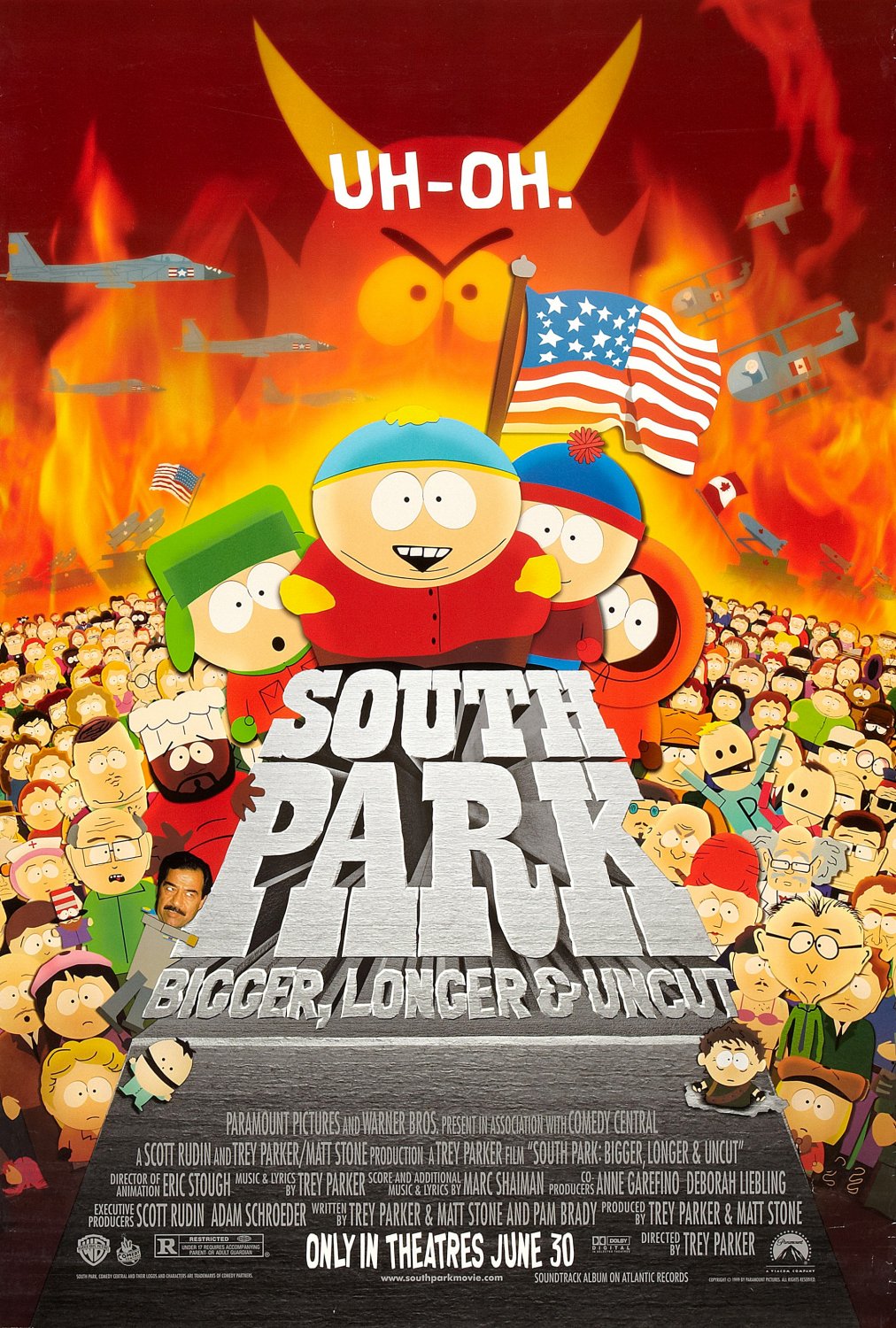
‘South Park: Bigger, Longer & Uncut’ – One of the Best Musicals Ever!

Walt Disney Pictures has released many classic animated movies over the years, but none of them compare to the sheer anarchic lunacy of Trey Parker and Matt Stone’s “South Park: Bigger, Longer, & Uncut.” While “Beauty and the Beast, “Aladdin” and “The Lion King” have given us songs not easily forgotten, so many other Disney animated musicals have only stayed in our minds for so long before they are easily forgotten, and they only dream of being as tuneful as this 1999 animated musical. It takes advantage of its big screen format to mercilessly satirize the MPAA (or the MPA as it is known as these days), hypocrisy, and of various musicals we all grew up with.

One does not have to be a fan of “South Park” to enjoy this movie. The characters of Stan, Cartman, Kenny and Kyle are introduced to the audience in wonderful fashion through the opening song “Mountain Town,” and they go off to the local movie theater for the opening day premiere of “Asses of Fire,” a Canadian film starring their favorite comedy duo of Terrence and Phillip. They are, however, denied admission as the movie has been rated R by the ever-reliable MPAA. But instead of paying for a PG-13 movie and sneaking into “Asses of Fire,” they pay a homeless guy to be their adult guardian. It sure saves on the anxiety of getting caught and kicked out of the theater by that one usher who actually bothers to follow the rules.

All four of them love “Asses Of Fire,” and this movie could be seen as the way parents view “South Park” on Comedy Central. The song “Uncle Fucka” ends up outdoing anything Parker and Stone ever did on the show. Hilariously profane without setting any limits for decency’s sake, it sets off this powder keg of a musical in an unforgettably hilarious style. Stan, Cartman, Eric, and Kenny brag of how cool they are for seeing Terrence and Phillip on the silver screen, and they gleefully spout off the vulgar profanity from the film to the shock and delight of their fellow classmates.

But it does not take long for their parents to discover what their kids been up to, and they end up doing what just about any loving parent would do; blame someone other than themselves. Parental hypocrisy is one of the big targets of “South Park: Bigger, Longer & Uncut” as the parents here all refuse to take any sort of responsibility for their children’s behavior. Instead, they launch an all-out war against Canada as Terrence and Phillip originated from the country, and also because, you know, why not?

Kids are far more of aware of hypocrisy when it confronts them, and in many ways this movie is seen through the eyes of a child. Their parents’ intention to obliterate a country just because a comedy duo inadvertently taught kids some utterly hideous words is completely ridiculous, but so was George W. Bush’s invasion of Iraq. The media, movies and music are such easy targets even though they are emotional outlets, and those in power are quick to criticize them and suggest legislation to limit what they seem as their immoral influence for no good reason other than to put the more conservative population of America (a.k.a. white people) at ease.

Kenny also gets a bigger part than he ever had in the television show as he, of course, dies and ends up going to hell. When he arrives, he meets Satan who is far more vulnerable and sensitive than various depictions of him in popular culture have led us to believe. But the bigger problem though is Satan’s boyfriend who is none other than Saddam Hussein as he is shown to have died years before he actually did in real life. Saddam treats Satan like crap while Satan begs for him to be an affectionate partner in all things love. Satan also does his “Little Mermaid” number of how he yearns to be “up there” on Earth and above ground. Where else can one find Satan be more kind hearted than Saddam Hussein, let alone groups of parents?

This movie also satirizes those most famous of Broadway musicals such as “Les Miserables” on top of all those Walt Disney animated musicals we were raised on. In the process, both Parker and Stone, along with composer and lyricist Marc Shaiman, created the best musical Hollywood has seen in years. The songs are brilliant and insidiously, let alone gleefully, inspired as they stay with you long after you have finished watching this particular animated classic.

Seriously, after watching “South Park: Bigger, Longer & Uncut,” who can forget songs like “Blame Canada,” which should have won the Best Original Song Oscar over “You’ll Be in My Heart,” or “What Would Brian Boitano Do?” For me, however, the real showstopper here is “Uncle Fucka” in which Parker, Stone and Shaiman deign to portray from their critics’ point of view of how the critics view the show “South Park” as opposed to the rational way any other decent human being would. Perhaps it might be easy to say that the music and songs here are brilliant because of the uninhibited profanity on display, but each song gets at a deeper meaning beneath its shamelessly filthy lyrics.

The other great thing about this “South Park” movie is how it is proof Parker and Stone did not sell out. They could have made this into a PG-13 comedy and would have made three times more money in the process, but they both resisted Paramount Pictures urging to tone things down and succeeded in taking the show beyond the stifling confines of television. Seeing them stick to their guns is highly commendable, but perhaps it should not be seen as a surprise as they go after everything and everyone, and the show no hesitation in biting the hand that feeds them (Comedy Central).

All these years later, “South Park: Bigger, Longer & Uncut” remains uproarious as ever. The MPAA (a.k.a. the MPA) remains an overly conservative bunch of hypocrites who give NC-17 ratings to movies for all the wrong reasons, and parents continue to blame others for the ills of their children and society. Thankfully, this is not a motion picture that can be easily relegated to the Disney vault for an “anniversary release” twenty years into the future. Trey Parker and Matt Stone still fight the good fight, and the big screen version of their brilliant television show became a brilliant musical, which later led to others like “Team America” and the Broadway smash “The Book of Mormon.”

Like Kenny, “South Park: Bigger, Longer & Uncut’s” legacy will never die. But, like Kenny, if it ever does die, it will eventually be resurrected sooner than we think.

* * * * out of * * * *

‘Moon’ – Sam Rockwell Lost in Space

WRITER’S NOTE: This review was written in 2010, long before a certain actor in this film became quite the pariah.

You know, in retrospect, maybe 2009 wasn’t such a bad year for science fiction movies. It’s just that the stench from some of the biggest movies in that genre lasted much longer than the memories we had of the movies we saw.

With “X-Men Origins: Wolverine,” we sadly watched a strong franchise fall victim to a prequel which lacked the thrills and the complex characters that made the three previous entries so good. “Terminator Salvation” will probably be remembered best for Christian Bale’s angry rant on set than with what ended up onscreen.

And then came “Transformers: Revenge of the Fallen,” and I still have the impulse to bitch and moan about that sequel whenever necessary. Michael Bay left a giant robot turd for us which we just couldn’t resist seeing, so it of course made hundreds of millions of dollars. It put such an enormous dent in my enjoyment of things science fiction, and I am still getting over my frustration with it even after all this time.

But getting past that awful stench, there were a number of sci-fi gems to be found in 2009. “Star Trek” turned out to be an enormous surprise and a fantastic piece of entertainment. Imagine that, a prequel heading in unpredictable directions. And although I keep running into more and more haters of this one, “Avatar” for me was a great reminder of why experiencing movies on the big screen with an audience can be so much fun. And let us not forget “District 9,” a film that paralleled the Apartheid movement which overtook South Africa for far too long. These films were so good that I believe they will stand the test of time as opposed to the others which let me down to an infinite degree.

And then there is “Moon” which came out in limited release and did not have the same publicity as those big blockbusters did. This one proved to be the most thought provoking and original sci-fi movie of 2009. Granted, it does borrow from many classics of the genre like “2001” and “Alien” to name a few, but first-time director Duncan Jones takes all these influences and molds them into a motion picture which feels very fresh compared to what we generally get year to year. Jones is also aided greatly by another in a long line of superb performances from Sam Rockwell who is more or less doing a solo show this time out.

Rockwell plays Sam Bell, an employee of Lunar Industries who is under a 3-year contract to extract Helium-3 from the moon’s surface; a natural gas which will provide much needed clean energy back on Earth. You would figure he would get more than just a robot companion as company during all this time far from home. But I guess corporations managed to find a way to cut the whole workforce down to one person in the future, hence saving them an obscene amount of money for themselves. Sam’s only human contact is the messages he gets from his wife and infant daughter as well as his superiors who are always checking on his progress. For him, it must be like staying at “The Shining’s” Overlook Hotel with outer space to deal with instead of snow. But at least here, he is spaced out instead of snowed in.

While doing his daily work on the land rover, Sam crashes and is knocked unconscious. When Sam comes to, he is back in the lunar base but has no idea of how he got back. He also ends up hallucinating to where he sees a little girl he does not know. In short, a number of things happen to where he goes outside the base and back to the damaged harvester to find someone barely alive: himself. To reveal more would be criminal because it would spoil the many surprises this film has for you.

For a moment, I thought “Moon” was an adaptation of another Philip K. Dick novel like “Blade Runner” or “Total Recall.” It turns out, however, it is not, but “Moon” does deal with some of the same themes. How would you feel if one day you woke up and found you were not who you thought you were? Would you continue on in life if you found you were nothing more than a copy of another person? How long can a secret be kept before it comes out into the open? While scientists may continue to play around with the evolution of human beings, they can never fully control the desires and actions of them. Throughout history, humanity has always found a way to break through its collective suppression to get at a reality which cannot be forever contained.

As I said, “Moon” borrows from many other sci-fi movies. The design of the lunar base looks much like the Nostromo from “Alien,” and a lot of the lettering and fonts seem very similar to those seen in “Aliens.” And there is no mistaking the influence “2001: A Space Odyssey” had on this film, especially with Sam’s robot companion GERTY (voiced by Kevin Spacey). Instead of an eerie looking red dot like HAL, GERTY has a smiley face which illustrates the different emotions which better relate to Sam’s emotional needs. This is that same smiley face Wal-Mart co-opted, and although this company is not mentioned here, seeing that icon makes me believe this particular corporate monolith may very well have the last laugh on the unions and remain more dominant in the future. Be afraid. Be very afraid…

Other directors would just take these elements and throw them up onto the screen without much forethought. Jones, however, takes all these familiar elements and more than makes them his own. “Moon” looks familiar in some ways, but it feels quite unique in others.

But what is especially impressive about “Moon” is how it was made for only $5 million dollars. Most sci-fi movies these days cost at least $150 million, and this does not include advertising and other promotion costs. Heck, when I see a sci-fi movie that costs only $30 million, I expect subpar effects and am usually forgiving about them. But Jones takes the budget he has and makes everything look like it cost ten times as much. I guess this further proves what Robert Rodriguez said about having less money forces you to be more creative.

“Moon” also benefits from an excellent music score by Clint Mansell whose career as a film composer keeps getting better and better. His music adds a strong emotional quality that strengthens our need to understand Sam on an emotional level. Ever since “Pi” and “Requiem for a Dream,” Mansell has proven to be one of the most original sounding composers working today, and the musical themes he typically deals with are perfectly suited to this kind of material.

In the end though, this is Rockwell’s show, and he has quite a challenge as he is essentially acting opposite himself. You have to wonder how an actor plays off of himself and yet makes it look so natural at the same time. Rockwell has become better known for playing bad guys or heavies in mainstream movies, but he is more than capable of playing outside of that and continues to prove so in movies like this, “Frost/Nixon,” and “Choke” to name a few. In giving his character a strong complexity to someone who may not really actually be human ends up forcing you to identify more with something which may simply look like a machine from the outside. As a result, you could say that “Moon” also has a bit of “A.I.: Artificial Intelligence” in it as well.

And I do not want to leave out Kevin Spacey whose voice as GERTY creates a soothing trust Sam wants to hold on to and, at other times, test. GERTY is HAL but without the homicidal tendencies, and that has to be reassuring if you are stuck on the moon with no one else but a robot. Spacey makes GERTY seem like more than just a robot, and he makes us see how GERTY more in common with Sam than at first glance.

“Moon” is easily one of the most intelligent sci-fi movies of 2009, and it got lost in the shuffle of all the other big Hollywood releases, both bad and good. It deserves a long shelf life at your local video store, if there are any left where you live. In the end, it will last much longer in the memory than Michael Bay’s desecration of all things Hasbro. But enough of that one already…

* * * * out of * * * *

‘Source Code’ – Like ‘Groundhog Day’ But with a Shorter Time Span

The best way to describe “Source Code?” It is “Groundhog Day” crossed with “Quantum Leap.” It stars Jake Gyllenhaal as Captain Colter Stevens, an army helicopter pilot who has been assigned to a mission which has him looking for a bomber who blew up a Chicago bound train and killed everyone onboard. The movie’s title refers to a special program which allows him to enter the body of one of the passengers on that train for the last eight minutes of their life. So, perhaps this film is more like “Groundhog Day,” except that the day is going to be a lot shorter than 24 hours, and I mean a lot shorter.

Now this is a great concept for a film as we all have those moments which can prove to be as painful as they are unforgettable. Whether we admit or not, we keep replaying certain memories in our minds over and over again, often changing the outcome to something far more pleasing to our ego and sense of well-being. Even though it does us no good to dwell on the past, we fall into those patterns when our present is not all that great, and our future is more uncertain than we would prefer it to be. And through the breakthroughs of science here, Captain Colter gets to relive a moment which, while not his own, allows him to manipulate reality whenever the opportunity presents itself.

Of course, we can replay a moment from our lives to where we can no longer remember what was real or what was not. “Source Code” explores this as well, making one believe that if our lives were predestined, they will cease to be thanks to what science can continually do for us.

This film is director Duncan Jones’ follow up to “Moon” which itself was one of the very best movies of 2009. Like “Moon,” its main character is caught up in a situation not entirely of his making, but which becomes clear as the story rolls along. Like Colter, we are making discoveries about who he is along with him, and we eagerly await the answers he comes across even if they do not produce the desired result of stopping the bombing.

From the outset, “Source Code” looks to be a whodunit, but this ceases to be the case before the film reaches its midpoint. Besides, it’s pretty easy to figure out who the bomber is, and it is only a matter of time before Colter confronts said person to learn their true intentions. In actuality, it is about a man caught up in a situation which he has no control over, and of how he gets that control back in a way no one can predict.

Gyllenhaal remains one of the most dependable actors in movies, and he does not let the audience down in this one. In many ways, his performance is not too different from others he has given in recent years, so there is not much new to what he does here. All the same, he is very good, so why complain? Gyllenhaal engages us emotionally in his character’s struggle as, like him, we do not know how we got into this and we are desperate to get answers.

Jones does great work in making each visit to the same eight minutes unique from the last Colter gets unwillingly subjected to. “Source Code” could have been redundant as hell, and certain moments and actions are repeated ad nauseam throughout, but each eight-minute period has a different theme or construction to it. There are various people Colter has to meet, and there are other things for him to take advantage of in the little time he has to work with. Colter also gets to pull the rug out from under us to where, once the bomber is found, he finds there is still work to do.

Aside from Gyllenhaal, “Source Code” features other strong performances like the one from Vera Farmiga who was so great in “The Departed” and “Up in The Air.” Her character of Captain Colleen Goodwin at first looks to be Colter’s embattled conscience, but it is really the other way around. Farmiga is great in taking a typical military stock character and giving them a heart and soul which strongly informs the decisions Colleen later makes.

Also in the film is Jeffrey Wright who plays the creator of Source Code, Dr. Rutledge. This could have been a simple obsessive doctor, one mad with power, or one who is overly cruel. Somehow, Wright succeeds in making Rutledge something of an enigma to where you are not quite sure what to make of him. He may not be a mad scientist, but he is also not the warm kind either.

And, of course, we have the infinitely lovely Michelle Monaghan here as Christina Warren, girlfriend to the man Colter inhabits. Whether it is “Mission: Impossible 3,” “Kiss Kiss Bang Bang” or “Gone Baby Gone,” she always has a wonderful presence about her, and her smile brightens our mood every time we see it. And, like many actresses I tend to have a crush on, she is already married (dammit).

Is “Source Code” an original movie? I do not know nor do I care, but it sure feels like one compared to most movies being released these days. While you could say that there is a bit of “Inception” in this film as it involves searching through the mind of another person, this one feels like its own thing. It is a pointless argument to complain about what Jones borrows from here because not much of anything is original these days. It becomes a quest to take elements from other movies or stories and make them your own, and Jones has succeeded in doing this here.

While “Source Code” is a bit confusing at times, and I did not fully buy the its concluding act, this film is an enthralling mystery with a good dose of exciting action. Hopefully, Hollywood studios will start taking the time in being more openly inventive instead of just regurgitating the blockbuster hits from the recent past.

Still, it would be nice to change some of the more painful moments from our past so that we can look at ourselves in a kinder light, one which will help make our egos rise out of the muck they too often sink into. While it is best to make peace and forgive ourselves for our foolish trespasses, science is always catching up with us. Just you wait!

* * * ½ out of * * * *

‘The King’s Speech’ – Best Picture Winner at the 83rd Academy Awards

Many will probably look at “The King’s Speech” as one of those snobby British art movies, but this of course will say so much more about its so-called critics than anything else. The story of a man who, it is said, “bloody well stammers” and works to overcome this affliction which keeps him from completing sentences let alone a whole speech sounds more like one of those formula movies where we watch a human being triumph over personal obstacles with the help of a mentor. Then again, not many of those movies are about King George VI, and with this being “based on a true story,” it all adds more dramatic heft to this particular story even as I continually tire of that overused phrase.

Formulaic or not, “The King’s Speech” is a magnificent film which takes hat seems like an easy to overcome problem (or so others might think) and turns it into compelling cinema. This is in large part thanks to a wonderful cast that includes Colin Firth, Geoffrey Rush, and Helena Bonham Carter. There’s nary a single weak performance to be found here, and this was one of the best acted films of 2010.

Seriously, I bow down to Firth after watching him here. That he gives a brilliant performance is no surprise as he has had an amazing career to date, but this particular role seems all the more difficult for him or anyone else to pull off. Mastering the technical part of it and making the stammering seem utterly believable must have been a job unto itself. How do you get an audience to suspend disbelief and get them to believe you are seriously afflicted with such a seriously irritating impediment?

Now other actors would probably try to master the stammer to where they are not thinking about it. But with Firth, he digs deep into the role to get at who King George VI was as a person and what has affected him emotionally. That he gets at the heart of this character and creates such a vivid portrait of a leader many do not know much about is what makes his performance so damn good. As for the technical aspects of the role, I am guessing Firth saw this as secondary, but it should go without saying that he perfects the stammer from start to finish.

Then there is Geoffrey Rush who also served as one of this film’s producers. As Lionel Logue, the King’s speech therapist, he serves as the Mr. Myagi of “The King’s Speech.” Lionel gets the King to do a variety of exercises which are as physical as they are vocal, but his biggest challenge is in getting George to exorcise the personal problems which affect him and his speech more than anything else. All the tongue twisters and warm ups won’t do a thing until the King confronts the emotional scars which he has endured up to this point in life.

Ever since his Oscar winning turn in “Shine,” Rush has been one of the most entertaining actors in movies. I don’t know if it is his deep voice or incredibly dry wit, but he’s never boring in any film he’s in. Whether it’s as the Queen’s servant in “Elizabeth” or Jack Sparrow’s foe in the “Pirates of The Caribbean” movies, Rush has remained such a fascinating presence in one performance after another. Sometimes all it takes is a look or a move from him to get a big response from the audience, and it was a big audience when I saw “The King’s Speech” at a nearby theater. Seriously, seeing him strike a pose in a chair Lionel has no business sitting in is enough to get a big laugh, and that is saying a lot?

When it comes to Helena Bonham Carter, just how many great performances has she given us? It still does not feel all that long since she appeared in “A Room with A View,” and that film was made back in 1985. Still, she glides effortlessly from role to role, and it truly is impossible to pigeonhole her. Whether it is “Fight Club” or Tim Burton’s disappointing remake of “Alice in Wonderland,” she has proven capable of playing any role given to her with relative ease, and not many can pull this off these days.

As the King’s wife, Queen Elizabeth, Carter is sublime throughout. She makes Elizabeth both empathetic to her husband’s problems and very strong in the role which is suddenly thrust upon her. Her performance here is actually quite subtle, and you never really catch her acting. Seeing her interact with “commoners” is a delight as she comes off as professional but very polite and never snobby. I keep talking about actors who inhabit roles more than play them and Carter proves to be one of them here.

There are also other great performances to take note of as well in “The King’s Speech.” I was surprised to see Guy Pearce on board as George’s brother, King Edward VIII, whose passion for another overcomes his royal responsibilities. Derek Jacobi shows up as Cosmo Gordon Lang, the Archbishop of Canterbury, whose advisements to the King perhaps go a bit further than they need to. I almost did not recognize Michael Gambon as King George V, his booming voice covered up by a face which is very un-Dumbledore like. Claire Bloom also is wonderful as Queen Mary, and she is also another one of those actors you never catch acting. And then you have Timothy Spall who plays the famous British Prime Minister Winston Churchill almost as well as I did back in junior high school.

The cast of this movie, when you look at it, is a roster of those British actors who were not cast in a “Harry Potter” movie, and those who had somehow managed to find a break in between those movies to pop in for a performance here.

Seriously though, the story does have that setup of a person who asks for help from a “wise old man” and then keeps coming and quitting on him before coming back again for more lessons. But director Tom Hooper and screenwriter David Seidler keep it from ever becoming a routine film, and their attention to historical accuracy throughout is very commendable. Adding to this is the chemistry of the actors who interact with each other so well. I also have to say that the process of a man giving a speech to an entire nation has never seemed so exciting before I watched this film. “The King’s Speech” may not be an action thriller per say, but the last half had me on the edge of my seat.

Hooper brilliantly sets up the tension between King George VI and his audience right from the start. As we watch George at a local race, stumbling over a speech he is forced to give, Hooper really puts us into the mindset of someone with a serious problem of speaking in front of others. We are made to feel the way Firth’s character does, and we immediately sympathize with what he is going through. That scene hangs over our heads and the main characters all the way to the end to when, I guess you could say, George has his “Rocky” moment.

“The King’s Speech” was more than deserving of the accolades which were bestowed upon it back in 2010. While “The Social Network” would have been my choice for Best Picture at the 83rd Annual Academy Awards, there is no denying just how well made Hooper’s film was, and it still holds up to this very day.

* * * * out of * * * *

‘The Artist’ – Best Picture Winner at the 84th Academy Awards

Believe it or not, “The Artist” is only the second silent film in cinematic history to win Best Picture at the Academy Awards. The first was “Wings” which itself was the first film to win this particular award. I figured there were several other silent films which took home this award, but I guess the Oscars came about as the movie business was quickly transitioning to what was once called “talkies” when these awards began.

Looking back at “The Artist,” I have to admit it was nice to see a filmmaker reach back to a time when the movie industry was in its infancy, just like what Martin Scorsese did with “Hugo.” But while “The Artist” does not quite reach the same level of greatness that “Hugo” did, it still proves to be a compelling motion picture with great performances, a powerful story, and it serves as a reminder of how great black and white can be for certain motion pictures.

The story told here is one which has been told a million times before. George Valentin (Jean Dujardin) is a silent film star who sees his great career suddenly crash to the ground when sound is introduced into motion pictures. George initially resists this change, feeling that it is a fad which will pass by quickly before anyone knows it. Of course, we all know this is not going to be the case as change is in the air and there is no stopping it.

As George finds his career ruined by this advancement in film and technology, another actress he once befriended named Peppy Miller (Bérénice Bejo) embraces this technological change and sees her star rise to the heavens as a result. She has gotten great and truly genuine advice from George in how to make her mark as an actress, and she forever holds a special place in her heart for him. So, it comes to deeply hurt her seeing his career fall apart after what he has done for her, and then we see things for him get even more difficult with the 1929 stock-market crash. Will Peppy save George and help him make a comeback?

That the plot of “The Artist” is such an old one ended up taking away from the overall experience for me a bit as I knew where it was heading and that everything would eventually be alright. All I could hope for was that the director and actors would keep things interesting so that I was not thinking about the outcome too much. This is where this movie succeeds because the performances are so rich and the direction is nothing short of excellent to where I was caught up in the moment to where I started watching and stopped thinking so much.

Jean Dujardin looks like he walked right out of a 1920’s silent film here, and he was clearly born to play George Valentin. In doing a movie within a movie, he manages to balance out both Valentin the star and Valentin the man. Much of the acting in silent films involved a lot of mugging, and its great fun to watch Dujardin getting ready to shoot a scene as he makes clear how much he is playing for the camera. But when Valentin is not making a movie, Dujardin’s performance becomes all the more remarkable as he expresses emotions he is not in a position to verbalize onscreen or off of it.

This is the thing about screen acting; the most powerful moments in a movie can come from just one look from an actor. Being able to make clear what a character is thinking without saying it out loud is the biggest challenge, and the actors in “The Artist” have to work even harder because words will not save them, especially even when certain dialogue is put on the screen for all to see. That they do succeed in drawing us in emotionally with little in the way of sound or dialogue is a true testament to their talents.

Matching Dujardin scene for scene is Bejo who plays rising film star Peppy Miller. She is a joy to behold and an infinitely appealing presence here, and that smile of hers lit up my heart in a way few things can. Seeing Peppy rise to the level of a movie star is endless fun, but Bejo also keeps her a likable character even when success threatens to spoil her rotten. This made me like Peppy all the more as a result.

There is a slew of other great performances to be found in “The Artist” which does not have a weak one to be found in its entire cast. John Goodman looks like he’s having a marvelous time channeling his “Matinee” character for the role of studio boss Al Zimmer. James Cromwell is very touching as Valentin’s loyal butler Clifton as he becomes the conscience this fallen movie star needs to hear out. It is also great to see Penelope Ann Miller here as Valentin’s wife, Doris, a character who does not seem to be the least bit satisfied with this marriage.

But the one who upstages everyone here is Uggie who portrays George’s ever so faithful Jack Russell terrier named Jack. Uggie reminded me of Mike the Dog who stole many scenes in “Down and Out in Beverly Hills” from his human co-stars and, like Mike, he becomes as big a character as everyone else here. That he is able to convey certain emotions to where he gets a police officer to save his owner from certain death is amazing. His performance topped off what had been a great year for dogs at the movies along with another named “Beginners.” Isn’t it about time the Academy Awards gave animals special Oscars for their work onscreen?

Director Michel Hazanavicius stays very true to the way silent films were shot back in the day, and his extensive research of them certainly shows from start to finish. He makes “The Artist” look like it really came from the 1920’s as he transports you back in time to this specific cinematic period. He is also served well by a beautiful film score by Ludovic Bource which heightens the already strong emotions to great effect, and by cinematographer Guillaume Schiffman who gives “The Artist” a striking look which does not betray any of today’s technological advances which could have been used here.

Having said all this, “The Artist” would not have been my choice for Best Picture at the 84th Academy Awards (my pick was “The Tree of Life”). Plus, with such a familiar story, it feels like we are getting hit here by a case of deja vu. Regardless, it is still a fantastic piece of filmmaking which you owe it to yourself to watch if you have not already. Along with “Hugo,” many may look at 2011 as the year movies reached back in time to remind us of what a magical experience they were when they first came to exist.

* * * ½ out of * * * *