Richard Gere on Making Us Root for the Bad Guy in ‘Arbitrage’

Photography By Myles Aronowitz

WRITER’S NOTE: This article was originally written in 2012.

Don’t get me wrong, Richard Gere has played many likable characters in movies like “Pretty Woman” and “An Officer and a Gentleman,” but it’s when he plays despicable ones that he truly excels as an actor. The latest example of this is his brilliant performance as Robert Miller in “Arbitrage,” the movie which marks the directorial debut of writer Nicholas Jarecki. Robert is a hedge fund magnate who is desperately trying to cover up his instances of fraud, cheats on his wife, and willfully deceives his children. On paper this character is a jerk, but the beauty of Gere’s performance is how he keeps us rooting for him regardless of this fact.

So, how does Gere manage to make such an unlikable person so fascinating and relatable on screen? Audie Cornish of NPR’s “All Things Considered” asked him this question as she couldn’t get past the fact that Robert Miller is a “monster” and yet still wanted him to get away with what he did.

“Isn’t that funny? I mean, that’s one of the uniform things and kind of mystifying things,” Gere said. “And the comments I’ve gotten back, even from very close friends, that they’re very angry with me, that they care about this guy and want him to get out of trouble, although they’re well aware the guy is a jerk, as you say, and makes some very bad decisions in his life and has a kind of a mindset that you go, huh?”

“But look, that’s my job, is to make characters human, to make them knowable on some level,” Gere continued. “I think it had root in when you spend time with even supposed monsters, there’s a human being there. And in storytelling, you’ve got to find that human being.”

This humanity certainly shows up in the scene between Robert and his daughter, Brooke (played by Brit Marling), where he has to break her heart by telling her the truth of his fraudulent activities. What he is doing to her is terrible, and yet you still feel for him as he tries to explain how his business really works. Regardless of all the bad things Robert has done, there’s no doubt as to just how much he loves his family.

“That was a scene we (Gere and Marling) worked on a lot, and in the end, it came out of an improvisation actually, that she’s not my partner, that she works for me,” Gere said. “And I found myself almost in an animal growl saying everyone works for me. And I think that was the truest moment with this character, that that’s his mentality – horrifying but true. I mean, he’s naked in that moment.”

Another great scene in “Arbitrage” has Robert to do the right thing only to see him look for another way out. Being the reckless gambler that Robert is, he always seems to find another angle which can keep him up and running for yet another day. Gere remarked about how his sister, who is a psychiatrist, found this moment in the film especially fascinating.

“That mentality of I’m always going to find a way out, always find a way out. I think it’s that kind of a gambler’s thing,” Gere said. “Well, I’m down to my last penny, but I’m going to turn that penny into two pennies, and I’m going to get out of this. It’s a really interesting kind of person that never truly gives in. Now, if you’d imagine they were in the service of something extraordinary on the planet, what they could achieve, I guess the hope for me is, is that the people who are so effective in the world and can do this stuff, which is just ultimately pretty silly, just the accumulation of wealth, if they were putting their minds and their talents and their skill towards being of service and responsible on this planet, man, this will be a garden.”

Whether or not he is playing good or bad guys, Richard Gere always comes across in his performances as someone we want to support. Regardless of whether he plays a self-serving defense attorney in “Primal Fear” or “Chicago” or portraying an infinitely corrupt cop in “Internal Affairs,” there is something about this actor which is always alluring. Just don’t expect him to explain what it is because even he’s not sure:

“I don’t know. I don’t know what that is. I suppose it’s some peculiar thing I’m able to do. I don’t know. It’s certainly nothing I work at or particularly aware of in the process.”

Perhaps it’s best he does not find out because we want to see him giving more great performances like this one in the near future.

SOURCE:

Audie Cornish, “Richard Gere on Playing a Jerk You Want to Root For,” All Things Considered, NPR, September 14, 2012.

Kelly Reilly on Portraying the Ravages of Addiction in ‘Flight’

WRITER’S NOTE: This article was written back in 2012.

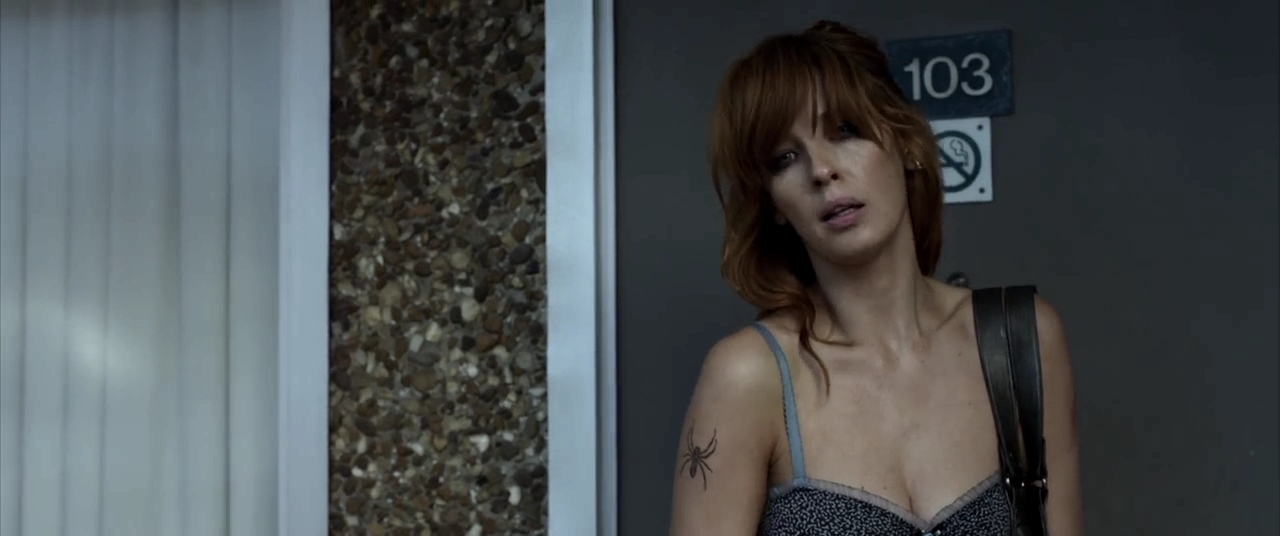
Robert Zemeckis’ “Flight” ended up surprising us all by being a riveting character driven film as opposed to your average Hollywood action movie. It is filled with a number of great performances from very talented actors, and one of the most notable is Kelly Reilly’s as former photographer Nicole Maggen. When we first meet Nicole, she is in the throes of a nasty heroin addiction that almost claims her life. While in the hospital, she meets airline pilot William “Whip” Whitaker (Denzel Washington) who is going through his own substance abuse issues and becomes a kindred spirit of sorts as they both look for ways to escape their demons.

For Reilly, “Flight” marks the first American movie she has appeared in. Before this, she was best known for playing Mary Watson in the “Sherlock Holmes” movies, and she starred opposite Michael Fassbender in the unnerving horror film “Eden Lake.” When it came to playing Nicole in “Flight,” she explained to Christopher Rosen of the Huffington Post how she goes about preparing for a role.

“If it’s there in the script it makes your life a lot easier,” Reilly said. “You’re not searching for something. You’re not trying to figure out how to make this character believable or real. You’re not trying to skirt around bad writing. This character, to me, just jumped out. I already felt a kinship to her; I wanted to play her. I knew that this sort of addiction that got hold of her so tightly was a symptom of this woman’s heartbreak. I knew there was somebody underneath worth fighting for. There are all these stereotypes of heroin addicts being junkies or dropouts or people who we shouldn’t care about. I just thought that can’t be true. They’re somebody’s son or daughter; they’re human beings. They’re just lost. That is something John Gatins got in his script. I really wanted to play that rather than the stereotype of the heroin addict.”

When it came to playing a heroin addict, Reilly explained to Rosen the amount of research she did to better understand her character. She spent a lot of time on Google learning about those addicted to this particular drug, but that only gave her so much information. But while I was at “Flight’s” press conference at the Montage Hotel in Beverly Hills, Reilly went more into depth about who gave her the answers she needed to know the most.

“I did consult a wonderful guy called Mitch in Atlanta who helped me understand the inner life of a heroin addict as much as one can without experiencing it, and he really did open up his story to me,” Reilly said. “There was a technical side of it as well as he taught me how to inject heroin without really injecting heroin. I wanted to honor the truth of somebody in that situation, and I think that was the most difficult part without ever having experienced that.”

But despite “Flight” gaining strong critical praise for its direction and performances, Reilly doesn’t see herself being nominated for an Academy Award. When it comes to the Oscars, they tend to honor the showiest performances above all others. Reilly’s performance as Nicole is powerful largely because it is an understated one which does not draw too much attention to itself. She explained this in more detail to Rosen.

“I know there is a lot of buzz around Denzel and the film. A few people have kind of suggested that it could be a possibility for me. I don’t see it myself,” Reilly said. “That’s just not me being humble or anything. I genuinely don’t imagine that to be the case. Mine is more of a quiet performance and I don’t think it’s an award winner. I still feel incredibly flattered to have people even suggest that. As much as it was never a dream of mine — a dream of mine would be to be on stage in New York — it would still be a mind-blowing thing to happen especially for something you feel proud of.”

Michael Caine once said that in the theater you play a character, but in television and film you are the character. Some of the greatest performances I see from actors in movies come from those who inhabit their characters more than play them, and Kelly Reilly’s performance in “Flight” is no exception. While we all love the showiest of performances, it is those subtle ones which deserve the most credit. My hope is that the Oscars will prove Reilly wrong and give her the credit she deserves for her work here. It’s one of the best portrayals of an addict I have seen ever since Michael Keaton played one in “Clean and Sober.”

SOURCES:

Christopher Rosen, “Kelly Reilly, ‘Flight’ Star, On Why She Probably Won’t Win an Oscar,” The Huffington Post, November 26, 2012.

Ben Kenber, “Interview with The Cast and Crew of Flight,” We Got This Covered, October 30, 2012.

‘Remote Area Medical’ Exclusive Interview with Jeff Reichert and Farihah Zaman

Remote Area Medical” focuses on the non-profit medical provider of the same name, better known as RAM, when they opened a three-day clinic held at the Bristol Motor Speedway in Tennessee, and we watch as hundreds wait by their cars in the hopes of getting the kind of health care they never have any easy access to. While there has been an endless debate in the United States about how to handle health care, this documentary chooses to focus on people instead of policy. We get a close up look at how this clinic starts off with a 3:30 a.m. ticket distribution which determines who will get seen for routine check-ups, and the patients tell us about themselves through stories which prove to be both vivid and heartbreaking. In addition, we also get to meet those who volunteer their time at the clinic like the organization’s founder, Stan Brock, a doctor who happens to drive a refurbished 18-wheeler truck, and a denture maker who also works as a jeweler. From start to finish, “Remote Area Medical” puts a human face on what it means to not have access to health care, and it makes for one of the most unforgettable documentaries of 2014.

I got the opportunity to speak with its directors, Jeff Reichert and Farihah Zaman, while they were in Los Angeles back in 2014. They are married to each other and actually volunteered at a RAM clinic back in Pikesville, Kentucky in 2011 where they were overwhelmed by stories they heard of patients in need and volunteer doctors working overtime to provide care. Reichert and Zaman also directed the documentaries “Gerrymandering” and “This Time Next Year.” They discussed what stunned them most as volunteers at RAM, what they learned about people who live in the Appalachian community, and they talked more about the conversations they had with Stan Brock.

Please check out the exclusive interview down below, and I have also included a trailer for “Remote Area Medical” as well for you to check out. This documentary is now available to own and rent on DVD, Blu-ray and Digital.

To learn more about Remote Area Medical (RAM), please feel free to visit their website at ramusa.org.

Bernardo Ruiz and Oscar Hagelsieb Talk About ‘Kingdom of Shadows’

WRITER’S NOTE: This interview took place back in 2015.

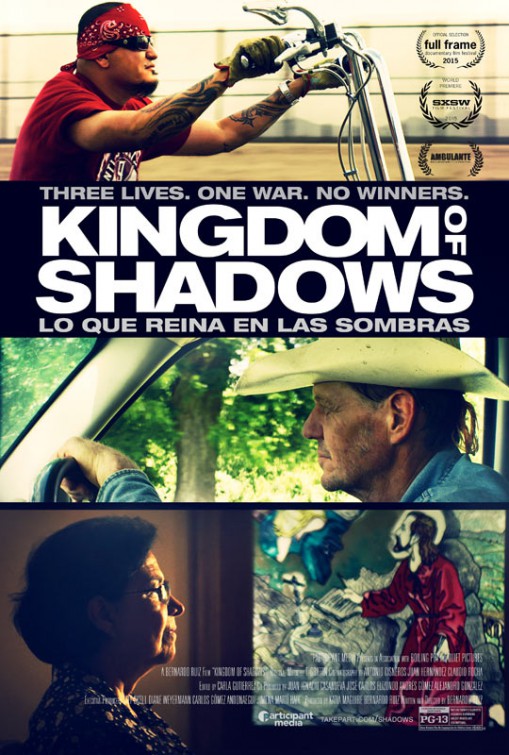
The U.S.-Mexico drug war is one many of us watch from a distance, but the documentary “Kingdom of Shadows” forces you to look at the war more closely than usual as it puts a human face on the damage left in its path. Director Bernardo Ruiz observes the ongoing conflict through the perspectives of three individuals: activist nun Sister Consuelo Morales who prods government officials to take action against the drug cartels who have kidnapped many people, Texas rancher and former drug smuggler Don Henry Ford Jr. who offers a descriptive context for the evolution of drug trafficking, and undercover agent turned Homeland Security officer Oscar Hagelsieb who offers a unique perspective on America’s role in the drug war. The majority of what we see takes place in Monterrey, a devastated and violence scarred town in Mexico that Oscar felt less safe to be in than when he was a soldier in the Middle East.

Watching “Kingdom of Shadows” is deeply moving and unsettling as we see how vicious the war on drugs has become, and it makes the intense thriller “Sicario” feel all the more real and unnerving in retrospect. Bernardo takes a real close look at the cost of this war from both the U.S. and Mexico sides, and he gives us an unflinching look at the human rights crisis it has generated and which only recently made international headlines.

I was among a group of reporters who got to sit in on an interview with Bernardo Ruiz and Oscar Hagelsieb while they were in Los Angeles to promote “Kingdom of Shadows.” Bernardo also directed the documentary “Reportero” which chronicled a veteran reporter and his colleagues at a weekly newspaper challenging drug cartels and corrupt local officials during an unprecedented wave of violence against journalists in Mexico. Oscar’s life began in a drug infested neighborhood where he was raised by undocumented parents, and despite having been an undercover officer for several years, he explained why he was more than willing to show his face in this documentary.

Bernardo talked about the kind of resistance and challenges he faced in making “Kingdom of Shadows,” and he explained why he introduced Oscar the way he did. Oscar was asked how he manages not to take his work home with him, and he explained why the legalization of marijuana will cause the drug war to become even more violent.

Please check out the interview below, and you can also check out the trailer as well. “Kingdom of Shadows” is now available to own and rent on DVD, Blu-ray and Digital.

Exclusive Interview with Salome Breziner about ‘Helicopter Mom’

Back in 2014, I got to speak with filmmaker Salome Breziner about her film “Helicopter Mom.” It stars “My Big Fat Greek Wedding” creator Nia Vardalos as Maggie, a completely overbearing single mother who is about to see her only son, Lloyd (Jason Dolley), finish up high school and then move on to college. Maggie feels ever so close to Lloyd, and she quickly proves to be much too close to him. While Lloyd does love his mom, he cannot help but be constantly annoyed at her being more of a best friend to him than a parent as she is almost completely unable to leave him alone for a second.

Maggie’s relationship with Lloyd then enters another plateau when she discovers that gays can get scholarships for college. Constantly worries about she will pay for Lloyd’s college tuition, Maggie decides to tell the whole world that her son is a homosexual in the hopes of securing a scholarship. The problem is, Lloyd is not really gay or, at least, doesn’t think he is. In fact, he finds himself very confused about his sexuality to where life is not about to give him an easy answer to who he really is.

What results is a motion picture which deals with the confusion teenagers typically experience about life and themselves during their formative years, and it promotes a message of acceptance for people of all kinds. Deep down, we are only so different from one another.

Breziner previously directed the 2013 independent comedy “The Secret Lives of Dorks,” and her other directorial efforts include “Fast Sofa,” “An Occasional Hell,” “Tollbooth” and “Lift.” During my interview, she talked about how she went about director the comedic powerhouse that is Nia Vardalos, her own experience as a single mother, the luck she had in being able to shoot the film in Los Angeles and Venice Beach, and of how she got to cast Mark Boone Junior in a role which allows him to go completely against type.

Please check out my exclusive interview below, and be sure to also check out the movie’s trailer.

Anthony Hopkins on Playing the ‘Psycho’ Director in ‘Hitchcock’

WRITER’S NOTE: This article was originally written back in 2012.

Sir Anthony Hopkins has played real-life people in movies such as President Richard Nixon in “Nixon” and John Quincy Adams in “Amistad,” but he was initially hesitant about playing the brilliant filmmaker Alfred Hitchcock in “Hitchcock.” The master of suspense has been imitated so many times over the years to where it seems impossible to portray the man without it feeling like it is a joke. Hopkins, however, was won ever by the film’s director, Sacha Gervasi, who told him, “You’re not Alfred Hitchcock, you’re Anthony Hopkins playing him.” From there, Hopkins knew he would be portraying Hitchcock without ever having to do a mere impersonation of him.

Hopkins actually had the unique privilege of meeting Mr. Hitchcock while he was alive. It’s always great fun to hear from actors who have met the highly esteemed filmmaker as the majority of us have only seen him from a distance. We all wondered what Hitchcock was really like as his films generally delved into the pitch-black darkness of humanity, and that had many assuming he was a somewhat disturbed human being himself. Hopkins described the experience of meeting Hitchcock to Fox News.

“I met Hitchcock in Hollywood in 1979. He had just been awarded his knighthood and I was with my agent, and his agent in fact, George Chasen,” Hopkins said. “This was many years ago. I saw Hitchcock sitting in the restaurant and I said to my agent, ‘I’d love to meet him.’ He said ‘I’ll introduce you.’ So, we walked out of the restaurant after we finished our meal, and Hitchcock was sitting there drinking a large brandy. And George said ‘Congratulations Sir Alfred,’ and he said, ‘Thank you very much George. How are you?’ and George said, ‘This is my client Anthony Hopkins,’ and (Hitchcock) said ‘Charmed, I’m sure, very good luck to you.'”

For Hopkins, a key importance for him was getting the look of the famous filmmaker right. The fact is he is far slimmer than Hitchcock was, and Hitchcock famously known for being overweight. It was up to Academy Award-winning makeup artist Howard Berger to transform Hopkins into Hitchcock. In a conversation with Andrea Mandell of USA Today, Berger talked about doing six makeup tests with Hopkins before filming on “Hitchcock” began, and they experimented with all sorts of prosthetics to get the look right.

“I think the biggest challenge was finding the right combination of Alfred Hitchcock and Anthony Hopkins,” said Berger. “We knew from the get-go; we didn’t want to completely cover and disguise Tony. As Hopkins became more comfortable with the character, slowly we started to strip things away.”

Berger went on to describe the end result of his work as being a portrait of Hitchcock on Hopkins. The makeup process took two hours each day to complete, and this included applying a prosthetic jowl and neck pieces to Hopkins. In addition, Hopkins took to wearing a bodysuit and brown contact lenses, and he also shaved “a patch of hair at the back of his head to replicate the director’s hair pattern.” With the makeup done, it freed Hopkins to concentrate on the inner life of his role as opposed to the physical aspects of it. In the end, this is what actors need to focus on the most when playing any role.

But the one thing you will not find Hopkins doing during shooting is staying in character when the cameras are not rolling. Right now, the movie “Lincoln” is in theaters, and it stars Daniel Day Lewis as President Lincoln. Stories from that set have described Lewis as staying in character throughout the shoot to where other actors kept referring to him as Mr. Lincoln. In talking with Philip Sherwell of The Telegraph, however, Hopkins made it very clear how this method of acting is completely unnecessary for him.

“I think that’s a lot of crap,” Hopkins said. “I just don’t understand that. If actors want to do that, fine. If they want to be miserable, that’s up to them. I’m not interested. It’s a job. Who the hell wants to be with some miserable grump because he wants to get his performance right, so you have to call him this or call him that? It’s so boring. I’ve been with actors like that and… they’re unpleasant to work with and I don’t think they’re always that good either.”

With all the great performances he has given throughout his illustrious career in “Silence of The Lambs,” “Remains of the Day” and “Titus,” Anthony Hopkins doesn’t need to stay in character a whole day in order to give audiences a confident performance. His role as Alfred Hitchcock in “Hitchcock” is just the latest example of the kind of work we can always expect from an actor of his caliber. Hopkins never takes the easy way out with a role, and he understands it is the inner life of a character that the actor needs to work on. As for how he looks on the outside, that is someone else’s concern.

SOURCES:

‘Hitchcock’ star Anthony Hopkins: To get a compliment from legendary director was ‘like being given a billion dollars,'” Fox News, November 21, 2012.

Andrea Mandell, “Anthony Hopkins’ scary transformation into Hitchcock,” USA Today, November 23, 2012.

Philip Sherwell, “‘Don’t call me ‘Mr. Hitchcock’: Anthony Hopkins does not want the Daniel Day-Lewis treatment,” The Telegraph, November 24, 2012.

Rolfe Kanefsky On His Horror Movie Satire ‘There’s Nothing Out There’

WRITER’S NOTE: This article is about a screening which took place in 2012.

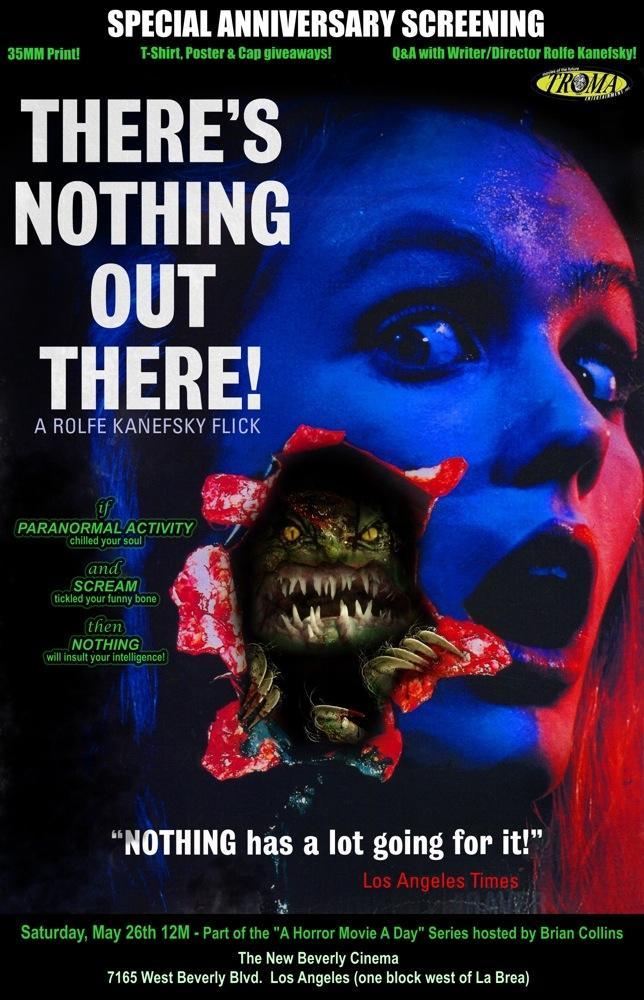
Writer and director Rolfe Kanefsky appeared at New Beverly Cinema where Brian Collins of the Horror Movie a Day website presented a special midnight screening of his directorial debut, “There’s Nothing Out There.” Joining him for this screening were two of the film’s crew members, still photographer Dave Shelton and assistant director Michael Berily. It tells the story of a group of teenagers, one of them a horror movie fan, spending spring break at a cabin in the woods, and it pre-dates Wes Craven’s “Scream” in making fun of the clichés horror movies always deal with.

Kanefsky spoke with audiences about what got him into movie making, and of what spurred the idea for this particular film of his:

Role Kanefsky: I’ve wanted to make movies since I was four years old. As I got older, I watched every horror movie that was ever made which got me to thinking about why people keep making the same mistakes in this genre over and over again. I wrote the script when I was in high school, but no one really liked it.

Kanefsky then went to college where he wrote several scripts, but then he came back to the one he wrote for “There’s Nothing Out There” after he graduated. It was 1988 when he started looking for the money to make it, and he was able to get a few private investors to help him out. He even told the audience his parents helped by selling their house, and after that he had a budget of around $150,000. One audience member asked him if his parents ever got to buy their house back with the profits and he responded:

Rolfe Kanefsky: You don’t get into movies to make money. You get into them because you love to make them.

When asked about the house used in the film, Kanefsky said a friend of his from college found it for him. It was located right near the border of New York and New Jersey, and he described what it was like filming in and around the house:

Rolfe Kanefsky: It was owned by two women who were a couple, and one of them was a sound artist which came in very handy for us. We did, however, have to use three different houses for the interior, and this forced us to cheat certain shots so that everything matched up in the end.

When it came to specific influences, Kanefsky looked mostly to 1950’s monster films, and he made several nods to them throughout. But he was also looking to make fun of the overused clichés in horror movies like the one where a cat jumps out at characters from nowhere, and of how one person warns of the danger ahead while everyone else ignores their advice. Kanefsky did, however, make one thing very clear to us:

Rolfe Kanefsky: It was never my intention to mock the (horror) genre, but instead the lazy filmmaking that has overwhelmed it.

One unique thing about “There’s Nothing Out There,” when compared to other horror movies of the time, is that what’s stalking the characters is not a deranged serial killer, but instead a monster from another planet. Keep in mind, this film was made long before the advent of CGI effects, so there was a lot of puppeteering involved in bringing this creature to life. Kanefsky was specific in what he was looking for:

Rolfe Kanefsky: I didn’t want a guy in a suit for the creature because I wanted to do something different. The way I saw it, the creature was half alligator and half octopus. I also intentionally made it a dumb creature, and you can tell it was not the smartest as there was a big learning curve going on with it. We ended up having to use crowbars just to move its tentacles around.

Kanefsky then invited his fellow crew members to share their experiences of making “There’s Nothing Out There.” Dave Shelton still has very vivid memories of how it all started:

Dave Shelton: I was working at Nickelodeon at the time and there weren’t many things being shot in New Jersey back then. When I met with Rolfe and he talked about his script, I knew right away what his vision was. He also said that no one is getting paid to make this movie and knew it was going to be good as a result. We got a lot of family and friends to be extras in the movie and we improvised a lot of stuff. Not everything worked, but we did the best with what we had. This was such a fun project to be a part of.

Michael Berily was originally hired to be the second assistant director on the set, but things changed for him very quickly:

Michael Berily: The first AD left three days into shooting, so I took over and spent a lot of time yelling and screaming at people because I didn’t know what I was doing. Still, it was an incredible experience working on it, especially when it came to raising the money. Rolfe was very ambitious then as he does a lot of set ups in one day.

Kanefsky attributed his working style of numerous set-ups a day, far more than what most Hollywood productions are able to accomplish, as he and his crew had a twenty-four-day shooting schedule. He has since made over twenty movies since “There’s Nothing Out There,” and to date it still has the longest shooting schedule of any movie he has made.

Horror Movie A Day’s screening of “There’s Nothing Out There” at New Beverly Cinema was certainly a historic one as it marked the first time a 35mm print of the movie had been shown in twenty years. Kanefsky said there were a number of reasons why this was the case:

Rolfe Kanefsky: When we showed it to studios and critics, they were all ambivalent about supporting it because they saw it as too funny to be scary and too scary to be funny. The movie ended up getting a small theatrical release back in 1992, and we managed to get some good reviews from newspapers like the Los Angeles Times. After that it began building up more and more of an audience through midnight screenings… and then the L.A. Riots (following the Rodney King verdicts) happened, and that destroyed us because no one went to the movies for a long time after that.

Kanefsky has attributed its ongoing success to cable and video and now sees this movie as an underground film which people found over the years. The studio which released “There’s Nothing Out There” never really got behind it, he said, and it really found its audience through word of mouth.

Before the evening ended, audience members asked Kanefsky if there would ever be a sequel or a Blu-ray release:

Rolfe Kanefsky: Blu-ray? Maybe, but right now it doesn’t make financial sense to do that and neither does the sequel. We do have the capabilities and original elements to remaster the movie in high definition, but the special edition DVD hasn’t sold enough copies to justify us doing that.

He does however have a title for the sequel:

Rolfe Kanefsky: There’s Still Nothing Out There.’ The tagline for it is, ‘if you were afraid of nothing before, its back!’

Well, hopefully we will get to see a Blu-ray release and a sequel become a reality. There is no doubt “There’s Nothing Out There” was a passion project for Kanefsky and his crew when they made it, and it is clear everyone involved in it worked really hard to make it a reality. That people are still talking about it twenty years later makes it a triumphant motion picture which survived in a marketplace where many other horror movies get swept under the rug, never ever making it to the silver screen.

Joe Swanberg on the Making of ‘Drinking Buddies’

WRITER’S NOTE: This article was written back in 2013.

Filmmaker Joe Swanberg has been a major figure in the Mumblecore movement, a subgenre of American independent film which is characterized by low budget production values and naturalistic dialogue. Among his films is “Hannah Takes the Stairs” which stars Greta Gerwig and was actually shot without a script. The way Swanberg works, he gives his actors an outline of the plot of what he wants to film, and they improvise their scenes from there. This way of filmmaking offers actors the opportunity to take a lot of risks and make the kind of movie Hollywood studios do not want to right now.

Swanberg’s latest film, “Drinking Buddies,” stars Olivia Wilde as Kate, an employee at a Chicago craft brewery who spends her days flirting with her co-worker, Luke (Jake Johnson). They would make the perfect couple, but Kate is already going out with Chris (Ron Livingston) while Luke is seeing Jill (Anna Kendrick). But when their significant others are out of town one weekend, both Luke and Kate begin to wonder if the feelings they have for one another will eventually come to the surface.

As with “Hannah Takes the Stairs,” “Drinking Buddies” was shot without a script, and the actors improvised all their scenes. Swanberg took the time to talk with us about the experience of making the movie while at the Four Seasons Hotel in Los Angeles, California as well as the fascinating world of craft beers.

What would you say is the difference between a microbrew and craft beer?

Joe Swanberg: Same thing, different terminology. The way that the world is soused out is basically in terms of how many barrels a year that places are outputting between micro-breweries and macro breweries. I would argue that you’re either there because you’re passionate about it, or you’re there because it’s a job, and that’s the difference between the two.

You mentioned “Bob & Carol & Ted & Alice” as one of your influences on this film, and that was a studio comedy with an adult point of view. Your films always have that great point of view and you keep going back to that well time and time again. What keeps you going back there, and what was your motivation to do this film?

Joe Swanberg: Well, a lot of it has to do with operating in a space where I can carve out a little area for myself to play in. Sadly, complex contemporary adult movies, there aren’t many of them. I’ve always been allergic to just doing what everybody else was doing, so it’s kind of just remained a place where there aren’t that many other things happening. I don’t have to be nervous that we’re sort of recycling the zeitgeist or anything like that, then it’s also just one I’m fascinated by. I think if you were to catch me most days of the week and asked me what I was thinking about, it would be a conversation my wife and I had about making time for each other to both be able to do our creative things, or some friend of mine who’s going through a breakup or something. I’m interested in people in that way, how we interact with each other. It’s very easy for me to continue to generate stories that are based around that because it’s kind of always on my mind anyway.

What would you say was your favorite scene in “Drinking Buddies?”

Joe Swanberg: My favorite sequence in the movie is Jake and Olivia playing cards, he’s playing blackjack with her, and Ron and Anna are hiking in the woods. Just the start of the back-and-forth of seeing these two couples we’ve established in terms of each other sort of swapping a little bit and feeling out how to flirt with someone else. I feel like I have this experience in my own life within the context of my relationship with my wife where I’ll just be with another woman and you just sort of get to play make-believe for 45 minutes or something of “oh this is what it would be like if we were together and we went to get lunch or something. This is how we would relate to each other,” and it’s different than the relationship you’re in. These little daydream scenarios, that scene in particular is really fun to me to see play out. I also love listening to Jake and Olivia on the porch. Anna has fallen asleep and they sneak out. I’ve had a lot of those nights in my life where the floodgates open and you just start being really honest and it starts feeding into the other person’s honesty. Before you know it, you’re just talking about things you’ve never told anybody with someone you hardly know. It was fun to try get something like that into the movie and to let them share stories with each other, and I just get to bear witness to it.

Did you have this great cast in mind from the beginning?

Joe Swanberg: No. Usually I’m working with friends of mine so I do know exactly who is going to play the parts before I gear the thing up, but this was one where I just sort of had broad stroke ideas about who the characters were. It’s the first time I’ve ever done a casting process where I met with a lot of actors and try to think about chemistry and placing different people in different roles.

Why did you film in Chicago? Why not Boulder, Colorado?

Joe Swanberg: Well, I live in Chicago, so that’s a big reason. Also, there’s a specificity that I can give the movie because I know what kinds of apartments these people live in and what bars they would drink at. So, every choice gets be a real choice because I know them and I’m friends with them. I’ve been to places I’ve never been to before and done the same process, but then I either have to take somebody else’s word for it like where the hipsters drink, or where it’s just not specific at all. I’m just like choosing places that look nicer something. It was fun to do something at home where I could use the city is an indicator of certain things. Also, I have a kid now so traveling is way less appealing than it used to be. Going to sleep in my bed every night was a huge bonus.

Was the backpack scene in the woods between Ron and Anna when they have that awkward moment completely improvised?

Joe Swanberg: Yeah. It’s the first film that I’ve done where I had an art department and a props master and all these people, so it was really fun as a director to show up to the production office every day and have somebody bring in four different backpacks that I could choose from. It was just too funny to pass up. It says a lot about her (Anna Kendrick). It’s a really great use of a prop.

Beer wise, what are you drinking now especially after you’ve had this little bit of education?

Joe Swanberg: I’m still leaning on the hoppy IPA side of things, but it’s interesting because I didn’t drink at all until I was 25. On my honeymoon I had a beer. I guess I must’ve felt like “alright, I’m here,” so it’s new to me. It’s really been something that I’ve just gotten into in the last five years. It’s interesting because I remember drinking a really hoppy beer early on and just thinking it tasted disgusting, and now I really like the flavor so I’m really curious as to where my taste buds will lead me in terms of the stuff. I find that I go through cycles with it. There was a period of time where I just wanted to drink stouts and dark beers, and then I got into Belgian stuff and then went to the hoppy stuff so I don’t know what the next wave will be.

Any brands you like?

Joe Swanberg: Sure, but too many to even name. I’ll stick to the Midwest: Revolution Bar where we shot, Three Floyds, and Half Acre. We are very spoiled in Chicago. I think twelve new breweries opened this year. It’s a nice time to be in Chicago right now.

Drinking Buddies” is available to own and rent on DVD, Blu-ray and Digital.

Adam Scott on Acting in ‘A.C.O.D.’

WRITER’S NOTE: The following interview took place on September 26, 2013.

A.C.O.D.” is an abbreviation for Adult Children of Divorce and the movie stars Adam Scott as Carter, a man who suffered through his parents’ bitter divorce as a child. Now as an adult, he owns a restaurant and appears to be a well-adjusted person despite what he has been through. But then his younger brother Trey (Clark Duke) informs him that he has just gotten engaged, he asks Carter to see if they can get their parents, Hugh (Richard Jenkins) and Melissa (Catherine O’Hara), to come to the wedding. This proves to be quite a challenge as neither Hugh nor Melissa can stand to be in the same room with one another, and this leads to a number of surprises that no one sees coming.

Scott started off as a dramatic actor, but in recent years he has proven to be quite adept at doing comedy. He starred in the movie “Friends with Kids” opposite Jon Hamm and Kristen Wiig, and he has given memorable performances in “The Aviator,” “Knocked Up” and “Torque.” Many still remember him best for his roles on the television series “Party Down” as failed actor Henry Pollard who rejoins a catering company and on “Parks and Recreation” where he plays the competent but socially awkward government official Ben Wyatt. The star of that show, Amy Poehler, also appears in “A.C.O.D.” as Carter’s stepmother Sondra.

I got to participate in a roundtable interview with Scott when he was at the SLS Hotel in Los Angeles, California for the “A.C.O.D.” press conference, and he talked about working with Clark Duke and Amy Poehler, and he also gave us an update on Ben Stiller’s upcoming adaptation of “The Secret Life of Walter Mitty.”

Question: Adam you were terrific in this movie as the exasperated older brother. What was it like working with Amy Poehler who plays your bitchy stepmother?

Adam Scott: Thank you. It was really, really fun because usually we’re just making googly eyes at each other on “Parks and Recreation,” so it was just fun to hate each other’s guts. I remember when I asked her to do it. I just said, “Would you like to come play my stepmother? Don’t worry, we’re the same age” (we are the same age in real life). Luckily, she said yeah. It was really, really exciting that she would even consider doing it. It’s just always fun working with Amy in whatever capacity. Sometimes I do yard work for her (laughs).

Question: How much of this movie was improvised and how much of it was scripted?

Adam Scott: The movie is pretty much all scripted. There’s not much improvisation at all in the movie. It was just a really strong script. There was no need for improvisation and there wasn’t much time to mess around just because we had to shoot the whole thing so quickly.

Question: When you are playing a character like Carter, how do you keep him grounded in reality?

Adam Scott: I think the script is very grounded in reality. We could all relate to certain bits of it so I think it all starts with that. And the atmosphere and tone that Stu Zicherman (the co-writer and director) was setting with the movie was a very real and grounded one.

Question: There is a lot of family dysfunction to be found in this movie, but the relationship your character has with Trey is one of the more tame, genuine relationships of brotherly love. How did you go about establishing that chemistry and working together?

Adam Scott: We never even talked about it, but I think that Clark and I just sort of get along in regular life so that just kind of carries over.

Question: And does Clark also help out with Amy Poehler’s yard work?

Adam Scott: Yes, we all work full-time for Amy at her mansion. Clark and I are in charge of all of her wigs (laughs).

Question: How did this project come to you and what was it about it that spoke to you?

Adam Scott: I just read it and immediately wanted to do it back I guess it was now a couple of years ago. I just thought it was really funny. It reminded me of “Flirting with Disaster” which is one of my favorite movies. I thought it was really smart and really funny, and I was already a fan of Ben Karlin (the movie’s co-writer) and Stu. I didn’t even hesitate. I just tried to get the job immediately and at that point there was no cast signed on to it, so it was sort of a steady stream of these wonderful surprises of amazing people they were getting to fill out the rest of the roles.

Question: Ken Howard plays Melissa’s current husband, Gary, in the movie. What was it like having the President of the Screen Actors Guild on set?

Adam Scott: Super scary. He carries a pistol (laughs). He deputized Clark and I during filming and we each got a firearm.

Question: What are you working on next?

Adam Scott: I’m doing “Hot Tub Time Machine 2” with Clark, “Parks and Recreation” starts this month, and then I’m in “The Secret Life of Walter Mitty” which comes out on Christmas.

Question: Regarding “The Secret Life of Walter Mitty,” have you seen the original movie before coming into this one?

Adam Scott: Yeah, I saw it years ago and loved it. This is very, very different from the original for sure. The story itself (written by James Thurber) is so short that any movie that’s made out of it is going to have to wildly extrapolate from what it was. It’s a really, really, really good movie.

“A.C.O.D.” is now available to own and rent on DVD, Blu-ray and Digital.

‘Trouble in Mind’ Celebrates Its Anniversary Screening at New Beverly Cinema

http://www.allwallpapersfree.org

WRITER’S NOTE: This article was written in 2010, back when this anniversary screening took place.

Alan Rudolph’s 1985 neo-noir movie “Trouble in Mind” reached its 25th anniversary in 2010. This is especially significant because it got lost by its distributors about twenty years ago, and they only recently found a print of it. The movie has since been restored and been released in a new special edition DVD. To celebrate its anniversary, the producer of “Trouble in Mind,” Dave Walker, showed a new print of it at New Beverly Cinema. Along with him were actors Keith Carradine who played Coop and Lori Singer who played Georgia, and they were also joined by the composer of the film’s score, Mark Isham.

In talking about working with Rudolph, both Singer and Carradine said they never really rehearsed any scenes. A lot of it came down to them meeting with Rudolph, talking about the screenplay, and getting on the same page with what he wanted to accomplish. Singer explained how he created a “very vivid atmosphere” which came about from an “organic, real feeling.” In summarizing Rudolph’s filmmaking process, Singer said, “Whatever he was shooting, he was capturing his vision. That was our rehearsal.”

Isham described Rudolph as a “jazz director” in that he wanted to get everything right in the first take. When asked how he got the job on “Trouble in Mind,” Isham explained he was being represented by CAA and his agent encouraged him to make a list of directors he wanted to work with. After seeing one of Rudolph’s other movies, “Choose Me,” Isham decided he wanted to work with him. Rudolph ended up listening to one of Mark’s albums, liked it and hired him.

One question asked of Isham was in regards to working with singer Marianne Faithful on two of the film’s songs. Isham said he knew nothing about Faithful beforehand, but that he quickly learned she was an artist of instinct, and they captured a lot of magic on tape whenever she sang. Basically, he did an acoustic piano version of each song she would sing, and he gave her the music through headphones. Isham went on to say he added synthesizers to the soundtrack afterwards.

Isham is also considered one of the best trumpet players ever, and he did perform on one here. He stated how he has been playing the trumpet since he was eight years old and is always looking to put it in any movie he works on.

Another audience member asked Carradine about Coop’s hair and why it got all funky throughout. Carradine said he contributed to the look and described it as an “expression of descent into a kind of netherworld from innocent to deeply urban sensibility he was defenseless against.” Coop saw the change of hair as him becoming beautiful, and he was convinced that Singer’s character would like it. Carradine described it as Coop’s way of trying to fit into a world he was utterly clueless about, and that the hair he used was indeed his own, and these days he doesn’t have much of it left.

Carradine and Singer also spoke of working with Divine, the actor made famous in several films directed by John Waters, “Pink Flamingos” in particular. They said they really loved him because he was the sweetest guy and wonderful to work with.

After twenty-five years, “Trouble in Mind” still holds up very well, and hopefully its DVD release will open it up to a young audience waiting to discover something new and different. Rudolph has said this films is meant to have the look of a dream, and he gave Singer all the credit for that. The dream is still a strong one even with an elongated passing of time.