Exclusive Interview with Andrea Iervolino and Lady Monika Bacardi on ‘In Dubious Battle’

andrea-and-monika-of-ambi

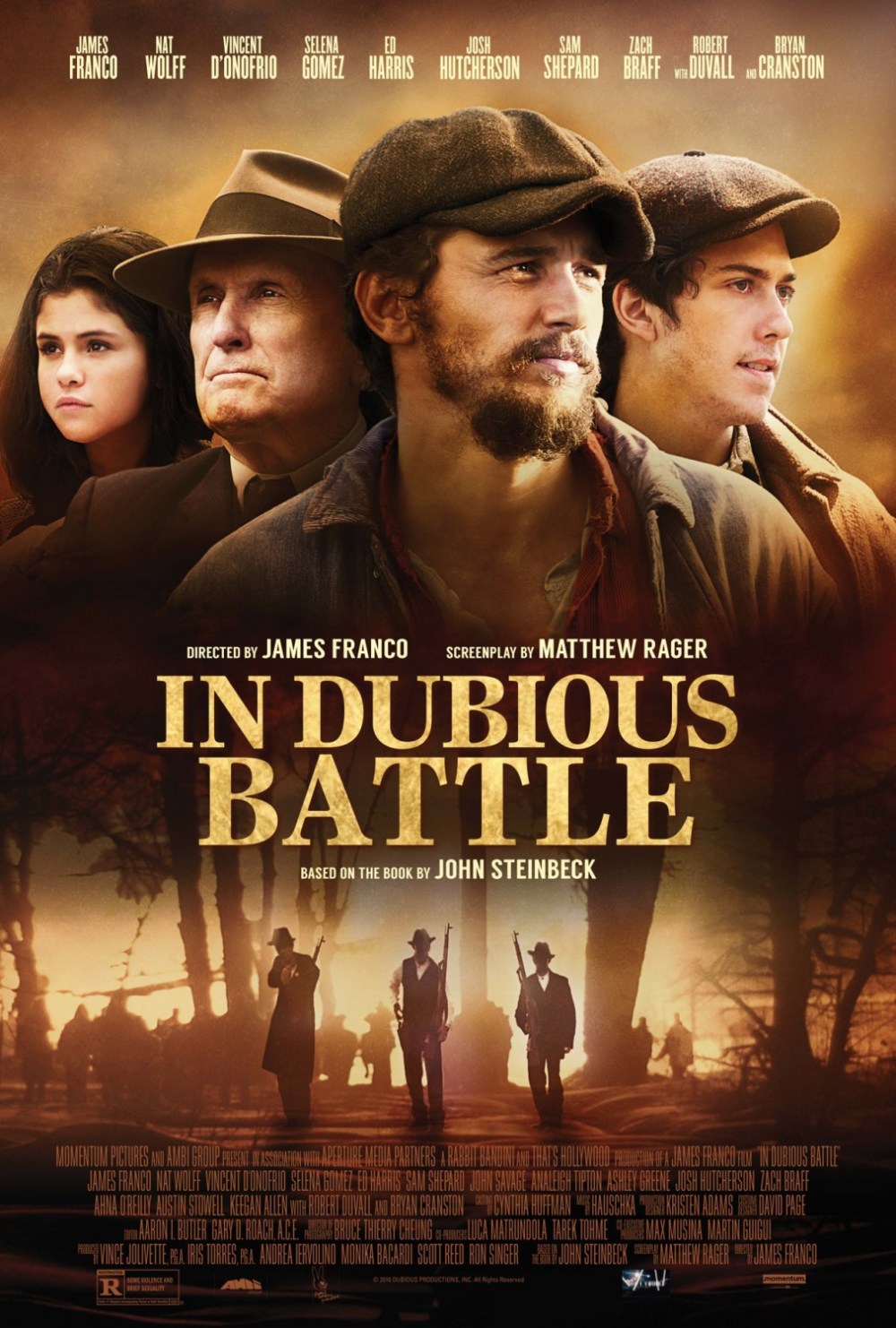
James Franco steps behind the camera once again for his directorial effort, and adaptation of John Steinbeck’s novel “In Dubious Battle.” This movie takes us back to the 1930’s when a group of migratory workers rose up and began a strike against landowners who informed them their pay was being cut from $3 to $1 a day for their work. In addition to directing, Franco also stars as one of strike’s key leaders, Jim Nolan, who struggles to stay true to his idealism of having the courage never to submit or yield. Also, it features a fantastic cast of actors which include Robert Duvall, Vincent D’Onofrio, Bryan Cranston, Ed Harris, Nat Wolff, Selena Gomez, Sam Shepard, Zach Braff and Josh Hutcherson.

I got to speak with the producers of “In Dubious Battle,” Andrea Iervolino and Lady Monika Bacardi, recently at the Redbury Hotel in Hollywood, California. Iervolino is considered one of the most accomplished entrepreneurs in the movie business as he has financed and distributed over 50 films since he was 16 years old. Bacardi is an entrepreneur as well and a successful businesswoman, patron of the arts, philanthropist, and humanitarian. Together, they founded the AMBI Group, a multi-national consortium of vertically integrated film development, production, finance and distribution companies.

in-dubious-battle-movie-poster

Ben Kenber: I thought the movie was really good, and it was surprising to learn that this was one of John Steinbeck’s lesser-known books because, in today’s world, it is so timeless. Is that what really attracted you to producing this movie?

Andrea Iervolino: You know, two years ago, when we decided to produce this movie, we didn’t expect what is now happening in the United States.

Lady Monika Bacardi: A lot of the demonstrations that have happened after the release of the movie. The demonstrations in the film and people fighting for their rights, and now history is repeating itself.

AI: We decided to do this movie because, first of all, we’re big fans of John Steinbeck. He is the best author in American culture, and of course, we love James Franco. When we read the script, me and Monika, we were in two different countries; I was in New York and she was in Monte Carlo. We received the script and we talked for six hours about it.

LMB: And then we decided (to do the movie). It was very fast.

AI: Super-fast. And then we tried to do the maximum we can to promote the movie, and we also went to the Venice Film Festival where it received two awards (for James Franco and Andrea Iervolino). We went to the Toronto Film Festival, the Vail Film Festival, in Capri, etc. So everywhere we went, he received awards for the movie. So, we are proud of the quality in this movie is timeless. We believe today that in 10 years when you watch the movie, for sure a revolution will happen again. A protest will happen again for many individuals so you can think this can be me.

LMB: Yes. When people fight for their rights and they gather together, it’s the hope that they can help them because in their time there were a lot of revolutions that changed things and help the workers get the rights they deserved. So, it’s a message of hope.

BK: It’s interesting how you talk about history repeating itself because it’s a sad fact we can’t seem to escape.

LMB: Yes, it’s sad because we should be learning from history, and the same mistakes should not be made again. There must always be a positive revolution, but unfortunately, we see over and over again that history doesn’t change we make the same mistakes. It repeats itself.

BK: Yes, and that’s why it’s great this movie is being released now. Also, it feels like a miracle this movie got made in today’s world of superhero movies. Was it hard to get the financing for it?

AI: If you do a movie at the right budget, you can do every type of movie you want. The toughest ones to market are the most commercial ones. We believe this movie was made for the right budget and had the right cast, and we believe this movie respects the audience it was meant for.

BK: How much time did you have to shoot this movie in?

AI: The movie was shot in around five weeks.

BK: That sounds like a longer schedule than you like this tend to get these days. Also, it has quite the cast. Was it difficult getting all those actors together?

LMB: James Franco actually has a lot of friends, and he loves John Steinbeck. As a director, he called his friends, and for that reason, this is why he has all the stars together here. He’s a great director and a great actor.

BK: You can tell this is a film people got involved in because of their love and belief in the material, and it really shines through here. Also, you to have been working in the movie business for a while now. How would you say movies have evolved during your time in the business?

AI: You know, I did my first movie was when I was 15, so 14 years ago, I was doing a movie in digital. So, I was the first one in Italy to do a movie in digital because they don’t pay you a lot of money to make your first movie. I financed it by going door to door in my town to collect money, so I was forced to do my movie in digital. But then a few years later I became more powerful because I was the first one with the experience in digital, and I also started to make a movie in Italy with the same technology and distribution point of view, and that was when I was 21. Basically, in my point of view, in the way you can produce a movie there is change, but today I think there are more independent people, young people, with opportunities to produce their movies because the key is that the distribution system has changed. Before you can monetize your movie, you have to go to a local agent to bring your movie to a local cinema or in the local store to someone who can print your DVD, and then you need the agent to go speak with a company. So today, you can run content by yourself. You can do one deal worldwide, and you can add your movie directly to the internet platform. For big managers today, this is a problem because the distribution power is going down, down, down because if you do have good content, you can go for direct distribution, so from who produces and who watches the movie, it is only one step. Before it was 10 or 20 steps which is what managers took advantage of.

LMB: This distribution changed on us.

AI: Yes. And if you think about it, it is like going back. My mentor in Italy, Luciano Martino, he was doing movies in Italy in the 1950’s, 1960’s, and the 1970’s. He was telling me he was producing the movies by himself with his company, and he was going to the cinemas everywhere in Italy to position the movies, and then the movies ran the cinema for six months. So, it was one step production, and today it is again one step. So, it’s like going back. The powers coming back to the producer, not the distribution companies.

LMB: I agree with Andrea always 100%. We cannot speak at the same time, but we have the same opinions on film.

BK: With the changes in distribution, did that help “In Dubious Battle” or take away from it at all?

AI: It actually helped this movie for sure because we were going to go out with the DVD system so we will go out in the principal market, and the same time we will go out in the DVD system. A movie like this cannot make 20 million in one week; it’s too risky. But today, with this new platform, this movie can embrace this distribution concept where you can arrive to your audience and make your audience find the movie all around them without losing your investment.

BK: There is so much money put into advertising movies these days to where it costs more to promote them than to make them.

AI: Yes, sometimes more.

BK: So, it’s nice to see a movie like this can still find its audience while not having a huge budget for advertising.

LMB: Yes, absolutely.

AI: I really believe in three, four or five years, it will become more and more possible to produce a movie with a specific audience because you will know where you can find the audience that likes this movie. Before you needed to spend $10 million dollars in TV advertising in order to get to 300 million people, and in order to reach 3 million people who like your movie.

LMB: (Laughs). It’s absolutely true. Plus, the young people have a different concept that they look a lot of internet, and they go to the movies a lot less than our generation did. It depends on the country, and every country is different

BK: Was there any pressure to modernize this book at all when it came to making this movie?

LMB: We had to keep it as a true story because the message it gives is actually timeless about how history repeats itself. You have to keep it at the time and be true to the book so we cannot change it completely.

AI: Also, the love story component in the movie between Selena Gomez and Nat Wolff and the friendship story between James and Nat, these help the movie be more accessible to young people. Maybe 15, 16 or 18-year-olds, they don’t know or care about John Steinbeck.

LMB: And the love story makes it very human and very touching. It’s about the revolution, but it’s also about the human story and the human aspect.

BK: It almost would have been great to see this movie made in black and white. Was that ever a consideration?

AI: You know, it was in the beginning for about five minutes, but it was too difficult. Black-and-white in a distribution point of view can give you so many limitations. Maybe we can do a black-and-white animation movie someday.

I want to thank Andrea Iervolino and Lady Monika Bacardi for taking the time to talk with me. “In Dubious Battle” premieres in theaters and VOD on February 17, 2017.

Save

Marielle Heller and Bel Powley Discuss ‘The Diary of a Teenage Girl’

Marielle Heller Bel Powley

The Diary of a Teenage Girl,” based on the graphic novel by Phoebe Gloeckner, follows 15-year-old Minnie Goetze (Bel Powley, in a star-making performance) as she goes on a journey for love and acceptance, and as the movie begins she has already started to experience her sexual awakening. She becomes embroiled in an affair with Monroe Rutherford (Alexander Skarsgard) who also happens to be her mother’s (Kristen Wiig) boyfriend. What results is an honest version of what it’s like to be a teenage girl, and the movie isn’t so much about sex as it is about finding your own self-worth which is very important for young people making their way through this crazy world we all inhabit.

This movie marks the directorial debut of actress and writer Marielle Heller, and I got to talk with her and Bel Powley while they were at The London Hotel in West Hollywood, California. One of the things I remarked about it was how beautiful the movie looked and of how it really transported the audience back to the 70’s. Granted, “The Diary of a Teenage Girl” does take place in San Francisco, California which, after all these years, hasn’t changed much since the 70’s, but director of photography Brandon Trost still did terrific work in bringing us back to a time period which is gone but not forgotten.

the-diary-of-a-teenage-girl

Marielle Heller: I love telling people that the same person who shot this movie also shot movies like “The Interview” and “Neighbors” because they couldn’t be more different in terms of content. But he is a real artist and I think he just did the most incredible job. He was so dedicated to making this film look and feel exactly how we envisioned it which was in some ways like an old Polaroid picture, but not with a hipster grossness on it. We wanted it to be really authentic to the story and to the characters.

Those who know Heller best know that she has been in love with Gloeckner’s graphic novel ever since her sister gave her a copy of it 8 years ago. She spent a long time trying to get the rights to adapt the book into a stage play, and she performed the role of Minnie Goetze herself in an acclaimed off-Broadway production. From there, Heller went on to develop “The Diary of a Teenage Girl” into a screenplay at the Sundance Labs, and the film eventually debuted at the 2015 Sundance Film Festival.

Having spent so many years with Gloeckner’s graphic novel, I asked Heller how her view of it has evolved from when she first read the book to when she began turning it into a movie.

Marielle Heller: The film version of the book had to take on its own new life and really shift and change because the narrative structure of a film has to have a different build than a novel can. You read a book and you put it down and you pick it up and you put it down and it can have a really episodic feel, and a movie has to have a really specific kind of emotional build. I had such reverence for Phoebe’s book. I loved it more than anything I had ever read before, which is sort of a problematic place to start an adaption from. It was too much love, too much reverence, and at some point I had to sort of give myself permission to destroy parts of what I loved too and let go of it and let the reverence go away. Things changed, storylines changed, so that was a big process and luckily Phoebe really understood that because she’s such an artist herself.

Heller also remarked about a conversation she had with Gloeckner during the making of the film:

Marielle Heller: She was like, “You have to do what you have to do for this process. I took my real diaries and I wanted to make them into a piece of art. I didn’t want to write a memoir. I wanted to change them and let them become something new and let them become a book, and so I put them through this big grinder and it came out the other side hopefully with some truth intact. But it was something new, and then you took it and you put it through another kind of meat grinder and out the other end came this other project and it’s something new and hopefully that kernel of truth is still the same.” So it’s been a long process and in some ways I internalized the whole book. I got to know it inside and out and then stopped looking at it and wouldn’t let myself look at it and let the movie just grow into something totally new.

Watching “The Diary of a Teenage Girl” reminded me of my favorite movies which dealt with adolescence and being a teenager like “Pump up the Volume,” “The Breakfast Club” and “Ferris Bueller’s Day Off.” I love movies which take adolescence seriously as so many others treat it like life won’t get any better than when you’re young. I asked Heller and Powley what their favorite teen movies which they felt treated being a teenager honestly were, and their answer pointed out how those movies are missing a particular point of view.

Marielle Heller: I think there are a lot of movies that deal with adolescence in an honest way for boys. I hadn’t really come across ones that really dealt with girls in an honest way which is why I think we wanted to make this movie. I know I really related to movies like “Stand by Me” or “Harold and Maude;” movies that felt like they were, like you said, really respecting the characters and giving adolescents a voice in it. And John Hughes’ movies too like “The Breakfast Club” and “Sixteen Candles.” Movies like that really did give voice to the teenager in a real way. And I guess actually that John Hughes did make movies about girls. “Sixteen Candles” was about being a girl, but we’re a long time from “Sixteen Candles.” We’re due for another one.

Bel Powley: I was a teenager six years ago (laughs), and I don’t think I related to anything. I found it really hard, and I think it honestly made me feel like really isolated and really alone. I think young female characters are presented in such flat, two dimensional ways especially when it came to sex. Like if you did have sex then you were this high school slut, or if you didn’t then you’re either frigid or you’re like this virgin waiting for your Prince Charming. I remember being so excited when “Juno” was coming out, and then it came out and it was like, well no one speaks like that. And also, she’s made to be kind of asexual. It was just so confusing to me, and I honestly didn’t relate to anything until “Girls” (the HBO series), and that was when I was like 19.

Hearing Heller and Powley say that makes you realize how important “The Diary of a Teenage Girl” is in today’s cinematic landscape. For once we have a movie that deals with the life of a teenage girl honestly, and that makes it all the more important for audiences to seek it out in the midst of another overcrowded summer movie season. It is truly one of the best adolescent movies made in recent memory, and it deserves your attention far more than many others in this genre.

“The Diary of a Teenage Girl” is now available to own and rent on DVD, Blu-ray, and Digital.

Alexander Skarsgard talks about ‘The Diary of a Teenage Girl’

the-diary-of-a-teenage-girl-alexander-skarsgard

Alexander Skarsgard stars in “The Diary of a Teenage Girl” as Monroe, an emotionally stunted man who finds himself in San Francisco, California and in a relationship with the free-spirited Charlotte Goetze (Kristen Wiig). But then he meets her daughter Minnie (Bel Powley) who is in the midst of her own sexual awakening, and she begins a complex love affair with him that will lead to even more awakenings about each other and their own self-worth.

I got to hang out with Skarsgard along with a few other journalists while he was at The London Hotel in West Hollywood, California to do press for “The Diary of a Teenage Girl.” Greg Srisavasdi of the website Deepest Dream asked Skarsgard how he goes about preparing for a role, and his answer illustrates why his performance as Monroe is so good.

the-diary-of-a-teenage-girl

Alexander Skarsgard: The very first step is to connect with the material obviously. In this case, I thought it would be a really interesting challenge to play Monroe. I felt he could easily be a villain or just like a predator and I wanted to avoid that. I felt like I don’t think it will be interesting if you play it that way, and you make it too easy for the audience if they can just lean back and go, “Oh, bad guy,” and it’s not going to be interesting to the film. And that really intrigued me and I thought this would be a cool challenge to make this real and find moments where you might feel empathy and you might connect with him and almost like him, and moments where you don’t. I think it’s important to not have an opinion (about the character) in the beginning and to be open, and that’s when you go into that creative process of discovering and developing that character. You have to be very non-judgmental and be very open.”

Skarsgard is best known for playing the vampire Eric Northman on the HBO series “True Blood,” and he has turned in memorable performances in movies like “What Maisie Knew,” “Melancholia” and “Kill Your Darlings.” What’s interesting about him as an actor is how he is able to derive such strong complexity in each character he plays. It made me wonder just how much he brought to the role of Monroe which wasn’t in the script, and I asked him if he prefers playing characters like Monroe over others. For Skarsgard, it all comes down to one thing.

AS: It’s all about finding depth and it doesn’t matter in what genre it is. I just wrapped a movie called “War on Everyone” which is a comedy by John Michael McDonagh who did “The Guard” and “Calvary.” It’s a weird, fucked up comedy about corrupt cops in Albuquerque. I play a coke-snorting alcoholic cop who beats up criminals and steals their money with Michael Pena as my colleague. I had an amazing time. It was so much fun and, tonally, very different from “Tarzan” that I finished just before that or this one. But what it’s always about is that you need to find depth in the character even if it is comedy. You can’t play a caricature, or you can but I just don’t find it interesting. I don’t subscribe to good versus evil unless it’s within you. I think we’re all struggling with that, good and bad, and I think we’re all capable of good deeds and bad deeds. It’s interesting in literature or movies when you find characters that are struggling with that, and if there’s no inner struggle then it’s not interesting to me.

Watching “The Diary of a Teenage Girl” reminded me of just how much I love movies which take adolescence seriously. Some of my favorite examples of those movies are “Pump up the Volume” and “The Breakfast Club,” and I’m convinced that everyone has their own favorite movies which really spoke to them about life as a teenager. When I asked Skarsgard to name a movie that spoke to him about the truth about adolescence, he instead thought of a book.

AS: The most obvious example would be “Catcher in the Rye.” I guess as a boy growing up, as a teenager you’re like yeah, I get it dude. But I don’t have one movie that stands out or where watching it was a pivotal moment of my adolescence. What was I into as a teenager? It was the 80’s, so it was “Star Wars” I guess.

Watching Alexander Skarsgard in “The Diary of a Teenage Girl” is proof of just how gifted an actor he is. The role of Monroe could have been reduced to being a mere one-dimensional character, but Skarsgard dove right into the complexities of this character and made him an empathetic one even though no one can condone his actions. It’s a fascinating portrait of a man who still needs to grow up, and it’s one of the many reasons to check out this movie on DVD, Blu-ray or Digital at your earliest convenience.

Save

Exclusive Interview with Peter Strickland on ‘The Duke of Burgundy’

the-duke-of-burgundy-peter-strickland

He received critical acclaim for his film “Berberian Sound Studio,” and now British filmmaker Peter Strickland follows it up with “The Duke of Burgundy.” Now while the title might have you believing this is just another stiff period piece, it proves to be anything but that. It stars Sidse Babett Knudsen and Chiara D’Anna as Cynthia and Evelyn, two women with a keen interest in butterflies who are involved in a sadomasochistic relationship. Despite what sounds like a harsh situation, Cynthia and Evelyn are very much in love with one another and enjoy playing the roles of the dominant and the submissive. But as Cynthia begins to yearn for their relationship to become a more normal one, Evelyn becomes increasingly obsessed with playing the submissive to where it becomes an addiction which cannot be easily fulfilled.

I got to speak with Strickland over the phone while he was doing press for “The Duke of Burgundy,” and we talked about how the movie is not what it appears to be. Strickland described how he achieved the movie’s beautiful look, what he wanted to see onscreen in regards to a sadomasochistic relationship, and of the challenges of shooting a six-minute scene in one take.

the-duke-of-burgundy-movie-poster

Ben Kenber: “The Duke of Burgundy” is a fascinating and mesmerizing movie, and what I liked about it was that while these two women are involved in a sadomasochistic relationship, it still feels like any other relationship in terms of how it runs on routine and gets run down by it as well.

Peter Strickland: Yeah. Ultimately what I found really interesting was that one of them is doing that out of the purest joy. There are two levels: one level is the joy of sex which makes us happy but also the joy of feeling desired I think especially as she’s (Cynthia) feeling that she’s getting older, but only have so much mileage to that. To me the film is about anybody who’s in a relationship with someone who has different needs and how you navigate those and how you find compromise, and I think coercion leads into it somehow. To be honest I was making the movie as a way to argue that afterwards or at least have discussions about who should compromise. Should it be one person doing things to somebody else that they find distasteful? It doesn’t matter what that thing is. It could be the most basic sexual acts. Or should the other person compromise and just withhold their desires and not express themselves? I don’t have the answers to that. I’m just showing this domestic drama really.

BK: Yeah, in any relationship those questions of who’s going to compromise the most comes up. In the end when you take away the sadomasochistic elements it really is like any other relationship.

PS: Yeah, I think so. And I think that, despite some of the harshness, there was a tenderness there as well. What I wanted to do was to start the first 10 minutes like your classic 70’s sexploitation film which would serve that kind of fantasy where they are all in character where the stern mistress is the stern mistress but then somehow unpeel that, and I want to see that stern mistress in her pajamas. I want to see her snoring at night, I want to see her get her lines wrong and miss her cues just to see what ticks underneath that somehow.

BK: This movie has such a beautiful look to it. It looks like it was shot on film, but I read that you actually shot it digitally. How did you make The Duke of Burgundy look like it was shot on film?

PS: That was Nicky (Nowland, the Director of Photography). He has literally been shooting on film for many, many years and he has been shooting stuff since the 60’s so he’s got a good feel for that. We were very close to shooting on 16mm but we just didn’t quite… We could’ve applied for more money, but the more money you get, the less control you have. So, we kept the budget around $1,000,000 pounds which meant I had complete control, but the consequence of having complete control is that we had to make cuts, so film was the first one to go. Nick can talk more about it in terms of the lenses he uses which were older lenses which I think were uncoated. That haze machine is quite important for him in terms of having this very diffuse quality to the whole movie. But also during the scenes where Evelyn is having her sort of excitable moments he was using doubles and mirrors so all that is done in camera, and I think we just did a lot of trial and error just moving the camera and moving the actors. Sometimes you have two doubles crossing into the mirror and crossing into another mirror and cover that up with the haze machine, and that really has a certain tasty look that’s reminiscent of the 70’s. We didn’t want to try too much to go down that route. Now you can make film looked distressed and so on, and that was the danger of sort of being a pastiche. We just wanted to do the most beautiful job we could, and I think the production design played a huge part in that and the costumes played a huge part as well.

BK: The movie kind of looks like it takes place in the 70’s, but in the end, it could be taking place in any time period. Was it your intention to leave the movie’s time period ambiguous?

PS: I wanted it to be kind of like a fairytale in that you don’t know where it is, you don’t know when it is, and you don’t know how in the hell they make their money to live in that place. It’s all those things that fairytales have been in a sense. Hopefully, you’re not worried about social elements of class or gender. There’s no counterpoint in that sense, so hopefully you’re just immersed in the dynamic of it. What was important as well was to be open to the fact that other people enjoy these practices so it doesn’t feel like this unusual activity. It’s kind of normalizing it so it’s not about treating it like it’s this odd thing. It could be any act in that sense, it’s just one person doesn’t like it, that’s all.

BK: I also got the impression that you designed “The Duke of Burgundy” to mislead viewers in a way starting with the movie’s title. Also, with the relationship between Cynthia and Evelyn, it looks like Cynthia is the dominant one, but it turns out to be the other way around.

PS: Yeah. Very subconsciously, I knew people wouldn’t watch the film so I just tried to make it like this kind of tasteful period drama, but I think it was kind of like a perverse pleasure having one concession to a masculine presence especially given that, being a male director, you can’t avoid that element of it. I’ve seen a lot of films on that subject, not everything, but I think what often happened was they would prop up the fantasy of masochism and never show the dominant out of character. What I wanted to look at was the idea of the masochist controlling the whole scenario, and the whole paradox is controlling the situation where you are controlled by someone else. The whole paradox of the submissive controlling the dominant is that it is being dominated on her terms. It’s exploring all these dynamics I guess.

BK: One of my favorite scenes is where Cynthia and Evelyn are in bed, and you see on Cynthia’s face a yearning for something normal in their relationship. The acting by Sidse Babett Knudsen who play Cynthia is extraordinary. How did you go about directing that scene?

PS: That was a weird one. There wasn’t enough space for me in the bedroom, so I directed it from the bathroom. Normally I talk to the actors in person but there was just so many wires that I had to sort of shout to them from the bathroom. Obviously, we spoke about it prior to that. In one sense, it was quite easy to do because of the whole dynamics of it, but it was very difficult in another sense because we had to do it in one take. If you get one line wrong, you have to go again. There’s a weird kind of meta thing going on because obviously if one line goes wrong for Evelyn’s character it’s gone wrong for her, and if one line is wrong for me it’s gone wrong. Since there was this double pressure, I actually think it was quite easy to do that scene. It was quite tense because it was actually six minutes long, and even though we got it in one take at the very end it was just too long. It’s a weird thing because when you’re on set time just flies by, and when you look at it at in the edit room out of context you think, oh my god this is so long, it’s just not working anymore. So all that effort to do it in one take was just kind of wasted; we had to do it like a sort of insert cut. But yeah, that scene kind of sums up the film: to being ordered to order someone. It sounds kind of preposterous but it’s really an interesting part of human nature.

BK: The music score by Cat’s Eyes is wonderful and sounded very unique. What was it like working with the band on the score?

PS: I loved working with them. They are really, really, really talented and woefully overlooked. Hopefully that will change now. They come from very different disciplines. Rachel (Zeffira) comes from a classical background and Faris (Badwan) comes from this rock ‘n roll, experimental background, and they just complement each other really well. They’re completely fine if it’s not right; they’ll just keep going. The main thing at the beginning is just setting them up for the right mood and just playing the music. In hindsight, I feel a bit guilty sometimes that maybe I’ve gotten too attached to some piece of music, but I think it was setting the mood for them and discussing the instruments they would use. I remember I put Mozart’s Requiem over that long montage towards the end, and I knew I shouldn’t do it because it’s such an obvious piece of music and everyone’s used it. Then Rachel just came on and said, “I don’t care. I can just write my own requiem.” It was just an amazing piece and I didn’t miss the Mozart at all. I assume that they will be asked a lot more to do soundtracks. I bought their first album in 2011 and it just blew me away. They’re the first band that made me say, “Okay this is The Carpenters if they were doing music now without any kind of ironic take or pastiche.” I highly recommend the first album they did. I was really, really lucky that they said yes (to working with me).

BK: It’s compelling to think that the use of butterflies in this movie serves as a metaphor for the relationship between the two women, but it’s my understanding that you never actually intended that to be the case.

PS: No, not really. I’m not a big fan of putting the audience through that (laughs). For me, it was a framework for the film. Obviously, there are connections you can make, but you can do that with anything if you wanted to because of the metamorphosis and the cataloging of the insects. But there’s something about the absence of these insects when they’re emigrating and their hibernating which really added to the atmosphere of this very autumnal love story where you just feel it might be coming to an end. And that last lecture that Cynthia gives with the mole cricket going into hibernation really connected with Evelyn’s dormant desires. So, you really feel this extreme hibernation that is coming.

Thanks to Peter Strickland for taking the time to talk with me. “The Duke of Burgundy” is now available to own and rent on Blu-ray, DVD, and Digital.

Forget ‘Fifty Shades of Grey,’ and Check Out ‘The Duke of Burgundy’

the-duke-of-burgundy-movie-poster

Looking at the trailer for “The Duke of Burgundy,” I couldn’t help but expect a sexploitation flick with lots of nudity and dozens of butterflies. But while the movie does deal with a sadomasochistic relationship between two women, it actually turns out to be a domestic drama about two people who love one another deeply. When the movie starts, however, it looks like this relationship is reaching its breaking point.

“The Duke of Burgundy” starts off with an innocent looking woman named Evelyn (Chiara D’Anna) cycling over to a grand mansion where she is greeted coldly by Cynthia (Sidse Babett Knudsen) who bluntly informs her she is late for work. From there it looks like Evelyn works as Cynthia’s maid and is rudely ordered around and made to do chores, each of which are increasingly demeaning. It’s a daily routine for these two, and the day ends with Cynthia punishing Evelyn behind a closed bathroom door. We have a good idea of what Cynthia’s doing to her, but director Peter Strickland is more content to let us visualize what’s happening instead of showing us everything.

At this point, I became very eager for Evelyn to smack Cynthia in the face, but as the saying goes, you can’t judge a book by looking at the cover. What’s actually happening is that these two are in a relationship where Evelyn is the submissive one and Cynthia is the dominant one. They are deep into role playing and enjoy each other’s company more than we could have realized. But as “The Duke of Burgundy” continues on, it becomes apparent that a compromise in this relationship is desperately needed. We see in Cynthia’s eyes a longing for a more normal relationship, but Evelyn has become hopelessly addicted to the submissive role she plays and wants her lover to punish her more aggressively than ever before. With any addiction, you eventually come to find too much is not enough.

This movie surprised me throughout as it plays around with what you think you know about sadomasochism to where you’d expect Cynthia to come out dressed as a dominatrix and carrying a big whip. But if you strip away the strange and painful things they do to one another, you see their relationship is no different from any other, and like any relationship, there needs to be some compromise. The question is, who’s willing to compromise more?

Both D’Anna and Knudsen are perfectly cast, and they nail each of their characters’ complexities with a lot of depth. It’s fascinating to watch their relationship evolve to where the most dominant one is actually Evelyn as she continually begs Cynthia to feed her dark desires. Knudsen, in particular, has a great moment where she’s getting intimate with D’Anna, and you see this wounded look in her eyes which says without words how this relationship is becoming a lot less comfortable for her.

“The Duke of Burgundy” is also one of the most beautifully filmed movies I’ve seen in a while as it looks like it was shot on 16mm film to where you think you’re watching something from the 70’s. To my astonishment, I discovered it was shot digitally which completely blew my mind. Many congratulations go to cinematographer Nic Knowland who has been working in movies since the 60’s. The lush and hazy look he gives this movie feels magical and makes you realize what amazing things can be captured with digital cameras. It was also fascinating to learn many of the images were created in the camera and not in post-production.

The movie also features a very unique and original score by Cat’s Eyes, an alternative pop duo made up of two musicians from entirely different disciplines. Their music adds immeasurably to the story which reaches a fever pitch towards the end when this relationship looks to be doomed. Like Mica Levi’s score for “Under the Skin,” I have a hard time comparing Cat’s Eyes score to others out there. Here’s hoping they compose more film scores in the future.

Strickland previously directed “Berberian Sound Studio” which brought him to the attention of many film critics who became immediately enthralled with his work. I regret to say I haven’t seen that movie yet, but watching “The Duke of Burgundy” does make me want to check it out sooner than later. Strickland shows a strong mastery of the filmmaking process, and he ends up taking us on a journey unlike few other have recently. He also tricks us into thinking we are watching one type of movie, and he ends up giving us something which is not only different but far deeper and more mesmerizing than we ever could have expected.

I also want to point out that there’s not a single male character to be found in this movie. That’s actually pretty amazing considering how hard it is to think of an American movie where this is the case. I’m sure there’s one like this one out there, but nothing comes to mind right away.

What bums me out is audiences will not be quick to come out in droves to see a movie like “The Duke of Burgundy.” Small and original movies like these tend to get swept under the rug far too quickly in this day and age of superhero franchises, and I hope those with a taste for challenging and unusual material will give it a shot. What Strickland has given us is an edgy fairy tale which could take place in any time period, and he sucks us into a story you cannot help but be enthralled by. With any luck, we’ll get more challenging movies like this one in the future. At the very least, it’s infinitely better than the awful monstrosity which is “Fifty Shades of Grey.”

* * * ½ out of * * * *

Save

Fifty Shades of Grey

fifty-shades-of-grey-movie-poster

I have not read E.L. James’ book “Fifty Shades of Grey,” but I have yet to hear anyone I know say a good thing about it. But after watching Sam Taylor-Johnson’s cinematic adaptation, I think I understand why it became such a literary phenomenon. It allows its readers to visualize sexual fantasies they don’t get perform in their own lives as the two main characters engage in a sadomasochistic relationship which appears alarmingly pleasurable. The question, however, is this, can the individual erotic desires James’ book conjures up come even close to equaling what we see in this long-awaited film adaptation? The answer is no, not even close, and I’m certain you don’t have to have read the book to confirm this.

Fifty Shades of Grey” is essentially a big tease of a movie which promises so much naughty stuff but instead ends up giving you very little if anything. It’s like the girl who kept teasing you in high school, and of course, you fell for her charms when you should have known better (don’t ask me how I know this). I came in with low expectations, and it proves to be a hilarious comedy for all the wrong reasons. But long before its climax or lack of one so to speak, I found myself becoming increasingly bored and started to wonder if this movie would ever end. When it finally did, I found myself breathing a huge sigh of relief.

We come to meet college student Anastasia Steel (Dakota Johnson), an English literature major on the verge of graduating when she is offered the opportunity to conduct an interview with the infinitely wealthy business entrepreneur Christian Grey (Jamie Dornan). Sparks end up flying for them instead of the audience, and while it takes far longer for them to kiss for the first time, it eventually allows Christian to bring Anastasia into his inner sanctum which includes a room filled with all the BDSM equipment you could ever hope to find or see so beautifully maintained.

Does Anastasia end up becoming the submissive to the dominant Christian? The answer seems fairly certain, but the movie takes forever to get to that point as Christian keeps encouraging Anastasia to sign a contract which will allow him to do the craziest things to her. It got to where I wanted to yell at the screen, “SIGN THE DAMN CONTRACT ALREADY!!!” Granted, Anastasia’s hesitation to do so is understandable and smart, but it just makes her inaction all the more tedious to endure. To encourage her, Christian does several things like buying her a new computer and a new car, selling her old one off in the process, and showing off the cars in his building’s garage. I kept waiting for Christian to reveal himself as a serial killer, but to do so would have threatened to make this movie interesting.

Perhaps it’s a mistake to come into “Fifty Shades of Grey” expecting anything truly realistic as it seems to exist more in a fantasy world than the real one. Still, I can’t help but wonder how Christian Grey finds the time to engage in any kind of sadomasochistic activity when he runs the kind of business which should keep him fully occupied 24/7. Then again, he does have plenty of time to work out at the gym so he can show off those six-pack abs you know he has hidden underneath his shirt.

Regardless of how I feel about Anastasia as a character and of her foolish descent into Christian’s twisted lifestyle, Dakota Johnson, the daughter of Don Johnson and Melanie Griffith, proves to be quite a good actress. I liked how she was able to convey a variety of emotions without having to say a word, and she is able to show her character’s longing while her co-star is unable to do so, which is putting it nicely. With the right role in the right movie, she may end up with quite the career as an actress, and she looks to be capable of doing so much better than appearing in this piece of dreck.

As for her co-star, Jamie Dornan who plays Christian Grey, watching him reminded me of a scene in “The Shawshank Redemption” when Red described Andy Dufresne as a guy who “looked like a stiff breeze would blow him over.” Watching “Fifty Shades of Grey,” I can’t help but think Dornan was cast just for his good looks. From start to finish, he comes across as so emotionally vacant to where I wondered if he was capable of exhibiting any kind of emotion at all. His face looks like it is frozen in place, and not even sex can seem to thaw it. Dornan does, however, have the best line when he says he’s “fifty shades of f**ked up,” and that line effectively sums up this whole movie.

Among the other things which cripple “Fifty Shades of Grey” is the fact that Johnson and Dornan don’t have much chemistry. Romantic relationships in movies thrive on the stars having some form of it, and this isn’t the case here. Rumor has it that they didn’t get along behind the scenes, and this shows here regardless of the studio’s efforts to hide the truth. Then again, it must be somewhat difficult to have chemistry when one lover punishes the other lover physically in order to feel anything.

Director Sam Taylor-Johnson only has one previous credit which is “Nowhere Boy,” a film which chronicles the childhood experiences of John Lennon. I haven’t seen it, but I’m certain my friend Trevor, a huge John Lennon fan, has many great things to say about it. But whatever great things she was able to accomplish with “Nowhere Boy” is not on display here as she succeeds in making the most sleep-inducing erotic movie ever. The sex scenes come way too late and are very unimaginative. Christian running an ice cube down Anastasia’s stomach? We’ve seen that before. As for Taylor-Johnson’s song selections which include “I Put a Spell on You” and “Beast of Burden,” they are far too obvious even if the former is sung by Annie Lennox.

“Fifty Shades of Grey” marks the first erotic studio movie Hollywood has released since “Unfaithful” which came out back in 2002. This movie represented a chance for Hollywood to deal with sexual relationships more frankly than others have in recent years, but it instead proves to be an astonishingly chaste motion picture which seems stunning considering the source material. Late night movies on Cinemax and Showtime have far more erotic power than this one (don’t ask me how I know this either), and the sex scenes are so sterile looking that it feels like they were shot in Irvine, California. The marketing department did a brilliant job in titillating moviegoers into thinking they were getting some sexy stuff they won’t find on the internet (unless they look in the right places, of course), but we went through the same thing with “Showgirls” and look what happened there. “Fifty Shades of Grey” ends up making Paul Verhoeven’s camp classic look like “Vertigo.”

Seriously, there are so many other movies that are far better than this piece of crap and which deal with sadomasochistic relationships in a healthier and far more sensual way like “Secretary” which starred James Spader and Maggie Gyllenhaal, and “The Duke of Burgundy” which is from the director of “Berberian Sound Studio,” Peter Strickland. What depresses me is audiences are going to flock out to this adaptation than they will to other movies far more worthy of their time and money. Some books translate well to the silver screen, but this one should have stayed on the written page. Then again, when a book like “Fifty Shades of Grey” sells an incredible amount of copies, why stop there?

* out of * * * *

No, I Haven’t Seen It Until Now: Empire of the Sun

empire-of-the-sun-movie-poster

Empire of the Sun” is one of the few Steven Spielberg movies which has eluded my watching it for far too long. I remember when it was released back in 1987, and my brother and I watched a documentary on its making. What we saw did not make it look like the typical Spielberg crowd-pleasing movie people had come to expect from him back then. It also dealt with a young boy who is separated from his parents, and separation anxiety was a HUGE thing for me back in the 80’s. But with it now at its 30th anniversary of its release, and having the opportunity to see it on the big screen at New Beverly Cinema in 35mm, the time had come to give what is largely considered to be one of Spielberg’s more underrated films a look.

Based on the semi-autobiographical novel by J.G. Ballard, “Empire of the Sun” takes us back to the days of World War II where we meet Jamie Graham (Christian Bale in his film debut), a young schoolboy who lives a privileged life with a wealthy family out in the Shanghai International Settlement where he sings in the school choir, rides his bicycle everywhere and anywhere, and has a love of airplanes which knows no bounds. A key shot for me comes early on when we see Jamie taking some food out of an overstocked refrigerator which is filled with goodies as it shows how easy things come to this young lad to where he can boss the Japanese maid around like his parents do.

Of course, this all changes when the Japanese invade the settlement following their bombing of Pearl Harbor, and Jamie and his family are forced to flee their home and escape with their lives. In the process, Jamie gets separated from his mom after he picks up his metal toy airplane which he dropped on the ground, and he is forced to fend for himself as he is swept into a conflict far beyond anything he could have imagined.

When it comes to “Empire of the Sun,” it was no surprise to learn David Lean was originally going to direct this adaptation as Spielberg certainly made it look like a Lean movie with scenes filled with crowds of people struggling to survive in life during wartime. Spielberg ended up putting together scenes which must have made Lean proud as it brings to mind the epic shots the director pulled off in his masterpiece “Lawrence of Arabia.” Today, most of those shots would have been accomplished with the use of CGI effects, but “Empire of the Sun” was made back in a time where they weren’t so readily available.

Watching this movie reminded me of how brilliant Spielberg is at taking us back to a day and age many of us were not alive to see, and he does it so vividly to where we can never doubt his authenticity to the period. Spielberg has visited the era of World War II time and time again to amazing effect whether it’s the Indiana Jones movies or “Saving Private Ryan,” and he never seems to miss a detail in the process.

And then there’s Christian Bale who made his film debut in “Empire of the Sun,” and he brings to this role the same kind of intensity he would later bring to his work in movies like “American Psycho” and “The Fighter” among others. I could never take my eyes off of him as he takes Jamie from being a privileged young man to one who struggles for even the smallest reward like a Hershey chocolate bar. Was there another young actor who could have pulled off such a brave and emotionally honest performance as Bale does here? I think not.

Another great performance to be found here is from John Malkovich who plays Basie, an American ship steward stranded in Shanghai who befriends Jamie in his most desperately hungry state. Basie looks to be the Han Solo kind of character who befriends a young innocent who has yet to learn how cruel the world can be, but he turns out to be more of a manipulator than a hero in the making. Malkovich makes Basie into a fascinating study of someone who seeks to benefit themselves more than anyone else, and he constantly leaves you wondering if his character can rediscover whatever humanity he has left.

In addition, there are fine performances from Miranda Richardson as a neighbor of Jamie’s, Nigel Havers as a doctor who desperately tries to teach Jamie about humility, Joe Pantoliano has some choice moments as a companion of Basie’s, and Burt Kwouk, best known as Cato from the “Pink Panther” series, shows up in a small role which he is almost unrecognizable in. Heck, even Ben Stiller shows up here as an American soldier. Seeing him at first is a bit disorienting as he has since become a big comedy star to where he now seems out of place here, but I’ll chalk that up to one of the disadvantages of watching this movie at a later date.

Looking back, I feel “Empire of the Sun” was Spielberg’s first real foray into darker material which would soon pave the way for films like “Schindler’s List,” “Saving Private Ryan” and “Munich.” While it feels like he was taking baby steps here, as those aforementioned films proved to be much darker than this one, it was a giant cinematic leap for him to tackle something like this back in the 80’s.

Still, part of me wonders if he played a little too nice with the source material. Being that this was an adaptation of a J.G. Ballard novel, the same writer whose controversial books “Crash” and “High-Rise” were adapted into deliriously dark motion pictures by David Cronenberg and Ben Wheatley, I can’t imagine “Empire of the Sun” was any easier of a book to read. Ballard wrote some pretty dark stuff, and it makes me wonder just how dark his novel “Empire of the Sun” was compared to Spielberg’s film.

All the same, “Empire of the Sun” is an amazing achievement to watch today as he managed to pull off many epic scenes long before the use of CGI effects. Part of me wishes I had watched it when I was younger as it would have had a more powerful effect on me emotionally, but better late than never with a film like this. Along with cinematographer Allen Daviau, composer John Williams, writer Tom Stoppard and editor Michael Kahn, Spielberg created a World War II epic which stands out among the most memorable of them all, and it deserves more attention than it received upon its release thirty years ago.

* * * * out of * * * *

Brendan Gleeson on Acting Naturally in ‘Calvary’

brendan-gleeson-in-calvary

As Father James in “Calvary,” actor Brendan Gleeson succeeds in giving one of the very best performances of his career. What I loved about his performance is you never really catch him acting. Instead of just playing the character, Gleeson inhabits him to where you’d think he’s been a priest all his life. Father James attends to the townspeople of the small Irish town he lives in, and he tries to keep his faith strong even as everyone else struggles with their own or have long since given up on finding goodness in life. We see the various emotions flow over Gleeson’s face such as grief, anger, sadness, disappointment and confusion to where he makes film acting look so easy. But anyone who knows the craft of acting in front of the camera can tell you it’s bloody difficult work.

After watching Gleeson in “Calvary,” I was very eager to learn about his style of acting. When it comes to awards seasons, the performances that get the most attention are the showy ones which scream out Oscar, but the subtlest ones like Gleeson’s don’t often get the credit they deserve which is a shame. I got to meet him when he was at the “Calvary” press day during a roundtable interview, and I asked him how he was able to pull off such a naturalistic performance. His answer showed how it has taken him a number of years to learn how to do just that.

Brendan Gleeson: You know, I had to quite meticulously look at my own performances when I started because I was 34 years of age before I started doing anything in front of a camera. I had to actually figure out how my face worked because it’s a different craft from stage work which I knew, but I knew theoretically that something you do on camera is magnified to such an extent. So I knew that I shouldn’t exaggerate by way of communicating where you have to talk to somebody there at the end of the room and all that in the theater. I knew I had to bring it down to a natural level. What I didn’t understand is that my particular face at least had a way of expressing itself. You kind of go, what’s going on there? You’d see it back and kind of say, it’s telling lies. I look angry there. I didn’t feel angry at the time. What’s going on? So there was a long period of kind of working at your craft, but at some point it becomes very dull just not making mistakes. It becomes very dull playing safe, and at some point you have to start trusting. When it comes down to it fundamentally, if you trust the person behind the camera and the person in the editing room, you can then let the walls down and just be, and that’s what your striving to do. They always say it’s that John Hurt thing about trying to get it into your DNA, and ultimately that’s what you’re trying to do; you’re trying to access it and then trust that it’s going to carry.

With that, Gleeson perfectly captured the challenges of film acting and of how hard it can be. A craft like this can take years to perfect, and Gleeson has paid his dues for quite some time now. His performance in “Calvary” contains some of the best acting I have seen in a 2014 movie. Here’s hoping we get to see more great performances from Gleeson again in the near future.

calvary-movie-poster-2

Calvary

calvary-movie-poster

Calvary” is one of those movies which left me in a deep state of contemplative silence after it was over. While it is advertised as a darkly comic tale, and it does have some funny moments, it is really a serious story about sin, faith, and of what it means to be a good person in this day and age. I am always fascinated with movies about Catholics as they deal with characters who suffer psychologically, who are always caught up in one sin or another, and who can’t deal with the state of the world today in a relatively sane manner. The word Calvary is defined as an experience or an occasion of extreme suffering, especially mental suffering, and it is the perfect title for this particular movie.

The character who suffers most in “Calvary” is Father James Lavelle (Brendan Gleeson), and the movie opens with him listening to an unseen parishioner who confesses to being sexually abused by a priest when he was a boy. But then the conversation takes a sinister turn when the parishioner tells Father James he will kill him in a week. When Father James asks why, the parishioner tells him it is because he is a good man as well as a good priest, and a good priest’s death will have a far more devastating impact on the Catholic Church. From there, Father James has a week to settle his affairs with the townspeople and his family, and hopefully give him time to discover the identity of his purported assailant. But more than anything else, we will see his faith in the things he believes in get tested more than ever before.

“Calvary” takes place in the small Irish town of Sligo where everyone seems to know one another quite intimately. The more we get to know the town’s inhabitants, the more it seems like any of them could be the one who wants to murder Father James. They all have problems in their lives which have led them to lose their faith or belief in God, and while they come to Father James for help, they also tease and question him over his supposed rule over the town and for supporting a church forever tarnished by scandal.

The movie was written and directed by John Michael McDonagh, brother of the insanely talented playwright Martin McDonagh. It’s tempting to think John would be suffering endlessly under his famous brother’s shadow especially after “In Bruges,” but he has already found his voice thanks to his previous film “The Guard.” With “Calvary,” he goes even deeper to explore issues of faith in a time where virtue seems like it’s in such short supply. As good hearted as Father James is, he is surrounded by people who have been scarred deeply by life and have sinned in one way or another. Heck, there are even people who go out of their way to flout their sins in his face just to see how he will react.

What’s really shocking about “Calvary” is John has gotten away with creating a truly good priest. Father James proves to be a good-natured man right from the start, and it made me realize how we don’t always see good characters like these in movies these days. Most characters we typically see are antiheroes or deeply flawed human beings struggling for some form of redemption, and it feels like filmmakers avoid using good characters in their movies for the fear of them appearing quite dull. This is not to say that Father James is not without his own flaws, but even when he waivers you feel his goodness flowing throughout, and you pray he doesn’t falter in the face of what seems at times like a godless town.

John also struck gold by casting Brendan Gleeson as Father James as the actor gives one of the very best performances of his career here. What I love about Gleeson here is he inhabits his character more than he plays him. From start to finish, he is simply Father James, and he gives this character an unforced naturalism which looks easy to portray, but in actuality is quite difficult to pull off. One scene which stands out is when Father James befriends a young girl whom he finds walking along the road by herself, only to be interrupted by the girl’s father who suspects this Catholic priest of being up to no good. It’s a painful moment as we, the audience, have gotten to know Father James quite well, and Gleeson makes the character’s wounded feelings all the more palpable.

Gleeson is also surrounded by a top-notch cast as well. Kelly Reilly, so good in “Eden Lake” and “Flight,” plays Father James’ daughter Fiona who was at one time suicidal and is now very eager to repair her relationship with her dad. From that description, this could have been a subplot overrun by a plethora of clichés, but Reilly invests her character with a wounded strength, and her scenes with Gleeson are wonderfully moving.

We all remember Chris O’Dowd from his star-making performance in “Bridesmaids,” and he is stunning here as Jack, the local butcher who doesn’t seem to mind his wife constantly cheating on him. O’Dowd has some funny moments here, but his role is a serious one as he constantly dares Father James to prove to him there is a god. It should be no surprise O’Dowd is as good as he is in “Calvary,” but then again, we still live in a world where most people think doing comedy is easy while making people cry is hard (it’s the other way around folks).

Irish comedian Dylan Moran successfully wrings the complexity out of his character Michael Fitzgerald, an extremely wealthy man whose life seems to have lost all its meaning. You also have Aidan Gillen here as the gleefully atheist surgeon Dr. Frank Harte, Marie Josee Croze as French tourist Teresa who suffers an unspeakable tragedy, Isaach de Bankole as car mechanic Simon Asamoah who does not like to be bossed around, David Wilmot as the good-natured but rather oblivious Father Leary, Pat Short as the incensed barman Brendan Lynch, Gary Lydon as shady detective Inspector Gerry Stanton, Killian Scott who plays the lovesick Milo, and Orla O’Rourke as the butcher’s flagrantly unfaithful wife Veronica. You even have veteran actor M. Emmet Walsh showing up here as American novelist Gerard Ryan, and even Brendan’s son Domhnall Gleeson shows up, and he looks completely unrecognizable by the way, as serial killer Freddie Joyce.

Every single actor in “Calvary” gives an exceptional performance. It doesn’t matter how big or small the roles are because all are very well written, and each actor seizes the material with tremendous passion. Every character is fully realized here, and no one looks to be off their acting game for one second.

While “Calvary” is a kind of whodunit story, it really doesn’t matter if you know the identity of the person threatening Father James long before it’s revealed because it’s not the point. What matters is how Father James struggles to maintain his faith as dark forces continually close in around him, and you pray he doesn’t lose an ounce of it in the movie’s climax. In the process, John forces you to question your own faith and of what means to be a good person in an increasingly cynical world.

“Calvary” does end on an ambiguous note which may annoy some members of the audience, but I happen to like ambiguous endings, and the one here is perfect. No, it doesn’t provide us with an easy answer, but so what? Not all movies are meant to have easy answers, and this one certainly wouldn’t benefit from any. Every once in a while, it is a good to watch a movie which really forces you to think long and hard about what you just saw.

If nothing else, John came up with a lot of great quotes which will stay with the viewer long after the movie has ended. My favorite has already been spoiled by the movie’s trailer:

“I think there’s too much talk about sins to be honest and not enough talk about virtues.”

Never has a truer line been spoken in a movie released in 2014.

* * * * out of * * * *

Click here to read an exclusive interview I did with John Michael McDonagh on “Calvary.”

War on Everyone

war-on-everyone-movie-poster

With a title like “War on Everyone,” you might expect something along the lines of a Donald Trump documentary as it seems to perfectly describe his state of mind as he goes about pissing world leaders for no good reason. But it is actually a black comedy, with special emphasis on the word “black.” I find black comedies endlessly fascinating because, when they are done right, filmmakers can get me to laugh at things I have no business laughing at any other time or place. Every once in a while, we need a comedy with a bit of edge as movies can’t afford to be polite or politically correct all the time.

Having said that, “War on Everyone,” despite having a very talented filmmaker behind the camera and terrific actors in front of it, proves to be a big disappointment. There are some clever lines of dialogue here and there, but while writer and director John Michael McDonagh is in love with his own words and story to where the fun he had with his material seemed contagious, this fun does not translate over to the audience. Considering the talent involved, it should have been so much better.

Terry Monroe (Alexander Skarsgard) and Bob Bolano (Michael Pena) are police detectives who are infinitely corrupt and do not allow rules and regulations to get in the way of blackmailing criminals who make the mistake of making a left turn into Albuquerque, New Mexico. Like Alec Baldwin in “Miami Blues,” they rob from people who rob from people, but they don’t give the money back to the poor. They are always on the lookout for a big payoff to help finance houses and apartments no cop could possibly afford on their own salary and pay for video games their kids will waste countless hours on.

But then they run afoul of British crime boss and unrepentant junkie James Mangan (Theo James), and he is not the average law-breaking citizen they typically deal with. Soon, Terry and Bob find themselves in a desperate situation which eventually becomes less about money and instead about settling a personal score.

McDonagh previously gave us the critically acclaimed buddy cop comedy “The Guard” as well as one of my favorite movies from 2014, “Calvary.” The latter made me very eager to check out “War on Everyone” as he looked like he could do no wrong. But this movie falls apart from the get go as the majority of the material left little in the way of laughs, and we get stuck with a couple of characters who frankly nowhere as interesting as McDonagh wants them to be,

Now characters don’t have to be likable for a movie to work, but they do have to at the very least be interesting. Terry and Bob feel more like they are made out of spare parts left over from a dozen other cop movies to where they barely exist as human beings. I didn’t care about their plight nor did I care about whether they lived or died. These are just two guys who hate everything and everybody in equal measure, and there isn’t much more to them.

It’s especially frustrating to say this because Skarsgard is typically a strong actor, and Pena is awesome in just about any movie he appears in. But Skarsgard is forced to play a character who is perpetually drunk and careless about life, and the only thing notable about him is his love of Glen Campbell music. As for Pena, he has terrific comedic skills but is unable to lift the material he has been given out of the dreary depths it is stuck in. In fact, he proves to be funnier in the trailer for the upcoming “CHiPS” movie than he does here, and that one looks terrible.

The other big problem with “War on Everyone” is the tone seems to be all over the place. McDonagh can’t seem to decide whether he wants the material to be broad or playfully realistic and, as a result, it feels like the other characters seem to be occupying different movies while inhabiting the same one. Caleb Landry Jones plays a jittery strip club manager named Birdwell, but he’s a little too edgy to where I wasn’t sure whether to laugh at or be fearful of him. Malcolm Barrett plays Reggie X, a black Muslim and ex-con, and his character goes in different directions to where it felt like McDonagh couldn’t decide what to do with him. Theo James plays Mangan as your typically cold villain to where any jokes he has fall flat because his performance feels depressingly one-note. And then there’s Paul Reiser who is wasted in a small role as Stanton, Terry and Bob’s boss. When Reiser isn’t able to make material like this funny, you know you’re in trouble.

“War on Everyone” feels like a jumble of ideas and situations which can’t find a cohesive plot on which to lay them on. It really sucks to say this because I still think McDonagh is a very talented filmmaker, and I have confidence he will bounce back from this misfire quickly. It’s clear he has watched a ton of cop movies and TV shows, but his screenplay feels like he threw a lot of elements in the air and then pinned them down at exactly where they landed.

This movie is being released a couple of weeks after Donald Trump became President, and it’s hard to watch it without thinking of how he has treated various ethnicities throughout the world (Muslims and Mexicans in particular). It’s hard to laugh at or with Bob and Terry as they spout off their objections of criminals based on the race or background as we are forced to deal with a new era of politics, so the timing of this movie’s release is unfortunate. Still, had it been released before all the Trump hoopla, I’m not sure it would have made much of a difference.

There are a number of great black comedies worth checking out like Martin Scorsese’s “After Hours” or Jody Hill’s “Observe and Report,” which coincidentally co-stars Pena, and they are far more worth your time than “War on Everyone.”

* ½ out of * * * *

Save

Save