‘Se7en’ Movie and 4K Review
The following review was written by Ultimate Rabbit correspondent, Tony Farinella.

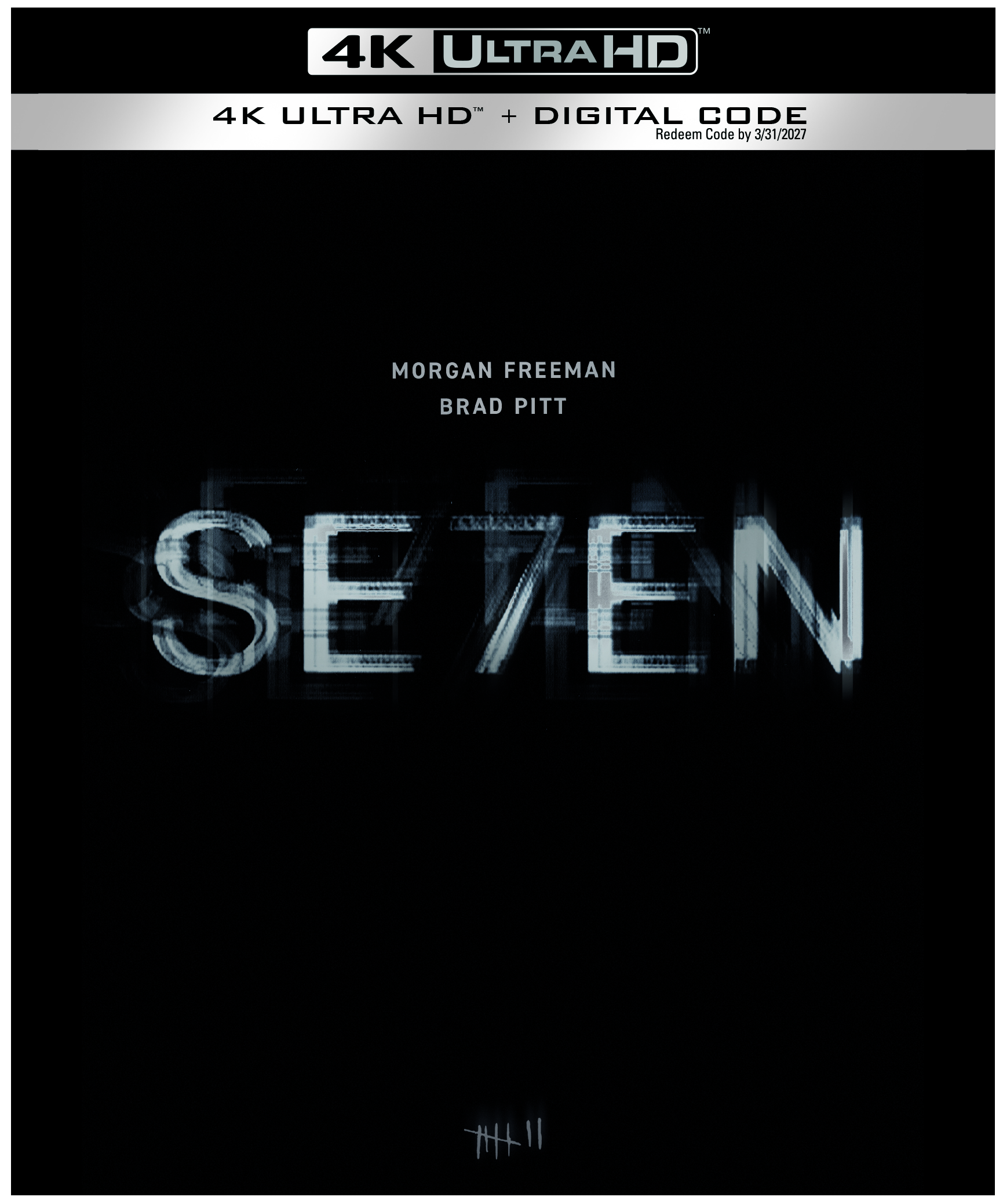
When it comes to 1990’s cinema, it’s difficult to find a film as popular or as well-received as “Se7en.”  It became part of the pop-culture zeitgeist when it was released, and it still is a film which elicits a strong reaction from audiences today.  Whenever people talk about it, they instantly quote Brad Pitt’s famous line of, “What’s in the box?”  The film also served as inspiration for the “Saw” franchise and was ahead of its time in terms of the true crime genre. Now, the film is celebrating its 30th anniversary on 4K from Warner Brothers Home Entertainment.  This is sure to be one of the most popular 4K releases of the year.

“Se7en” opens up by introducing the audience to Detective Lieutenant William Somerset (Morgan Freeman) who is one week away from his retirement before he is thrown into a case which captures his attention.  It starts off with a man who is found dead after being forced to eat spaghetti over and over again until he perishes.  Somerset teams up with a hot shot detective named David Mills, played by Brad Pitt.  He recently moved with his wife Tracy (Gwyneth Paltrow) to the city, and he’s looking to make a name for himself.  Somerset and Mills could not be more different in how they approach their jobs.

Mills has a short fuse and is ready to fly off the handle at anyone who gets in his way. He also doesn’t play by the rules.  Somerset is even-keeled, a deep thinker, and someone who believes you have to look at these cases as more than just black and white, crazy and sane. Before long, more murders are occurring, and the serial killer is murdering people based on the seven deadly sins. For Mills, he simply thinks the killer is a crazy person and writes him off as someone who is going to get caught and isn’t thinking straight. Somerset, on the other hand, sees there is a clear motive and agenda by the killer.

“Se7en” was one of my favorite films growing up. I was 10 years old when it was released, and I saw it when I was 15.  It was very much ahead of its time with its gritty, down and dirty filmmaking style.  When I watched it in 2025, I liked the film a lot and I admire the craft and precision which went into making it, along with the incredible performance by Freeman.  However, I do see some flaws in the film, such as Pitt’s performance.  Of course, his “What’s in the box?” scene has become a legendary meme, but he’s way too over-the-top here.  After a while, it becomes hard to spend too much time with his character.

I also wanted to learn more about Tracy, played by Gwyneth Paltrow.  Paltrow is a terrific actress, and her scenes with Freeman, especially at the diner, give the film some much needed levity. Her character isn’t given enough to do though, besides stay at home and just be written as a one-note character. She and her character deserved better. Going back to Pitt for a moment, I understand what he was going for with his performance, but he plays it too big.  In a serious movie like “Se7en,” it almost feels like his character doesn’t belong here. Freeman makes it look easy, and he’s able to portray all of his emotions on his face perfectly.   I understand the film was showing the contrast between the two characters, but it doesn’t work as well as I remembered it.

When it comes to films like “Se7en” which rely on a twist, they don’t always hold up as well on multiple viewings because the element of surprise is gone.  I still think it is a really good film though, and I enjoyed revisiting it on 4K.  The atmosphere and the sense of dread is on full-display from David Fincher.  The film also has a lot to say when it comes to its views on the world and the people in it.  While Mills believes he can make a change and clean up the world, Somerset is more realistic on what he can do and what the world is capable of as a whole.  It’s a film with some brainy ideas, but those ideas sometimes get lost in the middle of trying to solve the crime.

Overall, I still like “Se7en,” even though this might sound like a negative review.  I’m just not as enthusiastic about it as I was 10 or 15 years ago. I see more of the film’s flaws than I did in the past.  The second half, especially the big reveal, is still as powerful as it was upon its release.  The film works best when it allows its actors room to show off their acting chops and really get into the meat and potatoes of their characters.  I found the police work and the case itself not as interesting or multifaceted as I remembered it being in the past. “Se7en” is still a film worth revisiting and owning, despite some new flaws I’ve noticed along the way.

* * * out of * * * *

4K Info: “Se7en” is released on single-disc 4K Digibook or Steelbook from Warner Brothers Home Entertainment.  It comes with a digital copy of the film as well. It has a running time of 127 minutes and is rated R for grisly afterviews of horrific and bizarre killings, and for strong language.

4K Video Info: “Se7en” is a dark and grisly film, and this specific visual aesthetic is perfect for the 4K format.  I don’t think anyone is expecting the film to look crisp, clear and colorful in 4K. The 4K is not as washed out or bright as the Blu-ray, and this is a good thing. It has a more film-like look to it, which is what I was hoping for with this 4K release. 4K is supposed to bring out the best elements of what the director was looking to achieve with the picture, and “Se7en” is a solid 4K release.

4k Audio Info: “Se7en” comes with a DTS-HD Master Audio soundtrack for the film, which is consistent and steady throughout the course of the film.  This is a pretty quiet film with moments of loud and intense dialogue, but it never feels like it’s too much. Subtitles are included in English, Spanish and French.

Special Features:

Commentaries –

The Stars: David Fincher, Brad Pitt, Morgan Freeman

The Story: Richard Dyer, Andrew Kevin Walker, Richard Francis-Bruce, Michael De Luca, David Fincher

The Picture: Darius Khondji, Arthur Max, Richard Francis-Bruce, Richard Dyer, David Fincher

The Sound: Ren Klyce, Howard Shore, Richard Dyer, David Fincher

Deleted Scenes

Alternate endings

Still Photographs (featurettes) –

Production Design (featurette)

Mastering for the Home Theater (featurette)

Exploration of the Opening Title Sequence: Early Storyboards (featurette)

Exploration of the Opening Title Sequence: Rough Version (featurette)

Exploration of the Opening Title Sequence: Final Edit (featurette)

Exploration of the Opening Title Sequence: Stereo Audio Commentary One – The Concept – Designer Kyle Cooper (featurette)

Exploration of the Opening Title Sequence: Stereo Audio Commentary Two – The Sound – Brant Biles & Robert Margouleff (featurette)

Theatrical EPK

Should You Buy It?

“Se7en” is a must-own for physical media enthusiasts out there, but there is one problem with this release: the packaging.  If you are going to get the digibook, you should know the film is housed in a sleeve, which makes it very hard to take the disc out without touching the back of it.  As many of you know, 4K’s are easier to scratch and damage than Blu-rays.  While I appreciate the fact they tried something different with this packaging, they should have at least thought about the overall health of the disc. I would recommend you pick up the Steelbook release instead. I’ve noticed a lot of people are unhappy with the lack of updated special features, as these are the same special features that came with the Blu-ray. Special features on older films are not as prevalent in today’s releases as they were originally done during the height of DVDs and Blu-ray releases, and I think it’s important to remember that.  It costs money to interview the actors, and it’s not always easy to track them down for new interviews regarding older films they have done. While it would have been a nice addition to the 4K release, I understand it isn’t cost effective. The film looks sharp and the soundtrack is impressive. For the film itself, as stated in my review, it didn’t hold up as well as I remembered it, but it’s still a really good flick. This is a day-one purchase despite the less than stellar packaging options.

**Disclaimer** I received a copy of this film from Warner Brothers to review for free.  The opinions and statements in the review are mine and mine alone.

Exclusive Interview with Tim Smit on His Directorial Debut, ‘Kill Switch’

Tim Smit photo

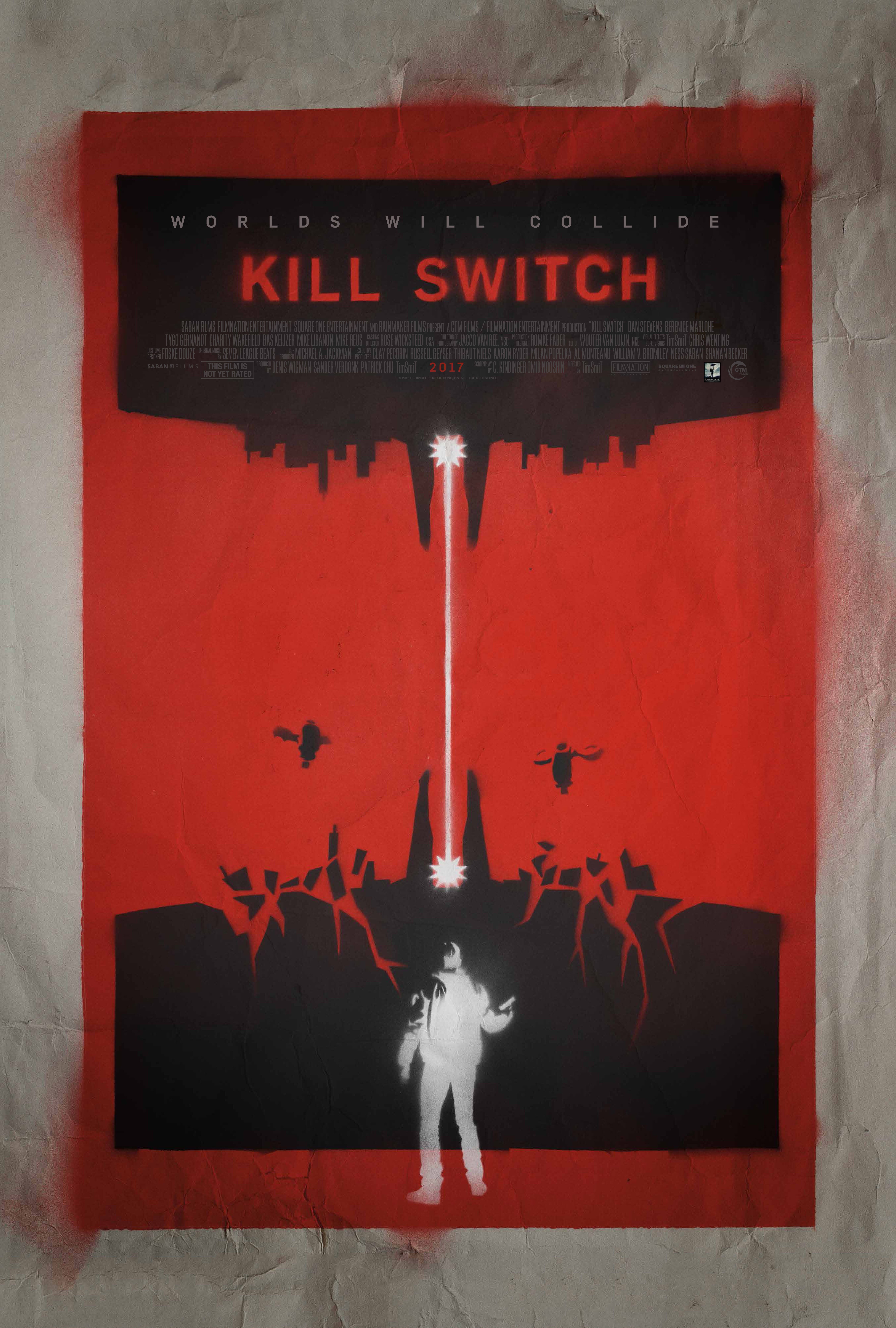
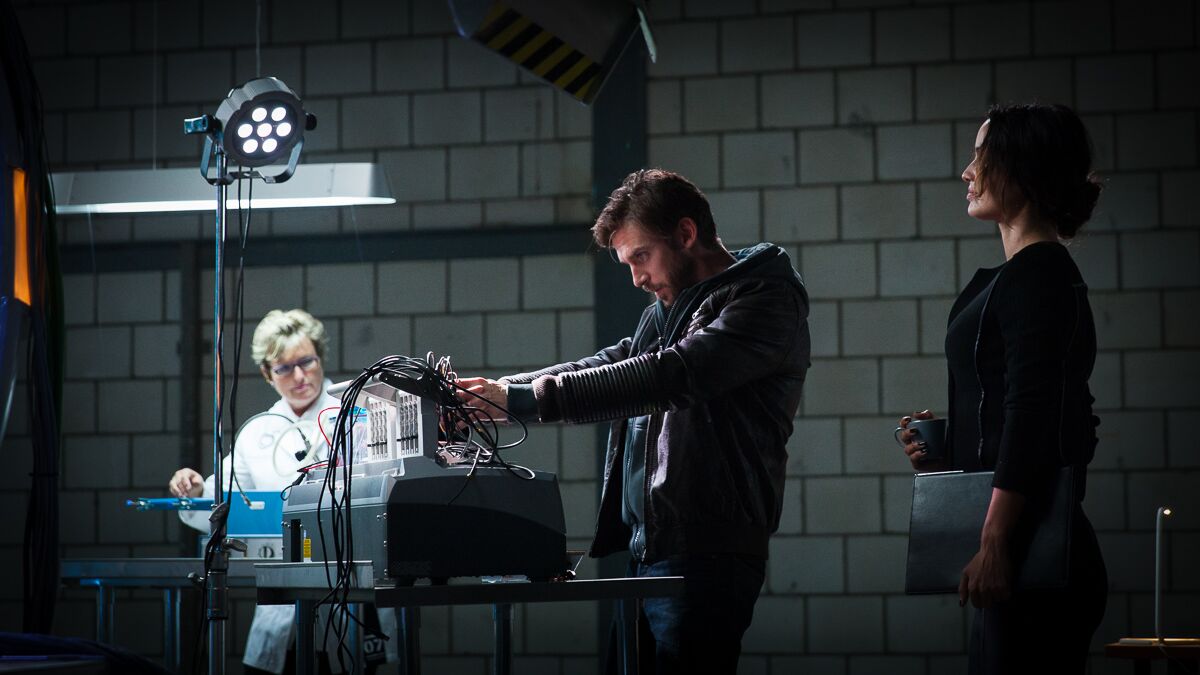
Acclaimed writer, director and visual effects artist Tim Smit makes his feature film directorial debut with “Kill Switch.” Based on his short film “What’s in The Box?” which gathered a large audience on YouTube, it stars Dan Stevens as physicist and NASA pilot Will Porter who is recruited by Alterplex, a power company which has built an enormous tower designed to harness unlimited quantum energy. The company’s vice-president, Abby (Bérénice Marlohe), informs Will a mirror universe has been created solely to drain energy from, and he is sent into it with a device called a “Redivider” which will balance the power between the two universes. But as you can imagine, nothing goes quite as planned as the mirror universe proves to more than anyone thought it could be as Will finds himself on the run from drones, soldiers, and people he is no longer sure he can trust.

“Kill Switch” takes place in a future version of our world, and it is largely a POV movie as we see much of the action from Will’s eyes as he struggles to say alive in an especially hostile universe. I talked with Smit about the movie’s origins, how the story evolved from a short into a feature film, and of how he was able to create a visual effects heavy movie in just 18 days and on a small budget.

Kill Switch poster

Ben Kenber: I really like the way this movie is set up because you are thrown into this story to where you cannot help but be gripped by everything going on. You’re not sure what is happening and, like Dan Steven’s character, you are desperate to find out. When conceiving “Kill Switch,” did you know how the story was going to end, or did you just start off with the idea and went from there?

Tim Smit: We knew that, when I did the short a couple of years ago, the box was going to be used as sort of a kill switch for destroying a parallel universe meant for energy harvesting. But we never really knew the full arc of the story before we hired the writers to get involved, so it took a while to get to the point we ended up with. It was interesting and a very steep learning curve for me to work on this as a conceptual arc as a writer and also as a director, and of course the visual effects too. It wasn’t fairly clear, but we got there as we developed the kill switch idea.

BK: The screenwriters you hired for this project, Charlie Kindinger and Omid Nooshin, what would you say they brought to this story which wasn’t in your short film?

TS: What they did is they fleshed out the characters much more than we already had in the original short. But they also wrote the dialogue and they did the screenwriting of the story. It was a difficult movie to write because of the whole POV aspect. It’s difficult to tell a story through POV. Also, we did have, for that reason, to introduce the whole flashback storyline to help us with that, and to help provide a rest for the audience so that they do not get POV tired. So, they focused on that the feeding of information so the audience knew enough to keep going with the movie, and they were more associated with that than the base idea.

BK: I did watch the short “What’s in The Box?” which led to the “Kill Switch” feature film, and the whole idea of the parallel universe is something which has been explored in science fiction constantly such as the “Dark Mirror” episode of the original “Star Trek” series. What inspirations did you draw from when putting together the short and the feature film?

TS: So, the main inspiration behind it was a couple of things actually. Visually it was inspired by a couple of video games because this was always meant to be sort of an homage to video gaming, and we used various inspirations like “Half-Life,” “Halo” and games like that. From a physics standpoint, the idea for the parallel world came from the concept of Schrödinger’s cat, a thought concept where you got a box and in it is a cat with a poison. If you keep the box closed, you don’t know if the cat survived because the poison still has a chance to kill the cat. You only know the cat is dead when you open the box. So, this is kind of like the idea for the initial mystery where you’ve got this black box and you don’t know yet what it is and you don’t know what it does, but it triggers you to go along and see what it ends up doing. So, the whole idea of Schrödinger’s cat was the main inspiration behind the short and the box as a MacGuffin.

Kill Switch POV still

BK: The POV shots reminded me a lot of Kathryn Bigelow’s “Strange Days” which also had them. When you put those shots together, did you have a set of rules you wanted your collaborators to follow during shooting?

TS: Yeah, we did a couple of things, some of them worked better than others, which we wanted to explore. One of them was, most of the time, we wanted to see the other actors. As a rule of thumb, we wanted Will Porter to be running behind the other characters so you can actually see what’s happening. So that was something we took into consideration while we filmed this because you are kind of used to the main character taking the lead, but in this case, he’s following them because otherwise it would be difficult to see them. It’s a very simple thing you have to keep in mind, and that was one of the rules we followed.

Kill Switch Dan Stevens

BK: Did Dan Stevens have to do any camerawork himself for the POV scenes?

TS: No. Obviously I would’ve loved to have used him, but we just didn’t have the budget for him for all the days. So, we just hired him on some of the days where he would be the voice, and of course on the days where we would shoot conventional scenes. Our DOP was basically the character, and then Dan came in later and did the ADR for the character.

BK: The special effects are actually pretty good for a low-budget movie like this. We see objects like train cars falling out of the sky. Did you set any rules for yourself as to what kind of objects and vehicles could fall into the echo universe?

TS: So, we focused initially on metallic objects just because that made it easier to create for us. The idea was that this parallel world is being arched for energy, but somehow the original world is fighting back as the universe is trying to balance itself out, and it does so by pulling over objects from the original universe into this echo universe. The rule of thumb was the first thing to be pulled over was small metal objects for various reasons, but you can figure out in physics that there are only four main forces, and one of them is electromagnetic. It is not inconceivable that something like metal will react first or that something else will react to metal first. It made easier for us to make these objects fall down. It’s harder to do entire buildings or something like water. It was a compromise, but I felt it worked from the basic physics ideas as well. We see this boat falling from the sky, it’s not metaphorical.

BK: The whole idea of an echo universe is interesting because the characters say there is not supposed to be any organic life in it, but we can see from the start there is.

TS: Yes, that’s what I like about the movie as well. It’s not as fleshed out as it should be, but the idea is that this company didn’t care. They were just interested in creating this echo universe, and they are telling us that it’ll be fine and there will be no organic life, but they don’t care. They just care about the energy, and of course they didn’t expect it to be that intense or of the rebellion that arrives. But I kind of like that idea of what are your priorities as a company. These huge oil companies are pretty much going across the line, and that’s what drew me to this story as well. That was something I could really personalize.

Kill Switch Berenice

BK: Dan Stevens has a very challenging role because he wasn’t on set too much, but he still had to get to the emotion of what is characters going through. Also, Bérénice Marlohe has a wonderfully intimate presence throughout the film. How did you come to cast both these actors?

TS: It was amazing to work with these two. The great thing about Bérénice and Dan is that they are both so interested in science fiction, and they are both really interested in broadening their own horizons and trying to do something new. It’s an experiment, this film. Let’s be honest, you don’t see a POV movie every day. It’s an attempt to do something new especially with a director that’s also doing all of the effects. It was an experiment on multiple levels, and they were committed and went for it, and that’s what I really appreciated about them. It was a very difficult movie especially for Bérénice because she was acting against I camera where there is no reaction, and most of the enemies are CG. It was very demanding for her to do, but she gave it her best and gave it everything she had. We had 18 days to do everything.

BK: 18 days? That’s very impressive especially for a science fiction movie.

TS: It was something I underestimated when I started working on this. I was experienced as a visual effects artist, but I wasn’t experienced as a character director. You would think shooting this movie, even though it was 18 days, would’ve given you a whole set of problems and obstacles to get over, which we had. But even after it was all done, that’s when the real challenge started. You would think that after having a number of years of the effects experience that it would be easier, but it was actually the other way around. It was very difficult for me to combine the directorial duties and the effects duties at one point. You can get so involved in the technical part that you get sort of a tunnel vision and you still have to be the director. There is the reason why the director is separate from the visual effects department because that makes the movie better.

Kill Switch vessel

BK: “Kill Switch” takes place in a future which seems not too distant from our own. We never get an exact date of the time the movie takes place in. Was that intentional on your part?

TS: Yeah, actually it was, but sometimes in the movie you do see the date on the newscasts, but it was never deliberately mentioned. I felt, in my mind, the movie was in the near future, but the concepts we are introducing we do not have access to in the near future. The problem with going further into the future is your design and your world view changes, and the budget doesn’t allow that. If you really want to know which year it was, it was actually 2043. So, it was further into the future, but not that far. It was a budget reason.

BK: You studied natural sciences as a student. Did those studies inform the science of this movie?

TS: Yeah, the studies did help. A lot of people wonder why I studied natural sciences if you wanted to be a filmmaker, but the way you were trained as a scientist really does help in making movies. There’s a certain amount of problem solving that you are used to which is really helpful as a director, and the visual effects that I did, they tend to be of a physical origin. With physics, you are trying to explain or describe the real world. With visual effects, you are kind of doing the opposite. You are using formulas to create a fake or, at least, a realistic looking fake world. To me, that is really fascinating and the physics background helped in doing that.

I want to thank Tim Smit for taking the time to talk with me. “Kill Switch” is now playing nationwide at the following theaters:

Laemmle Monica Film Center, Los Angeles

Cinema Village, New York

AMC Rio, Washington, D.C.

AMC Methuen, Boston

AMC Southfield, Detroit

AMC Arizona Center, Phoenix

AMC West Oaks, Orlando

AMC Ritz Center, Philadelphia

AMC Woodridge, Chicago

AMC Town Center, Kansas City

Poster, stills and trailer courtesy of Saban Films.

Click here to visit the movie’s website.