Stu Zicherman and Ben Karlin Discuss the Making of ‘A.C.O.D.’

WRITER’S NOTE: This article was written in 2013, and it contains spoilers for this film.

Stu Zicherman and Ben Karlin are best known for their work as writers in film and television. Zicherman was one of the screenwriters on “Elektra” which he did not even try to hide his disappointment over, and the Hong Kong action film “2000 AD,” and he is currently working on the FX show “The Americans.” Karlin made a name for himself as a writer and executive producer on “The Daily Show with Jon Stewart” and “The Colbert Report,” and these days he serves as one of the writers for the acclaimed ABC comedy “Modern Family.” But what you may not know is these two were best friends when they were growing up, and they are also children of divorce.

When they reunited as adults, Zicherman and Karlin began working together on the screenplay for “A.C.O.D.” which tells the story of when Carter (Adam Scott) is tasked to get his bitterly divorced parents, Hugh (Richard Jenkins) and Melissa (Catherine O’Hara), to come to their youngest son Trey’s (Clark Duke) wedding. Writing the script allowed Zicherman and Karlin to deal with their own memories of their parents separating, but they also manage to find humor in a situation which is usually filled with tremendous sadness and anger. In the process, they both succeed in turning a lot of comedy conventions on their heads and give us a movie full of endless surprises.

I got to participate in a roundtable interview with Zicherman and Karlin when they appeared for the “A.C.O.D.” press junket held at the SLS Hotel in Los Angeles, California.

Question: What was the genesis for this movie?

Stu Zicherman: Ben and I have actually been friends since we were born. What’s the quickest way to explain this? Basically, my mom was friends with Ben’s parents, and Ben’s parents were friends with my mom’s first husband who I didn’t even know about. We’ve been friends our whole lives. I have always wanted to do something with this subject matter, this generation of divorced kids. We’re both part of this generation.

Ben Karlin: Yeah. We were friends growing up and our families were friends growing up, but then, when his parents got divorced and shortly thereafter my parents got divorced, we stopped hanging out because that was the end of our families getting together and doing things.

Stu Zicherman: It was a very romantic journey where our families used to go on vacations together.

Ben Karlin: So, when we were both professional and we were established as adults in our careers, I moved to New York, and Stu was working there already and he said, “Hey, I want to write a movie about how messed up we all are” (laughs). I went, “I’m in!”

Stu Zicherman: We grew up on movies like “Kramer vs. Kramer” and dramas that were kind of tragic. Ben and I talked about this when we first started working on the movie. Our parents’ divorces were tragic and sad in their own way, but they were also not to be believed at times (laughs). They were irreverent, funny and weird. We wanted to try and find a way to make light of it and make a comedy that still had some gravity to it because it’s something that people don’t laugh about. What’s been really fun about making this movie and about taking it around and showing it at Sundance and all these places is that people are excited and relate to it. People will come up to me after screenings and want to tell their stories like, “My parents got divorced when I was 8.” We’re almost giving them license to laugh about it.

Ben Karlin: We were shooting in Atlanta, and the night before production started, it was just us. It was me, Stu, a couple of the actors, a couple of the producers, and we were out in the bar at the hotel. There was a wedding going on and there was the after party for the wedding. There was the groom, the bride, the whole bridal party. Everyone was in tuxedoes. So, it was like these two worlds. We were about to make this movie about divorce and these people who were just starting. And they were great. They were lovely people. We closed the bar down with them. And then, a week later, I got a letter from one of the bridesmaids who I had been chatting with, and she told me this long story about her family’s divorce and how it affected her. It was just so weird. Even in that moment, people were just connecting to what we were trying to do, and we found that throughout the whole process, that there seems to be something that everyone can relate to about this subject.

Question: So, everybody is trying to figure out who got married at the movie’s end…

Stu Zicherman: Well, you know, we didn’t really want to give it away. Ben and I always talked about the movie as being an anti-romantic comedy. There were certain beats we would get to in the movie as we were writing it. There’s the obvious romantic comedy beat. We were trying to turn away from that wherever we could, not to the detriment of the movie, but the end of the movie was not so much about who got married. It was more important to us that the characters, especially those three men, have evolved through the movie to a point where it could be any of them. When pressed, I always say it’s all three of them, but we like the idea of leaving it open-ended because it didn’t matter.

Ben Karlin: It didn’t really trouble us, I have to say. We wanted to create a scenario where all three characters were repaired to the point where you’d be just okay with any of them. And it could be all three of them or none of them. The point is that whatever was waiting for them in there in the church was okay.

Stu Zicherman: And it’s funny too, when editing the movie, every single time I would adjust frames or tried a different shot and put it in front of an audience, people always guessed a different person. It was bizarre. I started to lose track of why people felt what. We had to calibrate it so that it’s pretty hard to tell now. We’d had a version where there was a faceless bride running through the background.

Ben Karlin: Oh, deep, deep background. A limo, a bride, the whole thing.

Stu Zicherman: Again, it distracted from the movie. It’s such a nice, clean moment with the three of them walking in, and we like it.

Question: Everyone seems to have their own version of the movie’s ending, and that really serves as a testament to your writing because you got us so deeply invested in every single character to where we really want to know what happens to them

Ben Karlin: It’s a very hard thing to do. You want to give in. You want to give people what they want. And then, there’s the creative jerk part of you that’s like, “I know better.”

Stu Zicherman: But also, we thought about a lot of this when we were writing the movie that we didn’t want people to be right or wrong. It’s not a right or wrong thing. It’s the dad who does this impetuous thing and they get back together. He’s not wrong. He’s following his heart. What’s wrong with following your heart? And again, at the end of the movie, I always say to people it’s not a movie about divorce per se. I don’t want people just to think it’s about that. It’s really about if you’re married, if you’re not married, divorced, whatever kind of family you’re from, you’re not destined to repeat the patterns of your parents. You’re free to make your own mistakes. You’re free to live your life. That’s why I always love the word “adult” being in the movie. I always felt like you become an adult when you actually can put your past into perspective. That’s when you really start becoming an adult. And I like that about the ending because, up to that point, everybody is acting like a child.

Question: You have said the script is loosely based on your families. Have you gotten any flak from them about it?

Ben Karlin: We’ve done a pretty good job of hiding or changing details. There used to be more stuff in the script that was literally word for word from our lives. There was an incident in his family and a specific incident in mine that involved the handing off of kids on a bridge, like a prisoner transfer, but it was between the parents. And it literally, at this moment, happened to me in Cape Cod where it was my dad’s new wife actually and her children and her ex-husband, and they had to exchange and they decided the exact mid-point. It was like North Korea-South Korea. Here’s the DMZ and we’re going to trade these children over that line, and we had that exact scene in the movie for years. That probably wouldn’t have gone over so well.

Stu Zicherman: And then there was a thing in my family called the hysterectomy conspiracy that was so absurd that when it was in the script, people would read it and be like…

Ben Karlin: “That’s not real.”

Stu Zicherman: They didn’t believe it. “No, no. It’s real.” We had to take it out because people didn’t believe it. But that happened to me. There’s one moment in the movie that is sort of torn from my life and its funny. It’s the one where Carter sits his parents down. My sister was getting married, and my parents would not agree to come to the same wedding. My brother-in-law and I sat them down. What’s hilarious about that is my parents don’t remember that. They block it out.

Question: How long did it take you two to get this film made?

Ben Karlin: Oh my God! I was just talking about this the other day. I was living here (in Los Angeles) and I moved to New York in 1999, and Stu was already living there at that time. He probably approached me in 2000 or 2001 to start working on it. Obviously, we had other jobs.

Stu Zicherman: Yeah. We had other jobs, so we were working on it nights and on weekends and vacations.

Ben Karlin: The amazing thing is we were both single when we started working on this movie. I have since gotten married, had children, and gotten divorced (laughs).

Stu Zicherman: It’s crazy. We were both single when we started this thing, and now I’m married with two kids and he’s got two kids, which I think helped inform the movie a little bit.

Ben Karlin: Yes, definitely.

Stu Zicherman: It’s been a long process. It’s funny though. The movie almost got going at one point. It came really close to get going. What was great about it was once we committed to Adam Scott, the movie started to finally roll. Finally, eventually, you get so frustrated with all the games you have to play to try and get a movie made. The thing is that we always loved Adam for this. And again, it fits in a little bit with the anti-romantic idea. He’s got an anti-romantic lead in a way because he’s got a very cynical humor and perspective on life. It just worked really well. And once we got Adam, then we got Richard Jenkins. It just started to roll.

Ben Karlin: Once you have those first few pieces in place, it starts to gain a terminal velocity.

Stu Zicherman: Right. The phone starts to ring and all of a sudden people want to be in your movie. That was very exciting.

Question: What I like about the script is that you don’t know where it’s going to go. From a distance, it looks like your typical formulaic comedy, but it really isn’t. How did you go about that? Were you looking to avoid certain things that you see in a lot of comedies like this?

Ben Karlin: Yes. There are so many tropes to these kinds of movies. Because we always were around, we were like, “How do we deal with the subject of a wedding in a movie that’s essentially about divorce?” We were very resolute that if we were going to have a wedding, we were going to do it differently than that typical moment at the end of the movie where people are walking down the aisle. So, we knew we wanted that outside the wedding moment to end it. We just were acutely aware of convention and trying to understand why those conventions worked and why they existed, and then trying wherever we could to tiptoe around the obvious thing.

Stu Zicherman: But the big thing was stakes. I mean, there were so many times where we were hyperconscious with the movie, and we would do readings just to find out where we were with it. The main character, Carter, is in every single scene of the movie and he doesn’t have cancer. He isn’t beaten. It’s the kind of thing, at a certain point, where the audience could be looking at him and go, “Hey dude, get over it.” And so, there were scenes we really liked but we felt like we were going to lose the audience. We said, “We have to keep the audience rooting for him.”

Ben Karlin: We didn’t want to turn the guy into a jerk.

Stu Zicherman: So, it was this balance. At times, people would read the script and say, “Why doesn’t he want his parents to get back together?” We just had to find a way and we kept trying to find ways in through relationships. But we did at times always try to move away from the tropes like the scene with the ring that turns into the key, and moments like that. It was funny. I did a Q&A; in New York the other night and someone asked me about the whole cheating thing with Jessica Alba and how he never gets caught. In the classic romantic comedy, you always get that scene where she’s like, “What were you doing with that girl?” It never crossed our minds to go there, and the truth is because in real life most people don’t get caught. You’re just forced to live with it. And that was the great liberty of making this movie independently. We’re not beholden to a studio to hit certain tropes. Also, it made the tone what it is, because the movie is funny but it’s also got some gravity to it and it’s got this balance. I’m excited. The fact that the movie is finally coming out, I’m excited for people to see it, but I’m also going to miss it because we’ve just been carrying it around like this for so long.

“A.C.O.D.” is now available to own and rent on DVD, Blu-ray and Digital.
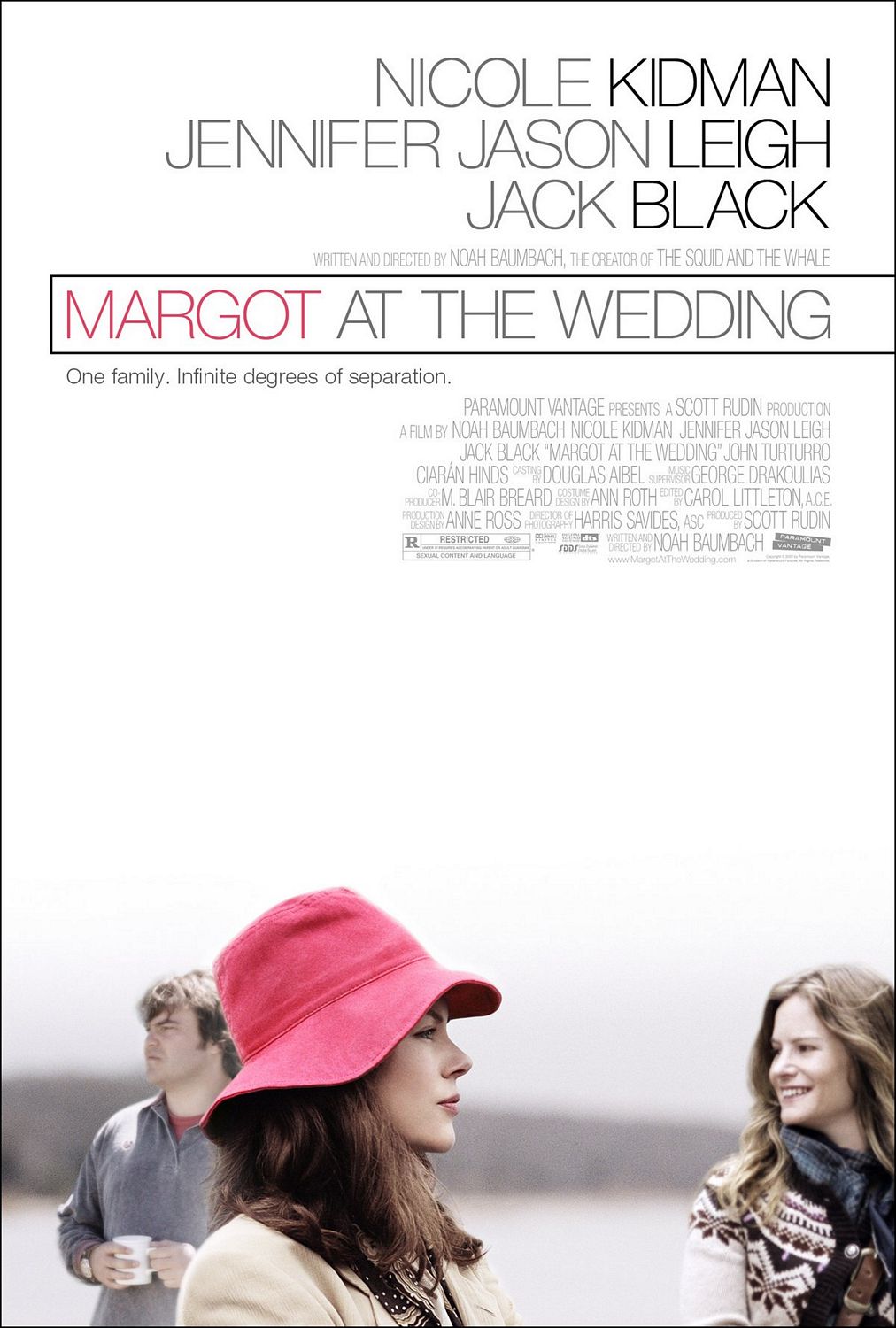
One From Noah Baumbach: ‘Margot at the Wedding’

Margot at the Wedding poster

Noah Baumbach must have had one messed up childhood. His 2005 film “The Squid and the Whale” which chronicled a divorce filled with animosity and the of effect it ended up having on the kids. In 2007 he gave us “Margot at the Wedding,” which focuses on two sisters who do their best not to explode at one another. This is sibling rivalry at its most vicious and with sly attacks throughout until the inevitable showdown where the wounds and scars reveal themselves in all of their hurt and anger. Once in a while, you will get a movie which shows the loving power of a family and how they all come together as one. This is not that movie.

Nicole Kidman stars as Margot, who is heading into the country to attend her sister’s wedding. With her on this trip is her teenage son Claude (Zane Pais) who she dotes on with increased restlessness. 2007 was a tough year for Kidman as the films she starred in, be it “The Invasion” or “The Golden Compass,” were not at as successful as they were expected to be. She was at one point the most underrated actress in movies with unsung performances in movies like “To Die For” which she was unfairly robbed of an Oscar nomination for. Following her Oscar win for her role in “The Hours,” she looked to be stumbling in movies underserving of her talent. Her performance as Margot, however, reminds you of just how brilliant and fearless an actress she can when given the right role.

Margot is a bitch with a capital B, and she is one of the most unsympathetic and spiteful characters you would ever want to see in this or any other motion picture. She is cruel to those who love and hate her, and she even reacts coldly at times to her son by saying something about his appearance which could not be any less true. Kidman tears into the role with gusto, and she never tries to sweeten this character up and make her more likable than she ever could have appeared in the script. She is fearless in her portrayal of Margot, and she even lets us see beneath the character’s cruel mask to reveal the pain her character feels inside. You never completely sympathize with her, but you do come to pity her.

Margot’s sister Pauline is played by Jennifer Jason Leigh, the former Mrs. Noah Baumbach, and it is great to see her here. Her portrayal of Pauline makes the character pitiful in a whole other way. While Margot is cold to those around her, Pauline is much more vulnerable and is skillful in the way she throws her sister’s carefully placed insults right back at her. Pauline seems to be striving for a happiness which is just out of her reach. Leigh works at keeping her cool around Kidman’s character, but you can see through her eyes that the last time these two sisters met, it resulted in a brutal confrontation which kept them apart for years. It takes a great actor to make you see things about their characters without having to tell you what they are.

Pauline is about to get married to an unemployed musician/painter named Malcolm, and he is played by Jack Black. This is Black at his most unglamorous as he portrays Malcolm as a sad sack of a man who never looks all that happy about the fact he is about to get married. His character is utterly depressed and lost about what he wants out of life. There are times where Black falls back into those mannerisms we know him best for, and they do take away from his performance at times. But for the most part, he is really good here as he is cast against type in a more dramatic role.

In many ways, this movie is a prolonged attack leading to an explosion of emotion which we can tell has been repressed for far too long. How long you ask? Years, maybe even decades. You know the first time these two sisters meet each other that there is still bad blood between them which is eventually going to spill over. They say they are no longer mad at each other, but we know this is not true. Tension fills the air as these two test one another’s patience, and they continually betray each other in their own subtle ways.

“Margot At the Wedding” is not quite as effective as “The Squid and The Whale,” and it is easy to judge the two in comparison because they deal with the same thematic elements. They deal with broken families, divorce, parental neglect, underlying feelings of anger and resentment, etc. It has been said the best directors make the same movie over and over again, be it Hitchcock or Spielberg or anyone else. Baumbach’s specialty is in the dysfunctional relationships which he was exposed to when he was young.

Either way, you will most likely come out of this movie thanking god your family relationships are nowhere as bad as they are portrayed in this movie. You think you have it bad? Wait until you watch this.

* * * out of * * * *

‘Rachel Getting Married’ is one of Jonathan Demme’s Best Films

Rachel Getting Married movie poster

One of the many things I have discovered about life is it is really easy to hate someone or be angry at them. As negative an emotion as it is, there is an unmistakable power from it which really makes you feel alive. At the same time, it is much harder to forgive that person for what they have done to you. You get so sick of someone getting the best of you to where you desperately don’t want to look like the fool. But eventually, it should become clear that the one person you really need to forgive most is yourself. This can be much harder than forgiving someone else, but it is necessary as it keeps you from sinking into the hideous swamp of bitterness which can eat you up. But can you forgive yourself when you have done something horrible and can’t you wipe away the cloud hanging over your existence because of what you have done? I would like to believe the answer is yes, but others may disagree.

Rachel Getting Married” is a movie about forgiveness, and the rough road people travel to get to it. It is also a movie about family and togetherness, and the joy of life. It almost moved me to tears the same way “Lars and the Real Girl” did as it deals with the saddest of things while surrounding itself in an atmosphere of love and much-needed togetherness. This is one of Jonathan Demme’s best movies as well as one of the very best of 2008. I really loved “Rachel Getting Married” and found myself wanting to hug all the characters in it. It is a movie of raw emotions, and I love seeing movies with this kind of power more often than not.

Anne Hathaway gives a phenomenal performance as Kym, the wild child of a Connecticut family who gets a vacation break from her current rehabilitation facility to go home for her sister Rachel’s wedding. It doesn’t take long to get an idea of how much of a “bad egg” she appears to be to everyone around her. As she goes into a convenience store to get a Pepsi, the female cashier behind the counter says, “Didn’t I see you on ‘Cops?’”

Kym is a full-blown drug addict and has been for several years, and while her family is happy to have her home, there are also raw emotions simmering just below the surface and waiting to come out into the open. We feel this tension from the very start, and it is illustrated in Hathaway’s face as we see her feeling like the wallflower at a party. While everyone is happy for the bride and groom, she is sullen and lost in a moment she cannot escape from. As the movie goes on, we come to see the reason for her self-destructive behavior and why she acts the way she does. I will not mention what it is here as it might take away from the emotional impact you will experience watching this movie.

This movie feels a lot different from others Demme has made in the past. He filmed the movie with high definition cameras to capture the movie on a more intimate level, and it feels like he really let the actors loose from start to finish. It is handheld camerawork going on here, so this will probably drive those who couldn’t stand all the shaky camerawork in “The Bourne Ultimatum” or “Cloverfield” crazy. While some people may experience motion sickness from this, I had no problem with it as the camerawork helped illustrate the emotionally fragile ground the characters are walking over, and how easily everything could come tumbling down.

What is so great about Demme’s direction is how he makes us feel like we really are attending the wedding along with these characters and sharing in the joys and sorrows of everyone involved. These characters feel so real, and it is so great to see no Hollywood artifice on display here. There have been so many big Hollywood movies dealing with families and marriage, and I find myself increasingly avoiding them. But the actions in “Rachel Getting Married” never felt staged for a second, and I loved that. Everyone in this movie feels like people we know from our own lives, and it connects us all the more strongly to what they go through.

“Rachel Getting Married” also, like all of Demme’s movies, has a very eclectic mix of music in it from the offbeat to the international. His movies don’t just have their own signature look, but their own significant sound. One character makes beautiful use of a Neil Young song as he sings it to another person. The audience I saw this with at Landmark Theaters in West Los Angeles were as silent as the characters onscreen during this moment, and I’ll never forget that.

I also loved how the soon to be married couple is an interracial couple, and no one ever brings this up at all. I guess none of the characters see it as an issue worth addressing. Hallelujah!

The script was by Jenny Lumet, and she gives her characters a vibrancy which elevates it from the couples we usually expect to see in movies like these. Her screenplay does tread familiar scenarios and storylines of the addict trying to go straight, but it finds its own voice and way of saying things to where everything feels fresh and new.

Demme always brings out the best in all the actors he has ever worked. There are many great performances to be had here, not just Hathaway’s. Rosemarie DeWitt plays Rachel, and she is a wonderful and real presence to be had in this movie. She goes from being so happy to seeing her sister Kym to being utterly exasperated and strung out that she is at home. It is clear that Rachel wants Kym to be well, but she constantly worries Kym will ruin the wedding in one way or another. Both Hathaway and DeWitt work really well off of each other as two sisters desperate to connect with one another despite the emotional damage between them. There’s a touching moment where Kym comes back from a rough night, and Rachel washes her clean in the shower as if she is washing her sins down the drain.

I also really liked Bill Irwin as Paul, Kym and Rachel’s dad, who is so happy to see his daughters under one roof, while at the same time harboring scars which will never fully heal. We also have Debra Winger, an actress we don’t see much of these days as the girls’ mother, Abby. She has great scenes with both daughters as she allows us to see beneath her seemingly calm exterior to the distrust she has had for Kym after all this time. The big scene between Hathaway and Wagner where the truth comes to a head is riveting and painfully raw as they each try to come to grips with the tragedy they both had a part in but are hesitant to take full responsibility for.

“Rachel Getting Married” is not just a triumph of acting, but also of writing and direction. All three elements come together to create a powerfully moving film about the flawed and fragile nature of humanity, and of the struggle for forgiveness. The movie has a very improvisatory feel to it and, despite the serious nature of the film, you cannot help but feel everyone had such a great time making it. You feel like you are with these families every step of the way, and you revel in their celebration of two families coming together as one. The reception near the end of the movie is one of ecstatic joy and happiness, even while some have wounds which take them out of the present.

But the person who carries this movie from beginning to end is Hathaway. Many see this as her escape from those “Princess Diaries” movies as she rids herself of the ever so clean image we have had of her. Truth be told, she has been doing this already with “Brokeback Mountain” and “Havoc,” but this should fully complete her transition to becoming an adult actress. All the Oscar talk she has been getting is justified. Kym is not an easily likable character, but Hathaway gives her a heart and soul and makes you care deeply about Kym all the way through. The moments where Hathaway does not say a word, her face does the acting and reveals a very uncomfortable soul trying to fit into a place which was once her home. She does brave and amazing work here, and she proves to be a dramatic force to be reckoned with.

“Rachel Getting Married” further shows how brilliant Demme is in getting to the wounded humanity of all the characters he observes. There is not one moment which feels faked in this movie, and it never really falls victim to any clichés that could easily tear it apart. This is another movie you don’t watch as much as experience, and I am always on the lookout for those. It also kept reminding me of the song “To Forgive” by The Smashing Pumpkins which kept playing in my head throughout:

“Holding back the fool again
Holding back the fool pretends
I forget to forget nothing is important
Holding back the fool again.”

Funny, I thought Billy Corgan was saying “forgive” instead of “forget.”

* * * * out of * * * *

Exclusive Interview with Olga Szymanska on Marcin Wrona’s ‘Demon’

It was very sad to learn of Polish director Marcin Wrona’s passing on September 18, 2015. He committed suicide before a screening of his latest film, “Demon,” the last in a trilogy which began with “My Flesh, My Blood” and “The Christening.” Like those two films, “Demon” deals with the nature of evil and a fate the protagonist is forced to deal with. Itay Tiran stars as Piotr (a.k.a. Python) who is on the verge of getting married to the beautiful Zaneta (Agnieszka Zulewska) and moving into a family home which has survived from one generation to the next. But on the day of his wedding, Piotr suddenly becomes possessed by a spirit which will no longer remain silent, and what should be a joyous day soon turns into the wedding from hell as the past will no longer remain buried.

While Wrona is no longer with us, his “Demon” is a tremendously well-made horror film which allowed him to leave his mark on the world of cinema, and it provides us with an interesting take on the Jewish legend of the dybbuk. It is a beautifully filmed movie with incredible vistas and an all-encompassing darkness as a bad situation gets even worse, and that’s not just because the wedding guests have drunk far too much vodka. Watching “Demon” also reminds us of the power of ambiguity as not all questions are answered here, and this forces the viewer to think more deeply about what they have just witnessed.

I got to speak with Olga Szymanska, the producer of “Demon” and Wrona’s widow, while she was in Los Angeles to promote the film. I applaud her for supporting her late husband’s work while dealing with a loss which is still hard for many to accept. She talked about what went into the making of “Demon,” how it relates to Wrona’s previous two films, if she was ever worried about people not understanding the legend of the dybbuk, and of how Wrona and his cinematographer Pawell Flis gave the film such a striking look.

Please check out the interview above, and be sure to check out “Demon” which is playing at the Nuart Theatre through September 15.

demon-movie-poster

AN ULTIMATE RABBIT NOTE: This video interview was updated in 2023 to add certain visual elements and to avoid copyright issues which never intended or inferred.