No, I Haven’t Seen It Until Now: Empire of the Sun

empire-of-the-sun-movie-poster

Empire of the Sun” is one of the few Steven Spielberg movies which has eluded my watching it for far too long. I remember when it was released back in 1987, and my brother and I watched a documentary on its making. What we saw did not make it look like the typical Spielberg crowd-pleasing movie people had come to expect from him back then. It also dealt with a young boy who is separated from his parents, and separation anxiety was a HUGE thing for me back in the 80’s. But with it now at its 30th anniversary of its release, and having the opportunity to see it on the big screen at New Beverly Cinema in 35mm, the time had come to give what is largely considered to be one of Spielberg’s more underrated films a look.

Based on the semi-autobiographical novel by J.G. Ballard, “Empire of the Sun” takes us back to the days of World War II where we meet Jamie Graham (Christian Bale in his film debut), a young schoolboy who lives a privileged life with a wealthy family out in the Shanghai International Settlement where he sings in the school choir, rides his bicycle everywhere and anywhere, and has a love of airplanes which knows no bounds. A key shot for me comes early on when we see Jamie taking some food out of an overstocked refrigerator which is filled with goodies as it shows how easy things come to this young lad to where he can boss the Japanese maid around like his parents do.

Of course, this all changes when the Japanese invade the settlement following their bombing of Pearl Harbor, and Jamie and his family are forced to flee their home and escape with their lives. In the process, Jamie gets separated from his mom after he picks up his metal toy airplane which he dropped on the ground, and he is forced to fend for himself as he is swept into a conflict far beyond anything he could have imagined.

When it comes to “Empire of the Sun,” it was no surprise to learn David Lean was originally going to direct this adaptation as Spielberg certainly made it look like a Lean movie with scenes filled with crowds of people struggling to survive in life during wartime. Spielberg ended up putting together scenes which must have made Lean proud as it brings to mind the epic shots the director pulled off in his masterpiece “Lawrence of Arabia.” Today, most of those shots would have been accomplished with the use of CGI effects, but “Empire of the Sun” was made back in a time where they weren’t so readily available.

Watching this movie reminded me of how brilliant Spielberg is at taking us back to a day and age many of us were not alive to see, and he does it so vividly to where we can never doubt his authenticity to the period. Spielberg has visited the era of World War II time and time again to amazing effect whether it’s the Indiana Jones movies or “Saving Private Ryan,” and he never seems to miss a detail in the process.

And then there’s Christian Bale who made his film debut in “Empire of the Sun,” and he brings to this role the same kind of intensity he would later bring to his work in movies like “American Psycho” and “The Fighter” among others. I could never take my eyes off of him as he takes Jamie from being a privileged young man to one who struggles for even the smallest reward like a Hershey chocolate bar. Was there another young actor who could have pulled off such a brave and emotionally honest performance as Bale does here? I think not.

Another great performance to be found here is from John Malkovich who plays Basie, an American ship steward stranded in Shanghai who befriends Jamie in his most desperately hungry state. Basie looks to be the Han Solo kind of character who befriends a young innocent who has yet to learn how cruel the world can be, but he turns out to be more of a manipulator than a hero in the making. Malkovich makes Basie into a fascinating study of someone who seeks to benefit themselves more than anyone else, and he constantly leaves you wondering if his character can rediscover whatever humanity he has left.

In addition, there are fine performances from Miranda Richardson as a neighbor of Jamie’s, Nigel Havers as a doctor who desperately tries to teach Jamie about humility, Joe Pantoliano has some choice moments as a companion of Basie’s, and Burt Kwouk, best known as Cato from the “Pink Panther” series, shows up in a small role which he is almost unrecognizable in. Heck, even Ben Stiller shows up here as an American soldier. Seeing him at first is a bit disorienting as he has since become a big comedy star to where he now seems out of place here, but I’ll chalk that up to one of the disadvantages of watching this movie at a later date.

Looking back, I feel “Empire of the Sun” was Spielberg’s first real foray into darker material which would soon pave the way for films like “Schindler’s List,” “Saving Private Ryan” and “Munich.” While it feels like he was taking baby steps here, as those aforementioned films proved to be much darker than this one, it was a giant cinematic leap for him to tackle something like this back in the 80’s.

Still, part of me wonders if he played a little too nice with the source material. Being that this was an adaptation of a J.G. Ballard novel, the same writer whose controversial books “Crash” and “High-Rise” were adapted into deliriously dark motion pictures by David Cronenberg and Ben Wheatley, I can’t imagine “Empire of the Sun” was any easier of a book to read. Ballard wrote some pretty dark stuff, and it makes me wonder just how dark his novel “Empire of the Sun” was compared to Spielberg’s film.

All the same, “Empire of the Sun” is an amazing achievement to watch today as he managed to pull off many epic scenes long before the use of CGI effects. Part of me wishes I had watched it when I was younger as it would have had a more powerful effect on me emotionally, but better late than never with a film like this. Along with cinematographer Allen Daviau, composer John Williams, writer Tom Stoppard and editor Michael Kahn, Spielberg created a World War II epic which stands out among the most memorable of them all, and it deserves more attention than it received upon its release thirty years ago.
* * * * out of * * * *

Das Boot

das-boot-movie-poster

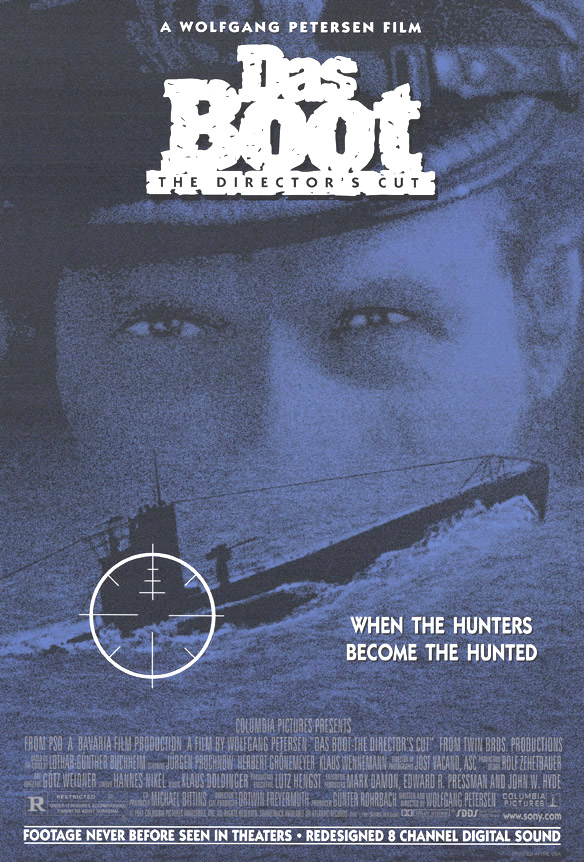
With it out on Blu-ray, viewers can once again see that “Das Boot” is still the greatest submarine movie ever made. Other underwater sea adventures like “Run Silent, Run Deep,” “Crimson Tide,” and “The Hunt for Red October” may come close, but none of them can capture or match its power in unbearable claustrophobic tension. It remains Wolfgang Petersen’s crowning achievement as a director, and it has lost none of its power in sucking us into the inescapable terror people face in the deep dark sea.

“Das Boot” takes place in World War II as Commander Willenbrock leads a group of boys to sea on a U-Boat, the German version of a submarine, and covers the tedium of life at sea when no battles are fought. You feel the sweat and body odor of the crew quite vividly to where you will want to take a cold shower afterward. But it’s when they face off against destroyer ships when the intensity really goes into serious high gear.

Petersen does a brilliant job of conveying the terror and claustrophobic nature everyone on the U-Boat is forced to endure. You are right there with the crew and experiencing their frenzied emotions as the destroyers sail over them dropping depth charges which threaten to sink their boat in a heartbeat. The “ping” noises make the suspenseful tension even worse as the position of the submarine becomes easier to determine, and this becomes a film you experience far more than watch.

The director also does a really good job of getting viewers to know various crew members and the important roles they have on the ship. There is Chief Engineer Fritz Grade (the wonderful Klaus Wennemann) who finds looking at pictures of his wife too painful. Then there’s Chief Mechanic Johann (Erwin Leder) who is in love with his engines the same way Scotty loved the Enterprise in “Star Trek.” And there is also Senior Cadet Ullmann (Martin May) who is constantly worried about his fiancée who is French and pregnant. The more viewers know about the crew, the more emotionally drawn they are to their predicament.

There may some people who object to seeing “Das Boot” on the grounds the crew members were Nazis. Truth be told, not all of them are big fans of Adolf Hitler, and they are never seen wearing a Nazi insignia on their uniforms while at sea. But regardless of this, take away the politics of what’s going on and you will realize just how universal this movie is in what it portrays. Had it been the “good guys” instead, they would have endured the same crippling terror and fatigue so this crew could have been of any nationality.

It is also a powerful anti-war movie as well in showing not just the horrors and destruction of war, but also of the victories which become empty ones when soldiers see what is left behind. This is especially the case in one scene when the crew members are on the surface and surveying a freighter they successfully destroyed. They revel in their victory, but then they see survivors jumping off the ship into the ocean. They swim to the submarine pleading for help, but while the German crew members want to assist them, the Captain concedes there is no room for them onboard, and they are left to drown. It’s an emotionally devastating moment which captures the senselessness and the price of war.

“Das Boot” is based on the novel by Lothar-Günther Buchheim which was inspired by his own wartime experiences as a war correspondent onboard submarines. The character most resembling him here is Lieutenant Werner, and he is our guide through the chaos as his lack of experience aboard a submarine mirrors our own. What he discovers about life at sea, viewers discover along with him. Playing him is German singer Herbert Grönemeyer, and he does great work in conveying his naivety while covering the goings on of a German crew.

The best performance, however, comes from the great Jürgen Prochnow who plays Commander Willenbrock, the hardened sea veteran who looks like he’s seen everything war has to offer. The other officers freak out easily during an attack, but he keeps his cool because he needs everyone to do their jobs. It’s when he starts losing it, however, when things get really bad, and then the audience has a reason to freak out. Prochnow creates a multi-dimensional character which feels very much lived in, and he gives the Commander a subtle vulnerability which looks and feels effortless.

Petersen has been known best for making movies about people who are stuck in small places where there’s not much room to hide. He enthralled us when the American President’s plane was hijacked in “Air Force One,” he had Clint Eastwood chasing after John Malkovich during “In the Line of Fire,” and he has George Clooney and company trapped in the rocky sea in “The Perfect Storm.” “Das Boot” is where it all started for him, and it is a seriously intense and emotionally exhausting experience which thrills and terrifies you in equal measure. The accuracy to detail is never in doubt, and the audience will come up gasping for air once the credits roll.

There may be another submarine movie or two coming to movie theaters in the future, but after watching “Das Boot,” you can bet they won’t come close to topping it. Movies don’t get much more thrilling than this one, and it is a must see for those who are fans of Petersen’s work or war movies in general. It is also more preferable to some of the director’s more recent work like “Poseidon” and “Troy.”

* * * * out of * * * *

Note: There are currently many different versions of “Das Boot” available. The original theatrical cut lasts about two and a half hours. The director’s cut of it added an hour of footage which gave more depth to each character. And before it made its way onto Blu-ray, there was the uncut miniseries version which runs for almost five hours. You may want to start off with the director’s cut and then move on to the miniseries which perfectly captures the infinite tedium of the crew that feels endless.

Eye In The Sky

eye-in-the-sky-poster

When it comes to drone warfare, it seems like such an easier way to fight an enemy without having to put “boots on the ground.” But like Snake Plissken said over and over in “Escape from L.A.,” the more things change, the more they stay the same. Just as in previous wars, there will always be much destruction and an inevitable number of civilian casualties. The question comes to this: is war worth it? Is it worth having all these civilian casualties while trying to take out the enemy? Now some might think these are easy questions to answer, but this is not the case at all, especially to those at the front line.

This is made clear in Gavin Hood’s intense thriller “Eye in the Sky.” It stars Helen Mirren as Colonel Katherine Powell who has been tracking a British citizen-turned-terrorist for six years and finally has her tracked down in Kenya. Thanks to local operative Jama Farah (“Captain Phillips’” Barkhad Abdi) and his nifty high-tech surveillance, she discovers this spy is quickly preparing along with others to carry out suicide attacks. As a result, what started as a mission of capture becomes a mission to kill terrorists, and Colonel Powell has drone pilot Steve Watts (Aaron Paul of “Breaking Bad”) target the safe house the terrorists are in and is prepared to take them out, but then a 9-year-old girl enters the kill zone to sell some loaves of bread, and she won’t leave until she sells them all. This quickly triggers an international dispute as the United States and British governments debate over whether or not to take action.

While most war movies enthrall viewers with bullets and bombs exploding constantly, “Eye in the Sky” leaves us in sweat-inducing suspense as we wonder if and when an explosion will go off at all. What’s great about Guy Hibbert’s screenplay is it never condescends to its characters or give us annoying ones who are out to make bone-headed decisions for their own benefit. Every reason each character gives for firing or not firing at the target makes perfect sense, and it adds to how difficult the question of attacking these terrorists with this little girl nearby is to answer. On one hand, stopping these terrorists will prevent the loss of many lives, but if the little girl is killed it will come back to aid the propaganda wars being fought against governments. Everyone is looking for a way to keep the blood off their hands, but no one gets off easy.

Watching this situation play out reminded me of a scene from “Blue Thunder.” This classic 1980’s movie is about a high-tech helicopter, and the characters see it do a demonstration of a strafing run where red dummies are terrorists and the white ones are civilians. In the course of shooting at the targets, all the red dummies are blown away as well as a few white ones. This leads the government official Fletcher to tell helicopter pilot Frank Murphy, “There’s one civilian dead for every ten terrorists. That’s an acceptable ratio.” To this Murphy replies, “Unless you’re one of the civilians.”

You almost want to laugh at the government officials who keep trying to contact their higher ups to get permission to obliterate the terrorists as it comes across as passing the buck. But whether or not there is an advantage to attacking or not attacking, there’s also how the rest of the population will interpret how their governments act. This is something governments can never fully control, and they are fully aware of the consequences of doing something and of doing nothing.

Gavin Hood has had a tough time in Hollywood ever since he won the Best Foreign Film Oscar for “Tsotsi.” His abduction thriller “Rendition” received a mixed reception, “X-Men Origins: Wolverine” proved to be a mess as it was undone by too much studio interference, and “Ender’s Game’s” chances of becoming a franchise of movies crashed as soon as it opened. But with “Eye in the Sky,” Hood is really in his element as he was once a soldier and has a clear understanding of the military’s responsibilities and the conflicts they endure. He’s also smart to not answer any of the questions the movie poses as he is not about to offer easy answers. Aside from the terrorists, there are no good or bad guys here, but instead, professionals trying to win a war against terrorism as well as the minds of the people.

Hood also shows how the drone pilots actually have it even harder than troops who see the action up close. They may be many miles away from their targets, but they can still see their targets up close and still have their finger on the trigger. At the movie’s press conference, Hood told reporters drone pilots have a higher rate of post-traumatic disorder than those troops who experienced armed combat up close. Having an actor like Aaron Paul playing the drone pilot gets this point across very well as we watch him suffer just as much as he did as Jesse Pinkman on “Breaking Bad.”

Mirren remains an impeccable actress, and she follows up her nasty turn as columnist Hedda Hopper in “Trumbo” with a much different character. Eager to stop another terrorist attack from happening, she undergoes tremendous stress while waiting for an answer from her commander. Mirren makes you feel her stress two-fold, and yet she never seems to break a sweat.

It’s also great to see Abdi here as he proves his Oscar-nominated performance in “Captain Phillips” was no fluke. His character is closest to the line of fire, and we watch as he does his best to do his work while under the prying eyes of fearsome soldiers. Abdi perfectly captures Jama’s desperation as he does what he can to save the little girl from a tragic fate, and he is riveting throughout.

The movie also contains the last onscreen performance from the late Alan Rickman who portrays Colonel Powell’s commanding officer, Lieutenant General Frank Benson. Rickman is as impeccable here as he has been in any other role he has played, and he will be deeply missed. He also has one of the movie’s most definitive lines which comes up towards the end, and he delivers it in a truly unforgettable way.

“Eye in the Sky” is one of those rare thrillers which thrills you just as much as it makes you think. The reality of drone warfare is hard to escape, and this is especially the case after watching this movie. As much as many of us want to leave life and death decisions up to others, Hood forces you to question what you would do in the same situation. You may not like the answers you come up with, but you can’t turn a blind eye to it forever.

By the way, in the case you were wondering, the Alan Parsons Project song of the same name is not featured in this movie. Bummer.

* * * ½ out of * * * *

Lone Survivor

lone-survivor

In a sense, this movie almost shouldn’t work. The title alone flat out tells you only one person will survive the battle we are about to see, and the opening shows doctors working furiously to save that person’s life. From the start, we know how this movie’s going to end even if we haven’t read the book it is based on, so this should kill any suspense it hopes to have right there. But thanks to the tense direction of Peter Berg and a terrific cast, “Lone Survivor” proves to be one of the most visceral war movies I have seen in quite some time.

Like every other movie coming out today, this one is based on a true story. Wahlberg portrays Marcus Luttrell, a United States Navy SEAL who, along with three other Navy SEALS, were dropped off in the mountainous Afghanistan-Pakistan border to conduct a reconnaissance mission on notorious Taliban leader Ahmad Shahd. This particular Taliban leader was said to have close ties to Osama Bin Laden, and we watch as these soldiers keep a very close eye on him.

But during their mission, they are accosted by a group of civilians whom they quickly restrain. Some of the Navy SEALS consider killing them so that their mission can remain a secret, but Marcus manages to convince his fellow soldiers that letting them go is the best option. To kill them would mean standing trial for murder and spending the rest of their lives in prison, and since this has already happened to other soldiers, they agree it is in their best interest to avoid this particular fate. So they let the civilians go and abort their mission, feeling they will be exposed if they stay any longer.

The time these men have to wonder if they made the right choice or not is cut short when they get ambushed by Taliban forces which end up surrounding them on all sides. From there, it is a race for survival as, despite their training, the SEALS find themselves outnumbered and out of communication range with the rest of their unit. From there, “Lone Survivor” becomes quite the blistering experience as you feel everything these soldiers are forced to experience and endure.

Berg starts the movie off with documentary footage of Navy SEAL training which is still considered the toughest military training anyone could endure. It is said 70% of the soldiers who enlist in this training end up dropping out, and from what we see here this is no surprise. I was immediately reminded of Ridley Scott’s “G.I. Jane” which had Demi Moore going through the torturous ritual of becoming a Navy SEAL, but seeing real people go through it here makes it seem all the more brutal.

This opening succeeds in showing us how these soldiers come to form such a close bond with one another, having succeeded in making it to the level of a Navy SEAL. But as this movie continues on, they will soon come face to face with something they are not used to enduring at all: failure.

Berg has proven himself to be a terrific action director with films like “The Rundown” and “The Kingdom,” and he really outdoes himself here. He makes you feel the bullet wounds, the cuts and dark bruises these men are forced to put up with as their chances for survival continue to erode. By the time “Lone Survivor” comes to its inevitable conclusion, I found myself feeling emotionally and physically exhausted by what I had seen. This is a movie which barely lets you come up for air. Even though we know who the lone survivor of the movie’s title will to be, we are still riveted because we still don’t want these soldiers to die.

Berg treats this story with tremendous respect and doesn’t ever try to exploit what these soldiers went through for the sake of entertainment. We get to know these men well enough to where their eventual demise is harrowing to witness. Berg also has quite the cast to help him make this film a reality. In addition to Wahlberg, “Lone Survivor” also stars Taylor Kitsch, Emile Hirsch and Ben Foster as the Navy SEALS, and each actor puts their all into roles which are physically and emotionally draining. Foster is especially a standout as Matthew Axelson who meets his end with sheer defiance.

2013 was a busy year for Wahlberg as he starred in “Broken City,” “Pain & Gain” and “2 Guns” in addition to this. When all is said and done, “Lone Survivor” represents the best work did that year. While watching him, you can tell how deeply he felt about this story just by looking at his eyes. Ever since he blew us away with his performance in “The Basketball Diaries,” Wahlberg has given us one unforgettable performance after another, and he rarely if ever lets us down when he’s onscreen. He has never been the kind of actor who just walks through a role, and I believe him when he talks about the effect playing Marcus Luttrell had on him.

There’s a lot more I would love to tell you about “Lone Survivor,” but I really don’t want to spoil it for those who haven’t read the book this film is based on. As much as I want to tell you this was one of the first really good movies of 2014, it was given a limited release before the end of 2013. Oh well, whether you consider it a 2013 or 2014 film, “Lone Survivor” is certainly one of the most visceral movie going experiences we have seen in a while. For those who like their movies filled with intense emotions, this is a must see.

* * * ½ out of * * * *

American Sniper

American Sniper poster

I came into Clint Eastwood’s “American Sniper” the same way I came into Dinesh D’Souza’s documentary ‘America: Imagine the World Without Her;” wondering if it was even remotely possible to review this movie in an objective fashion. With its look at the Iraq War, many on either side of the political spectrum have been arguing on whether this biopic of Chris Kyle, who is said to be the deadliest marksman in U.S. military history, is pro-war or anti-war. In the end, many are going to end up bringing their own emotional baggage to this movie whether they intend to or not.

The way I see it, Eastwood is not the slightest bit interested in making a case about whether or not we should have been at war with Iraq to begin with. Like Kathryn Bigelow did with “The Hurt Locker,” Eastwood just accepts the fact that, like it or not, we were in Iraq and he is far more interested in what this war did to the soldiers in the long run. While I wished Eastwood dug deeper into the subject matter here, “American Sniper” is the most compelling movie he has directed since “Gran Torino.”

Bradley Cooper portrays Chris Kyle, and he more than deserved the Oscar nomination he received for his performance. Cooper disappears completely into this role which required him to lift some seriously heavy weights to appear the least bit believable as Kyle, and he fearlessly shows us the moral weight he carries after killing so many people for better and/or for worse. Cooper’s face shows the toll of what Kyle has been through to where the actor doesn’t have to tell us what Kyle is experiencing psychologically. The moments where he may be forced to shoot a child weigh hardest on us because you see that his choices on how to resolve this situation are severely limited.

While Eastwood’s portrayal of soldiers under fire in Iraq might pale in comparison to what Bigelow pulled off in “The Hurt Locker” or the brutality of basic training Stanley Kubrick made us witness in “Full Metal Jacket,” he still captures the feel and atmosphere American soldiers got caught up in while on foreign soil. Although we may think we would have reacted to similar situations differently, it’s hard to convince ourselves of this after watching “American Sniper.” I don’t know about you all, but I have never served in the military and have no idea how I would and should react if I ended up in a war situation like this. Moreover, I shudder to think what I would have done under the same circumstances Chris had to face.

Sienna Miller plays Kyle’s wife, Taya, and she ends up being stuck at home while her husband keeps going off on several tour of duties. Now in some ways Miller has a thankless role as she has little to do but wait at home and hope her husband survives the war. However, her character provides a center in Chris’ life which he eventually realizes is more valuable than anything else he has in his life. So is Miller wasted in this movie? I don’t think so unless you really want to complain about how she doesn’t have a lot to do.

I have to applaud Eastwood and Cooper for bringing attention to how many soldiers still deal with severe cases of PTSD which has left them unable to fully function in civilian life. While I wish they dug a little deeper into this issue, the fact that any movie these days is dealing with it feels like a miracle. It’s a huge issue which many who have sent many brave souls to the battlefield never take the time to fully understand, and we see this in all the cuts in programs designed to benefit veterans.

Much has been said about the kind of person Chris Kyle was, and I can’t really attest to that because I don’t have much knowledge about the man other than what I have read and seen so far. What I can say is he served as a sniper in the Iraq War, came out of it with psychological issues which needed to be addressed and eventually came around to help those who suffered as he did. His death at such a young age was tragic however which way you look at it. Regardless of how you feel about Kyle, Eastwood’s “American Sniper” pays tribute to what American soldiers had to endure during the Iraq War. At the very least, the movie serves as a reminder of why we need to thank those soldiers for defending our freedoms regardless of whether or not we agreed with the war they fought it.

Here’s hoping those soldiers still dealing with mental health issues get the attention they deserve because they do not deserve to be left out in the cold.

* * * out of * * * *

Copyright Ben Kenber 2014.

Anthropoid

Anthropoid poster

Anthropoid” is kind of like a cousin to “Valkyrie,” another movie about soldiers looking to take out a high ranking Nazi. Like “Valkyrie,” it will not go down as one of the most memorable World War II movies ever made, but it is an entertaining film which engages us with noble characters, interesting questions about the price of war and a furious climax where resistance fighters make their last stand. More importantly, it deals with a true life event (yes, it is “based on a true story”) many probably don’t know about but should.

The movie starts in 1941 with two Czechoslovak exile soldiers, Jozef Gabčík (Cillian Murphy) and Jan Kubiš (Jamie Dornan), parachuting into their occupied homeland. Upon meeting the resistance fighters and their leader, “Uncle” Jan Zelenka-Hajský (Toby Jones), in Prague, they reveal that they are here to execute Operation Anthropoid which involves the assassination of Reinhard Heydrich, a high ranking Nazi who was one of the architects of the Holocaust and whom Adolf Hitler described as “the man with the iron heart.” Do they succeed in their mission? You’ll have to watch the movie to find out.

“Anthropoid” gets off to a bit of a slow start as Jozef and Jan try to settle in and not stand out among everyone else in town. They even recruit two lovely ladies, Marie Kovárníkovasá (Charlotte Le Bon) and Lenka Fafková (Anna Geislerová), to help them carry out their mission, and they are more than willing to help. Just watch as Lenka makes clear to the men how she can handle a gun.

There’s a subplot where Jan ends up getting engaged to Marie, and it just comes out of nowhere to where this section feels rather awkward. A number of characters are not developed fully enough to where “Anthropoid” threatens to feel like a missed opportunity. But what elevates the material are the performances which are very strong.

You can never go wrong with Cillian Murphy as he has yet to give a bad performance in any film he appears in. As Jozef, Murphy’s steely eyes stare into others with an intensity which wipes the smiles off their faces as he makes clear this is no ordinary mission. He also makes Jozef a most determined soldier who is infinitely determined to carry out this operation, but even he can only take so much before he falls apart emotionally.

Jamie Dornan shows more life here than he ever could have in the dreadful “Fifty Shades of Grey.” This is especially the case when his character suffers a brutal panic attack which has Jozef desperately trying to calm him down from. It’s way too easy to look like a fool when portraying such an emotional moment as the camera never lies, and it says a lot about Dornan that he was able to make this panic attack such a genuinely anxiety ridden moment.

There are also a number of other terrific performances to be found in “Anthropoid” like the one from Toby Jones. Then again, seeing him in a World War II movie these days instantly reminds us of his “Hail Hydra” character from the “Captain America” movies.

“Anthropoid” really kicks into high gear when an assassination attempt is taken and the Nazis come down hard on a particular group of people to where sympathy isn’t much of an option. It gets to where everyone wonders if killing one Nazi will have any effect on the war. With the world closing in on the main characters, the intensity keeps building and building all the way to the very end.

The last half of “Anthropoid” has the protagonists holing up in a church, and they are discovered by the Nazis to where a violent standoff ensues. Director Sean Ellis, who helmed the Oscar nominated short film “Cashback,” stages an impressive standoff which has us completely riveted. While the first half feels routine, the last half really does keep us on the edge of our seats. With “Valkyrie” we had a very good idea of things would turn out, but with “Anthropoid” we don’t. Bullets fly all over the place and emotions are shattered to where we can’t look away, and this is aided by a pounding music score composed by Guy Farley and Robin Foster.

Parts of “Anthropoid” may not stay in the conscious mind long after you have seen it, but the parts which do make it worth the price of admission. Many made tremendous sacrifices which can no longer be swept under the rug, and this movie gives those soldiers the respect they have deserved for the longest time. It also looks at the many costs of war and of how soldiers can only keep their cool for so long until they break under the pressure. It’s a bleak movie in many ways, but it also shows just how far the resistance fighters were determined to end Hitler’s genocidal reign.

* * * out of * * * *

Copyright Ben Kenber 2016.

Fury

Fury movie poster

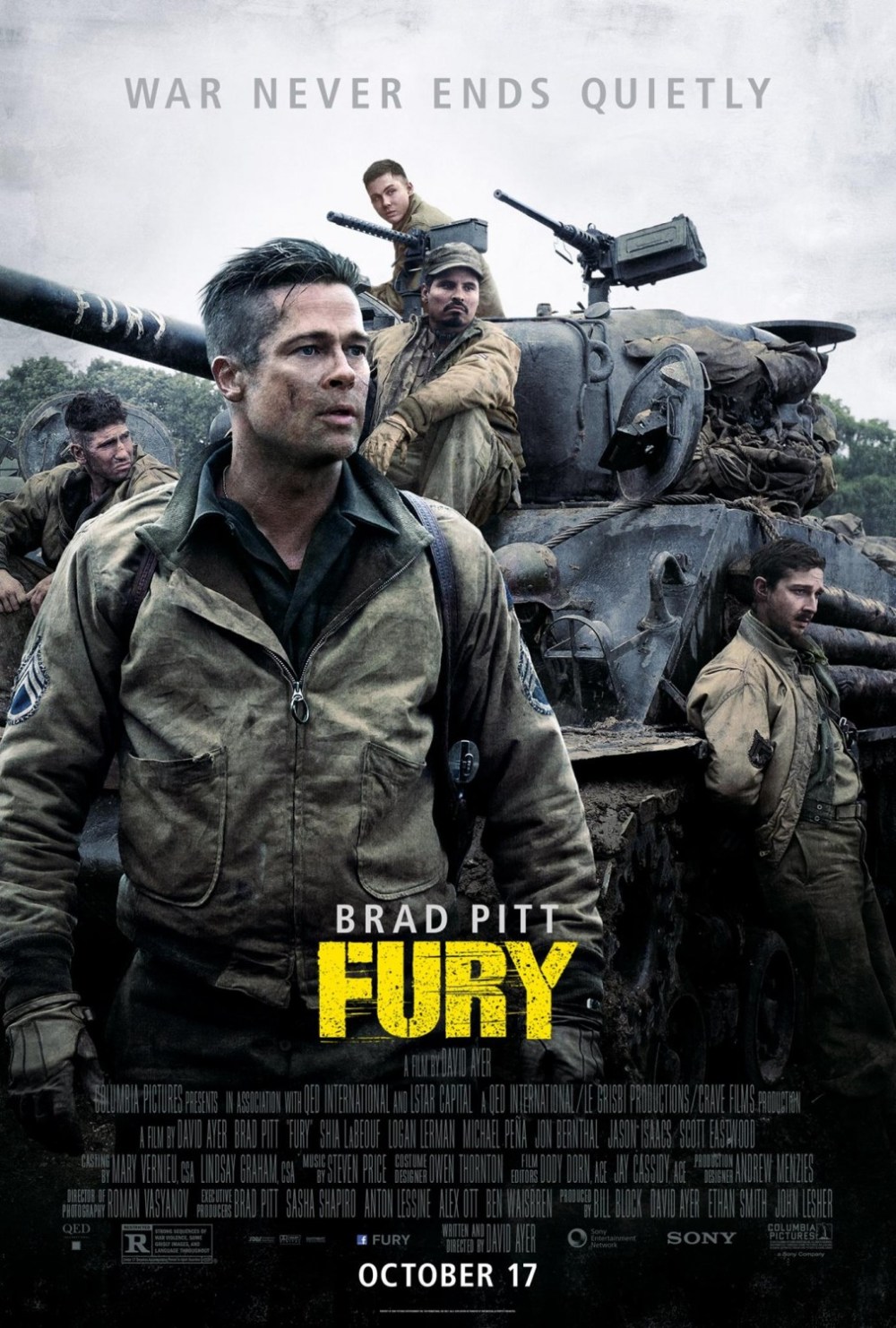
When it comes to David Ayer, you know he’s not going to slack off when it comes to researching his movie’s subject matter. His movies like the brilliant “End of Watch” and the underappreciated “Sabotage” had characters dealing with a vicious reality which they are forced to contend with on a regular basis, and Ayer makes us feel how frightening this reality is whether we want to be a part of it or not. That remains the case with “Fury,” a war film which takes us all the way back to the final days of World War II. It features all the usual characters we expect to see in a war film from the hardened Army sergeant to the innocent rookie, but you come out of it knowing what it feels like to be in a tank.

Brad Pitt stars as Don “Wardaddy” Collier, the commander of a five-man tank crew which is ordered to make a final push into Nazi Germany during World War II. Don is saddled with a battle ready crew which includes Boyd “Bible” Swan (Shia LaBeouf), Cpl. Trini “Gordo” Garcia (Michael Pena) and Grady “Coon-Ass” Travis (Jon Bernthal). After losing one of their members, they are suddenly saddled with the most baby-faced rookie imaginable in Army Private Norman Ellison (Logan Lerman). Don doesn’t like Norman’s presence one little bit as he feels it threatens everyone’s safety, but his superiors force him to take him on regardless of his objections. As a result, Don is forced to make Norman grow up a lot sooner than he wants, and it’s all in the name of survival.

For a time, I thought that Norman was going to be like Jeremy Davies’ character from “Saving Private Ryan” in that he would be the wimp who wouldn’t have the nerve to kill the enemy until the very end. Don, however, doesn’t have the patience to wait for Norman to grow a pair and forces him to kill a Nazi prisoner early on. Lerman gives a tremendous performance as Norman, and it’s fascinating to watch him go from being an anxiety ridden soldier to a hardened war veteran who doesn’t hesitate to take out as many Nazis as humanly possible.

There haven’t been many tank movies in the history of cinema. The only ones I can think of are Kevin Reynolds’ “The Beast” which came out in 1988 and the Israeli war film “Lebanon” which depicted warfare as witnessed from inside a tank. It’ll be interesting to see how they compare to Fury which puts you right into these characters’ mindsets as they lay waste to their target without the benefit of ear protection. You come to feel as battered and hardened as the crew does during their patrol through enemy territory where they find themselves outnumbered and outgunned.

It’s hard to watch “Fury” without thinking of Pitt’s performance as Aldo Raine in “Inglorious Basterds,” but he does succeed in making “Wardaddy” distinct from that character whether he is sporting facial hair or not. I always enjoy Pitt’s performances when he’s all dirtied up and free of his movie star looks, and this is one of them. You believe Pitt as a war veteran who has seen countless battles and has long since been worn down by them. But for Don, his main concern is keeping his crew alive, and Pitt is great at making you feel his character’s barely hidden vulnerability which is always on the verge of being exposed for all to see

Pena is an Ayer regular, having worked with him previously on “End of Watch,” and he has yet to disappoint in any role he takes on. As Trini, he gives us a character who was one of the many Latino military officers who fought for America back in the 1940’s. From start to finish, Pena makes Trini a war weary character who is not far from falling apart, and it makes for an intense performance.

I also give applause to Bernthal whose performance as Grady may not get all the recognition it deserves. On one hand Grady is a loathsome character we cannot stand to be around, but on the other he’s just a soldier trying to survive this war anyway he can. It’s rare to see an actor who makes you despise and sympathize with a character simultaneously, and Bernthal succeeds in pulling it off.

Another impressive performance in “Fury” comes from Shia LaBeouf as Boyd. Like Private Daniel Jackson in “Saving Private Ryan,” this guy is a trained killer but also quick to spout off passages from the Bible. Even after taking out a Nazi tank, he will still quote passages from that book with a great passion. LaBeouf got a lot of press for the method work he did on “Fury” which included pulling out a tooth, but seeing this movie is to be assured that all the work paid off for him.

Whether or not you consider “Fury” to be one of the best World War II movies ever made, it is one of the strongest to come out in the past few years. Ayer makes you feel the anxiety and exhaustion these soldiers go through while in battle, and you come out of this movie feeling as battered as they do. I very much liked what it had to offer, and I liked how Ayer didn’t try to sugarcoat reality for anyone in the slightest. That’s what makes his movies so unique and visceral.

* * * ½ out of * * * *

Copyright Ben Kenber 2014.

David Ayer Discusses an Unforgettable Scene in ‘Fury’

Fury movie poster

Fury” was written and directed by David Ayer, the man who gave us “Harsh Times,” “End of Watch” and “Sabotage.” This movie takes us back to World War II and stars Brad Pitt as Don “Wardaddy” Collier, the commander of a Sherman tank and its five-man crew. We follow them as they go on a dangerous mission behind enemy lines in Nazi Germany. They soon find themselves outnumbered, outgunned and saddled with a rookie soldier barely qualified to serve with them. But even as the odds continue to stack up against them, they stay with their tank which they have named Fury as they consider it the only home they have left.

I attended the “Fury” press conference held at Sony Pictures Studios in Culver City, California, and among those there were Ayer and actors Logan Lerman, Jon Bernthal and Michael Pena. For me, one of the most memorable scenes comes when Pitt and Lerman enter an apartment belonging to a pair of German women and proceed to make themselves at home by cooking breakfast. Then they are joined by the rest of their crew who treat the women and the gathering with a lot of hostility. But as the scene goes on, we see them slowly regain a part of their humanity as they share stories which reduce them to tears.

This scene reminded me of a similar one in Stanley Kubrick’s “Paths of Glory” where a bunch of soldiers jeer a captive German girl when she appears onstage, but they begin to cry when she starts singing a sentimental folk song. I asked Ayer how the scene came about.

“That’s a really good question,” Ayer said. “I did a lot of primary source research, and you realize it’s a workaday world for these guys. It’s sort of a blue-collar existence for these tank crews at this point in the war. It’s go capture the town. Go get this town. Take this hill. Take this ridge. Capture that road junction. You’re given a laundry list of tasks and we think about all these famous battles and all these war-winning battles, but I liken these guys to coal miners. They put on their safety gear and go in and do their work and they come out at the end of the day. And a common pattern was they would capture a town and by early afternoon they’d be in control of it, and then they’d start kicking in cellar doors and looking for wine and looking for food, and they’d make… they locals would cook for them, and they’d do what guys do and pass out and get up the next day at 4 a.m. and take the next town.”

“Something is interesting about that, the idea that you’re in this war zone and there’s humanity and there’s people in there,” Ayer said. “In these movies there’s always a one-sided depiction of either side and of what happens when these people are together in this living room. I imagine this scene as the ultimate Thanksgiving dinner. I think we’ve all had those bad family dinners ourselves. The idea is this crew’s a family, and family can be love-hate. No one can wound you like a family member. No one can hurt you like your brother or sister who just says that one thing that spins you. That was what all the training and the boot camp and the rehearsal and the familiarity was all leading up to, for me, was really that scene. To get these guys as close as brothers so that they can go at each other like older brothers can.”

The other actors echoed Ayer’s sentiments about the dinner scene, and Pena, who plays Captain Trini “Gordo” Garcia, described it as the most intense scene he had to deliver in “Fury.”

“I remember we started shooting and I was an emotional mess,” Pena said. “David said, ‘Let me shoot the other guys first so you can get warmed up,’ and I was like, ‘Dude, I’ve been doing this for five months, buddy. Let’s just go right now.’ Everyone had big scenes and we’d know when the next scene was coming up or when somebody’s big scene was coming up, and we’d try to be as supportive as possible. These guys Bernthal and Shia—we shot it in a day and a half or something like that. I don’t remember. But they were always there tearing up at every take, really supporting me, because it was almost like us against them. It’s like our big brother is playing favorites to this guy (Lerman) and we all took it very seriously. So when I tell the story about the horses, which he never wants repeated, these guys gave me the green light, so to speak, and they were emotionally there for me as well. So that was the toughest.”

Bernthal, who plays Grady Travis, also talked about that scene and how the countdown to it and others that were equally intense loomed over the actors during production.

“We all had those scenes that we sort of circled on the calendar,” Bernthal said. “We could pretty much count down to the hour of when we were going to get to those scenes. It’s sort of like what we were talking about before like family and going for the jugular. For me it felt like, looking back on it, it wasn’t about those scenes, but it was that at any moment everyone here and Shia and Brad and the boss were armed with this information that could cut you down and break you. And because we were familiar and so close with each other, David and the way he kind of orchestrates the thing, he’ll set people loose on people. He’ll set the camera on somebody’s face, and then rip them apart. Sometimes it’s something that another actor says, and sometimes it’s something he comes up with and whispers in your ear.”

“I’ll be honest with you, after just a month of shooting when he would walk towards me, I’d start to shake and sweat, because I know what was coming in my ear was going to break me,” Bernthal continued. “And even though you know what he’s trying to do and it’s for a result, it scares me now honestly just thinking about it. Also, to do that to one of these guys that you love so much, to see them and to get the word to go after that dude, go get him, and like David said, it’s family, so I know what to say to you to press your button. And it becomes this kind of perverse, beautiful game. We’re trying to cut each other down and break each other. That’s what family does. It was uniform among every tank veteran we talked to. You don’t pick your family. You don’t pick your tank crew. These guys are as close as units can possibly get. That’s what we were going for, that familiarity and that bond. It’s just as dangerous as it is lovely.”

Copyright Ben Kenber 2014.

Green Zone

Green Zone poster

It was the teaming of Matt Damon and Paul Greengrass which made me almost completely forget that “Green Zone” was yet another movie about our war in Iraq. I find myself, as well as many, avoiding this subject at the movies because we spend our days thinking about what goes on over there and of how we want this war to be over with already. But this director and actor were major forces behind some of the most exciting action movies of the past decade with “The Bourne Supremacy” and “The Bourne Ultimatum.” Furthermore, the composer of the Bourne trilogy, John Powell, is on board as well to give “Green Zone” an even bigger kinetic kick.

“Green Zone” was apparently inspired by the 2006 non-fiction book “Imperial Life in the Emerald City” by journalist Rajiv Chandrasekaran, but the end credits state the movie is actually a work of fiction. Still, while it is not exactly “based on a true story,” “Green Zone” still feels like one of the more logical and honest commentaries about our mess of a war in the Middle East.

Matt Damon stars as Army Chief warrant officer Roy Miller, and we see him with his unit as they investigate a warehouse believed to contain WMD’s. Turns out it doesn’t, and we quickly find this is not the first time Miller and his men have come up empty. As a result, Miller begins to doubt the intelligence reports provided to the troops from a “reliable” but anonymous source. Endlessly curious about why he and every other military officer are not finding any weapons, Miller starts his own investigation into the matter. At the same time, forces around him continue to try and contain a potentially combustible situation that may soon become impossible to control.

It’s no wonder Greengrass chose to work again with Damon on this film. Ever since “The Bourne Identity,” we have had problem accepting Damon as an action hero. What makes Damon perfect for this role is that he never descends into some clichéd portrayal of a soldier who thinks he’s all badass. Roy Miller is a down to earth kind of guy who is sincere in his quest to keep America safe from enemies foreign and domestic. Never does he try to be a hero or show off how macho he is.

You have the soldiers coming up empty, you have the CIA knowing they will come up empty, and you have special intelligence officers who know far more than they are willing to let their own military know about. Also, you have investigative reporters writing articles on Saddam having started up weapons programs again even though they have never been told who their source is. They have to take the word of an official who ends up leading them around in circles.

Now there are a lot of people calling this movie “anti-American” and “anti-war,” but I couldn’t disagree more strongly with that assessment. Many recent war movies are more respectful to the troops than some bother to realize. As for those who assume that it is appallingly “anti-American” as it shows Roy Miller going rogue, I wonder if they had that problem when Jack Bauer does the same thing on “24.”

If anything, the recent war movies have been more anti-mercenary than anything else. Be it “Green Zone,” “The Hurt Locker” or even “Rambo,” mercenaries are shown stepping all over the soldiers if they have to, and we know they get paid twice of what the average soldier makes each year. The soldiers in these films have been presented as far more prepared and patriotic in their commitment to protecting our country. If that isn’t pro-troop, I don’t know what is.

There is also a complexity to both the American and Iraqi characters throughout the film. You figure everyone would be on the same team regardless of what side they are on, but you see all the infighting tearing each side apart as they delude themselves into believing they are winning. One pivotal character in “Green Zone” is Freddy (Khalid Abdalla), an Iraqi who Miller befriends and later becomes his translator. Hollywood has often been accused of presenting Middle Eastern characters as nothing more than terrorists, but Freddy is not like that. Freddy wants to help his country and risks his own life to try to help the Americans while not necessarily welcoming them. He becomes the symbol of those Iraqis that feel wronged by their leaders and of how infuriated they are about the endless damage left in their wake. From a distance, it becomes clear both sides are confused and completely unsure of what to believe.

In some ways “Green Zone” is a criticism of American military involvement in other countries, but director Greengrass doesn’t necessarily hit you over the head with that. Still, during the scene where Miller comes face to face with General Al-Rawi (Yigal Naor, who gives the role a strong menacing quality), he learns the truth of why American military forces are really in Iraq. Al-Rawi is one of the bad guys, but he is also a victim of being in the position he is in. In other words, Al-Rawi is going to take a fall because the United States government wants Saddam.

When Al-Rawi asks Roy Miller if he thinks American forces can seriously change anything in Iraq, I was reminded of a scene in Ridley Scott’s “Black Hawk Down” where a helicopter pilot is being held by Somalia warlords who question the military’s involvement in their country:

“Do you think if you get General Aidid, we will simply put down our weapons and adopt American democracy? That the killing will stop? We know this. Without victory, there will be no peace. There will always be killing, see? This is how things are in our world.”

Throughout his career, Greengrass has never been afraid of dealing with topics which are very touchy. With “Bloody Sunday,” he captured the horrible events of January 20, 1972 when British soldiers clashed with Northern Ireland protestors fighting for their freedom. Then there was “United 93” which dealt with the events of September 11th and of how the passengers on that fateful flight were the first to deal with a post-9/11 world. With “Green Zone,” he defies those who think movies should just be an escape and not a forum for national conversation. It’s an action movie designed to be as thrilling as it is enlightening. His aim is not to show how America divided itself from the rest of the world with this invasion, but of how it created sharp and highly sensitive divisions in America itself.

In addition to Damon, there are other actors who bring their considerable acting talents to “Green Zone.” Brendan Gleeson is perfectly cast as Martin Brown, the CIA Baghdad bureau chief who has seen it all. Still, he is trying to cut through the BS hindering his efforts to control the situation in Iraq. Amy Ryan is excellent as Wall Street Journal foreign correspondent Lawrie Dayne. Her character has written many articles regarding weapons programs being continued in Saddam’s regime, but we see her doubt the source given to her. Most reporters in movies these days are despicable, but Ryan makes this one empathetic as she comes to discover the truth which contradicts all she has reported. The always reliable Greg Kinnear is also well cast as Clark Poundstone, a member of Pentagon Special Intelligence who knows far more than he lets on. It’s no secret these characters are based on real people, but the names have been changed to protect the guilty.

“Green Zone” isn’t as viscerally exciting as the Jason Bourne movies, and it won’t go down as the definitive Iraq war movie (“The Hurt Locker” holds that distinctive honor), but it is still edge of your seat entertainment. But not to worry, Greengrass films the action in a way that doesn’t make it all that hard to tell what’s going on.

Another key scene that comes to mind is when Roy Miller goes out to investigate a lead, and Kinnear’s character ends up cutting him off. As he walks inside the CIA headquarters in Baghdad he tells Miller, “You shouldn’t have been playing on the wrong team.”

It makes me wonder, when was the last time all of us Americans were on the same team?

* * * ½ out of * * * *

Copyright Ben Kenber 2010.