‘Ocean’s Trilogy’ Review and 4K Review

The following review was written by Ultimate Rabbit correspondent, Tony Farinella.

When you think of the “Ocean’s Trilogy,” you think of big movie stars, high stakes, and witty banter. These are individuals known for being con-artists and having a certain set of skills, but they bring an element of fun to the proceedings. They are interesting, layered, and unique.  These are not your bargain basement crooks and thieves. These films are also aided by the direction of the stellar Steven Soderbergh. He makes everything pop and sizzle on screen. He knows how to add just the right amount of style to these films without taking away from his ensemble cast.  The beauty of a Soderbergh film is the fact he can dabble in a number of genres and make a film successful both commercially and financially. He’s not just pigeonholing himself into one type of film.  He can do an independent film that gets people talking or he can do blockbuster films like the “Ocean’s Trilogy.”

Let’s start with “Ocean’s Eleven,” which is, of course, a remake of the 1960 film starring Frank Sinatra, Dean Martin and Sammy Davis Jr. I don’t think it is fair to compare these two films as they are forty years apart, but I will say that both are entertaining and sleek in their own ways. Remakes in general tend to get a bad rap, but when they are done with the right people involved and the right mindset, they can really deliver the goods.  It’s about taking an idea and making it your own without copying from the original source material.  This is not always easy to accomplish, but they did that with “Ocean’s Eleven” in 2001.

The charming George Clooney stars as Danny Ocean, a professional thief who has recently been released from prison. Even though he served time, he’s on the lookout for his next big caper.  Once he gets involved with the thrill of the chase and the risk and reward that comes with it, it’s hard to turn it down or live a normal lifestyle after that. He meets up with an old partner named Rusty Ryan (Brad Pitt), and they are looking to hit up Las Vegas for their next big heist. When it comes to a heist like this, money is important. They end up securing the money from Reuben Tishkoff (Elliott Gould), and their plan is to rob three casinos in Las Vegas, which are owned by Tishkoff’s rival. The stakes are high, at $160 million, so they need to make sure they are on their A-game.

In order for Danny and Rusty to pull this off, they will need to assemble the right team. They enlist the help of Basher Tarr (Don Cheadle), Livingston Dell (Eddie Jemison), Linus Caldwell (Matt Damon), Frank Catton (Bernie Mac), and Virgil and Turk Malloy (Casey Affleck and Scott Caan). Every one of them brings something unique and special to the table. Julia Roberts also shows up as the Danny Ocean’s ex-wife, Tess, and she has a bone to pick with Danny. Andy Garcia is in the film as well as Terry Benedict, the owner of the three casinos they are trying to rip off in the film.
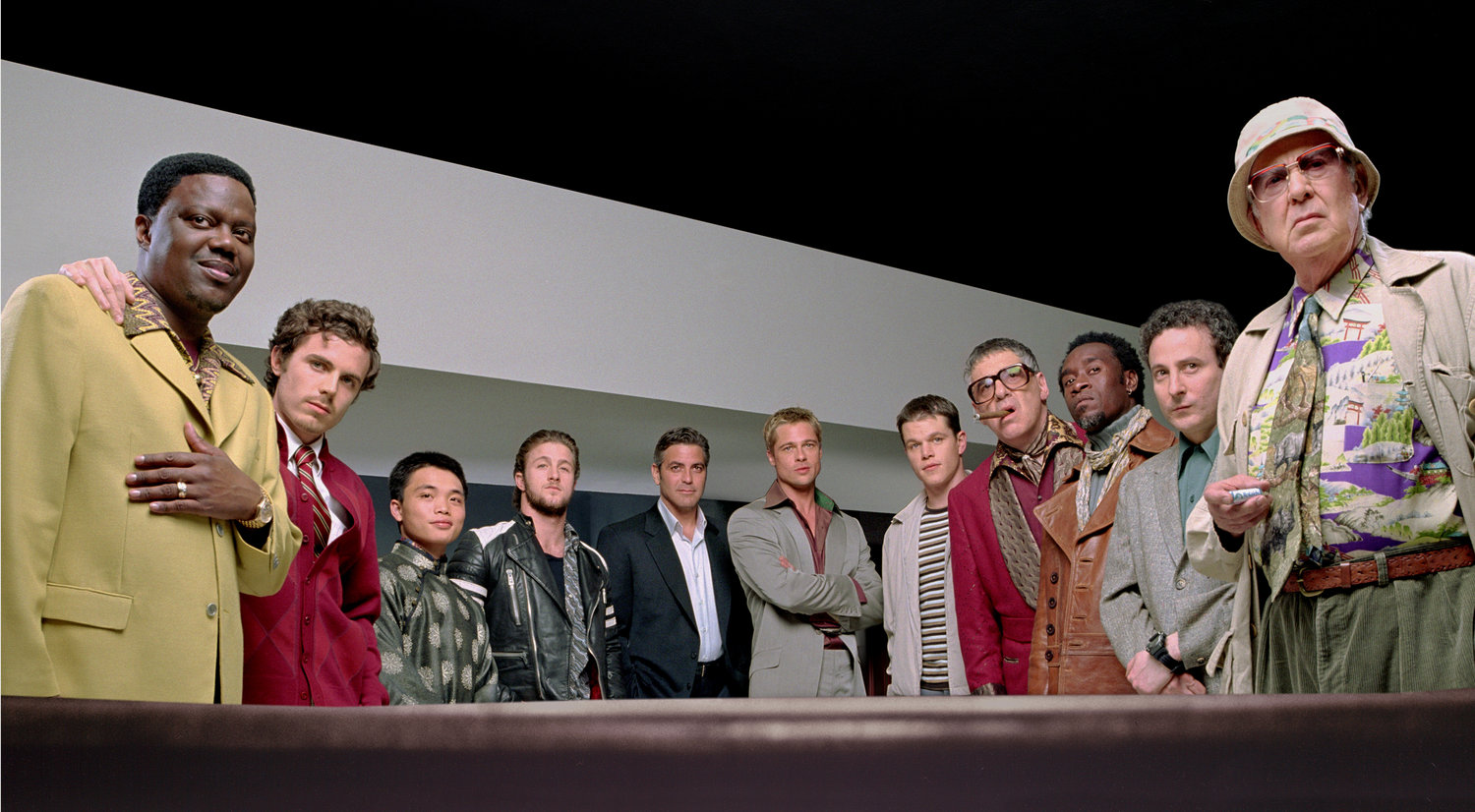
“Ocean’s Eleven” Cast Bernie Mac, Casey Affleck, Li Dian Feng, Scott Caan, George Clooney ,Brad Pitt ,Matt Damon, Elliott Gould, Don Cheadle, Edward Jemison and Carl Reiner © 2001 Warner Bros. Photo by Sid Avery

For my money, “Ocean’s Eleven” is the best of the three films.  The pacing is terrific, and there is never a dull moment in the film.  Even though there are a lot of moving pieces, it never feels like the movie is overstuffed, boring or too long as it moves at a brisk pace.  Also, when you have top-notch actors and actresses together, you know you are going to get some great performances.  A big part of the fun of these films is seeing these Hollywood legends go toe-to-toe with one another.

Moving onto “Ocean’s Twelve,” which came out in 2004, I don’t want to go into too much detail on this film just in case you are watching this trilogy in order for the first time.  I will say I found it to be a little bit more of a slog to sit through and a bit of a letdown after “Ocean’s Eleven.” It was merely an OK film.  It was successful at the box office, but I didn’t find the story as engaging this time around.  Of course, the characters are still entertaining and fun to spend time with, but since there isn’t a great story or plot to drive them, they quickly run out of steam here.  It ends up being one of those films where the cast had a lot more fun making it than we had watching it.
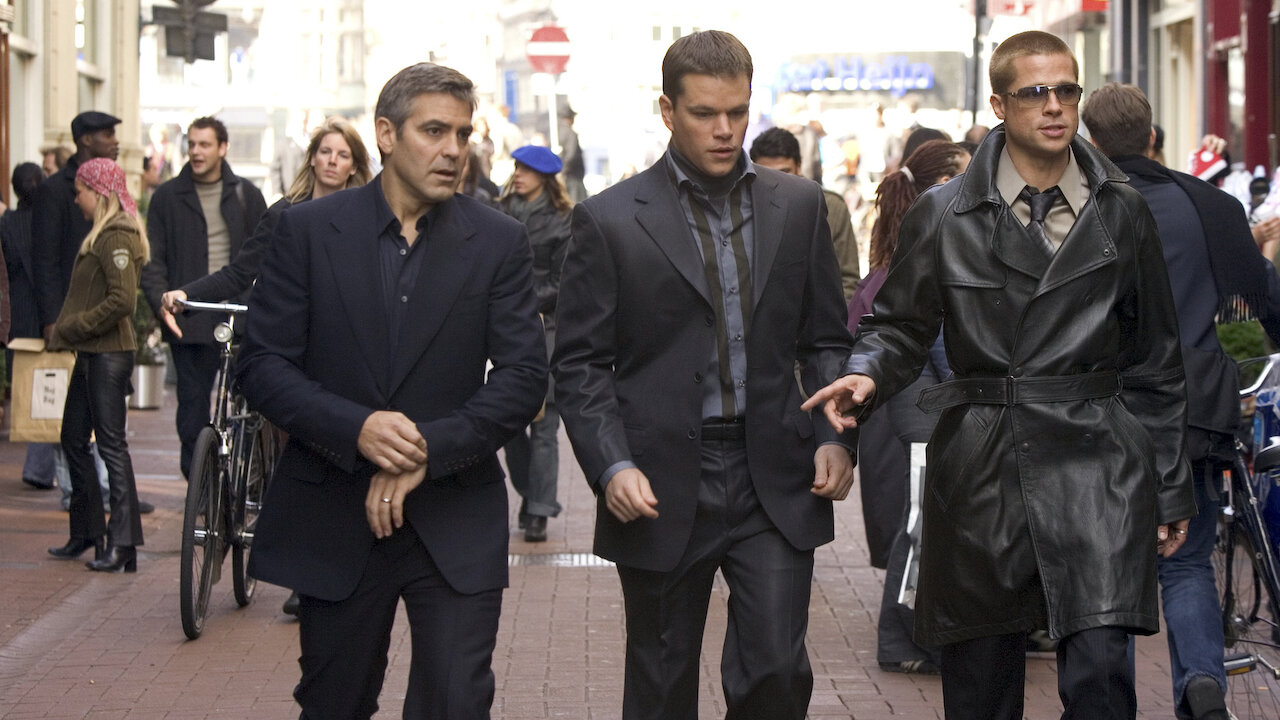
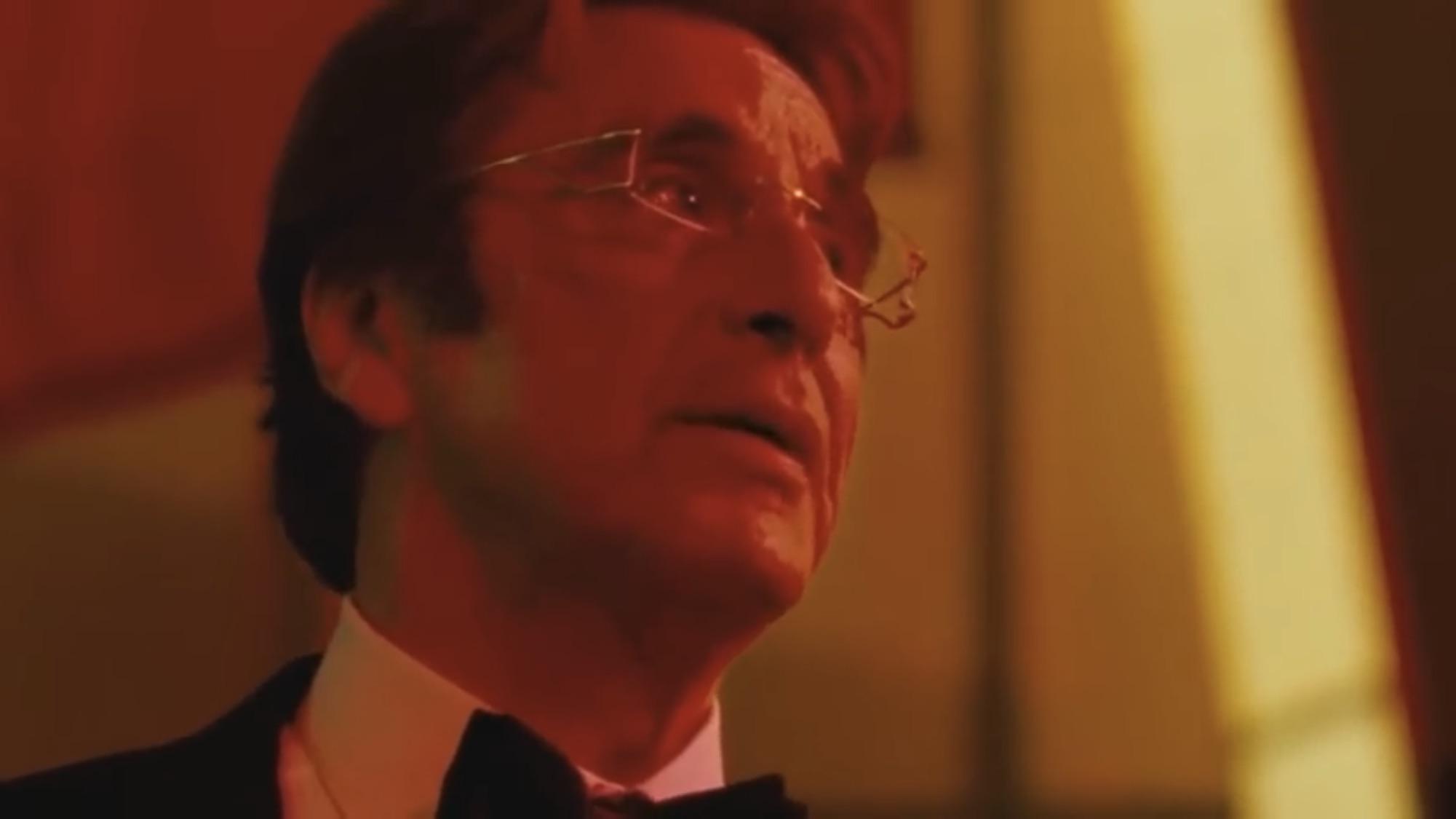
 In 2007, they came back with “Ocean’s Thirteen” which introduced Al Pacino to the proceedings and was once again directed by Soderbergh. Julia Roberts and Catherine Zeta-Jones are missing here, which makes this film feel a bit off in regards to the female-male ratio.  Roberts, especially, was such a big part of the first film, and Zeta-Jones was also very charming and lit up the screen in “Ocean’s Twelve.”

“Ocean’s Thirteen,” however, is a nice return to form after the lackluster and underwhelming “Ocean’s Twelve.” It’s almost as if Soderbergh sat down and realized what was missing from the last film and made sure to make up for those mistakes this time around.  The addition of Al Pacino to the mix is also a juicy twist as well.  What I enjoyed most about “Ocean’s Thirteen” is how it brought back the fun factor from the first film. “Ocean’s Twelve” was an entertaining film at times, but it was also a lazy one as well.  This time, they work on making sure the fun is included along with a story that can hold its own in the process. 
When these films work best in this franchise, it is when they realize we are just as interested in the story as we are in the characters.  They go hand-in-hand. They play off each other in a sense.  We love to see the characters in action and find out all of the twists and turns along the way.  It was clear they put time, effort and brains into the first and third films. They lost their way a little in “Ocean’s Twelve,” which feels like a sequel they didn’t put a ton of thought into.

“Ocean’s Eleven” – * * * ½ out of * * * *

“Ocean’s Twelve” – * * out of * * * *

“Ocean’s Thirteen” – * * * out of * * * *

4K Info:  The “Ocean’s Trilogy” is released on a three-disc 4K set from Warner Brothers Home Entertainment.  This set only includes the 4K discs, so if you are looking for Blu-rays and 4Ks together, you will not find them here. According to the press release, the 4K remasters of “Ocean’s Eleven,” “Ocean’s Twelve” and “Ocean’s Thirteen” were completed at Warner Brothers Discovery’s Motion Picture Imaging (MPI) with the participation of Soderbergh. All of the films are rated PG-13, and their respective running times are 116 minutes, 125 minutes and 122 minutes.  There is also a digital copy for each film which allows you to own all three copies of the trilogy.  Subtitles are included in English, Spanish, and French.

Video Info:  I really like the look of these movies on 4K.  Having previously seen “Contagion” on 4K, also from Soderbergh, I’m happy to report this is another fantastic looking 4K set.  Its color is vivid, bright and filled with a lot of life.  It’s also dark and mysterious when things turn up a notch. All three of the films look great on 4K.

 Audio Info: There is a lot of talking in these films as they are going over plans and information, and the dialogue comes in crystal clear on all three films.  The soundtrack is just right in covering the dialogue, music and background noise without being too distracting. It captures the essence of each film.

Special Features:

“Ocean’s Eleven”

• Commentary by Steven Soderbergh and Ted Griffin

• Commentary by Brad Pitt, Matt Damon and Andy Garcia

• Are You In or Out? The Making of Ocean’s Eleven

• Pros & Cons: Inside Ocean’s Outfit

• The Style of Steal

• The Look of the Con

• Original Ocean’s, Original Cool

“Ocean’s Twelve”

• Commentary by Steven Soderbergh and George Nolfi

• Ready, Jet Set, Go: The Making of Ocean’s Twelve

• HBO First Look: Twelve Is the New Eleven: The Making of Ocean’s Twelve

• Deleted Scenes

“Ocean’s Thirteen”

• Commentary by Steven Soderbergh, Brian Koppelman and David Levien

• Third’s a Charm: The Making of Ocean’s Thirteen

• Ahab with a Piggyback: The Means & Machines of Ocean’s

• Jerry Weintraub Walk and Talk

• Masters of the Heist

• Deleted Scenes

Should You Buy It?

I’m seeing this set go for about $55 right now online, which is a really good price. That’s a little less than $20 for each 4K.  If you enjoy a good movie collection, this one is definitely recommended.  You get all of the old special features included here along with updated 4K transfers on these films as well.  These are 4K transfers where it is clear they put a lot of care and effort into them. They didn’t just throw them together.  If you enjoy heist movies with great casts, you really can’t go wrong with this trilogy.  I’d recommend you go out and buy this set right now at its current price. You can make a weekend out of watching all three films and really enjoy yourself.

**Disclaimer** I received a copy of this film from Warner Brothers to review for free.  The opinions and statements in the review are mine and mine alone.

‘Irreversible: Straight Cut’ – Gaspar Noe’s Infamous Film Still Packs a Devastating Punch

I remember when Gaspar Noe’sIrreversible” was released in 2002 and of the polarizing responses it received at the Cannes Film Festival and from audiences around the world. A rape and revenge story which, like Christopher Nolan’s “Memento,” is told in reverse and comprised of scenes done in long takes, it is still best known for two scenes of punishing ultraviolence: one in which Monica Bellucci’s character is raped in an underpass which lasts for almost ten minutes, and another where a man’s face is bashed in by a fire extinguisher to where he is no longer recognizable to anyone.

I never got to watch “Irreversible” when it played at a theater near me. Back in the day, I considered myself quite the adventurous moviegoer as I went out of my way to watch those films which did not often screen at the local multiplex because they were considered too disturbing for mainstream audiences. But after being so emotionally drained by “Breaking the Waves” and “Dancer in the Dark,” not to mention going through the cinematic equivalent of electric shock treatment that was “Requiem for a Dream,” I was not sure I could stomach what “Irreversible” had to offer, so I waited to view it on DVD where I could lower the volume or fast forward through the hard to watch parts.

Still, part of me regretted never having witnessed Noe’s unnerving film on the silver screen, and this is coming from someone who watched Larry Clark’s controversial “Kids” in a theater with his parents. But now, Noe has released a new cut entitled “Irreversible: Straight Cut,” and on top of it being remastered, it presents the story in chronological order this time around. The question, however, is if this cut will be just a mere gimmick.

The story remains the same with lovers Alex (Monica Bellucci) and Marcus (Vincent Cassel) going to a party along with Alex’s former boyfriend, Pierre (Albert Dupontel). But this straight cut starts with Alex and Marcus waking up after a night of passionate love making. I love watching this opening scene as the intimacy between these two characters, played by actors who were married at the time, as it is so lovely and unforced. So much attention has been paid toward those two unwatchable violent scenes that many forget about these scenes here. Seeing these two lovers together proves to be a wonderful sight as this intimacy is rarely shown enough in movies, and I came out of it feeling envious for Cassel as he got closer to Bellucci than I ever will.

From there, “Irreversible: Straight Cut” goes on a path which leads straight to hell as the road to it is always paved with good intentions. Alex is eager to bring Pierre along for the ride because she knows he gets along rather well with Marcus, and he still has feelings for her. Hearing Marcus and Pierre brag about who was better in bed with her played more strongly for me this time out in this chronological take. In fact, as we are thrust more deeply into one of “Irreversible’s” main targets which is toxic masculinity. Marcus is so consumed with rage over what happened to Alex that he is utterly impulsive and not using anything resembling common sense. Pierre is infinitely desperate to make Marcus see that he would be better off staying in the hospital with Alex rather than trying to seek vengeance and, even though I have long since seen the original cut, I found myself hoping Pierre would succeed this time around.

With “Irreversible: Straight Cut,” Noe has done an excellent job of making this version more than just a mere gimmick. The edits between each scene feel as seamless as they did before, and our attention is now glued to what may happen as opposed to what has already transpired. The more I watched this cut, the more I came to see how it dealt more with the uncontrollable impulses of man to where anything can happen, and this makes the final outcome all the more devastating. Truth be told, the events portrayed here remind me of all those moments I would love to get back as they created a level of damage I never intended.

As for the elongated rape scene, it remains as brutal and unnerving as ever. I did see one man walk out of the theater during it, and part of me expected to see more audience members to do so. I found myself looking away from the screen at times as I became increasingly enraged as ever at what the unrepentant pimp, La Tenia (played by kick boxing champion Jo Prestia in a truly fearless performance), was doing to Alex. There are few other motion pictures I have sat through where I wanted to see a certain character die a most painful death, and La Tenia is seriously deserving of such a fate.

At this point, I should make clear some facts about the rape scene as many of “Irreversible’s” detractors consider this film to be “pro-rape,” something I completely disagree with. The truth is, Noe was not sure how long the rape scene was going to last, and it turns out Bellucci was the one who ended up directing the scene as she wanted it to be as disturbing as possible. Also, Noe’s camera is constantly moving all over the place throughout “Irreversible,” but it remains paralyzed throughout the rape scene as he wants us to remain in Alex’s frame of mind instead of La Tenia’s. Had the camera moved along with every thrust of La Tenia’s body, we would have been in his mindset, and that would have affected the morality of this film in an inescapable way. In my mind, Noe justifies the rape scene in “Irreversible” because of the way he filmed it.

Seriously, “Irreversible: Straight Cut” reminded me of when I first watched “Deliverance” years ago. While many motion pictures are meant to be enjoyed, this one was made to be experienced even if it was against my will. There is no easy escape from the rage of revenge here as Marcus descends even deeper into a hell which Pierre desperately wants to keep him away from. While I have watched “Irreversible” several times before, I still found myself praying still for another outcome.

This film has also been accused of being homophobic as Marcus yells out many degrading insults to the patrons at the Rectum club, but there a couple of things to consider. Noe himself has a cameo as a Rectum regular who is busy pleasuring himself, and this was his way of showing he was on equal footing with characters he portrayed here. As for Marcus, all I can say is that when you find yourself in a state of intense anger or rage, you find yourself saying things you never thought you would ever utter.

As for Pierre, whose vicious actions end up giving him the worst outcome in this film, he represents a case study of deep repression as he keeps his emotions deep inside. But when he bashes that guy’s head in with the fire extinguisher, his repression ends up finding an exit in the worse way possible, and he ends up destroying himself in a way he could never have seen coming.

Basically, what I am trying to say about either cut of “Irreversible” is that Noe did not make this film simply to shock audiences. Yes, he went out of the way to make us feel uncomfortable while we watched it, but there is more substance to this film than we initially saw on the surface of it. In the end, it presents us with a tragedy we would be best to avoid in our own lives as it is anti-rape and anti-revenge more than anything else. If you do not believe me, then you did not look at this film closely enough.

In comparing the two cuts, I have to say I prefer the original cut more as its reverse structure carries more dramatic weight. As we come to see these horrific acts and what led to them, each preceding scene makes us think about what could have been done to avoid such horrific fates. Still, “Irreversible: Straight Cut” gives audiences something to chew on even as it takes things to a finale which is as bleak as can be. When it comes down to it, I am curious to see what people think about the straight cut, particularly those who have not seen either cut before this one. With a film like this, the responses to it prove to be endlessly fascinating.

Come to think of it, comparing “Irreversible” to “Deliverance” reminds me of the pieces of advice characters give in each film. In “Deliverance,” Jon Voight tells Burt Reynolds, “Let’s go back to town and, ah… play golf.” Imagine the horrors those men would have avoided had Reynolds heard Voight out. But when it comes to “Irreversible,” it features a terrible piece of advice which hangs over the film as Alex attempts to cross a busy street when she is told by a woman nearby:

“Take the underpass. It’s safer.”

Original Cut: * * * * out of * * * *

Straight Cut: * * * ½ out of * * * *

‘Black Swan’ is a Tour de Force for Darren Aronofsky and Natalie Portman

Black Swan movie poster

JESUS CHRIST!!! This was my immediate reaction after witnessing Darren Aronofsky’s “Black Swan.” A combination of “The Wrestler” and “Requiem for A Dream” with a dose of “Rosemary’s Baby” thrown in for good measure, it is a brilliantly over the top psychosexual thriller which continually ratchets up suspense and tension all the way to its horrifying climax. And unlike Mia Farrow’s character in “Rosemary’s Baby,” Natalie Portman has a really nice haircut.

Just as it was with “The Wrestler,” “Black Swan” serves as an expose sorts on the athletic arena it focuses on. The backstage world of ballet dancing is highly competitive, and the career of a dancer can easily be short-lived if an unexpected injury, either a big or small one, occurs. Many view ballet as being very boring and would rather tune into Monday Night Football. Try dragging kids to a production of “The Nutcracker” and watch how they run for the hills. This is the reaction I get from most people I know, although I’m sure there are exceptions.

But don’t let any preconceptions about ballet turn you off from seeing this film. It is anything but boring, and both Aronofsky and Portman brilliantly capture the physically and psychologically draining aspects of ballet to where you feel as wiped out and crazed as they do throughout. Like any other art form, ballet demands years of training in order to reach a level of perfection few can achieve. It is also shown to be an isolating career because, with so many people going after the same lead role, making friends is a struggle as you wonder what they are saying behind your back. With the bitterness level sky high, ballet threatens to be more damaging psychologically than physically.

Portman plays Nina Sayers, a member of a prominent New York City ballet company. After years of hard work, Nina gets her lucky break when she snags the lead role in “Swan Lake,” a show is as overdone as many of Neil Simon’s plays. This show has one of the most coveted roles in any show as it is incredibly challenging. Nina has to play the White Swan who is a creature of innocence, and also the Black Swan who is one of a sensual and dark nature. Basically, it is the dancer’s “Hamlet.” While her director Thomas Leroy (Vincent Cassel) thinks she is perfect as the White Swan, he has doubts about her ability to play the Black Swan as she is so technically precise in her movements, and the latter role requires her to lose herself in the passionately dark nature of the character.

Once we see Nina walk down the streets of New York past a woman who looks exactly like her, we are caught up in her downward spiral which she is helpless to stop. We watch as she encounters people and situations which feel real, but later turn out to be nothing more than hallucinations. There are times where she even looks like she is turning into a swan. While this may sound ridiculous on paper, it is brilliantly conceived visually from the rash on Nina’s back to those blood red eyes she develops. There are even points where she is dancing in front of a mirror, and her reflection turns around to glare at her malevolently.

The line between what is real and what is not becomes completely blurred, and neither the audience or Nina are able to tell the difference between the two. Many may be maddened at not being able to understand all of what is happening, but that’s precisely the point. Aronofsky puts you directly into Nina’s mindset, which has already proven to be an emotionally fragile place, and we are instantly caught up in her psychological disintegration. This makes “Black Swan” all the more visceral to experience. We are not just watching Nina go mad, we feel like we are going mad with her.

Portman does truly give the performance of her career here. She trained in ballet for a year or so, and her preparation really paid off. Throughout, she captures the sweet nature of Nina as well as the paranoia and resentment which overwhelms her the closer she gets to the opening performance. Watching Portman practice her dancing to no end is emotionally exhausting as it is for her physically, and she makes us feel like we are right on the edge of disaster with her. Portman has always been an amazing actress, but her work in “Black Swan” represents the culmination of a great career which is more than ready to head into adulthood.

Mila Kunis, looking even sexier here than she did in “Forgetting Sarah Marshall,” co-stars as another dancer, Lily. Unlike Nina, she is free with her body and mind, and what she lacks in precision she makes up for in unbridled passion. She’s at times friendly, wanting to break the ice between her and Nina, and her power of seduction is one Nina desperately wants to capture for herself. Kunis has become an increasingly fascinating actress, and seeing her go from sweet to a cold back stabber of a human being is made very believable by her work.

Oh yeah, there is a sex scene between Portman and Kunis which will have people checking out “Black Swan” for all the wrong reasons. Then again, any reason to get people to see this film might not be so bad. Furthermore, to dismiss this as a simple lesbian sex scene will only show how short sighted you are.

Aronofsky again employs his frequent collaborators to excellent effect. His director of photography, Matthew Libatique, almost makes this film look like a remake of “Suspiria” as the colors become overpowering once they become blacker and infinitely vicious. “Black Swan” is as much a sensory experience as it is a psychological one, just like “Requiem for A Dream” was. Libatique makes the special effects appear seamless in scenes where CGI is clearly utilized. As the background dancers pass by her, Nina sees her face in all of them. It’s such an eerie moment to where it doesn’t even feel like a special effect.

Then there is the fantastic Clint Mansell whose work on Aronofsky’s movies has become a main character in each of them. Mansell takes Pyotr Ilyich Tchaikovsky’s “Swan Lake” and breathes fresh life into it which is exhilarating to take in. His score becomes as intense as the images we see on screen, and I loved how visceral and thrillingly alive it all feels.

The movie also offers great performances from actresses we don’t see as much of on the silver screen: Winona Ryder and Barbara Hershey. Ryder clearly understands the frustration her character of veteran dancer Beth MacIntyre is going through, and she captures this deeply hurt and excessively bitter character perfectly. At once an empathetic and at other times a pathetic person, we see just how much Beth has lived for ballet, and now that it has been cruelly taken away from her, she has little else to devote her life to. To be placed on a pedestal so high only to be yanked from it leaves her with nothing but desperation and deep self-loathing which is hard to dig oneself out of.

As for Hershey, she remains a phenomenal actress as she has been for many years. In movies like “A World Apart” and “Portrait of a Lady,” she has created indelible female characters who are never easily forgotten. Her role in “Black Swan” is no exception as she takes the clichéd role of a stage mother and makes her a loving person as well as an overbearing one. When we come to see how her character failed at a dancing career, it becomes frighteningly clear how much of her happiness is based on how successful her daughter is at hers.

“Black Swan” once again shows how brilliant a director Aronofsky is as he mixes up different genres to create one hell of a movie going experience. Portman’s magnificent performance really is one for the ages, and few other characters have been as physically demanding for an actor as Nina is. Even as things get more and more horrifying, Aronofsky keeps your eyes focused on the screen to where looking away from it would feel like a crime. Is it more intense than “Requiem for a Dream?” No, but it sure does come close!

One thing’s for sure, this will not be a good recruiting film for dancers. They’ll want to go into accounting or dentistry after watching this one!

* * * * out of * * * *