‘Megalopolis’ – A Beautiful Mess, and I Liked It
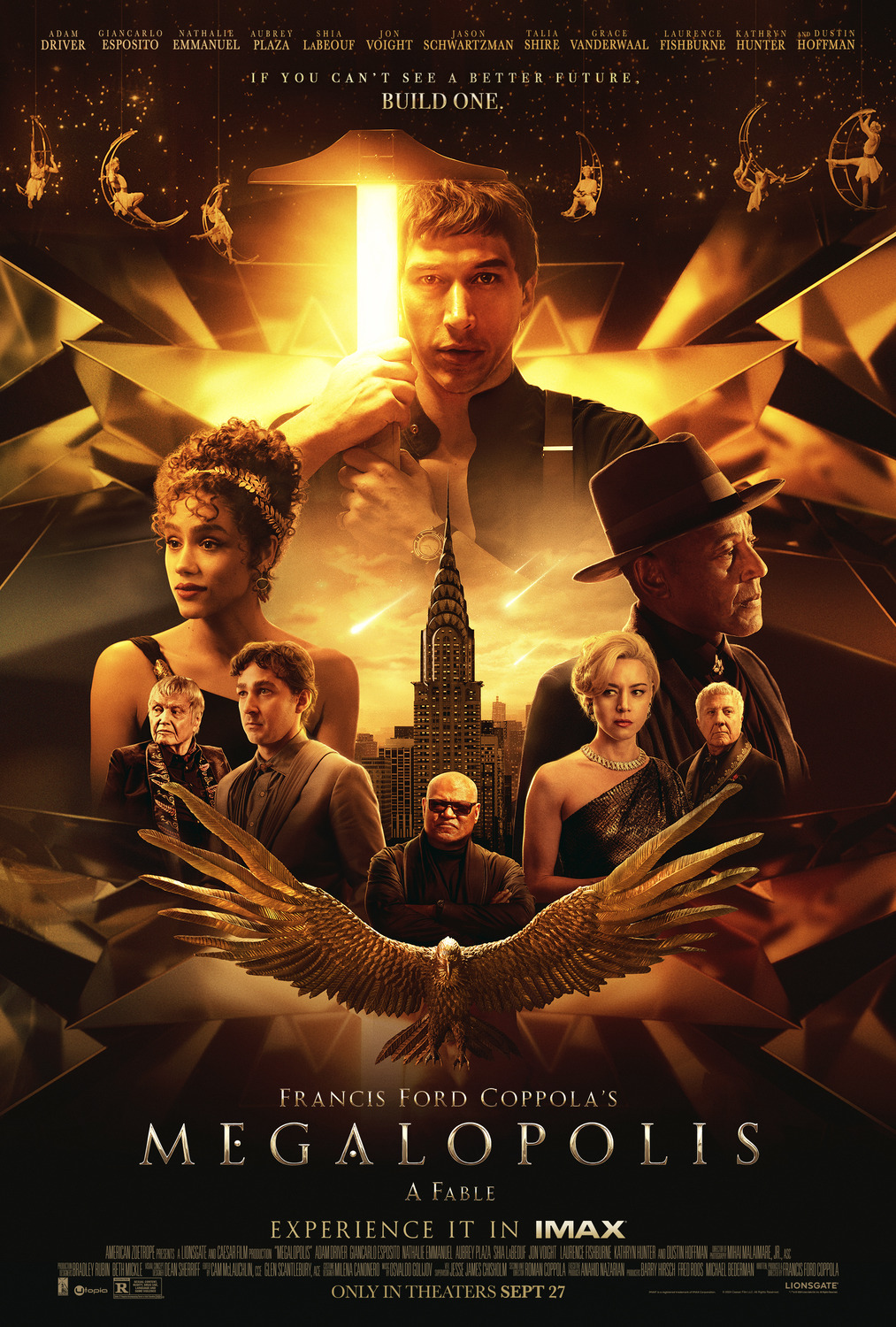
So, help me, I liked “Megalopolis.” Francis Ford Coppola’s passion project which has been decades in the making. It was finally unleashed unto the world at large, and the reviews have been incredibly polarizing as audiences were either enthralled or baffled by what they witnessed. it was pretty much considered a box office bomb in advance as studios had no idea of how to promote it, and it debuted with a terrible $4 million gross which looks horrid for a film with a $120 million budget. But while it has been met with the same critical and commercial derision as another Coppola film, “One From The Heart,” was greeted with back in 1982, it shows he has no fear or shame in taking grandiose risks with the material given to him.
Going into “Megalopolis,” I was determined to watch it with as open a mind as possible. Judging from the many Hollywood studios’ collective refusal to promote or market it, I assumed this would be a genre defying motion picture since no executive had a clear idea of how to sell it. I also did not go in expecting something along the lines of “The Godfather” or “Apocalypse Now.” Those classic films were their own things, and this one is quite another.
What I discovered was a cinematic mess, but it’s an enthralling mess with many ideas on its mind and beautiful visuals few other filmmakers could pull off. Seeing it with an audience, some of which did walk out on it, made it all the more entertaining as everyone really got into it, for better or worse. Like Richard Kelly’s “Southland Tales,” I really dug the heedless ambition Coppola brought to this long gestating project, but “Megalopolis” is a bit better as the story is a little more understandable and easier to get the gist of.
The film, which is described as a fable, is set in an alternate version of America where New York City has been rechristened as New Rome. Crime is terrible and poverty is rampant while the rich revel in their decadent desires. Then along comes Cesar Catalina (Adam Driver), a futuristic architect whose invention of the Megalon, a new bio-adaptive building material, offers a great change to the world. His plan is to use it to build a futuristic utopian city of his design. He also has the ability to stop time in its track, which gives no meaning to the term, “time stops for no one.”
But, as Nick Nolte once said at a press conference I attended, “there will always be change and there will always be resistance to change.” The resistance comes from corrupt New Rome Mayor Franklyn Cicero (Giancarlo Esposito) who prefers to keep the status quo the same as it ever was where the rich get richer, and the poor get poorer and like the average New York mayor, Cicero is constantly booed by the citizens he zealously yields power over. Even as the crowds jeer him, he still smiles that big smile of his which makes me wonder if he is ignorant, hopelessly naïve, or just a narcissist.
Now I am sure you guessed it already, but the Roman names are intentional as Coppola is comparing the fall of Rome to what America is going through, and he was influenced by the Catilinarian conspiracy when he wrote the screenplay. That conspiracy involved a coup back in 65 BC when Lucius Sergius Catilina attempted to overthrow the Roman consuls of Marcus Tullius Cicero and Gaius Antonius Hybrida, and forcibly assume control of the state. it is clear both Catalina and Cicero want a measure of power over the citizens of New Rome, and neither will let anything stand in their way in obtaining it.
Another character making a play for political power is Clodio Pulcher (Shia LaBeouf who is especially lively here), Catilina’s resentful cousin who looks to embarrass him in the most unforgettable ways possible. He looks to win the New Rome citizens over by starting a campaign which invites comparisons to the term “Make America Great Again.”
There is a lot more I can tell you about “Megalopolis’” story, but there is honestly enough for several movies here. As a result, watching it once is not nearly enough for me. There are a lot of plot threads which go in various directions, and while some may say this film does not have enough of a center, I think it does. Perhaps it will take some time to put all the pieces together when it comes to this passion project. Or, if Coppola lives long enough, we will get another cut of the film as he likes to fiddle around with his previous works.
Some have expressed fierce criticism over how the actors seem to be acting in different movies here as the performances range from natural to utterly theatrical. Indeed, there are a various number of acting styles clashing with one another here, but I was not really bothered by this. Considering how divided America has become in the past decade or so. We have citizens accepting one reality while others are accepting its polar opposite. As a result, the conflicting styles this motion picture has to offer us made a lot of sense to me.
Adam Driver makes Catilina into an especially compelling character like he always does, Jon Voight does some of his best work in a while as Catalina’s wealthy uncle, Crassus, who has more tricks up his sleeves than the actor would ever be quick to let on. Nathalie Emmanuel, who plays Julia Cicero, Catalina’s love interest and Cicero’s daughter, and does a great job of further emphasizing the intense conflict between the two men.
But if there is a most valuable player to be found in “Megalopolis.” It is Aubrey Plaza who portrays Wow Platinum, a television personality who goes from being Catalina’s mistress to Crassus’ lover and wife as she desires nothing more than money and power, and it becomes crystal clear what she will do to get them. Plaza is given free rein to chew the scenery every which way she likes. there is no forgetting her presence once you walk out of the theater as she revels in portraying such a despicable Lady Macbeth-like character.
What else can I say about “Megalopolis” that I haven’t already? Yes, it is a mess full of ideas which Coppola has spread all over the place, and there are flaws which are quite glaring. Still, it is an infinitely creative piece of work. The visual effects serve the material without overwhelming it, and there is an unforgettable beauty in the color scheme Coppola employs here.
I have no shame in giving “Megalopolis” a positive review. No, it is not Francis Ford Coppola’s masterpiece (for me, that would be “The Conversation”), but it was great fun seeing the famed filmmaker and winemaker swinging for the stars. He walks a tightrope throughout, taking risks and challenges along which most directors would never do today.
“Megalopolis” is very, very earnest in its designs as Coppola leaves us with a plea for peace and a world which everyone regardless of class and creed can fully benefit from. This may seem like a pipe dream considering how the world is currently tearing itself apart due to religious or ideological differences, but it is a memorable epitaph, should this film be his final work.
And at the very least, we will always have Adam Driver’s unforgettable delivery of “da club.”
* * * ½ out of * * * *

 The Ultimate Rabbit