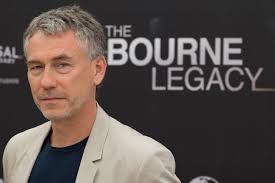
Tony Gilroy on ‘The Bourne Legacy’ and how it Differs from What Came Before
WRITER’S NOTE: As the opening paragraph indicates, this article was written over a decade ago.

Writer/Director Tony Gilroy and actor Jeremy Renner dropped by the AMC movie theater in Century City on July 9, 2012 to answer questions regarding their upcoming summer blockbuster, “The Bourne Legacy.” The emcee of this Q&A was Dan Gilroy, Tony’s brother, who also co-wrote the screenplay for it. The film itself was not shown that evening, and the audience had to settle for its latest trailer instead, but people were allowed to ask questions about how it will differ from the “Bourne” films which came before it.

This event was presented over the internet live as well as in front of a live audience, so questions came from all over the world as well as Century City. One question came from a guy named Jose on Facebook who asked how “The Bourne Legacy” will differentiate itself from the previous three films. To this, Tony said:

“If you’ve been a casual observer of the films before, it will have an extra bit of boost. If you’re a freak, if you’re a real fan, there’s a lot of stuff that’s in there that’s designed to pay back people who have really been paying attention.”

Catherine, who submitted her question through Twitter, asked, “what does Aaron Cross bring to the Bourne franchise that makes it different from the previous movies?” Tony’s response to this was very descriptive:

“What we’re saying in this film is that there were many programs. The Treadstone program, that Jason was a part of, was an early program that was shopped out to the CIA. The program that Jeremy is in is called Outcome. The Outcome agents are not designed as assassins; they are long lead isolated people who bury down into places. So, the skill set is slightly different, and there’s an adaptive quality, there’s a verbal quality, and there’s a curiosity that we really shine on for the Outcome agents that we meet. In ‘badassery,’ the physical aspects of a lot of this are very familiar; he is a cousin to Jason Bourne in that regard. But the job is different, the design is different, and the flaws are very different. The things that go wrong are very different.”

Dan himself said, as one of the writers of this screenplay, that he was especially interested in the conspiracy side, and he asked his brother Tony how it differs from the franchise:

“Well, this time we’re pulling back (the curtain). We’re saying that what you saw before was a small piece; you watched the other three films and thought that that was the entire universe. It turns out now when we pull back the curtain that there has been a mastermind behind the entire program and these other programs, and that’s Edward Norton. In a way he’s been sitting beside you in the theater for the last 12 years watching this all go on, wondering if it’s going to cause larger problems for him and getting irritated as (“The Bourne) Ultimatum” explodes.”

Many fans of the Jason Bourne movies have been arguing loudly about the series continuing on minus Matt Damon and Paul Greengrass, but Tony Gilroy has made it clear how he made “The Bourne Legacy” with them in mind. It sounds like he has put together an exciting movie which audiences will get a kick out of, and I for one cannot wait to see it.

Jeremy Renner on ‘The Bourne Legacy’ and Preparing a Character

WRITER’S NOTE: This article was written back in 2012.

Jeremy Renner appeared at the AMC Century City on July 9, 2012 along with writer/director Tony Gilroy to talk about “The Bourne Legacy.” In addition, Renner also took time to answer questions regarding how he went about preparing to play Aaron Cross, and of his preparation for roles in general. His answers showed him to be an actor always looking to challenge himself constantly and to not get trapped in a comfort zone.

Renner has long since made a name for himself with his performances in “The Hurt Locker,” “The Town,” “Mission: Impossible – Ghost Protocol” and “The Avengers.” One person asked him which movie has required him to do the most training, and he said it was definitely “The Bourne Legacy.” Renner said this was because it required from him “a level of authenticity” the other movies did not ask of him, and that he “had to work diligently to make the fights look like I could actually do them.”

Another person quoted Renner as once saying he “makes himself uncomfortable” when he can and asked him if that has made all the difference in his life. Renner replied it makes all the difference and said it is about constantly challenging himself:

“It’s about not being complacent and not fall into the trappings of repeated behaviors and getting comfortable. As I’ve gotten older, if there are things I knew I don’t like, I would still go try them again just to make sure that I don’t like them.”

Unlike his previous movies which had him acting in a supporting role, “The Bourne Legacy” marks Renner’s first starring role in a big budget Hollywood movie. He did, however, make it clear that his preparation for this movie was no different than any other he has appeared in, and that it remains the same on each role plays. He did say, however, that his workout regimen has changed a lot from “Mission: Impossible – Ghost Protocol” to “The Bourne Legacy:”

“For ‘Mission’ I was really out of shape. I mean, I stretched for twenty minutes and that was my workout. And now I stretch for an hour and a half, fight for two hours, workout for an hour and a half, and then stretch for another hour and then go to work.”

For Renner, saying yes to “The Bourne Legacy” was actually very easy as he felt all the elements were fantastic and that he could not say no to it even if part of him wanted to. And while he may have graduated from indie films to big budget action movies, his mindset has not changed in the slightest as he compared making this sequel to movies he has done beforehand:

“For a big movie, it felt very tiny in the sense of it was not just the stunts but also the intimacy of really quiet scenes I feel I’d rather be doing as an actor. So, for me it had the balance of both; it felt like a little independent movie and a massive action movie, so I got both feels all in one.”

In answering what it was like to play Aaron Cross and how he would turn off the character at the day’s end, Renner’s response did not have any Hollywood ego in it at all:

“Oh, come on man! It’s something that’s not that far away in that we’re talking about every physical role here. I have to stick to the truth on page one to page whatever and just stick to the truths within that. There’s no turning it on or turning it off; I’m not some freak actor that way. This is a character that’s closer to me than say Jeffrey Dahmer (whom the actor played in the 2002 movie “Dahmer”), so it’s not something I have to completely lose myself in. It’s just part of my job, and I can’t explain my job.”

From this evening, we can see that Jeremy Renner is a very respectful actor who takes his craft very seriously, and he revels in his unexpected success and working with actors like Rachel Weisz and Edward Norton whom he resented for stealing so many interesting movie roles from him in the past. We look forward to what Renner has to give us not just in “The Bourne Legacy,” but in so many other performances he has yet to deliver.

‘Dolores Claiborne’ – A Stephen King Horror Tale of the Real-Life Kind

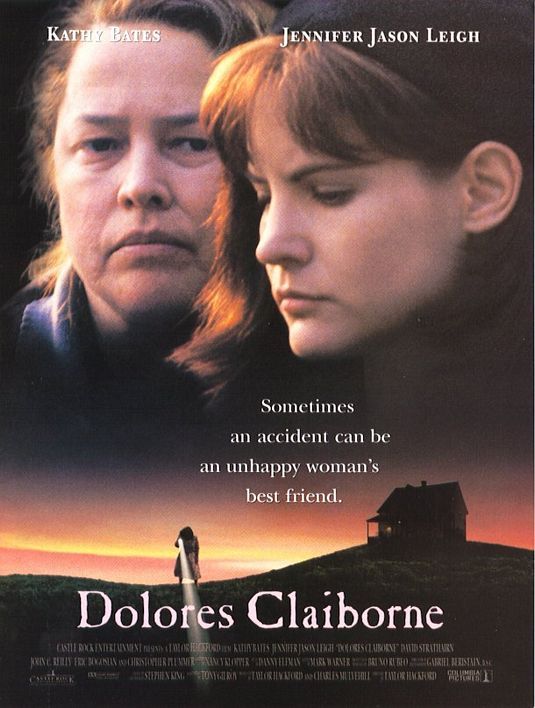
Dolores Claiborne” is, on the surface, not your typical Stephen King novel, and this is important to note before you begin watching this particular adaptation of his work. This cinematic treatment reunites him with the great Kathy Bates who won an Oscar for playing Annie Wilkes in “Misery,” but she’s not playing a deranged psycho this time around. Also, while much of King’s writings deal with terrifying supernatural powers and unspeakable terrors, the horror generated here comes from real life horrors no one should ever have to endure. In some ways, this makes it one of his more terrifying tales because it deals with the kind of horrible crimes we hope and pray never to experience first-hand. Having said this, it is clear how many of us can never be so lucky as to avoid the worst traumas humanity has to offer.

Bates plays the title character who, as “Dolores Claiborne” opens, is believed to have killed her rich employer Vera Donovan (Judy Parfitt). This crime immediately reminds the town of Little Tall Island in Maine when Dolores’ husband, Joe (David Strathairn), died twenty years ago under mysterious circumstances, and the general consensus was that Dolores killed him. Detective John Mackey (Christopher Plummer), who had pursued the case against her back then is determined to put her behind bars this time and for good. Into this mix comes Dolores’ daughter, Selena St. George (Jennifer Jason Leigh), a big-time reporter who arrives to defend her mother despite the two of them having been estranged for over a decade.

The novel “Dolores Claiborne” was essentially one long monologue as the story was written entirely from the title character’s point of view. This makes the work director Taylor Hackford and screenwriter Tony Gilroy have done here all the more impressive. They have taken Dolores’ unsettling story and have stretched it out into a character driven motion picture filled with various characters who have been fleshed out in unforgettably compelling ways. None of these characters, even that drunken lout of a husband and father, are one-dimensional or throwaway caricatures. Each one is complex, and they take unexpected directions which might seem jarring at first, but eventually make sense in the large scheme of things.

The plot shifts back and forth in time as we flashback to when Dolores lived with her drunk and abusive husband and of the vicious abuse she took from him in his endlessly drunken state. Director of photography Gabriel Beristain shoots this hideous past with such vivid colors to where he gives the scenes an innocent look which is soon contrasted with horrible violence. It almost acts as a façade for how the past was seen as if it were some sort of Norman Rockwell painting, the kind made to cover up the severe family dysfunction many would like to pretend does not exist.

For the record, King said he wrote the character of Dolores Claiborne with Kathy Bates in mind, and it is very hard to think of another actress who could have inhabited this role. Stripped of any false glamour, Bates takes her character from being a victim to one who understandably takes matters into her own hands. Her acting here is flawless and compelling, and we root for her even though her actions have devastating moral implications.

When you look at her overall body of work, this movie almost seems like a walk in the park for Leigh. She has gone to great physical and emotional lengths to portray a character throughout her long career, but here it looks like she is taking it easy. However, her character of Selena is no less challenging to portray than the others listed on her vast resume. Selena is not easily likable, but she has to be empathetic because the viewer slowly starts to see how her innocence was irrevocably and unforgivably destroyed. Leigh matches Bates’ performance scene for scene by showing how much Selena wants to forget the past, but she comes to see how her most repressed memories cannot stay below the surface forever.

Special attention also needs to be paid to Ellen Muth who portrays Selena as a little girl. This is not the kind of role parents want their children to portray to as it deals with abuse and molestation among other things, but Muth proves to be utterly convincing in making the young Selena deeply distraught and confused by actions no child should ever have to be put through.

There’s also a bevy of excellent performances from the rest of the cast as well. Christopher Plummer, who is never bad in anything, is memorable as the relentless Detective John Mackey. This could have been a throwaway role, but Plummer makes Mackey a complex character to where you question whether his determination is based more on personal revenge than justice. Judy Parfitt is unbearably domineering as Dolores’ wealthy employer, Vera Donovan, and their relationship runs much deeper than we see at first glance. And David Strathairn manages to flesh out his despicable character of Joe St. George to where he’s just slightly more than your average mean drunk.

Most of King’s novels deal with the horror of supernatural elements or ghosts and demons which haunt our nightmares. But “Dolores Claiborne,” much like “Stand by Me,” deals with the horrors of real life which we are never quick to confront unless we are put in a position where the awful truth can no longer be ignored. Perhaps the unsettling nature of this particular work by King is what kept many from checking out this motion picture when it arrived in movie theatres back in 1995, but those of us who were willing to dive into the dark side of things like myself did not deny ourselves a journey to the horrors this film has to offer. But now, 25 years later, this film fits in perfectly with a time which includes the Time’s Up movement as we are forced to realize we have thoughtlessly ignored the worst abuses made against other human beings for far too long. As a result, this particular King cinematic adaption plays even better than it did back when it was released.

* * * ½ out of * * * *

The Bourne Legacy

The Bourne Legacy poster

Some consider “The Bourne Legacy” to be a cinematic cheat, nothing more than a greedy attempt by Universal Pictures to continue a hugely successful franchise without its main stars (Matt Damon and director Paul Greengrass). Truth be told however, Universal has done a good job making it clear to audiences that this movie is not out to replace the character of Jason Bourne or have an actor other than Damon playing him. Even though it doesn’t break any new ground in the franchise and threatens to pale in comparison to the trilogy of films which preceded it, “The Bourne Legacy” proves to be an exciting action flick that finds its own rhythm and goes with it.

Describing this movie is a little complicated as it cannot easily be called a sequel or a prequel. This one is really more of a parallel story or a “parallel-quel” if you will. Like “Paranormal Activity 2,” it surrounds the events of the movie which came before it, “The Bourne Ultimatum.” With Jason Bourne systematically taking apart Operation Blackbriar, “Legacy” looks to pull back the curtain to reveal there were several other secret government programs which trained American soldiers to do their dirty work. The program focused on here is Operation Outcome which has employed Aaron Cross (Jeremy Renner), an agent who’s not suffering from amnesia but one who knows he is as easily expendable as Bourne.

In differentiating Aaron Cross as a character, Outcome agents are shown to be more like mice in a science lab as they are given certain kinds of medication which give them increased mental and physical abilities. There are no red or blue pills like in “The Matrix,” but instead green and blue ones which Aaron needs to function. If he misses a dose or doesn’t have access to a refill, he will go into serious withdrawal and could die. Anyone who has had experience with certain medications can certainly understand how bad the withdrawal part can get.

When the situation with Bourne gets as explosive as it did in the last film, retired Air Force Colonel Eric Byer (Edward Norton) is brought in to contain the situation and decides the Outcome agents need to be eliminated for the government’s own protection. So despite the agents’ allegiance to their countries, they are stabbed in the back and assassinated in the coldest way possible.

Aaron narrowly escapes an assassination attempt and ends up going on the run to escape detection and to find some more of those pills. This has him traversing through the Alaskan wilderness while being chased by wolves and going all the way to the Philippines. Joining him in his exploits is Marta Shearing (Rachel Weisz), one of the doctors who helped Aaron achieve such amazing abilities. The setup does have a ring familiarity about it as Marta, like Marie in “The Bourne Identity,” sees her life get turned upside down and is forced to go on the run with Cross. But whereas Marie was an individual who ended up in the wrong place at the wrong time, Marta does have a stronger purpose as Aaron needs her to stay alive.


I could spend a lot of time comparing “The Bourne Legacy” with the three previous films, but I would rather not. Those three movies set a new standard for action movies which is extremely hard to top, and that makes certain comparisons somewhat unfair. Greengrass at one time joked that doing another Jason Bourne movie might as well have him calling it “The Bourne Redundancy,” and that could have been the case here. Indeed, the setup is the same with two characters on the run from a government that has betrayed them, but Tony Gilroy does ground this story in a reality that wasn’t as present in the previous movies.

Gilroy has already made himself well known as one of the main architects of the Jason Bourne movies with his involvement in writing the screenplays for them, but his talents as a director were established before “The Bourne Legacy” with “Michael Clayton” which was one of 2007’s best movies. He does solid work in making this particular Bourne movie stand out from the others, and he doesn’t have the camera shaking all over the place.

Renner creates an intriguing enough character in Aaron Cross that makes us want to follow him some more in the future. Renner has long since acquitted himself as an actor in movies like “The Hurt Locker,” “The Town” and “Mission Impossible: Ghost Protocol,” and with “The Bourne Legacy” he gets a lead role in a motion picture worthy of his talents.

And while her character yells more than she should, Weisz is Renner’s equal in one scene to the next as she is thrown into a situation which changes her life permanently. Weisz is a powerful actress to say the least, and she keeps us hanging on during the movie’s more intense sequences.

Edward Norton creates a down to earth nemesis with his character of Eric Byer. While Norton is not always known as one of the easiest actors to deal work with, we know he will always give a multi-dimensional portrait of each character he plays. Eric is not a man driven to do evil, but one whose patriotism forces him to do extreme things in order to protect his country.

You also have to acknowledge actors like Oscar Isaac, Donna Murphy, Zeljko Ivanek and Stacy Keach who take their small roles and made them into compelling characters. Other actors who show to reprise their roles, however briefly are David Strathairn, Albert Finney, Scott Glenn, and Joan Allen who once again proves with a single line that Deputy Director Pamela Landy is not a person to be messed with.

I missed John Powell’s brilliant music from the past three movies, and the scoring duties this time are left to Gilroy’s frequent composer James Newton Howard. Powell created adrenaline pumping music for the previous three movies that fused orchestral and electronic elements together to thrilling effect. Having said that, Howard is an excellent composer in his own right, and he does give the movie the kinetic score it deserves.

With “The Bourne Legacy,” Tony Gilroy gives us a new chapter in this franchise which in some ways is more realistic than the ones which came before. This may take fans for a bit of a loop depending on what they expect, but it still manages to deliver the goods all the same. Still, it would have been nice for Aaron Cross to have his own theme song instead of Jason Bourne’s (“Extreme Ways” by Moby). How about “Renegade” by Styx? That would work.

* * * out of * * * *

Copyright Ben Kenber 2012.