‘The Departed’ Movie and 4K Review

The following review was written by Ultimate Rabbit correspondent, Tony Farinella.

When it comes to filmmaking, Martin Scorsese is not known for his brevity.  His films are lengthy and complex. However, because there are so many moving parts that are interesting and layered, it rarely feels like a slog to sit through them.  He also makes sure to assemble an all-star cast of some of the best actors in Hollywood so, as an audience, we are glued to the screen with each and every performance. It’s so hard to pick a favorite Scorsese film, as he’s trying to achieve something different and unique with each one.  From an entertainment standpoint, however, I think “The Departed” might be the most thrilling movie he’s ever made.  It was also the film which earned him his first and only Best Director and Best Picture Academy Award.

“The Departed” is initially set in 1980’s Boston and introduces us to a series of seedy and underhanded characters.  The local Mob boss is named Frank Costello, played by Jack Nicholson. He befriends a young Colin Sullivan and buys him groceries, as he knows he comes from a struggling family.  Fast forward to present day in the film, and Colin (Matt Damon) is now working on the inside for the Massachusetts State Police in their Special Investigation Unit.  Frank is still the leader of the Mob, but he has even more power because he knows Colin will keep him in the loop when the police get too close to him.

Billy Costigan (Leonardo DiCaprio), a police academy recruit, is brought in to meet Captain Queenan and Sergeant Dignam, played respectively by Martin Sheen and Mark Wahlberg. Considering Billy’s family has a criminal record a mile along, they think he’s the perfect mole to go undercover and bring Frank down once and for all. In order for Billy to gain the trust of Frank, he needs to serve some time in prison and also commit some crimes with the help of his cousin, so his cover isn’t blown.  However, Billy is starting to feel as though he’s living a double life and his mental health is suffering.  This is when he meets Madolyn (Vera Farmiga), a police psychiatrist who is also currently dating Colin Sullivan.  Needless to say, this is a messy and tricky situation for all parties involved.

The beauty of “The Departed” is that it keeps you guessing all the way until the finale. There are a lot of different characters and pieces of the puzzle here, but the film never feels overplotted or too complicated.  It’s very engaging, well-paced and highly entertaining.  As an audience member, it takes you on quite a ride from start-to-finish. Scorsese also takes his time in developing his characters, and he trusts his actors to put their own personal touches on their performances.  There are so many standout performances here to choose from, but Nicholson and DiCaprio in particular are remarkable.  Nicholson brings an unhinged charisma to his role as the mob boss while DiCaprio is tortured and powerful in his performance.  As the old adage goes, “Do Your Job.” Everyone in this film knows how to do their job, and Scorsese gives them the platform to do their jobs to the best of their abilities.

The screenplay, which was written by William Monahan, is also able to keep the audience engaged and thrilled without ever feeling too gimmicky or implausible.  These are well-written characters that are looking to stay alive and pull the wool over the eyes of those looking to bring them down.  They have to stay one step ahead of the audience and also one step ahead of the characters in the film.  “The Departed” is also a remake of the Hong Kong Film, “Infernal Affairs,” which I own as part of the Criterion Collection. I have yet to see that one, but I definitely need to check it out after having seen “The Departed” numerous times.

All in all, “The Departed” shows Scorsese at his best in a world he has inhibited many times in the past.  This time, though, he has new players to work with.  Of course, we are familiar with the Martin Scorsese/Robert De Niro films of the past such as “Casino” and “Goodfellas,” but it’s great to see him working with Nicholson for the first and only time along with Damon, Mark Wahlberg, and Alec Baldwin. Of course, his collaborations with DiCaprio have become legendary, but this was in the early stages of their working relationship, and you can see why they work so well together.

Screenshot

Hollywood has always had a fascination with crime movies and the characters who inhabit that world. Scorsese knows this world very well and how to make it accessible and fun for mainstream audiences. If I had to choose, my favorite Scorsese movies are “Raging Bull,” “The King of Comedy,” and “Taxi Driver.”  However, as stated earlier, if you are talking about pure entertainment value and pure fun, it’s hard to deny the power of “The Departed.” Even eighteen years later, this film still captivates and engages with its words, its story, and its players.   It only gets better and better with age. If you are seeing it for the first-time, you are in for a real treat.

* * * * out of * * * *

4K Info: “The Departed” is being released on a single disc 4K from Warner Brothers Home Entertainment.  There is also a steelbook version of the film as well.  Whether you pick up the steelbook or the 4K slipcover, you can’t go wrong with either copy of “The Departed.”  It also comes with a digital copy of the film. It has a running time of 151 minutes and is rated R for strong brutal violence, pervasive language, some strong sexual content and drug material.

Video Info: This is a gritty looking 4K that is able to keep the dark and moody look of Boston and its seedy characters alive while also cleaning up the dirt and artifacts to make it look sharp and vivid.  This is a solid 4K transfer. The HDR is a big improvement from the Blu-ray.

Audio Info:  I would have liked a Dolby Atmos soundtrack on this 4K release, but as it stands, this is still a powerful audio transfer. At times, the music and the action scenes can be a little too loud as the dialogue is more leveled, but that’s a minor issue.

Special Features:

Guilt and Betrayal: Looking into The Departed (new)

Stranger than Fiction: The True Story of Whitey Bulger, Southie, and The Departed

Crossing Criminal Cultures

9 Deleted Scenes with introductions by Martin Scorsese

Should You Buy It?

When great films, Academy Award winning films at that, are available on 4K, you have to buy and add them to your collection, if you are a film collector.  It is the only way studios are going to keep releasing these films on physical media. Now, more than ever, with more and more brick-and-mortar stores getting rid of physical media altogether, we have to purchase these films and add them to our collection.  “The Departed” looks really, really sharp on 4K.  There are the previously released special features from the Blu-ray along with a new special feature as well. This is a great film from the legendary Martin Scorsese being released in the best format possible to watch movies.  This is a no-brainer in my book.  You can’t go wrong with either the steelbook or the slipcover version of this film on 4K. This 4K of “The Departed” comes highly recommended!

**Disclaimer** I received a copy of this film from Warner Brothers to review for free.  The opinions and statements in the review are mine and mine alone.
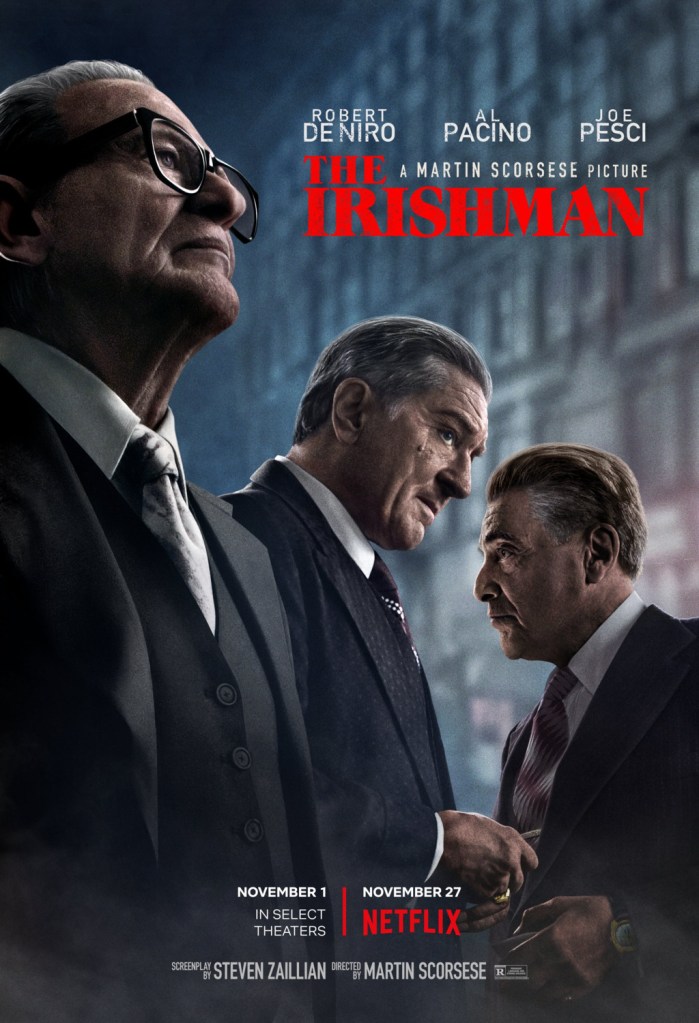
The Irishman – A True Martin Scorsese Masterpiece

I cannot believe it took me so long to watch Martin Scorsese’s “The Irishman.” Then again, when a movie is three and a half hours long, it feels like you have to set aside a whole day in order to watch it. Like many, I am working from paycheck to paycheck, so taking time off from work is tricky to say the least. But hey, this is Scorsese and, as I write this, we are still in a pandemic quarantine because of Coronavirus (COVD-19). With this in mind, there is no better time to watch a movie which is almost four hours long. Besides, it’s not like we can go anywhere.

Well, to be honest, at 209 minutes there is not a single wasted shot to be found in “The Irishman.” Like Scorsese’s best films, it takes you back to a place and time so vividly to where you feel like you are there. It also features a main character who gets sucked deep into the criminal underworld where one’s morality takes a backseat, and we come to see the high price many pay for living such a life. But with this film, Scorsese takes things a bit further as we see this main character whittling away his last days in a nursing home, and we are made to wonder if one person who has killed so many can ever find redemption.

We are introduced to Frank Sheeran (Robert De Niro), a World War II veteran who is working as a delivery truck driver in 1950’s Philadelphia. On one of his routes, he runs into Russell Bufalino (Joe Pesci), head of the Northeastern Pennsylvania crime family, and eventually comes to do jobs for him as well as for members of the South Philadelphia underworld. Many of these jobs have him, as he puts it, “painting houses.”

Now while this film is called “The Irishman,” but you do not see this title at the beginning. Instead, we are the following: “I Heard You Paint Houses.” This is the name of the nonfiction book by Charles Brandt upon which “The Irishman” is based, but this title is not meant to be taken literally as it proves to be a euphemism for murder or contract killing. When Frank paints houses, he is essentially painting the walls with the blood of his targets. Later on, Frank also says he does his own carpentry work, meaning he cleans up after himself as well.

Just as in “Goodfellas” and “Casino,” the violence comes fast and bloody, and no one knows they are about to get hit. But unlike those films, Scorsese largely portrays the violence in “The Irishman” as largely banal or being just an average day at work. There was one sequence where we see Frank dumping a variety of firearms into the river, and this leads to a scene I have been waiting to see in a film for ages; We see a gun, after it has been dropped, sinking into the water and landing at the bottom where dozens of other firearms have been dumped as well. Considering the endless number of TV shows and movies which have shown characters doing this, this scene had to happen eventually.

Working with longtime editor Thelma Schoonmaker, Scorsese takes a non-linear approach with “The Irishman,” and it proves to be a brilliant study in film editing. Just as Ethan Hawke did with “Blaze,” Scorsese and Schoonmaker takes us from one period of time in Frank’s life to the next with what seems like relative ease. No sudden change in the storyline ever seems jarring or misplaced, and it made this great film even more compelling than it already is.

As Frank continues to keep painting houses, Russell eventually comes to introduce him to the head of the International Brotherhood of Teamsters, Jimmy Hoffa (Al Pacino). As pro-union as Hoffa appears to be, he still has one foot in the criminal underwood which has provided him with much funding. He struggles to balance out his duties with the teamsters and with members of the federal government, several of which look to take him down and send him to prison. During this era, Frank and Jimmy become great friends to where Jimmy hires him as his personal bodyguard. However, knowing what eventually happened to Hoffa, we know this story will not have a happy ending.

Seriously, how great is it to see all these actors working with Scorsese again? This is De Niro’s first film with him since 1995’s “Casino,” and I wondered if Scorsese could ever pull himself away from Leonardo DiCaprio long enough to do one more project with the “Raging Bull” actor. As Frank Sheeran, De Niro gives us one of his more subtle performances in recent years as he presents this character as someone who could easily disappear into the shadows. Had he never run into Russell Bufalino, Frank would have been another guy just doing a day job and supporting his wife and kids as best he can. De Niro makes us see this clearly as Frank does what he can to protect his family even as he delves deeper and deeper into a sinful life.

I am glad to see Pesci come out of retirement to appear here as he makes Russell into a study in quiet power. Russell never has to speak up too loudly to let you know who makes the rules in the mob, and Pesci almost succeeds in making Russell into the nicest character he has ever played in a Scorsese film. This is especially the case when you compare him to the characters he portrayed in “Goodfellas” and “Casino.”

There are some other performances I want to single out here as well. Harvey Keitel, working with Scorsese for the first time since “The Last Temptation of Christ,” is a very welcome presence here as mob boss Angelo Bruno. I also got a real kick out of Ray Romano who plays IBT attorney, Bill Bufalino, and he continues to prove to the world he is a better actor than we typically give him credit for.

And then there’s Al Pacino who, to everyone’s utter astonishment, is making his first ever appearance in a Scorsese film. Looking at their careers, you figured these two were made for each other, but it took the role of Jimmy Hoffa for these two to finally collaborate. While he does have some of those “whoo-ah” moments which have infected his acting ever since “Scent of a Woman,” Pacino ends up giving one of his very best performances in quite some time here. As Hoffa, he makes the long-lost teamster boss a study in pride as it comes to be one of his biggest sins. Even when the cards are stacked against him, Hoffa believes he is untouchable, and Pacino makes his boundless pride all the more reckless and palpable.

Now there has been some controversy regarding Anna Paquin who plays Frank’s daughter, Peggy Sheeran. Many have said she does not have enough dialogue, and this is especially pertinent as “The Irishman” relegates the majority of its female characters to the back burner. However, I think people miss the point. After Frank beats up a storekeeper for berating Peggy, we see her living in constant fear of her father to where she is terrified to speak up. When Peggy does, Paquin turns it into a truly a shattering moment as any trust between Peggy and Frank is forever shattered to where no one needs to spell out why. Seriously, the look on Paquin’s face speaks volumes, and she needs no extra dialogue to tell us what we need to know.

As we watch Frank recede in his golden years, we see him desperately trying to reconnect with his family his efforts are rebuffed constantly as they see right through him. Peggy, in particular, shuts him down at every opportunity even as he begs for her to listen to him. When I think of the relationship between Frank and Peggy, I am reminded of a scene between Michael and Kay in “The Godfather Part III:”

“I did what I could, Kay, to protect all of you from the horrors of this world.”

“But you became my horror.”

When we reach “The Irishman’s” last act, Frank is a shell of his former self as he wastes away in a wheelchair and reflects on a past which everyone has forgotten or never bothered to learn about. This proved to be one of the most interesting aspects of this film to me. When “Goodfellas” and “Casino” reached their conclusions, their main characters barely managed to escape certain death, and the stories stopped there. But here, we see what happens to Frank long after he has left his criminal life behind, and there isn’t much left for him except to pray for some form of redemption. Looking at Frank’s life, it is tempting to think he is hardly worthy of any kind of redemption. But then again, who are we to deny anyone in their attempts to make peace with their sins?

When it comes to “The Irishman,” I have to say thank god for Netflix as this film would not exist otherwise. Granted, the short span of time between it shown in theaters and then being available for streaming is unfortunate as this film, like many of Scorsese’s works, deserves to be seen on the silver screen. But considering the state of entertainment today which values franchises and superhero movies above thoughtful character studies, it is sadly easy to see why no Hollywood studio would touch it. It’s a real shame as it is films like these which demonstrate the wonderful and amazing power cinema can have over us.

In many ways, this is the perfect career capper for Scorsese. While he is revisiting many themes such as organized crime, greed, destruction and redemption, he is also seeing it in a different perspective. “The Irishman” belongs on the same shelf alongside his best works, and it is one worth revisiting over and over again. I just hope the next time I see it will be in a movie theater.

* * * * out * * * *

Martin Scorsese’s ‘Hugo’ is a Splendid Love Letter to the Power of Movies

Hugo movie poster

Maybe it was Martin Scorsese’s desire to utilize the 3D format which kept me from seeing “Hugo” on the first day of its release. 2011 saw 3D movies get a serious public beating as audiences became convinced it existed solely for Hollywood studios to jack up ticket prices. But to watch “Hugo” is to be reminded of how amazing 3D can be when using the right tools and not just throwing cheap gimmicks at the audience. But moreover, it is backed up by a great story and remarkable performances as Scorsese shares with us his love of all things cinema.

Seriously, the first five minutes of “Hugo” will blow you away as you will feel like you are traveling over the Paris of the 1930’s. It truly looks as though the snow it is literally blowing in your eyes, and it reminded me of when kids were grasping at the snowflakes coming off of the silver screen during “The Polar Express.” Scorsese was lucky enough to use the same Fusion Camera System which James Cameron used to superb effect in “Avatar.” The images stretch out from the screen, and the extra dimension gives these visuals a depth which at times feels remarkably real.

Based on the novel “The Invention of Hugo Cabret” by Brian Selznick, Asa Butterfield stars as Hugo, a young boy living alone in a Paris railway station while maintaining the clocks and stealing whatever supplies he needs in order to survive. One major obstacle he has to deal with is Inspector Gustav (Sacha Baron Cohen) who patrols the station with his vicious looking dog. Gustav shows no hesitation in picking up orphans and sending them straight to the orphanage which, in the kids’ eyes, seems like an unforgiving house of horrors.

Two people come to play an important role in Hugo’s life: the toy shop owner Georges Méliès (Ben Kingsley) and his spirited goddaughter Isabelle (Chloë Grace Moretz). They enter Hugo’s life as he continues to work on fixing an automaton he and his father, Mr. Cabret (Jude Law), were putting it back together in working order when Mr. Cabret was tragically killed in a museum fire. It is this same automaton which will draw these three together in ways none of them could ever have imagined.

By taking us back to a time when motion pictures were in their infancy, effects we now see as cheesy and simple to create come to feel as magical as they once did. Scorsese is brilliant in putting us into these characters’ shoes as we watch audiences react strongly to a film with a train which looks like it is coming straight at them, or at Buster Keaton hanging on for dear life from a clock outside a tall building. Looking at the awe which is so vivid in the faces of these children reminds us of how movies can magically draw us into another world, and this is a feeling many movies do not give us these days. In this day and age, we take the power of motion pictures for granted.

Butterfield’s performance is remarkable. Showing the pain and resourcefulness of a young boy who has lost his parents and is forced to fend for himself is no easy task, and he ended up giving one of 2011’s most underrated performances. Butterfield inhabits the character of Hugo so deeply to where, after a while, it does not feel like we are watching a performance at all.

Kudos also goes to Moretz, the star of “Kick Ass” and “Let Me In,” for adding yet another superb role to her already splendid resume. As the adventurous Isabelle, she pulls off a flawless English accent which is worth noting as we have gotten so used to actors screwing them up. The warmth of her smile onscreen is utterly genuine, and she lights up “Hugo” whenever it feels like it is getting a bit too dark.

There are other great performances to be found in “Hugo” as well. Ben Kingsley is fantastic as usual as Georges Méliès, and the late Christopher Lee has some wonderful moments as bookshop owner Monsieur Labisse. One of the big standouts in the supporting cast though is Sacha Baron Cohen who takes a break here from his “Borat” and “Bruno” mockumentaries as Inspector Gustav. He’s a hoot throughout, and his interactions with the infinitely lovely Emily Mortimer (“Lars and the Real Girl”) who plays Lisette are hilariously sweet.

Scorsese has put together a truly beautiful motion picture which deserves a bigger audience than it received while it was in theaters. The fact that more people went to see “Alvin and the Chipmunks: Chipwrecked” than this is deeply depressing. A lot of moviegoers really hated 3D movies back in 2011, so this did not do “Hugo” any favors. But after watching it, you will find yourself believing this extra dimension is worth your money when it is put together by the best masters of filmmaking.

* * * * out of * * * *