‘The Muppets’ – Jason Segel and Company Get Jim Henson’s Creations Just Right
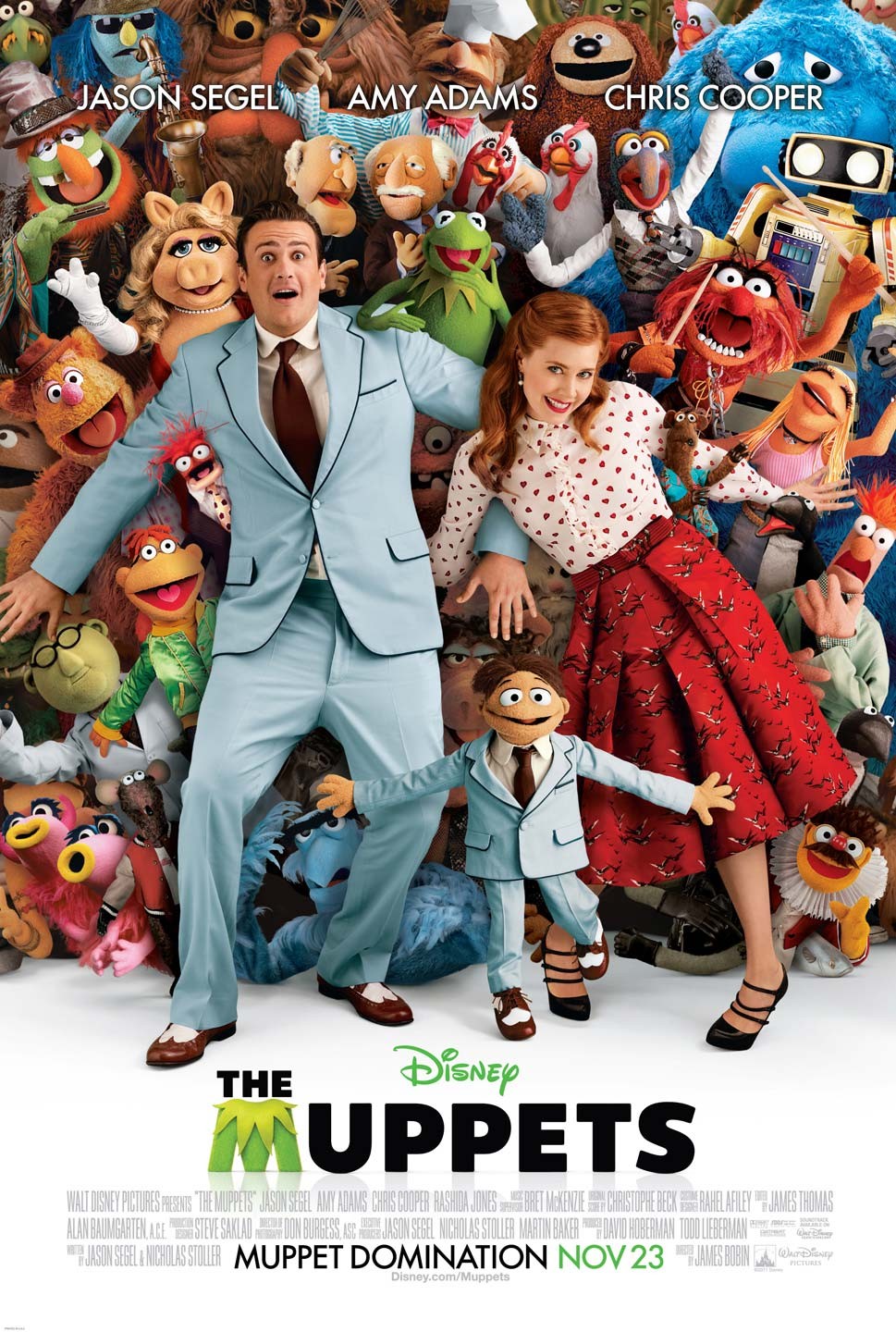
Watching Kermit the Frog sing “Rainbow Connection” in “The Muppets” brought back one of my most cherished memories. “The Muppet Movie” was the first film I ever saw on the silver screen, and I consider myself fortunate that this was the case. I even brought along my own Kermit hand puppet with me, and I had him singing “Rainbow Connection” along with the real Kermit, and this was long before such actions might have been annoying to other audience members like when anyone takes out their cellphone during the latest cinematic spectacle which the MCU has to offer. These characters were a large part of my childhood, and I still find them endlessly entertaining all these years later.

“The Muppets” represents the kind of Muppet movie I have been yearning to see for years; one which appeals to the whole family and does not condescend to kids in the slightest. Ever since Jim Henson passed away in 1990, everything Muppet has been geared towards children without much thought to adults. The ironical humor we knew these felt characters for vanished without a trace, and Disney took over the franchise without really knowing how to sell them to either new or old generations. This became abundantly clear when “Muppets from Space” collapsed both critically and commercially back in 1999, and perhaps this was because they were not partying like it was 1999.

But with “Forgetting Sarah Marshall’s” Jason Segel and “Flight of the Conchords'” co-creator James Bobin directing and Bret McKenzie supervising the music, “The Muppets” is a movie the whole family can enjoy together, and it will put a smile on even the most jaded fan’s face. Granted, a number of puppeteers from this infamous franchise (namely Frank Oz) refused to participate because they felt the script did not respect the characters. I beg to differ on that.

Segel stars as Gary whose brother Walter is a Muppet himself, and both are die-hard fans of “The Muppet Show” in childhood. Their love for the Muppets stays strong even through puberty, and they finally get their chance to visit Muppet Studios when Gary invites Walter to come along with him and his girlfriend Mary (Amy Adams) on a vacation to Los Angeles. But when they get there, they find the Muppet theatre it is now in a dilapidated state as Kermit and company have not performed together or seen each other in years.

Even worse, Walter overhears the evil oil magnate Tex Richman (Chris Cooper) planning to buy the Muppet theatre not to preserve it as a historic landmark, but to instead drill for oil underneath it. As a result, Walter, Gary and Mary join forces to reunite the Muppets in order to put on a telethon which will raise the money needed to save not just the Muppets, but the theatre where all the magic started.

My guess is Oz and the other puppeteers never saw the Muppets splitting up and going their separate ways, but having re-watched a lot of “Muppet Show” episodes recently, they did not always have the best time working together. Besides, they did split up, if only temporarily, in “The Muppets Take Manhattan” when Kermit got all pissed off about the gang constantly leaning on him to figure out what to do next. Heck, that Kermit didn’t ditch Miss Piggy sooner is amazing in retrospect.

Starting off with the Muppets having gone their separate ways years ago gives “The Muppets” an interesting jumping off point. Like many, these characters wonder if they are still relevant in today’s popular culture. While they are a big favorite of my generation, whether they can translate to another is still feels uncertain.

Even though the voices of the original Muppet performers are not present, the characters have not changed nor have they gotten cynical (unlike Statler and Waldorf). Steve Whitmire performs Kermit the Frog and does great work in capturing his unforgettable mannerisms without ever simply going through the motions. The same goes with the rest of the puppeteers here as they make each character from Miss Piggy to Animal all their own.

It ia also interesting to see where all these Muppets are at today. Kermit is living in a mansion which is not in the best condition, Miss Piggy is the editor in chief of Vogue Paris, Scooter works at Google, and Sam the Eagle is a Fox News-like personality which seems to be the perfect venue for his endless pomposity. But the one Muppet who practically steals this movie is Animal who we meet up with again at an anger management clinic where Jack Black is his sponsor.

As for the human actors, Segel is a hoot as Gary, and his love for the Muppets shines through every contribution he has in this film. Amy Adams remains infinitely adorable as her sweetness is no act, and she scores a huge musical highlight with the song “Party of One.” We even get to see Chris Cooper do a rap song, and it is not as terrifying as it sounds. As for Jack Black, he becomes the most unwilling guest star “The Muppet Show” has ever had.

The music is really good as well, and it never becomes cringe-inducing thank goodness. “Life’s a Happy Song” starts off the proceedings with a happiness which feels genuine, and you can tell Segel is having the time of his life while singing it. The one song though which truly deserved a Best Original Song nomination is “Man or Muppet” where both Segel and Walter bring down the house in deciding who they really are, as if the answer was not the least bit obvious. And yes, it did win the Oscar in that category, but this should not have surprised anyone as this song did not have much in the way of competition.

It is also great to see that ironic humor the Muppets were famous for back on display here. They push the bounds of the PG rating to where if the kids do not get what is being said, it is probably just as well. I loved how they got away with the Muppet chickens singing Cee-Lo Green’s “Fuck You” without its explicit lyrics. Oh, I’m sorry, I mean Cee-Lo Green’s “Forget You” (right, whatever).

But what makes “The Muppets” so good is that everyone, be it the Muppets, the human actors or those making cameos, comes into this project without any cynicism. Making a movie with the best of intentions or one with a happy ending is greeted with our eyes rolling in the back of our heads as we come out feeling utterly and shamelessly manipulated. The filmmakers even bring back “The Muppet Show’s” opening theme song as it was performed in season three, and it looks almost exactly like it did all those years ago. Even “Mahna Mahna” is brought back, and being it was the very first sketch on “The Muppet Show,” that should show you how much these filmmakers value their childhood entertainment.

Kermit, Fozzie, and Miss Piggy will never feel or sound exactly as they did from years ago, but “The Muppets” proves they still have their charms and humor long after their glory days. It is a film made with a lot of love for the imagination Jim Henson gave us, and deep down we all would hate to see his wondrous imagination die away without a trace.

* * * ½ out of * * * *

Underseen Movie: ‘Paul Williams Still Alive’

Going into this documentary, I thought it would be one of those great comeback stories of a fallen celebrity who gets their dormant career resurrected through the help of one die-hard fan. But while filmmaker Stephen Kessler seems intent on reminding the world of what this gifted songwriter has given us, “Paul Williams Still Alive” is not that kind of documentary. Instead, it’s a story of a man whose life was run into the ground by a strong addiction to fame and drugs, and of his journey back to a place of happiness and fulfillment he is ever so thankful for today. This is not an artist looking to make a comeback, but of one who appreciates what they have to where not much more is needed than that. As a result, this makes “Paul Williams Still Alive” one of the sweetest and most life affirming documentaries I have seen in some time.

Kessler is best known for having directed many popular television commercials and “Vegas Vacation,” a sequel which rated high in test screenings, but still turned out to be a dud. Kessler starts off this documentary recounting how he grew up being such a big fan of Williams and of how the songwriter seemed to be everywhere in the 1970s. Williams appeared on “The Muppet Show,” made numerous appearances on television shows such as “Beretta,” and he became an incredibly popular guest on “The Tonight Show” with Johnny Carson. On top of that, he composed the music for “The Muppet Movie,” the cult classic “Phantom of The Paradise,” and eventually won an Oscar along with Barbara Streisand for the song “Evergreen.”

Somewhere along the line, Kessler assumed Williams had passed away at far too young an age. But while ordering one of Williams’ albums on the internet one night, he discovers to his surprise that the singer and songwriter is still very much alive and continues to create and perform music throughout the world. From there, Kessler makes it his mission to make a movie about Williams in an effort to let the world today know how much of an impact his music has had on all of us and still does to this day. Remember, he was a featured artist on Daft Punk’s “Random Access Memories.”

Kessler started filming Williams when the songwriter visited Winnipeg, Canada where a fan convention for “Phantom of The Paradise” was taking place. This collaboration gets off to a rocky start as Williams shows a sharp reluctance to being filmed. There’s even a moment where he is singing in a San Francisco nightclub and gets the house manager to dim the lights so Kessler can’t get a good view of him onstage. As for Kessler, his solution to this problem provides this documentary with one of its funniest moments.

In some ways William’s reluctance is refreshing because, in a time where we are constantly flooded with reality shows with people becoming famous just for the sake of being famous, he is not keen about being part of this. In fact, it doesn’t take long to see he is not the least bit interested in becoming famous again like he once was as he has described the pursuit of fame as being in his own words, “pathetic.” As this documentary goes on, the narrative focuses much more on the person he is today, a much healthier human being who is humble and thankful for what he has.

“Paul Williams Still Alive” does give us a brief biography of the songwriter and of how he grew up with an alcoholic father who made him sing “Danny Boy,” and that his being so short ended up ostracizing him from his classmates at school. He comes to blame his lack of height on hormones being injected into him early in life. This was done to make him taller, but it ended up having the exact opposite effect. After moving out to Los Angeles to become a film actor, he ended up finding success as a songwriter which eventually turned him into a huge celebrity. The attention it gave him was something he came to live for, and it would eventually become an even bigger addiction for him than drugs.

As time goes on, Williams eventually warms up to Kessler, and this becomes clear during a trip to the Philippines. Williams even encourages Kessler to join him in front of the camera instead of just staying behind it, and that is saying a lot. Now this might have proven disastrous as “Paul Williams Still Alive” could have ended up becoming more about the filmmaker than his subject, but Kessler’s increased involvement proves to be a major plus. The relationship between these two men helps to define Williams as he is today.

While Kessler constantly looks to the past, Williams only wants to look forward. The one scene which makes this clear is when Williams watches himself guest hosting Merv Griffin’s talk show. Clearly high on drugs and making an absolute fool of himself, the realization of what he was doing back then forces him to stop watching the rest of the footage. The person Williams was back then is so different from who he is today, and the pain which crosses his face over his embarrassing past deeds is impossible to hide.

Near the end, Williams gives Kessler a whole bunch of videotapes he has in storage, having no idea of what’s on them. One particularly disturbing video has Williams celebrating Christmas with his family, and then later going upstairs to film himself getting high. Watching this illustrates just how far down the songwriter’s drug addiction took him and, looking at him today, it’s almost like we’re looking at a completely different person.

It should be clear by now that Kessler is not out to embarrass Williams in the slightest. Instead, his intention is to bring the songwriter back to the world’s attention, and this is a noble intention indeed. Williams is the same man who wrote the song “Rainbow Connection” for Kermit the Frog, “We’ve Only Just Begun” for the Carpenters, and “An Old-Fashioned Song” and “Rainy Days and Mondays” for himself. Heck, he even did the music for “Emmett Otter’s Jug Band Christmas,” one of my favorite holiday specials ever.

Today, Williams continues to make beautiful music which deals with themes like love, loneliness and alienation, and he definitely deserves to be recognized for the countless music contributions he has given us. Maybe not everyone has forgotten who he is, but we do need to be reminded of what he has created.

Now some have accused “Paul Williams Still Alive” of not including more of his music, but this documentary is not intended to be a career retrospective. In actuality, it becomes more about how Williams is a better, not to mention a far more interesting, human being today compared to when he was an overindulgent celebrity. He has been clean and sober for over 20 years, and he is even a certified drug and alcohol counselor. Looking back, it seems as though he lives to be a counselor more than he wants to create new music, and that is saying a lot.

With “Paul Williams Still Alive,” Kessler has given us far more than the average showbiz documentary. He has given us an individual worth appreciating who, while having made some serious mistakes in life, has come out of it on the other side a proud and happy person. All of this is all accomplished without Kessler ever trying to be manipulative or play at our heartstrings unnecessarily. This is a warts-and-all documentary which doesn’t hide anything, and I came out of it with not just a deep respect for Williams, but also for his healthy perspective on life.

During a time which sees certain celebrities desperately grasping for whatever fame is available to them, here is one who has found the happiness we all mistakenly thought we would get when we became a super star in everyone’s eyes. In the end, “Paul Williams Still Alive” is more about what it means to be happy, and Williams has more than earned the happiness he has today. Like he says, he does not need “another cup of fame” to make him a satisfied man.

* * * * out of * * * *