Underseen Movie: ‘The Congress’ in which Robin Wright Plays Herself
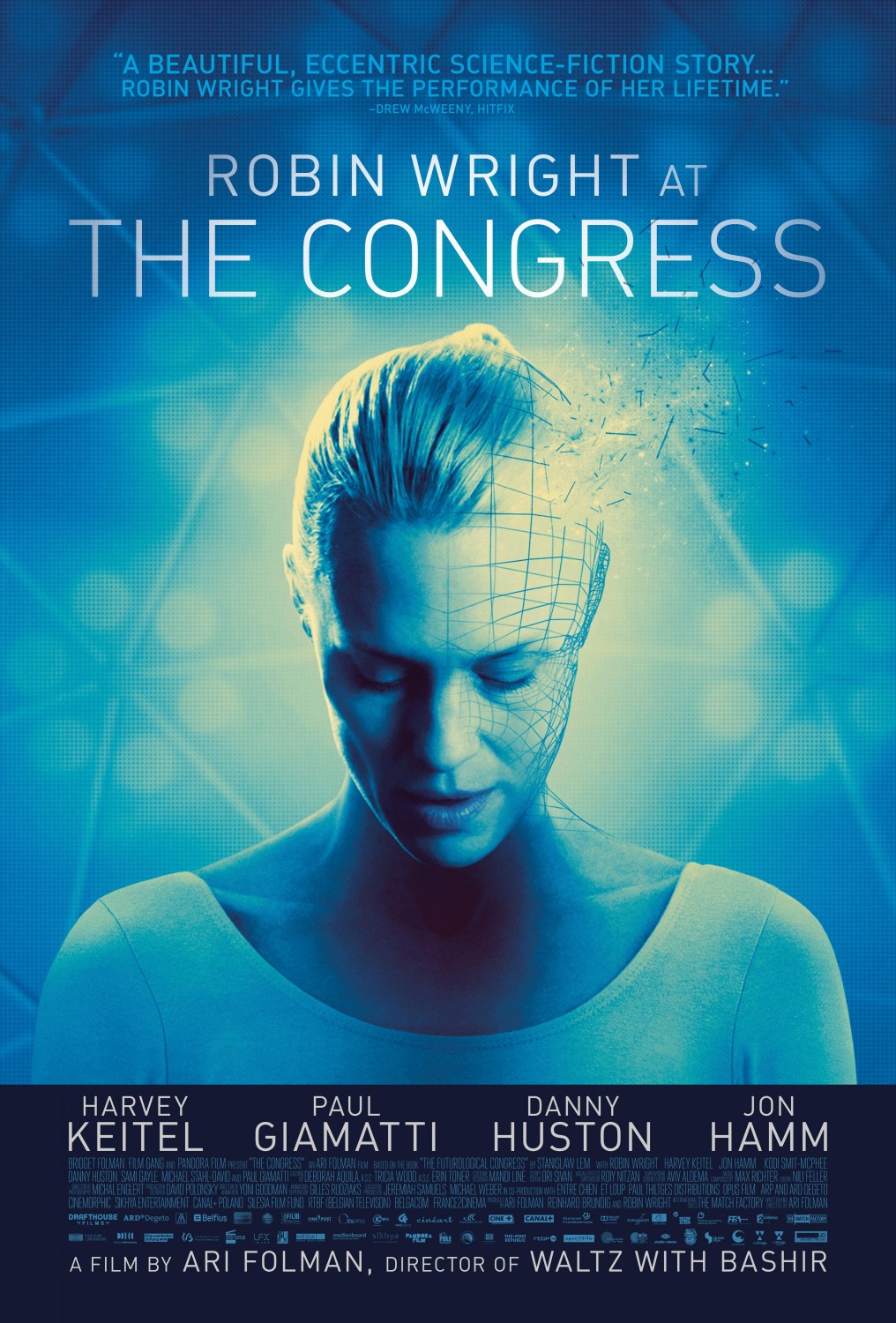
“The Congress” is one of the most bizarre motion pictures I have ever seen, and I mean that as a compliment. It combines live-action scenes with animated sequences to tell a story about an actress who willingly gives up her identity so she can be digitized by a movie studio so they can make many films starring her. In the process, it offers a look at the value of one’s identity, how we are unique in our own way, and it questions whether or not it is worth it to give up who we are as individuals so that other people can take on our own identity. With the constant advent of AI in every facet of our lives, those questions are now more important than ever.
Robin Wright stars as a fictional version of herself in this movie. After so many years in which she appeared in such classic motion pictures like “The Princess Bride,” “Forrest Gump” and “Unbreakable,” she is presented here as a washed-up actress who has been in one box office bomb too many. Even worse, she has long since been seen as someone who is very difficult to work with. We see her living with her two children in an airplane hangar located right next to an airport, and this is due to her son, Aaron Wright (Kodi Smit-McPhee), being convinced he is the heir to the Wright Brothers. Aaron’s belief in this leads him to build huge kites on a regular basis.
It also turns out that Aaron is suffering from a rare condition known as Usher’s syndrome, a disease which causes partial hearing loss which gradually deteriorates into total deafness and blindness. Aaron believes he can be cured of it if he smashes one of his kites into a real passenger plane. Looking at this, it is no wonder Wright gave up on her acting career so she could be there for him.
Then one day her longtime agent, Al (Harvey Keitel) comes to her with a deal he has brokered with the head of Miramount Studios, Jeff Green (Danny Huston at his most cynical and slimy), to capture her cinematic identity in a digital format so he can put her in all sorts of movies she does not have to come to a studio to act in. Basically, she is asked to sell her identity and her soul to the studio, and in return she will receive a very hefty compensation which will allow her to look after her family. The only thing is that she has to agree never to act on any other stage in the world ever again, and this leaves the viewer wondering if this is worth such a price.
When Robin Wright was cast in “The Congress,” she was at a certain peak in her career thanks to her role as Claire Underwood on the Netflix series “House of Cards.” On top of that, she had given memorable performances in “Moneyball,” “The Girl with the Dragon Tattoo” (the David Fincher version) and in “A Most Wanted Man” in which she co-starred opposite the late Phillip Seymour Hoffman. In real life, we had no business considering her as anything close to a washed-up actress, but she is so convincing here to where any irony in the air was beside the point.
“The Congress” takes place in a time where the economy is laser focused on scanning actors to where signing off your identity is easier than trying to make a living in show business. Now it has never been easy to make a living as an actor, but if this can happen to Wright, then it can happen to any actor. While we still may be way off from digital actors taking over for real life actors in movies, this reality is proving to be much closer to a reality than we would like to think or believe.
When we catch up with Robin in a distant future, this is when “The Congress” takes a serious left turn I did not see coming. She ends up entering a completely animated world where everything is being transferred to a chemical method which will allow everyone can be someone famous or anyone or anything other than themselves. The animation feels distinct from any other animated movie I have watched then and now, and it makes the experience of watching “The Congress” a unique one. This is a captivating world to be immersed into, but after a while you feel Robin’s concern as she comes to see her deal with the studio has come at a bigger price than she realized. While it might be fun to be someone other than yourself, is it really worth giving up your own identity in the process?
“The Congress” was written and directed by Ari Folman who directed the critically acclaimed “Waltz with Bashir.” With this movie he sucks us into a world which is full of an array of colors and possibilities, but once we discover this is part of a new Hollywood dictatorship, we become desperate to escape it. Robin comes to regret the decisions she has made as her identity no longer feels like her own, and her family has long since become the most valuable thing in her life as well.
After watching “The Congress,” it was hard for me to think of a better actress who could have been in this movie other than her. From start to finish, we are with Robin as she traverses her way through an ever-changing technology she cannot keep up with, and she is mesmerizing throughout. We feel for her as she attempts to salvage what is left of herself in this strange new world, and any kind of victory she ends up achieving here feels like a significant one.
The rest of the cast proves to be more than up to the challenge as they either play or voice their characters with a lot genuine emotion. In addition to Wright, Keitel and Smit-McPhee, we also have Jon Hamm who plays Dylan Truliner, an animator who invented Robin on Miramount’s computers and has long since become enraptured by her. Even Paul Giamatti shows up as Dr. Barker, and you can never really go wrong with an actor like him.
Seriously, the best way to enjoy “The Congress” is to walk into it with an open mind. It is far from the typical mainstream fare we see playing at our local multiplexes, and it takes you on a journey few movies can. In the process of examining the effects of a Hollywood dictatorship on the rest of the world, Folman has given us a motion picture which leaves you with a lot on your mind after the end credits. In this day and age, this is even more the case than ever.
* * * ½ out of * * * *

