Ben Younger Returns to the Director’s Chair with ‘Bleed for This’

Director Ben Younger on the set of BLEED FOR THIS.

Ben Younger made his directorial debut with “Boiler Room” in 2000, but “Bleed for This” marks his first directorial effort since “Prime,” and that film was released over a decade ago. After failing to get his Isle of Man racing movie off the ground, he withdrew for a time to Costa Rica where he became a pilot, cooked in a restaurant, and even raced professionally on motorcycles for a year. When it came to making “Bleed for This,” he originally approached it as a writing assignment and had no intention of directing it.

“Bleed for This” tells the true-life story of champion boxer Vinny Paz (played by Miles Teller) who, after winning a fight, is involved in a nasty car crash which leaves him with a broken neck. Many tell him his boxing career is over as a result, but Vinny is determined to repair the damage and get back in the ring. That he succeeded in doing so makes his comeback one of the greatest ever in sports history.

bleed-for-this-poster

While at the Four Seasons Hotel in Los Angeles, California, Younger explained what finally made him want to tell this story.

Ben Younger: Simply because of the comeback. Vinny won 50 fights, I don’t know if you guys knew that. I’m sure to real boxing aficionados that would be an exciting thing. I’m not one of them. For me, it was all about the crash and the comeback. I started this as a writing assignment. I wasn’t supposed to direct this. I didn’t think I wanted to direct it. But once I realized there was a parallel between his story and mine… You guys know I took a long time off. I didn’t make a movie for 12 years which is kind of like having a broken neck.

So yes, “Bleed for This,” like every other movie released these days, is “based on a true story.” This term has long since lost its meaning as filmmakers tend to embellish the real-life events they are portraying to where they resemble something which feels canned and artificial. Younger, however, sought to pull back from this, and his explanation led to my question regarding certain things I figured filmmakers do their best to avoid.

BY: In every other way, we had to reverse embellishment. For example, that scene with Vinny lifting the bar? That happened five days after the Halo went on in real life. I couldn’t present that because no one would believe it. Same for Ciarán Hinds’ performance of Angelo (Vinny’s father). Angelo was such a colorful character that he bordered on a caricature of an Italian-American in New England. If I showed him as he was, you would say I was racist or we would’ve made a comedy.

Ben Kenber: It’s interesting because when it comes to East Coast people, I think a lot of us have a sort of a specific view which might seem clichéd in the way they are portrayed on-screen. How did you manage to keep it to where it felt like the actors and the accents felt natural and not clichéd?

BY: That was a fear. Boxing wise, there are so many clichés. Those I was like, we are going to avoid those, those are easier to avoid. But this is tougher because the actual accents can in themselves sound caricature like. So, we had a great dialect coach, Tom Jones (not the singer), a really talented guy, and we prayed and we were just careful and we really listened. I wasn’t looking at the monitors. I just stood next to the camera and just stared. You know when someone’s full of shit and when they’re someone they’re not, and you just can tell when they are getting it. Even if you don’t know the world, there’s just something if you really pay attention.

One thing which astonished me about “Bleed for This” was how several of the actors were unrecognizable in their roles. This is especially the case with Aaron Eckhart who plays Vinny’s coach Kevin Rooney, Ted Levine who plays boxing promoter Lou Duva, and Katey Sagal who portrays Vinny’s mother, Louise. One person even told me he didn’t realize it was Sagal in the role until her name came up during the end credits. I brought this up to Younger, and he responded with the following.

BY: That’s the nicest compliment you can pay an actor. They really want to disappear (into their roles). That’s more them than me, but thank you.

Another highlight of this interview was when Younger was asked which movie inspired him to become a filmmaker. His answer was not at all what anyone could have expected.

BY: No one’s ever asked me this question strangely, and I’ve been avoiding it for 16 years because I have to tell the truth. It is Steven Seagal’s “Above the Law.” It was his first movie, I was 16 years old, I cut school. I was going to a Yeshiva, like a Jewish seminary school, and I cut and I went and saw it. It was the first time I realized that someone made movies and that there were people behind it and some thought had gone into it. It was mostly that opening. There’s archival footage in the first 30 seconds. It’s footage of Seagal as a 19 or 20-year-old studying martial arts in the Far East cut together with the narrative they were doing which was about him being a CIA operative. The movie holds up. I see it probably once a year and it’s completely watchable.

Truth be told, Younger is correct. “Above the Law” featured Seagal in his prime, and it does still hold up. Some might see the movie as a guilty pleasure, but it really is not. It was also directed by Andrew Davis who would later direct Seagal in his biggest hit, “Under Siege,” and gave us the excellent cinematic adaptation of “The Fugitive” with Harrison Ford and Tommy Lee Jones. Everything Seagal did following “Under Siege” has proven to be pretty much abysmal.

It’s great to see Younger directing again, and he ended his time by saying he finally got the financing for his Isle of Man movie which is now heading into pre-production. Odds are we will not have to wait 15 years for it to reach the silver screen.

Bleed for This” is now playing in theaters. Whether you are a boxing fan or not, it is definitely worth checking out.
Miles Teller talks about Boxer Training and Wearing the Halo in ‘Bleed for This’

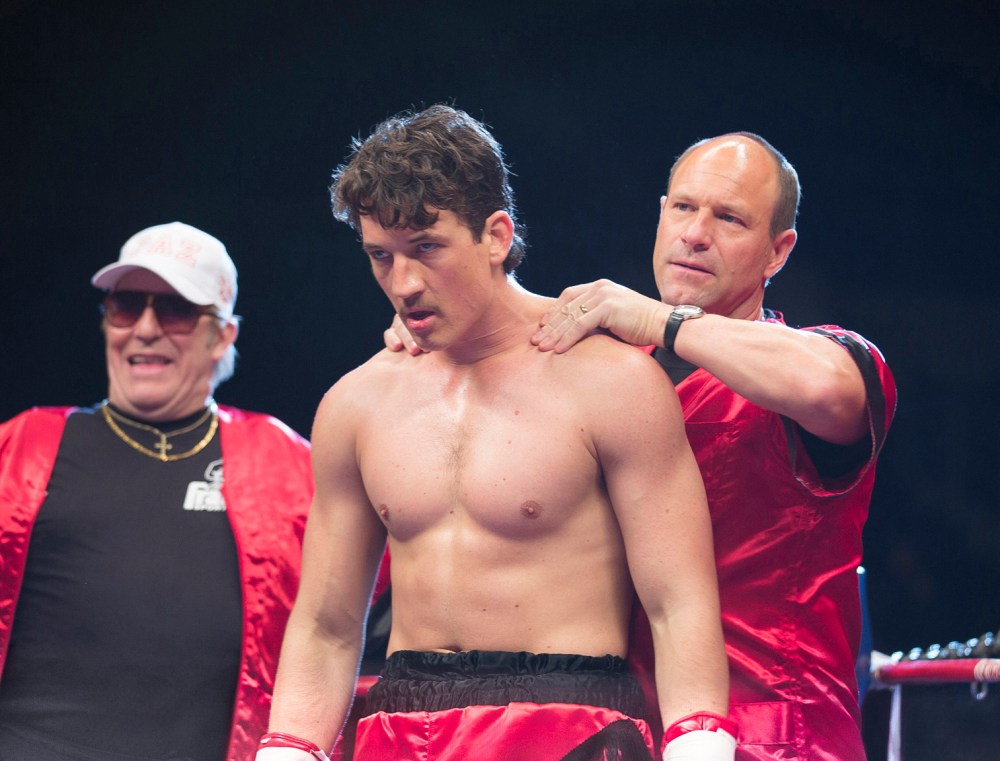
bft-d25-212_r_c_rgb

Jake Gyllenhaal played one in “Southpaw,” Michael B. Jordan portrayed another in “Creed,” and now Miles Teller gets to put on his own set of gloves to play a boxer in “Bleed for This.” The biographical drama, directed by Ben Younger, focuses on Vinny Paz, a champion boxer from Rhode Island who became Super Middleweight champion of the world after defeating Gilbert Dele in the ring. Paz’s victory, however, is short-lived when he gets seriously injured in a nasty car accident. With his neck broken, his boxing career is assumed to be over by everyone, but he became determined to regain his title through a brutal rehabilitation regimen, and this led to one of the greatest comebacks in sports history.

Teller recently sat down for an interview and talked at length about how he trained and prepared to play Paz in “Bleed for This.” He also discussed what it was like to wear the halo Paz opted to wear in an effort to repair his neck. The boxer’s doctors initially encouraged him to undergo spinal fusion which would have ensured his ability to walk again but also would have erased any chance of him getting back into the ring. Paz chose the halo instead, and it involved having a number of screws drilled into his head in order to ensure this apparatus would keep it in one place for months.

bleed-for-this-poster

Question: Did growing up in South Jersey help you with your accent?

Miles Teller: The Jersey accent is different. It’s just impossible to sound intelligent honestly, especially in South Jersey. The Northwest is just a specific kind of energy and people, and even though Rhode Island is totally different from New Jersey… I’ve just been around those guys, so I think it probably added something to the kind of relation that I found to Vinny.

Q: What was the most difficult thing that Vinny had as a person for you to get for the movie?

MT: The physicality was very tough. To get that look for me to just be able to have the conditioning to be able to shoot a boxing fight for a 16-hour day. The last two fights were back-to-back days. Each fight took one day which is unheard of. We shot the movie in 24 days. To even just look like a boxer… I had to shoot two movies in between, but that was eight months of just a very strict diet and working out. I lost 20 pounds and got down to 6% body fat for the first fight, but Vinny also moved up in weight and won the title of Lightweight and Super Middleweight, and we showed that. That’s also something very unique and special to Vinny’s legacy. He and Roberto Durán were the only two guys to win titles in those two weight classes specifically. So, I started at 160 and then I had to gain 15 pounds to get to 183 in like 2 ½ weeks. But once I had to gain weight, that was fun. It was just like Dunkin Donuts in Federal Hill. I don’t know if you’ve ever been to Providence, but Federal Hill has amazing Italian food.

Q: But while you were eating a lot, you still had to be boxing.

MT: I got cast two and a half years ago. We filmed it two years ago. This was pre- “Whiplash.” I had never done anything like this where I just got to play like a man or a world champion boxer. Even when I was on set, if I had any time in between I was always doing something like push-ups or sit-ups because I knew I didn’t walk into this movie with this God-given talent of being in shape. They tell you just get a workout and diet, but I think I went anti that early in my career because I was just like, I don’t want to be that guy with the six pack and a tan who’s worried about his makeup and stuff.

Q: Did doing this movie help you to appreciate the nuances of boxing, or is that something you already had as a sports fan?

MT: I was a big MMA fan and I still am, but I started watching it when it was the WCE when I was in high school; I was 16 years old. And then with boxing, I always played the video games and I always watch certain guys like Tyson and Holyfield and Lennox Lewis; the heavyweights back then were the big draws. But once you start training in it, you realize it is very highly nuanced. I don’t see it as two guys in a blood sport. I see it as technique.

Q: The mind is very important to being a champion boxer? Strategy?

MT: Yeah, for sure, but that’s what they say: you have a game plan until you get hit in the face, and then it all goes away. We didn’t have a ton of time. I only had about five weeks in Los Angeles with my boxing trainer, and he was Sugar Ray Leonard’s trainer for 18 years. He was just a very high-level guy. The first fight in the movie against Roger Mayweather, I had five days to work with that boxer. The second boxer, we had a day and a half. And the third boxer, this dude Edmund Rodriguez, got in a fight, professionally, that he wasn’t supposed to. He told Ben (Younger, the director) he wasn’t going to fight, got in a fight, luckily knocked the dude out, didn’t get messed up, flew down, and I honestly only had maybe like a day with him.

Q: You also had to wear the halo in this movie. What was it like reading about that in the script and then wearing it for however long?

MT: For the beginning physical transformation, it was eight months of all that stuff that you hear. You can’t eat any bread or drink for that time. You’re just eating like a rabbit and hoping it all pays off. This guy dedicated like everything in his life to this, so it would’ve been very immature of me to slack off and mess with that. As far as the halo goes, that was highly uncomfortable. Again, you don’t like to complain because, for Vinny, it was screwed in his head. But for me, it wasn’t actually screwed in my head so we really had to make it as tight as possible because if the thing moves at all, then it doesn’t matter what you just did in that take. You only get so many takes, but it’s not usable because when it moves, people understand it’s not real. If this was like a big-budget studio film, I would have had a ton of fittings with it. I just did a firefighter movie and I had more fittings with my boots than I did for this thing. The girl just went to a hospital in Providence and got one from them, and then we put little rubber pieces on the end and just put it so far up my head that I could tell when it was in the right spot because I just had indentations on my head.

“Bleed for This” opens in theaters on Friday, November 18th.

‘Major League’ Cast and Crew on Working with Charlie Sheen

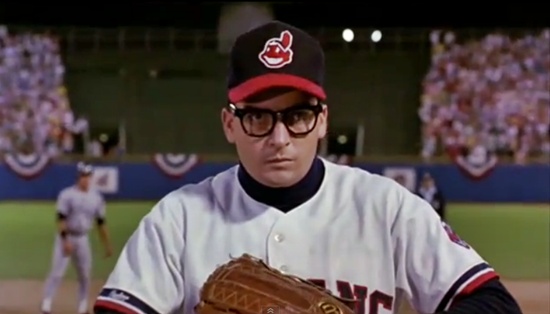
major-league-charlie-sheen

Charlie Sheen is better known these days for his bad reputation than his talents as an actor. His ouster from the CBS show “Two and a Half Men” looked to be the end of him, but he soon bounced back and filmed a plethora of episodes for the FX series “Anger Management.” Still, his bad boy image is impossible for him to shake, and it makes one wonder just how much he is like his character of Ricky Vaughn in “Major League.”

The question of what it was like working with Sheen was brought up when American Cinematheque did a special screening of “Major League” and “Major League II” at the Aero Theatre. Sheen’s role as the Cleveland Indians star pitcher Ricky “Wild Thing” Vaughn remains one of his best and most memorable roles, and his current troubles in the press can’t take away from our pleasure in watching him. Among the guests at this screening were writer/director David S. Ward, Tom Berenger, and Corbin Bernsen, and each described their memories of working with Sheen.

Ward, who wrote and directed the first two “Major League” movies, described Sheen as being the consummate pro on set and said he showed up every day on time.

“He knows his lines, he gives everything, he very seldom goes up on a line, he’s very generous with the actors and they all love to work with him,” Ward said about Sheen. “I can’t say enough about him.”

Ward even remembered a time while making “Major League II” when Sheen had a scene with David Keith who played the overly cocky Jack Parkman. It was a scene where Sheen was pitching to Keith, and it turns out that Keith had lost his contact lenses and was seeing two baseballs instead of the one being thrown to him.

“I was trying to get a shot of him (Keith) hitting a ball that looked like it got in the air enough to get out of the stadium,” Ward said. “Well he (Keith) was seeing two baseballs coming at him, and Charlie threw him 128 pitches. And I said ‘Charlie let’s stop, we can do this tomorrow, we can do this some other day’ and he said ‘no, no, no let’s do this. I’m warmed up, let’s do this.’ 128 pitches, never complained, and it took us that many for Keith to hit one in the air! That’s the way Charlie was. He gave everything, he loves baseball, he loves to play baseball, he’s a terrific baseball player, and he’s got a great arm and throws hard.”

Berenger, who had previously worked with Sheen in Oliver Stone’s “Platoon,” recalled playing ball with him at Santa Monica High School before “Major League” began filming.

“He threw ten pitches, and out of the ten one was a little outside and nine were right on the corners of the strike zone,” Berenger said. “That’s how much control he had, and he was fast too. We went down and did batting practice with the Savannah Cardinals which was a minor league team at the time, and I warmed up one of the pitchers and he threw 94 miles an hour. And I’m guessing Charlie was about 88-89 miles an hour.”

Bernsen ended up telling this story of when Sheen was working on “Major League II.” One day Sheen found out his hotel room had been robbed, and among the items stolen were his wallet, his Walkman (remember those?) which he always had on him, and his gun.

“Charlie had just flown in one of 15 women who had come in during the shoot. Charlie is Charlie, he’s still professional but Charlie is Charlie,” Bernsen said. “I got pretty close with him and I remember him saying, ‘Fuck! I don’t care about my wallet, I don’t care about my Walkman, they took my fucking gun! Whatever happens, I just don’t want that to get out!’”

“So he and his girlfriend and I walked from the hotel across this walkway because he’s got to find another Walkman to do tomorrow’s shoot with because he likes to have his music,” Bernsen continued. “And he’s gonna go into the appliance store to buy a Walkman and always going, ‘I don’t care about the money and I don’t care about the Walkman. Don’t mention the fucking gun!’ And we walk into this department store into the appliance section back in the old days where they had a hundred TVs on the same station. The news was on and as we entered the department, ‘Breaking news: Charlie Sheen was robbed while in town making ‘Major League.’ Among the things stolen was his gun…’ And I just saw him freeze.”

Whether this adds or takes away from all those crazy stories we’ve heard about Charlie Sheen over the years, it also shows him to be far more professional than we give him credit for in general. Sheen’s performance in the “Major League” movies was no fluke, and if Ward and company are serious about making another movie in the future with these characters, they would be incredibly foolish to not include Sheen in it.

David S. Ward Looks Back at the Making of ‘Major League’

major-league-movie-poster

The 1989 sports comedy “Major League” got a special screening at the Aero Theatre in Santa Monica, and joining moderator and American Cinematheque program director Grant Moninger for a Q&A was the movie’s writer and director David S. Ward and producer Chris Chesser. This screening brought out many excited fans who consider “Major League” to be the best baseball movie ever made.

Moninger started off by saying that after watching “Major League,” it seemed like the most fun film to make as everyone got to film and play baseball. When he asked Ward what the making of the movie was like, we were surprised by his answer.

“It was one of the most difficult movies to make that I ever had been associated with,” said Ward. “When we started we had one of the hottest summers in 75 years in Milwaukee where we shot the movie. We started out with six weeks of night shooting because we had to work around the (Milwaukee) Brewers schedule at the time, and staying up all night for six weeks just kills you. It was an independent movie at the time, and we didn’t have a lot of money and we didn’t have a lot of anything.”

Regardless of the production difficulties, however, Ward said he did have a great time making “Major League” because of the guys, and he even said that Rene Russo, who played Berenger’s ex-girlfriend Lynn Wells, was one of the guys as well. Ward described the cast as being magnificent and said everybody pulled together to make this movie work. It was just the physical difficulty of making it was hard, and it was something the cast and crew hadn’t planned on dealing with.

Ward went on to describe the “red tag” scene in the locker room in which the players discover whether or not they have been cut from the team. This scene ended up being shot in the basement of a high school which had no windows, and it was already 95 degrees when they began shooting there at four in the morning.

“We had two jerseys for each player, and I remember Tom (Berenger) doing a take and he would sweat through his jersey because it was so hot,” Ward said. “We would take his jersey and give him the other one, and we’d blow dry the one that was sweated through with a hair dryer. Well, it dried it, but it also made it hot. When he sweated through the other one, he had to put on the dry one which was hot!”

When it came to casting “Major League,” Ward said he would only cast people who could play baseball:

“I had actors come in and tell me they played Triple-A ball for the Cardinals, and Chris (Chesser) and I would take them outside and we’d play catch with them, and the Triple-A guy couldn’t throw the ball 15 feet; he never played baseball in his life! People will say anything to get the part, so we just took them outside and we tested them out.”

The cast ended up having two weeks of training before filming began with Steve Yeager who was a former Major League baseball player himself. This was about getting everybody in shape not only to play baseball but also to do basic physical conditioning.

“If you’re not used to playing baseball every day, you don’t realize how many quick starts and stops there are and you can pull muscles and hamstrings,” Ward said. “If an actor gets injured, you can’t shoot with them for a while and your schedule gets screwed up. So, everybody got in shape both physically and baseball-wise and that was a big help.”

Players from other baseball teams were also cast such as Peter Vuckovich who was an All-Star pitcher for the Milwaukee Brewers and Cy Young award winner. Vuckovich played the New York Yankees’ first baseman Haywood, and Chesser remarked he was actually asked to read for the part of the Yankee reliever nicknamed “The Duke.” However, he and Davis found Vuckovich to be “so ugly and so menacing” to where it made more sense to cast him as the player who insults Berenger and hits home runs off of Charlie Sheen. But Chesser also said although Vuckovich looked like he could hit a baseball out of the field, he actually “never hit the ball out of the infield” and never hit a single home run in his entire career.

When it came time to film the climatic game where the Cleveland Indians play against the New York Yankees for the division title, Ward said he and Chesser promoted a night at the stadium to get extras, and 27,000 people showed up. Looking back, the evening was an amazing experience for him and the cast as they had so many cheering people to work with.

“We taught them how to sing ‘Wild Thing,’” said Ward. “We had cameras roaming around all night just picking up people. The girls who came out and danced on the dugout, they just did it! We didn’t ask them to do it, they just got out and did it! I just looked at that and said, thank God!”

Ward added there was a group of about 350 people who came out every night, and he even remembered a couple who had tickets to the Summer Olympics in Seoul that same year. The couple debated whether to travel to Seoul like they planned or stay for the last two days of the movie’s shooting. Ward encouraged them to go to the Olympics, but they ended up staying.

Moninger also asked about the late James Gammon who played head coach Lou Brown, and the mention of the actor’s name got a big applause from the audience. Ward got a bit choked up when talking about Gammon and said he never had any other actor in mind for Lou other than him.

“I was just thrilled to get him, “ Ward said. “He was everything I thought he would be. He’s a great gentleman and a wonderful man. Nothing bothered him. He was a rock of Gibraltar in every way. I remember going to his memorial service and one of the things that was really moving to me is they had his jersey from ‘Major League’ hanging up. He gave so many great performances, and yet the one everyone identifies him with is this one.”

When it came to writing “Major League,” Ward said he was inspired to write about Cleveland as he grew up there. The year this screening took place, every major sports team in Cleveland was pathetic, and Ward remembered it being pretty much the same way when he was deciding on what movie he was going to write next.

“I was thinking that probably the only way the Cleveland Indians would win anything in my lifetime is if I wrote a movie with them winning,” Ward said. “So what kept me going was I just didn’t want to be another Cleveland failure.”

One big question the audience had was why “Major League,” which takes place in Cleveland, wasn’t actually shot there. Ward responded he knew he was going to get into trouble for that.

“The reason we shot it in Milwaukee was that Cleveland is a big union town, and we couldn’t do it independently there,” Ward said. “The other thing was that they hadn’t built the Jacobs Field (which is now the Progressive Field) ballpark yet, so the team was still playing at Cleveland Municipal Stadium. Also, the Browns were playing pre-season games there, and the field had football lines on it. That wouldn’t have looked very good, so it wasn’t feasible to shoot there.”

Another audience member brought up Bob Uecker who played Indians sportscaster Harry Doyle in “Major League” and asked how much of his dialogue was written and improvised. Ward replied he wrote the character of Harry and his lines, but when Uecker was cast he discovered just how incredibly funny he was. What also helped Ward was that Uecker knew a lot of things about baseball players he didn’t, and he felt he would have been an idiot not to let Uecker improvise if he wanted to. When it came to Uecker’s famous line of “just a bit outside,” Ward said he wrote it, but it didn’t sound anywhere as funny in his head as when Uecker said it.

Everyone at the Aero Theatre had a wonderful time hearing all these stories about how “Major League” came to be. After so many years, this movie really holds up as it is hilarious and has a lot of heart. While many of the actors other than Berenger and Bernsen were not able to make it to this screening, we did get a surprise guest with Jo-bu, Pedro Cerrano’s voodoo god doll. Ward and company celebrated the appearance with Jo-bu with some rum, the same kind Eddie Harris (played by Chelcie Ross) stole and took a drink from when nobody was watching. You all remember what happened to him, right?

Exclusive Video Interview with J.K. Simmons on ‘Break Point’

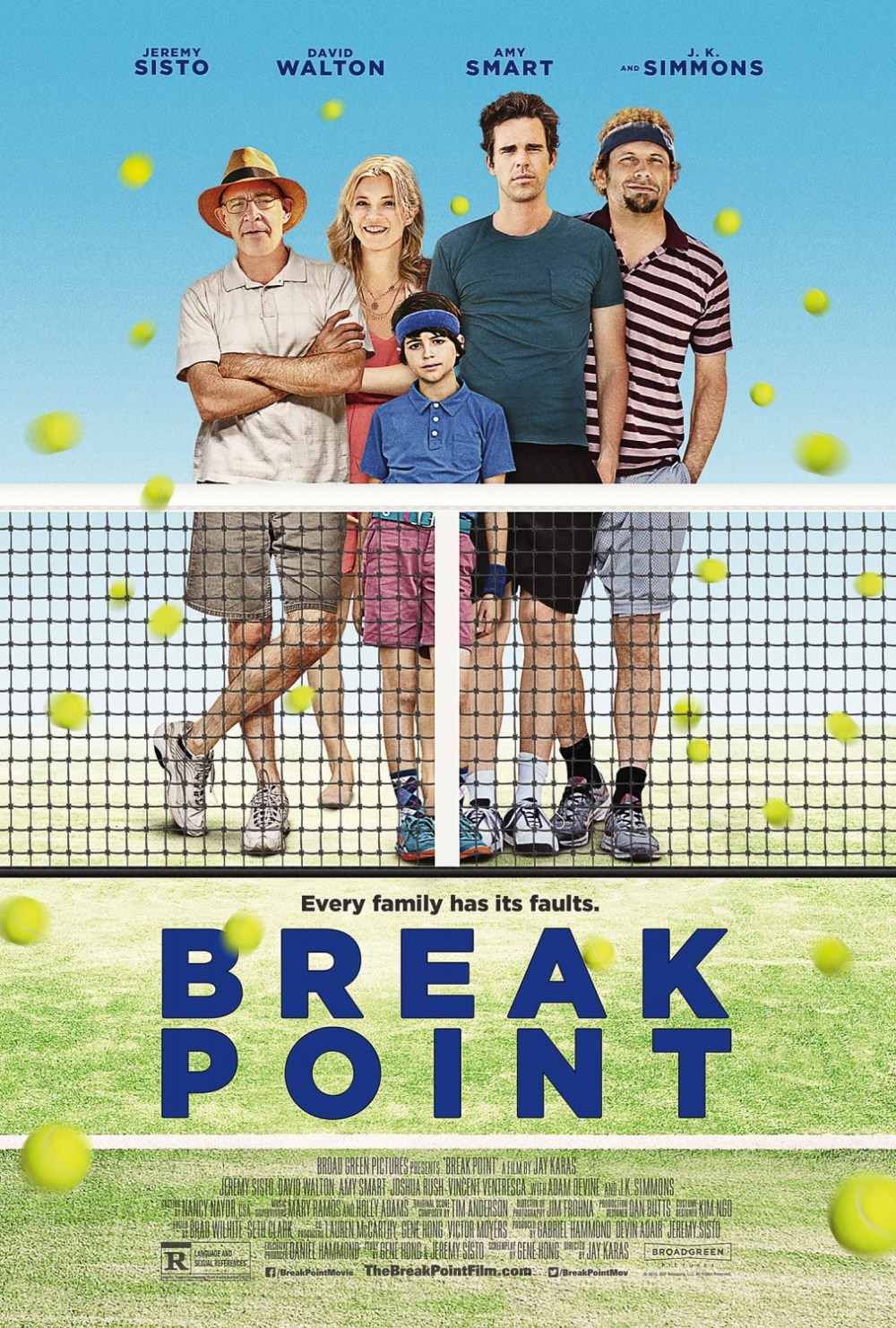
It’s been a very busy time for J.K. Simmons ever since he won an Oscar for his truly frightening performance in “Whiplash” as he has not been lacking for work in the slightest. We watched him steal scenes from Arnold Schwarzenegger in “Terminator Genisys,” and now he steals the show yet again in the sports comedy “Break Point.” In it he plays Jack Price, a veterinarian, widow and father of two boys who were once a great tennis team but have long since become estranged from one another. When the boys decide to re-team to take one last shot at winning the grand slam tournament, Jack is pleased to see his sons playing together again. But will Jack be able to keep the peace when his sons inevitably clash over who’s the better player?

Now whereas many actors would take the father role and either overplay it or underplay it, Simmons finds a middle ground to where he makes Jack a believably down to earth guy who is relatable and someone you would really like to hang out with. He is such a wonderful presence in “Break Point” to where you want his onscreen sons to thank the lord they have such a wonderful father in their lives. The actor also brings his trademark deadpan humor to the role which is always a welcome addition.

Simmons sat down with me for an interview at the “Break Point” press day held in Los Angeles, California. He talked about his approach to playing Jack Price and how making the movie helped change his view on the game of tennis. He also talked about his experience making “Terminator Genisys” which allowed him to play the kind of character he usually doesn’t get cast as: a good guy.

Check out the interview above. “Break Point” is now available to watch on various formats. To find out how you can watch it, be sure to visit the movie’s website at www.thebreakpointfilm.com.

Copyright Ben Kenber 2015.

Break point movie poster

Save