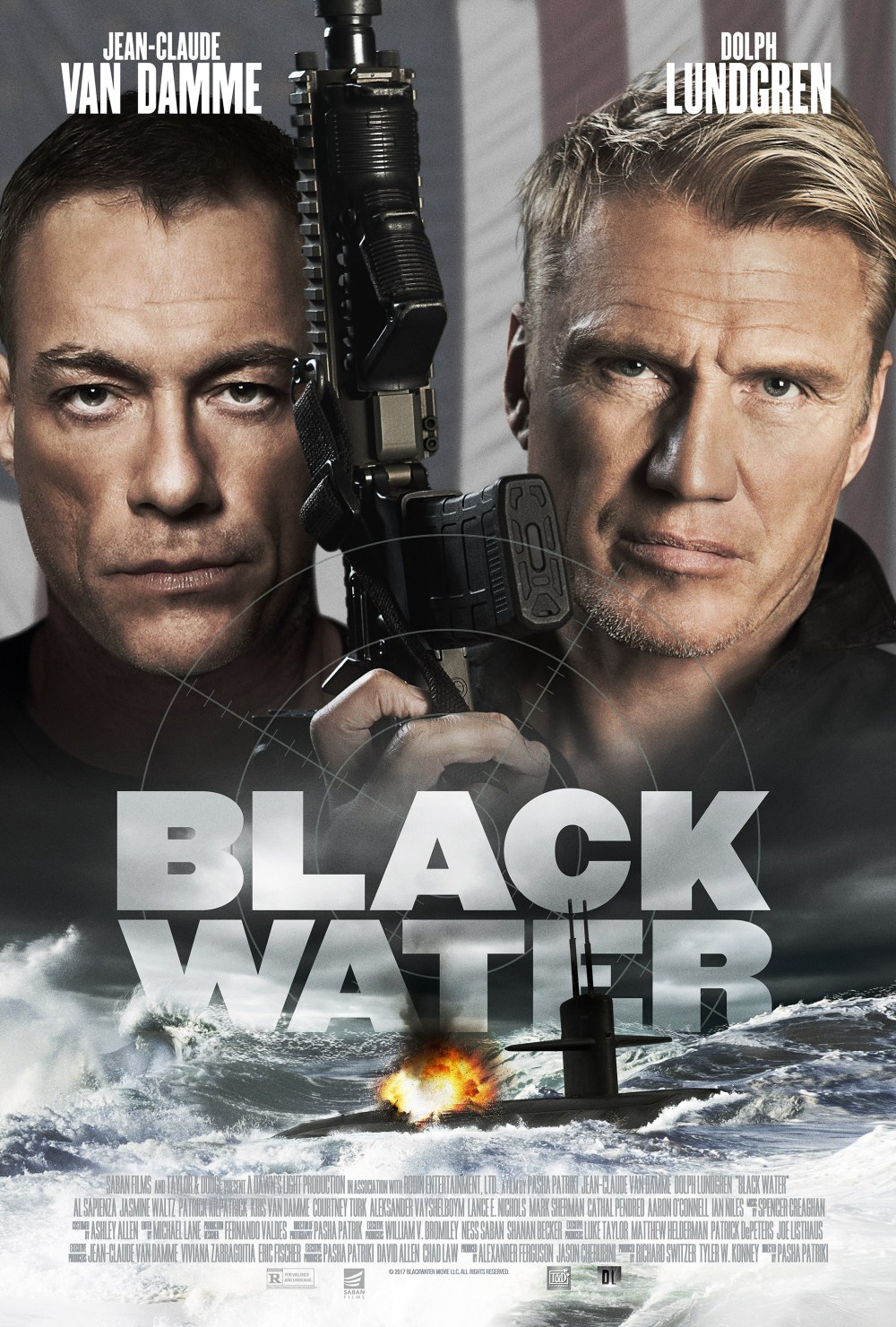
For many, Jean-Claude Van Damme and Dolph Lundgren are still a match made in action movie heaven. They first appeared as soldiers on opposite sides in Roland Emmerich’s 1992 film “Universal Soldier,” and they returned to this franchise years later for two sequels, “Regeneration” and “Day of Reckoning.” And, of course, they had to make at least one appearance in “The Expendables” franchise to show they were not worse for the wear, and they did so together in “The Expendables 2.” Now, Van Damme and Lundgren share the screen in their fifth film collaboration, the action thriller “Black Water.” But this time, they are on the same side.
The first image we see in this trailer is of a submarine diving underwater, and from there we are introduced to deep cover operative Wheeler once the hood over his head is removed. Wheeler has been imprisoned on the submarine which serves as a CIA black site, those places we are not supposed to know about but do anyway, and his interrogator, Patrick Ferris (Patrick Kilpatrick), tells him he is an enemy combatant and will not be granted any rights. Upon giving Wheeler the old action cliché of “welcome to hell,” Patrick orders an agent to prepare to insert a hypodermic needle into Wheeler’s eye in the same way Michael Myers did to an unsuspecting nurse in “Halloween II.” But as you can expect, Wheeler breaks free of his captors and escapes, and from there he does what he can to clear his name.
This just released trailer for “Black Water” is of the “what you see is what you get” variety as the movie’s plot points come from a dozen other action flicks of the past like “The Fugitive” and “Air Force One.” Clearly, no one here is trying to present us with something original, and this one is designed to show us the kind of story we all grew up on to where it makes us interested to see it done once again. Having the story take place in a submarine underwater is clever as the claustrophobic nature of such an environment will make the action more intense. I also imagine it is a way for the filmmakers to keep costs down as they won’t have to build too many sets.
Van Damme’s face is beginning to look a bit like Danny Trejo’s these days as it shows a life lived hard, perhaps too hard. Perhaps these hardened looks of his will help add to his role here. At the very least, we know he can still perform the perfect split.
Having interviewed Lundgren in the past, I know what a great sense of humor he has and seeing him in this trailer makes me hope he will bring some of it to this movie. Furthermore, he looks to have loosened up a lot over the years, and I hope Van Damme can loosen up to the same degree as well. But even though these two stars are headlining this underwater adventure, I get the feeling one will have more screen time than the other.
Kilpatrick looks to give “Black Water” the typical CIA agent who obsesses over controlling the uncontrollable, but I couldn’t help but be amused when he talks about how Wheeler is a “highly trained officer and a trained killer,” so it makes me wonder if he put enough thought into how he would handle this operative to where he would not be a problem (my guess is he did not).
We are also meet Cassie Taylor, a rookie agent played by Jasmine Waltz who, like any other rookie, wants to know what the hell is going on here. She also shows a bit of skin here which suggests there will be a sex scene at some point. The question is, can such a scene take place between her and another character (I am guessing Wheeler) when they are busy avoiding detection in the most claustrophobic of environments? In space no one can hear you scream, but in a submarine, you should be able to hear an orgasm let alone gunshots.
“Black Water” is set to be released on the Dish Network on May 25th, and it will premiere in theaters and on demand starting June 29th. Please feel free to check out the trailer below.
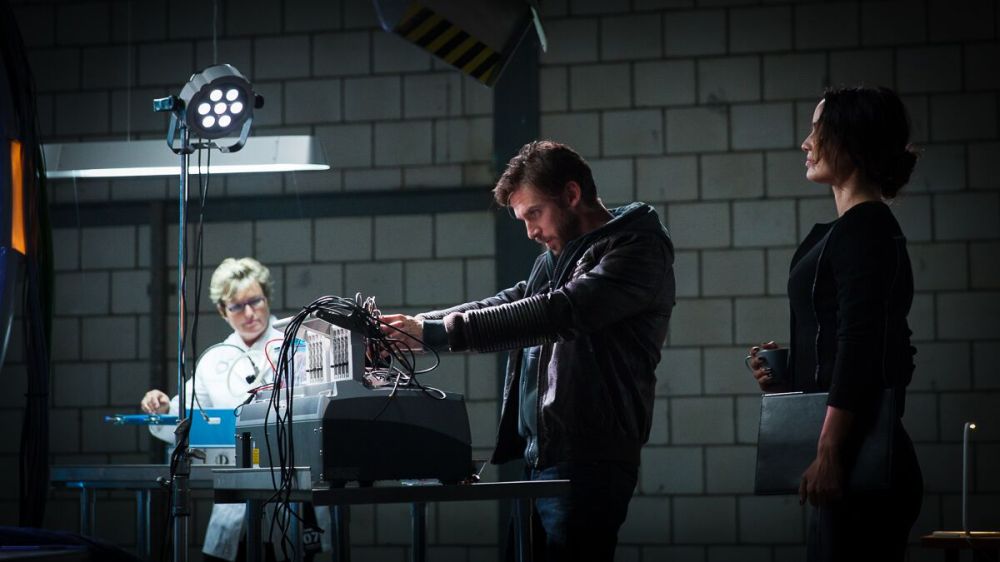
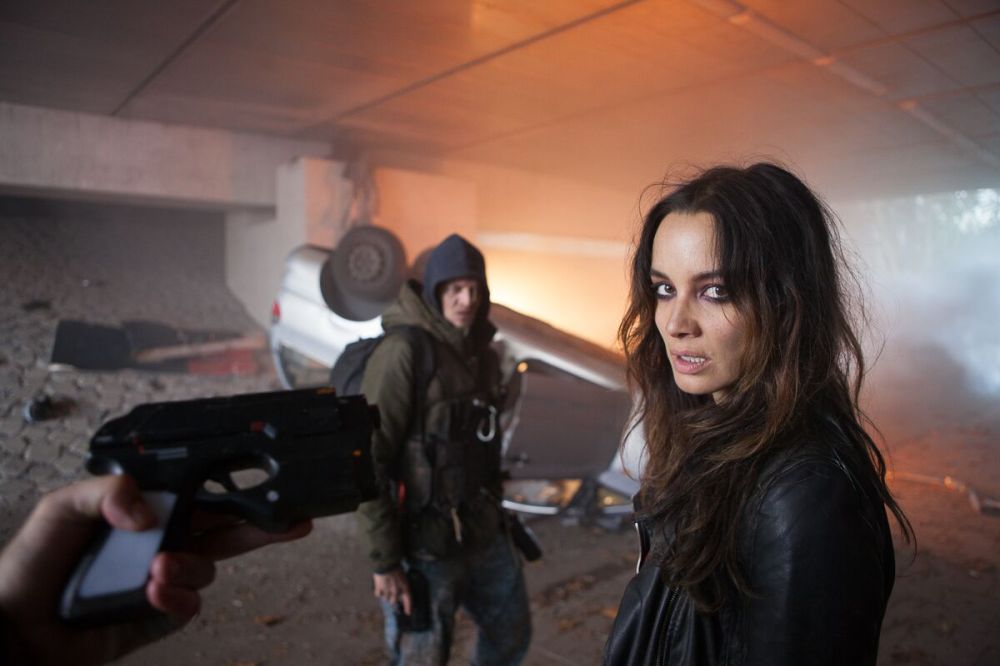
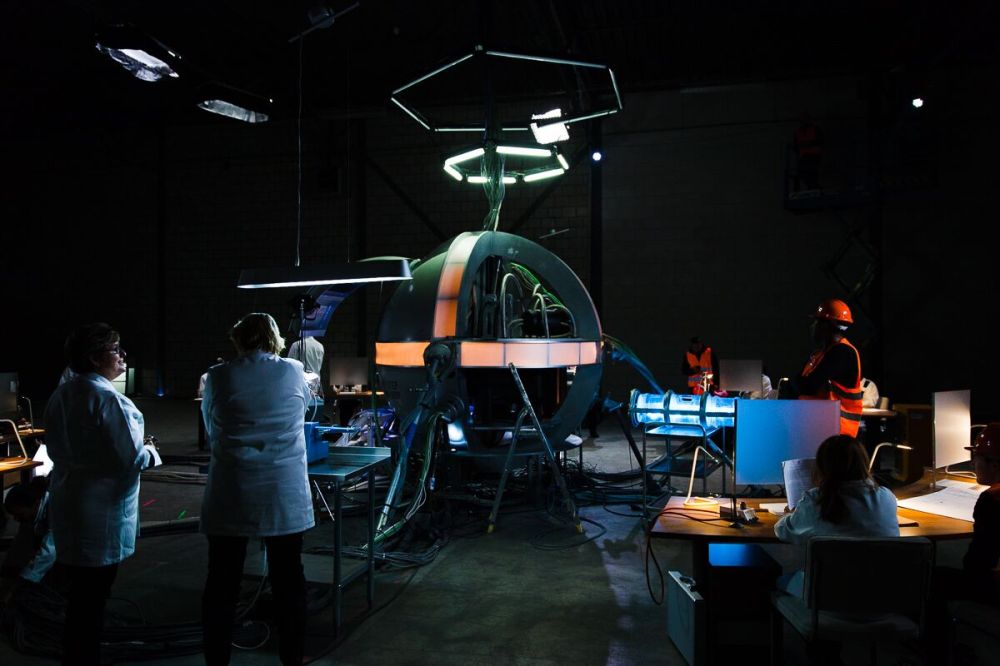
Acclaimed writer, director and visual effects artist Tim Smit makes his feature film directorial debut with “Kill Switch.” Based on his short film “What’s in The Box?” which gathered a large audience on YouTube, it stars Dan Stevens as physicist and NASA pilot Will Porter who is recruited by Alterplex, a power company which has built an enormous tower designed to harness unlimited quantum energy. The company’s vice-president, Abby (Bérénice Marlohe), informs Will a mirror universe has been created solely to drain energy from, and he is sent into it with a device called a “Redivider” which will balance the power between the two universes. But as you can imagine, nothing goes quite as planned as the mirror universe proves to more than anyone thought it could be as Will finds himself on the run from drones, soldiers, and people he is no longer sure he can trust.
“Kill Switch” takes place in a future version of our world, and it is largely a POV movie as we see much of the action from Will’s eyes as he struggles to say alive in an especially hostile universe. I talked with Smit about the movie’s origins, how the story evolved from a short into a feature film, and of how he was able to create a visual effects heavy movie in just 18 days and on a small budget.
Ben Kenber: I really like the way this movie is set up because you are thrown into this story to where you cannot help but be gripped by everything going on. You’re not sure what is happening and, like Dan Steven’s character, you are desperate to find out. When conceiving “Kill Switch,” did you know how the story was going to end, or did you just start off with the idea and went from there?
Tim Smit: We knew that, when I did the short a couple of years ago, the box was going to be used as sort of a kill switch for destroying a parallel universe meant for energy harvesting. But we never really knew the full arc of the story before we hired the writers to get involved, so it took a while to get to the point we ended up with. It was interesting and a very steep learning curve for me to work on this as a conceptual arc as a writer and also as a director, and of course the visual effects too. It wasn’t fairly clear, but we got there as we developed the kill switch idea.
BK: The screenwriters you hired for this project, Charlie Kindinger and Omid Nooshin, what would you say they brought to this story which wasn’t in your short film?
TS: What they did is they fleshed out the characters much more than we already had in the original short. But they also wrote the dialogue and they did the screenwriting of the story. It was a difficult movie to write because of the whole POV aspect. It’s difficult to tell a story through POV. Also, we did have, for that reason, to introduce the whole flashback storyline to help us with that, and to help provide a rest for the audience so that they do not get POV tired. So, they focused on that the feeding of information so the audience knew enough to keep going with the movie, and they were more associated with that than the base idea.
BK: I did watch the short “What’s in The Box?” which led to the “Kill Switch” feature film, and the whole idea of the parallel universe is something which has been explored in science fiction constantly such as the “Dark Mirror” episode of the original “Star Trek” series. What inspirations did you draw from when putting together the short and the feature film?
TS: So, the main inspiration behind it was a couple of things actually. Visually it was inspired by a couple of video games because this was always meant to be sort of an homage to video gaming, and we used various inspirations like “Half-Life,” “Halo” and games like that. From a physics standpoint, the idea for the parallel world came from the concept of Schrödinger’s cat, a thought concept where you got a box and in it is a cat with a poison. If you keep the box closed, you don’t know if the cat survived because the poison still has a chance to kill the cat. You only know the cat is dead when you open the box. So, this is kind of like the idea for the initial mystery where you’ve got this black box and you don’t know yet what it is and you don’t know what it does, but it triggers you to go along and see what it ends up doing. So, the whole idea of Schrödinger’s cat was the main inspiration behind the short and the box as a MacGuffin.
BK: The POV shots reminded me a lot of Kathryn Bigelow’s “Strange Days” which also had them. When you put those shots together, did you have a set of rules you wanted your collaborators to follow during shooting?
TS: Yeah, we did a couple of things, some of them worked better than others, which we wanted to explore. One of them was, most of the time, we wanted to see the other actors. As a rule of thumb, we wanted Will Porter to be running behind the other characters so you can actually see what’s happening. So that was something we took into consideration while we filmed this because you are kind of used to the main character taking the lead, but in this case, he’s following them because otherwise it would be difficult to see them. It’s a very simple thing you have to keep in mind, and that was one of the rules we followed.
BK: Did Dan Stevens have to do any camerawork himself for the POV scenes?
TS: No. Obviously I would’ve loved to have used him, but we just didn’t have the budget for him for all the days. So, we just hired him on some of the days where he would be the voice, and of course on the days where we would shoot conventional scenes. Our DOP was basically the character, and then Dan came in later and did the ADR for the character.
BK: The special effects are actually pretty good for a low-budget movie like this. We see objects like train cars falling out of the sky. Did you set any rules for yourself as to what kind of objects and vehicles could fall into the echo universe?
TS: So, we focused initially on metallic objects just because that made it easier to create for us. The idea was that this parallel world is being arched for energy, but somehow the original world is fighting back as the universe is trying to balance itself out, and it does so by pulling over objects from the original universe into this echo universe. The rule of thumb was the first thing to be pulled over was small metal objects for various reasons, but you can figure out in physics that there are only four main forces, and one of them is electromagnetic. It is not inconceivable that something like metal will react first or that something else will react to metal first. It made easier for us to make these objects fall down. It’s harder to do entire buildings or something like water. It was a compromise, but I felt it worked from the basic physics ideas as well. We see this boat falling from the sky, it’s not metaphorical.
BK: The whole idea of an echo universe is interesting because the characters say there is not supposed to be any organic life in it, but we can see from the start there is.
TS: Yes, that’s what I like about the movie as well. It’s not as fleshed out as it should be, but the idea is that this company didn’t care. They were just interested in creating this echo universe, and they are telling us that it’ll be fine and there will be no organic life, but they don’t care. They just care about the energy, and of course they didn’t expect it to be that intense or of the rebellion that arrives. But I kind of like that idea of what are your priorities as a company. These huge oil companies are pretty much going across the line, and that’s what drew me to this story as well. That was something I could really personalize.
BK: Dan Stevens has a very challenging role because he wasn’t on set too much, but he still had to get to the emotion of what is characters going through. Also, Bérénice Marlohe has a wonderfully intimate presence throughout the film. How did you come to cast both these actors?
TS: It was amazing to work with these two. The great thing about Bérénice and Dan is that they are both so interested in science fiction, and they are both really interested in broadening their own horizons and trying to do something new. It’s an experiment, this film. Let’s be honest, you don’t see a POV movie every day. It’s an attempt to do something new especially with a director that’s also doing all of the effects. It was an experiment on multiple levels, and they were committed and went for it, and that’s what I really appreciated about them. It was a very difficult movie especially for Bérénice because she was acting against I camera where there is no reaction, and most of the enemies are CG. It was very demanding for her to do, but she gave it her best and gave it everything she had. We had 18 days to do everything.
BK: 18 days? That’s very impressive especially for a science fiction movie.
TS: It was something I underestimated when I started working on this. I was experienced as a visual effects artist, but I wasn’t experienced as a character director. You would think shooting this movie, even though it was 18 days, would’ve given you a whole set of problems and obstacles to get over, which we had. But even after it was all done, that’s when the real challenge started. You would think that after having a number of years of the effects experience that it would be easier, but it was actually the other way around. It was very difficult for me to combine the directorial duties and the effects duties at one point. You can get so involved in the technical part that you get sort of a tunnel vision and you still have to be the director. There is the reason why the director is separate from the visual effects department because that makes the movie better.
BK: “Kill Switch” takes place in a future which seems not too distant from our own. We never get an exact date of the time the movie takes place in. Was that intentional on your part?
TS: Yeah, actually it was, but sometimes in the movie you do see the date on the newscasts, but it was never deliberately mentioned. I felt, in my mind, the movie was in the near future, but the concepts we are introducing we do not have access to in the near future. The problem with going further into the future is your design and your world view changes, and the budget doesn’t allow that. If you really want to know which year it was, it was actually 2043. So, it was further into the future, but not that far. It was a budget reason.
BK: You studied natural sciences as a student. Did those studies inform the science of this movie?
TS: Yeah, the studies did help. A lot of people wonder why I studied natural sciences if you wanted to be a filmmaker, but the way you were trained as a scientist really does help in making movies. There’s a certain amount of problem solving that you are used to which is really helpful as a director, and the visual effects that I did, they tend to be of a physical origin. With physics, you are trying to explain or describe the real world. With visual effects, you are kind of doing the opposite. You are using formulas to create a fake or, at least, a realistic looking fake world. To me, that is really fascinating and the physics background helped in doing that.
I want to thank Tim Smit for taking the time to talk with me. “Kill Switch” is now playing nationwide at the following theaters:
Laemmle Monica Film Center, Los Angeles
Cinema Village, New York
AMC Rio, Washington, D.C.
AMC Methuen, Boston
AMC Southfield, Detroit
AMC Arizona Center, Phoenix
AMC West Oaks, Orlando
AMC Ritz Center, Philadelphia
AMC Woodridge, Chicago
AMC Town Center, Kansas City
Poster, stills and trailer courtesy of Saban Films.
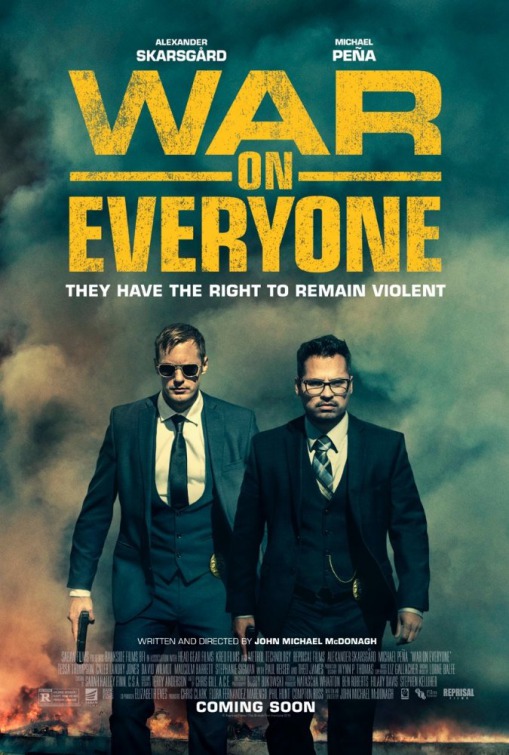
With a title like “War on Everyone,” you might expect something along the lines of a Donald Trump documentary as it seems to perfectly describe his state of mind as he goes about pissing world leaders for no good reason. But it is actually a black comedy, with special emphasis on the word “black.” I find black comedies endlessly fascinating because, when they are done right, filmmakers can get me to laugh at things I have no business laughing at any other time or place. Every once in a while, we need a comedy with a bit of edge as movies can’t afford to be polite or politically correct all the time.
Having said that, “War on Everyone,” despite having a very talented filmmaker behind the camera and terrific actors in front of it, proves to be a big disappointment. There are some clever lines of dialogue here and there, but while writer and director John Michael McDonagh is in love with his own words and story to where the fun he had with his material seemed contagious, this fun does not translate over to the audience. Considering the talent involved, it should have been so much better.
Terry Monroe (Alexander Skarsgard) and Bob Bolano (Michael Pena) are police detectives who are infinitely corrupt and do not allow rules and regulations to get in the way of blackmailing criminals who make the mistake of making a left turn into Albuquerque, New Mexico. Like Alec Baldwin in “Miami Blues,” they rob from people who rob from people, but they don’t give the money back to the poor. They are always on the lookout for a big payoff to help finance houses and apartments no cop could possibly afford on their own salary and pay for video games their kids will waste countless hours on.
But then they run afoul of British crime boss and unrepentant junkie James Mangan (Theo James), and he is not the average law-breaking citizen they typically deal with. Soon, Terry and Bob find themselves in a desperate situation which eventually becomes less about money and instead about settling a personal score.
McDonagh previously gave us the critically acclaimed buddy cop comedy “The Guard” as well as one of my favorite movies from 2014, “Calvary.” The latter made me very eager to check out “War on Everyone” as he looked like he could do no wrong. But this movie falls apart from the get go as the majority of the material left little in the way of laughs, and we get stuck with a couple of characters who frankly nowhere as interesting as McDonagh wants them to be,
Now characters don’t have to be likable for a movie to work, but they do have to at the very least be interesting. Terry and Bob feel more like they are made out of spare parts left over from a dozen other cop movies to where they barely exist as human beings. I didn’t care about their plight nor did I care about whether they lived or died. These are just two guys who hate everything and everybody in equal measure, and there isn’t much more to them.
It’s especially frustrating to say this because Skarsgard is typically a strong actor, and Pena is awesome in just about any movie he appears in. But Skarsgard is forced to play a character who is perpetually drunk and careless about life, and the only thing notable about him is his love of Glen Campbell music. As for Pena, he has terrific comedic skills but is unable to lift the material he has been given out of the dreary depths it is stuck in. In fact, he proves to be funnier in the trailer for the upcoming “CHiPS” movie than he does here, and that one looks terrible.
The other big problem with “War on Everyone” is the tone seems to be all over the place. McDonagh can’t seem to decide whether he wants the material to be broad or playfully realistic and, as a result, it feels like the other characters seem to be occupying different movies while inhabiting the same one. Caleb Landry Jones plays a jittery strip club manager named Birdwell, but he’s a little too edgy to where I wasn’t sure whether to laugh at or be fearful of him. Malcolm Barrett plays Reggie X, a black Muslim and ex-con, and his character goes in different directions to where it felt like McDonagh couldn’t decide what to do with him. Theo James plays Mangan as your typically cold villain to where any jokes he has fall flat because his performance feels depressingly one-note. And then there’s Paul Reiser who is wasted in a small role as Stanton, Terry and Bob’s boss. When Reiser isn’t able to make material like this funny, you know you’re in trouble.
“War on Everyone” feels like a jumble of ideas and situations which can’t find a cohesive plot on which to lay them on. It really sucks to say this because I still think McDonagh is a very talented filmmaker, and I have confidence he will bounce back from this misfire quickly. It’s clear he has watched a ton of cop movies and TV shows, but his screenplay feels like he threw a lot of elements in the air and then pinned them down at exactly where they landed.
This movie is being released a couple of weeks after Donald Trump became President, and it’s hard to watch it without thinking of how he has treated various ethnicities throughout the world (Muslims and Mexicans in particular). It’s hard to laugh at or with Bob and Terry as they spout off their objections of criminals based on the race or background as we are forced to deal with a new era of politics, so the timing of this movie’s release is unfortunate. Still, had it been released before all the Trump hoopla, I’m not sure it would have made much of a difference.
There are a number of great black comedies worth checking out like Martin Scorsese’s “After Hours” or Jody Hill’s “Observe and Report,” which coincidentally co-stars Pena, and they are far more worth your time than “War on Everyone.”



 The Ultimate Rabbit