‘Megalopolis’ – A Beautiful Mess, and I Liked It
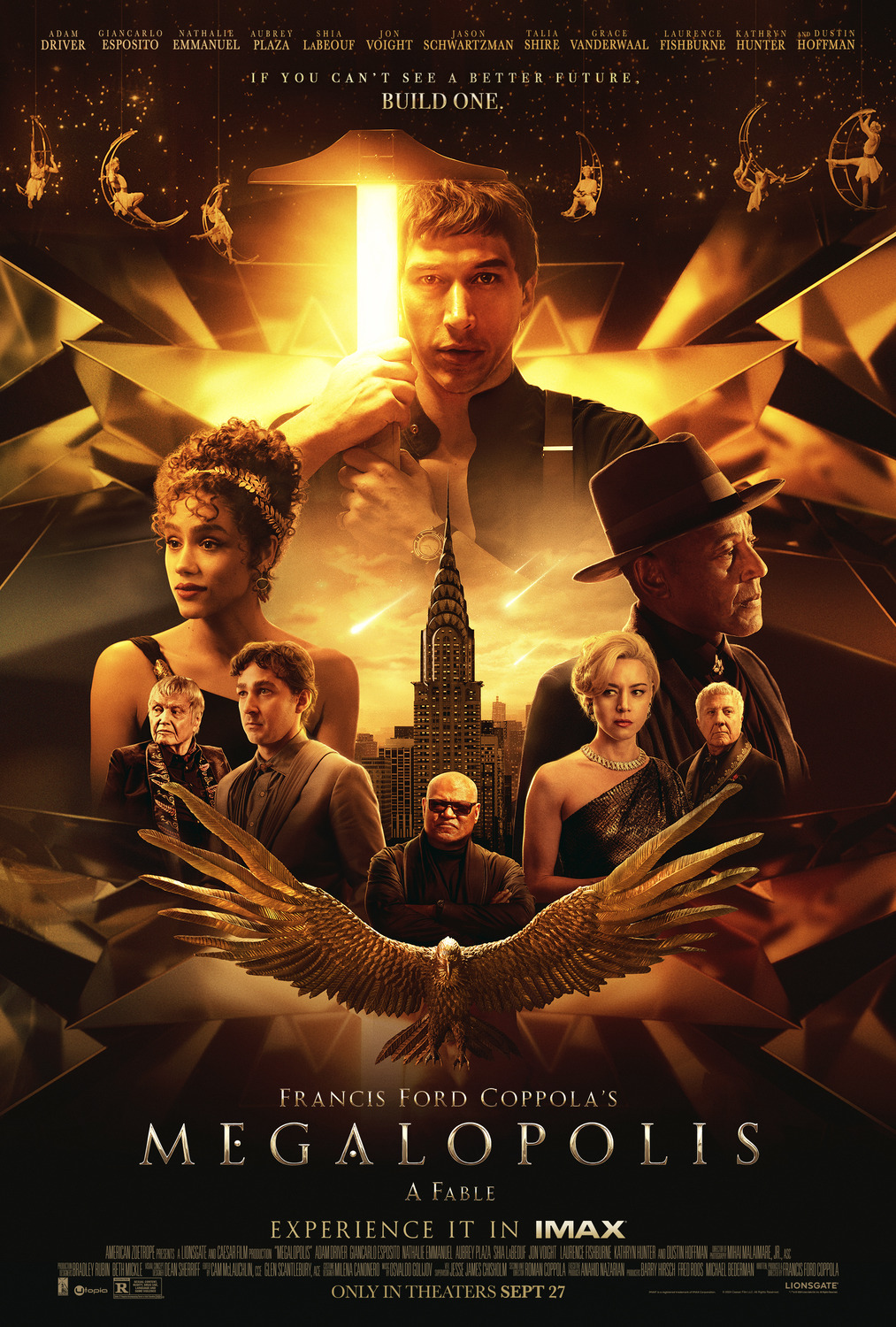
So, help me, I liked “Megalopolis.” Francis Ford Coppola’s passion project which has been decades in the making. It was finally unleashed unto the world at large, and the reviews have been incredibly polarizing as audiences were either enthralled or baffled by what they witnessed. it was pretty much considered a box office bomb in advance as studios had no idea of how to promote it, and it debuted with a terrible $4 million gross which looks horrid for a film with a $120 million budget. But while it has been met with the same critical and commercial derision as another Coppola film, “One From The Heart,” was greeted with back in 1982, it shows he has no fear or shame in taking grandiose risks with the material given to him.

Going into “Megalopolis,” I was determined to watch it with as open a mind as possible. Judging from the many Hollywood studios’ collective refusal to promote or market it, I assumed this would be a genre defying motion picture since no executive had a clear idea of how to sell it. I also did not go in expecting something along the lines of “The Godfather” or “Apocalypse Now.” Those classic films were their own things, and this one is quite another.

What I discovered was a cinematic mess, but it’s an enthralling mess with many ideas on its mind and beautiful visuals few other filmmakers could pull off. Seeing it with an audience, some of which did walk out on it, made it all the more entertaining as everyone really got into it, for better or worse. Like Richard Kelly’s “Southland Tales,” I really dug the heedless ambition Coppola brought to this long gestating project, but “Megalopolis” is a bit better as the story is a little more understandable and easier to get the gist of.

The film, which is described as a fable, is set in an alternate version of America where New York City has been rechristened as New Rome. Crime is terrible and poverty is rampant while the rich revel in their decadent desires. Then along comes Cesar Catalina (Adam Driver), a futuristic architect whose invention of the Megalon, a new bio-adaptive building material, offers a great change to the world. His plan is to use it to build a futuristic utopian city of his design. He also has the ability to stop time in its track, which gives no meaning to the term, “time stops for no one.”

But, as Nick Nolte once said at a press conference I attended, “there will always be change and there will always be resistance to change.” The resistance comes from corrupt New Rome Mayor Franklyn Cicero (Giancarlo Esposito) who prefers to keep the status quo the same as it ever was where the rich get richer, and the poor get poorer and like the average New York mayor, Cicero is constantly booed by the citizens he zealously yields power over. Even as the crowds jeer him, he still smiles that big smile of his which makes me wonder if he is ignorant, hopelessly naïve, or just a narcissist.

Now I am sure you guessed it already, but the Roman names are intentional as Coppola is comparing the fall of Rome to what America is going through, and he was influenced by the Catilinarian conspiracy when he wrote the screenplay. That conspiracy involved a coup back in 65 BC when Lucius Sergius Catilina attempted to overthrow the Roman consuls of Marcus Tullius Cicero and Gaius Antonius Hybrida, and forcibly assume control of the state. it is clear both Catalina and Cicero want a measure of power over the citizens of New Rome, and neither will let anything stand in their way in obtaining it.

Another character making a play for political power is Clodio Pulcher (Shia LaBeouf who is especially lively here), Catilina’s resentful cousin who looks to embarrass him in the most unforgettable ways possible. He looks to win the New Rome citizens over by starting a campaign which invites comparisons to the term “Make America Great Again.”

There is a lot more I can tell you about “Megalopolis’” story, but there is honestly enough for several movies here. As a result, watching it once is not nearly enough for me. There are a lot of plot threads which go in various directions, and while some may say this film does not have enough of a center, I think it does. Perhaps it will take some time to put all the pieces together when it comes to this passion project. Or, if Coppola lives long enough, we will get another cut of the film as he likes to fiddle around with his previous works.

Some have expressed fierce criticism over how the actors seem to be acting in different movies here as the performances range from natural to utterly theatrical. Indeed, there are a various number of acting styles clashing with one another here, but I was not really bothered by this. Considering how divided America has become in the past decade or so. We have citizens accepting one reality while others are accepting its polar opposite. As a result, the conflicting styles this motion picture has to offer us made a lot of sense to me.

Adam Driver makes Catilina into an especially compelling character like he always does, Jon Voight does some of his best work in a while as Catalina’s wealthy uncle, Crassus, who has more tricks up his sleeves than the actor would ever be quick to let on. Nathalie Emmanuel, who plays Julia Cicero, Catalina’s love interest and Cicero’s daughter, and does a great job of further emphasizing the intense conflict between the two men.

But if there is a most valuable player to be found in “Megalopolis.” It is Aubrey Plaza who portrays Wow Platinum, a television personality who goes from being Catalina’s mistress to Crassus’ lover and wife as she desires nothing more than money and power, and it becomes crystal clear what she will do to get them. Plaza is given free rein to chew the scenery every which way she likes. there is no forgetting her presence once you walk out of the theater as she revels in portraying such a despicable Lady Macbeth-like character.

What else can I say about “Megalopolis” that I haven’t already? Yes, it is a mess full of ideas which Coppola has spread all over the place, and there are flaws which are quite glaring. Still, it is an infinitely creative piece of work. The visual effects serve the material without overwhelming it, and there is an unforgettable beauty in the color scheme Coppola employs here.

I have no shame in giving “Megalopolis” a positive review. No, it is not Francis Ford Coppola’s masterpiece (for me, that would be “The Conversation”), but it was great fun seeing the famed filmmaker and winemaker swinging for the stars. He walks a tightrope throughout, taking risks and challenges along which most directors would never do today.

“Megalopolis” is very, very earnest in its designs as Coppola leaves us with a plea for peace and a world which everyone regardless of class and creed can fully benefit from. This may seem like a pipe dream considering how the world is currently tearing itself apart due to religious or ideological differences, but it is a memorable epitaph, should this film be his final work.

And at the very least, we will always have Adam Driver’s unforgettable delivery of “da club.”

* * * ½ out of * * * *

‘Spectre’ – The Global Criminal Organization Returns to Haunt James Bond in the New Millennium

WRITER’S NOTE: The following review was written in 2015.

James Bond fans will be thrilled to know that the gun barrel sequence has been returned to the opening of this latest 007 adventure. For the past few Bond films, it has been relegated to the end to make clear just how rebooted this long running franchise became when Daniel Craig came on board to fill that tuxedo and enjoy the shaken, not stirred martinis. But now it precedes the action-packed prologue, and it’s just as well because “Spectre” aims to be more along the lines of the classic 007 adventures where the suave spy does battle with a secret organization which is bent on world domination and ends up seeing so much more than the NSA does on a daily basis. Still, it does have a strong focus on character as the past continues to haunt Bond to where the dead are not really dead.

First, let us get this out of the way: Is “Spectre” better than or as good as “Skyfall?” No, but this was kind of a given since the previous installment reached such extraordinary heights which the average Bond film usually never reaches, and this includes grossing over a billion dollars at the box office. In the end this did not matter much to me because, on its own, “Spectre” is a compelling and thrilling movie which reunites Craig with the brilliant Sam Mendes whose work on the last installment was impeccable. With this latest Bond film, they both are determined to dig even deeper into 007’s fractured and turbulent history, and it reintroduces us to certain character types and criminal organizations which defined many of the early Bond adventures.

After a thrilling action-packed opening sequence in Mexico, one of this franchise’s very best by the way, Bond is informed by M (Ralph Fiennes) he is being suspended from duty as his mission there was not authorized by him or the British government. However, we later learn he received a cryptic message from a previous mentor informed him to kill a man in Mexico and attend his funeral in Rome, and this is just the beginning to his uncovering the criminal organization whose name is an acronym for Special Executive for Counter-intelligence, Terrorism, Revenge and Extortion. Suffice to say, they got everything covered.

Mendes hasn’t lost a step here, and he is also served well by cinematographer Hoyte van Hoytema (“Interstellar”) who gives even the dirtiest scenes an inescapable beauty. This movie also has a great opening and unbroken shot which lasts several minutes as we watch Bond attend a Day of the Dead parade, head upstairs with a lovely lady presumably to bed, and then he suddenly goes out the window in pursuit of his latest nemesis who has seriously pissed off her majesty’s secret service.

The main villain is Franz Oberhauser, and he is portrayed by the brilliant and endlessly entertaining Christoph Waltz. This is the same actor who gave us one of the most fiendish villains in cinematic history in Quentin Tarantino’s “Inglourious Basterds,” but he’s not out to replay Hans Landa here. When we first see Franz, he doesn’t even have to speak up or raise his voice to show how powerful he is. Everyone simply stands at attention, and no one questions his decision making at any point. This makes Waltz’s job even easier as his character clearly exerts a power very few bother to question. Some claim he is too quiet in his first scene, but for him to yell at everyone or shout to keep everyone in place would strike me as being desperate to keep everything under control. Franz doesn’t need to do this because everything has long since come under his control.

As for the Bond women (calling them Bond girls does not feel the least bit appropriate anymore), they are played by Monica Bellucci and Lea Seydoux. Bellucci plays Lucia Sciarra, the widow of an assassin killed by Bond, and she mesmerizes us in the far too few minutes she appears onscreen. Bellucci is said to be the oldest Bond woman ever, but does this really need to be pointed out? I don’t care how old she is because she still sizzles and holds her own against Craig even as he seduces her to the audience’s delight.

Seydoux is best remembered from her role as the beautiful but cold-hearted assassin in “Mission: Impossible – Ghost Protocol,” and here she plays Dr. Madeleine Swann, a psychologist who has a link to a person Bond dealt with in the past. She proves to be a strong Bond woman here as she brings up her tragic upbringing which has informed her defensiveness around those she doesn’t know very well, and she makes clear of how she has a strong dislike of guns. She’s a wonderful presence here, and she and Craig make quite the couple.

Dave Bautista co-stars as Mr. Hinx, a character designed to spark our nostalgic memories of Oddjob. Mr. Hinx is a henchman of few words, but his actions speak a lot louder than his words and leave a lot of damage in his path. This is not a henchman content with throwing a hat around as his hands do all the work and leave quite the impression.

Ralph Fiennes confidently fills the shoes of Dame Judi Dench’s M as Mallory, and like the previous head of MI6, Mallory finds he can control Bond as well as she could, which is to say only so much. Naomie Harris returns as Eve Moneypenny who has since settled in to becoming M’s assistant, Rory Kinnear remains reliable as always as Chief of Staff Bill Tanner, Jesper Christensen reprises his role as Mr. White from previous installments, and Ben Whishaw steals every single scene he’s in as Q. Seriously, watching Whishaw is such a delight this time out as he infuses the role with a wonderfully dry sense of humor as he reminds Bond of how he has a mortgage and two cats to feed.

And, of course, Mendes brings back composer Thomas Newman to give “Spectre” an emotional and propulsive film score which will has me eagerly awaiting its release on compact disc. I especially enjoyed his collaboration with the Mexican contemporary classical percussion group Tambuco on the music they composed for the Day of the Dead scenes. As for the theme song “The Writing’s on The Wall” which is performed by Sam Smith, it’s good but nowhere as priceless as Adele’s “Skyfall.”

But let’s not leave out the man of the hour, Daniel Craig. Ever since he made his debut as 007 in “Casino Royale” he has not only made this iconic role his own, but has also given Ian Fleming’s classic character a humanity and a depth his predecessors hoped to give as much of. His respect for Bond is never in doubt as he brings 007 around full circle to where we learn even more about his past than we did previously, and how it has come to define his present state in life. It’s still up in the air as to whether this will be Craig’s last time playing the famous British secret agent who likes his martinis shaken, not stirred, but I have to believe he has at least one more Bond film left in him.

How you come to view “Spectre” may depend on the kind of expectations you bring to it, and it’s hard not to have high expectations after the brilliant “Skyfall.” Do yourself a favor and leave them at the door and just enjoy it for what it is; a gorgeous and extravagant Bond film which, while a bit too long (editor Stuart Baird is missed here), has us wondering where 007, a man who another character describes as being a “kite dancing in a hurricane,” will go from here.

* * * ½ out of * * * *