About Time

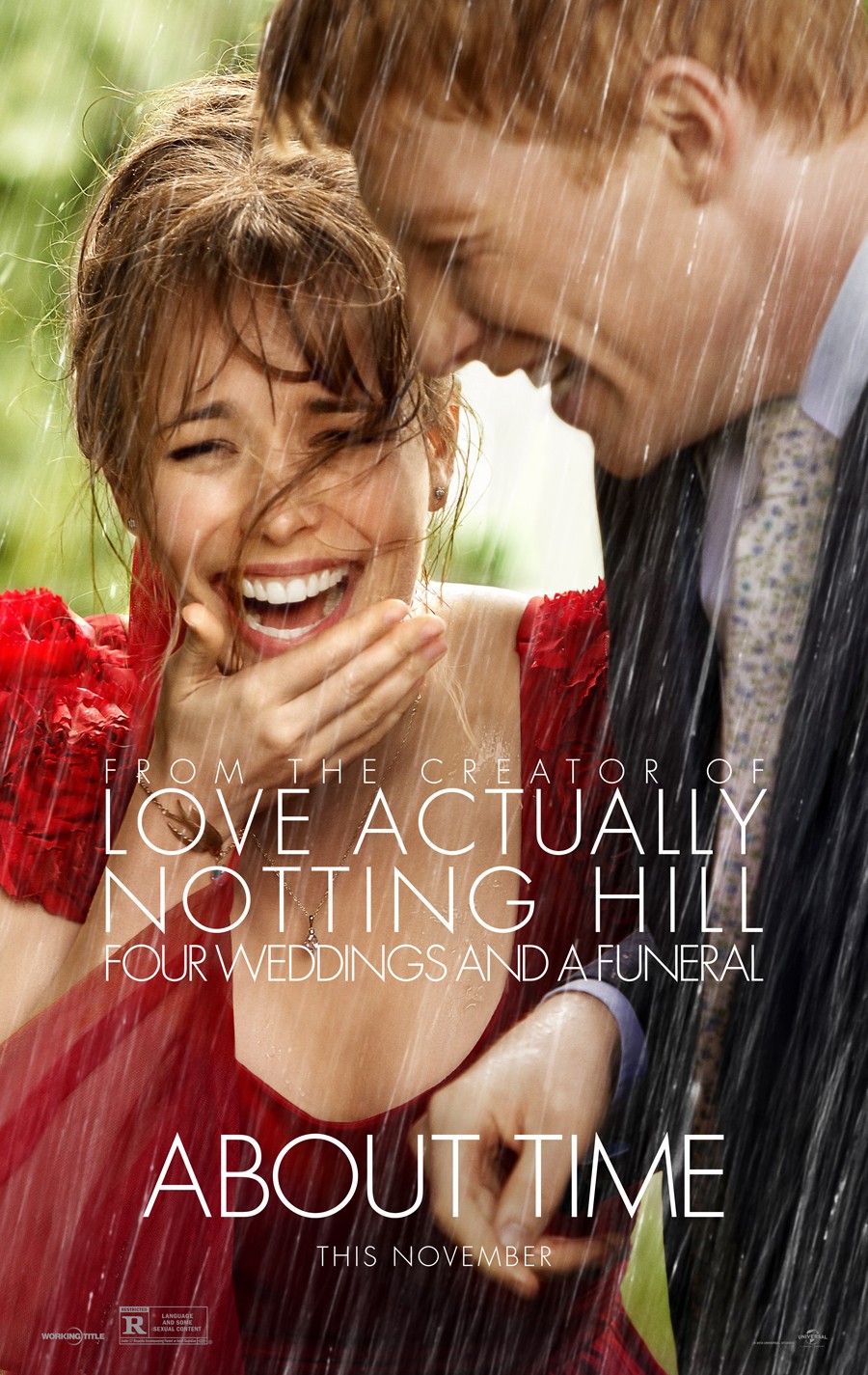
About Time movie poster

Those who know me best know I typically cannot tolerate romance movies. Sure, there are exceptions like “When Harry Met Sally” and “(500) Days of Summer,” but I usually find most of them to be unforgivably manipulative, inherently cheesy and full of cringe inducing dialogue. As a genre, I typically avoid it whenever possible, so my enthusiasm for “About Time” was not at an all-time high. But then I noticed a familiar name on the movie’s poster, Richard Curtis. This is the same man who wrote the screenplay for “Four Weddings and a Funeral,” one of the few romance movies which actually had me on the edge of my seat, and he also wrote and directed “Love Actually” which has become my dad’s favorite film to watch on Christmas Eve. As a result, my excitement for this movie suddenly went up to an unexpected height.

“About Time,” on the surface looks, like the kind of romantic comedy where a man and woman get together, fall in love and then break up only to become a couple again by the movie’s end. But the fact is its trailer doesn’t do the movie any justice. The story ends up becoming more than the usual romance, and it ended up go in directions I didn’t expect it to. Curtis is obviously aware of the trappings inherent in this genre, and he succeeds in avoiding them and gives yet another film which is genuinely moving and full of characters who are relatable and refreshingly down to earth.

The main character of this romantic tale is Tim Lake (Domhnall Gleeson), a 21-year-old desperate to have a girlfriend in this lifetime. His attempts at getting a kiss on New Year’s Eve don’t work out as planned, and it only adds to his self-deprecating attitude which he has clearly spent years perfecting. He can’t even capture the heart of his sister’s best friend Charlotte (Margot Robbie) who is quite the looker.

Before he heads off to London to become a lawyer, Tim’s dad (played by Bill Nighy) lets his son in on a little secret: the men in his family have the power to time travel. All Tim has to do is go inside a closet, clench his fists tightly and think about a place he wants to go to, and suddenly he’s there. He immediately tests this time travel power out and goes back to New Year’s Eve to get the kiss he missed out on, and from there he uses it to benefit himself and those closest to him whenever possible.

Now on the surface this seems like a silly plot for a movie, and the Bill Murray comedy “Groundhog Day” quickly came to mind as I watched “About Time,” but Curtis has not given us the typical time travel movie here. In fact, the time travel aspect gets pushed more and more into the background as Curtis aims to focus on not one but two love stories.

Tim ends up meeting an American woman at a blind dating restaurant where everyone is served food in the dark, and through their conversations they form a connection which becomes unbreakable. Once he gets outside and back into the light, he discovers the person he spoke with is the beautiful but insecure Mary (Rachel McAdams), and their moment on that quiet London street had me rooting for them to make this relationship work.

The other love story in “About Time” is between Tim and his dad, and I found it to be the most moving part of this movie. At first it looks like they have the usual father-son relationship where the father gives his son life advice and the son takes it with a grain of salt, but their relationship feels a lot more real than those I have seen in recent movies. Once Tim learns his dad is headed for a certain fate he can’t escape from, their relationship becomes even deeper and you dread the moment these two people will have their last ever conversation.

Are there some logistic problems with the time travel aspect of this movie? Probably, but I didn’t care. It serves as an interesting plot device as Tim accidentally erases his initial encounter with Mary after helping a friend, and he ends up having to make her fall in love with him all over again. It’s also amusing to watch Tim try to improve on certain moments in his life with Mary like when they have sex or when he proposes marriage. Heck, we’d all love to have the power to undo the more embarrassing moments in our lives, and I got a huge kick out of Tim undoing his.

But the time travel device does serves to illuminate one of the movie’s main themes which is to not be overly concerned with the past or the future, but to instead stay in the present and take pleasure in every moment. This is what I love about Curtis’ movies, how he takes the most mundane, ordinary things and turns them into a thing of beauty. They are the things in life we take for granted and don’t always take the time to appreciate. By the movie’s end, Curtis makes us realize this, and we come out of “About Time” with an upbeat look on life we don’t always have.

The other thing I’ve come to love about Curtis is how populates his films with multi-dimensional characters we can relate to. The thing that drives me nuts about a lot of movies, especially ones from the romantic genre, is how they give us characters that are doing so much better than the rest of us, and it gets to where we just believe that all these problems with love only happen to successful white people. Curtis, however, continues to give us the most memorable characters we could ever hope to meet in our lifetime.

It also helps that Curtis has quite the cast to work with. Domhnall Gleeson, whom you might remember as Bill Weasley in “Harry Potter and the Deathly Hallows,” is terrific in the way he radiates that Hugh Grant awkwardness as his character goes from being unlucky in love to being very lucky in life. As for Rachel McAdams, I’m trying to remember the last time I found her to be so radiant in a movie. McAdams does some of her best work here as Mary, and every time she smiles it just fills your heart with joy. There’s also some nice performances from Lydia Wilson as Tim’s wayward sister Kit Kat (yup, that’s her name), Lindsay Duncan as Tim’s mom, and the late Richard Griffiths has a wonderfully memorable moment as an actor who doesn’t need help memorizing his lines and will bluntly let you know this.

But the best performance in “About Time” comes from Bill Nighy who portrays Tim’s dad (we never learn his character’s real name). It’s the simplicity of his performance which really gets to you as he never overplays or underplays the character. He never tries to go for that “Oscar moment” which the Academy easily goes crazy over for all the wrong reasons. Nighy doesn’t give us an extraordinary man or a boring father. Instead, he just gives us a man and a dad who is no different from the one we’ve grown up with, and he makes it so, when we watch him, we can’t help but think of our own dad.

Seriously, “About Time” moved me to tears. The only other movie this year I’ve cried after was Terrence Malick’s “To the Wonder,” but that’s mainly because he just had to use Henryk Gorecki’s “Symphony of Sorrowful Songs” which remains the saddest piece of music I have ever heard. With this film, Curtis reminds you of how the simple pleasures in life can often be the greatest, and of how you need pain in order to better appreciate happiness. There are a lot of movies out there which try and make you see this, but few filmmakers these days can make us appreciate this as much as Curtis does.

It’s a bummer to hear Curtis say “About Time” will be his last film as a director. He’s not leaving the movie business, but he is going to spend more time on the charities he works for. Still, it’s hard to think of any director, other than Mike Newell, who can better convey Curtis’ views on life as well as Curtis. Here’s hoping he changes his mind at some point in the future.

* * * * out of * * * *

Fifty Shades of Grey

fifty-shades-of-grey-movie-poster

I have not read E.L. James’ book “Fifty Shades of Grey,” but I have yet to hear anyone I know say a good thing about it. But after watching Sam Taylor-Johnson’s cinematic adaptation, I think I understand why it became such a literary phenomenon. It allows its readers to visualize sexual fantasies they don’t get perform in their own lives as the two main characters engage in a sadomasochistic relationship which appears alarmingly pleasurable. The question, however, is this, can the individual erotic desires James’ book conjures up come even close to equaling what we see in this long-awaited film adaptation? The answer is no, not even close, and I’m certain you don’t have to have read the book to confirm this.

Fifty Shades of Grey” is essentially a big tease of a movie which promises so much naughty stuff but instead ends up giving you very little if anything. It’s like the girl who kept teasing you in high school, and of course, you fell for her charms when you should have known better (don’t ask me how I know this). I came in with low expectations, and it proves to be a hilarious comedy for all the wrong reasons. But long before its climax or lack of one so to speak, I found myself becoming increasingly bored and started to wonder if this movie would ever end. When it finally did, I found myself breathing a huge sigh of relief.

We come to meet college student Anastasia Steel (Dakota Johnson), an English literature major on the verge of graduating when she is offered the opportunity to conduct an interview with the infinitely wealthy business entrepreneur Christian Grey (Jamie Dornan). Sparks end up flying for them instead of the audience, and while it takes far longer for them to kiss for the first time, it eventually allows Christian to bring Anastasia into his inner sanctum which includes a room filled with all the BDSM equipment you could ever hope to find or see so beautifully maintained.

Does Anastasia end up becoming the submissive to the dominant Christian? The answer seems fairly certain, but the movie takes forever to get to that point as Christian keeps encouraging Anastasia to sign a contract which will allow him to do the craziest things to her. It got to where I wanted to yell at the screen, “SIGN THE DAMN CONTRACT ALREADY!!!” Granted, Anastasia’s hesitation to do so is understandable and smart, but it just makes her inaction all the more tedious to endure. To encourage her, Christian does several things like buying her a new computer and a new car, selling her old one off in the process, and showing off the cars in his building’s garage. I kept waiting for Christian to reveal himself as a serial killer, but to do so would have threatened to make this movie interesting.

Perhaps it’s a mistake to come into “Fifty Shades of Grey” expecting anything truly realistic as it seems to exist more in a fantasy world than the real one. Still, I can’t help but wonder how Christian Grey finds the time to engage in any kind of sadomasochistic activity when he runs the kind of business which should keep him fully occupied 24/7. Then again, he does have plenty of time to work out at the gym so he can show off those six-pack abs you know he has hidden underneath his shirt.

Regardless of how I feel about Anastasia as a character and of her foolish descent into Christian’s twisted lifestyle, Dakota Johnson, the daughter of Don Johnson and Melanie Griffith, proves to be quite a good actress. I liked how she was able to convey a variety of emotions without having to say a word, and she is able to show her character’s longing while her co-star is unable to do so, which is putting it nicely. With the right role in the right movie, she may end up with quite the career as an actress, and she looks to be capable of doing so much better than appearing in this piece of dreck.

As for her co-star, Jamie Dornan who plays Christian Grey, watching him reminded me of a scene in “The Shawshank Redemption” when Red described Andy Dufresne as a guy who “looked like a stiff breeze would blow him over.” Watching “Fifty Shades of Grey,” I can’t help but think Dornan was cast just for his good looks. From start to finish, he comes across as so emotionally vacant to where I wondered if he was capable of exhibiting any kind of emotion at all. His face looks like it is frozen in place, and not even sex can seem to thaw it. Dornan does, however, have the best line when he says he’s “fifty shades of f**ked up,” and that line effectively sums up this whole movie.

Among the other things which cripple “Fifty Shades of Grey” is the fact that Johnson and Dornan don’t have much chemistry. Romantic relationships in movies thrive on the stars having some form of it, and this isn’t the case here. Rumor has it that they didn’t get along behind the scenes, and this shows here regardless of the studio’s efforts to hide the truth. Then again, it must be somewhat difficult to have chemistry when one lover punishes the other lover physically in order to feel anything.

Director Sam Taylor-Johnson only has one previous credit which is “Nowhere Boy,” a film which chronicles the childhood experiences of John Lennon. I haven’t seen it, but I’m certain my friend Trevor, a huge John Lennon fan, has many great things to say about it. But whatever great things she was able to accomplish with “Nowhere Boy” is not on display here as she succeeds in making the most sleep-inducing erotic movie ever. The sex scenes come way too late and are very unimaginative. Christian running an ice cube down Anastasia’s stomach? We’ve seen that before. As for Taylor-Johnson’s song selections which include “I Put a Spell on You” and “Beast of Burden,” they are far too obvious even if the former is sung by Annie Lennox.

“Fifty Shades of Grey” marks the first erotic studio movie Hollywood has released since “Unfaithful” which came out back in 2002. This movie represented a chance for Hollywood to deal with sexual relationships more frankly than others have in recent years, but it instead proves to be an astonishingly chaste motion picture which seems stunning considering the source material. Late night movies on Cinemax and Showtime have far more erotic power than this one (don’t ask me how I know this either), and the sex scenes are so sterile looking that it feels like they were shot in Irvine, California. The marketing department did a brilliant job in titillating moviegoers into thinking they were getting some sexy stuff they won’t find on the internet (unless they look in the right places, of course), but we went through the same thing with “Showgirls” and look what happened there. “Fifty Shades of Grey” ends up making Paul Verhoeven’s camp classic look like “Vertigo.”

Seriously, there are so many other movies that are far better than this piece of crap and which deal with sadomasochistic relationships in a healthier and far more sensual way like “Secretary” which starred James Spader and Maggie Gyllenhaal, and “The Duke of Burgundy” which is from the director of “Berberian Sound Studio,” Peter Strickland. What depresses me is audiences are going to flock out to this adaptation than they will to other movies far more worthy of their time and money. Some books translate well to the silver screen, but this one should have stayed on the written page. Then again, when a book like “Fifty Shades of Grey” sells an incredible amount of copies, why stop there?

* out of * * * *

Exclusive Interview with Carlos Marques-Marcet on ‘10,000 Km’

carlos-marques-marcet-photo

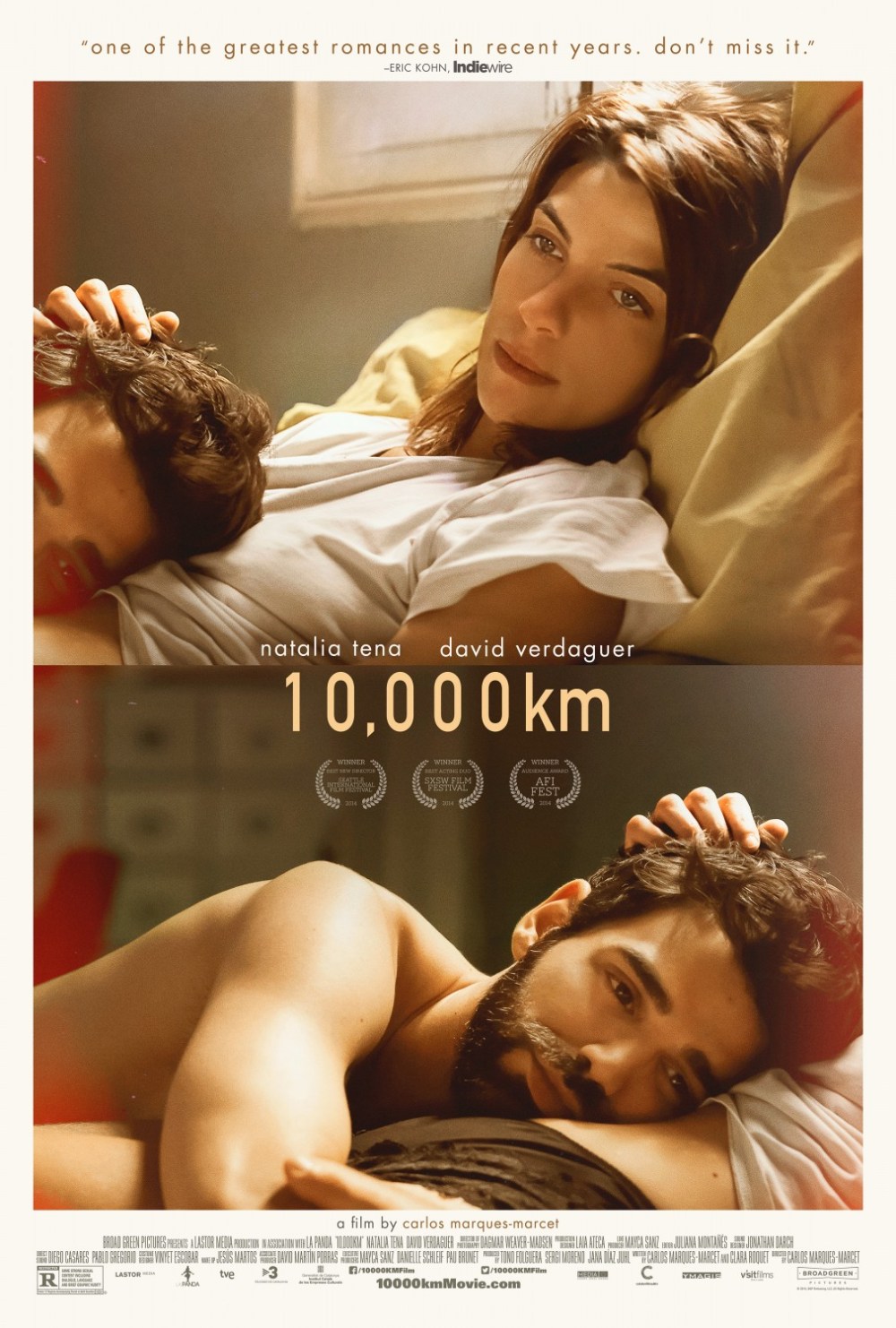
The thought of a long-distance relationship is frightening as it thoroughly tests the bond between a loving couple to where it looks like they are destined for disaster. One relationship is put to this test in “10,000 Km,” a romantic drama co-written and directed by Carlos Marques-Marcet.

Alexandra (Natalia Tena) and Sergi (David Verdaguer) are a loving couple living in Barcelona, Spain, but they also struggle to balance out their careers while trying to start a family. Then Alexandra accepts a one-year residency in Los Angeles which could really jump start her photography career, and Sergi has no choice but to stay in Barcelona where he works as a teacher. Luckily, they have modern technology which allows them to keep in touch on a daily basis, but what is helping to keep them together may also tear them apart.

“10,000 Km” proved to be a powerful meditation on the struggle of a long-distance relationship, and it starts off with a scene which lasts several minutes and captures the characters in their most intimate state. I got to talk with Marcet while he was in Los Angeles, and he talked about how that scene came about and how long it took to shoot. In addition, he also clarified how much of the movie was shot in Spain and Los Angeles, how he came to cast Tena and Verdaguer, and of how he kept the actors separated during shooting.

10000-km-poster

Ben Kenber: It’s interesting to see how this relationship evolves once the two lovers are separated by continents and use technology to keep in touch with one another. Was it hard to balance out the benefits of technology with the human element in this movie?

Carlos Marques-Marcet: No. We knew from the beginning that the driving point was to portray the relationship which derives from the human element. The technology was the tool and the human part was the means somehow, so it wasn’t so much about finding a balance but trying to see how to use these tools to convey the means.

BK: The opening sequence of “10,000 Km” is amazing as it lasts several minutes and features the two lovers being intimate with one another, and then one of them receives an unexpected job opportunity. How did you go about setting the scene up?

CMM: It was a long process to arrive there. It was originally not such a long scene, but then we looked at the script and it suddenly made sense to have this very long scene where you see them together. It’s a two shot of them and you are with them, then afterwards the rest of the movie we shot over shot because they have no other possibilities. There’s a symbolic element to it, this raw thing of being with two people together that weren’t there together. The making of it involved a lot of preparation. The location was the producer’s house, so I knew where I was going to shoot. It was a combination of working with all the departments, the actors and rehearsing. It was like a dance.

BK: This scene must have taken a very long time to shoot.

CMM: 17 takes and three days of shooting. We planned it and we wanted to do it with the dollies. There was no handheld camera. We wanted it to be grounded to the ground. I think it was an interesting way of how to go about it.

BK: Natalia Tena and David Verdaguer are both terrific in this movie. What was the casting process like?

CMM: So basically, we found David about a year before shooting. I had just graduated from UCLA and I didn’t want to shoot another short. I just took a couple of scenes from the movie and shot them just as an experiment with another actress. I watched a lot of You Tube videos and interviews. I like to see how actors move and how they talk, and I was looking for another actor, not David, and then I saw him in this video he made with a cell phone of two friends. Then I saw that he was an actor and I proposed to my producers that we bring him in for casting, but then it turned out that he’s actually known as a comedian. I had no idea. He’s like a “Saturday Night Live” comedian. Actually, he’s done a lot of theater, very serious theater, but people love him for his comedic aspect. But then he came into the casting process, and it was a very long casting process with two people for hours. I like to work with the actors instead of just having them come in to read. I like to meet people. It was David for sure, no doubt. And then with Natalia, it was a last-minute thing. We were actually going to shoot with another actress and she had to cancel, and when we finally found Natalia it was like a miracle. It was very clear that they had chemistry, and they became very close friends instantaneously.

BK: When it came to shooting the scenes when she’s in Los Angeles and he’s back in Spain and they are using Skype to keep in touch with one another, did you purposely separate the actors?

CMM: Yeah. Originally I wanted to shoot it in Los Angeles and in Barcelona at the same time, but Natalia had some scheduling conflicts. It wasn’t that cheap to do it. I wanted to shoot it in my own house in Los Angeles, but schedule wise it was not possible. So we put them in two different apartments in Barcelona and I actually after shooting the first scene said that it would be nice if they didn’t see each other, but that lasted like two or three days (laughs). After three days I was like it’s fine if they hang out with each other. I wanted to create the feeling of missing somebody, and three days was totally enough. In the end, they were hanging out together every night playing cards, going over the lines and drinking wine, and in the morning they had to be separated. So, for them being in touch every day and then during the day not being able to be together was very frustrating, and I think that shows up somehow in the movie.

BK: When “10,000 Km” begins we see this couple at their most intimate, and they still have that intimacy throughout the movie to a certain extent. I don’t want to give away the ending, but I loved how you ended the movie on an ambiguous note. It’s not the kind of movie that begs for a solid or more definitive conclusion.

CMM: Yeah, that came about during the editing. Actually, the script was much more clear, but while we were editing there was a bunch of dialogue that we decided to take out because I felt that already through the images we could tell what was going on. Then we took it out and then for some people it became more ambiguous than it was in the script. I like it. It was not in the plan of how I shot it. I have my own vision of it, but I also like to let people imagine whatever they want.

BK: “10,000 Km” is not designed to give anyone a definitive answer to whether long-distance relationships can work or not, but I came out of it hoping these two would find a way to make things work out.

CMM: That’s a very optimistic view (laughs). We leave it so that the very optimistic people can think that (laughs).

BK: Despite the scheduling conflicts, were you able to shoot any of the movie in Los Angeles, or was it mostly shot in Barcelona?

CMM: Mostly in Barcelona, and then I shot some of the stuff in LA. There are some shots where you see my home in Echo Park with the webcam and everything, but mostly we shot it in Barcelona. We faked the LA interior in Barcelona. It was not possible to do it the other way around. In Los Angeles, you won’t find interior like you would in Barcelona. I didn’t want to shoot in a studio. I wanted to shoot in a real location so they have the feeling that they are in a house or a real apartment.

I want to thank Carlos Marques for taking the time to talk with me. “10,000 Km” is now available to own and rent on Blu-ray, DVD, and Digital.

Movies My Parents Wanted Me To See: Love Actually

love-actually-movie-poster

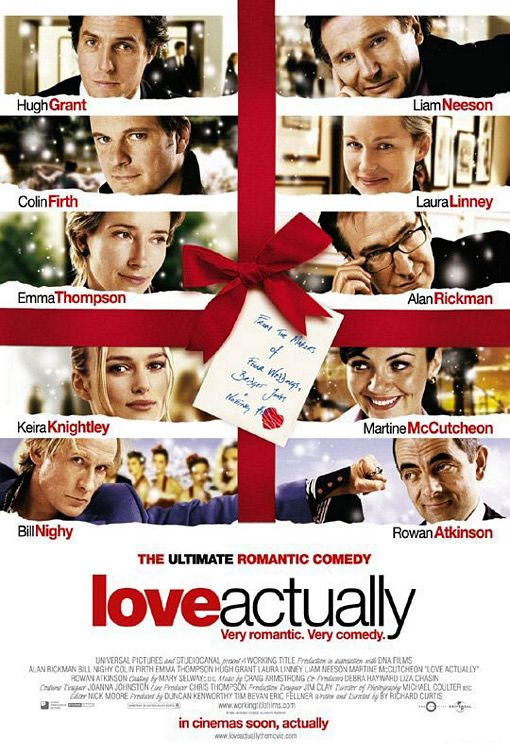
Around Christmas, most families watch “A Christmas Carol” as an annual holiday tradition. Others watch “It’s A Wonderful Life” which I still haven’t seen (don’t ask me why). For my family, their annual tradition is not “National Lampoon’s Christmas Vacation,” but a British romantic comedy called “Love Actually.” I myself prefer “Bad Santa” with Billy Bob Thornton, but I’m in the minority of those in my family who want to see it at Christmas time. Now when it comes to romantic comedies, I usually can’t stand them because they all look the same. But my parents kept begging me to watch it just like they did with “The Big Lebowski,” so I gave in and sat on one of those comfy leather chairs they have. It took me no time to be won over by what was shown onscreen, and it got off to a perfect start with Hugh Grant’s character of Prime Minister David saying:

“Whenever I get gloomy with the state of the world, I think about the arrivals gate at Heathrow Airport. General opinion is starting to make out that we live in a world of hatred and greed, but I don’t see that. It seems to me that love is everywThere. Often it’s not particularly dignified or newsworthy, but it’s always there – fathers and sons, mothers and daughters, husbands and wives, boyfriends, girlfriends, old friends. When the planes hit the Twin Towers, as far as I know none of the phone calls from the people on board weren’t messages of hate or revenge, they were all messages of love. If you look for it, I’ve got a sneaky feeling you’ll find that love actually is all around.”

Now whereas your average romantic comedy focuses on one relationship which goes from its wonderful beginning to its horrific breakup only for those same two people getting back together again, “Love Actually” instead focuses on relationships between eight couples. So basically, we get to view love in all its various stages from where it is just starting for some, become uncertain for others, remains unrequited for the unlucky few, and young love which is typically fret with wonder and the first of many heartaches. You have no clear idea where the movie is going, and this is what makes it so good. You become so enamored of these characters and what they go through, and you feel all the various emotions they are forced to deal with.

“Love Actually” was directed by Richard Curtis who brought to the screen one of the all-time great romantic comedies with “Four Weddings and a Funeral.” Like that one, he keeps a sweet and mostly innocent tone which never becomes overly manipulative as it does in American movies. Plus, he gets nothing but genuine emotions from the actors, and this is a big help to say the least. With a cast as great as this, you can always expect them to make their characters appear as real as they can be.

In describing the various stories, I think it’ll be easier to talk about my favorite moments from the film. One which comes immediately to mind is the story of Juliet (Keira Knightley) who has just married Peter (Chiwetel Ejiofor) whose best man Mark (Andrew Lincoln) videotapes their wedding. There’s one problem, all the footage Mark gets is of her. Watching Keira pick up on this and realize what it means is powerful, and Mark’s reaction to her is perfectly complemented by Dido’s “Here with Me.” Hence the pain of unrequited love comes up again, dammit.

Then you have Alan Rickman, so sublime in every role he plays, as Harry who works as a managing director of a design agency whose secretary Mia is not so subtly hitting on him. However, he is happily married, or so it seems, to Karen (Emma Thompson). Karen’s reaction to the present she didn’t expect to get is a painful one to witness. Thompson, dare we ever forget, is still an amazing actress who can move you without using words. The things people can tell about others without having to spell it out represents how good the screenplay is.

The hardest actor to watch in “Love Actually,” however, is Liam Neeson as we see his character trying to move on after the sudden death of his wife. You can’t help but think of what happened to his real-life wife Natasha Richardson when Neeson delivers a touching eulogy here to his movie wife. But getting past that, it’s fun to watch the wonderful relationship he has with his stepson Sam (Thomas Sangster) as he convinces him to chase after the girl he pines for. This might seem foolish in hindsight because we don’t want to see our kids get their hearts shattered at such a young age, but it doesn’t make sense to bottle up your feelings forever, does it?

Now while this movie has a wealth of fantastic British actors like any “Harry Potter” movie, a few Americans do find their way into the mix. The most prominent one is the always fantastic Laura Linney who portrays Sarah, a woman tending to her mentally ill brother Michael while harboring an insatiable crush on the devastatingly handsome Karl (Rodrigo Santoro). For such a well-trained stage actress, Linney has such emotionally honest moments which she handles with such delicate subtlety. Seriously, it gets to where you don’t even realize she is acting.

As for Grant, you can always count on him to bring the befuddled nervousness from “Four Weddings and a Funeral” and perform it to sheer comic perfection in a movie like this. I also loved the scene in which he puts the American President (Billy Bob Thornton) back in his place. You’d figure he would be stumbling about, but he plays the Prime Minister after all, and this is a Prime Minister who is not looking for a Bush/Blair relationship. Also, seeing him go door to door looking for the girl who strikes his fancy leads to a comic highpoint where he is forced to sing carols for young kids, and they react as if they were at a Justin Bieber concert.

But the one actor who steals the show in “Love Actually” is the hilarious Bill Nighy who plays the aging rock and roll legend Billy Mack. He is a gift for those who do not want their Christmas movie characters to be overly, if at all, sentimental. The contempt Billy has for himself as he promotes his “festering turd of a record” is somewhat softened by his inescapable sense of humor even when he blatantly acts inappropriately:

“Hiya kids. Here is an important message from your Uncle Bill. Don’t buy drugs. Become a pop star, and they give you them to you for free!”

Colin Firth’s performance as broken-hearted writer Jamie Bennett serves as a reminder of why women still swoon over him ever since he was in “Pride & Prejudice.” Watching him as he professes his love for his housemaid Aurélia (Lúcia Moniz) shows how disarmingly polite he can even while he is clearly scared to death. It’s all funny and touching at the same time. It’s also fun watching him trying to master the Portuguese language which he has the same amount of luck with as Lieutenant Uhura had trying to speak Klingon in “Star Trek VI: The Undiscovered Country.”

There are several other cute stories in “Love Actually” worth taking in like the budding relationship which builds up between John (Martin Freeman) and Judy (Joanna Page). It’s great seeing John talk about how nice it is to have someone to chat with while he and Judy are working buck naked as stand-ins for a sex scene in a movie. It gives new meaning to the term “skip the foreplay.”

Granted, some stories in “Love Actually” get shorter shrift than others, but everything seems to balance out just right. Movies these days tend to be better when they are condensed in structure, but the mix of stories on display here serves to show how powerful love can be to lift us up and tear us down in a heartbeat. I’m so glad this romantic comedy is anything but conventional. There are so many of them out there, several of them starring Katherine Heigel, that it drives me up the wall.

I do have to mention something in particular about the film; when we watch all the characters meeting up at the airport, it is interspersed with images of people meeting their family and loved ones at Heathrow Airport, so happy to see each other. It blends perfectly into the movie and makes you realize just how true to the heart “Love Actually” is in what it portrays. Having written this, I now understand and appreciate why my parents have made watching this movie an annual Christmas tradition.

I still like “Bad Santa” better though…

* * * * out of * * * *

The Choice

The Choice movie poster

Okay, I’ll admit I got choked up at some scenes in the latest Nicholas Sparks adaptation, “The Choice,” and the story took turns I didn’t expect it to. But saying “The Choice” is a better cinematic version of Sparks’ work than “Safe Haven” is the equivalent of saying “Cannonball Run” is better than “Cannonball Run II.” In the end that is faint praise of the very, very faint kind. While the Sparks faithful may find much to enjoy about “The Choice,” it is the usual romantic nonsense which will have you scratching your head more often than not.

The movie stars Benjamin Walker of “Abraham Lincoln: Vampire Slayer” fame as Travis Parker, a perennial ladies’ man who works at his dad’s veterinarian office and yet has all the time in the world to travel around the North Carolina shore on his boat. How this guy makes a living is beyond me as the 40-hour work week doesn’t seem to apply to him. While all his friends have a significant other in their lives, Travis believes having one will seriously cramp his lifestyle for no good reason. But even his sister is quick to inform him how he is in real trouble when a new girl arrives in town.

Next thing you know, we get introduced to medical student Gabby Holland (Teresa Palmer) who has just moved into a small house right next to Travis’, and she becomes incensed when he is sitting outside and blasting Ram Jam’s “Black Betty” on his stereo. These two do not get off to a great start, and Gabby finds herself repelled by Travis’ presence whenever she ends up in the same place as him. But in truth they are having a Han Solo/Princess Leia relationship in which they look like they can’t stand each other, but underneath they are fighting a strong attraction which cannot be denied. Plus, it reminds me of a great dialogue exchange between Iris and Gilbert in Alfred Hitchcock’s “The Lady Vanishes:”

“You’re the most contemptible person I’ve ever met in all my life!”

“Confidentially, I think you’re a bit of a stinker, too.”

Please note: those two characters ended up falling for each other.

While their eventual coming together is no surprise, it is a stunner to see just how quickly Gabby forgets about her long term boyfriend. He’s a doctor named Ryan McCarthy (played by former Superman Tom Welling) who’s a genuinely good man with a great future ahead of him, and Gabby knows he is someone she can depend on. But when Travis enters her life, she finds an excitement unlike any she has previously experienced. Still, it is astonishing how one person can easily forget their significant other in what seems like a heartbeat. Then again, anything’s possible.

From there, “The Choice” goes on a journey which is not as predictable as its poster might suggest, and it reaches a point where you realize why the movie has the title it does. It’s a look at some of the hardest choices one has to make in a relationship, but it ends up being assigned to one character in particular. Travis has to consider his options while Gabby doesn’t have much of a say, and the reasons for this will become clear to you if you decide to subject yourself to what is yet another emotionally manipulative romantic movie.

Somehow it seems ridiculous the choice this movie’s title refers to is up to one person and not others. If more characters were involved, then “The Choice” might have been more interesting than it ended up being, but this is a romantic movie done by the numbers and which serves to play with your emotions rather than be honest with you about the human condition.

The movie’s ending is one which undoubtedly please audiences, but it is also a largely unrealistic one and bound to have many rolling their eyes in severe disbelief. I won’t spoil it for you here, but I found it impossible to see this as anything other than an overblown fantasy. Romantic movies work best when they deal with real people in situations we can relate to, but this one does not.

If there is one thing “The Choice” has going for it, it’s how it makes North Carolina look like the most beautiful place to take a summer vacation at. North Carolina is to Nicholas Sparks as Maine is to Stephen King, and it’s hard to think of many other movies where this state looks as beautiful as it does here. Perhaps Sparks can write a novel about the history of North Carolina and someone can make a movie out of it worth watching. Like I said, anything is possible.

Walker and Palmer do have a palpable chemistry and Palmer, who is Australian, does pull off a very impressive American accent, but this is just another romantic movie which reminds me why I tend to avoid them on a regular basis. Some directors love to play their audiences like a piano, but they should be forbidden to do so when it comes to motion pictures like these.

You want a romantic movie worth watching? Try “When Harry Met Sally,” Say Anything,” “Obvious Child” or “What If” instead because those at least engage the viewer in an honest way. “The Choice” is just another one that plays by a rulebook which should have been obliterated a long time ago. Like many Sparks adaptations before it, this one can’t hold a candle to “The Notebook.”

Copyright Ben Kenber 2016

* * out of * * * *