WRITER’S NOTE: This article was originally written in 2013.
Ever since she first found recognition for her character of Sookie St. James on “Gilmore Girls,” Melissa McCarthy has left an indelible impression on us all. After watching her breakthrough role as the abrasive and shamelessly raunchy Megan in “Bridesmaids,” a role which earned her a deserved Oscar nomination for Best Supporting Actress, there was no forgetting who she was. McCarthy wasn’t just funny in the role, she also made Megan a complex character with wants and needs we could easily relate to, and this made her performance all the more wonderfully memorable.
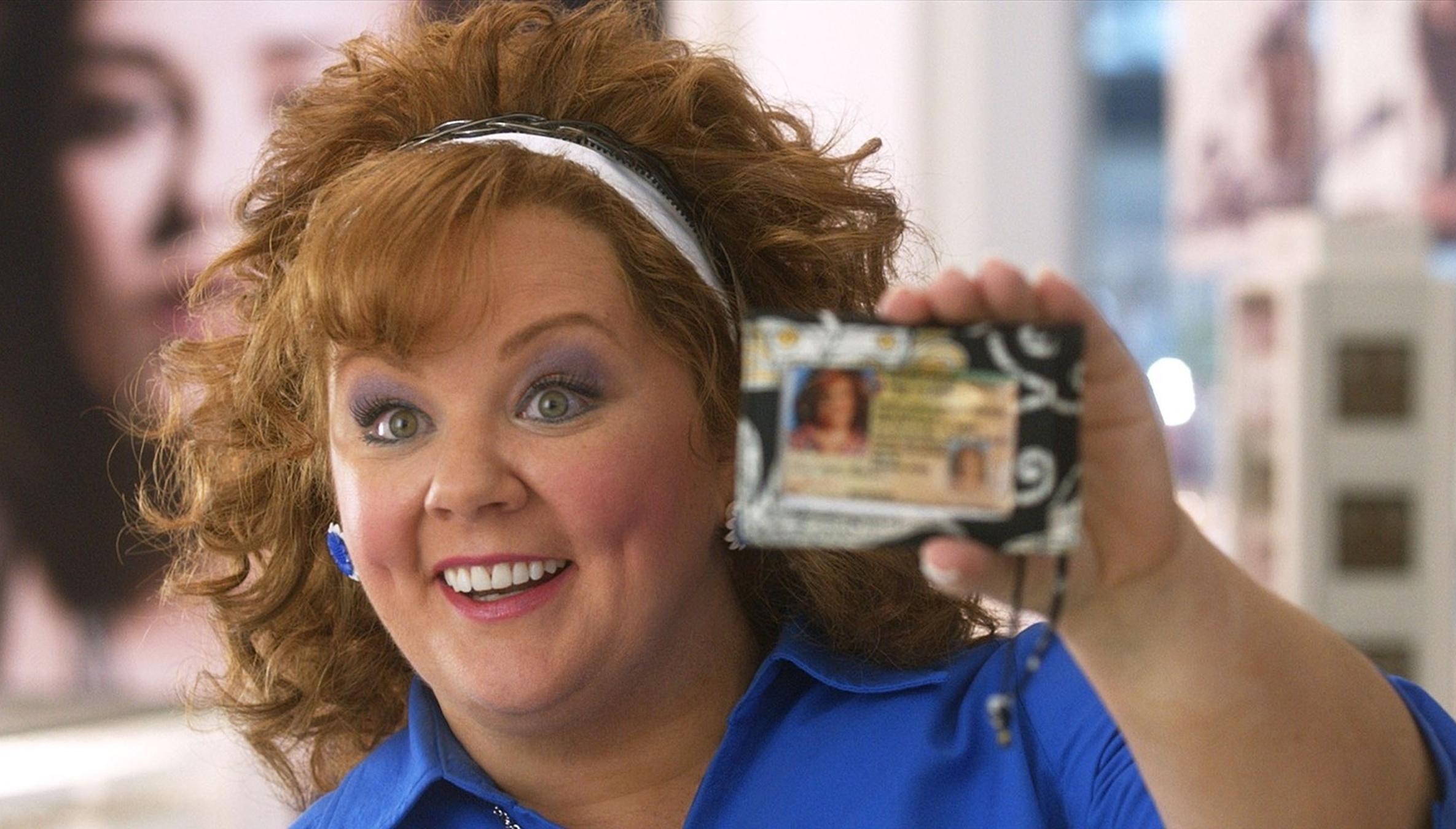
Now she gets the opportunity to put her comedic skills to solid use again in “Identity Thief” as Diana, a con artist who steals the identity of Sandy Bigelow Patterson (played by Jason Bateman) for her own benefit. This actually marks McCarthy’s first lead role in a motion picture, and it came as the result of Bateman loving her performance in “Bridesmaids.” The role of Diana was originally written as a man, but Bateman had the character’s gender changed to a woman just so he could get her cast in the movie.
Now the role of a con artist is a challenging one to make the least bit sympathetic, but McCarthy proved to be up to the challenge. She got her start at The Groundlings which is an improvisational and sketch comedy troupe located in Los Angeles, but while this character would have made for a hilarious five-minute sketch, McCarthy realized she had to do things differently in a feature length motion picture. She made this clear in her interview with Amy Longsdorf of Delaware Online.
“I wanted to make sure Diana wasn’t just a one-dimensional, mustache-twirling villain because I thought that while that’s kind of interesting for a scene, I don’t know how to play that for a whole movie,” McCarthy told Longsdorf. “I love the thought of someone doing criminal acts but not doing them to be menacing. She does them because she’s lonely and doesn’t have anyone. She kind of steals identities so she can go out to a store and pretend to have these lives. She can pretend to have a husband and a family, pretend to be engaged.”
Whether it is film or television she is doing, McCarthy is a comic force of nature and she appears fearless in what she will do to get a laugh. This was especially the case when she hosted an episode of “Saturday Night Live” and came close to swallowing a whole bottle of ranch salad dressing. I was lucky enough to attend the “Identity Thief” press conference which I covered for the website We Got This Covered, and I asked her if there ever is a limit to how far she will go for a laugh, or if she is willing to do anything to get one.
“For me, I think as long as it makes sense for the character,” McCarthy said. “I like to see if you can, on the worst day or the most extreme circumstance, I like to see how far you can push it. But to me it’s not funny anymore if it doesn’t make sense. And I don’t like to do anything that’s mean-spirited just because I don’t find it funny. I’d rather be the jackass than make fun of somebody else because that just seems too cheap and easy. So those are my only limits.”
The one thing, however, that McCarthy was more fearless about than getting laughs was doing her own stunts. It turns out that she tried to do as many of them as possible on the set of “Identity Thief,” and Bateman was stunned at just how far she was willing to go. She even volunteered to do the stunt where Diana gets hit by a car, and it does look very painful when you watch it onscreen. McCarthy ended up admitting to Kevin P. Sullivan of MTV News that she and Bateman did a lot of hand-to-hand combat in order to make their fight scenes look more believable.
“We hurt each other the most, for real, and the most exhausting,” McCarthy said. “You’re just covered in bruises and muscles are ripped.”
Many also wonder where McCarthy comes up with the inspirations for each character she portrays. It is said most actors base their characters on people they grew up with or whom they remember from their hometowns. McCarthy herself was raised on a farm in Plainfield, Illinois, and during the press conference she realized that her upbringing still plays a big part in the roles she chooses.
“In terms of the characters I think are really fun to play, a lot of times it’s someone in my head saying I know that woman,” McCarthy said. “There are women like that in my hometown and there’s one like that the Midwest. I guess I do kind of always go back to that them and draw from there because I really love them. I find them great and interesting and quirky and eccentric. I think everything that any actor does, I would assume, is shaped by how and where they grew up. I steal a lot from a lot of Midwestern women that I weirdly watch, that’s what I should say.”
We are going to be seeing a lot more of Melissa McCarthy in the near future as her star continues to rise in Hollywood. In addition to her television show, “Mike & Molly,” she has a number of starring roles in movies coming up like “The Heat” with Sandra Bullock. No matter what that thoughtless snob Rex Reed may think of her, McCarthy is a superb comedic actress who has many unforgettably hilarious performances left to give the world.
SOURCES:
Amy Longsdorf, “Melissa McCarthy morphs into ‘Identity Thief,'” Delaware Online, February 9, 2013.
WRITER’S NOTE: As the opening paragraph indicates, this article was written over a decade ago.
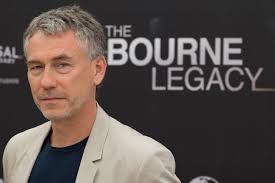
Writer/Director Tony Gilroy and actor Jeremy Renner dropped by the AMC movie theater in Century City on July 9, 2012 to answer questions regarding their upcoming summer blockbuster, “The Bourne Legacy.” The emcee of this Q&A was Dan Gilroy, Tony’s brother, who also co-wrote the screenplay for it. The film itself was not shown that evening, and the audience had to settle for its latest trailer instead, but people were allowed to ask questions about how it will differ from the “Bourne” films which came before it.
This event was presented over the internet live as well as in front of a live audience, so questions came from all over the world as well as Century City. One question came from a guy named Jose on Facebook who asked how “The Bourne Legacy” will differentiate itself from the previous three films. To this, Tony said:
“If you’ve been a casual observer of the films before, it will have an extra bit of boost. If you’re a freak, if you’re a real fan, there’s a lot of stuff that’s in there that’s designed to pay back people who have really been paying attention.”
Catherine, who submitted her question through Twitter, asked, “what does Aaron Cross bring to the Bourne franchise that makes it different from the previous movies?” Tony’s response to this was very descriptive:
“What we’re saying in this film is that there were many programs. The Treadstone program, that Jason was a part of, was an early program that was shopped out to the CIA. The program that Jeremy is in is called Outcome. The Outcome agents are not designed as assassins; they are long lead isolated people who bury down into places. So, the skill set is slightly different, and there’s an adaptive quality, there’s a verbal quality, and there’s a curiosity that we really shine on for the Outcome agents that we meet. In ‘badassery,’ the physical aspects of a lot of this are very familiar; he is a cousin to Jason Bourne in that regard. But the job is different, the design is different, and the flaws are very different. The things that go wrong are very different.”
Dan himself said, as one of the writers of this screenplay, that he was especially interested in the conspiracy side, and he asked his brother Tony how it differs from the franchise:
“Well, this time we’re pulling back (the curtain). We’re saying that what you saw before was a small piece; you watched the other three films and thought that that was the entire universe. It turns out now when we pull back the curtain that there has been a mastermind behind the entire program and these other programs, and that’s Edward Norton. In a way he’s been sitting beside you in the theater for the last 12 years watching this all go on, wondering if it’s going to cause larger problems for him and getting irritated as (“The Bourne) Ultimatum” explodes.”
Many fans of the Jason Bourne movies have been arguing loudly about the series continuing on minus Matt Damon and Paul Greengrass, but Tony Gilroy has made it clear how he made “The Bourne Legacy” with them in mind. It sounds like he has put together an exciting movie which audiences will get a kick out of, and I for one cannot wait to see it.
“Bridesmaids” looks like it has “chick flick” written all over it to where many, including myself, were not quick to rush out and see this film when it arrived in movie theaters everywhere. But having since watched it, I can confirm this is not your average “chick flick” in the slightest. Moreover, it will appeal to a wider audience than its title might suggest. There is nothing groundbreaking about “Bridesmaids” as it initially comes across as a typical formulaic comedy, but the laughs do come at us fast, many of them gut busters. But seriously, it also has a lot of heart and makes you care about the characters very much to where we can easily relate to their struggles.
Kristen Wiig, one of the most acclaimed alums of “Saturday Night Live” who co-wrote this film’s screenplay with Annie Mumolo, stars as Annie Walker, a single underachiever whose cake shop went bankrupt due to the recession, and who is currently having sex with Ted (an uncredited John Hamm), a man who sees her as nothing more than a fuck buddy. Then she finds out that her best friend since childhood, Lillian (Maya Rudolph, another “SNL” vet) has gotten engaged, and Lillian asks Annie to be her maid of honor. From there, we know things are going to go south between these two as the road to any marriage is filled with endless speed bumps which lead many to encourage others to elope instead.
Complications arise almost immediately when Annie meets Lillian’s other BFF, Helen Harris (Rose Byrne), a beautiful and wealthy woman who seems to have everything together in her life. The resentment and insecurity between these Annie and Helen are evident on their faces following their first encounter. This is made even clearer when both toast Lillian and then try to top each other in showering their love on her, attempting to prove who is the better best friend.
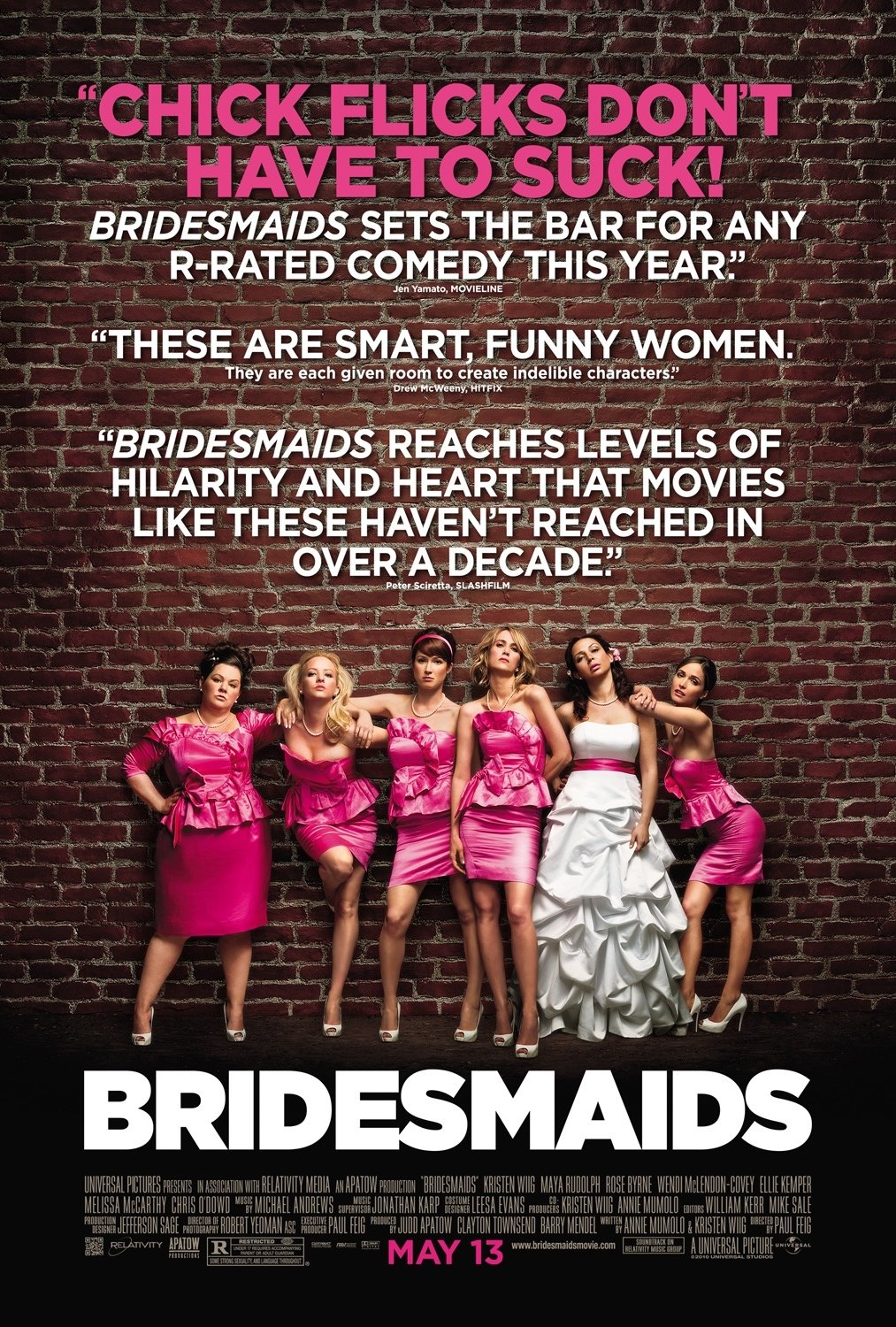
Things get even more complicated when Lillian selects the rest of her maids of honor. They include Becca (Ellie Kemper) who loves wedding and pities Annie because she is not currently engaged to anyone, Megan (Melissa McCarthy) who is as aggressive as they come, and Rita (Wendi McLendon-Covey) who may very well be the unhappiest wife and mother on the face of the Earth as well as the most consistently drunk of the bunch. With all these different personalities working together, will the road to this wedding be a happy one? Was Donald Trump always faithful to Melania?
What I really loved about “Bridesmaids” was the same thing I also loved about “Knocked Up;” the characters are very down to earth and easy to relate to. Being that Judd Apatow is a producer on both films, this should have been obvious from the start. These characters are real people with real problems which are not far removed from our own, and we come to care deeply about each and every character here. It does not matter if none of you have ever been a bridesmaid. As for you men, being groomsman is enough qualification to understand the headaches in planning matrimony.
“Bridesmaids” also a film where facial expressions at times speak more loudly than words. It certainly does have great dialogue, but the looks on these actresses’ faces is what really cracked me up. They say one thing, but their eyes tell us what is really on their mind. This goes for the men in as well, and they all seem to pale in comparison to the females in terms of inner strength. We see right through each character, and the tension resulting from a possible slip of the tongue is always in the air.
This film proved to be the true cinematic breakthrough for Wiig. When I have seen her in other films, she always seems to be doing a riff on her most deadpan characters from “SNL” whether she is appearing in “Knocked Up” or “MacGruber.” But as Annie Walker, Wiig really inhabits this character and gives her life in a way we did not get to see her do previously. She makes us embrace Annie as a kindred spirit because we have all felt the way she feels; lost in a world she feels betrayed by, and desperately trying to hold on to what means the most to her.
Maya Rudolph is equally wonderful here as the bride to be, Lillian. She previously showed us in Sam Mendes’ “Away We Go” what a great actress she can be, and she vividly reminds us of our best friends from childhood. Lillian runs through a gamut of emotions as her road towards marriage start off wonderfully and then eventually turn into an unmitigated disaster. In a pivotal scene in which Lillian about to leave her apartment for the last time, Rudolph shows us a worry and concern which we all see within ourselves from time to time. Not once does she portray Lillian as your usual clichéd character, and this says so much about what she is capable of.
Rose Byrne proves to be a delight as Helen, and her beautiful face and eyes cannot quite mask the growing resentment she has towards Annie. This character could have easily turned into your typical one-dimensional villainess, but by the end we discover tshe and Annie are not all that different. Byrne makes you like Helen despite her overly meddling ways, and she has since proven to be a strong presence in every motion picture she has appeared in.
But out of all the characters here, the one who stands out the most is Megan who is portrayed in a deservedly Oscar nominated performance by Melissa McCarthy. Overweight and raunchy whenever she wants to be, McCarthy is a trye comedic powerhouse when the camera focuses on her. Seducing airplane passengers and showing no shame in what she is, she makes Megan a strong character and never once digresses into making her a cloyingly sentimental one.
“Bridesmaids” was directed by Paul Feig, Mr. Eugene Pool from “Sabrina, The Teenage Witch” and the creator of “Freaks and Greeks;” a brilliant show that like many other brilliant shows which aired on network television lasted only one season. With this film, he manages to find humor even in the most painful of moments and never makes the comedy too overly broad. Sure, some scenes are broadly played, but Feig remembers comedy can only work if you truly care about the characters.
Looking back, “Bridesmaids” proved to be one of the best comedies to be released back in 2011, and no man out there should dismiss it as a film only women would be interested in. The audience for this one proved to be far more diverse than its promotion may have suggested. Plus, you have Wiig and Rudolph on display here, and they always kick ass! If you liked them on “Saturday Night Live,” you are bound to love them here.
* * * * out of * * * *
WRITER’S NOTE: This film marked the very last screen performance of actress Jill Clayburgh who passed away in November 2010 from leukemia. She is a wonderful presence here as Annie’s mother, Judy Walker. May she rest in peace.
WRITER’S NOTE: This article was written back in 2012.
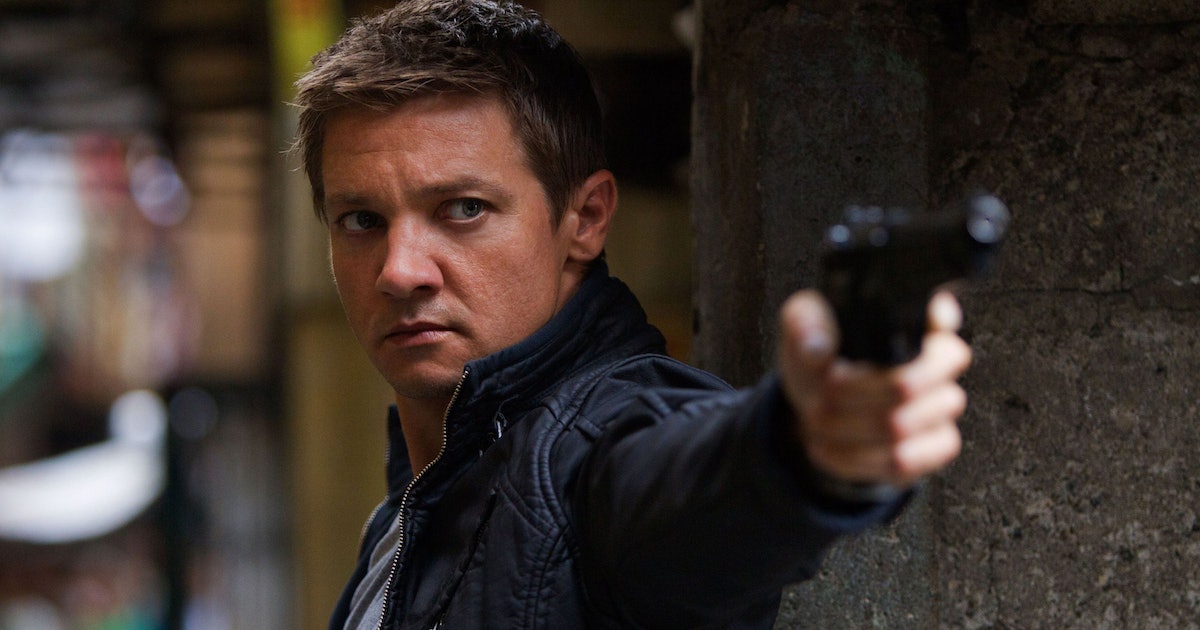
Jeremy Renner appeared at the AMC Century City on July 9, 2012 along with writer/director Tony Gilroy to talk about “The Bourne Legacy.” In addition, Renner also took time to answer questions regarding how he went about preparing to play Aaron Cross, and of his preparation for roles in general. His answers showed him to be an actor always looking to challenge himself constantly and to not get trapped in a comfort zone.
Renner has long since made a name for himself with his performances in “The Hurt Locker,” “The Town,” “Mission: Impossible – Ghost Protocol” and “The Avengers.” One person asked him which movie has required him to do the most training, and he said it was definitely “The Bourne Legacy.” Renner said this was because it required from him “a level of authenticity” the other movies did not ask of him, and that he “had to work diligently to make the fights look like I could actually do them.”
Another person quoted Renner as once saying he “makes himself uncomfortable” when he can and asked him if that has made all the difference in his life. Renner replied it makes all the difference and said it is about constantly challenging himself:
“It’s about not being complacent and not fall into the trappings of repeated behaviors and getting comfortable. As I’ve gotten older, if there are things I knew I don’t like, I would still go try them again just to make sure that I don’t like them.”
Unlike his previous movies which had him acting in a supporting role, “The Bourne Legacy” marks Renner’s first starring role in a big budget Hollywood movie. He did, however, make it clear that his preparation for this movie was no different than any other he has appeared in, and that it remains the same on each role plays. He did say, however, that his workout regimen has changed a lot from “Mission: Impossible – Ghost Protocol” to “The Bourne Legacy:”
“For ‘Mission’ I was really out of shape. I mean, I stretched for twenty minutes and that was my workout. And now I stretch for an hour and a half, fight for two hours, workout for an hour and a half, and then stretch for another hour and then go to work.”
For Renner, saying yes to “The Bourne Legacy” was actually very easy as he felt all the elements were fantastic and that he could not say no to it even if part of him wanted to. And while he may have graduated from indie films to big budget action movies, his mindset has not changed in the slightest as he compared making this sequel to movies he has done beforehand:
“For a big movie, it felt very tiny in the sense of it was not just the stunts but also the intimacy of really quiet scenes I feel I’d rather be doing as an actor. So, for me it had the balance of both; it felt like a little independent movie and a massive action movie, so I got both feels all in one.”
In answering what it was like to play Aaron Cross and how he would turn off the character at the day’s end, Renner’s response did not have any Hollywood ego in it at all:
“Oh, come on man! It’s something that’s not that far away in that we’re talking about every physical role here. I have to stick to the truth on page one to page whatever and just stick to the truths within that. There’s no turning it on or turning it off; I’m not some freak actor that way. This is a character that’s closer to me than say Jeffrey Dahmer (whom the actor played in the 2002 movie “Dahmer”), so it’s not something I have to completely lose myself in. It’s just part of my job, and I can’t explain my job.”
From this evening, we can see that Jeremy Renner is a very respectful actor who takes his craft very seriously, and he revels in his unexpected success and working with actors like Rachel Weisz and Edward Norton whom he resented for stealing so many interesting movie roles from him in the past. We look forward to what Renner has to give us not just in “The Bourne Legacy,” but in so many other performances he has yet to deliver.
WRITER’S NOTE: THIS REVIEW WILL CONTAIN SPOILERS AS IT HAS BECOME IMPOSSIBLE TO TALK ABOUT THIS FILM WITHOUT GIVING CERTAIN THINGS AWAY. IF YOU DO NOT WANT IT RUINED FOR YOU, SEE IT BEFORE READING THIS REVIEW.
I must confess, I have not read any of Nicholas Sparks’ books nor have I seen any other cinematic adaptations of them before I sat down to watch “Safe Haven.” As a result, I am not sure whether to blame him or the screenwriters for ripping off the plot of “Sleeping with the Enemy” for this misbegotten effort. Those expecting this to equal the greatest of Sparks’ cinematic adaptations, “The Notebook,” will be severely disappointed as even those who have not seen that Julia Roberts starring vehicle will be confident in admitting this one falls way short. “Safe Haven” lacks any sense of originality, and it is completely undone by a couple of ludicrous plot twists which sink any legitimate reason for this film to exist at all. Furthermore, watching it reminded me of why I typically avoid romance movies in general.
Julianne Hough from the “Footloose” remake and “Dancing with the Stars” stars as Katie Feldman, and at the start we see Katie running for her life for reasons which are later made clear. Katie is ever so desperate to avoid police detective Kevin Tierney (David Lyons) to where she even makes herself look pregnant in the hopes it will throw him off. She ends up escaping his clutches and takes a bus out to the small town of Southport, North Carolina where she hopes to start a new life.
Look, I love how people want to escape a dark past by moving to a new town, but for some immensely stupid reason they move to one which is not all that far away from the place they used to live. Word to the wise: if you want to move away to where no one can find you, try moving to another state or country. Even with the advances in today’s technology which typically render anonymity a joke, you have a better chance of not being found out if you go to a place you cannot drive to in one day’s time.
Anyway, Katie gets a job as a waitress at a local restaurant and ends up leasing a beautiful apartment out in the woods. Of course, where she found the money for such a place is beyond me and every other audience member. We know she is looking to avoid any personal connections as the last one she was involved in caused her a lot of psychological damage, but someone as adorably cute as her is bound to find a suitor whether she wants one or not. That suitor comes in the form of Alex Wheatley (Josh Duhamel from the god awful “Transformers” movies), a widow with two kids. Alex lost his wife to cancer a few years ago, and he is having trouble relating to his kids, especially his son. Guess who fills the missing part of his life…
Okay, as much as I despised “Safe Haven,” I do have to admit that Hough and Duhamel have good chemistry together and make a cute couple here. Hough herself has a wonderful earthiness which makes her seem more down to earth than other actresses I could quickly think of while watching this film. Even if her range as an actress goes only so far, she has a very appealing presence here even if it might seem a bit too vanilla for some.
As for Duhamel, he does himself good by not giving an emotive performance as Alex. I expected him to be overdoing it for the whole film, but he doesn’t make his character a whiny little bitch or the typical self-pitying widow who often inhabits the romance genre. Alex has suffered a terrible tragedy in his life by losing his wife far too soon, but we see him moving on as well as he can, and he does not waste much time bemoaning what is missing in his life.
Now I mentioned at the start of this review how this film is essentially a rip off of “Sleeping with the Enemy,” and this proves to be the case even before the first big twist is revealed. We watch as the Kevin becomes increasingly obsessive in discovering where Katie is hiding out as it becomes implied that she is wanted for first degree murder. But it eventually becomes to light that Katie is actually Kevin’s husband, and from there I knew exactly where the story was heading which had me rolling my eyes endlessly as a result.
There is a flashback sequence in which we see what drove Katie and Kevin apart, and watching it made me wonder what Katie ever saw in this creep in the first place. In a lot of ways, I feel sorry for Lyons, best known for his work on the television series “ER” and “Revolution,” because I am sure he came into this project believing he was not just playing any ordinary villain, but this is essentially what Kevin Tierney is. The character is here to give us someone to despise, and he really serves no other purpose to this film beyond that.
I was also amazed at how Katie stabbed Kevin pretty hard with a kitchen knife. We do not see where he has been stabbed exactly as this is a PG-13 movie, and yet he somehow recovers from this knife wound in record time. Maybe the American health care system is slightly more effective than we think, but even the smallest of stab wounds still require an extended period of time to recover from. No one just jumps out of bed a day after a sharp object is inserted into their body as the word “ouch” takes on a very significant meaning when this happens.
Furthermore, Kevin spends a good portion of “Safe Haven” being drunk as a skunk. Now maybe this explains how he copes with the pain he is forced to endure from that knife wound, but seeing Kevin trying to outdrink Denzel Washington’s character in “Flight” renders him unintentionally hilarious as a result. While this character is meant to be a frightening presence in “Safe Haven,” all he really ends up being is an abysmal idiot who is lucky to have survived as long as he has. The fact he still has a pulse by this film’s midpoint is quite astonishing to say the least.
But then comes “Safe Haven’s” second big plot twist, and this one is ripped off from “The Sixth Sense.” At the end, we come to discover one of Katie’s friends whom she has confided in throughout is actually not alive and died some time ago. As a result, I kept waiting for Katie to say “I see dead people.” This ludicrous revelation calls into question everything we have seen up to this point. Are certain characters here meant to be delusional, or is it just circumstance that they are talking to a walking corpse? If the filmmakers wanted to make “Safe Haven” the romantic movie answer to “The Usual Suspects” or any of what my friends would call “mind fuck” motion pictures, they failed miserably.
Speaking of which, the director of “Safe Haven” is Lasse Hallström, and his career as a director has always fascinated me. He has gone from directing such great movies like “My Life as a Dog,” “The Cider House Rules” and “What’s Eating Gilbert Grape” to pure drivel like this and “Dear John.” You are never sure if his next film is going to be way too sentimental or not sentimental enough, but this time he outdoes him by being cloyingly manipulative. While he still does an admirable job of getting good performances from his cast, I came out of this film hating him for playing with the audience’s emotions so shamelessly.
I don’t know, maybe I should read Sparks’ novels to see if what did not work in a movie actually works better on the written page. I am sure there are a lot of reasons why he remains a best-selling author after so many years, but watching “Safe Haven” makes me wonder what those reasons are. This film is far too silly to be taken seriously, and the absurdity of its plot twists makes the whole endeavor feel like a pointless cinematic adventure.
Following this misbegotten motion picture, I did my best to avoid any kind of romantic movies. Granted, there have been some like “What If?” which surprised me, but there have been others such as “The Choice” which was also based on one of Sparks’ novels. If you do not see many reviews of romantic movies or romantic comedies on this website, I am sure you will understand why.
WRITER’S NOTE: This review was written back in 2012. Some edits have been made since then to make it more interesting in the Ultimate Rabbit’s eyes.
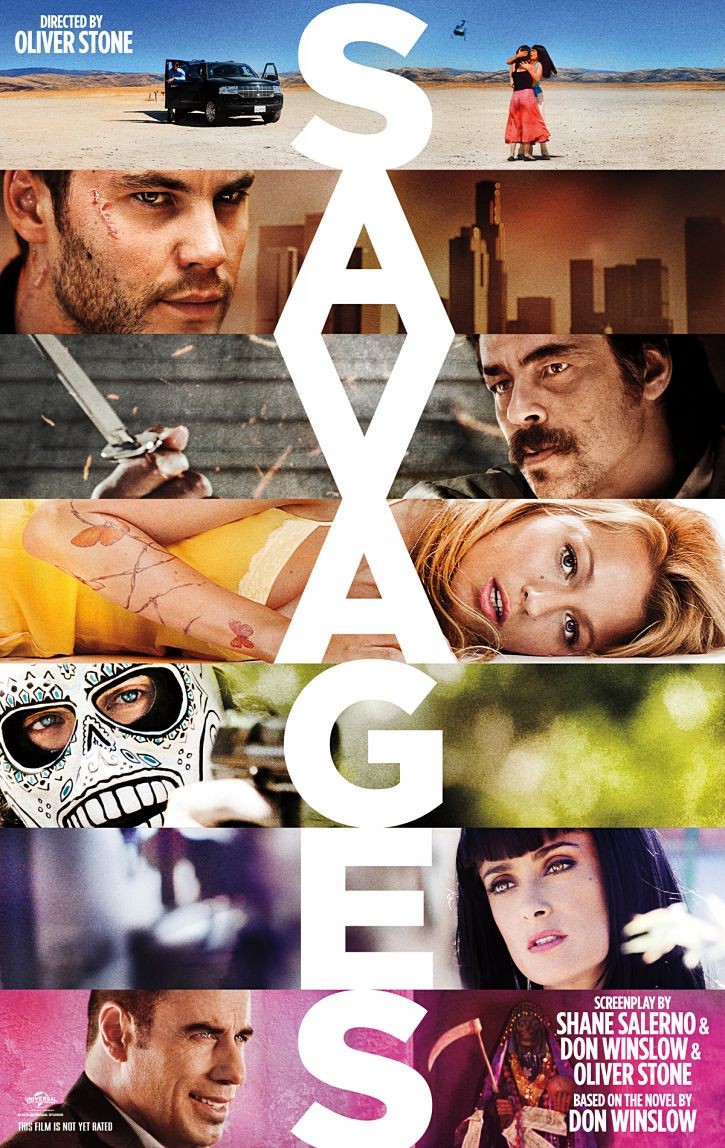
“Savages” is being looked at as Oliver Stone’s comeback movie, as if it is implied that he hasn’t made one worth watching in years. Granted, movies like “World Trade Center,” “Wall Street: Money Never Sleeps” and even “W.” might have made it look like Stone was starting to get too soft on us, but none of these movies, however, showed him to be losing any of his power as a filmmaker. I guess we just miss him generating some kind of controversy because we all expect him to have some conspiracy he is just waiting to unleash on an unsuspecting populace.
Based on the book of the same name by Don Winslow, “Savages” shows Stone getting down and dirty again as the film deals with a couple of weed producers who, quite unfortunately, capture the attention of a brutal and greedy Mexican cartel. While it doesn’t reach the exhilarating highs of “Natural Born Killers” or “Scarface” (which he didn’t direct but wrote the screenplay to), it is still a compelling film to watch. However you look at it, Stone is not about to play it safe with the story or its characters this time around.
Blake Lively stars as O (short for Ophelia) who begins “Savages” by saying that just because she’s narrating the movie does not mean she will be alive at the end of it. Now this is a clever beginning as Stone teases us with the possibilities of what is to come, fully ready to rip the rug out from right under us if the occasion calls for it. These days, it is so nice to see any filmmaker, let alone one who has won several Oscars, take such risks these days.
O lives with her two boyfriends, former U.S. Navy SEAL Chon (Taylor Kitsch) and University of California at Berkeley graduate Ben (Aaron Johnson), both of whom happen to grow some of the best marijuana you could ever hope to inhale. They live their days in Laguna Beach, California which is so beautifully captured by cinematographer Dan Mindel to where I want to drive down there in a New York minute. Heck, I used to go to school near there!
Anyway, Chon and Ben receive a very cryptic message from the Baja Cartel which comes along with a video featuring beheaded drug dealers whom, like these two guys, were independent sellers. Basically, the cartel wants to go into business with them and take a cut of their profits. Chon and Ben, however, refuse to get involved with any cartel, and they make plans to move out of the country with O to another where they can stay for at least a year. But the head of the cartel, Elena Sánchez (Salma Hayek), believes these guys need to show her some respect, so she gets her henchmen to kidnap O in order to make them comply with her demands. But Chon and Ben are not about to let go of their O without a fight.
The movie’s title, “Savages,” makes me wonder who it is referring to among its cast of characters. It is tempting to think it refers to the Baja Cartel as they utilize horrific methods to get what they want, but it could really be referring to any of the characters we see here. Stone is examining just how far we can be pushed before we are forced to embrace our animalistic nature, and he gets at this horrifying truth of what violence we are all capable of when we get pushed to extremes.
“Savages” is far from original as its story may remind many of their favorite “Miami Vice” episodes. With a movie like this, I expected Stone to be pushing our buttons a little bit harder than he does here. But even though I came out of it feeling Stone could have gone even further with the violence, the action is still jolting and, at times, extremely graphic; one guy even finds one of his eyes hanging out of its socket during a moment of torture. Stone also utilizes his many ways of shooting which include black and white footage along with scenes of psychedelic power as characters find themselves under the influence either by choice or by force.
Now I don’t care what anybody says, Blake Lively is a good actress. Many seem to sneer whenever she is starring in a movie, but maybe this is because she was on “Gossip Girl,” a show I have never bothered to watch. Lively has to take her character of O from being a fun seeking woman to one who has to learn to live again, and she is excellent throughout. After her turn as a drug addicted single mother in Ben Affleck’s “The Town,” there should be zero doubt that she can act.
It has been a tough year thus far for Taylor Kitsch who has seen two big budget blockbusters he starred in, “John Carter” and “Battleship,” bomb hard at the box office. Then again, those movies probably would have bombed no matter who starred in them. With his role as Chon, he shows a toughness and attitude which is not easily faked, and you can see why so many were looking to cast him in their projects. Many actors yearn to play a ballbuster when given the opportunity, and Kitsch rises to the occasion and gives a terrific performance.
Aaron Johnson, who plays Chon’s more philosophical partner Ben, seems to have grown up a lot between this movie and “Kick Ass.” Once again, Johnson is playing a character who is eager prove himself and yet completely unaware of what that will take. From start to finish, he does an excellent job of transitioning his character from a peaceful man to a bloody defender of what he loves.
But leave it to some acting demigods to give “Savages” its potent power which nails us right into our seats. Benicio Del Toro is brilliant as the sociopathic henchman Lado. Like the most entertaining cinematic sociopaths, Lado is at times charming while more often menacing and extremely sick. He thinks nothing of killing people when the opportunity presents itself, and Del Toro looks to be having a blast as he explores the different facets of his character’s twisted personality.
And then there’s Salma Hayek who singes the screen as drug queen Elena Sánchez. All Hayek has to do is give the audience one look, and you know this is a person you do not want to mess with. She also gets a surprisingly complex character to play as Elena’s ascent to being a big-time drug dealer had more to do with tragedy than it did with opportunity.
“Savages” also features strong performances from John Travolta as a corrupt DEA agent, Emile Hirsch as the money launderer Spin, and Demián Bichir as one of Elena’s representatives, Alex. There is not a single weak performance to be found here as everyone looks to be as thrilled as can be to be acting in an Oliver Stone movie.
Now there has been some controversy over the movie’s ending as it offers up two very different conclusions. The way it comes across reminded me of when Michael Haneke got one of his characters to grab a remote control to reverse and alter the events in “Funny Games.” Both directors are looking to mess with our heads. While the fates of the characters are not entirely resolved, it was worth seeing things turn out the way they did as some end up getting very clever about the situations they are trapped in.
Is “Savages” classic Oliver Stone? Not quite, but it is certainly more potent and energetic than some of his other recent work. Give him the right story, and he can still give you a cinematic experience like few others can.
“The reason you caught me, Will, is we’re just alike! You want the scent? Smell yourself!”
-Dr. Hannibal Lecktor (Brian Cox) speaking to Will Graham (William Peterson) from a scene in Michael Mann’s “Manhunter.”
After all these years, Michael Mann still has a strong fascination with criminal masterminds and those who spend their careers chasing them down. Film after film, he has spent his time delving into how the “good guys” and “bad guys” feed off of one another, and if they could not exist without one another. “Public Enemies” reminded me a lot of “Heat” in that respect, and it shares a lot of similarities as it looks at the famous John Dillinger, played here by Johnny Depp, and at the man sent to catch him, Melvin Purvis. It’s not as great a film as “Heat” was, but it is still a masterful piece of filmmaking and the kind we have come to expect from director Michael Mann.
“Public Enemies” starts with Dillinger and his friends breaking out of a maximum-security prison, something which seemed easy to do back in 1933. It turns out Dillinger is actually quite the celebrity and can find safe havens in one town or another. To many he is seen as a hero, and to others he is nothing more than a criminal. But as Dillinger continues to rob more banks, the FBI and J. Edgar Hoover (played by Billy Crudup) become increasingly persistent in bringing him to justice. In the process, Hoover turns to Melvin Purvis (played by Christian Bale) who subsequently leads a manhunt to take down Dillinger, and in the process changes from the person he thought he could be to the one he is chasing after.
One thing which has not changed about Mann’s movies is he still knows how to stage one hell of a gunfight. Back in 1995, he gave us one of the greatest in Downtown Los Angeles with “Heat,” and he has lived in the shadow of that brilliantly staged moment ever since. Sure, he has choreographed gun battles every bit as effectively brutal like in “Collateral” and his film version of “Miami Vice.” In his films, you don’t just watch guns go off, you feel them going off. When a bullet hits a body, characters don’t just fall down like in an old western. Their bodies are forever shattered, and the wounds they carry last long after the end credits have finished. There are a lot of strong action scenes like this throughout “Public Enemies,” and each one is equally hair raising. While “Heat” may remain his masterpiece, his other works do not pale in comparison necessarily.
Having Johnny Depp cast as Dillinger must have seemed like a no brainer. They appear to share some similar tastes minus the heavy gunfire, given Depp’s previous reputation as a “wild boy:”
“I like baseball, movies, good clothes, fast cars… and you. What else you need to know?”
-Johnny Depp as John Dillinger from “Public Enemies”
Depp remains one of the best actors of his generation, and he has constantly challenged himself to where this particular role is no exception. Dillinger was a criminal celebrity, perhaps one of the first, and Depp effortlessly shows you how Dillinger made this seem possible. With his eyes, Depp can still seduce the most knowledgeable and naïve of women without even having to try too hard. The actor also clearly brings out the joy Dillinger gets out of life, and he also gets at the depth of pain he experiences as those closest to him leave him, cut him loose, or get killed.
As Melvin Purvis, Christian Bale delves into many of the same situations which haunted Bruce Wayne/Batman in “The Dark Knight.” Melvin starts off as a man who is dedicated to the law and follows the rules and regulations to the letter. But after some serious setbacks, Melvin finds he has to use different methods in order to get his man. These methods include acts and people which and who work outside of the law. In the process, he comes to see what he has to become in order to capture Dillinger. But unlike Bruce, Melvin may not be able to live with himself when this is all through. Bale pulls off a really solid accent while playing Melvin, and he has a much more nuanced character to play here than he did in movies like “Terminator Salvation.”
But the one performance I enjoyed most in “Public Enemies” was Marion Cotillard’s who plays Dillinger’s girlfriend, Billie Frechette. Cotillard won the Best Actress Oscar for giving one of the greatest performances of all time in cinematic history in “La Vie En Rose.” She shares great chemistry with Depp throughout, and she is delightful to watch as Billie is ever so quickly drawn into Dillinger’s dangerous world. Billie does sense the trouble which lies ahead, but everything happening is too exciting for her to pass up. Showing both fear and excitement in a film scene without words is easier said than done, and she pulls it off like it’s no big deal.
If there’s anything which takes away from “Public Enemies,” it is that it doesn’t delve as deeply into the characters’ lives as I had hoped it would. If anything, this film would have benefited more from a back story, especially for Dillinger as to why and how he became a bank robber. It was also said that Dillinger was a hero because the banks he robbed ended up freeing things up for those who were economically challenged because of the Great Depression. I would have liked to have seen more of this because Mann may have thought this was clear from the way regular people treat Dillinger, but it doesn’t feel like they have a good enough reason to. Had there been a little more depth to these characters, this could have been as great a movie “Heat.”
Still, “Public Enemies” is fine filmmaking and continues Mann’s theme of looking at how the line between cops and criminals is often blurred and how both are actually one and the same. You could almost call this “Heat” as a period piece. Mann makes you wonder if a criminal can ever find and hang onto a love despite their law-breaking nature, and if the cop can ever lead a normal life outside their career of going after the crook. From William Petersen trying to think like the killer in “Manhunter” to James Caan trying to leave a life outside of crime in “Thief,” it’s a thin line indeed. Perhaps Mann keeps pursuing this theme in hopes that there will be a tomorrow for characters like these regardless of their opposing natures. Maybe he will find the answer in a future motion picture, and hopefully we will not have to wait too much longer for such a cinematic work.
William Shakespeare’s “Romeo and Juliet” is a play which has been done to death. Keeping track of all the adaptations is aggravating, but on top of that, there are other plays or musicals which were, at the very least, inspired by this classic tragedy (“West Side Story” is the most obvious example). Since Shakespeare’s time, “Romeo and Juliet” has been done in many different styles and taken place in various time periods. It seems the only way to do a production of it these days is to break free of the way it was done during Shakespeare’s time. Baz Luhrmann’s modern take on “Romeo and Juliet” was absolutely entrancing in how it made us feel like we were watching the doomed story of two young lovers for the first time, and Leonardo DiCaprio and Claire Danes never had a shortage of chemistry between them.
Taking all of that into account, that makes this “Romeo and Juliet,” directed by Carlo Carlei and adapted to the screen by Julian Fellowes, come across as a renegade version for they have instead brought Shakespeare’s work back to its traditional and romantic version. It is filled with medieval costumes, balcony scenes and duels, and the filmmakers even got the opportunity to shoot it at the story’s original location of Verona, Italy. But for all the effort put into this umpteenth film adaptation of this famous tragedy, the whole endeavor feels like it is severely lacking in passion.
Perhaps the main problem is the lack of chemistry between the two leads, Douglas Booth and Hailee Steinfeld, who play Romeo and Juliet. When they first meet at the dance, their attraction to one another is not all that palpable and feels rather forced. While both actors do their best to connect with one another, their relationship never felt believable enough for me to really care about what happens to them. In fact, towards the end, I started to get impatient and kept waiting for Romeo to do himself in already.
Steinfeld is a wonderful actress, having deservedly received an Oscar nomination for her performance in “True Grit” (though she should have been for Best Actress, not Best Supporting Actress). As Juliet, she does well and has quite a radiant smile which lights up the screen. At the same time, she seems miscast in this role when paired with Booth. While Steinfeld is around the same age as Juliet, she seems too young to be taking on this famous role now. It’s a shame to say this because she isn’t bad, but I came out of this movie thinking an actress a few years older might have fit this role more realistically.
As for Booth, it takes too long for him to come to life as Romeo. When we first see him, he doesn’t seem all that crazy about Rosalind even after we see him making a bust of her likeness. When it comes to the classic balcony scene, the attraction between him and Juliet feels awkward as they still don’t seem as madly in love as they are supposed to be. Booth’s performance does get stronger as the movie goes on, but he never digs deep enough into the character to where it seems like he is only touching the surface of Romeo’s dilemmas.
Carlei, whose work as a director I am not familiar with, does capture the beauty of Verona, Italy to where it made me want to get on a plane and visit it. His handling of the conflict between the Capulets and the Montagues, however, is not clearly defined, and we never quite get a full idea of what made them hate each other in the first place. This is the original gang story for crying out loud! As for the battle scenes, they feel a bit too staged and could have been far more exciting.
Fellowes is best known for creating the popular show “Downton Abbey,” and he seems a natural to adapt any Shakespeare play let alone “Romeo and Juliet.” He preserves the dialogue for the most part, and it’s clear he has a deep love and understanding for the Bard’s words. At the same time, this film has been severely affected by a misleading advertisement which stated it would not be using Shakespeare’s traditional dialogue but would still follow the play’s plot. But having been exposed to this play many times myself, I could not tell the difference between what Shakespeare wrote and what Fellowes came up with. Go figure.
It is a real shame because this “Romeo & Juliet” has a number of great supporting performances which almost make it worth watching. Ed Westwick makes a fierce antagonist out of Tybalt, his eyes filled with rage over a betrayal he can never forgive. Lesley Manville, best known for work with Mike Leigh, is priceless as the Nurse and succeeds in taking this character from her ecstatic highs to her tragic lows. Manville never misses a beat every time she appears onscreen.
There’s also Damian Lewis as Lord Capulet, and he gives the character of Juliet’s father a twisted feel which really makes his performance stand out. Kodi-Smit McPhee is very strong as Romeo’s good friend Benvolio, Natascha McElhone gives us a sympathetic Lady Capulet, and Stellan Skarsgård is a welcome presence as the Prince.
But it should be no surprise to see Paul Giamatti stealing the show as Friar Laurence, as it’s truly one of the best interpretations of this role I have ever seen. Friar Laurence is the moral center of “Romeo & Juliet,” and he sees the union between the two lovers as a way of bringing peace between the Capulets and the Montagues. I could tell just how much Giamatti put his heart and soul into this role, and I wept with him when his well-intentioned plans fall apart so tragically.
Still, despite all the great performances, this “Romeo & Juliet” never really comes to life in the way a truly great Shakespearean production does. The language in his plays is so rich, and it can be so intoxicating to take in when done right. This is how I felt after watching Kenneth Branagh’s cinematic adaptations of Shakespeare’s work, but Carlei is not as successful in making this famous playwright’s words come alive, and he is working from a script by Fellowes for crying out loud!
Every generation definitely deserves their own version of “Romeo and Juliet,” but this one is not going to do it. They will be better off with Baz Luhrmann’s version which ended up breaking my heart as it made me wonder if things might take a different turn from what we remember. Or perhaps it was just that big crush I had on Clare Danes which made Baz Luhrmann’s movie affect me so much. Oh well…
WRITER’S NOTE: This is from a press day which took place in 2013.
With “About Time,” writer/director Richard Curtis once again proves that he is the master of making romantic movies. While romantic films are currently a dying breed in America, Curtis gives the genre a much-needed re-invigoration. This is the same man who wrote the screenplays for “Four Weddings and a Funeral,” “Notting Hill” and “Bridget Jones’s Diary,” and he also wrote and directed “Love Actually” which has become everyone’s favorite movie to watch at Christmastime. Curtis populates his films with characters we can all relate to, and he shows us how the simplest things in life can be so wonderful.
I got to meet up with Curtis when he appeared for the “About Time” press conference at the Four Seasons Hotel in Los Angeles, California, and he proved to be as charming and funny as many of the characters who inhabit his films. During the roundtable interview he talked about “About Time” differs from other romantic films, how he came to cast Domhnall Gleeson and Rachel McAdams, and why this will be his last movie as a director.
While these questions came from several reporters, I did take the time to put my name to the questions I asked Richard. You will find them eventually.
Question: Why did you not tear Tim (Domhnall Gleeson) and Mary (Rachel McAdams) apart in the middle of the movie only to bring them back together?
Richard Curtis: Well, I quite liked the idea in the film. There is a kind of habit in romantic films of getting people who hate each other when they meet; he’s a Nazi and she’s a member of the Socialist Worker’s Party (laughs), however will they fall in love? But most of us, when we bump into the people we are going to spend the rest of our life with, quite like them when we first meet them. I quite liked the idea that you could do something where people like each other, and then there was the time travel and then they liked each other again. I’m interested in if you can do it. I was writing about sort of a happiness in a funny way and writing about the interesting business of how things work rather than being really interested in the way things don’t work.
Q: Speaking of the time travel aspect, it’s something that people keep watching these movies for. They’re always keeping an eye out for the loophole or plot holes. Did that make it harder writing the script?
Richard Curtis: Look, you know you’re gonna fail, that’s the thing. I know where I failed in this so you just do your best and the people and the production keep you up to it, and anybody who spots anything that’s wrong will always say it to you because it’s a fun thing to spot when they’re reading the script. So, you know you’re getting closer to true without actually getting there, and it was fun to play with it. It’s also a thing where when you decide you’re going to do a time travel movie, it is something that is in your head as you’re walking around. The thing about not being able to go past the birth of your child was definitely the result of another conversation I was having with someone about how weird it is that you commit your entire life to people who you have no ability to choose, and then I thought that’s so true. And not only that, if I had sex four seconds later, I’d have a different child and then immediately I thought that would become a key plot point.
Q: This movie has two love stories in it. It has the father and son and it has the man and the woman. How were you able to find the balance so that one didn’t overshadow the other?
Richard Curtis: On the whole you try and rig films to make sure they turn out as you want them to turn out, but I think it seems as though perhaps the strength of the Bill Nighy story is more than I expected. It’s turned out to be more emotional than I expected, and I think that’s all down to the way Bill chose to play it. He chose to play it in such a sort of gentle way that I think, when you see the film, you can insert your own father into the space that Bill creates. Oddly enough, this film is in some ways less manipulative. If you’re doing a movie that ends in a big kiss and a romance, your kind of playing the cards all the way through to try and get the maximum emotion at the end. In this one I always knew that I was always aiming for this bizarrely simple final moment which was just gonna be a guy doing the most banal things in the course of an ordinary day. So, I didn’t think so much about the dynamics of the film, perhaps I have in others. But one of the ways of doing it was by getting them to get married halfway through, so that film’s done and there’s another film to rely on.
Q: Has it affected sort of the carpe diem qualities, or is that something you practiced before you started writing the script?
Richard Curtis: No. Oddly enough I think, and Bill and I talk about, because I’ve done the movie, I am thinking about that a lot more, I really am. My girlfriend, who never makes any concessions to me, says I always work far too hard and I always think that I’m not working as hard as I used to and always am. But even she is saying that she’s noticed that I seem to be creating more space and enjoying things a little bit more and making more time for normal things. So that’s why I have said I am not going to direct another film because I think that directing a movie is not a good way to have a happy life.
Q: Is that a Steven Soderbergh promise or are you just gonna keep coming back?
Richard Curtis: Anyone who says that, Steven is their hero because it means you can change your mind. It is becoming a great tradition; the great heroes like Jay-Z, doesn’t he resign? If I come back, I’m part of a noble tradition, but that is my intention at the moment.
Q: Can you talk about Comic Relief and how that came to you at a young age?
Richard Curtis: Wow, do other people know about that side of my life? Well, it started off by an almost comical mistake in that a girl I know asked if I would like to go with her to Africa, and I just said I would go to keep her company and then the charities decided to send us to different countries. They said we would cover more ground, so that was a mistake. So, I was in Ethiopia at a very bad time and that could not but change my life. That’s something I have to carry. We did a stage show and then we did a TV show, and the TV show made so much more money than was expected that I couldn’t not do it again, and I have just gone on doing it. Every time we do it, we make more money than I will earn in my entire career. I think of it as my difficult child, it takes exactly half my time, it changes its nature so I now, and after doing it now for 25 years I got a feeling that the money we’ve raised might be less important than the education or part of it. Kids in England have always grown up knowing a lot about poverty in Africa and problems at home, and that educational thing may have actually turned out to be the function of it. The next thing I’m doing is doing a year and a half trying to be part of making the new declaration by the United Nations in 2015 to end poverty, so it’s a never-ending big subject. I think the way it’s bounced off on my career is that I haven’t written my seven bad films. I do think a lot of times when people, when they finish the thing, say have I got any other ideas whereas I’m always a year behind. I thought of this film in 2005, and then I chose to do the pirate movie (“Pirate Radio”) because I wanted to be a bit older by the time I made it. It’s actually given me breathing time and let things stew longer, so I always believe quite a lot in the projects I do by the time I get to them.
Q: Fighting poverty seems like an even bigger challenge now with the gap between the rich and poor growing bigger and bigger. Do you feel sometimes like it’s a never-ending battle and how we are going to do this?
Richard Curtis: Well, you have to be realistic about that. Actually, statistically speaking, the lives of the very poorest people on the planet have never gotten better quicker than in the last 15 years. It’s been extraordinary so I’m paying more attention to that. But the rich and poor inside countries, I’d just think it increases your responsibility to try and make sure that people like me who do live in the bubble of comfort are really aware of how peoples’ lives are at the other end of the scale. I made all my children watch a documentary called “Poor Kids” the other day. It’s just a really brilliant, very sweet-natured documentary about four really poor kids in the UK, and they literally could not believe what they saw and that increases the desire to communicate this.
Q: You also focus a lot on the joy of real people like with the Heathrow Airport scenes in “Love Actually,” and then there are scenes in “About Time” that look like they had regular people in them. Where did you find those people?
Richard Curtis: Well with “Love Actually” we put up a little black box with curtains in Heathrow and just filmed and then sent assistants rushing around and saying do you mind signing this release. It’s very weird, you haven’t seen your mom for 17 years and somebody’s saying we’ve just filmed you crying embarrassingly. The strange thing is when we edited that, over half of what I wanted in that sequence I couldn’t use because it turned out we hadn’t got the permissions. The bit at the end of this one was sort of the same thing. Quite a lot of it was sort of staged. There are some things that weren’t. Most of that was directed by my girlfriend. That was the weird thing. It was the final day of the shoot. I woke up and I was in the most astonishing pain. I thought I had kidney stones or whatever, and she leapt out of bed in the highest of spirits and said she would ring a doctor on the way to the set (laughs). Some of the loveliest images there were got by her which I think sort of shows because she is full of an energy and joy about her. It was interesting how ordinary those images had to be. I didn’t shoot them at the beginning, so I didn’t quite know how it was going to end. When I thought that I would end with a series of just normal images, I took a film by a friend of mine called Kevin McDonald called “Life in a Day” which is a movie he made about YouTube, and I cut like ten favorite images from that in and showed that to friends and it was a disaster because they were good. They were so definitive, so beautiful, so picturesque, and everyone said the movie’s all been about ordinariness and you can’t then say that every day is a beautiful sunset and every day is an astonishing child framed perfectly in a window in Milan. So, I did try and keep those end bits as sort of banal as they could be, but still joyful.
Ben Kenber: “Love Actually” is my family’s favorite movie to watch every Christmas Eve. I love it too but I’m always hoping we can add “Bad Santa” as a double feature though.
Richard Curtis: Lauren Graham’s in “Bad Santa!” I love her!
Ben Kenber: I’m not usually a big fan of romantic movies, but what I love about your movies is that the people and what they go through feels so real and relatable. A lot of American romantic films are manipulative but your films never feel like they are. Your movies touch on issues that most other filmmakers don’t really take seriously.
Richard Curtis: Well, thank you very much. I don’t have an answer for that, but don’t down American filmmakers because I think there’s a kind of feeling that romantic films may not be in a good place at the moment. “(500) Days of Summer” I thought was an incredible movie, “Like Crazy” is an amazing movie about love, and “Lost in Translation” is the greatest ever romantic comedy even though it’s not a romantic comedy. I’ve been looking back because I’m thinking about finishing and thinking why did I write all these films on this subject and then suddenly realizing it is because it is the context of my life and what matters to me. How your family treats you, who you love, how you get on with your kids and your friends are what fills most of your emotional time, and I’m just trying to hang on to that and write about normal things because I never, never bump into serial killers.
Q: A lot of people don’t seem to realize that “Love Actually” is a Christmas movie because the holiday gets so pushed into the background.
Richard Curtis: I think the funny thing about “Love Actually” is the casting is now out of whack. Originally it was 50% well known and 50% not, and now the naked guy is in “The Hobbit,” January Jones is Betty Draper on “Mad Men,” and even the boy is now in “Game of Thrones.” Liam Neeson is the greatest action hero in the world and Andrew Lincoln is on “The Walking Dead,” so it’s a hell of a cast now.
Q: You are obviously a believer in love. Do you have thoughts on marriage?
Richard Curtis: Well in a way “Four Weddings and a Funeral” was a long way of explaining to my mum why I wasn’t married. She always found it hard to accept. I haven’t gotten married for particular, peculiar reasons, but I’m sure that marriage is a wonderful thing.
Q: You make great use of music and songs in your movies. Can you give us an insight into what your playlists are?
Richard Curtis: Well, the insight I would say is that I really do have to use music in order to get through the process of writing. It really is part of me learning what I’m trying to do, and sometimes that takes very specific forms. When I handed this movie in, it said on the front cover “About Time” or “The Luckiest” or “Golden Lapels.” I thought about those two so much and was so sure I was going to use them, and I thought I might even name the movie after them. So, in this movie, all the cues were there as I was writing and helped me write the right scenes and work out what I wanted to say. There’s a version of “Downtown Train,” a Tom Waits song, by Everything But The Girl, an English group which was all I listened to while I was writing “Notting Hill.” That was all I was trying to do in the whole of that movie was reproduce the emotional temperature of that song which I knew could not be in the movie, but it was my sort of guide. And then I just use pop music to cheer me up, so I got different playlists on my computer. I’m trying to make my tastes more modern. My sons are pushing me hard in that direction. My 16-year-old says he can’t listen to traditional pop music anymore because the lyrics of the songs he listens to by people like Jay-Z are so much better than normal pop songs. Normal pop songs are so thin and so repetitive, he says, that he can’t listen to them anymore.
Q: The scene in the underground subway station is one of the best in this movie. Your use of music in all your movies is great.
Richard Curtis: Well, thank you. That was a really interesting day because sometimes you hope something works but you don’t know how. I couldn’t work out as I was shooting it how it was going to be possible to edit it because he’s always going to be singing the wrong words of the song. It was never going to be correctly timed so I just shot all night and hoped the editor could work it out, and the editor said there was no problem when we got to it.
Q: Can you talk about casting the two main parts? How did that come about?
Richard Curtis: There are completely different ways that casting works. My friend, Mike Newell, said to me, “When the movie is cast, the movie is made.” He was extraordinary when we were casting Vicar #3 in “Four Weddings and a Funeral.” The guy came in and Mike said, “So tell him about Vicar #3,” and I said, “Well the leading character is trying to decide whether to get married and the vicar comes in and…” And Mike said, “No, no, tell me why did he join the church” (laughs). That level of detail and three dimensionality, I think that casting is hugely important. Rachel, having always loved her work and having picked up a sort of vibe about her as a human being and being very interested in this part about sort of contentment and in the idea of going from someone you meet on the first date and, by the end of the film, she is the mother of three, was based on trust and faith and things that she had seen and things I had also heard about her from the people who had worked with her. Domhnall on the other hand was seen as one of the top 25 young actors in the country, and I saw lots of them as often happens when I audition. Unless it’s the right actor, there doesn’t seem to be anything there at all. That was very much the case with the sister’s part until we found Lydia Wilson. It seemed as though there wasn’t anything there, and then we got Lydia with all her complicated emotions and Domhnall instantly made it funny which is absolutely key because he’s actually interested in comedy. So many young actors, you know, aren’t. They’re actually trying not to be funny and they’re trying to make people take them more seriously and think them cool or attractive, and he was really happy to be stupid and loving. He’s a lovely actor and a very sweet man. It was complicated because he was wearing his “Anna Karenina” beard so he looked like he’d stumbled out of the woods in “Deliverance” (laughs). The beard looked great if you’re wearing a military uniform, but if you’re wearing a t-shirt and jeans you look like you’re too fond of farmyard animals. It was a real act of faith, and then I made him do a whole day on camera, still with the beard, actually acting out the part and stuff. So, he worked very hard for it and was then sort of perfect.
Q: There’s a lot of Hugh Grant in Domhnall’s role, sort of like the younger version of him in “Notting Hill.” Was there any kind of connection made there?
Richard Curtis: I wasn’t aiming for Hugh at all. It’s obviously a voice that comes out when I write that part. I actually voted against Hugh in “Four Weddings and a Funeral” when it came down to it and I was, thank God, defeated 2 to 1 because Hugh was brilliant. But I think there’s something about Domhnall that’s much closer to my original inspiration when I started writing films. I was really inspired by “Gregory’s Girl,” “Breaking Away,” “Diner” and the guys in that except Mickey Rourke, and Woody Allen really. I was always looking for awkward, normal people, and I think when you first sit down with him at the party you don’t think that he’s the guy. You think he’ll be lucky to ever get a girlfriend. I like that side of him whereas with Hugh, girls would like him.
“About Time” is available to own and rent on DVD, Blu-ray and Digital. Please feel free to check out some other “About Time” interviews I covered for the website We Got This Covered by clicking on the names below:
WRITER’S NOTE: This article was written back in 2012.
Max Thieriot’s acting career has been on the rise ever since his film debut in “Catch that Kid,” and now he gets one of his biggest roles to date in the horror movie “House at the End of the Street.” In it, he plays Ryan Jacobson, a sole survivor of a vicious attack which claimed the lives of his immediate family. Thieriot talked about how he prepared for the role and of what it was like working with Jennifer Lawrence who co-stars as the new girl in town, Elissa.
Thieriot got really excited about playing Ryan after he read the script, finding him very complex and full of many layers which get peeled back as the screenplay unfolds. The challenge of the role for him was to find a way to make this soft spoken and quiet character more unique than the ones which usually inhabit horror movies.
“I watched a lot of videos, and all sorts of stuff on people with different issues, and tried to find some common ground and similarity between them and their actions, and Ryan,” Thieriot said. “I put together a lot of stuff, and came up with what I did.”
Like many horror and thriller movies, “House at the End of the Street” contains endless twists and turns as filmmakers love to keep audiences guessing. Thieriot said it is actually rare for him to find a script like this one which has twists he did not see coming. The trick became to not reveal too much as it can be ridiculously easy to give a lot of things away.
“One of the hardest parts is when you’re playing a character and you know what’s going on with the character, it’s easier to not show it,” said Thieriot. “In this film, there are moments where you reveal little secrets without telling people that it’s happening – whether it’s a look and being able to have them noticeable enough that when you finish the movie, you go, ‘Oh!'”
Of course, many people have asked Thierlot what it was like working with Jennifer Lawrence whose career has gone into hyper drive thanks to the success of “The Hunger Games.” He spoke very highly of Lawrence and described her as really cool and that he had a lot of fun playing off her and working with her. What also made them work so well together in “House at the End of the Street” is they have similar backgrounds in regards to how they grew up.
“Immediately, I could tell she was a fantastic actress. It was always very real with her. It made it so much easier for me to come off like that,” Thieriot said. “She was a down-to-earth, small-town girl. I’m from a small town in Northern California. We understood each other. It (this movie) was before any of her success. Nobody in the industry knew her. That’s how it always is – you’re unknown until you get that one chance to show it.”
Up next for Max Thieriot is playing Norman Bates’ older brother Dylan in the upcoming A&E drama series “Bates Motel.” He has previously only been in one horror movie before “House at the End of the Street” (Wes Craven’s underappreciated “My Soul to Take”), but he is certainly making his presence felt in this genre. It will benefit from actors like Thieriot who are out to give audiences something that’s not just the same old thing.



 The Ultimate Rabbit