‘The Color Purple’ Movie and 4K Review

The following review was written by Ultimate Rabbit correspondent, Tony Farinella.

This was my first time having the pleasure of sitting down to watch “The Color Purple,” directed by the legendary Steven Spielberg. This is a director who has never been afraid to tackle any type of film project.  When watching this film, his trademark heart is clearly on display.  What makes it stand out and be as memorable as it is, though, is the terrific acting, especially from Whoopi Goldberg and Oprah Winfrey.  “The Color Purple” is based on the novel by Alice Walker, which I have not read, so my film review will be solely based on the film itself. I have no frame of reference to compare it to, and I think that is more than OK. Too often, people get caught up in comparing films to books, and in the end, they are two totally different mediums.  You will never be able to cover everything from the book because you are limited by the running time of the film.

The film takes place from 1909 to 1943 in Georgia where we are introduced to Celie Harris (Whoopi Goldberg), a young teenager who already has two children, a boy and a girl, because she was raped by her father. Her father took the children from her and has essentially sold them off for profit.  Celie wonders where her children are and worries about them constantly, as any mother would when they are abruptly taken.  She was also married off, thanks to her father, to Albert Johnson (Danny Glover), an abusive man who makes her do anything and everything for him.  He beats her, forces her to have sex with him, and controls every aspect of her life. In his eyes, this woman serves one purpose and one purpose only, which is to take care of him. She even has to call him “Mister.”
During this time, she was separated from her sister, Nettie, played by Akosua Busia. When Albert came looking for a wife, he was initially interested in Nettie, but their father would not part with her and insisted on Celie going with Albert.  Celie is often told she is too skinny and ugly.  She sees inspiration in the strong-willed Sofia, played by Oprah Winfrey.  Sofia is not one to take guff from anyone in her life, but you wonder how long this will last before she is beaten down by the rampant racism she experiences.  We get to know another woman named Shug Avery, played by Margaret Avery, a flamboyant performer who has Albert Johnson’s full attention. Even though Shug comes with some baggage, she seems to know how to hold her own and capture the attention of men while remaining independent and tough. Celie is hoping to receive some letters from her sister Nettie, but she starts to wonder why they never show up and if her sister is even alive after they were separated.

“The Color Purple” covers a great deal of time and because of the amount of time it covers, four decades, it makes sense that the film is 153 minutes. This was one of those films where I rarely noticed the running time because it was a prime example of good old-fashioned Hollywood craftsmanship. When film critics and fans say things like, “They don’t make ‘em like they used to,” in my eyes, they are talking about films like this one, which was released in 1985.  It’s a drama made by adults for adults.  This is a serious subject matter, but it’s handled with Spielberg’s trademark warmth, tenderness and care. Because we spend so much time with Celie on her journey, we can’t help but root for her to overcome her circumstances.  We get to know her and the women close to her as they have made an impact on her life.
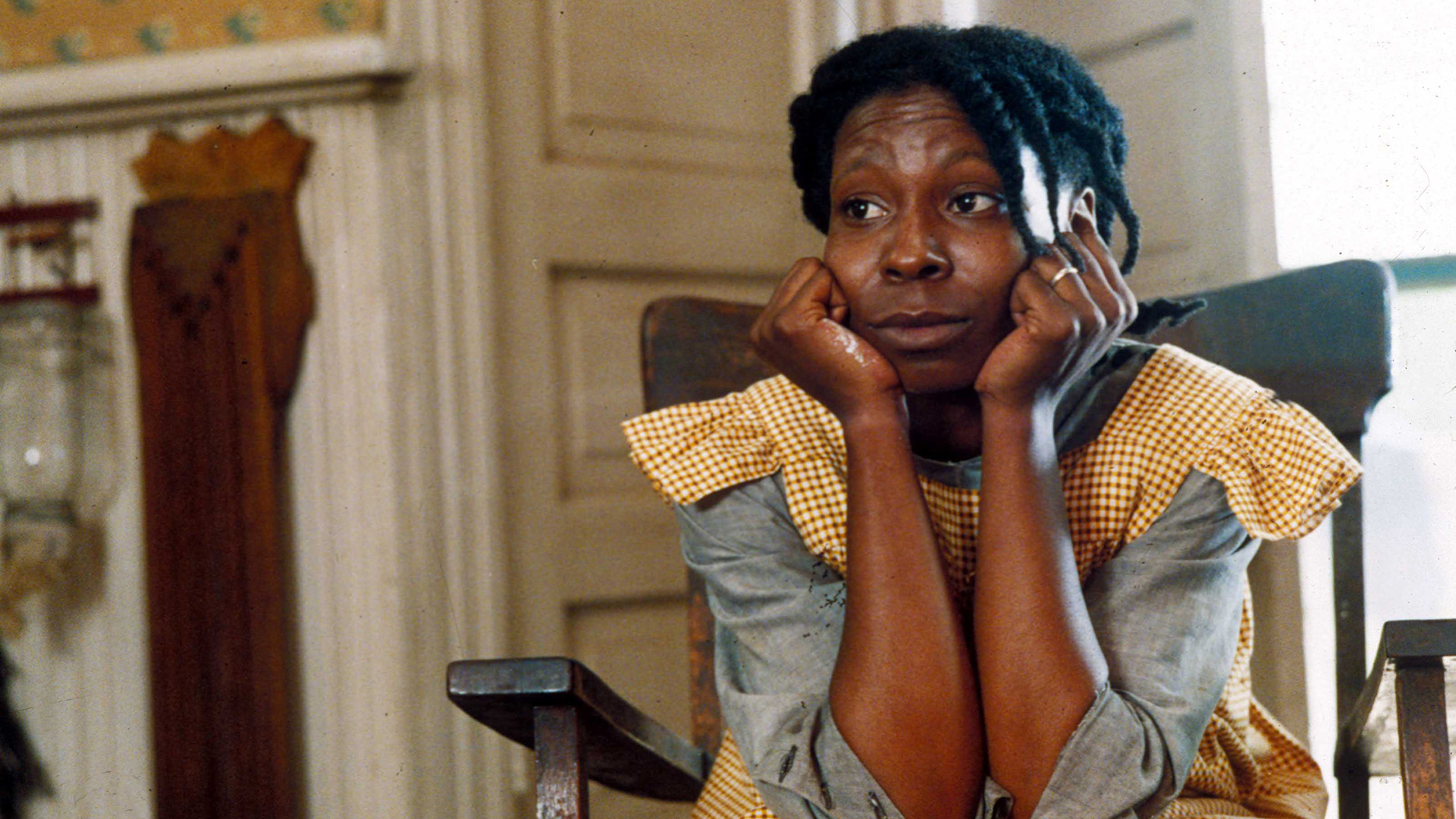
The film is incredibly patient in allowing things to slowly build up to its climax without ever feeling like it’s taking too long to get there. Goldberg is tremendous here.  She expresses a plethora of emotions on her face without ever overacting or doing too much. You can look in her eyes and see the pain and heartache of her character.  It’s a terrific performance, and I think people forget what a great actress she is when given the chance to show off her range of emotions. Of course, she won an Oscar for “Ghost” in 1991.  However, this is clearly the film she should have won an Oscar for, with all due respect to Geraldine Page.

“The Color Purple” does sometimes go off the beaten path with its narrative plot and, at times, it can spend too much time with one character in a specific time and place instead of sticking with Goldberg and her character’s story.  I was very, very close to giving this film four stars, especially because of the emotional weight which was incredibly powerful.  It earns the tears of the audience here by allowing things to build up and develop.  Winfrey is also really, really good here and earned an Oscar nomination for her performance in this film along with Avery.

One of the biggest criticisms of this film is that it was directed by a white director in Steven Spielberg. This is a film populated with a cast which is 95% Black.  I can see why audiences would take issue with that, but Spielberg is wise to stay out of the way of the material and the actors.  Even though some of his familiar touches are here, as mentioned earlier, it doesn’t feel like a typical Spielberg film.  He is sensitive to the story, and he does a terrific job of allowing the performances of his cast and the story itself to take center stage.  He’s more in the background here and, for once, it isn’t a bad thing.

* * * ½ out of * * * *

4K Info: “The Color Purple” is released on a single 4K disc from Warner Brothers Home Entertainment.  It also comes with a digital copy of the film.  The film is rated PG-13 and has a running time of 153 minutes.

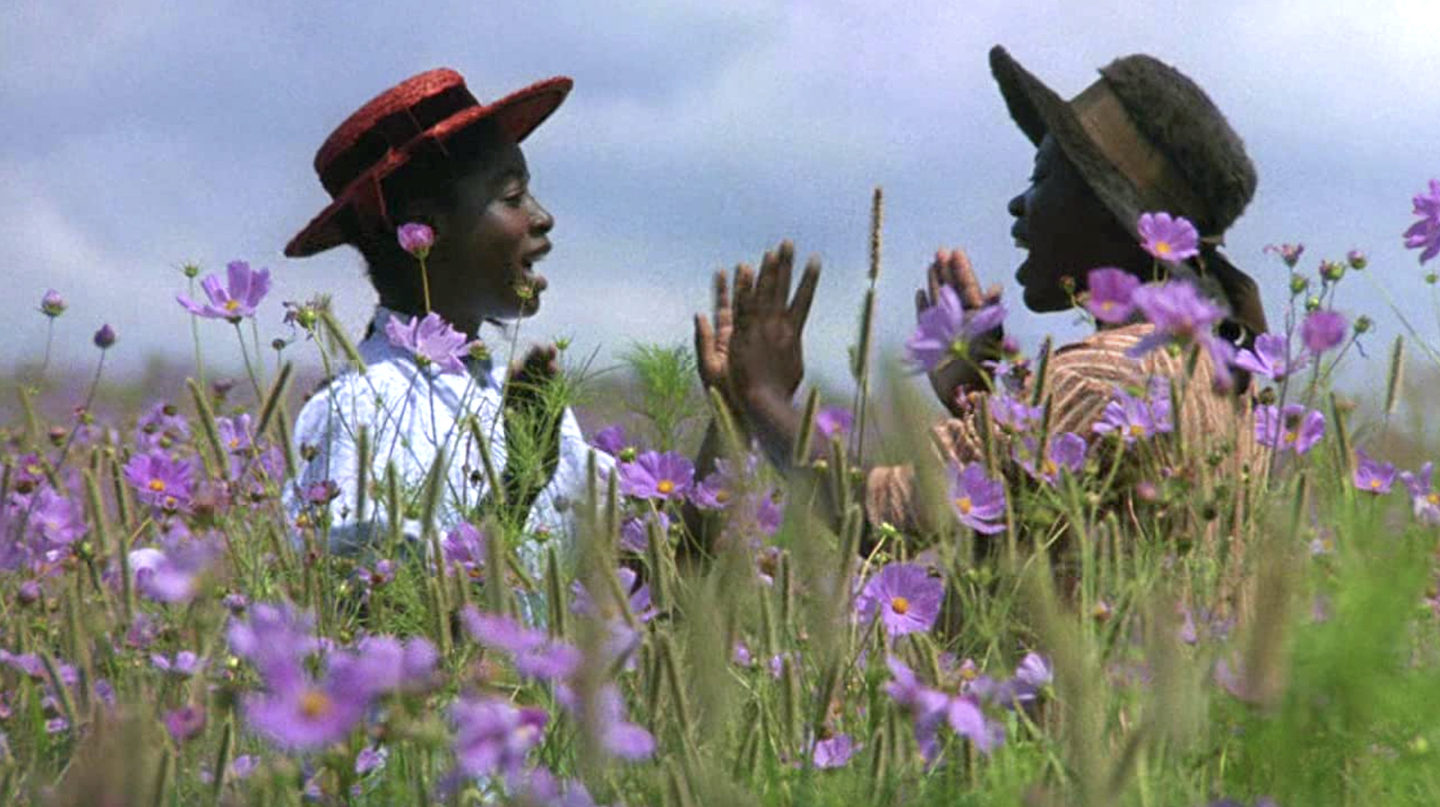
4K Video/Audio Info:  This is another top-notch transfer from the folks over at Warner Brothers Home Entertainment. The HDR here really shines in some of the outdoor scenes which are lively and colorful.  It has a cinematic feel to it while also cleaning up the picture as well.  The audio track is also really solid, as this is a dialogue heavy film, and it’s easy to understand everything that is being said with a clean and crisp audio track here. Subtitles are included in English, Spanish and French.

Special Features:

Conversations with the Ancestors: The Color Purple from Book to Screen

A Collaboration of Spirits: Casting and Acting The Color Purple

Cultivating a Classic: The Making of The Color Purple

The Color Purple: The Musical

Teaser #1

Teaser #2

Trailer

Should You Buy It?

If you read my 4K reviews (and thank you if you do), you know what a big proponent I am of film history and preservation. In the year 2023, Warner Brothers has done their job in going through their extensive catalogue of films and bringing them to 4K and making them look bigger and better than ever.  There are a ton of important films in the Warner Brothers library that have received their day in court this year. In order for them to continue doing their job, we need to support their restorations of classic cinema, especially when they are done in such a magnificent manner, leaving no stone unturned. “The Color Purple” pops off the TV here and looks better than it ever has, thanks to this 4K transfer.  It sounds great as well. The film itself is an important piece of cinematic history that shows off great acting and tells a vital story with a great cast of actors and one of the best directors of all-time. At its current price point, which is around $23, this is a day one purchase on its December 5th release date.

**Disclaimer** I received a copy of this film from Warner Brothers to review for free.  The opinions and statements in the review are mine and mine alone.

‘Irreversible: Straight Cut’ – Gaspar Noe’s Infamous Film Still Packs a Devastating Punch

I remember when Gaspar Noe’sIrreversible” was released in 2002 and of the polarizing responses it received at the Cannes Film Festival and from audiences around the world. A rape and revenge story which, like Christopher Nolan’s “Memento,” is told in reverse and comprised of scenes done in long takes, it is still best known for two scenes of punishing ultraviolence: one in which Monica Bellucci’s character is raped in an underpass which lasts for almost ten minutes, and another where a man’s face is bashed in by a fire extinguisher to where he is no longer recognizable to anyone.

I never got to watch “Irreversible” when it played at a theater near me. Back in the day, I considered myself quite the adventurous moviegoer as I went out of my way to watch those films which did not often screen at the local multiplex because they were considered too disturbing for mainstream audiences. But after being so emotionally drained by “Breaking the Waves” and “Dancer in the Dark,” not to mention going through the cinematic equivalent of electric shock treatment that was “Requiem for a Dream,” I was not sure I could stomach what “Irreversible” had to offer, so I waited to view it on DVD where I could lower the volume or fast forward through the hard to watch parts.

Still, part of me regretted never having witnessed Noe’s unnerving film on the silver screen, and this is coming from someone who watched Larry Clark’s controversial “Kids” in a theater with his parents. But now, Noe has released a new cut entitled “Irreversible: Straight Cut,” and on top of it being remastered, it presents the story in chronological order this time around. The question, however, is if this cut will be just a mere gimmick.

The story remains the same with lovers Alex (Monica Bellucci) and Marcus (Vincent Cassel) going to a party along with Alex’s former boyfriend, Pierre (Albert Dupontel). But this straight cut starts with Alex and Marcus waking up after a night of passionate love making. I love watching this opening scene as the intimacy between these two characters, played by actors who were married at the time, as it is so lovely and unforced. So much attention has been paid toward those two unwatchable violent scenes that many forget about these scenes here. Seeing these two lovers together proves to be a wonderful sight as this intimacy is rarely shown enough in movies, and I came out of it feeling envious for Cassel as he got closer to Bellucci than I ever will.

From there, “Irreversible: Straight Cut” goes on a path which leads straight to hell as the road to it is always paved with good intentions. Alex is eager to bring Pierre along for the ride because she knows he gets along rather well with Marcus, and he still has feelings for her. Hearing Marcus and Pierre brag about who was better in bed with her played more strongly for me this time out in this chronological take. In fact, as we are thrust more deeply into one of “Irreversible’s” main targets which is toxic masculinity. Marcus is so consumed with rage over what happened to Alex that he is utterly impulsive and not using anything resembling common sense. Pierre is infinitely desperate to make Marcus see that he would be better off staying in the hospital with Alex rather than trying to seek vengeance and, even though I have long since seen the original cut, I found myself hoping Pierre would succeed this time around.

With “Irreversible: Straight Cut,” Noe has done an excellent job of making this version more than just a mere gimmick. The edits between each scene feel as seamless as they did before, and our attention is now glued to what may happen as opposed to what has already transpired. The more I watched this cut, the more I came to see how it dealt more with the uncontrollable impulses of man to where anything can happen, and this makes the final outcome all the more devastating. Truth be told, the events portrayed here remind me of all those moments I would love to get back as they created a level of damage I never intended.

As for the elongated rape scene, it remains as brutal and unnerving as ever. I did see one man walk out of the theater during it, and part of me expected to see more audience members to do so. I found myself looking away from the screen at times as I became increasingly enraged as ever at what the unrepentant pimp, La Tenia (played by kick boxing champion Jo Prestia in a truly fearless performance), was doing to Alex. There are few other motion pictures I have sat through where I wanted to see a certain character die a most painful death, and La Tenia is seriously deserving of such a fate.

At this point, I should make clear some facts about the rape scene as many of “Irreversible’s” detractors consider this film to be “pro-rape,” something I completely disagree with. The truth is, Noe was not sure how long the rape scene was going to last, and it turns out Bellucci was the one who ended up directing the scene as she wanted it to be as disturbing as possible. Also, Noe’s camera is constantly moving all over the place throughout “Irreversible,” but it remains paralyzed throughout the rape scene as he wants us to remain in Alex’s frame of mind instead of La Tenia’s. Had the camera moved along with every thrust of La Tenia’s body, we would have been in his mindset, and that would have affected the morality of this film in an inescapable way. In my mind, Noe justifies the rape scene in “Irreversible” because of the way he filmed it.

Seriously, “Irreversible: Straight Cut” reminded me of when I first watched “Deliverance” years ago. While many motion pictures are meant to be enjoyed, this one was made to be experienced even if it was against my will. There is no easy escape from the rage of revenge here as Marcus descends even deeper into a hell which Pierre desperately wants to keep him away from. While I have watched “Irreversible” several times before, I still found myself praying still for another outcome.

This film has also been accused of being homophobic as Marcus yells out many degrading insults to the patrons at the Rectum club, but there a couple of things to consider. Noe himself has a cameo as a Rectum regular who is busy pleasuring himself, and this was his way of showing he was on equal footing with characters he portrayed here. As for Marcus, all I can say is that when you find yourself in a state of intense anger or rage, you find yourself saying things you never thought you would ever utter.

As for Pierre, whose vicious actions end up giving him the worst outcome in this film, he represents a case study of deep repression as he keeps his emotions deep inside. But when he bashes that guy’s head in with the fire extinguisher, his repression ends up finding an exit in the worse way possible, and he ends up destroying himself in a way he could never have seen coming.

Basically, what I am trying to say about either cut of “Irreversible” is that Noe did not make this film simply to shock audiences. Yes, he went out of the way to make us feel uncomfortable while we watched it, but there is more substance to this film than we initially saw on the surface of it. In the end, it presents us with a tragedy we would be best to avoid in our own lives as it is anti-rape and anti-revenge more than anything else. If you do not believe me, then you did not look at this film closely enough.

In comparing the two cuts, I have to say I prefer the original cut more as its reverse structure carries more dramatic weight. As we come to see these horrific acts and what led to them, each preceding scene makes us think about what could have been done to avoid such horrific fates. Still, “Irreversible: Straight Cut” gives audiences something to chew on even as it takes things to a finale which is as bleak as can be. When it comes down to it, I am curious to see what people think about the straight cut, particularly those who have not seen either cut before this one. With a film like this, the responses to it prove to be endlessly fascinating.

Come to think of it, comparing “Irreversible” to “Deliverance” reminds me of the pieces of advice characters give in each film. In “Deliverance,” Jon Voight tells Burt Reynolds, “Let’s go back to town and, ah… play golf.” Imagine the horrors those men would have avoided had Reynolds heard Voight out. But when it comes to “Irreversible,” it features a terrible piece of advice which hangs over the film as Alex attempts to cross a busy street when she is told by a woman nearby:

“Take the underpass. It’s safer.”

Original Cut: * * * * out of * * * *

Straight Cut: * * * ½ out of * * * *

‘I Spit on Your Grave: Deja Vu’ Has Its World Premiere in Beverly Hills

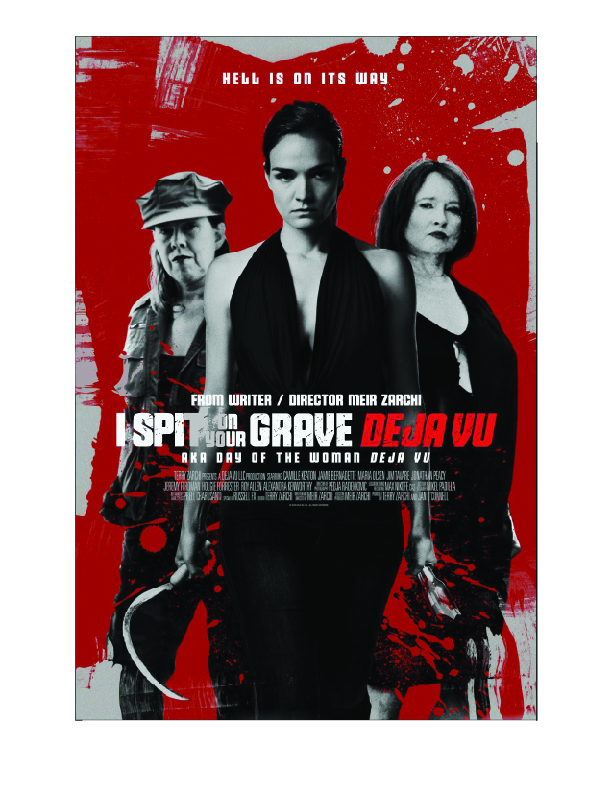
i-spit-on-your-grave-deja-vu-ISOYGDV_3WOMEN8X11_rgb

A sequel 40 years in the making, “I Spit on Your Grave: Déjà vu,” had its world premiere on April 18, 2019 at the Laemmle Music Hall Theater in Beverly Hills, California. Among those in attendance were its director Meir Zarchi who also wrote and directed the 1978 original, his son Terry Zarchi, Camille Keaton who returns as Jennifer Hills, and Jamie Bernadette who plays Jennifer’s daughter, Christy Hills. The sequel sees Jennifer and Christy getting abducted by the infinitely vengeful Becky (Maria Olsen) who looks to make Jennifer pay for what she did to her husband years ago. For those who have seen the original, you can expect blood, gore, acts of revenge which know no bounds, and the intensely painful separation of certain body parts which no one is ever quick to part with.

Following the screening, there was a Q&A with the cast and filmmakers who were also watching this sequel on the big screen for the very first time. It was an exciting evening for everyone as this sequel was actually finished back in 2015, and it is only now being released. When Keaton was asked what made her return to this iconic role, she made it clear how she wanted Zarchi to make a sequel for many years.

“I had been trying to get him to make a sequel to this movie for about 30, 35 years at least,” Keaton said. “One day I get a call, and lo and behold (Meir Zarchi told me) we’re gonna make a sequel. So I said, what? I was surprised and was happy we were going to do this, and it was great to work with him again.”

Jamie Bernadette was asked how she came to be cast in “Déjà vu,” and her response showed how thoughtful she is as a working actress.

“I saw the casting notice and I had seen the original 1978 film and thought it was brilliant,” Jamie said. “The casting notice said Christy Hills was a supermodel and gorgeous, and I thought no, I’m not going to submit. I’ll never get this. And then I sat and stared at that notice and said you know what, what the heck. So, I just pushed a button, and then I got asked for a tape. So I sent in a tape and I thought well, I won’t get a callback but we’ll just do this for kicks. Sent in a tape and I got called back in and I thought, you know what, if I meet Meir Zarchi, I’m happy. So, I walked into that callback room and Meir was sitting there with Terry (Zarchi), our producer. I did the scenes and I was in there for like 40 minutes. It was a long audition, and then Terry caught me on my way to the elevator and said can I take my picture with you because Terry told me later that he just knew before I spoke…”

“(It was) the eyes, the eyes,” Terry Zarchi said. “There was a look that she gives… She gave that look in the audition before she uttered a word. I said wow, that spoke so many words without her saying a word. I can’t wait to hear her, and then a second later three words came out of her. I really hoped Meir likes her enough to (cast her), because he has the ultimate decision on who is going to be cast, but I knew.”

Terry’s relationship with the “I Spit on Your Grave” movies began when he was just nine years old and back when the 1978 original was referred to as “Day of the Woman.”

“I had a hippie guy come up to me while I was on the set and asked me hey, do you want to be in the movie,” Terry said. “I was like no, I really don’t. I was a shy kid, and they talked me into it by saying that my father would offer me $10 if I did the film. I decided to do the film.”

Meir Zarchi himself eventually made it to the front of the audience, and he answered the question which was all on our minds before anyone could ask it.

“Somebody asked me why did it take 40 years to make this sequel,” said Meir. “So I said because I was waiting (he points to Jamie) for this girl. She wasn’t born yet.”

An audience member asked the cast what they did to prepare for their roles and of what they did to get into the psychotic mindset. Jamie was very open about the research she did.

“I spent months watching horrific videos about rape and murder, and I had a lot of nightmares during those months,” Jamie said. “I watched the original film over and over. It was a lot of research into gang rape and things like that, so it was a dark time. I also lost a lot of weight for the role because I am playing an anorexic model. Every day was emotional.”

This evening also allowed Meir to share a moment with Camille whom he married after the making of “I Spit on Your Grave.” Unfortunately, their union did not last long as they divorced in 1982 after three years of marriage. Still, they appeared to have a great respect for one another, and it should be noted how Camille flew all the way over from Florida just for this screening (“I wouldn’t have missed it for the world,” she said).

“Tell us, what do you think about seeing yourself on the big screen after 40 years for this time,” Meir asked Camille.

“I felt the same way I felt about it when I saw myself the first time,” Camille replied.

“That’s a lie, that’s a beautiful lie” Meir said. “You know we were married once. No wonder she divorced me. What did I do? What did I do wrong?”

“I don’t think you did anything wrong,” Camille replied.

Regardless, they both shared a kiss which had the audience applauding.

2018 had Jamie Lee Curtis resurrecting Laurie Strode to tremendous effect in “Halloween,” and now Camille Keaton gets to do the same with Jennifer Hills while at the same time passing on the torch of vengeful female to Jamie Bernadette. As for Meir Zarchi, he isn’t terribly concerned whether or not you like or hate “I Spit on Your Grave: Déjà vu.” He does, however, want to make certain you were not bored while watching it. Suffice to say, the audience responded loudly that they were not.

I Spit on Your Grave: Déjà vu” is set to be released on DVD and Blu-ray April 23, 2019.

The video below is from the Q&A following “Deja Vu’s” screening. My apologies for the the shakiness and visual quality as I shot this on my cell phone. Still, it was fun to hear how the cast and crew came to work on this long-awaited sequel.

‘I Spit on Your Grave’ Remains an Infinitely Repulsive Motion Picture

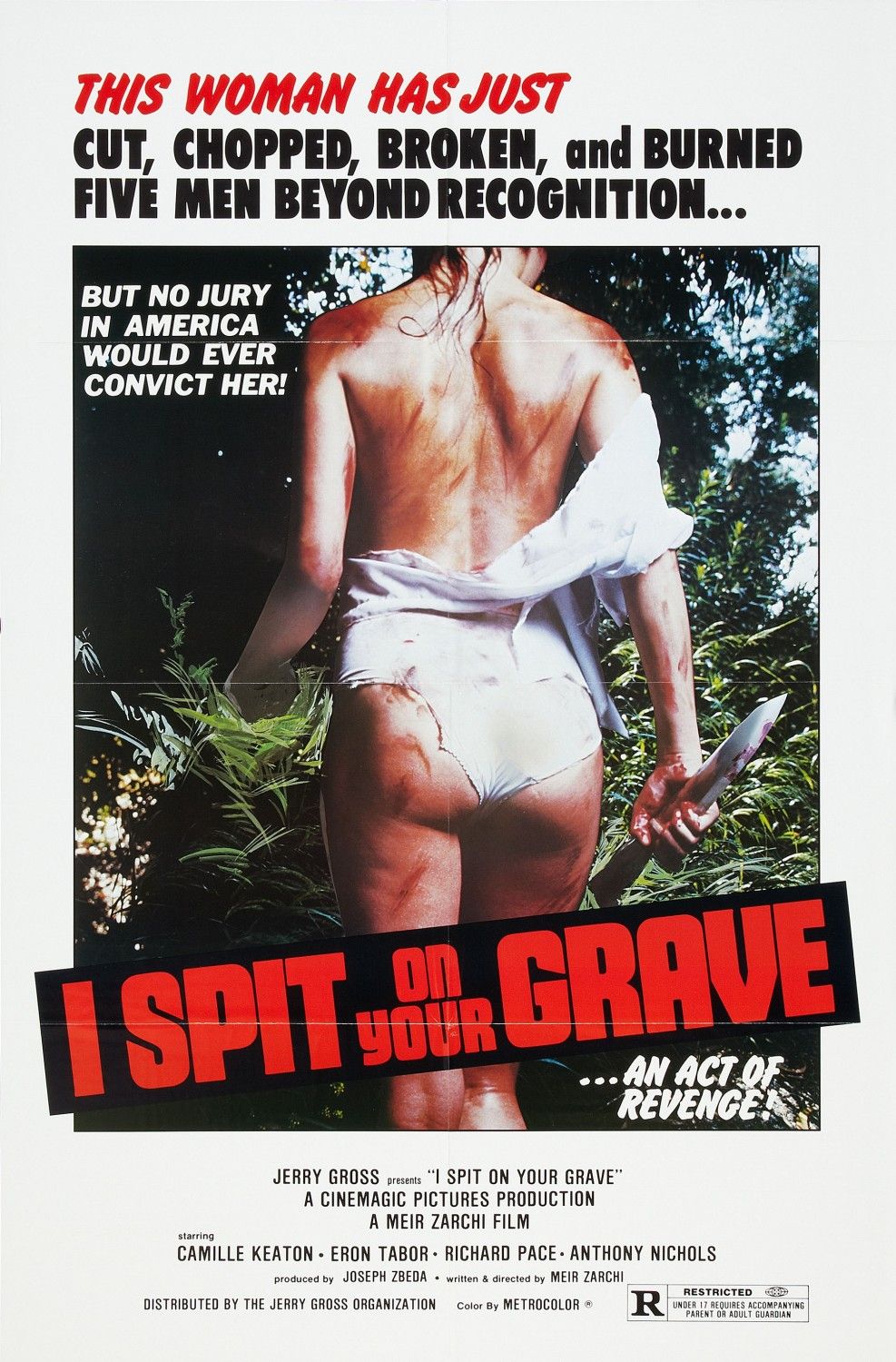
I Spit On Your Grave 1978 poster

I should have known better than to sit through this infamous motion picture. Years ago, when I received my first Roger Ebert Home Movie companion as a Christmas present, I read his review in which he described this particular movie as a “vile piece of garbage” and that attending it was one of the most depressing experiences of his life. After I finished reading his review, I felt as though I had watched as he didn’t even warn his readers how his review contained spoilers, and it showed how serious he was about convincing us to avoid this exploitation film as he found it to have no redeeming value in the slightest.

Reading Ebert’s review of “I Spit on Your Grave” filled my head with images my young brain had no business thinking about at such a tender young age, but I probably would never have known about this movie were it not for his review. As the years went by, the thought of it remained strong in my consciousness to where I was compelled to find out more about it. Plus, it had a cool movie trailer I couldn’t help but watch multiple times. Then again, “Maximum Overdrive” also had a really cool trailer, and we all know how that one turned out. Curiosity may have killed the cat, but I am still alive, therefore I am no cat.

I Spit on Your Grave” is by far one of the most repulsive motion pictures I have ever allowed myself to sit through, and I have seen “The Human Centipede 3.” It tries to pass itself off as a feminist movie, but it instead proves to be a complete insult to feminism, and you don’t need to be a woman to realize this is the case. Even in the realm of exploitation movies, I could not divorce myself from the moral standards I was raised to believe in as they came into play here.

In case you don’t know the plot of “I Spit on Your Grave,” it follows Jennifer Hills (Camille Keaton) as she drives from Manhattan to an isolated cottage out in Connecticut in an effort to start writing her first novel. While there, she attracts the attention of three men and their mentally disabled friend, Matthew, who eventually abduct and brutally rape her for what seems like an eternity. Somehow, she survives and eventually turns the tables on her attackers in ways which will have men crossing their legs more often than not.

This is a motion picture I found myself skimming through more than watching as the rapes prove to be far too disturbing to endure. The sexual assault of Jennifer lasts for over half an hour, and just when you think it is over, it starts up again to where I wondered what writer and director Meir Zarchi was trying to prove. If he wanted to show how unforgivably brutal a crime rape is, he succeeded far more than he needed to.

For what it’s worth, I have to give Camille Keaton credit as she does make Jennifer’s suffering feel all too real to where she deserves a Purple Heart for her efforts. While the performances in “I Spit on Your Grave” are generally poor, Keaton doesn’t hide from the terrors her character is forced to experience in the most demeaning way possible. There is something to be said for her work even as this film proves to be every bit as deplorable as the violence perpetrated on her character.

At the same time, the major flaw of “I Spit on Your Grave” is how it revels in its heroine’s degradation more than in her revenge. In fact, Jennifer’s bloody vengeance on her attackers takes up less than half the time Zarchi spent on her multiple rapes, and there is something deeply wrong when you realize this. Jennifer comes to strangle, decapitate, castrate and disembowel those men who inflicted an infinite amount of cruelty on her, but we never feel her satisfaction as the morality of what she is doing never feels as justified as you would expect it to in any other exploitation film.

Another big problem with “I Spit on Your Grave” is that it is such an amateurishly made motion picture. The artistry behind the camera is seriously lacking to where the low budget cannot be blamed for this film’s shortcomings. There is no music score to speak of, and there is very little to no music throughout. As a result, the whole thing feels like a home movie which never should have seen the light of day.

The original title of “I Spit on Your Grave” was “Day of the Woman,” and this should show how intent Zarchi was on selling this as a feminist movie. But seriously, this is not what a feminist movie looks like in the slightest. While Jennifer is certainly entitled to her revenge, it doesn’t take away from the fact that what she does is just as bad, if not worse, than what those men did to her. This may be nothing more than a movie, but it is hard for me to escape this fact.

There are other movies which deal with rape in a far more probing and intelligent manner than “I Spit on Your Grave.” Among them are “The Accused” which stars Jodie Foster in her first Oscar-winning performance, and Gaspar Noe’s “Irreversible” which features a scene in which Monica Bellucci’s character is raped and beaten for 10 minutes straight and in a single shot. Even Wes Craven’s “The Last House on the Left,” a movie every bit as violent as this one, dealt with rape and revenge in a way which was as intelligent as any subject Craven dealt with in his career.

And yet after all these years, I find myself writing about “I Spit on Your Grave” as if it were a motion picture worthy of being celebrated. Many may see it as a film worth noticing, but I say it is one you must avoid even if you are open to movies which are psychologically damaging to sit through. It is also so poorly made to where you want to smack its most ardent fans in the face and ask them what they see in it. Some may defend its quality, but this will only make you wonder what the term quality actually means.

As I write this review, “I Spit on Your Grave” has long since been remade, and that remake has so far spawned two sequels. Also, it has just been announced that Zarchi completed a direct sequel to the original entitled “I Spit on Your Grave: Déjà vu” which will be released in 2018. All I can hope is that the sequel will show Zarchi as having learned more about filmmaking in the 40 years since he inflicted this infamous motion picture on us.

* out of * * * *

WRITER’S NOTE: I really wanted to give this film a ZERO STARS rating, but I cannot deny the credit Camille Keaton deserves for enduring what she did here.