‘Se7en’ Movie and 4K Review
The following review was written by Ultimate Rabbit correspondent, Tony Farinella.
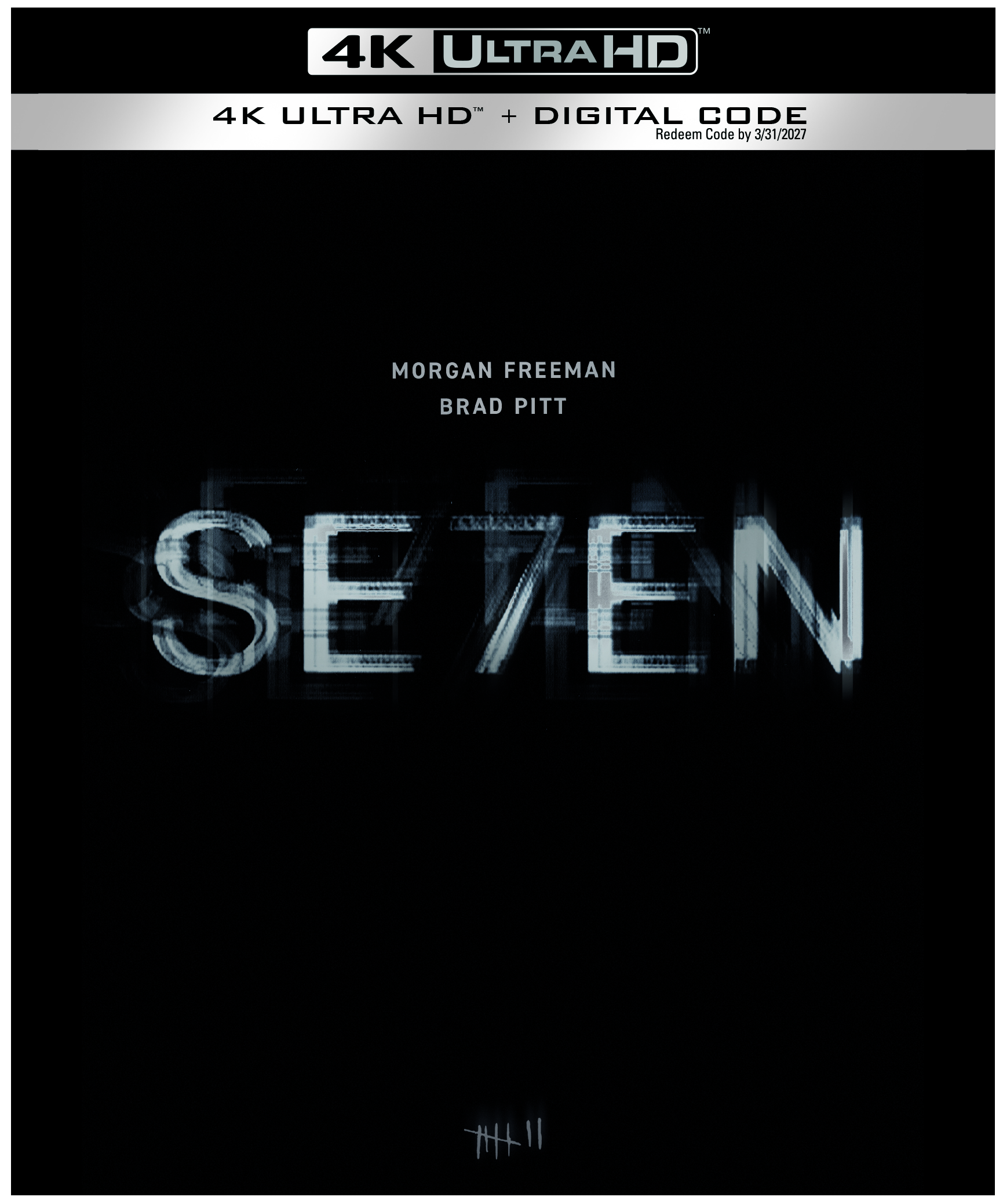
When it comes to 1990’s cinema, it’s difficult to find a film as popular or as well-received as “Se7en.” It became part of the pop-culture zeitgeist when it was released, and it still is a film which elicits a strong reaction from audiences today. Whenever people talk about it, they instantly quote Brad Pitt’s famous line of, “What’s in the box?” The film also served as inspiration for the “Saw” franchise and was ahead of its time in terms of the true crime genre. Now, the film is celebrating its 30th anniversary on 4K from Warner Brothers Home Entertainment. This is sure to be one of the most popular 4K releases of the year.
“Se7en” opens up by introducing the audience to Detective Lieutenant William Somerset (Morgan Freeman) who is one week away from his retirement before he is thrown into a case which captures his attention. It starts off with a man who is found dead after being forced to eat spaghetti over and over again until he perishes. Somerset teams up with a hot shot detective named David Mills, played by Brad Pitt. He recently moved with his wife Tracy (Gwyneth Paltrow) to the city, and he’s looking to make a name for himself. Somerset and Mills could not be more different in how they approach their jobs.

Mills has a short fuse and is ready to fly off the handle at anyone who gets in his way. He also doesn’t play by the rules. Somerset is even-keeled, a deep thinker, and someone who believes you have to look at these cases as more than just black and white, crazy and sane. Before long, more murders are occurring, and the serial killer is murdering people based on the seven deadly sins. For Mills, he simply thinks the killer is a crazy person and writes him off as someone who is going to get caught and isn’t thinking straight. Somerset, on the other hand, sees there is a clear motive and agenda by the killer.
“Se7en” was one of my favorite films growing up. I was 10 years old when it was released, and I saw it when I was 15. It was very much ahead of its time with its gritty, down and dirty filmmaking style. When I watched it in 2025, I liked the film a lot and I admire the craft and precision which went into making it, along with the incredible performance by Freeman. However, I do see some flaws in the film, such as Pitt’s performance. Of course, his “What’s in the box?” scene has become a legendary meme, but he’s way too over-the-top here. After a while, it becomes hard to spend too much time with his character.

I also wanted to learn more about Tracy, played by Gwyneth Paltrow. Paltrow is a terrific actress, and her scenes with Freeman, especially at the diner, give the film some much needed levity. Her character isn’t given enough to do though, besides stay at home and just be written as a one-note character. She and her character deserved better. Going back to Pitt for a moment, I understand what he was going for with his performance, but he plays it too big. In a serious movie like “Se7en,” it almost feels like his character doesn’t belong here. Freeman makes it look easy, and he’s able to portray all of his emotions on his face perfectly. I understand the film was showing the contrast between the two characters, but it doesn’t work as well as I remembered it.
When it comes to films like “Se7en” which rely on a twist, they don’t always hold up as well on multiple viewings because the element of surprise is gone. I still think it is a really good film though, and I enjoyed revisiting it on 4K. The atmosphere and the sense of dread is on full-display from David Fincher. The film also has a lot to say when it comes to its views on the world and the people in it. While Mills believes he can make a change and clean up the world, Somerset is more realistic on what he can do and what the world is capable of as a whole. It’s a film with some brainy ideas, but those ideas sometimes get lost in the middle of trying to solve the crime.

Overall, I still like “Se7en,” even though this might sound like a negative review. I’m just not as enthusiastic about it as I was 10 or 15 years ago. I see more of the film’s flaws than I did in the past. The second half, especially the big reveal, is still as powerful as it was upon its release. The film works best when it allows its actors room to show off their acting chops and really get into the meat and potatoes of their characters. I found the police work and the case itself not as interesting or multifaceted as I remembered it being in the past. “Se7en” is still a film worth revisiting and owning, despite some new flaws I’ve noticed along the way.
* * * out of * * * *
4K Info: “Se7en” is released on single-disc 4K Digibook or Steelbook from Warner Brothers Home Entertainment. It comes with a digital copy of the film as well. It has a running time of 127 minutes and is rated R for grisly afterviews of horrific and bizarre killings, and for strong language.
4K Video Info: “Se7en” is a dark and grisly film, and this specific visual aesthetic is perfect for the 4K format. I don’t think anyone is expecting the film to look crisp, clear and colorful in 4K. The 4K is not as washed out or bright as the Blu-ray, and this is a good thing. It has a more film-like look to it, which is what I was hoping for with this 4K release. 4K is supposed to bring out the best elements of what the director was looking to achieve with the picture, and “Se7en” is a solid 4K release.
4k Audio Info: “Se7en” comes with a DTS-HD Master Audio soundtrack for the film, which is consistent and steady throughout the course of the film. This is a pretty quiet film with moments of loud and intense dialogue, but it never feels like it’s too much. Subtitles are included in English, Spanish and French.
Special Features:
Commentaries –
The Stars: David Fincher, Brad Pitt, Morgan Freeman
The Story: Richard Dyer, Andrew Kevin Walker, Richard Francis-Bruce, Michael De Luca, David Fincher
The Picture: Darius Khondji, Arthur Max, Richard Francis-Bruce, Richard Dyer, David Fincher
The Sound: Ren Klyce, Howard Shore, Richard Dyer, David Fincher
Deleted Scenes
Alternate endings
Still Photographs (featurettes) –
Production Design (featurette)
Mastering for the Home Theater (featurette)
Exploration of the Opening Title Sequence: Early Storyboards (featurette)
Exploration of the Opening Title Sequence: Rough Version (featurette)
Exploration of the Opening Title Sequence: Final Edit (featurette)
Exploration of the Opening Title Sequence: Stereo Audio Commentary One – The Concept – Designer Kyle Cooper (featurette)
Exploration of the Opening Title Sequence: Stereo Audio Commentary Two – The Sound – Brant Biles & Robert Margouleff (featurette)
Theatrical EPK
Should You Buy It?
“Se7en” is a must-own for physical media enthusiasts out there, but there is one problem with this release: the packaging. If you are going to get the digibook, you should know the film is housed in a sleeve, which makes it very hard to take the disc out without touching the back of it. As many of you know, 4K’s are easier to scratch and damage than Blu-rays. While I appreciate the fact they tried something different with this packaging, they should have at least thought about the overall health of the disc. I would recommend you pick up the Steelbook release instead. I’ve noticed a lot of people are unhappy with the lack of updated special features, as these are the same special features that came with the Blu-ray. Special features on older films are not as prevalent in today’s releases as they were originally done during the height of DVDs and Blu-ray releases, and I think it’s important to remember that. It costs money to interview the actors, and it’s not always easy to track them down for new interviews regarding older films they have done. While it would have been a nice addition to the 4K release, I understand it isn’t cost effective. The film looks sharp and the soundtrack is impressive. For the film itself, as stated in my review, it didn’t hold up as well as I remembered it, but it’s still a really good flick. This is a day-one purchase despite the less than stellar packaging options.
**Disclaimer** I received a copy of this film from Warner Brothers to review for free. The opinions and statements in the review are mine and mine alone.

 The Ultimate Rabbit