Green Zone

Green Zone poster

It was the teaming of Matt Damon and Paul Greengrass which made me almost completely forget that “Green Zone” was yet another movie about our war in Iraq. I find myself, as well as many, avoiding this subject at the movies because we spend our days thinking about what goes on over there and of how we want this war to be over with already. But this director and actor were major forces behind some of the most exciting action movies of the past decade with “The Bourne Supremacy” and “The Bourne Ultimatum.” Furthermore, the composer of the Bourne trilogy, John Powell, is on board as well to give “Green Zone” an even bigger kinetic kick.

“Green Zone” was apparently inspired by the 2006 non-fiction book “Imperial Life in the Emerald City” by journalist Rajiv Chandrasekaran, but the end credits state the movie is actually a work of fiction. Still, while it is not exactly “based on a true story,” “Green Zone” still feels like one of the more logical and honest commentaries about our mess of a war in the Middle East.

Matt Damon stars as Army Chief warrant officer Roy Miller, and we see him with his unit as they investigate a warehouse believed to contain WMD’s. Turns out it doesn’t, and we quickly find this is not the first time Miller and his men have come up empty. As a result, Miller begins to doubt the intelligence reports provided to the troops from a “reliable” but anonymous source. Endlessly curious about why he and every other military officer are not finding any weapons, Miller starts his own investigation into the matter. At the same time, forces around him continue to try and contain a potentially combustible situation that may soon become impossible to control.

It’s no wonder Greengrass chose to work again with Damon on this film. Ever since “The Bourne Identity,” we have had problem accepting Damon as an action hero. What makes Damon perfect for this role is that he never descends into some clichéd portrayal of a soldier who thinks he’s all badass. Roy Miller is a down to earth kind of guy who is sincere in his quest to keep America safe from enemies foreign and domestic. Never does he try to be a hero or show off how macho he is.

You have the soldiers coming up empty, you have the CIA knowing they will come up empty, and you have special intelligence officers who know far more than they are willing to let their own military know about. Also, you have investigative reporters writing articles on Saddam having started up weapons programs again even though they have never been told who their source is. They have to take the word of an official who ends up leading them around in circles.

Now there are a lot of people calling this movie “anti-American” and “anti-war,” but I couldn’t disagree more strongly with that assessment. Many recent war movies are more respectful to the troops than some bother to realize. As for those who assume that it is appallingly “anti-American” as it shows Roy Miller going rogue, I wonder if they had that problem when Jack Bauer does the same thing on “24.”

If anything, the recent war movies have been more anti-mercenary than anything else. Be it “Green Zone,” “The Hurt Locker” or even “Rambo,” mercenaries are shown stepping all over the soldiers if they have to, and we know they get paid twice of what the average soldier makes each year. The soldiers in these films have been presented as far more prepared and patriotic in their commitment to protecting our country. If that isn’t pro-troop, I don’t know what is.

There is also a complexity to both the American and Iraqi characters throughout the film. You figure everyone would be on the same team regardless of what side they are on, but you see all the infighting tearing each side apart as they delude themselves into believing they are winning. One pivotal character in “Green Zone” is Freddy (Khalid Abdalla), an Iraqi who Miller befriends and later becomes his translator. Hollywood has often been accused of presenting Middle Eastern characters as nothing more than terrorists, but Freddy is not like that. Freddy wants to help his country and risks his own life to try to help the Americans while not necessarily welcoming them. He becomes the symbol of those Iraqis that feel wronged by their leaders and of how infuriated they are about the endless damage left in their wake. From a distance, it becomes clear both sides are confused and completely unsure of what to believe.

In some ways “Green Zone” is a criticism of American military involvement in other countries, but director Greengrass doesn’t necessarily hit you over the head with that. Still, during the scene where Miller comes face to face with General Al-Rawi (Yigal Naor, who gives the role a strong menacing quality), he learns the truth of why American military forces are really in Iraq. Al-Rawi is one of the bad guys, but he is also a victim of being in the position he is in. In other words, Al-Rawi is going to take a fall because the United States government wants Saddam.

When Al-Rawi asks Roy Miller if he thinks American forces can seriously change anything in Iraq, I was reminded of a scene in Ridley Scott’s “Black Hawk Down” where a helicopter pilot is being held by Somalia warlords who question the military’s involvement in their country:

“Do you think if you get General Aidid, we will simply put down our weapons and adopt American democracy? That the killing will stop? We know this. Without victory, there will be no peace. There will always be killing, see? This is how things are in our world.”

Throughout his career, Greengrass has never been afraid of dealing with topics which are very touchy. With “Bloody Sunday,” he captured the horrible events of January 20, 1972 when British soldiers clashed with Northern Ireland protestors fighting for their freedom. Then there was “United 93” which dealt with the events of September 11th and of how the passengers on that fateful flight were the first to deal with a post-9/11 world. With “Green Zone,” he defies those who think movies should just be an escape and not a forum for national conversation. It’s an action movie designed to be as thrilling as it is enlightening. His aim is not to show how America divided itself from the rest of the world with this invasion, but of how it created sharp and highly sensitive divisions in America itself.

In addition to Damon, there are other actors who bring their considerable acting talents to “Green Zone.” Brendan Gleeson is perfectly cast as Martin Brown, the CIA Baghdad bureau chief who has seen it all. Still, he is trying to cut through the BS hindering his efforts to control the situation in Iraq. Amy Ryan is excellent as Wall Street Journal foreign correspondent Lawrie Dayne. Her character has written many articles regarding weapons programs being continued in Saddam’s regime, but we see her doubt the source given to her. Most reporters in movies these days are despicable, but Ryan makes this one empathetic as she comes to discover the truth which contradicts all she has reported. The always reliable Greg Kinnear is also well cast as Clark Poundstone, a member of Pentagon Special Intelligence who knows far more than he lets on. It’s no secret these characters are based on real people, but the names have been changed to protect the guilty.

“Green Zone” isn’t as viscerally exciting as the Jason Bourne movies, and it won’t go down as the definitive Iraq war movie (“The Hurt Locker” holds that distinctive honor), but it is still edge of your seat entertainment. But not to worry, Greengrass films the action in a way that doesn’t make it all that hard to tell what’s going on.

Another key scene that comes to mind is when Roy Miller goes out to investigate a lead, and Kinnear’s character ends up cutting him off. As he walks inside the CIA headquarters in Baghdad he tells Miller, “You shouldn’t have been playing on the wrong team.”

It makes me wonder, when was the last time all of us Americans were on the same team?

* * * ½ out of * * * *

Copyright Ben Kenber 2010.

Exclusive Video Interview with ‘Gleason’ Director Clay Tweel

Few movie going experiences in 2016 will be as hopeful or as emotionally draining as the documentary “Gleason.” It takes a good long look at the life of former NFL player Steve Gleason, a defensive back for the New Orleans Saints, who was best known for blocking a punt from the Atlanta Falcons on September 25, 2006. This game marked the first time the Saints had been back to their home stadium since the devastation of Hurricane Katrina, so it made their welcome back celebration all the more thrilling.

In 2011, Steve was diagnosed with Amyotrophic lateral sclerosis (ALS) or Lou Gerig’s Disease, an incurable disease which slowly robs the body of all its motor functions and eventually leads to death. It was around that time that he also discovered his wife Michel was pregnant with their son, and this led him to start a video diary for their unborn child so that he could leave as much of who he is as a person to him before the disease takes its toll. While his situation is bleak, Steve still lives life to the fullest and is determined to be there for his wife and son no matter what.

I recently had the opportunity to talk with the director of “Gleason,” Clay Tweel, while he was in Los Angeles. Tweel previously directed “Make Believe,” a documentary which won the Grand Jury Prize at the 2010 LA Film Festival, and “Finders Keepers” which premiered to rave reviews at Sundance in 2015. For “Gleason,” Tweel had to go through 1,500 hours of footage to give us the documentary that is now arriving in theatres everywhere.  He explained how he managed to whittle down that footage, how “Gleason” compares to the film “The Theory of Everything” which also deals with ALS, and of how the health struggles of a family member and the late, great Muhammad Ali inspired him to get the director’s job for this.

Please check out the interview above, and please be sure to see “Gleason” when it arrives in theatres on July 29, 2016. You can also watch the trailer below and visit the website at www.gleasonmovie.com.

The Neon Demon

The Neon Demon poster

This is a motion picture you will either be on the same wavelength or not. That’s usually the case with any Nicolas Winding Refn film whether it’s “Bronson,” “Drive” or “Only God Forgives,” but I imagine “The Neon Demon” will be his most divisive movie yet. As for myself, I was entranced with this movie from start to finish as it combines the visual aesthetics of a Gaspar Noe film with the dreaminess of a David Lynch one, and those elements come together to form something that is uniquely Refn. In a sea of movies out right now which feel largely underwhelming, “The Neon Demon” is a refreshing one with its undeniably strong visuals, and that’s even though it takes a very sharp left turn in the last half.

We are introduced to Jesse (Elle Fanning), an aspiring model looking to get into the Los Angeles modelling scene. Equipped with some striking pictures shot by her friend Dean (Karl Glusman), she succeeds in getting signed with top Hollywood agent Roberta Hoffman (Christina Hendricks) who encourages Jesse to lie about her age and is quick to dismiss other aspiring talents coldly and without a second thought. Soon Jesse comes to befriend makeup artist Ruby (Jena Malone) who introduces her to the kinky club scene as well as a pair of models, Sarah (Abbey Lee) and Gigi (Bella Heathcote), who are ruthless in their intent to stay relevant in an industry quick to chew them up and spit them out.

Essentially, “The Neon Demon” is Jesse’s descent into the hellish and shallow world of modelling as she becomes the envy of photographers and fashion designers in the industry and creates a cauldron of resentment for those who can only dream of having her natural beauty. That’s the thing; Jesse has a look that feels infinitely real compared to other models who have long since resorted to plastic surgery which has made them look like lifeless statues. How does a novice model make her way through such a cutthroat and friendless realm of existence? Well, Refn is not out to give us the definitive answer to that question, but the journey he takes us on gives us kind of an idea of what it could be like.

I loved the beautiful and yet clinical look Refn gives “The Neon Demon” as it is entrancing and immersive. We are sucked into a world that is not healthy for us, but we can’t turn away from it as, like Pandora’s Box, we have an insatiable desire to see what is inside. Colors abound as if he tried to combine the beautiful images from Noe’s and Dario Argento’s films (“Suspiria” in particular) and turn them into something original. This movie also benefits largely from the beautiful electronic score composed by Cliff Martinez which hugs these images while poking at the darkness lying beneath them.

Elle Fanning has long since distinguished herself from her equally famous sister Dakota, and her role here as Jesse is her most daring yet. Some will complain that all she does in “The Neon Demon” is just sit around and look beautiful, but that’s missing the point. What’s utterly fascinating about Elle’s portrayal is how she takes Jesse from being a seemingly innocent rookie in a business that can be quite cruel to someone who fiercely owns her beauty in a way that is as seamless as it is haunting. This is not a dialogue heavy movie, so Elle has to show this transition without words for the most part and she succeeds to where we cannot help but be horrified about what Jesse will become.

However, Elle is almost upstaged by Jena Malone who combines an earthly look with an almost alien one as makeup artist Ruby. Malone has always been a tremendous actress, and she makes Ruby a wondrous enigma of sorts as she reveals only so much about her character on the surface. As the movie goes on, Malone comes to exhibit a strong vulnerability as Ruby is denied the thing she desires most and ends up acting out in sheer desperation. Malone is riveting and fearless, and she shows no hesitation in embracing Ruby’s dark side.

Abbey Lee deserves credit for bringing unexpected depth to Sarah, a model slowly realizing she is now past her prime, as she sinks into a swamp of infinite envy and resentment. I liked how Bella Heathcote makes Gigi into a model who is unapologetic about the sacrifices she has made for her career and is fiercely defensive of her place in the industry. While Glusman doesn’t get to show a lot of range here as Dean, he does have some nice moments as a man trying to hold strong to his ideals of what real beauty should be. And even Keanu Reeves shows up as Jesse’s unsavory apartment manager Hank, a man John Wick would show no hesitation to beating the crap out of. Say what you will about Reeves’ acting skills; he’s much better here than he was in Eli Roth’s “Knock Knock.”

If there was anything that perplexed me the most about “The Neon Demon,” it was the last half where it suddenly turns into a Grand Guignol horror film. It’s like the movie suddenly turned into something completely different as we find the women in Jesse’s life determined to possess her natural beauty any way they can, and I mean any way. Granted, this is a Refn film so you have to expect the unexpected, but it bears repeating here as things take a direction that almost seems out of whack with what came before.

Many will keep trying to get answers from Refn in regards to the questions “The Neon Demon” casually leaves unanswered. Then again, this is not a movie designed to have easily answered questions as the viewer will have to use their own imaginations to decipher what they have just seen. The movie’s title alludes to an antagonist that can take on a variety of forms that even the real world can’t separate itself from. Or maybe it’s the one deep fear we have to conquer before moving on with life. Whatever the case, “The Neon Demon” in not a movie to be easily dismissed or forgotten. People will either like it or hate it, and I am not afraid to say that I liked it a lot.

* * * ½ out of * * * *


Check out the Star Wars Intro Creator!

Star Wars The Force Awakens scroll

This past weekend we have seen the “Star Wars Celebration” take place in Europe which featured new footage from the upcoming “Rogue One: A Star Wars Story,” a trailer for season 3 of “Star Wars Rebels,” Alden Ehrenreich being introduced as the new Han Solo, and then news that “Star Wars Episode VIII” will begin right where “The Force Awakens” ended. Of course, there was the issue of the new “Rogue One” trailer that we were promised but did not get. The fans were not happy about that, and when “Star Wars” fans are not happy you have to take their dissatisfaction very seriously.

But in the midst of all this hoopla, I came across the Star Wars Intro Creator on the internet. Basically it allows you to create your Star Wars scroll like the ones we have seen at the beginning of the (so far) seven movies which always fill us excitement about the space adventure we are about to be taken on. This fun little tool was developed by Bruno Orlandi and Nihey Takizawa, and it is based on the work of Tim Pietrusky.

I took a lot of joy in putting my together my own “Star Wars” scroll, and I invite you to check it out. Furthermore, you can create your own very easily, although downloading it may take a while.

Check it out below!

Star Wars Intro Creator

Michael Cimino

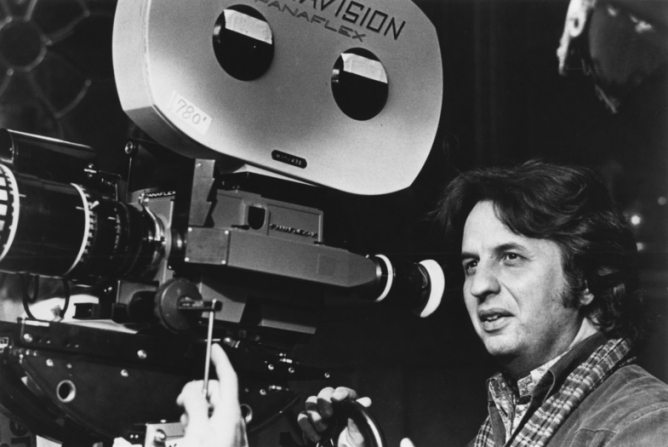
I was shocked and saddened to learn that Oscar winning filmmaker Michael Cimino passed away on July 2, 2016 at the age of 77. It should go without saying that he will always be remembered for two films: “The Deer Hunter,” one of the best war movies ever made, and “Heaven’s Gate,” one the biggest critical and commercial disasters ever unleashed on moviegoers. He only made seven films in his lifetime, and his last full length feature film was released back in 1996. His last directorial effort was the short film “No Translation Needed” which was part of the 2007 French anthology “To Each His Own Cinema.” There is no doubt in my mind that there were many other great movies brimming inside of him, but now we will never see them which is tragic.

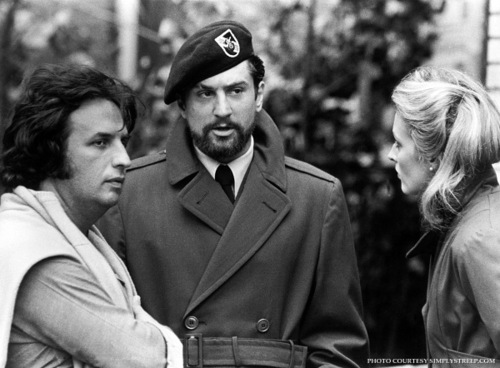
Deep down I always hoped that Cimino would make another movie. I remember when I first saw part of “The Deer Hunter” on cable television. In a time where flipping through channels became a habit impossible to get rid of, I could never take my eyes off what was unfolding before me. The wedding which opens the movie was extraordinary in its presentation, and the Russian roulette sequence remains one of the emotional visceral and draining moments I have ever witnessed on film. While I never got around to watching all of “The Deer Hunter” that evening, I did not even hesitate to buy it on DVD the very next day. After all these years it remains one of the most enthralling cinematic experiences I have ever sat through.

Michael Cimino with De Niro and Streep

That was the thing about Cimino’s movies; that felt thrillingly alive. Whether it was “The Deer Hunter,” “Heaven’s Gate,” “Desperate Hours” or “Year of the Dragon,” there was a life force pulsating through each frame he put on screen. As terrible as “Desperate Hours” was, the images Cimino captured felt kinetic, and that wasn’t just because he had great actors like Anthony Hopkins, Mickey Rourke and Mimi Rogers to work with. For better and worse, his films were operatic to where you were reminded of the powers and beauty of cinema. Even “The Sunchaser” had a look to it that was unmistakably Cimino, and while it was deeply flawed there was an excitement to it that was undeniable.

Movies these days don’t feel that way most of the time. Many are simply made for entertainment purposes which is fine if they work, and others are made for the sake of creating the next big franchise that will spur profits beyond anyone’s imagination (hopefully). Few directors are able to capture their unique vision or get final cut with the exception of Steven Spielberg or Quentin Tarantino to name a couple. The world of movies always needs a cinematic grenade thrown into it to shake things up, and it could really have used one from Cimino. Whatever he could have come up with, good or bad, would have made a sizable impact.

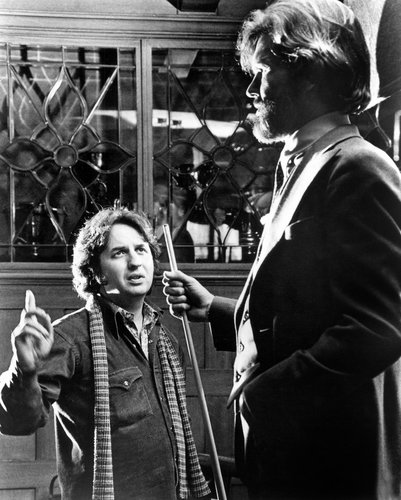
Michael Cimino and Kris Kristofferson

Like many auteurs, he was described as being egomaniacal, selfish, vain and self-indulgent. Who knows if he still would have been an unforgettable filmmaker without any of those attributes. True, he brought a lot of bad karma on himself with his extravagant demands, and yet it’s hard to think of another filmmaker who suffered more. The critical and commercial disaster of “Heaven’s Gate” shadowed him throughout the rest of his career, and even a recent critical appraisal and a Criterion Collection special edition of it could never take away all the shame Hollywood threw at him. How he lived through all that is beyond me. Other filmmakers have suffered flops, but they rebounded somehow. No one ever really let Cimino rebound from “Heaven’s Gate” as its failure marked the end of the director-driven movie era, and he spent practically the rest of his life in seclusion, coming out of it only to make another film or write a book.

With his death, perhaps Michael Cimino’s legacy will get a different perspective, one that’s more positive (even if it’s only a little more). Whether you loved or hated his films, his vision was unique and energetic. He left his mark on Hollywood, and nobody will ever forget that.

Rest in peace Michael.

Michael Cimino at film festival

Copyright Ben Kenber 2016.