Star Trek Beyond

Star Trek Beyond poster

With “Star Trek Beyond,” the rebooted franchise now follows the Enterprise crew on its five-year mission to explore strange new worlds, to seek out new life and new civilizations and to boldly go where no one has gone before. What results is a mixed bag of a movie that gets a little too bombastic for its own good at times, but which still entertains better than many of the other summer blockbusters released in 2016. More importantly, this movie remembers what makes “Star Trek” so memorable: the relationships these characters have with one another.

We meet up with James T. Kirk (Chris Pine) and his crew in the third of their five-year mission. Kirk finds his duties as captain growing monotonous and becomes increasingly interested in accepting a promotion to Vice Admiral. Spock (Zachary Quinto) is reeling from his breakup with Uhura (Zoe Saldana) and the death of Spock Prime (the late Leonard Nimoy) to where he is considering leaving Starfleet to help New Vulcan. Scotty (Simon Pegg) still loves his warp engines, Sulu (John Cho) and Chekov (the late Anton Yelchin) are still at the helm, and McCoy (Karl Urban) is still eager to remind everyone that he is a doctor and nothing other than that.

The Enterprise’s latest assignment has them traveling through an unstable nebula on a rescue mission, but it turns out to be a trap that destroys the Enterprise and leaves its crew stranded on an alien planet whose inhabitants are quick to enslave them. An alien commander named Krall (Idris Elba) seeks to destroy the Federation of Planets for reasons which eventually become clear as the movie goes on.

As the trailers for “Star Trek Beyond” have long since revealed, the Enterprise is destroyed early on. This isn’t the first time we have seen this famous starship destroyed. We watched helplessly as it self-destructed in “Star Trek III: The Search for Spock” and we its lower half explode and its saucer section make a spectacular crash landing in “Star Trek: Generations.” But what’s significant about this movie’s Enterprise is that it is destroyed very early on as opposed to the halfway point. This is a bold move as these films thrive on the presence of the Enterprise for the most part, but here we see it destroyed from the get go to where you wonder how the crew can do their jobs without it. As a result, things in “Star Trek Beyond” feel more unpredictable than usual as everyone is separated from one another and trying to figure out what to do without easy access to the Federation of Planets.

J.J. Abrams stepped away from the director’s chair as he was busy directing “Star Wars: The Force Awakens.” In his place is Justin Lin who is best known for his numerous contributions to “The Fast & The Furious” franchise, but I also like to remind people of his 2002 film “Better Luck Tomorrow” which I felt made him a good choice to helm this “Star Trek” movie. Thanks to a script by Simon Pegg and Doug Jung, he takes the time to focus on the characters and their evolving relationships with one another. I especially loved the scenes between Spock and McCoy as these two can’t stand one another but still need to rely on each other when danger looms over them. Spock may find the fear of death of illogical, but McCoy rightly points out that it is what keeps us alive. This is reminds me of a pivotal moment from the original “Star Trek” television series when McCoy said, “Do you know why you’re not afraid to die Spock? You’re more afraid of living.”

Having said that, Lin does make the action scenes in “Star Trek Beyond” feel, and I have to say it, a little too fast and furious. It gets to where we threaten to lose sight of the movie’s plot and what its main antagonist is aiming for. I imagine that when I see this “Star Trek” movie again, and seeing any “Star Trek” movie just once is not enough, I will better understand all that is going on, but the fact that I wasn’t able to follow every little detail here did take away from my enjoyment. I liked “Star Trek Beyond,” but I came out of it feeling like I could have liked it a lot more.

Speaking of the main antagonist, he is Krall and is portrayed by Idris Elba, an excellent choice as he is the kind of actor who can elicit fear with just a look of his eyes. Like Oscar Isaac in “X-Men: Apocalypse,” he is covered up with way too much makeup which threatens to take away from his natural charisma, but he still gives us a villain that is in no way, shape or form a one-dimensional character. As “Star Trek Beyond” goes on, we learn that he is a victim of circumstances beyond his control, but while that doesn’t justify his actions, it certainly explains why he does what he does. Elba is one of the best actors out there today, and his performance here is further proof of that.

It’s great to see how these actors have grown into the roles they were first cast in seven years ago. Pine shows how the years of space travel have worn down Kirk’s soul but not his spirit. Quinto continues to do excellent work as Spock, having made this character his own a long time ago. Urban remains a pitch perfect McCoy, and his delivery of that character’s classic catchphrases is worth the price of admission. Saldana continues to give us a kick-ass Uhura who isn’t about to take shit from anyone, and I mean anyone. With this “Star Trek” movie, Pegg gets to make Scott more than a comic foil as he works to get the support of a particular alien who can help him and the crew defeat Krall. And there’s Yelchin who finally gets to do much more as Chekov here than in the previous films. He’s terrific here, and it makes his recent death all the more tragic as he was a major talent whose life was cut much too short.

Special mention also goes to Sofia Boutella who gives a genuinely strong alien warrior character in Jaylah. This is the same actress who made an undeniably memorable impression as the henchwomen whose prosthetic legs were designed to leave some serious damage. Boutella steals every scene she has here as Jaylah looks to defend herself against those who destroyed her family, and I can’t wait to see what role she will take on next.

While part of me wishes “Star Trek Beyond” was a better movie than it is, it still proves to be better than many of the other summer blockbusters released so far in 2016. Many believe that this franchise is still be converted into one resembling “Star Wars,” but I don’t believe that as the filmmakers involved are fully aware that the characters are far more important in this one than the special effects. It also makes me smile that this franchise continues to live on to further generations no matter what. While some look at Gene Roddenberry’s vision of a hopeful future as nothing but hooey, others see it as one that nobody should stop believing in, and I am one of those people. Here’s to this franchise continuing to live long and prosper no matter what.

* * * out of * * * *

Copyright Ben Kenber 2016.

’10 Cloverfield Lane’ is an Infinitely Intense Thriller

10 Cloverfield Lane poster

A few hours after watching “10 Cloverfield Lane,” I found my nerves were still fried by what I had just witnessed. It feels like it has been ages since a movie made me feel that way, so that’s quite the compliment. Billed as a “spiritual successor” and a “blood relative” to the 2008 monster movie “Cloverfield,” this one works best if you know very little about it when you go inside the theater. Alfred Hitchcock would have gotten a kick out of this as the filmmakers play with your expectations and leave you in a suspended state of suspense throughout. It would be wise to see the movie before reading this review because it is that riveting.

The movie opens on Michelle (Mary Elizabeth Winstead) hurriedly packing her things and moving out of the apartment she shares with her fiancé Ben. While driving through rural Louisiana, she ends up getting into a very serious car accident which renders her unconscious, and she later wakes up to find herself in a concrete room chained to the wall. Eventually she meets Howard (John Goodman), a survivalist who tells her he saved her life and is nursing her back to health. However, Howard also tells her that a deadly attack has taken place and that everyone outside is dead or dying.

They end up occupying an underground bunker which Howard built himself as he always suspected that America was going to be attacked somehow, and along with fellow survivor Emmett (John Gallagher Jr.) they try to live normally by watching videos, doing puzzles, playing board games and occasionally playing a song on the jukebox. But things are never what they appear to be, and soon the bunker won’t be big enough for the three of them.

“10 Cloverfield Lane” marks the feature film directorial debut of Dan Trachtenberg whose previous work includes a short film entitled “Portal: No Escape” which caught the eye of producer J.J. Abrams. It’s a heck of a debut as Trachtenberg puts us right into Michelle’s shoes as we come to have as much an idea of what’s going on as she does. Was there really an attack? Is Howard really worth trusting? Should they stay in the bunker until it’s alright to come out? Questions keep coming up as we try to stay one step ahead of the characters, but anything is possible and nothing can be left to chance.

Trachtenberg is also well served by a strong screenplay from Josh Campbell, Matt Stuecken and “Whiplash’s” writer/director Damien Chazelle which gives us characters who are complex and easy to relate to. These three people are not cardboard idiots out to make the dumbest mistakes possible but instead complex individuals trying to navigate through their own personal issues while attempting to adjust to a possibly post-apocalyptic world. This only adds to the very palpable tension which escalates throughout as does the sharp cinematography by Jeff Cutter, the efficient editing by Stefan Grube and the pulse-pounding music score by “Battlestar Galactica” composer Bear McCreary.

Mary Elizabeth Winstead has long since proven to be a terrific actress thanks to her unforgettable turns in movies like “Live Free or Die Hard,” “Scott Pilgrim vs. The World” and in the criminally underrated “Smashed.” She is a revelation here as Michelle as her character goes from running away from trouble to being forced to confront it head on. It’s great to see Winstead portray Michelle not as some ordinary action heroine, but instead as someone trying to stay one step ahead of those who might not have her best interests in mind.

John Gallagher, Jr. is perhaps best known for his work onstage in the rock musicals “Spring Awakening” and “American Idiot” as well as for appearing on “The Newsroom.” For a moment it looks like his character of Emmett is going to be some clichéd southern dude, but Gallagher never falls into that trap as he reveals Emmett to be a man whose best days may have passed him by, but who is not about to give up on life and those he cares about.

But after coming out of “10 Cloverfield Lane,” I kept wondering if audiences realize just what a great actor John Goodman is. He has delivered one terrific performance after another for years, but has his talent been taken for granted? After serving time on “Roseanne,” he delivered a stellar performance as the seriously disturbed insurance salesman Charlie Meadows. I was reminded of that performance while watching him here as Howard as this is a character who cannot be simply described as a good or bad guy. Goodman makes him into a complex human being and one who is driven by fear more than anything else, and this makes the actions he commits all the more unnerving.

It may still be early in 2016, but Goodman most definitely deserves Oscar consideration here. He proves what a masterful actor he is in that he never has to move a muscle in certain scenes to generate severe unease in the other characters as well as the audience. Just a glare from his eyes will have you on edge as Howard is a man desperate to control his surroundings as well as the people living with him. It’s a frightening performance as Goodman makes Howard terrifyingly unpredictable in his actions. At one point Howards seems agreeable, and in the next he finds himself in a rage. If you are not convinced that Goodman is one of the best actors working in movies today, watching him here should change your mind.

Like I said, “10 Cloverfield Lane” has been described as a “blood relative” or a “spiritual successor” to “Cloverfield.” Those descriptions are very appropriate as it differs quite a bit stylistically to the 2008 movie. None of the characters from “Cloverfield” appear here, and this one is not a found footage film which means no shaky cam. In fact, it’s highly likely that “10 Cloverfield Lane” doesn’t even exist on the same timeline as “Cloverfield.” Still, this movie does share a number of thematic elements that were prominent in its predecessor. To say just how many of them it shares, however, would ruin many of the surprises in store for the audience.

While most sequels or follow ups try to outdo their predecessors by giving us something even bigger, this follow up is instead more simplistic in its approach and shows how less can be more. Trachtenberg makes you experience every claustrophobic and nerve wracking moment to an infinite degree, and it makes “10 Cloverfield Lane” blow “Cloverfield” right out of the water.

2016 has so far given some good movies and others that will be forgotten in no time at all, but “10 Cloverfield Lane” is one of the first great movies I have seen so far in this early year. It takes you on a rollercoaster ride filled with sharp turns, and keeps you guessing all the way to the end.

Copyright Ben Kenber 2016

* * * * out of * * * *

Save

The Duel

The Duel poster

The Duel” is one of those movies that wants to generate tension you can feel simmering below the surface, but it doesn’t come to life until it is much too late. It’s a shame because it features a pair of mesmerizing performances that are offset by a weak one, and its last half really does keep you on the edge of your seat. Everything leading up to that, however, is undone by a dullness that infects the whole proceedings.

The movie starts off in the year 1866 as young David Kingston watches his father get killed in a knife duel by Abraham Brant (Woody Harrelson), and then it moves to 20 years later with David (now played by Liam Hemsworth) a man and serving as a Texas Ranger. David gets assigned to investigate a series of murders and disappearances that have taken place in an Old West frontier town named Helena, and he reluctantly brings along his wife Marisol (Alice Braga) who doesn’t want to wait for him to return home. It is there that he becomes reacquainted with Abraham who is the town’s preacher and manages to keep the people there in a fearful grip. You should have a pretty good idea of where the story will go from this description.

The setup of the story is reminiscent of Martin Scorsese’s “Gangs of New York” which had Leonardo DiCaprio avenging his father’s death at the hands of Daniel Day Lewis, and “The Duel” looks to travel that same path. The problem is that director Kieran Darcy-Smith and screenwriter Matt Cook are not entirely sure how to reach the expected climax with David and Abraham fighting to the death. There are also many questions the movie raises and never answers in a satisfying way, and it really should not have taken long for Abraham to realize who David really is. As a result, the movie never comes to life until we get past the halfway point.

The best thing about “The Duel” is Woody Harrelson who, at this point in his career, can play just about any character he wants to whether it’s in a comedy or a drama. Right from the start, he is a menacing presence as he stares down into everybody’s soul and manages to put the town under a hypnotic spell. Harrelson has played his share of bad dudes before in movies like “Natural Born Killers,” “Out of the Furnace” and “Rampart,” and Abraham Brant is another he can add to his ever-growing resume. Harrelson may have made his Hollywood breakthrough playing a dim-witted bartender on “Cheers,” but watching him in “The Duel” makes that seem like such a distant memory.

Another strong performance comes from Alice Braga as Marisol, David’s wife who falls under Abraham’s spell to where you really want to kick David for leaving her alone so much. Braga is riveting as she takes Marisol from a strong-willed woman to one who is under the grip of something she is desperate to get control over. This is not some stock female character that can be found in your typical western movie, and Braga makes that very clear throughout.

But then there’s Liam Hemsworth who is simply miscast as David Kingston. It’s not that he isn’t believable as a Texas Ranger, but that he shows no real acting range in the role. In many ways he gives an emotionless performance, and it would have been better if another actor equal to Harrelson were cast in his place. Hemsworth just doesn’t bring much to the part, and the movie suffers considerably as a result.

For what it’s worth, Darcy-Smith does a very good job of transporting the audience back to the 1880’s as everything we see feels authentic to the era. He also jacks up the tension considerably in the last half as David and Abraham try to outsmart one another in the barren fields outside of town, and there’s a taut scene where the two face off in the town’s bar. It’s a very effective moment as the anticipation of guns going off becomes unbearably strong, and we can’t be sure of who is going to walk out of there alive.

Indeed, there are many things to like about “The Duel” from its production values to its performances, so it is frustrating to say that it really disappoints. The filmmakers may have wanted to emulate the great and gritty westerns of the past like “The Wild Bunch” or any starring John Wayne, but it can’t hold a candle to them. They are many who say that the western is dead, but no genre ever really dies. But after watching “The Duel,” it does feel like it needs a lot of reenergizing.

Copyright Ben Kenber 2016.

* * out of * * * *

Cell

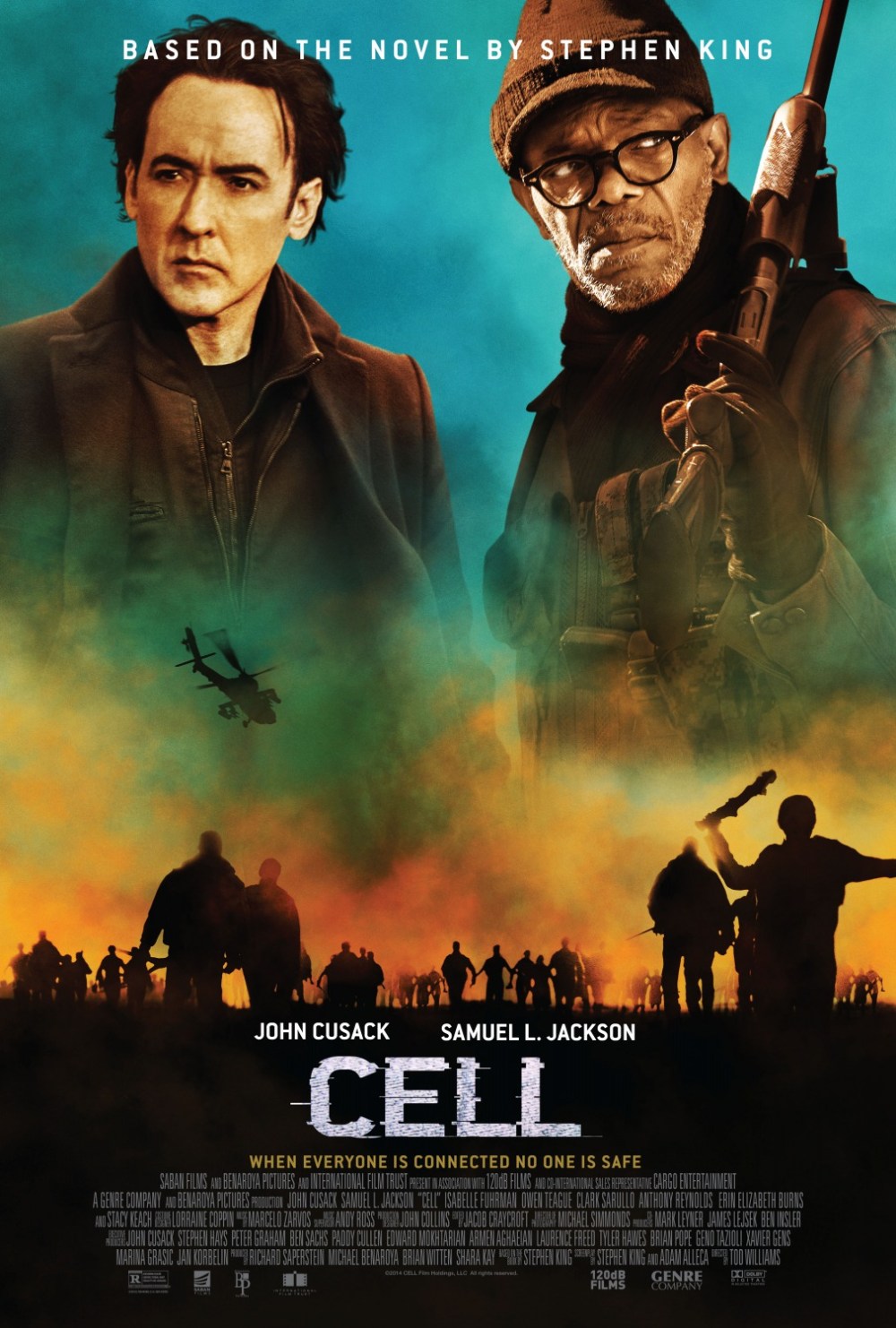
Cell movie poster

I did have the opportunity to read Stephen King’s “Cell” while I was on vacation in Hawaii. It’s not one of King’s best novels, but it was an entertaining read as it delved into our increasing obsession and dependence on technology, in particular cell phones. When the novel was released in 2006, cell phones still had a bit of a ways to go to get to where they are today; devices that can do just about everything and anything in our daily lives except make coffee. But now it’s 2016 and we have long since reached that point where we can’t bear to live without our cell phones and are a slave to them.

A movie adaptation of “Cell” had been in the works for years and Eli Roth was originally going to direct it, but that didn’t work out. Now it has finally arrived in theaters and can be quickly added to the garbage heap of terrible Stephen King adaptations like “Maximum Overdrive” and “The Mangler.” While its subject matter is still timely, “Cell” quickly devolves into just another zombie movie where the clichés are rampant to where we know exactly what to expect to where any suspenseful moments it hoped to have are rendered moot. In short, it is an uninspired retread of “28 Days Later,” a movie this one can only dream of being as terrifying as.

“Cell” opens up on Clayton Riddell (John Cusack) getting off his flight which has brought him back home, and he is eager to reconnect with his wife and son, both of whom he has been estranged from for too long. But it doesn’t take all that long for all the fellow travelers around him to start losing their minds and convulse to where they start attacking everyone and everything in sight. Clayton manages to escape the airport and teams up with subway worker Tom McCourt (Samuel L. Jackson) and Alice Maxwell (Isabelle Fuhrman) to find a safe haven away from those infected with the cell phone virus that controls the actions of everyone infected by it.

The movie gives us sights and sounds we have seen endlessly in one apocalyptic movie after another. We see scenes of cities in utter ruins, cars turned over, survivors travelling through empty roads and fields, etc. All this does is remind me of other movies that are far scarier and more unnerving to where it’s tempting to turn off “Cell” and watch them instead. There’s almost nothing to separate this film from others of its genre, and it becomes a glum and languid bore of a motion picture that feels too long even at 98 minutes.

Watching John Cusack here made me feel sorry for him. After suffering through a number of bad movies these past few years, he delivered a truly great performance as the elder Brian Wilson in “Love & Mercy” which proved he still has much to give to the world of acting. But here in “Cell,” Cusack just looks bored and barely interested to be a part of this particular Stephen King adaptation. His character is just another father trying to get to his child to ensure his safety, and the actor just goes through the motions with little to show for it.

Samuel L. Jackson fares a little better here as Tom McCourt as he gives a performance that is subtle instead of bombastic. The “Pulp Fiction” actor effortlessly turns his character into an everyman who has seen far too much in this lifetime to where this apocalyptic situation is no different to him than being a soldier in a foreign land. Jackson has been in countless movies over the years, many of them flat out bad, but there is no doubt that he will survive this critical catastrophe to give us great performances in the future.

What’s especially galling is that both Cusack and Jackson starred in another Stephen King cinematic adaptation almost ten years ago, “1408,” and that proved to be a scary time at the movies. Why they couldn’t bring the same enthusiasm they clearly had on that one to “Cell” almost feels like a mystery.

But then again, we shouldn’t be blaming the two stars as much as we should be blaming the director of this uninspired mess, Tod Williams. Back in 2004 he gave us the blistering drama “The Door in the Floor” which starred Jeff Bridges and Kim Basinger as a couple forever torn apart emotionally by the death of their sons. It was a breakthrough feature for Williams as he got some of the best performances out of Bridges’ and Basinger’s careers, and he dug deep into the lives of unlikable characters whose psychological wounds were too deep for us to look away from. A few years later he directed “Paranormal Activity 2,” a sequel which proved to be as terrifying as the original. And considering how terrifying the original was, that’s saying a lot.

Those two movies show Williams to be a huge talent behind the camera, so it is very hard to understand why he couldn’t make “Cell” the least bit scary or unnerving. King’s novel dealt with material that was familiar to him, but the writer made “Cell” more than just another exploration into the end of civilization as we know it. Williams doesn’t bother to do that here as he simply throws out one tired cliché after another at us, and some scenes are so badly lit to where it’s impossible to figure out what is going on. This is also not to mention the horrible CGI effects on display which illustrate how this low budget horror movie had an even lower budget than others.

This all leads to a climax which is not at all satisfying, and an ending that is unforgivably confusing. King’s conclusion to “Cell” was a bit anticlimactic and too ambiguous for many readers, but it was still a haunting conclusion that Williams doesn’t bother to include here.

Adapting Stephen King novels to the silver screen has always been tricky as filmmakers have to balance out their attention to both the gory aspects of his stories and the characters which inhabit them. Perhaps Williams tried to do both here, but he’s not able to shock us or care about the protagonists at the center of “Cell.” What we get instead is a very below average genre movie that isn’t worth anyone’s money or time. That should more than explain the studio’s decision to dump it in a handful of theaters this past weekend for a limited release. Do audiences even know “Cell” is out in theaters this weekend? Well, even if they do, I can’t blame them for not caring.

* out of * * * *

Copyright Ben Kenber 2016. All Rights Reserved.


The Innocents

The Innocents movie poster

The Innocents” is one of those movies which just washes over you. Anne Fontaine has directed it in such a way to where it never calls attention to itself. Instead it just sucks you into its post-war setting to where you never question the attention paid to the period detail, and you enter the lives of these characters in the same way the movie’s protagonist does as you make the same discoveries as she while the story unfolds. It feels like it has been a long time since a movie has had that effect on me, so that makes this one rather unique.

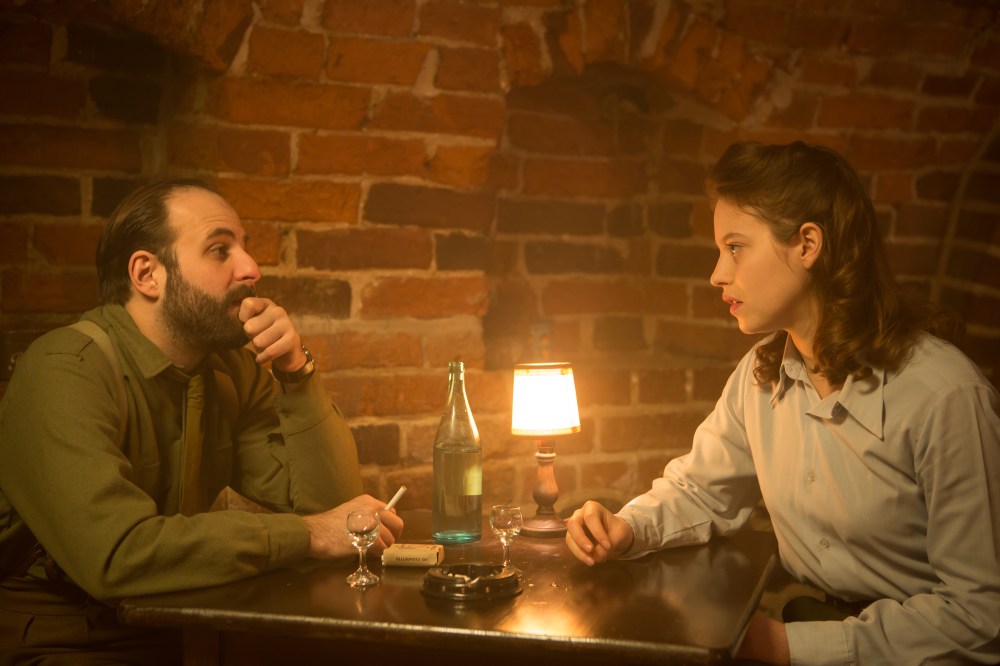
The movie takes us back to December 1945 in Warsaw. The second World War has ended and Mathilde Beaulieu (Lou de Laâge), a young French Red Cross doctor, is treating the last batch of patients who survived their time in the German camps. One day she comes into contact with Benedictine nun who begs her to visit the covenant she lives at, and it is there where Mathilde shockingly discovers several nuns who are pregnant, one of which is about to give birth. These nuns were raped by Soviet soldiers, and the covenant is desperate to keep these incidents as its inhabitants are fiercely private and eager to avoid shaming and persecution from the new anti-Catholic Communist government. But as their strongly held beliefs continually clash with harsh realities, they become reliant on Mathilde to help their sisters with a condition forced unto them.

“The Innocents” covers a part of history that many, including myself, were not aware of before. It was inspired by Madeleine Pauliac, a Red Cross doctor, who documented in her notes the story of these nuns who were raped by Soviet soldiers as much as 40 times in a row. It’s an infuriating crime that many will still not admit happened even though historians know full well that it did. To see it covered in this movie feels like an overdue recognition of the cruelness many women were forced to experience against their will. I came out of this movie angered at what happened to these nuns, and that’s the way I should have come out of it.

Innocents_-_3

Fontaine’s previous films include “Gemma Bovery,” “Coco Before Chanel” and “The Girl from Monaco” Along with screenwriters Sabrina B. Karine, Pascal Bonitzer and Alice Vial, she has given us a tale where the views and beliefs of believers are forced to clash with those of non-believers. This is always a fascinating debate as our views on religion and God always differ in various ways. Because of this vicious crime that has been perpetrated, the nuns have to confront how their beliefs are threatened and forever changed by it. And then there’s Mathilde who is not a believer but shows no hesitation in helping those who are. This brings about many fascinating conversations which make you wonder if much has changed in the years since World War II.

I’m not familiar with Lou de Lou de Laâge’s work as an actress before this movie, but she is perfectly cast here as Mathilde. Here is a doctor, let alone a female one, who risks her life to help those who could be unfairly persecuted for reasons we would never accept today, and she barely bats an eye in the face of adversity. De Laâge is a natural as she makes Mathilde an especially brave character, but one who is simply doing her job to help those who need mending. Other doctors in that same situation might have stayed away in fear of severe consequences, but de Laâge gives us one who is not out to be a hero in the slightest as she is simply doing the job she was trained to do.

Vincent Macaigne also gives a fine performance as Mathilde’s superior and lover, Samuel. At first it looks like these two will have a relationship not unlike the one Peter Benton had with John Carter on “ER,” but theirs proves to be more complex than that. They fall for one another not out of lust but necessity as their lives may be snuffed out on the front lines before they know it, and that makes what they go through especially unpredictable. Macaigne makes Samuel into a doctor who could have easily fallen into clichéd conventions, but he turns him into a fully fleshed out character who is ready to overcome his deeply held prejudices to help those in need.

Innocents_-_5

Then there’s Agata Kulesza who portrays Mère Abesse, the Mother Superior of the covenant. This is the movie’s most complex character as she struggles to keep all the nuns in line while committing rash actions to protect them from what she feels would be an unbearable derision. In another movie this would be a character you would come to seriously hate, but here she is a person doing what she can to keep her sisters in line with the faith while doing things they will come to hate her for. They say the road to hell is paved with good intentions, and Mère comes to show how that is the case.

In some ways “The Innocents” could have dug deeper into the themes it explores as the movie feels like it only goes so far. Also, its conclusion feels a bit too pat as such circumstances can never be easily solved in so simple a fashion. Still, a movie like this is an immersive experience which demands your attention in a way few others do. Many I know have a ridiculous aversion to movies with subtitles, but I invite them to put that to the side as this one covers a part of history that can no longer be ignored. In a day and age where women are still not considered equal to men, this one reminds us of how that should never be the case.

PLEASE NOTE: “The Innocents” will open on July 1st at The Landmark in West Los Angeles and on July 8th at Laemmle’s Town Center 5 in Encino, Laemmle’s Playhouse 7 in Pasadena and Edwards Westpark 8 in Orange County.

Copyright Ben Kenber 2016.

* * * ½ out of * * * *