‘Se7en’ Movie and 4K Review
The following review was written by Ultimate Rabbit correspondent, Tony Farinella.

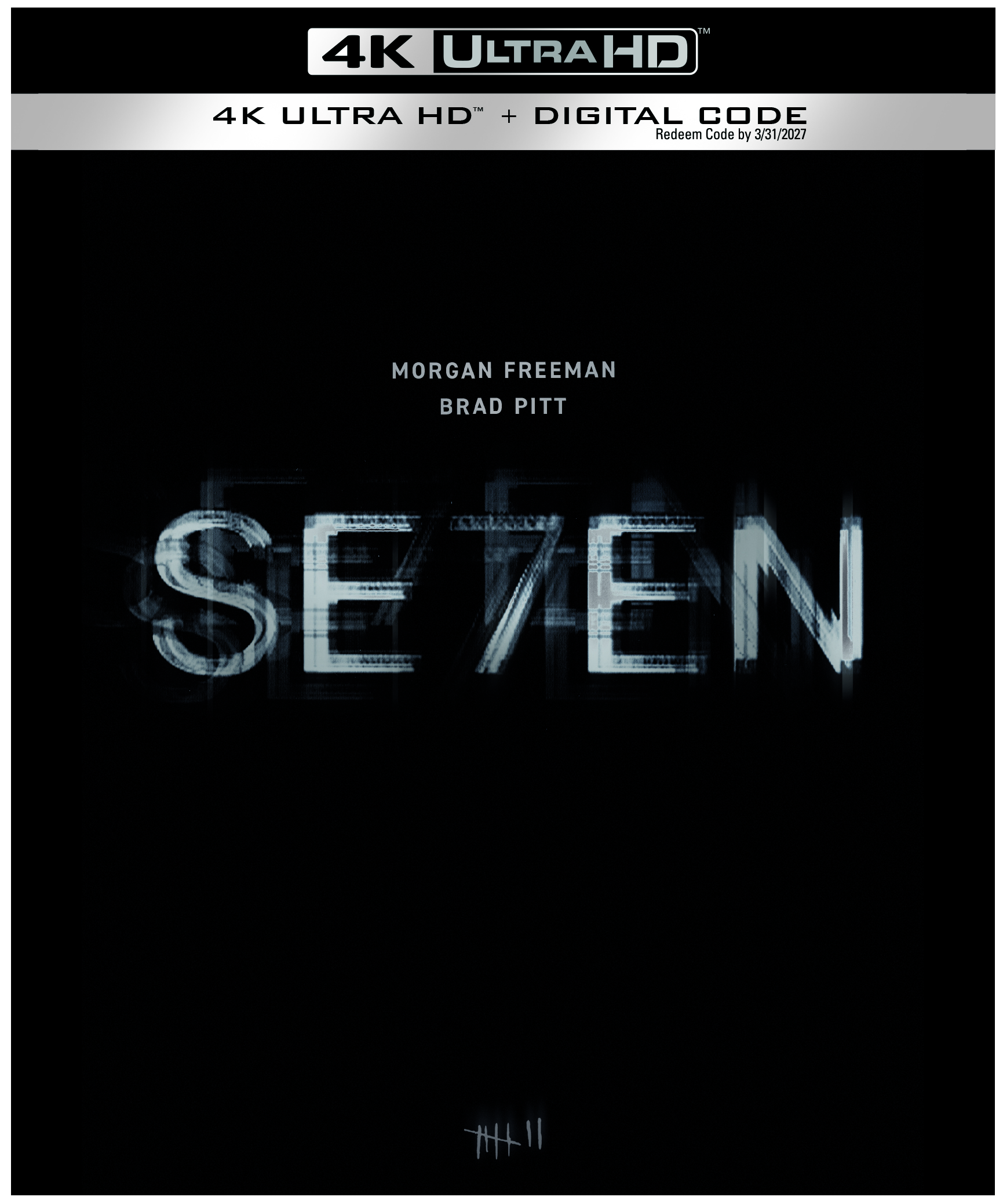
When it comes to 1990’s cinema, it’s difficult to find a film as popular or as well-received as “Se7en.”  It became part of the pop-culture zeitgeist when it was released, and it still is a film which elicits a strong reaction from audiences today.  Whenever people talk about it, they instantly quote Brad Pitt’s famous line of, “What’s in the box?”  The film also served as inspiration for the “Saw” franchise and was ahead of its time in terms of the true crime genre. Now, the film is celebrating its 30th anniversary on 4K from Warner Brothers Home Entertainment.  This is sure to be one of the most popular 4K releases of the year.

“Se7en” opens up by introducing the audience to Detective Lieutenant William Somerset (Morgan Freeman) who is one week away from his retirement before he is thrown into a case which captures his attention.  It starts off with a man who is found dead after being forced to eat spaghetti over and over again until he perishes.  Somerset teams up with a hot shot detective named David Mills, played by Brad Pitt.  He recently moved with his wife Tracy (Gwyneth Paltrow) to the city, and he’s looking to make a name for himself.  Somerset and Mills could not be more different in how they approach their jobs.

Mills has a short fuse and is ready to fly off the handle at anyone who gets in his way. He also doesn’t play by the rules.  Somerset is even-keeled, a deep thinker, and someone who believes you have to look at these cases as more than just black and white, crazy and sane. Before long, more murders are occurring, and the serial killer is murdering people based on the seven deadly sins. For Mills, he simply thinks the killer is a crazy person and writes him off as someone who is going to get caught and isn’t thinking straight. Somerset, on the other hand, sees there is a clear motive and agenda by the killer.

“Se7en” was one of my favorite films growing up. I was 10 years old when it was released, and I saw it when I was 15.  It was very much ahead of its time with its gritty, down and dirty filmmaking style.  When I watched it in 2025, I liked the film a lot and I admire the craft and precision which went into making it, along with the incredible performance by Freeman.  However, I do see some flaws in the film, such as Pitt’s performance.  Of course, his “What’s in the box?” scene has become a legendary meme, but he’s way too over-the-top here.  After a while, it becomes hard to spend too much time with his character.

I also wanted to learn more about Tracy, played by Gwyneth Paltrow.  Paltrow is a terrific actress, and her scenes with Freeman, especially at the diner, give the film some much needed levity. Her character isn’t given enough to do though, besides stay at home and just be written as a one-note character. She and her character deserved better. Going back to Pitt for a moment, I understand what he was going for with his performance, but he plays it too big.  In a serious movie like “Se7en,” it almost feels like his character doesn’t belong here. Freeman makes it look easy, and he’s able to portray all of his emotions on his face perfectly.   I understand the film was showing the contrast between the two characters, but it doesn’t work as well as I remembered it.

When it comes to films like “Se7en” which rely on a twist, they don’t always hold up as well on multiple viewings because the element of surprise is gone.  I still think it is a really good film though, and I enjoyed revisiting it on 4K.  The atmosphere and the sense of dread is on full-display from David Fincher.  The film also has a lot to say when it comes to its views on the world and the people in it.  While Mills believes he can make a change and clean up the world, Somerset is more realistic on what he can do and what the world is capable of as a whole.  It’s a film with some brainy ideas, but those ideas sometimes get lost in the middle of trying to solve the crime.

Overall, I still like “Se7en,” even though this might sound like a negative review.  I’m just not as enthusiastic about it as I was 10 or 15 years ago. I see more of the film’s flaws than I did in the past.  The second half, especially the big reveal, is still as powerful as it was upon its release.  The film works best when it allows its actors room to show off their acting chops and really get into the meat and potatoes of their characters.  I found the police work and the case itself not as interesting or multifaceted as I remembered it being in the past. “Se7en” is still a film worth revisiting and owning, despite some new flaws I’ve noticed along the way.

* * * out of * * * *

4K Info: “Se7en” is released on single-disc 4K Digibook or Steelbook from Warner Brothers Home Entertainment.  It comes with a digital copy of the film as well. It has a running time of 127 minutes and is rated R for grisly afterviews of horrific and bizarre killings, and for strong language.

4K Video Info: “Se7en” is a dark and grisly film, and this specific visual aesthetic is perfect for the 4K format.  I don’t think anyone is expecting the film to look crisp, clear and colorful in 4K. The 4K is not as washed out or bright as the Blu-ray, and this is a good thing. It has a more film-like look to it, which is what I was hoping for with this 4K release. 4K is supposed to bring out the best elements of what the director was looking to achieve with the picture, and “Se7en” is a solid 4K release.

4k Audio Info: “Se7en” comes with a DTS-HD Master Audio soundtrack for the film, which is consistent and steady throughout the course of the film.  This is a pretty quiet film with moments of loud and intense dialogue, but it never feels like it’s too much. Subtitles are included in English, Spanish and French.

Special Features:

Commentaries –

The Stars: David Fincher, Brad Pitt, Morgan Freeman

The Story: Richard Dyer, Andrew Kevin Walker, Richard Francis-Bruce, Michael De Luca, David Fincher

The Picture: Darius Khondji, Arthur Max, Richard Francis-Bruce, Richard Dyer, David Fincher

The Sound: Ren Klyce, Howard Shore, Richard Dyer, David Fincher

Deleted Scenes

Alternate endings

Still Photographs (featurettes) –

Production Design (featurette)

Mastering for the Home Theater (featurette)

Exploration of the Opening Title Sequence: Early Storyboards (featurette)

Exploration of the Opening Title Sequence: Rough Version (featurette)

Exploration of the Opening Title Sequence: Final Edit (featurette)

Exploration of the Opening Title Sequence: Stereo Audio Commentary One – The Concept – Designer Kyle Cooper (featurette)

Exploration of the Opening Title Sequence: Stereo Audio Commentary Two – The Sound – Brant Biles & Robert Margouleff (featurette)

Theatrical EPK

Should You Buy It?

“Se7en” is a must-own for physical media enthusiasts out there, but there is one problem with this release: the packaging.  If you are going to get the digibook, you should know the film is housed in a sleeve, which makes it very hard to take the disc out without touching the back of it.  As many of you know, 4K’s are easier to scratch and damage than Blu-rays.  While I appreciate the fact they tried something different with this packaging, they should have at least thought about the overall health of the disc. I would recommend you pick up the Steelbook release instead. I’ve noticed a lot of people are unhappy with the lack of updated special features, as these are the same special features that came with the Blu-ray. Special features on older films are not as prevalent in today’s releases as they were originally done during the height of DVDs and Blu-ray releases, and I think it’s important to remember that.  It costs money to interview the actors, and it’s not always easy to track them down for new interviews regarding older films they have done. While it would have been a nice addition to the 4K release, I understand it isn’t cost effective. The film looks sharp and the soundtrack is impressive. For the film itself, as stated in my review, it didn’t hold up as well as I remembered it, but it’s still a really good flick. This is a day-one purchase despite the less than stellar packaging options.

**Disclaimer** I received a copy of this film from Warner Brothers to review for free.  The opinions and statements in the review are mine and mine alone.

‘Moneyball’ – One of the Best Baseball Movies Ever

WRITER’S NOTE: This movie review was written in 2012. I present it now as the latest baseball season has now begun.

Moneyball” is, for my money, the best baseball movie since “Bull Durham” as, like Ron Shelton’s 1988 classic, it takes a very unique look at this American pastime and the players who inhabit it. Whereas most baseball movies are about rising to the occasion and winning the big game, this one is more interested in the mechanics and statistics as the characters, all based on real life people, work to see if the current state of this sport can be improved. This is not about winning mind you, but of recapturing a love for the game which has long since passed so many people by.

Brad Pitt stars as Billy Beane, general manager of the Oakland Athletics (a.k.a. the Oakland A’s) who has just witnessed his team’s tough postseason lost to the New York Yankees. In its aftermath, he watches as the team’s key players of Johnny Damon, Jason Giambi and Jason Isringhausen leave for more lucrative deals with other more desirable franchises. From there, the team’s management becomes obsessed about finding the best players to fill their spots. What stands in their way, however, is they have a budget of $40 million to work with which, in any other case, would sound like a lot, but it’s pitiful compared to the Yankees’ overall budget of $100 million.

While visiting a coach from a rival team, Beane comes across Peter Brand (Jonah Hill), a Yale economics graduate who has new and radical ideas of how to assess a baseball player’s value. After hearing Brand’s theories, Beane hires him to join the Oakland A’s, and they both put his unusual theories to the test. This quickly upsets the team’s scouts who cannot, and do not, want to see the validity of these chances being taken. Regardless of the objections, Beane is insistent everyone go in this new direction. But as “Moneyball” goes on, it becomes clear that Beane is not just doing this because of a lack of money, but to find a new way to fall in love with baseball as it ended up betrayed him years before he became a manager.

There are a number of things at work in this film; the need to change the game, the disadvantage some teams have compared to others, and the demons that keep fighting certain baseball players who continue playing this game even when they are long past their prime. In flashbacks, we discover how Beane was an exceptional baseball player in high school, and that scouts for the big teams were serious about signing him up for the major leagues before he could even consider college. His baseball playing career, however, turned out to be a stunning disappointment, and it is this failure which haunts him to this day.

Brad Pitt gives one of his best performances ever as Billy Beane, and he finds a balance to where he inhabits the character more than acts. He draws us emotionally into this movie even more than some might expect, and he brings a realism to Beane which makes his acting never less than compelling.

Jonah Hill, best known for “Superbad,” “Funny People” and “Get Him to The Greek” among other films, gets to go against type here with this dramatic role. He does an excellent job of playing Brand as so fresh-faced to this job and becomes our eyes to the realities of baseball which many people may not be aware of. Seeing Hill imbue Brand with a strong intelligence and a big heart proves he has a lot more to offer than just hilarious performances in comedy movies, and it marks an important change of pace for him as a result.

Another great performance comes from Philip Seymour Hoffman as Art Howe. You never catch Hoffman acting as he portrays Howe as an individual being worn down by endless contract negotiations and is constantly questioning the control he has over his own team. Howe is adamant that he is the one to manage the players above everyone else, but he eventually finds he does not have the energy for a prolonged argument with Beane or Brand as they have their own plans. It is the weariness of Howe which Hoffman so perfectly captures, and he remains one of the best actors working today.

“Moneyball” is based on Michael Lewis’ non-fiction novel of the same name, and it has been adapted by two of Hollywood’s best screenwriters: Steven Zaillian and Aaron Sorkin. Neither of them ever tries to spell out everything for the audience because they are smart enough to give them enough information to where we can all come to very understandable conclusions. And on top of everything, their dialogue remains as brilliant as ever.

In a year which has seen more remakes or recycled ideas as opposed to anything resembling originality, “Moneyball” succeeds in giving us a story which feels so fresh and highly innovative. In dramatizing real-life events, the movie makes you want to see people go against the grain because it does not help to keep things the same as they have always been. It also makes us remember what is so great about the game of baseball in a time where headlines about steroids and other performance enhancing drugs and the constant abuse of them make it all seem like a sick joke. Surely there is plenty of innocence left to this American pastime, right?

* * * * out of * * * *

‘The Social Network’ Remains an Unforgettable Statement on Where Society Is

So, why was this particular David Fincher film called “The Social Network” instead of just “Facebook” or “The Facebook Movie?” When going into the movie theater back in 2010, I figured this film would be all about how Facebook came into existence and of how its audience grew so quickly, but it was not just about that. Looking more closely at “The Social Network,” I think the title is meant to be intentionally ironic as it describes the key individuals who got it off the ground, particularly Max Zuckerberg, as they were more antisocial than they cared to realize. Max was clearly more comfortable being up close and personal with a computer screen than in interacting with real people. The Facebook phenomenon may have brought people closer together than ever before, but ten years later after this film’s release, we are reminded of how it also succeeded in keeping us further apart. And in the year 2020, this is more apparent than ever before.

The beginning of “The Social Network” quickly illustrates Max Zuckerberg’s (Jesse Eisenberg) antisocial behavior as we watch him talk with his girlfriend Erica Albright (Rooney Mara), and it quickly devolves into an increasingly awkward conversation to say the least. Max can’t look her in the eye, and he ends up insulting her without even realizing it. It looks as though his mind is moving at 100 miles a minute to where he never really slows down enough to take in the reactions coming his way. This is our first look at the young man who has long since become the youngest billionaire in America thanks to his bringing about the world’s most prolific social networking website, and he is proving to be anything but social. Erica makes her frustration with his one-track mind and insensitive nature perfectly. Max fears that unless he gets into one of Harvard’s exclusive clubs, he will never be taken seriously and will just be some techno nerd in everyone’s eyes. Erica, fed up with his attitude, tells him people will keep their distance from him because he is a jerk, not because he is exceptionally bright.

Well, love has a very strange effect on us all, and instead of trying to reconcile with Erica right then and there, Max instead heads straight back to his dorm room and creates a page along with his roommates called “Face Mash.” With this page, he allows students to pick which female students at Harvard are the prettiest by comparing them to one another. Of course, this is right after Max cruelly disses his now ex-girlfriend Erica in a number of ways which includes describing her bra size. “Face Mash” ends up bringing in so many viewers in one night to where Harvard’s computer network crashes completely, and Max becomes one of the most vilified individuals on campus, by girls mostly, as well as one of Harvard’s most ingenious students. In record time, he exploited the network’s vulnerability in a way Harvard never saw coming, and the university is quick to cover their own ass as a result.

This all leads to an invitation by identical twins Cameron and Tyler Winklevoss (both played by Armie Hammer) along with their business partner Divya Narendra (Max Minghella) to program a new website they want to put together called “Harvard Connection.” The way they see it, it will be a great way for the students at Harvard to connect with one another. Later, Max meets up with his best, and only, friend Eduardo Saverin (Andrew Garfield) and proposes putting together a website he calls “The Facebook,” an online social networking tool which would be exclusive to Harvard University students. Eduardo agrees to help finance the site, and thus begins a phenomenon which just about everyone has a profile on except for those who have long since had their fill of anything with the name Zuckerberg attached to it. But from there on out, battle lines are drawn and lawsuits are underway as the Winklevoss twins and Narendra claim Mark stole their idea, Eduardo ends up suing Max for cutting him out of the whole thing even though he was a co-founder, and friends and acquaintances soon become the most bitter of enemies.

“The Social Network” jumps back and forth between different perspectives of what actually happened. We watch events progress as Max gets “The Facebook” up and running, and of the reaction his supposed business partners have when their friends set up profiles on it. You never know exactly where the film is going as it goes from one event to a litigation between an annoyed Zuckerberg and the infuriated Winklevoss twins and the deeply bitter Divya Narendra. It goes even further to another lawsuit Eduardo files against Max which illustrates how this endeavor forever terminated their friendship. Even if you know everything there is to know about the creation of Facebook, this film succeeds in intensifying the hurt feelings of everyone involved ever so vividly. We know this house of cards will soon collapse on all the main people involved, but you just don’t know how hard the hits will affect you and everyone else.

Now Fincher and screenwriter Aaron Sorkin working together might not sound like a match made in heaven, and it’s easier to expect them trying to strangle one another in the process of making “The Social Network.” But together, they make cinematic magic as Fincher’s razor-sharp direction more than complements Sorkin’s brilliant dialogue and story construction. This represents some of their best work, and there is nary a false note to be found here. The visual elements never upstage the script and vice versa. It’s a perfect marriage of sights and sounds in a story of friendship, power and betrayal.

Ever since Sorkin’s unforgettable work on “A Few Good Men” and “The American President,” he has mostly worked in television where he was best known for “The West Wing,” my big brother’s favorite TV show. But his screenplay for “The Social Network,” which was adapted from Ben Mezrich’s non-fiction book “The Accidental Billionaires,” is full of some of the most creative dialogue I have heard in any film I have ever seen. One standout scene comes when the Winklevoss twins meet up with Harvard President Larry Summers (Douglas Urbanski) to discuss their desire to sue Max. Watching Summers dryly dismissing their accusations and politely tearing them a new one as if they had no reason to bother him in the first place is so indelibly clever to where the exchange merits a whole play unto itself.

But much of the credit for “The Social Network’s” success belongs to the actors, all of whom were perfectly cast. At the top of the list is Eisenberg who, as Max Zuckerberg, is never afraid to make his character less than likable, and I admired how he and the filmmakers were never looking to whitewash him for the sake of good press. Eisenberg makes you see how fast Max’s mind is moving and of how his single-mindedness keeps him from realizing who he is as a person. You do find yourself admiring Max in spite of himself, and Eisenberg really succeeds in creating a believable sense of empathy for him. It’s this empathy which makes us all want to follow along with this alienated genius all the way to the very end. It’s a tough role, but Eisenberg nails it perfectly while delivering Sorkin’s rapid-fire dialogue without missing a beat.

Rooney Mara only appears in a couple of scenes as Erica Albright, but her presence on the screen is quite powerful as she wounds Max for all he is worth. This proved to be a stronger showcase for Mara’s talents as opposed to her appearance in the remake of “A Nightmare on Elm Street,” and it made me all the more excited to see her performance as Lisbeth Salander in Fincher’s “The Girl with the Dragon Tattoo.” The fact her performance as Lisbeth was so brilliant was hinted at in her work here.

Then you have Andrew Garfield who, at the time, was more well-known for the role he was cast in as Peter Parker and his alter-ego in “The Amazing Spider-Man.” In many ways, Garfield gives this film’s best performance as the most well-meaning guy of the bunch who becomes the biggest victim of all. As we watch him lose control over something he helped create, Garfield makes us feel Eduardo’s vulnerability and pain of being so thoughtlessly cut out of this internet juggernaut all the more vivid and wrenching to witness. We relate to Eduardo’s situation as we have all been duped once or twice. This could have been a performance which might have come across as hopelessly melodramatic and manipulative, but Andrews makes his character so achingly real to where there is no forgetting him once the film has ended.

With Justin Timberlake, “The Social Network” proved there could be no denial of his acting talents with his revelatory performance as Sean Parker, founder of Napster. Fincher made Timberlake screen test for this role a dozen times, and it looks like all those times he hosted “Saturday Night Live” are giving him dividends he truly deserves. Yes, he gave terrific performances in “Alpha Dog” and “Black Snake Moan” beforehand, but his performance here feels all the more astonishing as he seduces not just Max Zuckerberg, but the audience as well. Timberlake slyly turns Sean into the guy who gets inside your skin to effortlessly take advantage of you as he can clearly see what your soul cries out for. Sean makes you believe that the world can be yours and that anything and everything is possible for you and only you. Timberlake is exquisite in Sean seem all the more appealing to be around while making you completely forget he is a back stabbing snake looking to get Eduardo Saverin out of the way.

A lot of praise is also in store for Armie Hammer who portrays the Winklevoss twins, Cameron and Tyler. It helps that Fincher chose an actor most people were not familiar with at the time because, for a while, I honestly thought it was two different actors playing these roles. Seeing an actor playing twins is nothing new, but it hasn’t been done this well since Nicolas Cage played two sides of Charlie Kaufman in “Adaptation.” Hammer nails all the specific nuances of each brother down perfectly to where you can easily tell them apart, and credit also needs to be given to Josh Pence who was a stand in for Hammer. You never catch yourself witnessing special effects whenever Hammer is onscreen, and this makes his work all the more impressive.

Seriously, even the smallest of roles in “The Social Network” are acted with the upmost skill, and no character could ever be mistaken as an easy throwaway. Actors like Max Minghella, Joseph Mazzello, Brenda Song, and Douglas Urbanski all make great use of their time onscreen, and each leaves their mark on our minds.

Trent Reznor composed the score for “The Social Network” along with Atticus Ross, and their music captures how the world around the characters becomes more and more mediatized as the world keeps turning and technology keeps advancing. The electronic sound Reznor is best known for serves to also illustrate the divisions which emerge among everyone here and of how their emotions end up being drained through anger and hurt feelings which may never be fully repaired. Fincher was convinced Fincher and Ross would not receive an Oscar nomination for their work, but they did and eventually won the Oscar for Best Original Score in a way the filmmaker did not see coming. This would lead to a remarkably creative working relationship between these three as they have composed to other Fincher films including the deliciously twisted “Gone Girl.”

“The Social Network” is not meant to be the definitive story of who is truly responsible for the creation of Facebook. Indeed, no one will ever fully know what went on other than the main people involved, and while hefty settlements were made out of court, there does not seem to be a consensus as to what truly happened. Clearly, neither Fincher or Sorkin were interested in getting down to the truth as much as they were in observing the effect this behemoth of a website had on everyone and of how Facebook came to make an inescapable mark in the realm of social media.

Frankly, I don’t give a damn if the movie is completely accurate as there is always a good dose of dramatization in movies dealing with non-fiction stories. What does matter to me is this all makes for a highly dramatic experience which holds our attention from the start to the very end. There are no gun fights or car chases to be found in “The Social Network,” but the emotionally damage inflicted feels every bit as visceral and brutal as any action picture.

The film’s last scene with Max Zuckerberg sitting alone in an office in front of his laptop computer pretty much defines what we have all become in the past decade; a slave to technology and the world wide web. It makes you wonder if we will ever be able to live without such technology as it has long become an inescapable part of our lives. Can we even remember what the world was like before the internet? These days, we are more comfortable being up front and close with our computers than we are with other people, and this was the case before the current global pandemic. Still, there is still a part of us yearning for human contact which we all need, and the fact we are more removed from it than usual is a sad statement on humanity.

* * * * out of * * * *