Underseen Movie: ‘Things I Don’t Understand’
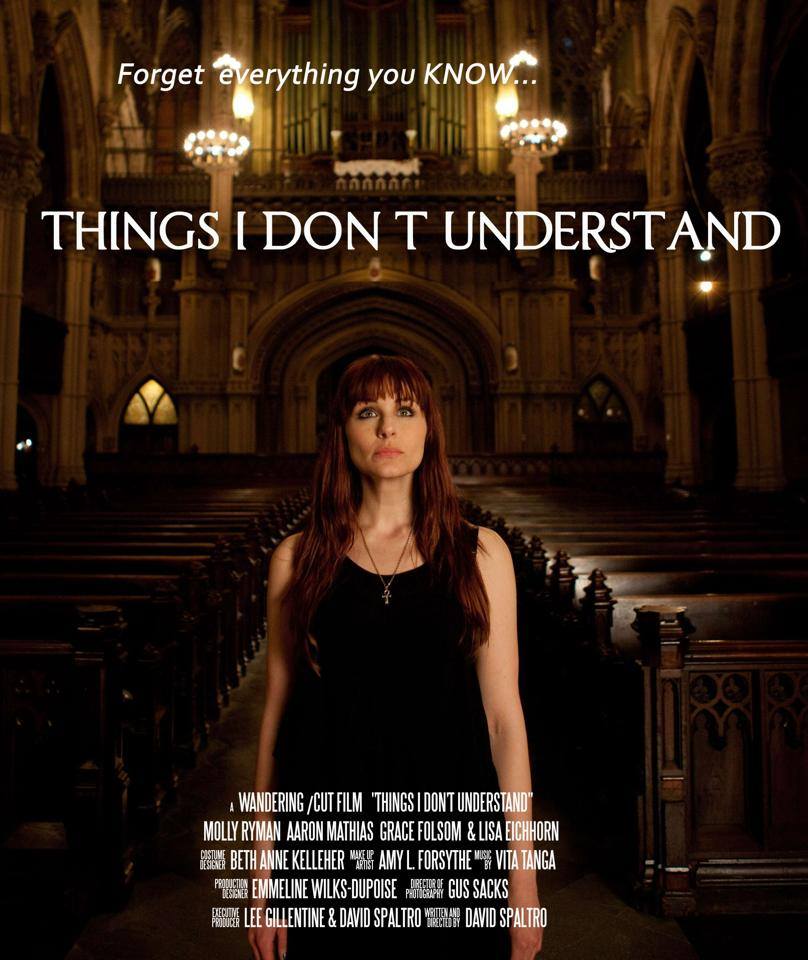
“You’ve got to get yourself together,

You’ve got stuck in a moment

And now you can’t get out of it.

Don’t say that later will be better…”

-U2

“Nothing fades as fast as the future,

Nothing clings like the past.”

-Peter Gabriel

 “More Than This”

What really happens to us when we die? It almost seems like a foolish question to ask because we will only get to find out when we depart this mortal coil, and we won’t be able to tell anyone what it’s like. The only thing people can seem to agree on is that they move towards a “bright light,” but this only tells us so much. Nevertheless, we still look for an answer to this question mainly because we hope it will confirm the things we are led to believe. At the same time, thinking about the future this deeply is not much different from being stuck in the past.

Movies like “Flatliners,” “The Sixth Sense” and even “Heaven Can Wait” have explored this subject in various ways, but David Spaltro’s “Things I Don’t Understand” is one of the more thoughtful I have seen on it in recent years. It’s not interested in coming up with some supernatural answer to this question, but instead in how our curiosity can somehow rob us of what meaning our lives have. Here we meet a variety of characters whose mind and thoughts are broken as their present lives seem unfulfilling because of physical and emotional scars, and their futures all seem relentlessly bleak as a result.

Molly Ryman stars as Violet Kubelick, a graduate student working on a thesis of what becomes of us after death. Over time, Violet has emotionally detached from the world and those around her after surviving a failed suicide attempt, and she has since developed a pessimistic attitude about life and what it has to offer. She lives to avoid every customer who enters the bookstore she works at and freely embraces a life of drugs, alcohol and promiscuous sex as though she is daring death to take her away from this ever so cruel world.

Things come to a head for Violet as she and her obsessively artistic roommates, bi-sexual musician Remy (Hugo Dillon) and hypersensitive artist Gabby (Melissa Hampton), face eviction from their home in Brooklyn and have to quickly come up with the money to save it. As this is happening, Violent comes to interview Sara (Grace Folsom), a girl with end stage cancer who approaches the end with a sardonic sense of humor, and she forms a friendship with lonely bartender Parker McNeil (Aaron Mathias) who is trapped by a tragic past that won’t leave him be. All these relationships bring about a much needed catharsis for everyone as they need to break free of what holds them back.

What I really liked about “Things I Don’t Understand” is how it doesn’t come to us with easy answers about the afterlife as it is far more interested in raising questions about life after death. To define what happens when you die in a movie is tricky because you threaten to lose half your audience with your own interpretation. Spaltro avoids this trap and examines how our questions about life after death come to define how we live life day by day. For these characters, it has seemingly robbed them of a positive outlook on life and has frozen their emotions at a moment in time to where they may never fully thaw.

The acting all around is very good, and Spaltro has given each actor a challenging role regardless of how big or small it is. Ryman has the tough job of portraying a character who is not altogether likable, and she simultaneously (and without words mind you) has to indicate the psychological trauma which has come to define her life. As Spaltro has us guessing as to what that is, Ryman gives us a deeply felt complex portrait of an individual we might easily, and thoughtlessly, dismiss as damaged goods, but who is fighting a battle within herself to find a reason to keep on living.

The best performance in “Things I Don’t Understand,” however, belongs to Grace Folsom as Sara. The role of a terminally ill person can be a thankless one as we have seen it so many times to where it often feels like a shamelessly manipulative device filmmakers use to lay waste to our emotions for no really good reason. But Folsom fully inhabits this character with a hard-won dignity and a biting sense of humor that keeps what is left of her spirits up. Everything Folsom does here feels genuine and real, and her emotions never ever appear faked in the slightest.

Aaron Mathias also has a tough role of someone whose happiness came to an abrupt stop years ago, and the shadow of his past hovers over everything he does. As Parker, he comes across as genuinely nice but still struggling with guilt he cannot put to rest. Mathias succeeds in capturing the complexities of his role in giving us a good-natured guy whose eyes betray a deep sadness which still overwhelms him. I could have done without his line of how being a bartender is like being a psychiatrist spiel, but that is only because I have heard it so many times before.

As for the supporting performances, they at first seem too broad for a movie like this, but in retrospect, they feel just about right. Hugo Dillon and Melissa Hampton play artists so dedicated to their art that they have foolishly denied other outlets which could very well add to it. Their characters strive not just for artistic truth but for acceptance from others, something they feel completely lacking in. In a world which can be so cold and unfeeling to their desires, they have forgotten to respect themselves. As much as Dillon and Hampton go over the top, they both inhabit their characters fully and are more than willing to experience their longings and horrific embarrassments (just wait until you see Gaby’s play) in order to reach a new level of understanding about themselves.

Other performances worth noting include Eleanor Wilson’s as Darla, the new to town actress who looks and sounds dumb, but who turns out to have a positive view of life by choice to where she cannot be mistaken as a victim of blissful ignorance. Lisa Eichhorn takes what could have been a throwaway roll as Violet’s psychiatrist, Anne Blankenship, and gives it a nice edge you don’t always see in characters like this one. And let’s not forget Mike Britt who gives great comic support as Parker’s good friend, Big Felix.

“Things I Don’t Understand” is one of those movies wandering around in the overcrowded world of independent cinema which I hope finds the audience it deserves. While it looks like yet another movie wondering about what happens when we die, it takes this question and uses it to define how we can live for today. The more I think about this film, the more it reminds me of the lyrics of one of my favorite Pearl Jam songs:

“You can spend your time alone, redigesting past regrets, or you can come to terms and realize you’re the only one who can’t forgive yourself. Makes much more sense to live in the present tense.”

* * * ½ out of * * * *

‘Enter the Void’ is Mind-Blowing and Unique in a Way Few Movies Are

Enter the Void movie poster

WRITER’S NOTE: This review was written back in 2010.

Gaspar Noe’s “Enter the Void,” his first feature length film since the highly controversial “Irreversible,” is one of the craziest and hypnotic cinematic experiences I have ever sat through. A hallucinogenic kaleidoscope of colors, some of which looked like they were taken from Dario Argento’s “Suspiria,” it’s a surreal out of body experience and the kind you do not see today in American cinema today. In a time of soulless remakes and films which shamelessly manipulate our emotions, this is a one of kind motion picture as it breaks boundaries to create something unlike anything we have seen before. Like Noe’s previous films, it is destined to have sharply polarized reactions. Some will admire it, and others will find it excruciating to sit through. As for myself, I was mesmerized from beginning to end, thankful I got to take in something not bound by your typical Hollywood formula.

Straight after the IFC Films logo appears, Noe propels us into this visionary experience by beginning with the end credits, just as he did with “Irreversible,” racing through them at warp speed. Watching this, I was reminded of what Homer Simpson said during the end credits of “The Simpsons Movie:”

“A lot of people worked hard on this film, and all they ask is for you to memorize their names!”

Then the movie goes from there into the opening titles which themselves are exhilaratingly creative and makes you feel like you’re at a rave party in Tokyo. Crazy visuals done to the song “Freak” by LFO, they alone were worth the price of admission and got applause from the audience I saw it with at the Lamelle Sunset 5 in Los Angeles.

The word “enter” gets blasted onto the screen, and we then make it to the seamier side of Tokyo as seen through the eyes of the main character, Oscar (Nathaniel Brown). Just like in the opening sequence of Kathryn Bigelow’s “Strange Days,” we see everything from his perspective as he talks with his sister Linda (Paz de la Huerta) who lives with him in a small apartment, and as he smokes some Dimethyltryptamine (DMT) which provides him with the ultimate high, filled with amazingly beautiful colors. During this time, we see Oscar is reading a book his friend Alex (Cyril Roy) gave him called the “Tibetan Book of the Dead.” Alex describes the book as one person’s experience after death, and of how it eventually leads to rebirth. From there, you get a good idea of where “Enter the Void” is going as Oscar later gets shot dead by police while attempting to flush his drugs down the toilet.

At this point, “Enter the Void” becomes a literal out of body experience as Oscar dies and his soul, no longer caged in its human form, rises from his lifeless body. From there, he floats through the darker sections of Tokyo as he watches over his sister as she moves on with life, devastated she can no longer spend it with her dear brother. Throughout, Noe goes back and forth in time as we come to see the connection Oscar and Linda developed in their youth, and how their promise of always being together is strong even as tragedy threatens to tear them apart.

Many will probably see “Enter the Void” as being a pro-drug movie, but I will leave this up to you, the viewer to decide. This is a movie meant for an adult crowd anyway, not for pre-teens. With drug trips, or so I am told, you are lifted high into a state of euphoria which seems untouchable in our everyday lives, but you are also brought down to emotionally shattering lows you will be desperate to look away from, but you won’t be able to tear your eyes away from what you will soon wish you’d forget. Your mind may be freed up in this state, but don’t ever expect to have any control.

Look, I’m not saying drugs are right, but if we’re not taking something illegal and very dangerous, then we are probably relying on something pharmaceutical. Anyway, this is not a movie to get all political about.

When the movie veers into Oscar’s youth, we get to see the close relationship he and his sister have with their ever-loving parents, and the times we see them together are very sweet and captured with a strong sense of innocence. But this later turns out to be a setup for when the parents are killed in horrific fashion after a truck going in the wrong direction smashes into their car, killing them instantly. It’s impossible not to feel the shattered emotions of the children as their lives are irrevocably altered in ways which rob them of a childhood they deserved to have.

Noe does manage to counter many of the disturbing moments of the movie with scenes of innocence and sweetness, and this is an aspect of his filmmaking people don’t often give him credit for. In the midst of shocking scenes filmed in all their psychologically damaging glory, he does capture intimate moments between which I rarely seen in movies being released these days. This was even the case in “Irreversible” when we watched Vincent Cassel and Monica Bellucci frolicking with one another in their apartment, and the fact the two were married in real life at the time makes those scenes feel more emotionally honest as a result.

As with your typical Noe motion picture, “Enter the Void” is not the kind which can be easily recommended to those interested in mainstream fare. In fact, is as far from mainstream cinema as you can get these days, and those who are easily offended would do their best to keep a marathon-like distance away from it. There’s even a scene where we watch helplessly as Linda gets an abortion, and although I was afraid it would be a much harder to sit through than it was, it is bound shake up a lot of the audience members’ emotions.

The acting for the most part is good. Special praise goes to Paz de la Huerta whose character of Linda has to go through the film’s most viscerally emotional moments, and she portrays them without a hint of simply playing the emotion. I also liked Cyril Roy as Oscar’s mentor Alex and found him to be an enjoyable presence even in the film’s more damning  moments of despair. But let’s be honest here, this is a director’s movie more than anything else, and it is easy to believe this was Noe’s dream project for years. It’s a movie for visual and sound designers to go nuts on, and they must have had a blast trying to bring the director’s own psychedelic visions to the silver screen.

At two and a half hours long, “Enter The Void” does get a bit tedious at times. When the movie ended and the lights came up, I heard one guy say, “So at what point did you fall asleep? For some, this movie will be a lot longer than it should. The only time I got a bit restless was during the hotel orgy scene which overstays its welcome after not too long. Noe uses this scene to make clear the difference of having sex and making love, but he spends far too much energy filming this moment instead of just cutting down to its bare essence. I started to feel like Sean Young at the DGA awards when she told “The Diving Bell and the Butterfly” director Julian Schnabel to “get on with it.”

In spite of this, I was completely mesmerized by “Enter the Void” from start to finish as it took me on a cinematic journey far different than most I have sat through this past year. It will surely go down as one of the definitive love-it or hate-it movies of 2010, but I have no problem sticking up for what Noe has accomplished even if it became a bit overindulgent.

Personally, I’m glad we have directors like Gaspar Noe around because it feels like cinema worldwide is lacking filmmakers who take risks and challenge the conventional structure of your typical corporate product posing as a movie. We need more directors like him now because it has become increasingly understandable as to why many no longer go out to the movies like they once used to.

* * * * out of * * * *