‘Glass Onion’ – Another Ingenious Film From the ‘Knives Out’ Filmmaker
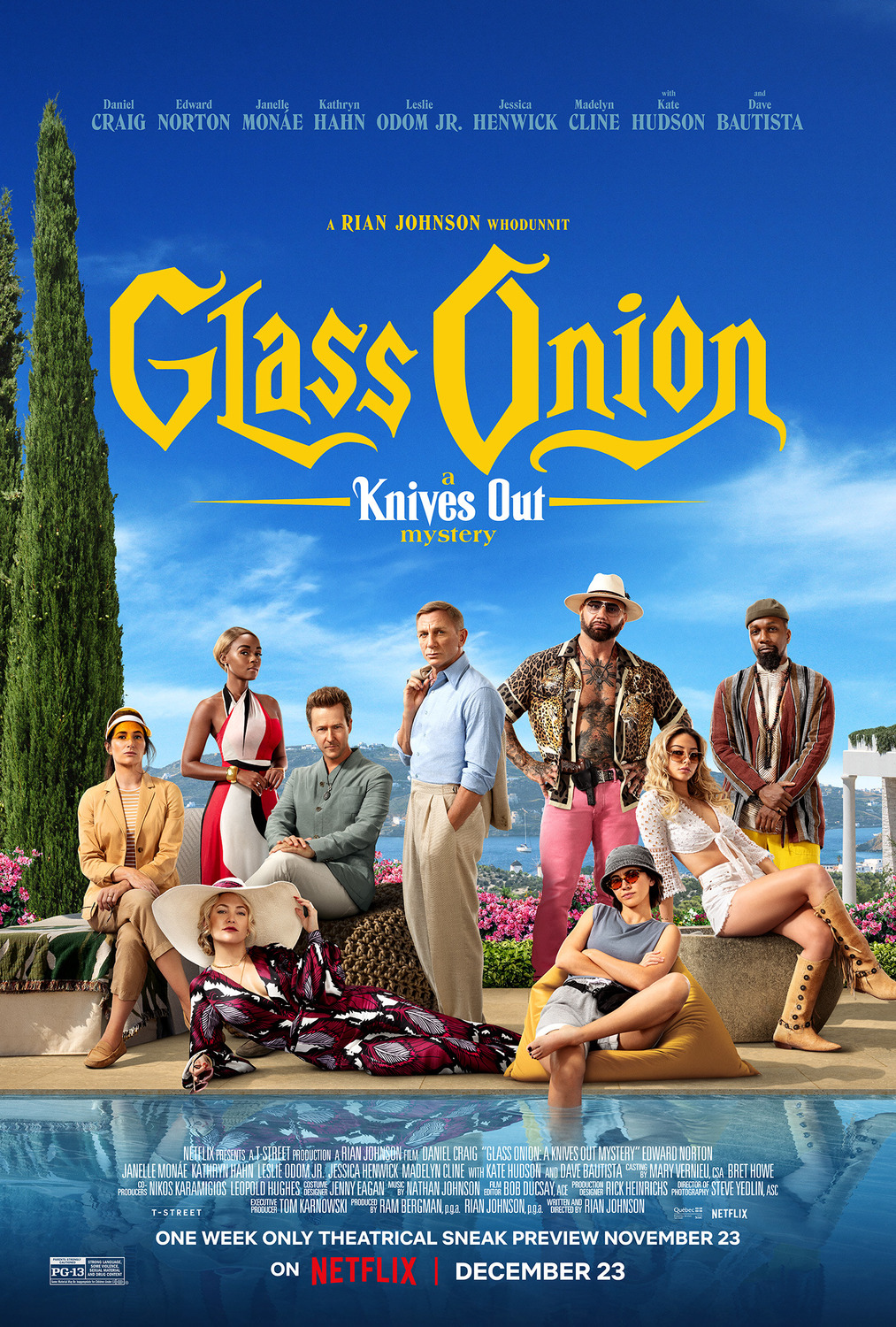
Rian Johnson’s “Glass Onion” is one of those movies I would love to analyze in every single way. It is so cleverly constructed to where I want to know how he went about writing the screenplay. Putting a mystery like this together cannot be the least bit easy because nothing this ingenious comes to any filmmaker easily, and I have to believe Johnson had this story percolating in his brain for many years before it became a reality. This film has several layers viewers will have plenty of fun peeling away at, and the misdirections it employs are wonderfully insidious in a way Ben Shapiro will never be able to appreciate like any intelligent audience member can.

On top of being named after a classic Beatles song, “Glass Onion” is also Johnson’s sequel to “Knives Out.” Or, more correctly, it is a standalone sequel as the only actor returning from “Knives Out” is Daniel Craig who returns to play private detective Benoit Blanc. This time, Benoit has found himself invited to the private island of the billionaire co-founder of the technology company Alpha, Miles Bron (Edward Norton). Miles has brought together a group of his friends together on his island in Greece to play a murder mystery game, and they include Alpha head scientist Lionel Toussaint (Leslie Odom Jr.), Connecticut governor Claire Debella (Kathryn Hahn), controversial fashion designer Birdie Jay (Kate Hudson) who is accompanied by her harried assistant Peg (Jessica Henwick), and men’s rights streamer Duke Cody (Dave Bautista) who is accompanied by his girlfriend Whiskey (Madelyn Cline). But the most controversial guest of all is Andi Brand (Janelle Monae), the other co-founder of Alpha who was ousted from this group a long time ago, and yet she appears here to everyone’s utter shock.

Still, none of this deters Miles from getting his guests to solve the murder mystery he has in store for them. There is, however, one catch. The murder everyone needs to solve is Miles’, and it is here my friends that I refuse to tell you anymore about the story. To do so would ruin an insidiously good time you are bound to have while watching this.

Having seen “Knives Out,” I was tempted to believe I knew which direction Johnson was going to take the audience in with this follow up. But after a good twenty or so minutes, he pulls the rug out right from under us to where I really did not know where things would be heading. While it might seem obvious as to who will get murdered, it is actually not in the slightest. And once the first murder is committed, you become every bit as inquisitive and fearful as the other characters because no one can ever feel safe on this island from there.

Watching “Glass Onion,” I kept wondering what inspirations fueled Johnson to write and construct this screenplay with. Surely he could not have come up with all of this on how own, or did he? Did he read a lot of mystery novels by Agatha Christie and Gregory McDonald? Even I have to catch up with all those “Fletch” novels which I keep promising to myself I will read someday. Watching everything come together is a sheer blast as I kept thinking the fun could only last for so long until everything falls apart. But nothing ever fell apart for me as all the story elements seem to fit together perfectly in a way they never could have in all those “Saw” movies.

The average Pixar movie has so many easter eggs to where watching them once can never be enough. “Glass Onion” is no different as there are so many things you have to keep an eye out for, and the number of name drops of famous people throughout feels endless. There is also a plethora of cameos here which are too good to spoil here as they come out of nowhere, and the one involving Benoit’s partner in life is truly priceless.

I believe Craig’s role as Benoit Blanc may eventually supersede his most famous role to date as James Bond since he is clearly having far more fun playing this character than he ever did as 007 (seriously, just ask Dave Bautista). While playing a British spy may have forced this actor to act within certain boundaries, writer/director Johnson is more than willing to let him turn loose as a private investigator who is a mix of Jacques Clouseau and Sherlock Holmes. The joy of Craig’s performance is that he keeps you guessing as to whether he will solve a crime by sheer accident, or if he will actually deduce who the guilty person is before anyone else can.

The rest of the “Glass Onion” cast prove to be as game as the cast of “Knives Out,” and this did not surprise me in the slightest. Kate Hudson channels her mother Goldie Hawn’s character from “Overboard” here as Birdie Jay, and it is nice to see here in a motion picture which is as deserving of her talents as “Almost Famous” was. Kathryn Hahn brought her sublime and harried comedic talents as Governor Claire Debella here, and her constant exasperation proves to be a continued joy. Bautista once again proves there is much more to him than his character of Drax in those “Guardians of the Galaxy” movies in his portrayal of YouTube star Duke Cody, and that’s even though we should have known this after seeing him in “Blade Runner 2049.” And there is no ignoring Edward Norton who makes tech billionaire Miles Bron into every bit the bumbling manager Elon Musk has proven to be when it comes to Twitter. Of course, this is nothing more than an amazing coincidence as Johnson started writing this movie long before the Tesla visionary even thought about buying the internet app James Woods used to go apeshit on.

But the one performance worth singling out in “Glass Onion” is the one given by Janelle Monae. She portrays Andi Brand, but her role proves to be far more complex than at first glance asshe has to sell us on different facets of an individual we did not walk into the theater expecting to see. Again, I do not want to give anything away, but Monae has more to do here than the other actors, and the fact she pulls this off is beyond admirable as it makes her work look all the more impressive.

You know, when you look at Rian Johnson’s filmography, he has always appeared to be a mystery buff of sorts. His breakthrough movie, “Brick,” was a neo-noir mystery, but while his next film, “The Brothers Bloom,” was more of a caper, it still featured characters searching for answers which constantly elude them. The same goes with my favorite Johnson movie to date, “Looper,” as well as “Star Wars: The Last Jedi” in which characters we know or don’t know are trying to find some way to silence the chaos which constantly disrupts their seemingly peaceful existence.

Taking this into account, I cannot wait to see where Johnson and Craig take this franchise next. Thanks to the deal they have with Netflix, we can expect at least one more “Knives Out” installment in the future, and maybe there will be even more following that. Like James Cameron with his “Avatar” movies, Johnson and company are not about us to give us the same exact thing twice.

* * * ½ out of * * * *
One From Sam Mendes: Revolutionary Road

“Once in a lifetime comes a motion picture that makes you feel like falling in love all over again. This is not that movie.”

– Tagline for “War of The Roses.”

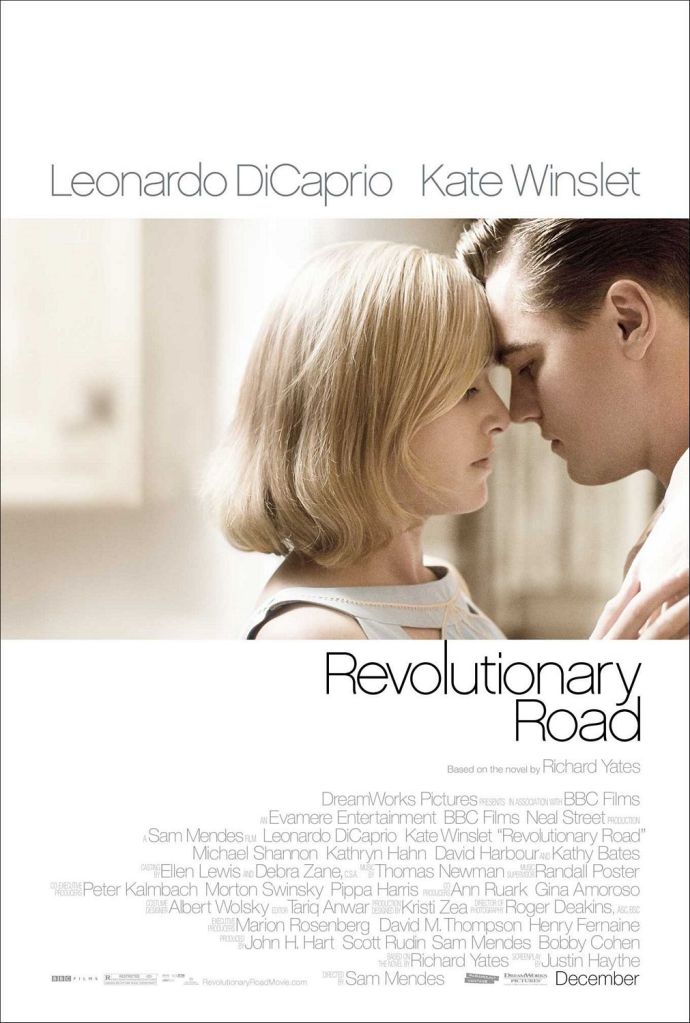
Revolutionary Road” feels more like a horror movie than a romantic drama. It is brutally honest in the way it depicts the terrible disintegration of a marriage, the kind none of us ever want to get trapped in. Those of you who still think gay marriage is a threat to the sanctity of marriage should take a look at this movie, for it is a much more astute examination of what can really destroy such a prized institution. When the movie starts, we know we are in for a fateful journey of two people who at first look like they belong together, but we know they will eventually tear each other apart limb from limb.

But as tough as “Revolutionary Road” is to watch, it is also an utterly brilliant film which serves as further proof of how Sam Mendes’ Oscar win for his directorial debut of “American Beauty” was no fluke. There is not a single false note to be found here, and it feels practically flawless in its making and design. It has great visuals, a great screenplay and amazing performances from the entire cast. Mendes makes “Revolutionary Road” an enthralling experience into the horrors of conformity, the very thing we all try to fight against.

The movie starts with its two main characters, Frank and April (Leonardo DiCaprio and Kate Winslet), when they first meet at a party where they are instantly attracted to each other. The story then moves forward to years later when April is taking a curtain call for a play she is acting in, and she ends up bowing to a very unenthusiastic response from an indifferent audience. It is clear their relationship has gotten cold, and the utter frustration constantly simmering under the surface seem to be the only thing left for them to deal with. This leads to April to come up with what she sees as the perfect plan: They can sell their house and car and move to Paris where she can support Frank through secretarial work while he figures out what he really wants to do with his life. They both see it as their great chance to escape the confines of normalcy which has been eating away at their fragile little souls. However, reality threatens to take away from their dream one piece at a time.

This was Mendes’ fourth film as a director, and you can see a common thread through all his movies. Mendes seems endlessly fascinated with characters whose lives are at a standstill, and who hope for something incredible to happen to them. They are waiting for that moment where they can change into what they always hoped to be, and yet it never quite arrives. In “American Beauty,” it was the characters’ desire to wake up from their dead and dysfunctional lives. In “Road to Perdition,” it was the desire of Tom Hanks’ character to get his son away from the devious life he was leading as a mob enforcer, and to redeem himself in the eyes of his son. In “Jarhead,” it was the desire of the soldiers to enter a war and fight like men, and to take down their enemies by lethal force.

All of this comes around full circle in “Revolutionary Road” as this film deals with characters eager to escape their suffocatingly conformist suburb to live a life of sheer excitement. But they soon come to find they are not as special as they thought they were, and the desires of Frank and April seem to work in opposition to one another. The characters are complex in their creation, and we see what fuels their individual needs, desires, fears and anxieties which serve to define them and their actions. It’s almost like Frank and April are like George and Lenny from “Of Mice and Men;” they are two people hoping to get something they can never truly have, and they constantly delude themselves into thinking all is within their grasp and that their dreams will soon become a reality. But reality comes to rear its ugly head at them, and you know that it ain’t gonna pretty.

In a sense, “Revolutionary Road” can be seen as kind of a distant cousin to “American Beauty” in how it details the suffocating environment of suburban living, but each film approaches this differently. While “American Beauty” dealt with its characters with a dark sense of humor, the environment in “Revolutionary Road” is much bleaker and more consuming. In fact, “American Beauty” seems like a delightful walk in the park compared to this one.

This movie takes place in 1950’s Connecticut, and yet it feels quite contemporary which shows how frighteningly timeless story is. This is what will make the movie hard for many people to watch as they may end up seeing themselves in these two people; the longing for a more exciting existence, for an escape from the suburban way of living which has drained them almost completely of feeling, and to get another chance to get what they truly want out of life.

Along with cinematographer Roger Deakins (“No Country for Old Men“) and production designer Kristi Zea (“The Silence of The Lambs”), Mendes perfectly captures the look and feel of the 1950’s to where you feel like you are right in it. He also captures the routine of the life in suburbs and manages to capture some unforgettable moments like when April takes the garbage out to the front of the driveway, and she sees everyone else has placed theirs out in front as well. In this moment, he captures April’s realization of how she and Frank have bought into the resigned way of living they both thought they would somehow avoid. It’s a beautiful movie to look at, but the ugliness of its characters’ frazzled emotions come through to make this seem like anything other than a Norman Rockwell portrait.

In addition, Mendes is served very well by his frequent film composing collaborator, Thomas Newman. While his music score may sound like many of his others, Newman captures the longings of both Frank and April as they tumble through their seemingly mundane existence, and soon end up being driven crazy by it and each other. Throughout all his work, Newman seems to work with music so subtle in how it is performed, and yet so powerful in what it ends up conveying. It’s no accident that Newman also scored Mendes’ “American Beauty” and Todd Field’s “In the Bedroom.” Like Mendes, Newman has a strong feel for life in the suburbs no matter what decade a movie takes place in.

“Revolutionary Road” is really a tremendous acting showcase more than anything else, and I don’t just mean from the two main actors. You have the always wonderful Kathy Bates who plays Mrs. Helen Givings, the endlessly talkative real estate agent who sells Frank and April the home they end up living in. The smile on her bright face serves to hide the pain that we see later as we are introduced to her son who has just been released from a mental institution. You also have the terrific Dylan Baker as Frank’s co-worker, Jack Ordway, a man who endlessly waxes philosophically over the craziness of our existence. David Harbour and Kathryn Hahn are also excellent as the next-door neighbors, Shep and Milly Campbell. The excitement April and Frank have over their plan to go to Paris both enthralls and depresses Shep and Milly, and the way they react to it implies how April and Frank are not the only ones leading lives of quiet desperation.

But one of the true standout performances from the supporting cast comes from Michael Shannon as Helen Giving’s mentally unhinged son, John. In an atmosphere where the truth is felt but never verbalized, John finds himself completely incapable of telling a lie. Essentially, he is a Vulcan like Mr. Spock, but with an overabundance of raw emotion. Through his thoughtlessly cruel remarks to everyone around him, he exposes the seemingly perfect couple and their marriage for the sham it has become, and you can clearly feel his betrayal by these two people who had promised to escape the lifestyle they found themselves so hopelessly trapped in. Shannon’s performance is astonishing in its uninhibited nature as he becomes the voice of reason in a world so full of lies.

This of course brings me to the two main actors, Leonardo DiCaprio and Kate Winslet. This is the first film they have appeared in together since “Titanic,” but one is very different. It could almost be seen as a story of what happened to Jack and Rose after the big ship sank, assuming Jack survived the freezing waters. Both DiCaprio and Winslet have an incredible chemistry with onscreen, and it seems crazy it took them over 10 years to do another movie together.

DiCaprio continues to prove why he is one of the best film actors of his generation. Throughout the movie, he lets us look past the egotistical nature of Frank Wheeler which allows him to seduce a naïve young secretary (played by the wonderful Zoe Kazan), and to see the pain and fear which threatens to steer him further in a direction he never planned to go in. The relationship he had with his father always seems to be surrounding him in ways which are never fully explained, but we can see how it enforces the decisions he ends up making. Frank clearly cannot stand the job he has as a salesman, but he is also equally terrified of leaving it as he feels he may let down his family in the process. DiCaprio brilliantly captures the complexity of this character whose needs and desires constantly tangle with one other, and whose anger and frustration with life eventually boils over to the only person he can take it out on, his wife.

But as raw and complex as DiCaprio’s role is, he is almost completely blown away by Winslet’s performance. Watching her here, you might think she was in a Lars Von Trier movie. Whereas Frank may have been desperate to escape his mundane existence, April is ten times as desperate to do the same. Her desire to escape the boring life she sold herself out to is never ending, and she can never hide her pain and feelings of hopelessness from those around her. You have to wonder where she gets the energy to do this emotionally exhausting work, and she has more than earned her place in the ever-growing pantheon of great actresses.

“Revolutionary Road” is not the most enjoyable of movies to sit through, but not all movies are meant to be, and this one is not without purpose. We empathize with Frank and April in spite of the way they treat each other because we know all they go through could easily happen to us.

Sam Mendes is one of the best directors working today, and he created another masterpiece of suburban isolation which stands proudly alongside “American Beauty” and “In the Bedroom” among others. It also shows how the term “civil marriage” can seem like the ultimate oxymoron. It goes back to people saying how love is a four-letter word, or that it is a sentence. Frank and April’s story is a tragic one, and probably not a movie to be watched by those who just got engaged.

* * * * out of * * * *