Helen Hunt on Portraying a Sex Surrogate in ‘The Sessions’

WRITER’S NOTE: This article was written in 2012.

Ever since her Oscar win for “As Good as It Gets,” it seems like Helen Hunt has been keeping a markedly low profile. She has kept busy with other projects and even took the time to make her directorial debut with “Then She Found Me,” but we do not hear about her as much these days as we did back in the 1990s during her “Mad About You” heyday. But now she is back in a big way with her critically acclaimed performance as sex surrogate Cheryl Cohen Greene in Ben Lewin’s “The Sessions,” and it serves as a reminder of how great she can be when given the right material.

“The Sessions” is based on the true story of poet Mark O’Brien (played by John Hawkes) who hired Greene to help him lose his virginity at the age of 38. O’Brien had spent the majority of his life in an iron lung and was paralyzed from the neck down due to getting polio as a child. However, a certain part of his body below the waist still works, and Greene became the person he hired to help him exercise it.

Now playing a real-life person has its challenges because you want to honor the individual without impersonating them. For Hunt, however, the challenge became understanding Greene’s job of being a sex surrogate as she was never aware a job like this existed before. Talking with Greene opened Hunt up to how she could respectfully portray such a person onscreen.

“She used the term ‘sex positive,’ ” Hunt said of Greene. “And I went: ‘Wow, I want to be sex-positive. I want to be part of a movie that is that; I’ve never seen that.’ So, it was more her vibe about her positive, enthusiastic, nonjudgmental way of talking about this topic that is usually laden with weirdness.”

Hunt ended up doing 90% of her research for the role with Greene, and it was Greene’s enthusiasm and frankness about everything which made Hunt ever so excited to portray her in “The Sessions.”

“She (Greene) has a sense of adventure about her grandkids growing up, helping someone have an orgasm, making this movie, meeting me and my boyfriend, chocolate from the raw restaurant I took her to,” Hunt said. “All of those things light her up. I thought, ‘What if I could be like that about sex in a movie?’ That would be amazing.”

Greene also made it very clear to Hunt how her job as a sex surrogate differs greatly from being a prostitute.

“The prostitute wants your return business, and she (the sex surrogate) doesn’t. She wants you to learn what you need to learn, so you can go off and have a relationship. That’s a substantial difference,” Hunt said of Greene’s description of her work.

Director Lewin went even further in describing Greene as being “a middle-class soccer mom who has sex with strangers.” As a result, the role Hunt plays in “The Sessions” proved to be more complex than the one Hawkes plays.

“Her preoccupation was in achieving the emotional journey,” Lewin said of Hunt. “I got a real buzz talking with her because there were aspects of the character I hadn’t thought through that she had. She’s a frighteningly intelligent actor.”

The sex scenes between Hunt and Hawkes have a wonderfully awkward feel to them as his character gets to experience sexual intimacy for the very first time. Hunt said neither she nor Hawkes ever did a full read-thru of the script or even rehearsed together much. Instead, Hunt spent a lot of time on her own writing down her own feelings about sex, and what she ended up saying about the act really shows up in the film.

“Sex is never perfectly elegant: The light isn’t just right, and the underwear doesn’t fall on the floor perfectly, and the hands don’t clutch, and you don’t come at the same time. It’s all bullshit, basically,” Hunt said. “And the disability of this character renders all of that impossible, so you’re left with something much more like your own experience as a nondisabled person, which is that you’re human and that it’s good and it’s bad and it’s weird that it’s silly, and it’s embarrassing that it’s scary, so I think that the disability is just a way to get to what it’s actually like.”

Like her co-star Hawkes, Helen Hunt deserves all the accolades she has been getting for her performance in “The Sessions.” You believe her when she says that parts like this one don’t come around often enough, and you can sense her sheer excitement in playing Greene in this movie.

“She was someone who radiated this unabashedly humanistic view of what the human body is capable of,” Hunt said of Greene. “As an actress, I was hungry to play someone like that. As a person, I’m hungry to live that way.”

SOURCES:

Jordan Zakarin, “Helen Hunt, Star of ‘The Sessions,’ Wants to Be Sex Positive,” The Hollywood Reporter, October 19, 2012.

Julie Miller, “Helen Hunt on Overcoming Inhibitions for The Sessions, the Difficulty of Playing a Real Person, and ‘the Sexiest Quality There Is,'” Vanity Fair, October 18, 2012.

Marshall Fine, “Helen Hunt says intense emotional journey of sexual surrogate made ‘The Sessions’ a can’t-miss role,” NY Daily News, October 18, 2012.

John Horn, “Helen Hunt fully invests in ‘The Sessions,’” Los Angeles Times, August 31, 2012.
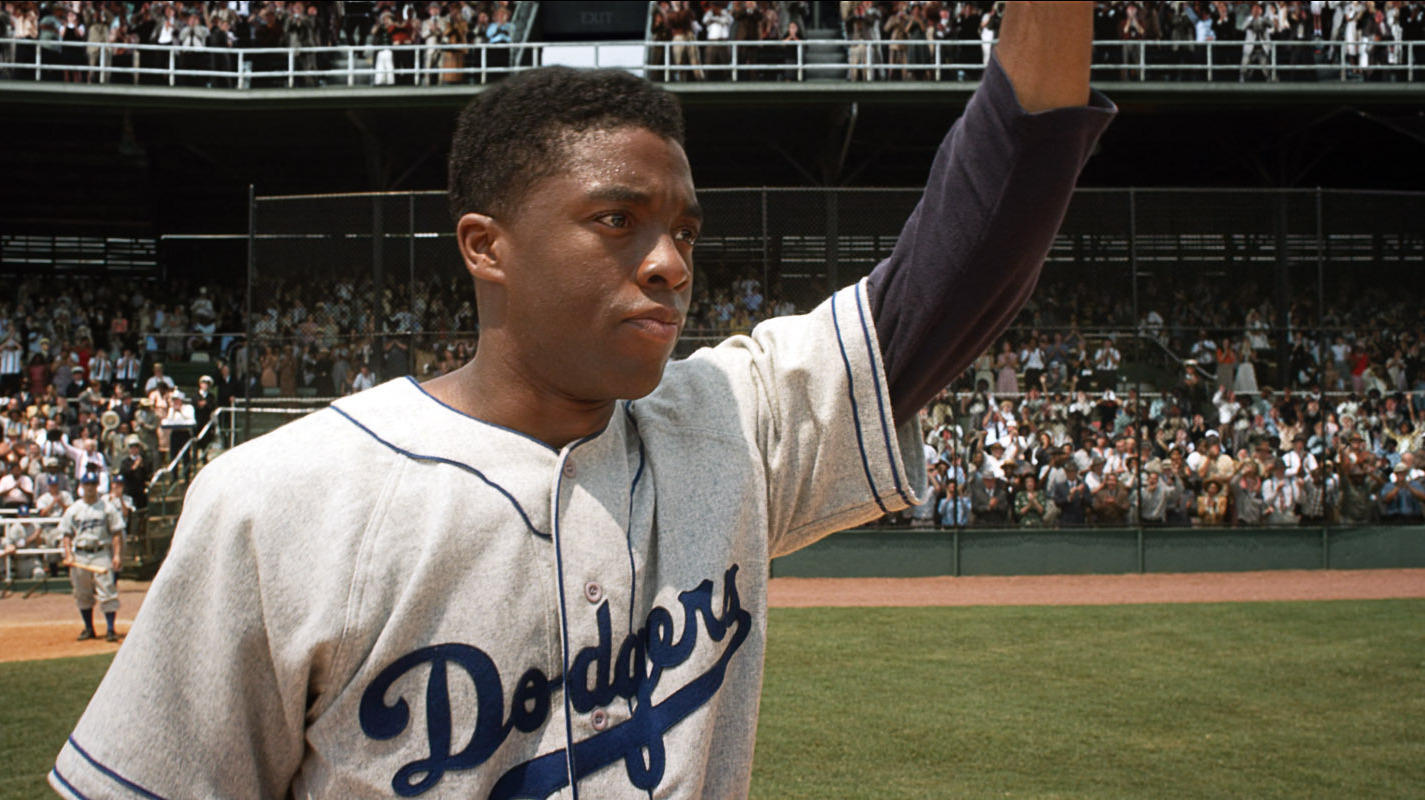
Chadwick Boseman on Playing Baseball Great Jackie Robinson in ’42’

42-fp-0292

Before he took on the title role in “Black Panther,” Chadwick Boseman had the honor of portraying baseball great Jackie Robinson in “42.” With Hollywood being the way it is, you would expect to see studio executives insisting on a getting a big time movie star to portray the famous baseball legend, but writer/director Brian Helgeland got away with casting Boseman back when he was relatively unknown to audiences at large. An actor and playwright by training, Boseman started to burn into our collective consciousness with this performance.

Filmmakers and actors over the years like Spike Lee and Denzel Washington have tried and tried to bring the story of Robinson to the big screen but with no success. It took Helgeland, who won an Oscar for co-writing the screenplay to “L.A. Confidential,” to finally succeed in making such a film a reality. The burning question is how did Boseman get the role of Robinson over so many others? There must have been thousands upon thousands of actors desperate to play the legendary ballplayer, and there is something very inspiring about a lesser known actor beating out a bunch of big-name stars for this opportunity. Boseman, during an interview with Julie Miller of Vanity Fair, explained how he got cast.

“I had left L.A. for a few months, and I was directing a play Off Broadway in the East Village,” Boseman told Miller. “I came back to Los Angeles for a visit and was supposed to go back to New York on a Friday, and my agent said, ‘No, they want to see you for 42. For the Jackie Robinson film.’ I met with 42 director Brian Helgeland, and I knew that I would love to work with him. He’s an Oscar winner and a great writer but also, the way that he works, you know sometimes that you can vibe with a person and that you will work well together.”

“The additional meeting was great. A lot of it was just talking about the role and project and why he wanted to do it,” Boseman continued. “I left thinking that it was a great audition but didn’t necessarily know if I would get it. The next week, they called me back in again, and I could tell that he was trying to show me to somebody else. They were taping it and saying stuff like ‘What else might they want to see?’ I realized at that point that I was Brian’s choice, so I was just trying to prove it.”

Before “42” came along, Boseman had been working a lot in television and appeared on shows like “ER,” “Law & Order” and “CSI: NY.” Eventually, he started starring in movies such as “The Express” among others. Surprisingly though, Boseman did not originally set out to be an actor. A graduate of Howard University and the British American Dramatic Academy at Oxford, he saw his career heading in a different direction.

“When I started in theater and film, I thought I would be a director,” Boseman said. “The only reason that I started acting was because I felt like I needed to understand what the actors were doing and their process so that I could better guide them. During the course of that, I caught the acting bug. But once I finished my acting training, I still was thinking I would be a writer/director. I don’t really think I focused on acting until I came to L.A. in 2008. That’s when it got serious for me.”

As a kid, Boseman played Little League baseball for a time, but he was more serious about playing basketball after a while. When it comes to sports movies, most directors prefer actors to have some sort of experience in baseball or whatever sport their film is about. It looks like Boseman had just about enough experience to show he could play Robinson, but he still had to go through a lot of baseball training in order to prepare for the role before the cameras started rolling. He related his training regimen to Eric Alt of Athlon Sports as well as the challenges he faced during pre-production.

“All the coaches I worked with concentrated on the way he did things,” Boseman told Alt. “They studied his swing, and I studied his swing on my own. We would tape batting practice and they would film me base running, and then every two or three weeks they would take his footage and split-screen it with mine and give it to me and let me compare. We did that for almost five months.”

“The fielding was much more difficult than the batting,” Boseman continued. “I’m a natural athlete, so I have the hand-eye coordination to hit the ball. But the fielding? The footwork? Understanding where to throw the ball from, depending on where you receive it? I just wish there was more of it in the movie because I worked so hard on it! (laughs) When I saw the movie I was like, ‘Man, that’s all? That’s it?'”

The cast and crew of “42” also had a great asset in having the participation of Jackie’s widow, Rachel Robinson. It turns out Rachel was very much involved in looking over different drafts of the screenplay, and it gave the film a genuine legitimacy it might otherwise not have had. Boseman told Miller he began his preparation for the role by talking to Rachel.

“When you’re trying to tackle a hurricane, or something larger than life, I knew that the first thing I had to do was talk to her,” Boseman said. “She gave me some books. She sat me down on the couch and told me about their relationship and the rules that they set for themselves to get through the experience. That was a great start, because you are meeting someone who is still connected to him and you get a sense of him when you meet her. You see what kind of a man could actually stand by her. Who is this guy that she would fall for?”

“In some sense, you got the sense of the edges of him, like the two of them were a puzzle. She is one piece and his piece is not here, but I can feel the edges from her,” Boseman continued. “She started the journey, definitely. She showed up on set. And she challenged me by asking me why I should play him. That’s a good place to start because you have to start with yourself.”

While Chadwick Boseman must have felt a great deal of pressure in bringing the legendary Jackie Robinson to life in “42,” he did deliver a terrific performance which had audiences applauding loudly when the credits come up. Acting may not have been Boseman’s first choice as a profession, but it is certainly working out for him in a great way.

SOURCES:

Julie Miller, “42 Star Chadwick Boseman on Playing Jackie Robinson, Copying His Baseball Moves, and Being Stood Up by the President,” Vanity Fair, April 12, 2013.

Eric Alt, “A Chat with Chadwick Boseman, Star of Jackie Robinson Biopic ’42,’” Athlon Sports, April 19, 2013.