Underseen Movie: ‘Danny Collins’ in Which Al Pacino Plays a Rock Star

When “Danny Collins” was released back in 2015, it felt like Al Pacino had played every kind of character there is on the stage and silver screen. But with this film, he plays a character unlike any he has taken on before; a rock star. Granted, a lot of people treat Pacino like he is a rock star already, especially when it comes to his role as Tony Montana in “Scarface,” but this did feel like a new thing for him. For a moment, the thought of Pacino as a popular singer was a bit terrifying. Can he even sing? Will he come off like the male version of Kim Carnes? By the way, I love Kim Carnes, so let’s not get the wrong impression here.

Well, Pacino can sing, and he is one of the reasons why “Danny Collins” proves to be far more enjoyable than I expected it to be. The story of an aging musician looking for redemption has been told time and time again, and there is very little in the way of originality to be found here. Still, I found this film to be a sweet and heartfelt look at a man looking to reclaim parts of his life which he has long since lost.

Pacino modeled Danny on both Barry Manilow and Rod Stewart, and we first see Danny singing songs to adoring crowds who cannot seem to get enough of him. He used to write his own songs, but after his second album got such a negative response, he went on to sing everybody else’s hits instead. These days he has all the fame and fortune he could ever want, all the drugs and alcohol to keep his deepest fears at bay and, of course, a fiancé half his age.

But then one day, Danny’s manager, Frank Grubman (Christopher Plummer), shows up with a letter written to him by John Lennon from forty years ago. For some reason, this letter was never delivered to Danny, but in it, John tells him not to worry about fame and fortune being detrimental to his talent. Upon reading this long-lost letter, Danny begins to wonder what his life would have been like had he gotten it much, much sooner. As a result, he drops out of his current tour and travels out to New Jersey to reconnect with his family and, hopefully, rediscover his musical muse.

For a moment, I thought I was going to be cringing non-stop as Danny goes to meet the son he never got to know. We know that those kinds of father-son meetings are fraught with tension and a lot of understandably hurt feelings, and the one shown in Danny Collins is no different. The chemistry, however between Pacino and Bobby Cannavale who plays Danny’s son, Tom, is very strong, and their acting really lifts this material up and away from the generic kind it could have easily fallen victim to. Cannavale previously acted opposite Pacino in a Broadway production of “Glengarry Glen Ross,” so these two have a rhythm of working together which they have clearly gotten comfortable with.

Jennifer Garner plays Tom’s wife, Samantha Leigh Donnelly, and she is a lovely presence to watch here. What I loved about her performance is how down to earth she is to where you never catch her acting. Samantha is a doting mother to hers and Tom’s daughter, Hope, and she is already pregnant with their second child, so you know she is capable of handling more things than either Danny or Tom can on their own. She proves to be the calm in the stormy relationship between estranged father and son, and she makes it clear to the men in this family that they had best listen to what she has to stay.

While we’re at it, I have to applaud young Giselle Eisenberg for her exceptional performance as Hope. It says a lot about the 7-year-old actress that she can hold her own with Pacino and company from scene to scene.

Right from the start, Christopher Plummer makes his manager character of Frank Grubman anything but a cliché. I liked how effortlessly Plummer made Frank the much-needed conscience Danny has desperately needed throughout his career, and he remains compulsively watchable throughout as he takes what could have been your typical backstabbing show business manager and turns him into a reasonable human being.

Another real delight to be found in “Danny Collins” is the great Annette Bening who gives her character of hotel manager, Mary Sinclair, a wonderfully biting sense of humor. Of all the characters here, Mary is the one who is not easily enamored by Danny and is not about to be seduced by his endless charisma. Throughout, I enjoyed the back-and-forth Bening and Pacino have, and her performance serves as a reminder of what a brilliant actress she can be. May we never forget this important fact.

As for Pacino, I very much appreciated his work here. There is none of the bombast which he became inescapably identified with after his Oscar winning performance in “Scent of a Woman.” He is also great at hinting at the fears tearing away at Danny as he tries to write his first song in lord only knows how long, and he makes you root for him to do more than just sing “Baby Doll.”

“Danny Collins” marks the directorial debut of Dan Fogelman, the screenwriter of such films as “Crazy Stupid Love,” “The Guilt Trip” and “Last Vegas.” He based it on the true story of when musician Steve Tilston received a long-lost letter from John Lennon, but he basically took the idea of that story and went from there. My hat is off to him for introducing this movie to us as something other than “based on a true story.” There’s an opening epigraph which says this film is kind of based on a true story, but not really. Kudos to Fogelman for introducing his film with something other than one of the most overused cinematic terms which has long since lost its meaning.

This could have easily been schmaltzy affair that ran on too much emotional manipulation, but Fogelman manages to keep the proceedings from ever feeling completely cringe-inducing. The plot is very formulaic, and there is a certain disease thrown in for one of the characters which may not have been entirely necessary, but he keeps things running smoothly to where you realize a lot of heart went into this.

But what really elevates “Danny Collins” above the usual formulaic norm are the performances and a director eager to not give us the same old stuff (not entirely anyway). This film was made for a fraction of what most motion pictures cost to make these days (and this does not include advertising), so it should be clear that this is a labor of love more than anything else. I left this film with the hope Danny will find the courage to be a songwriter once again, and that means a lot as I often lose my mojo as a writer to where I get nothing written. Here is hoping we all find our way back when we lose our way in life.

* * * out of * * * *
John Lennon Lives Again in ‘And Now It’s All This!’

And Now Its All This

In March of 1966, John Lennon was quoted by Evening Standard reporter Maureen Cleave as saying The Beatles were “more popular than Jesus.” Looking back at this piece of history, I find it hard to disagree as, by then, the whole world seemed to have embraced those four lads from Liverpool as girls were screaming endlessly when they performed in concert and passed out in large numbers. At the same time, religious leaders, not to mention the Ku Klux Klan, came down hard on the band, particularly on John, once this comment was published, and it became one of the main reasons why the band stopped touring altogether.

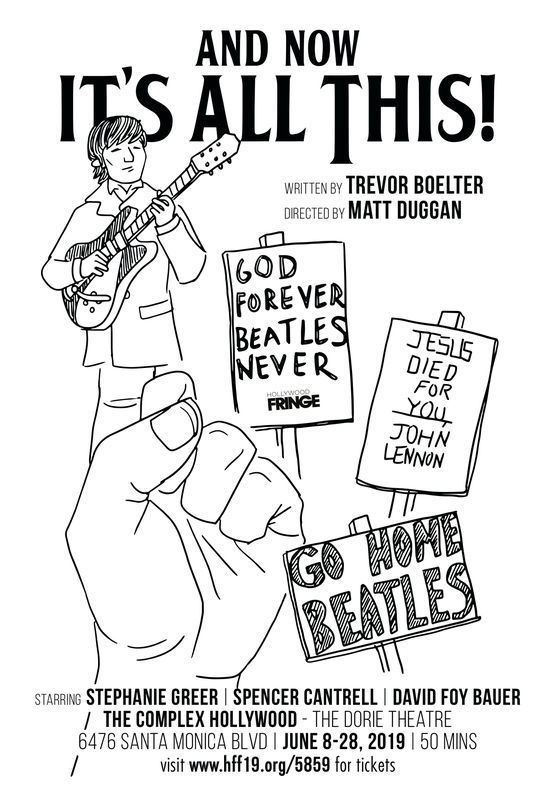
The subject of whether or not The Beatles were more popular than God is the key point of “And Now It’s All This,” a play written by Trevor Boelter which is now being presented as part of the Hollywood Fringe Festival through June 28, 2019. It should be noted that this play is actually the second act of a three-act play Boelter wrote called “Kenwood,” and this act follows Lennon during the years of 1965 to 1966 when The Beatles were at the height of their fame. It focuses on when Lennon made his infamous remark and of the reaction elicited, and we watch as this period in his life comes to inform the peace-loving musician and anti-war activist he eventually became.

When John Lennon (played by David Foy Bauer) first appears, he is reveling in the amazing success The Beatles are having as he gets up close and personal, and we are talking very personal, with Maureen Cleave (Stephanie Greer) during an interview. When he tells her how the band is more popular than Jesus, it really sounds like an offhand remark which he never intended for anyone to take seriously. In a sense, you cannot blame John for saying this as even he points out how we never see screaming teenage girls ripping the clothes off of the Pope. Nevertheless, once Maureen publishes her article, the damage is done and religious figures do nothing to hide their fury.

From there, the play moves ahead to July 1966 when The Beatles’ manager, Brian Epstein (Spencer Cantrell), is under tremendous stress to calm down the furor over John’s remarks which have resulted in many death threats even as the band is about to go on tour. As beloved as The Beatles were, and still are, there was a time when some despised them quite strongly as their allegiance to Jesus trumped everything else in their lives. Indeed, this makes the play seem timely as those same people continue to defend Jesus based on an all too literal meaning and even in the face of facts.

Anyone who knows Mr. Boelter knows he is as big a fan of The Beatles as I am of Eeyore. Even though “And Now It’s All This” is technically a work of fiction, there is no doubt of how thorough he was in his research of the band and, even more so, of John Lennon’s life. He has been studying the history of this band ever since he was 12, he hosted “Jasper’s Beatle Hour” while a student at Cal Poly, and he even interned on Chris Carter’s “Breakfast with the Beatles” radio show on 95.5 KLOS FM. At some point in the future, I expect him to have his own show on The Beatles Channel on Sirius XM.

What is especially interesting about this play is how it examines the effect his offhand remark had on his life and career as we watch him transition from being a spoiled brat to becoming the peace-loving individual he was destined to become. This transition is made all the more convincing thanks to Bauer’s terrific performance as he inhabits the iconic singer to where he can never be accused of doing just a mere impersonation of him. More importantly, the actor makes us see John as a man instead of as an icon who remains infinitely popular decades after his tragic death.

Directing this play is Matt Duggan, the same man who made the terrific science fiction film “Inverse” and who recently released his first novel called “Ostraca.” With it being part of The Hollywood Fringe Festival, Duggan has to make do with a small theatre with an even smaller stage and a handful of props as do the other shows being performed in this particular venue, so he keeps his focus on the actors and the connection they have together on stage. Not once does he let the energy drop as the action moves from one period of time to another as we listen to news reports of what was going in the world back then such as the Vietnam War. It is perfectly paced and never drags for a second.

Speaking of the actors, they are all outstanding. In addition to Bauer, Stephanie Greer is a standout as Maureen Cleave, a role she originated when this play made its world premiere in England. Greer is an infectious delight as she delivers her lines with precision timing and makes Maureen into an ever so clever character who refuses to be easily intimidated.

Spencer Cantrell is excellent as Brian Epstein as he could have easily played this role for laughs but never does. The actor captures Brian’s exasperated state quite vividly as he struggles to gain a foothold over the controversy which threatens to damage The Beatles’ reputation forever, and its hilarious at times to see him struggle with the most mundane of things. At the same time, he makes us see how tough his job is, and being a manager can at times be a thankless job even though it is an important one.

Even Boelter himself shows up here as Reverend Deluxe, a fire-breathing preacher bent on making John Lennon see that Jesus died for his sins. Heck, he almost steals the show with his inspired performance as he captures the zealous nature of someone so dedicated to God to where they are blissfully ignorant of their own hypocrisy. Just watch as he orders his parishioners to burn all the Beatles memorabilia they have on him even as he invites them to buy any of it left over.

“And Now It’s All This” has been selected as a “Pick of the Fringe” selection and rightfully so. It runs only 50 minutes but still manages to say a lot about John Lennon during its brief running time. It is full of laughs and heartbreaking moments, and I am eager to see where Boelter and Duggan will take the material from here. I caught up with Boelter following this performance, and he did say he is planning to stage the full three-act play in the near future, and I look forward to checking it out when he does. But while this play may act as a teaser for a bigger one, it is a must see even if you are not a fan of The Beatles.

By the way, if you are not a fan of The Beatles, why?

“And Now It’s All This” has its next and final performance on Friday, June 28, 2019 at The Complex Hollywood in The Dorie Theater off of Santa Monica Boulevard. Click here to find out how you can get tickets.

Interview with Harry Benson and Matthew Miele on ‘Harry Benson: Shoot First’

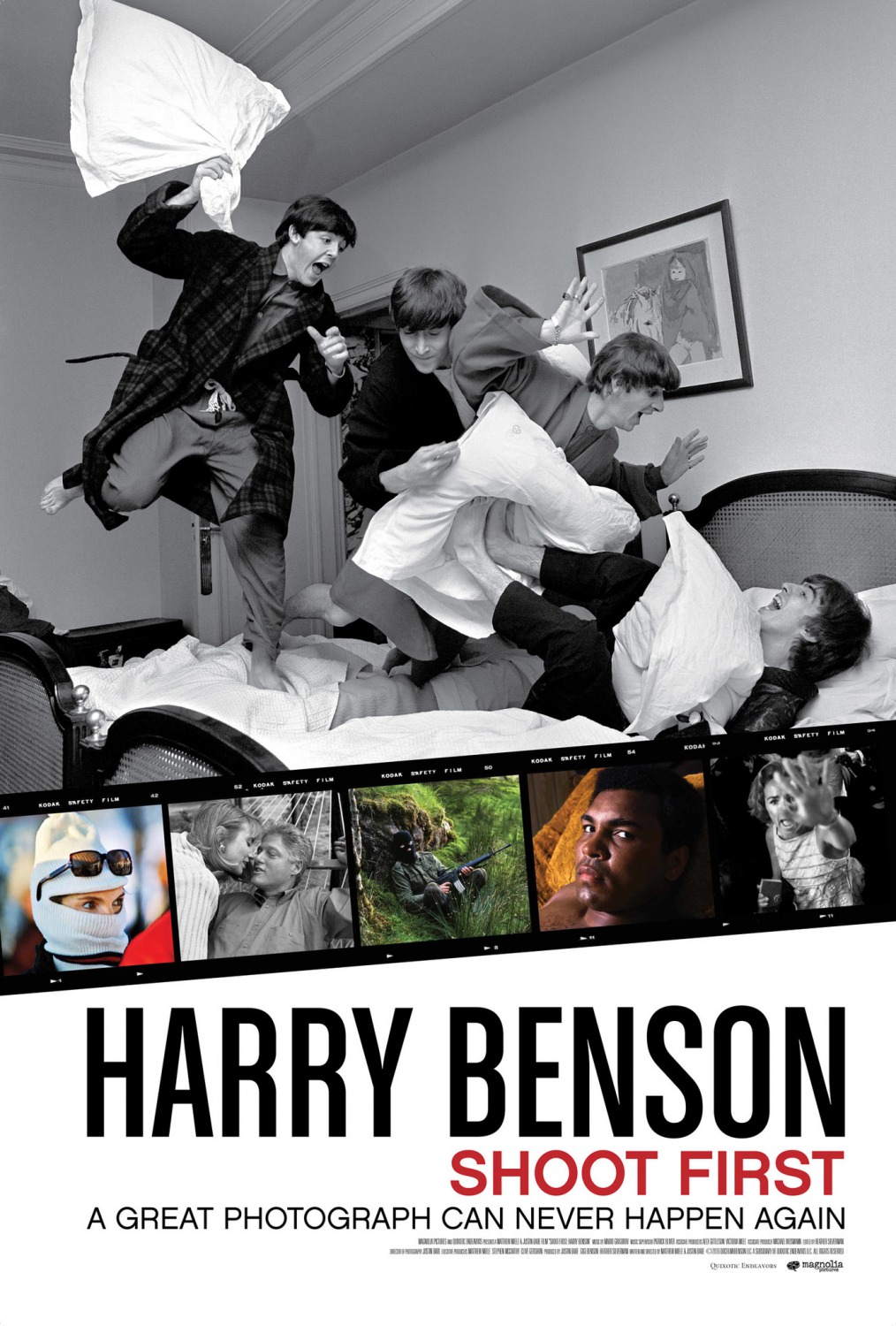
The documentary “Harry Benson: Shoot First,” directed by Matthew Miele and Justin Bare, looks at the life and work of renowned photographer Harry Benson who shot and captured unforgettable images of many famous figures such as The Beatles, Michael Jackson, Muhammad Ali, Donald Trump, and Hillary and Bill Clinton. What is especially striking about his photography is how wonderfully intimate and vivid his photos are. These are not just still images made to promote a new project of some kind, but instead are ones which show celebrities at their most natural and down to earth. Looking at Benson’s photographs today, it feels like you are going back in time and arriving at a place which feels so incredibly real.

I had the opportunity, along with Rama Tampubolon of the website Rama’s Screen, to talk with Benson and Miele about how this documentary came about and how it evolved from start to finish. Benson also told us stories of how he got the photo of Paul McCartney, John Lennon, George Harrison and Ringo Starr who were in the midst of a pillow fight, and of the haunting images he captured of Robert Kennedy before and after he was assassinated.

“Harry Benson: Shoot First” is another terrific documentary in a year filled with them, and it is a must see for pop culture fans and anyone interested in photography. It opens on December 9 at the Laemmle’s Monica Film Center in Santa Monica, and it is also available to watch on Amazon Video, VOD and iTunes.

Please check out the interview above, and be sure to watch the documentary’s trailer below.

harry-benson-shoot-first-poster