‘Moonrise Kingdom’ – One of My Favorite Wes Anderson Films
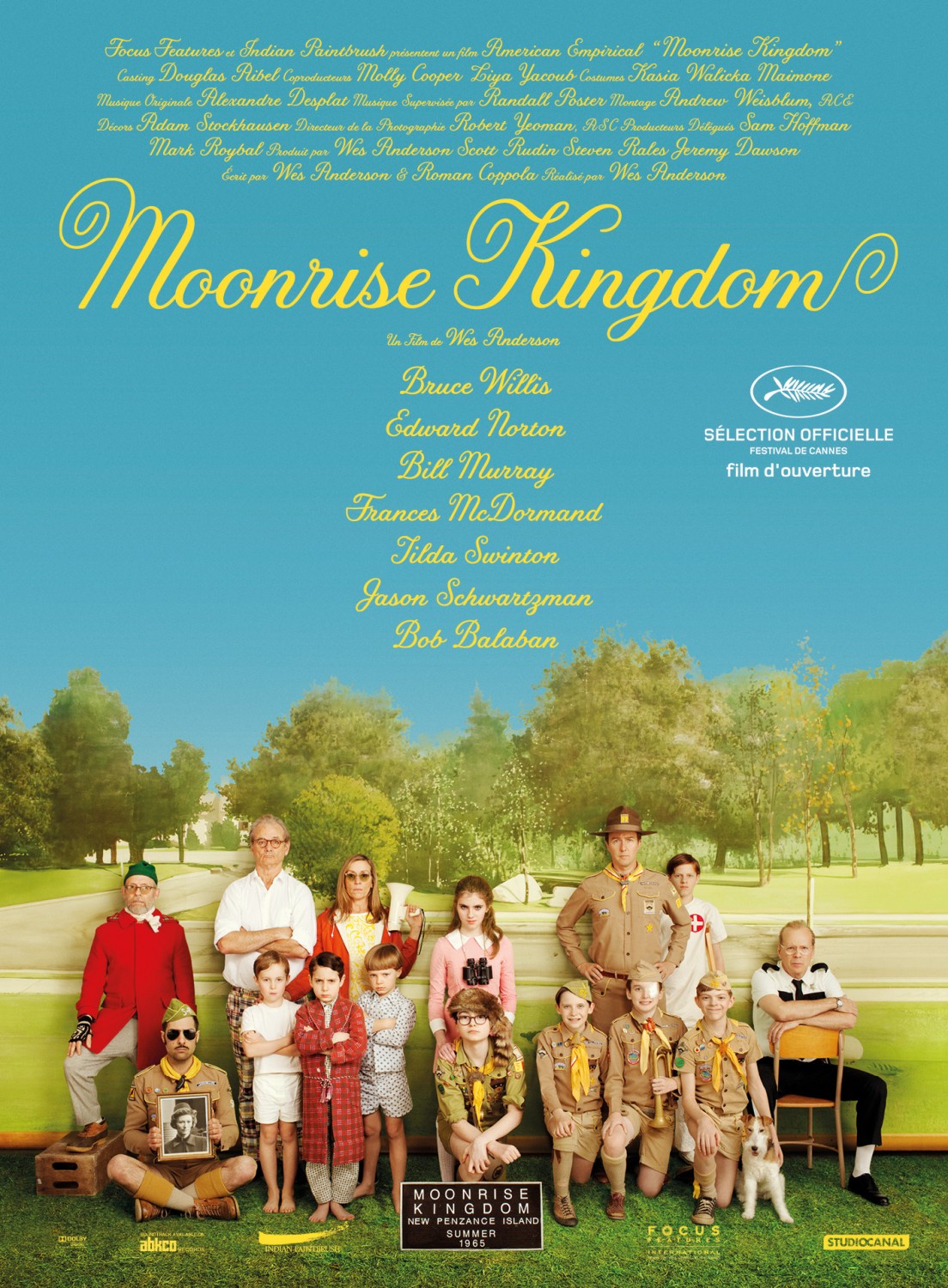
Moonrise Kingdom” is one of many examples which shows Wes Anderson to be one of the most imaginative filmmakers working today. With his story of two 12-year-old kids falling in love and running away together, he gives us a whimsical journey into a past filled with innocence that constantly gets upended by bouts of family dysfunction. In a time where Hollywood relies too much on old ideas and endless remakes, seeing Anderson get an original movie like this made feels like a miracle.

“Moonrise Kingdom” takes place on the New England island of New Penzance in the year 1965. Sam Shakusky (Jared Gilman) has encouraged his pen pal of one year, Suzy Bishop (Kara Hayward), to run away with him into the island’s wilderness. Doing this, however, sends their parents and the town into a frenzy as they desperately search to find them before all hell breaks loose.

Sam himself is an orphan whose foster parents no longer want him around, and his running off with Suzy coincides with his resigning as a member of the Khaki Scout summer camp which is led by Scout Master Randy Ward (Edward Norton). While Sam has learned many useful skills, he is despised by all the other members he is forced to spend time with. In Suzy, he finds a much-needed soul mate who herself is ostracized from her schoolmates and is not blind to the marital difficulties her attorney parents, Walt (Bill Murray) and Laura (Frances McDormand), are going through. Suzy is even aware of her mother having an affair with the island’s police Captain, Duffy Sharp (Bruce Willis).

But it turns out that these two kids have done the island of New Penzance a huge favor as their romantic getaway wakes up its inhabitants from the sullen slumber their lives have descended into. This is especially the case with Walt and Laura who appear to be bereft of emotions for one another. It gets to where Laura can barely communicate with Walt without using a bullhorn to get his and their kids’ attention. When Walt finds out his daughter has run away, he responds to Laura by informing him of this situation as a “loaded question” more than anything else.

The sullenness of the adults is contrasted sharply with the sheer innocence of Sam and Suzy as we watch their romance bloom. Their adventurous behavior proves to be contagious as they read through storybooks Suzy stole from the local library, and dance to vinyl records of lively French rock music. The specific details Anderson gives these characters make them among the most unique kids I have ever seen at the movies. With their taste in art, literature and music, they threaten to seem more mature than their parents to an infinite degree.

It is this theme of innocence which permeates “Moonrise Kingdom” throughout as Sam and Suzy deal with what is left of their innocence while others desperately try to recapture it for themselves. Randy Ward is an example of a man trying to stay young by embracing his role as a scout leader to where he takes it a little too seriously. To him, this role gives his life more meaning than any day job ever could, but the kids under his command do not all see it in the same way he does.

Then there’s Willis’ character of Captain Sharp who, like Sam and Suzy, feels like a loner on this small island. In this role, Willis almost threatens to outdo Murray’s sullen expression as his face becomes a mask of inescapable sadness. It is through searching for these kids that his life finds new meaning as they make him feel young again and give him a reason to live a life with more purpose.

Having read all this, one might think “Moonrise Kingdom” is some sort of serious drama, but it’s really a wondrous coming of age movie with a lot of gleefully inspired comedic moments. Anderson has always populated his movies with sad characters, and yet he still finds ways for the audience to laugh with them during their endless struggles. While this film has him once again dealing with his favorite themes of family dysfunction and arrested development, he finds a wonderful slant which ends up making it one of his best efforts.

One of Anderson’s other successes here is in making a period piece that is not a prisoner to its period. While its eclectic soundtrack (a must buy by the way) gets the music of 1965 down perfectly, this movie takes place in a world which does not completely mesh with reality. As a result, “Moonrise Kingdom” almost feels like it could be taking place at any period of time. Perhaps that can be the result of us remembering the first time we ever fell in love like Sam Suzy do.

Like the best Wes Anderson movies, there is not a single weak performance to be found here, and the actors inhabit their characters to the best of their abilities. Murray, a veteran of several Anderson movies, still strikes comedic gold even as his characters he portrays seem to get sadder and sadder. McDormand is highly entertaining to watch as always, and that is regardless of whether or not her character needs a bullhorn to be heard.

Among the newbies to the Anderson cinematic universe, Bruce Willis proves to be a surprising and welcome addition as the lonely police captain. His face can speak a thousand words even when he does not speak, and he looks to be having a blast in the kind of movie one we often do not expect to see him in.

Norton was another newbie to Anderson’s movies when “Moonrise Kingdom” was made and released, and it is nice to see him let loose in a way he was not always able to back in the day. His role of the hapless scout master Randy Ward allows him to create a character who could have easily just been someone to laugh at with endless disdain. Never does he play Randy for laughs like others would have, and that makes his performance all the stronger for it.

As for the actors inhabiting Sam and Suzy, Jared Gilman and Kara Hayward do a fantastic job of capturing their characters’ individual sensibilities and unique aspects. Thanks to their performances, they make these pre-teens seem very human and not your typical kids searching for meaning in a formulaic motion picture.

In addition, you get excellent performances from Jason Schwartzman as Cousin Ben, and another from Khaki Scout who aids the two runaways in their quest to be together. Even Harvey Keitel shows up in a delightfully unexpected way as Commander Pierce, the king of all Khaki Scouts.

Beautifully shot and wonderfully written, “Moonrise Kingdom” stands alongside “Rushmore,” “The Royal Tenenbaums” and “Fantastic Mr. Fox” as one of Anderson’s best and most inventive movies, and this will continue to be the case with each successive motion picture he makes. His work represents a highly imaginative cinematic landscape that filmmakers in general do not have the opportunity and support to pull off, and the realization of this proves to be quite depressing. Movies like this one make me hope there are still those in Hollywood who will not be risk adverse on a regular basis and embrace creativity more often than not.

* * * * out of * * * *

‘Fantastic Mr. Fox’ is One of Wes Anderson’s Most Inspired Works

WRITER’S NOTE: This review was written in 2009.

After watching “Fantastic Mr. Fox,” I am convinced Wes Anderson should make as many stop-motion animated movies as he possibly can. Nothing against his live action work, but this form of animation seems really suited to Anderson’s unique blend of comedy and dysfunction. While his last film, “The Darjeeling Limited,” was very good, it started to seem like he had been dealing with the same themes once too often. But with the brilliantly made “Fantastic Mr. Fox,” his material is given a freshness which, for a moment, seemed to have escaped him. I wasn’t sure what to expect, but this turned out to be one of the most enjoyable movies I saw in 2009. As a result, any frustration I had over not being able to see “Avatar” (it was a family outing, and it didn’t seem right for my 5-year-old niece) was completely forgiven.

“Fantastic Mr. Fox” is based on a children’s novel written by Roald Dahl whom Anderson considers one of his personal heroes. Dahl is the same man who wrote “Charlie and the Chocolate Factory” and “James and the Giant Peach” among other stories, and his work is characterized by a lack of sentimentality and a lot of dark humor. Judging from “Rushmore” and “The Royal Tenenbaums” with their strong black humor, it’s no wonder Anderson digs Dahl!

The Mr. Fox of the title is a cool and exceedingly clever animal, and we first see him with his wife sneaking into a farm to steal food. They are, however, caught in a trap which has his wife pointing out they should choose a safer form of work. Oh yeah, she also tells him she’s pregnant, and this changes the dynamics of their relationship in a heartbeat. We catch up with these two a couple of years later after they have found a home within a hole in the ground. Mr. Fox is now a newspaper columnist, and he and his wife are parents to a son, the sullen Ash, who constantly feels unappreciated in all he does. Still, Mr. Fox does not like where his family lives and promises to do better by them. Despite the warnings of his lawyer, Badger, he ends up buying a new home in the base of a tree. These new lodgings are also coincidently right near the gigantic farms owned by three ugly looking farmers: Walter Boggis, Nathan Bunce, and Franklin Bean. So, of course, this gets Mr. Fox all excited and back to his usual tricks of stealing food and drink while the rest of the family remains unaware. To quote another fox from a vastly different 2009 movie, “chaos reigns!”

The first thing people will notice about this movie is its “star studded” (what does that term mean anyway?) cast of actors. Voicing Mr. Fox is the most debonair of movie stars right now, George Clooney. With this, “The Men Who Stare at Goats” and “Up in The Air,” I can’t help but wonder when Clooney gets the time to sleep. At this moment, he’s everywhere, and his constant presence would be ever so annoying if he weren’t such a terrific actor. Clooney perfectly captures Mr. Fox’s confidence without ever becoming overly smug, and he exudes the cleverness this character has in getting back at the three farmers.

Meryl Streep, who has also had a busy year with this, “Julie & Julia” and “It’s Complicated,” voices Mrs. Fox. I actually wonder how much sleep she gets as well as Streep always seems to be learning a new accent she has not taken on yet. Streep is the perfect contrast to Clooney’s charmingly reckless nature, and she serves as the conscience Mr. Fox needs to hear out more often. Streep doesn’t do anything incredibly different with her voice like she did for Julia Childs, but its warmth is quite seductive at times.

Anderson has also employed many of his regulars for “Fantastic Mr. Fox” as well. Jason Schwartzman who was featured quite prominently in “Rushmore” and “The Darjeeling Limited” voices Mr. Fox’s son, Ash. Schwartzman perfectly captures the angst Ash feels at never fully winning his dad’s approval, and you feel Ash’s desperation as he goes to dangerous lengths to get any approval. Owen Wilson, who co-wrote “The Royal Tenenbaums” with Anderson, has a cameo voicing Ash’s athletic coach, Skip. You can tell its Wilson right away, and he gives Skip a wonderfully dry voice which gets a good number of laughs whenever he appears. Even Bill Murray, who has had a role in just about all of Anderson’s movies, voices Mr. Fox’s lawyer, Clive Badger, and he always seems to fit in perfectly in Anderson’s cinematic universe. And let us not forget Wallace Wolodarsky who voices the confidence challenged Kylie Sven Opossum who somehow gets sucked into Mr. Fox’s schemes against his better judgment.

Others to be found here are Michael Gambon, the current Dumbledore of the “Harry Potter” movies, who voices one of the farmers hellbent on eliminating the thieving Mr. Fox, Franklin Bean. Eric Chase Anderson, who is responsible for those illustrations of Anderson’s movies when they are given Criterion Collection releases, voices Mrs. Fox’s nephew Kristofferson who is perfect in every way Ash is not. But the most surprising voice here is from the actor who voices Rat, Bean’s security guard. Rat was a French character, so I assumed the actor voicing him was French. Turns out that it was actually Willem Dafoe! That’s right, the same guy who was in that other delightful 2009 movie with a fox, “Antichrist.”

With just about all of animated movies being done with computers and digital effects, it’s refreshing to see other filmmakers go a little retro with the stop-motion animation. The work here is brilliantly done, and I was surprised at how lifelike everything looked. Movies like these must require an exceeding amount of patience to make because they clearly take years to produce. It also fits right in with Anderson’s quirky sense of humor which remains intact a good ten years or so after “Rushmore.”

I also really dug the soundtrack Anderson chose for “Fantastic Mr. Fox.” Each of his movies contain a great selection of music which veers from classic British rock songs to American rock among other genres. With this film, Anderson includes songs from the Beach Boys and Burt Ives which fuel the proceedingas with an undeniable sense of innocence and adventure. It also made me an instant fan of The Bobby Fuller Four whose song “Let Her Dance” plays during one of the most joyful moments this film has. Composing the score is Alexandre Desplat who has composed music for movies like “Firewall” and “The Curious Case of Benjamin Button” among others. I love how Desplat captures the infectious spirit of everything which takes place.

Is this a kid appropriate movie? I think so. It did get a PG rating which seems appropriate. Sure, there are many bottles of alcoholic apple cider and some smoked chickens which might give you the wrong impression of the goings on being displayed, but I really think this movie is harmless. Compare this to the recently released sequel to “Alvin and the Chipmunks” which has not so subtle references to classic movies like “Taxi Driver” and “Silence of the Lambs” among others. This film is not just aimed at kids, but for the whole family as well.

While many will be more likely to view this movie on DVD or Blu-ray (or VHS if it’s still available), ” Fantastic Mr. Fox” really is a fantastic piece of work which deserves a big audience. Anderson, along with co-writer Noah Baumbach (“The Squid & The Whale” and “Margot at the Wedding“), has managed to take his fascination with families that are less than perfect and put them in a context which will not scar your kids for life. It was also cool to see Clooney play a character who, unlike the one he portrayed in “The Men Who Stare at Goats,” was not afraid to dance.

Was it worth not going to see “Avatar” this day and watching this instead? I hate to say it, but yeah.

* * * * out of * * * *

Mia Wasikowska Fearlessly Dives Into the Dark Side in ‘Stoker’

Mia Wasikowska in Stoker

WRITER’S NOTE: This article was written in 2013.

After watching her in Tim Burton’s “Alice in Wonderland” and seeing her portray the highly intelligent daughter of Annette Bening and Julianne Moore in “The Kids are All Right,” Australian actress Mia Wasikowska goes from lightness to darkness in “Stoker.” In it she plays India, a mysterious, dark-haired teenager whose father has just been killed in a car accident on her 18th birthday. Throughout the movie we see India trying to deal with both her emotionally unstable mother Evelyn (Nicole Kidman) and her enigmatic uncle Charlie (Matthew Goode) who has arrived to stay with them. Thanks in large part to Wasikowska, India is one of the most original and haunting teenage characters to appear in movies in quite some time.

It’s fascinating to watch Wasikowska’s transformation in “Stoker” as there is very little trace of the good-natured characters she has portrayed previously. Even her work in “Jane Eyre” felt like a fairy tale compared to the creepy nature of this film. Going into it, I wondered if Wasikowska was really looking to distance herself from the roles she has played in the past. It turns out she was, but in an interview with Helen Brown of The Telegraph, she also said it was because she was drawn to the character’s ambiguity.

“You don’t know if India’s a hero or a villain, the hunter or the hunted,” Wasikowska told Brown. “The film toys with your perception. It’s a weird love triangle between a mother, an uncle and a daughter. That feels very modern and very classic, at the same time.”

“It’s less about evil being in the bloodline than an idea of evil as contagious,” Wasikowska continued. “I think violence is something that catches on. I was interested in something India’s father says: ‘Sometimes you have to do something bad to stop you from doing something worse.'”

I loved how Wasikowska avoided making India seem like the average sullen, anti-social or Goth-like teenager we’ve seen in so many movies and TV shows. There’s something about India which feels wholly original, and it is a wonderfully complex character you spend all of “Stoker” constantly trying to figure out. Wasikowska explained to Brown what she was aiming for when she decided to play India.

“Stereotypes are much more prominent in teen movies,” Wasikowska said. “As a teenager, it’s more attractive to watch something you don’t necessarily feel you are, to watch movies about pretty people in love. But it was always exciting for me to find roles that gave me an opportunity to express what I felt was the more realistic side of teenagers.”

The most memorable scene in “Stoker” comes when Uncle Charlie joins India on the piano for one of the most exhilarating duets ever filmed. The whole moment feels like a cross between the “Dueling Banjos” scene from “Deliverance” and David Helfgott playing Sergei Rachmaninoff’s blisteringly difficult Concerto No. 3 in “Shine;” it’s a moment of harmony combined with a psychological unraveling which reaches a fever pitch. This is a movie scene I will be studying for a long time, and while talking with The Hollywood Reporter’s Rebecca Ford, Wasikowska described what it was like filming it.

“That’s sort of one of the scenes that you’re always anticipating during the shoot,” Wasikowska told Ford. “It was almost my favorite one to film, because we had the music there, playing really loudly for us, and then, to a certain extent, I felt like I didn’t have to do anything because so much of the emotion and the feeling was in the music, and if I just sort of surrendered to that, it was all there.”

“Stoker” marks the English-language debut of South Korean filmmaker Park Chan-Wook who is best known for his “Vengeance Trilogy” of movies which includes “Sympathy for Mr. Vengeance,” “Oldboy” and “Sympathy for Lady Vengeance.” Both he and Wasikowska worked closely together on India to make sure they were on the same page throughout filming, and Wasikowska told Ford they kept sending each other pictures back and forth through email which helped to illustrate their thoughts on the character.

“Some of the images were from India’s perspective, so things that I thought would explain the way that she sees the world,” Wasikowska said. “And then the other images would be something that had an essence of her physicality or her emotionally, so that was really helpful.”

Now with a movie as dark and disturbing as “Stoker” is, you would think the atmosphere on set would be very serious as to not break the mood of the piece. But as we found out on this movie and many others before it, the dark nature of the script was counterbalanced by a lot of humor amongst the cast and crew. Wasikowska made this abundantly clear to contactmusic.com while at a press conference.

“I’ve often found on the films that have a more serious nature, the more light-hearted and silly and goofy it becomes in between the scenes out of necessity to counter the intensity of the scenes and material,” Wasikowska said. “I felt like we were pretty good at that!”

Watching Mia Wasikowska in “Stoker” gives you an idea of what great work lies ahead for her. Here she digs deep into a character she hasn’t previously portrayed, and she completely disappears into the part as a result. While India is still a hard character to figure out at the movie’s end, it is Wasikowska’s journey into the role which renders it all the more fascinating.

“The best way to explain it is when I’m filming, I have a definite story that I follow for her, but then when I finish and I let go of the project a bit, it’s sort of up to interpretation,” Wasikowska said. “So one of the interesting things has been seeing how people have interpreted her (India) and her character in the story. And the only thing that’s consistent is how different everybody’s opinion is of her.”

SOURCES:

Helen Brown, “Stoker’s Mia Wasikowska, interview: ‘It’s a weird love triangle between a mother, an uncle and a daughter…,'” The Telegraph, March 1, 2013.

Rebecca Ford, “‘Stoker’s’ Mia Wasikowska on Her Mysterious Character and Sexualized Piano Playing,” The Hollywood Reporter, February 28, 2013.

Mia Wasikowska: ‘Stoker’ shoot was fun,” contactmusic.com, February 28, 2013.