Okay, I have not seen this particular sequel yet, nor have I seen the workprint which has been floating around the internet for years. But seriously, I came across not just one but two trailers for “Grizzly II: Revenge,” and neither of them try to hide how god awful this film must be. It’s bad enough the title reminds me of another excruciatingly awful sequel involving a killer animal, “Jaws: The Revenge,” but this one is so shameless in inviting audiences to check it out regardless of its subpar filmmaking on display (and that’s being generous).
Truth be told, “Grizzly II’s” backstory is bound to be far more interesting than the film itself. A sequel to the 1976 “Jaws” knock-off “Grizzly,” it was made back in 1983, but its production quickly got derailed due to a lack of funding, constant feuding behind the scenes, and technical issues with its 16-foot mechanical bear. 37 years later, after a ton of legal wrangling, it is now being shown in its final cut. But unlike other long-lost films such as “Gone with The Pope” or long in the making sequels like “I Spit on Your Grave: Déjà vu,” this one is unlikely to be worth the wait.
The first thing we in these trailers is the appearance of a couple of Oscar winners, George Clooney and Laura Dern, and Charlie Sheen before he did “Platoon.” Their names headline this movie, but as we can see, they are not in it for very long. We see their screaming faces up close, and it is clear the bear will treat this trio as dinner since hibernation is out of the question. This is not the first time recognizable names have been exploited to garner attention for a movie, and it won’t be the last either.
From there, we are introduced to actors who are forced to spout ridiculous dialogue a film like this always has to offer. A female scientist tells a group that the bear they are hunting is “huge.” No! Really??!! I mean, heaven forbid the bear they are dealing with is a small one! Can you imagine a little cub going psycho on so many stupid and unsuspecting humans?
There is also a brief moment with Louise Fletcher of “One Flew Over the Cuckoo’s Nest” fame telling someone to kill the bear as soon as possible because there is a big concert coming up. And then we have John Rhys-Davies playing what I guess is a mountain man of sorts, and he has one of those dramatic moments where he pauses before saying something intended to be hair-raising (“It’s very bad… you got the devil bear!”).
Speaking of the concert, we are shown some of it as well. But while the crowd looks huge, the onstage performers look like they are re-enacting scenes from the so bad it’s good rock musical “The Apple.”
But perhaps the biggest problem with these trailers is the lack of the bear itself. We hear it grunting throughout and see its point of view from time to time, but we never see its face until the last few seconds. Before this, we see Davies preparing to attack it, and it looks like the actor is about to attack a big pile of wool designed to look like a bear’s legs. Clearly there is no real bear there as it would have gobbled up Davies before he had a chance to draw a weapon.
In the end, these trailers for “Grizzly II: Revenge” represent filmmaking and marketing at its most cynical. The producers are simply looking for a quick buck here as they are exploiting big names and this film’s troubled production history for all it is worth. This sequel may have been 37 years in the making, but that was never intended to be the case. Its production was simply a case of very bad luck, and now this sequel exists as a mere oddity.
All of this just makes me miss Bart The Bear, a real-life grizzly who upstaged Anthony Hopkins and Alec Baldwin in “The Edge.” Now if Bart were in this, it just might have been worth watching.
The following review was written by Ultimate Rabbit correspondent Tony Farinella.
Good horror is hard to find these days in Hollywood. Between the endless number of sequels, remakes and jump scare flicks, it can be quite difficult to find a horror flick truly worth of your time. However, the beauty with cinema are the little gems like “The Wolf of Snow Hollow.” This film is also notable for being one of the last to feature the late, great Robert Forster. It was written and directed by its star Jim Cummings. Thankfully for the audience, he’s up to the task of being the lead, and he has terrific comedic timing. He knows how to balance the quirky tone of the flick, which is why it’s such a beauty to watch from beginning to end. The film is 80 minutes when you take out the credits, but it makes the most of each and every scene and character.
“The Wolf of Snow Hollow” is set in Snow Hollow, Utah where not much of anything happens on a day-to-day basis for local police officer John Marshall (Jim Cummings). In John’s personal life, there is a lot going on as he’s trying to raise a 17-year-old daughter on her way to college despite the fact he and his ex-wife don’t get along at all. There is also the fact his father, played by the late Robert Forster, is having health issues and struggling to stay retired from his job as Sheriff. It also doesn’t help that some of the individuals working with him aren’t the brightest and most ambitious bunch of police officers out there. However, there is one bright spot in Officer Julia Robson (Riki Lindhome) as she takes her job seriously and is there to help out John Marshall whenever he needs her.
In addition to these issues, John is also struggling to stay sober. He’s three years sober after being in AA for six years, but the urge to drink starts to increase when local women are showing up dead left and right in Snow Hollow. He’s having a hard time solving the case, which is causing increased stress and an inability to sleep until he finds the killer. He also wants to prove to himself, his daughter, his father, and everyone else that he is Sheriff material. The longer this case goes on, the more blame he is facing from the locals. There are theories out there that it’s a werewolf because of the work of the killer, and he’s not sure if he believes in werewolves or if his mind is playing tricks on him.
However, with each full moon another woman is gruesomely torn to shreds. The stress and anxiety of the job and John’s day-to-day life is getting to him. On paper, this might not sound like the type of material which would produce a comedy or a solid horror film. It’s all in the tone and delivery by the actors and what I would imagine was a very specific script. The deadpan comedic moments are executed flawlessly. The beauty comes in the little moments of the film where the characters are interacting with each other. John also has an anger problem, which produces some clever and offbeat moments. It reminded me a lot of “Fargo” if it had werewolves.
“The Wolf of Snow Hollow” is gorgeously shot as well, and this really stands out when taking the film in as an audience member. There are a number of overhead shots which are breathtaking. Near the end, Cummings decides to switch tones a bit, and this is a smart move because he transitions to a heartfelt conclusion that is satisfying on many levels. This is a prime example of a film with a $2 million dollar which makes the most of its script, actors and scenery. It was a film I was not familiar with until its Blu-ray release, but I was pleasantly surprised with it.
This is the perfect cult movie which is going to find an audience as it ages and more people check it out. With its Blu-ray release, now is the perfect time for you to discover and enjoy it. I enjoyed the hell out of it, and I look forward to more projects from Cummings in the future. He has shown a lot of talent and ability here as a writer, director and actor. I had never seen anything from him before, but I’m very curious to check out his feature film debut from 2018, “Thunder Road.” He’s the kind of talent who likes to do things on his own, but he has proven it is a task not too big for him. I highly recommend you seek out “The Wolf of Snow Hollow.” You will not be disappointed.
* * * ½ out of * * * * __________________________________________________
Blu-Ray Info: “The Wolf of Snow Hollow” is released on a single-disc Blu-ray with a digital code from Warner Brothers Home Entertainment. It has a running time of 85 minutes and is rated R for violence, bloody images, language throughoutand some drug use.
Video Info: The film is presented in 1080p high definition. It looks outstanding, and I loved the snowy overhead shots. For a $2 million dollar budget, as mentioned, it surely stands out on screen and there is a lot to enjoy from a visual perspective.
Audio Info: The Blu-Ray comes with a DTS-HD MA: English 5.1 audio track along with an English Descriptive Audio track. Subtitles are in English and Spanish.
Special Features:
· The Story and the Genre
· The Impetus
· Working with Jim Cummings
· The Design of the Werewolf
· The Story and The Genre
Should You Buy It?
Yes! You need to support independent cinema which is daring, takes risks and has something unique to offer to the film world. I have a feeling I’m going to be hearing a lot about Jim Cummings in the future. The film also comes with some solid special features as well. The Blu-ray looks outstanding and really adds to the atmosphere of the movie. The more removed I was from this film and the more I thought about it, the more I liked it. It’s also only $14.99 at most major retailers. If you know someone who is a horror fan, this is the perfect Christmas gift to surprise them with this upcoming holiday season. “The Wolf of Snow Hollow” is a delightful surprise. I really enjoyed every minute of this film.
**Disclaimer** I received a Blu-ray copy of this film from Warner Brothers to review for free. The opinions and statements in the review are mine and mine alone.
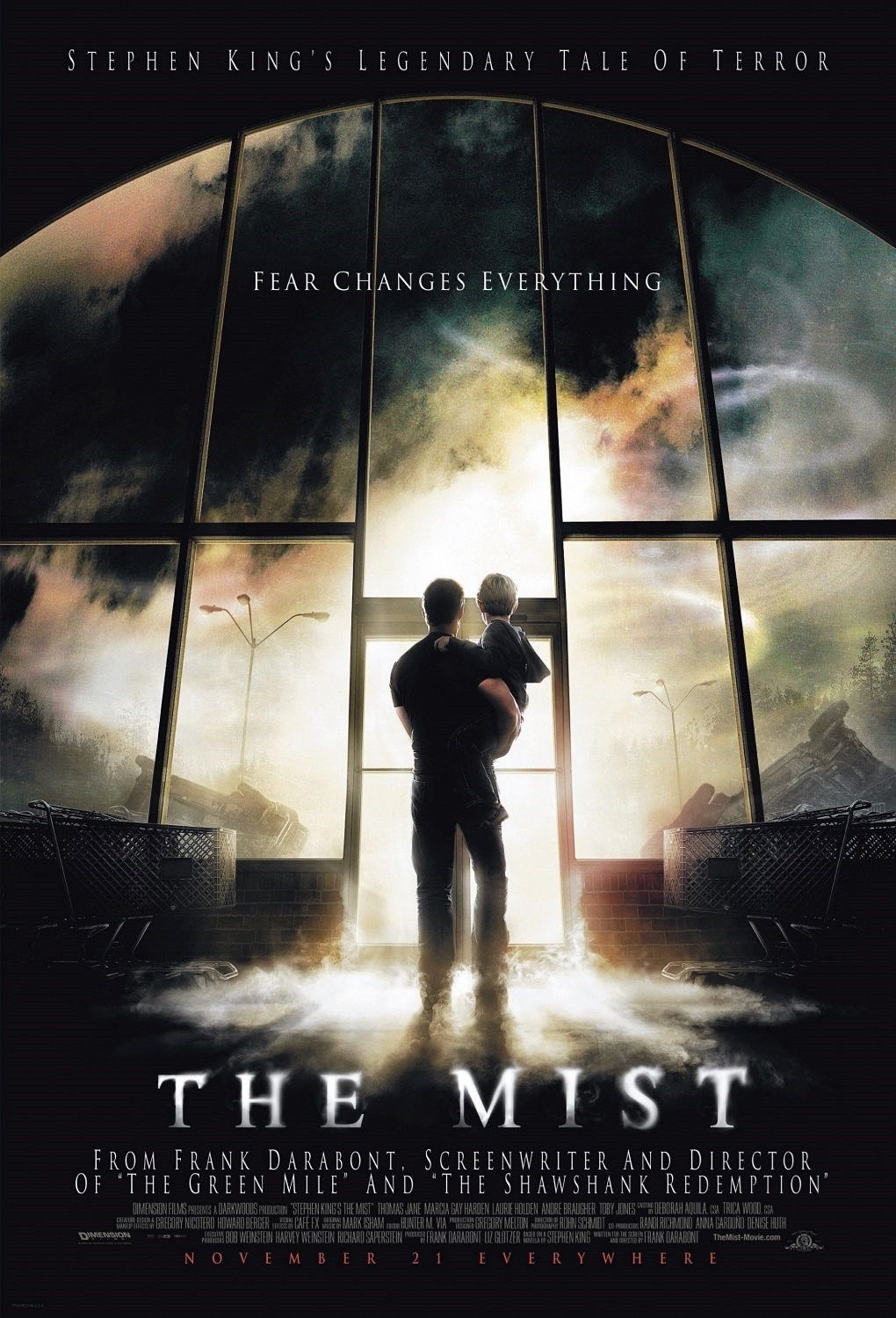
There was a time when Frank Darabont created the most effective cinematic adaptations of Stephen King’s novels. He gave us one of the all-time great adaptations of King’s works with “The Shawshank Redemption,” a classic which you can still catch it on TBS or TNT every other week. Darabont also directed “The Green Mile” which was very good and left its audience in tears at its humbling conclusion. These days, Mike Flanagan has become the King adaptation master of choice with his takes on “Gerald’s Game” and “Doctor Sleep,” both of which proved to be wonderfully unnerving. Before this, however, was Darabont’s adaptation of King’s “The Mist,” and it represented his first time dealing with one of King’s full out horror stories. Having said this, he still brings this particular King horror tale to life in way few other filmmakers ever could.
“The Mist” takes place, as many of King’s works do, in the state of Maine. We see our main character, David Drayton (Thomas Jane), doing his work as a graphic artist on something which appears to be right out of “The Dark Tower,” and it establishes what David does while simultaneously establishing the kind of movie we are about to see. It is a motion picture which deals with people whom we recognize from the real world we inhabit and the small towns we grew up in. This is not often the case as many horror films deal with stock characters we cannot wait to see done away with.
One day, there is a storm which hurls a tree into David’s work studio, and he ends up going into town with his son the next day to pick up supplies. In the process, he also ends up taking along his next-door neighbor Brent Norton (Andre Braugher) regardless of the fact Brent’s tree fell down on David’s boathouse and completely destroyed it. But while at the market, a mist starts to blanket the town to where there is zero visibility. A local townsman named Dan ends up rushing into the store crying out, “There’s something in the mist!”
From there, everyone is trapped in the supermarket as the thought of stepping outside its doors is far too fearful an action. This is largely the result of there being something in the mist which quickly proves to be anything but human, and this creates divisions between everyone trapped in the store. This division is primarily brought about by Mrs. Carmody (Marcia Gay Haden), a fervent believer in the word of the bible who believes judgment day is upon us and that the end is indeed very near.
Watching “The Mist,” you can recognize the familiar types of characters which occupy the average Stephen King story; the man who doesn’t want to be the hero but ends up being one even if it is not by his own doing, the religious fanatic who will not allow themself be torn away from they believe to be the truth, and townspeople who appear to be brave on the outside but terrified on the inside. What I really liked about this film is how Darabont never lets them become just mere stereotypical characters. While these characters may appear to be just that, it is a credit to the writing and acting that everyone involved in this film’s production rose above the genre’s conventions to give us something more human than we typically expect.
What interests Darabont here is not so much the monsters on the outside, but instead the monsters which lurk deep in our psyches. How we would possibly react when all the things we depend on in our life are suddenly taken away from us? No easy answer is given, but it is clear we are left with our instincts for survival at any cost. Darabont does excellent work in creating an inescapably claustrophobic environment where escape is easier said than done and trust can easily become a disposable commodity.
Leading the cast is Thomas Jane who first has made an unforgettable impression when he co-starred in “Boogie Nights.” He then went on to do “Deep Blue Sea” which more or less typecast him as the hardened hero who shows more courage than anyone around him. But here, he is simply an ordinary man caught up in an unimaginable situation, and he is struggling to maintain his sanity in an increasingly desperate situation.
“The Mist” is filled with many fine actors who fully humanize their roles and succeed in avoiding the mistake of making these characters seem stereotypical and easily disposable. It is great to see Andre Braugher here as the disbelieving neighbor/lawyer who makes the idiotic assumption he is being setup for a practical joke. In any other movie, we would simply just hate his character Brent for not believing the protagonists, but Braugher succeeds in making us believe why he might see how Brent could not see the inherent danger everyone is caught up in. As an audience, we of course know better of what is really going on, but it makes you think of how people would normally react in a horrifying situation like this. Could we easily believe in such things? Wouldn’t we be skeptical of what others tell us? Aren’t some us sick and tired of being the butt of everyone’s jokes?
Also in the cast is Toby Jones who is a wonderful presence here as Ollie, a supermarket employee who turns out to be very handy with a gun. Then we have other character actors like Jeffrey DeMunn who plays Dan Miller, and William Sadler who plays Jim Grondin. Frances Sternhagen is also on board as a friendly schoolteacher named Irene and has some of the best and most memorable of moments in this movie. You also have Lauren Holden as Amanda Dunprey, a new school teacher who befriends David and his son Billy (Nathan Gamble).
All of these actors do a great job of making the characters all the more real to us so that we don’t simply laugh them off the screen for doing stupid things that horror movie characters usually do. You get the sense that if this were written and directed by anyone other than Darabont, it would look like just about any other horror movie we have seem hundreds of times already. But there is going with the story of this movie that makes it more than your typical horror movie.
But the best performance comes from Marcia Gay Harden who plays the seemingly crazed Mrs. Carmody. A religious zealot if there ever was one, Carmody can be easily compared to Carrie Wright’s mother from “Carrie” as both are hopelessly devoted to God and the Bible even though their belief structure has long since been corrupted. Harden is a brilliant actress, and she makes Mrs. Carmody far scarier than the monsters which constantly threaten to infiltrate the overcrowded supermarket everyone is stuck in. She also makes you believe how people would end up following her when the fate of the world continues to descend down on them all. Her crazy beliefs end up making believers out of others, and a mob mentality quickly forms a sharp division between the characters stuck in the store which threatens to bring out the worst in everyone. Harden’s portrayal of such a frightening individual has long since stayed with me after watching this film when it came out in 2007.
Not everything about “The Mist” is perfect. The monsters, when they do appear, are effectively creepy and eerie, but they are also clearly CGI, and this takes away from what we are shown. Darabont ends up creating more of an intense effect when we don’t see the monsters up close, but instead from a distance. When they are shrouded by weather they inhabit, they seem infinitely more terrifying as a result. If you have a fear of creepy crawlers like spiders, you may want to think twice about checking this movie out.
The ending of “The Mist” is different from King’s book, and King himself was quick to point this out to everyone who bothered to listen. What I can tell you about the ending is that it is both uncompromising and devastating in its impact. It makes you look back at everything which happened to where you realize the line between good people and bad people, protagonists and antagonists, heroes and villains can be ever so easily blurred. The people we end up fearing the most are ourselves and of what we are capable of. We can easily descend into craziness and insanity when all the things we need most in life are suddenly taken away from us. The moment we give up on life and accept its horrifying fate is the moment when we all become less than human, and considering the times we are currently living through, this seems more pertinent than ever before.
I walked out of “The Mist” completely shaken and unable to speak. It contains a shattering ending which is unlike any we usually from any film we typically watch. What makes it all the more unsettling is that we cannot help but think of what we would do in the same situation. There are many who cannot bear to think of the answer such a question, but there are those whose drive to survive is impossible to ignore.
“The Mist” may not as good as “The Shawshank Redemption,” but it is still an effectively made motion picture with excellent performances and an ever-growing intensity. It is also one of the better adaptations of a Stephen King novel in years, and it keeps itself from sinking into the clichés of the average horror movie.
Whether or not you believe in extra-terrestrials is beside the point. We end up fearing ourselves more than anything else, and this fear can easily cripple us from doing what we want to do in our lives.
The tagline of “The Mist” was right: Fear changes everything…
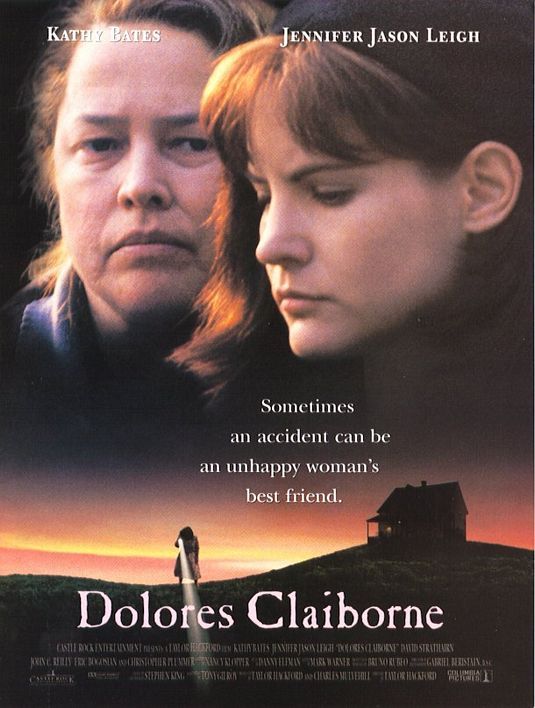
“Dolores Claiborne” is, on the surface, not your typical Stephen King novel, and this is important to note before you begin watching this particular adaptation of his work. This cinematic treatment reunites him with the great Kathy Bates who won an Oscar for playing Annie Wilkes in “Misery,” but she’s not playing a deranged psycho this time around. Also, while much of King’s writings deal with terrifying supernatural powers and unspeakable terrors, the horror generated here comes from real life horrors no one should ever have to endure. In some ways, this makes it one of his more terrifying tales because it deals with the kind of horrible crimes we hope and pray never to experience first-hand. Having said this, it is clear how many of us can never be so lucky as to avoid the worst traumas humanity has to offer.
Bates plays the title character who, as “Dolores Claiborne” opens, is believed to have killed her rich employer Vera Donovan (Judy Parfitt). This crime immediately reminds the town of Little Tall Island in Maine when Dolores’ husband, Joe (David Strathairn), died twenty years ago under mysterious circumstances, and the general consensus was that Dolores killed him. Detective John Mackey (Christopher Plummer), who had pursued the case against her back then is determined to put her behind bars this time and for good. Into this mix comes Dolores’ daughter, Selena St. George (Jennifer Jason Leigh), a big-time reporter who arrives to defend her mother despite the two of them having been estranged for over a decade.
The novel “Dolores Claiborne” was essentially one long monologue as the story was written entirely from the title character’s point of view. This makes the work director Taylor Hackford and screenwriter Tony Gilroy have done here all the more impressive. They have taken Dolores’ unsettling story and have stretched it out into a character driven motion picture filled with various characters who have been fleshed out in unforgettably compelling ways. None of these characters, even that drunken lout of a husband and father, are one-dimensional or throwaway caricatures. Each one is complex, and they take unexpected directions which might seem jarring at first, but eventually make sense in the large scheme of things.
The plot shifts back and forth in time as we flashback to when Dolores lived with her drunk and abusive husband and of the vicious abuse she took from him in his endlessly drunken state. Director of photography Gabriel Beristain shoots this hideous past with such vivid colors to where he gives the scenes an innocent look which is soon contrasted with horrible violence. It almost acts as a façade for how the past was seen as if it were some sort of Norman Rockwell painting, the kind made to cover up the severe family dysfunction many would like to pretend does not exist.
For the record, King said he wrote the character of Dolores Claiborne with Kathy Bates in mind, and it is very hard to think of another actress who could have inhabited this role. Stripped of any false glamour, Bates takes her character from being a victim to one who understandably takes matters into her own hands. Her acting here is flawless and compelling, and we root for her even though her actions have devastating moral implications.
When you look at her overall body of work, this movie almost seems like a walk in the park for Leigh. She has gone to great physical and emotional lengths to portray a character throughout her long career, but here it looks like she is taking it easy. However, her character of Selena is no less challenging to portray than the others listed on her vast resume. Selena is not easily likable, but she has to be empathetic because the viewer slowly starts to see how her innocence was irrevocably and unforgivably destroyed. Leigh matches Bates’ performance scene for scene by showing how much Selena wants to forget the past, but she comes to see how her most repressed memories cannot stay below the surface forever.
Special attention also needs to be paid to Ellen Muth who portrays Selena as a little girl. This is not the kind of role parents want their children to portray to as it deals with abuse and molestation among other things, but Muth proves to be utterly convincing in making the young Selena deeply distraught and confused by actions no child should ever have to be put through.
There’s also a bevy of excellent performances from the rest of the cast as well. Christopher Plummer, who is never bad in anything, is memorable as the relentless Detective John Mackey. This could have been a throwaway role, but Plummer makes Mackey a complex character to where you question whether his determination is based more on personal revenge than justice. Judy Parfitt is unbearably domineering as Dolores’ wealthy employer, Vera Donovan, and their relationship runs much deeper than we see at first glance. And David Strathairn manages to flesh out his despicable character of Joe St. George to where he’s just slightly more than your average mean drunk.
Most of King’s novels deal with the horror of supernatural elements or ghosts and demons which haunt our nightmares. But “Dolores Claiborne,” much like “Stand by Me,” deals with the horrors of real life which we are never quick to confront unless we are put in a position where the awful truth can no longer be ignored. Perhaps the unsettling nature of this particular work by King is what kept many from checking out this motion picture when it arrived in movie theatres back in 1995, but those of us who were willing to dive into the dark side of things like myself did not deny ourselves a journey to the horrors this film has to offer. But now, 25 years later, this film fits in perfectly with a time which includes the Time’s Up movement as we are forced to realize we have thoughtlessly ignored the worst abuses made against other human beings for far too long. As a result, this particular King cinematic adaption plays even better than it did back when it was released.
The following review was written by Ultimate Rabbit correspondent Tony Farinella.
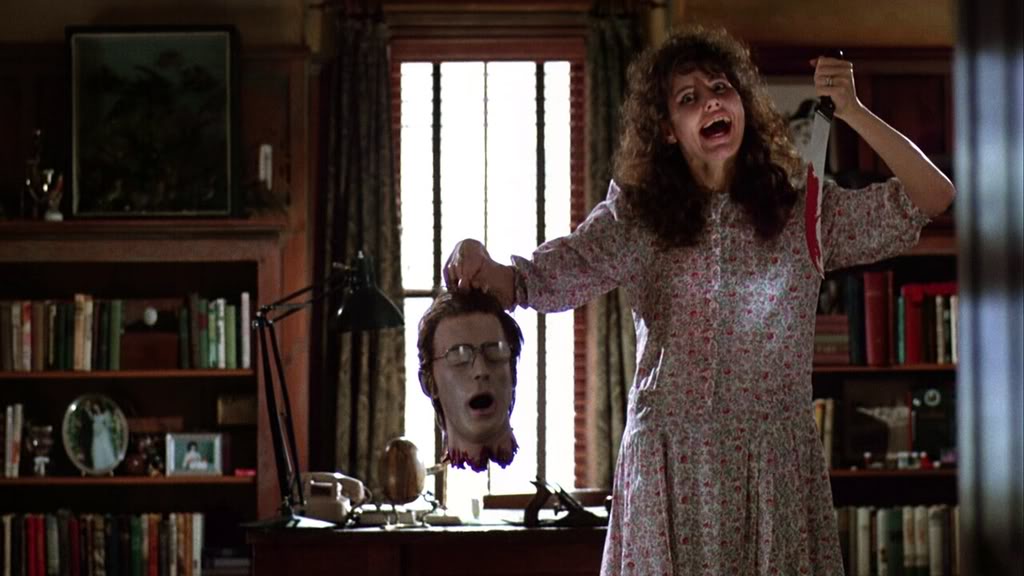
Your enjoyment level for Tim Burton’s “Beetlejuice” is going to depend on how you feel about Burton as a director. He is an eccentric director with a flair for style and bright, vivid colors. However, in my view, I sometimes feel as though his characters and stories can distance themselves from audiences. I realize he has many devoted fans and “Beetlejuice” is one of his most beloved films. Whenever Halloween rolls around, I know it is a film which families sit around and watch together, even though there is an F-bomb and some odd innuendos which parents might find off putting to young children. As a first-time viewer of the film, I found I liked certain elements of it, but not nearly enough to recommend it or call it a Halloween classic.
One thing “Beetlejuice” definitely has going for it is the talents of Alec Baldwin, Geena Davis and Winona Ryder. Whenever they are on screen together, the film is really hitting the right notes. The character of Beetlejuice, played by Michael Keaton, is barely in the film, which is odd considering he is displayed so prominently on the film’s poster and in its title. It is more about the dilemma of Barbara and Adam Maitland (Davis and Baldwin) wanting to enjoy two weeks of a nice, quiet vacation at their Connecticut country home. All of this is thrown for a loop when they get into a car accident and perish.
Now, they are ghosts that have returned to their home, only to find it has been taken over by the Deetz family, which includes Charles (Jeffrey Jones), Delia (Catherine O’Hara), and their daughter Lydia (Winona Ryder), although the film is quick to point out that Delia is the stepmother of Lydia. Delia has plans of her own for the house with the help of her interior designer, Otho, played by Glenn Shadix. The father, Charles, is looking to make a real estate deal with the property and its surrounding areas. Lydia is suspicious of the place when she notices the ghosts of Barbara and Adam looming over the house. Here is the catch—Lydia is the only one who is able to see or notice them.
Since Barbara and Adam want the Deetz family out of their home, they are desperate to come up with any solution. They enlist the help of Beetlejuice (Michael Keaton), even though he comes with a lot of baggage, according to their afterlife caseworker, Juno (Sylvia Sidney). She is very familiar with all that comes with Beetlejuice and warns them to stay away from him. In her mind, the best way to get this family out of the house is to find creative and simple ways to scare them into moving out. When Barbara and Adam find this harder than they thought, they say the name Beetlejuice three times, and he appears ready and willing to help, as long as there is something in it for him.
The major problem with “Beetlejuice” is just that, Beetlejuice. As an audience, are we supposed to like this guy? He wants to get married to what we assume is an underage teenage girl. He is very perverted around Barbara and is not all that funny or interesting. For the most part, as a viewer, I found him quite annoying on screen. This is no fault of Keaton, as he is simply playing the character as best he can based on the screenplay he was given and the direction of Burton. Baldwin tries to carry the movie on his back along with the help of Davis, but their charms are not enough to make this film worthwhile.
It’s hard to deny the great make-up and special effects which are on display in “Beetlejuice.” The concept for the film is rather creative as well. The actors are ready and willing to do whatever they can to help the flick. However, because Beetlejuice is so obnoxious and the film is so over-the-top and filled with tricks, there is really no heart to the story. It’s not scary or funny, so it fails as a horror/comedy. It is nice to look at, filled with some clever scenes, and there is good acting on display. In the end, this is not enough to save this film which relies too much on style instead of substance.
4K Info: “Beetlejuice” is released by Warner Brothers Home Entertainment on a 4K Ultra HD Combo Pack, which comes with the Blu-Ray and a digital code. The film comes in the following languages: English, Latin Spanish, Canadian French, and Brazilian Portuguese. It has a running time of 92 minutes and is rated PG. The film is presented in 2160 Ultra High Definition. With 4K, you can’t help but be impressed by the HDR (High Dynamic Range), especially on a film like this. It really stands out.
Video Info: The film comes on 2160 Ultra High Definition for the 4K Version. The Blu-Ray comes in 1080p High Definition.
Audio Info: The 4K Audio is Dolby Atmos-TrueHD: English and Dolby Digital: French and Spanish. For the Blu-Ray, it comes with Dolby TrueHD: English 5.1 and Dolby Digital: English 5.1, French and Spanish. Subtitles for both versions are in English, French, and Spanish.
Special Features:
Three Hilarious Episodes from the Animated “Beetlejuice” TV Series: “A-Ha!,” “Skeletons in the Closet,” and “Spooky-Boo-Tique.”
Theatrical Trailer
Danny Elfman Score Audio Track
Should You Buy It?
Much like my review of “The Goonies,” if you LOVE “Beetlejuice,” you will be very, very happy with the 4K update. You might not be so happy with the lack of special features. If they are going to upgrade a film to 4K, you would expect they would add some new special features which look back on the film. This is not the case here. If you are strictly in this for the visual and audio upgrades, you will get your money’s worth. If you haven’t seen the film before and are not a Tim Burton fan, this film is not going to win you over. I would say rent it just to say you have checked it out as Halloween is fast approaching.
I did not become aware of Alfred Hitchcock’s “Psycho” until its first sequel, “Psycho II,” was released back in 1983, 23 years after the original. Of course, I didn’t watch this sequel at the time as I was just a kid, but I do remember its movie trailers and the title cracking up on the big screen as it played before the feature presentation of “Return of the Jedi.” This image really freaked me out, and it was just as well I didn’t see the classic film which inspired it until many years later. When I rented and watched it on VHS with my older brother, we did not see what the big deal was as we had long since been spoiled by the “Friday the 13th” and “Nightmare on Elm Street” movies with all the blood and gore a hormonal teenager could ever want or endure.
Well, it turns out watching it once was not nearly enough. Whether or not you think “Psycho” is Hitchcock’s best movie ever, it is often the one he is remembered best for making. After 60 years, it remains a great study of how a director can maintain suspense throughout the entire running time of a movie, and of a master playing the audience all the way up to the last frame. This becomes even more apparent when you watch it for a second and third time. Hitchcock puts you into the mindset of Marion Crane as she drives out of town after embezzling some money, and then he completely changes the dynamic of the story once Norman Bates arrives.
With “Psycho” now at its 60th Anniversary, we have another chance to go behind the scenes to see how this horror classic was made. It also represents another opportunity for Universal Pictures to release a new digital edition of the movie so they can fleece a few more dollars from our wallets. There has already been a Blu-ray release which made it look exquisite, and there has got to be a 4K Ultra HD version at some point. Anyway, looking back at the history of this classic proved to be one of the most interesting research projects I have taken on in years as there is much to be said about what went on behind the scenes.
“Psycho” originated as a novel written by Robert Bloch which itself was based on Wisconsin serial killer Ed Gein, a man whose horrific exploits would inspire many horror movies to come. Hitchcock acquired the film rights through his agent for $9,000, and he chose to film it after two projects he was working on for Paramount Pictures, “Flamingo Feather” and “No Bail for The Judge,” fell through. But Paramount did not want to help Hitchcock out on this one either as they were quoted as saying they found Bloch’s novel “too repulsive” and “impossible for films.” The executives refused to finance the production, and they even went as far as telling Hitchcock their soundstages were unavailable because they were being used for other projects. Of course, this proved to be a bold-faced lie as their production schedule was already in a slump at the time.
Undaunted, Hitchcock was still determined to bring “Psycho” to the silver screen, and he even offered to defer his normal director’s fee of $250,000 in exchange for 60% ownership of the movie’s negative. Still, executives would not grant him the financing he desired, so he continued to go through several different cost-cutting measures before getting a budget of no more than $1 million to make the movie his own way. Hitchcock had planned to make the film fast and cheap anyway, and he employed the crew members of his television series “Alfred Hitchcock Presents” who were already skilled at doing the same. He also succeeded in casting proven stars Janet Leigh and Anthony Perkins at a quarter of their usual salaries.
Bringing down the budget also meant shooting the film in black and white, but this was fine with Hitchcock as he wanted to film it that way as to make the shower scene come across as less gory, and he was also a big fan of “Les Diabolique” which was also shot in black and white.
Like “Psycho,” “Les Diabolique” was remade many years later. Unlike the originals, both were filmed in color. Even more unlike the originals, they received mercilessly scathing reviews upon their separate releases.
In filming “Psycho,” Hitchcock started off by making it as objective an experience as possible, and we feel what Marion goes through as the voices in her head fill her with guilt and doubt over what she has done. To help emphasize this effect, Hitchcock shot much of the movie with 50 mm lenses on 35 mm cameras. By doing this, the camera was said to mimic normal human vision. As a result, you are not just watching the movie, you are experiencing it. This even goes on after Marion has gone and the story turns its focus to Norman Bates. When he pushes her car into a nearby swamp, you share in his anxiety when it does not completely sink. That’s the thing; like Norman, you want the car to sink, and it makes one feel like a voyeur just as Hitchcock intended.
Then, of course, you have the famous shower scene, and after all these years it remains one of the most talked about and heavily dissected moments in cinema history. I am sure you all know the details regarding it: it was shot over six days from 77 different camera angles, and the scene features around 50 cuts in the three minutes which it lasts. Not much is shown as you never see the knife penetrating Marion’s flesh, and there is no gore other than the blood (chocolate syrup was used) going down the drain along with the water. Indeed, it is what you do not see which makes the scene feel so violent. Like Spielberg later did with “Jaws,” Hitchcock dared the audience to use their imagination in regards to what they thought they saw here. This is one of many reasons why this scene has stood the test of time, and it was also the first time a director killed off his leading lady in the middle of a movie. Back in 1960, audience members could not help but wonder where things could possibly go from there, and shower curtain sales have never been the same since.
I also cannot go on without mentioning the infamous score composed by the great Bernard Herrmann, and it remains one of the scariest pieces of music ever applied to a motion picture. Throughout his career, Hermann proved brilliant in composing film scores which really captured the psychology of the characters. This proves to be as true about “Psycho’s” score as it was with Hermann’s work on “Cape Fear” and “Taxi Driver.” It was a surprise to learn how this score almost didn’t come about as Herrmann balked at Hitchcock’s request to take the job on a reduced salary. Somehow though, Herrmann agreed to the terms and ended up writing music for a string orchestra as opposed to a full symphony which would have included brass and woodwind instruments. This is now clearly seen as a masterstroke on his part as the screeching of violins captures the sheer terror which overtakes Marion and the audience during the infamous shower scene.
Although “Psycho” is now recognized today as a classic, it actually received mixed reviews upon its release. Some admired the buildup of tension, but others questioned the psychological elements as being less effective. It even made one critic, C. A. Lejeune, so offended to where she walked out of the movie before it was even over, and she soon after resigned from her position as film critic for The Observer. Looks like Norman’s mother did not just claim victims onscreen!
When you look at the history of cinema, it is important to keep in mind how movies we see these days as classic were not necessarily treated this way upon their original release. It is over the passing of time where movies get re-evaluated or seen in a different light, and none can ever truly be perfect (although some do come very close to it). “Psycho” was a game changer as it came about during the Motion Picture Production Code which was heavy in its censorship of violence and sex in American films. With “Psycho,” Hitchcock flirted with showing nudity as well as gore, and this later opened up doors for filmmakers to exploit these elements with far more detail. Without “Psycho,” there may never have been a “Halloween” which by itself inadvertently sparked a whole wave of slasher movies. And without “Halloween,” there certainly would not have been a “Friday the 13th” as Jason Voorhees, like Norman Bates, also had serious mommy issues.
The cultural impact of “Psycho” lasts on to this very day. There are only so many movies which could have a sequel made to it several decades later. “Psycho III” followed a few years later, and a prequel came about because some just thought it would be a good idea to show how Norman Bates got to be the shy psycho we know him to be. There was even a failed television pilot called “Bates Motel” which starred Bud Cort as Alex West, an asylum inmate who befriends Norman and later inherits the motel and the house where mother lived (Anthony Perkins wanted nothing to do with that one). It also inspired a shot-for-shot remake by Gus Van Sant which seemed almost every bit as odd as Norman himself. The only purpose of it seemed to be proof of how remakes will never be able to recapture what made the original so good. But if they make money, the studios will clearly not mind the critical bashing even if it proves to be justified.
Television would later take another shot at the “Psycho” franchise with another version of “Bates Motel,” and this one starred Freddie Highmore as Norman Bates and Vera Farmiga as his mother. This version ended up lasting five seasons and proved to be very compelling as our fascination with the dark side of human nature is always stronger than we ever bother to realize. While some may have said enough already with “Psycho,” this show proved there was more life to it than we cared to initially realized.
Even today, you cannot hear screeching violins and not think of “Psycho.” Filmmakers reference it today like Wes Craven did in “Scream,” and there are dozens of movies out there which have done the same. That shower scene has been spoofed lord only knows how many times, my favorite being on “The Simpsons” where Maggie ended up attacking Homer with a mallet after watching one Itchy & Scratchy cartoon. Another great one came about during one of Billy Crystal’s Oscar montages where he was in the shower and ends up getting accosted by Kevin Spacey who plays his “American Beauty” character of Lester Burnham. Turns out it was not the same shower Marion got stabbed in, but instead the one where Lester often experienced the highlight of his day.
Leigh never looked at taking showers the same way again, and it would be ages before she ever took one. Perkins would forever be typecast in roles similar to Norman Bates, but he said he would still have done “Psycho” even if he knew this would be the case. Many filmmakers (Brian DePalma especially) have tried to use the tricks Hitchcock employed in this and his other films to varying degrees of success. Still, there is no topping what Hitchcock did with this classic 1960 movie, and it remains the one so many other suspense and horror movies are judged by. Hitchcock’s powers of manipulation remain very hard to duplicate after all these years, and this illustrates what he meant when he was quoted as saying, “I enjoy playing the audience like a piano.”
WRITER’S NOTE: As the opening paragraph indicates, this is about a screening which took place several years ago.
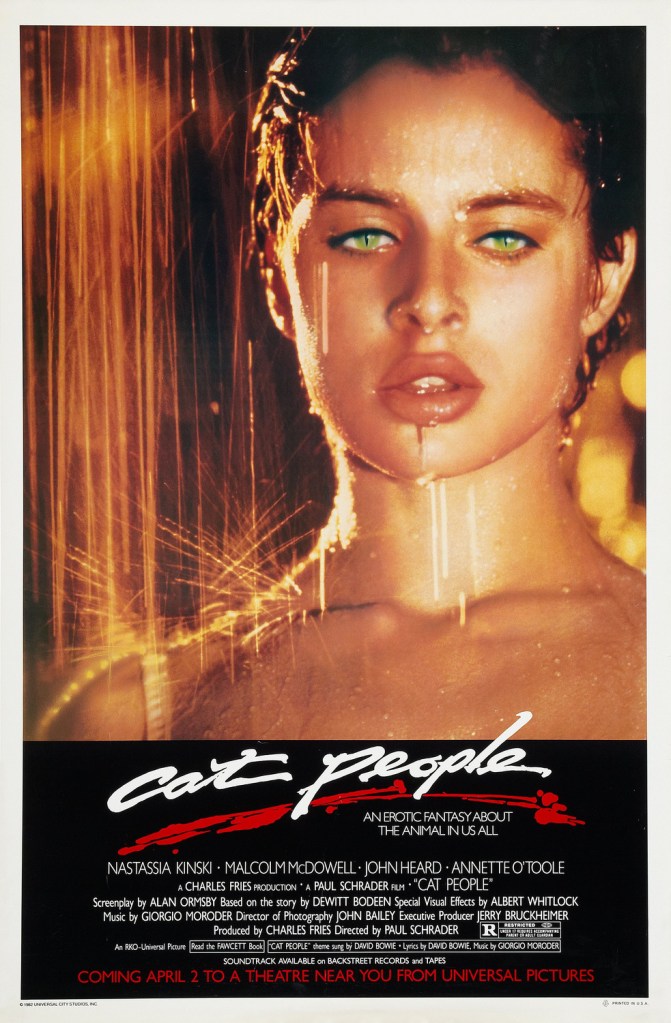
Actress Lynn Lowry, one of the famous horror queens of 1970’s movies, made a special appearance at New Beverly Cinema on Thursday, April 19, 2012 for a double feature of George Romero’s original version of “The Crazies” and Paul Schrader’s erotic remake of “Cat People.” Lowry took some time to talk about her brief appearance in Schrader’s take on the 1942 horror film, and her responses truly surprised the small but faithful audience attending this screening.
Filmmaker Ryan Stockstad, who was about to make a movie with Lowry called “Eggs,” asked the veteran actress what it was like working with Schrader, who may be best known for writing the screenplay to “Taxi Driver.” Lowry described Schrader as “insensitive,” and also said, “Is it okay if I say Paul Schrader is the least favorite director I’ve ever worked with?”
In auditioning for “Cat People,” Lowry said she asked the casting directors if they wanted her to do the scene “full out.” They said they had no problem with that, and she didn’t hold anything back as a result. Looking back, she said the secretaries who heard her from a distance loved what she did.
Lowry’s scene had her playing Ruthie, a prostitute who goes to a seedy motel to fulfill the pleasures of a particular customer. While there, she gets attacked by a black leopard hiding underneath the bed and screams in horror when she realizes how badly one of her feet has been slashed.
Lowry started the scene by walking to the hotel, and Schrader wanted the makeup people to spruce her up from head to toe. He wanted to light up the streets of New Orleans where “Cat People” was being filmed as she made her way to the location, but she ended up only being filmed from below her knees.
The actress described Schrader as working so fast to where he couldn’t quite get what he needed. For her scene, Lowry had to keep falling on her knees over and over again. As the day went on, she said the crew finally had to put a cat paw on the leopard to make this scene work.
The climax of had Lowry falling down a flight of stairs, a sequence she noted had to be shot multiple times. Part of the problem was her bra would not open up on cue, and she said Schrader wanted to see a lot of skin throughout the film. This ended up necessitating the use of Velcro on the undergarment to make it open more easily.
Lowry also remarked how there were nails on the stairs which the crew members did not bother removing. As a result, she ended up getting cuts on various parts of her body.
On the DVD commentary for “Cat People,” Schrader said he wanted to share credit with the movie’s visual consultant, Ferdinando Scarfiotti, and this was because he felt Scarfiotti was mostly responsible for the look of the film. Lowry, however, said she never ever saw anyone else on set directing.
It is a bummer to hear Lynn Lowry was not very happy with her time making “Cat People,” and she is certainly entitled to her opinion. But after all these years, this movie is a fascinating remake which truly stands on its own.
“Re-Animator” may be the definitive Stuart Gordon cult classic, but his follow-up film entitled “From Beyond” is just as good. Like the former, it’s based on a short story by H.P. Lovecraft, whose love of horror and fantasy made him a unique writer in his field. “From Beyond” also represents the kind of horror movie Hollywood is not always quick to make: one with a vivid imagination and something other than your typical slasher fare. Were it made today, and assuming any studio would finance such a genre flick, it would probably go straight to Netflix or Shudder. Granted, this would not be a terrible fate, but movies like these are best experienced in a darkened movie theatre.
Jeffrey Combs stars as Crawford Tillinghast, a scientist who has created a ground-breaking machine called the Resonator. It is designed to stimulate the pineal gland which, for those who didn’t pay attention in science class (don’t worry, I didn’t either), allows subjects to see beyond normal, perceptible reality. Aside from getting, as one character says, an “orgasm of the mind,” they also see creatures unlike any others which inhabit the planet. Of course, when these same creatures proceed to attack Tillinghast and his sadomasochistic partner Edward Pretorius (Ted Sorel), we know things will not end well for anybody.
Pretorius ends up getting killed and Tillinghast is arrested and wrongly charged with his murder. But after meeting Katherine McMichaels (Barbara Crampton), who is utterly shocked after viewing Tillinghast’s brain scan which shows his pineal gland as larger than ever, she goes against her superiors and takes him back to the house to start the Resonator up again and confirm his story. From there pain and pleasure take on visceral new meanings even Pinhead from “Hellraiser” would never have thought of (seriously, such things are possible).
Gordon effectively finds the shock and awe in this story which gets at our conflicting desire to play it safe and yet still test our limits. These characters have no business reactivating the Resonator but, like them, their fascination over what they could happen is far more enticing than we would openly admit. He also brings much of the black humor from “Re-Animator” to this film as well, allowing us to take the story only so seriously. With antennas sticking out of heads and characters wearing bizarre costumes, you could almost call this his version of a David Cronenberg film.
All the actors in “From Beyond” remain incredibly underrated long after this film was released back in 1986. Combs is superb as a doctor who is even more of a loose cannon than “Re-Animator’s” Herbert West ever was, and you come out of this wondering why he isn’t a movie star. Barbara Crampton matches him scene for scene as McMichaels, who goes from being a person in control to one completely losing it with great abandon. Then you have “Dawn of the Dead’s” Ken Foree, who plays Bubba Brownlee (yes, this is his character’s name), the one man who has not completely lost his sanity. This is one of the many roles on Foree’s resume which quickly reminds us of what a bad ass he is and can be.
But one performance worth singling out is the late Ted Sorel’s as he dives head-first into the perverse nature of his character, Dr. Pretorius. Seeing him excited about the next ultimate drug makes him such a repellant character, yet Sorel still makes him so charismatic at the same time. Even when covered in makeup to where he looks infinitely slimy and mutated, the effects never upstage his excellent performance.
Gordon, working with a bigger budget this time, revels in the love he has for Lovecraft’s work, and this love can be seen all throughout “From Beyond.” He was never a guy who wanted to just churn out forgettable junk, but one who brings us to a horrifying place we may are compelled to visit against our better judgment. Scary movies are always fun to watch, but many of them are as imaginative as they claim to. “From Beyond,” however, is one of those movies and definitely worth your time. If you loved “Re-Animator,” you will enjoy “From Beyond” every bit as much.
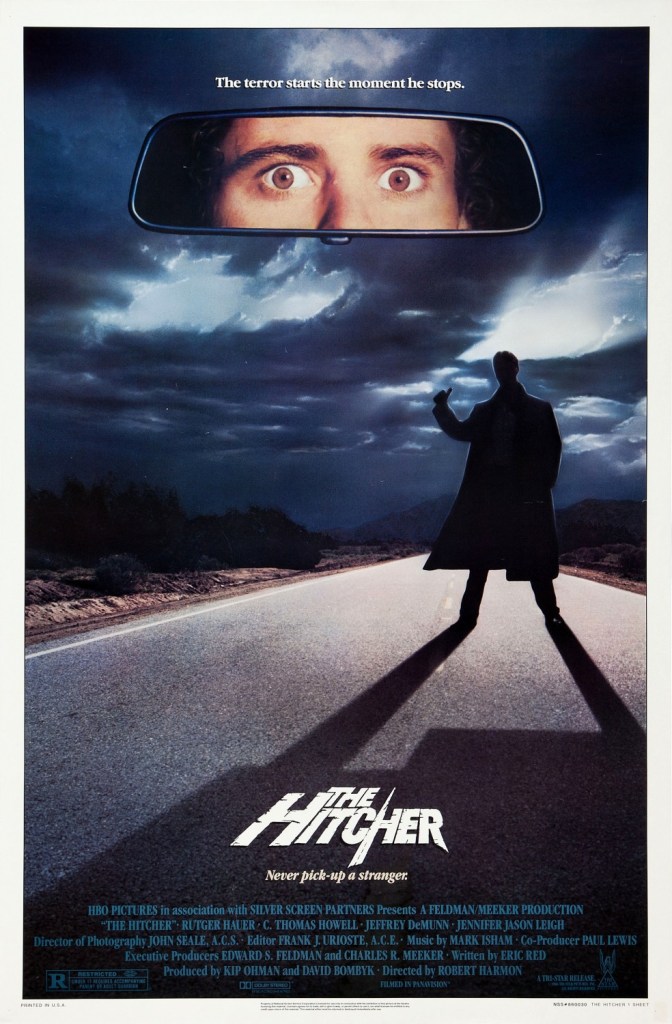
After all these years, “The Hitcher” (the original, not the godforsaken 2007 remake) has lost none of its suspenseful power, and it continues to terrify new generations of horror movie fans. In addition, it also marked a memorable point in the careers of the actors cast in it. Rutger Hauer created one of his most devilish villains ever with John Ryder, C. Thomas Howell gave one of his very best performances as Jim Halsey, and Jennifer Jason Leigh’s performance as Nash proved to be a real stretch for the actress (that pun was most definitely intended).
When the screenwriter of “The Hitcher,” Eric Red, arrived to do a Q&A at the Silent Movie Theatre in Los Angeles on October 9, 2011 where Cinefamily was showing the film, he gave the small but very attentive audience a lot of great stories involving the actors involved in the production, and he had plenty of unforgettable things to say about Hauer.
The audience was very surprised to hear Sam Elliott was originally cast as John Ryder before Hauer came along. Apparently, Elliott’s audition was so terrifying, one of the movie’s producers refused to stay inside the casting office whenever Elliott was around. Somewhere along the line, however, Elliott got cold feet and ended up dropping out of the production.
But even after hearing that, it is still hard to think of another actor who could have played this truly frightening character as memorably as Hauer. As Ryder, Red said Hauer “evoked the character to such a degree” and was always “unpredictable” in what he did. Red described his screenplay as being “sparse” and said it was more about looks than it was about dialogue as there wasn’t much of the latter. Hauer, however, brought so many ideas to the role which were not on the page. During this particularly screening, some of us actually noticed how Ryder was actually wearing a wedding ring. To this, Red simply said, “That’s Hauer!”
Oddly enough, the evening’s funniest story involved the scene where Leigh’s character of Nash was tied between a truck, and Halsey has to keep Ryder from stepping on the gas and ripping her apart. It turns out Hauer did not want to shoot this scene and would not even come out of his trailer when everything was ready to start shooting. The filmmakers talked to him regarding his concerns, and Hauer told them the following:
“I don’t want to shoot the scene because the audience will end up figuring out that my character is the bad guy.”
Hmm … Dismembering the driver who picked up Ryder before Halsey did, murdering a whole family and sticking a human finger in a pile of French fries was not enough to indicate Ryder was the bad guy? How scary it is to learn of this!
When it came to casting Halsey, the filmmakers did not have any particular actors in mind. Red said they all went with Howell as they remembered him from “The Outsiders” and described him as having “the right look.” Ryder is described as being a “father figure” to Halsey, and he wants Halsey to kill him. Howell convincingly portrays his character, who goes from a terrified young man in over his head to one who gains control and becomes almost as cold-blooded as Ryder.
With “The Hitcher,” Red was aiming to create a movie where the audience got an inescapable feeling of claustrophobia in wide open spaces. He said it does not only have to happen in a tiny room or an elevator. Even with the infinite expanse of land on display, no one can escape their pursuers. But the movie also benefits from its memorable performances from a cast who bring more to their characters than what was on the page. Without Hauer, Howell and Leigh, “The Hitcher” would never have been half as effective as what we ended up seeing onscreen.
The following review was written by Ultimate Rabbit correspondent Tony Farinella.
The work of Stephen King has usually produced highly entertaining and enjoyable films. Not everything has been great or even good, but for the most part, there is usually something to take away from them which is unique and falls right in line within the realm of King’s wonderful and twisted brain. That is definitely the case with “Silver Bullet,” which is based on his novella “Cycle of the Werewolf.” King also wrote the screenplay as well, so he was very hands-on with his approach to this film and in making sure his vision was seen clearly on screen. The fine folks over at Scream Factory have brought it back into the public eye with this special collector’s edition on Blu-ray.
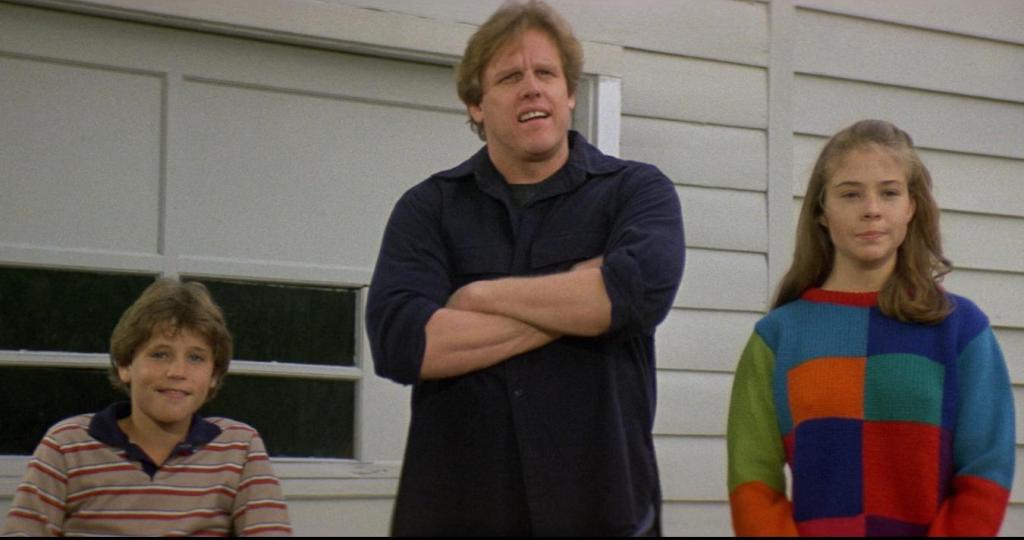
The film was released in 1985, the year I was born, and it stars Corey Haim as Marty, a 13-year-old boy who is stuck in a wheelchair. Because of this, he tends to get special treatment from his family. This does not endear him to his sister Jane, played by Megan Follows. She feels as though her parents are always taking his side and that he can get away with anything and everything. He is also very popular with his Uncle Red, played by Gary Busey. Red is coming off his third divorce, and he is not shy about hitting the sauce as often as possible.
Deep down, however, Uncle Red has a lot of love and affection for Marty, and this leads him to build Marty a special wheelchair he names Silver Bullet which allows him to get around and have a little more fun. But suddenly, this quiet and quant town where they live gets turned upside down when they start to notice people are being killed off left and right. First, there was the local town drunk. And then a young child, an angry father and a pregnant woman also end up dead in a matter of days. The people of this small-town start to get restless and they want answers right away, but the local sheriff Joe Haller (Terry O’Quinn) is not able to provide them. Because of this, they decide to go out looking for some private justice of their own. Even the local Reverend Lowe (Everett McGill) doesn’t know what to say to the people anymore about the deaths which are occurring, and it is about to get worse before it can possibly get better.
Corey Haim, Gary Busey and Megan Follows.
“Silver Bullet” is only 94 minutes, but a lot happens in those 94 minutes. There is never really a dull moment or a scene which doesn’t make sense to the overall film. At times, the category it falls under can be a little confusing. Is it a straight up werewolf movie? Is it a horror movie about a werewolf for young children to watch? At times, the film goes full throttle with the gore which set up some gruesome and enjoyable death scenes. During other scenes, it cuts away from the gorier aspects of the killings. It seems to want to have its cake and eat it too.
What I mean by that is it wants to be accessible for young children as a horror movie they can watch, but it doesn’t want to go too far. Tonally, it seems to be trying to please young children and horror fans, and this is not an easy task to pull off. There is a brother/sister relationship which is something a lot of kids can relate to, and the kids are trying to get the adults to see there is a werewolf out there. On the other hand, they deal with topics such as divorce, suicide, and alcoholism. While the film worked for me, I could see it having a tough time finding an audience back when it was released.
According to IMDB, the budget was seven million dollars, and it grossed 12 million worldwide. It was not a total bust, but it didn’t set the world on fire either. That is why Scream Factory is perfect for films like “Silver Bullet.” I had never seen it in the past, but I enjoyed it quite a bit. The film has a good sense of humor, great performances from Haim, Follows and Busey, and it contains some pretty cool kills. I think it will find a whole new audience on with this collector’s edition Blu-ray.
Blu-Ray Info: “Silver Bullet” is released on Collector’s Edition Blu-Ray from Shout Factory/Scream Factory. It has a running time of 94 minutes and is rated R.
Video Info: “Silver Bullet” is presented in 1080p High-Definition Widescreen (2.35:1), and it looks out of this world on Blu-ray for being thirty-four years old. At this point, we should expect no less from Scream Factory. They do not disappoint with their transfers, and there is not a single shot in the film which is grainy or dirty. It is clear, bright and filled with life.
Audio Info: The English DTS-HD Master Audio Mono is also top-notch. It must be mentioned that the music was composed by Jay Chattaway who will forever hold a place in my heart for his work on the “Maniac Cop” Rap. He does a great job with the music in knowing when to keep it calm and mellow and when to take it up a notch.
Special Features:
NEW Audio Commentary with Producer Martha De Laurentiis
NEW Cutting to The Bone – An Interview with Editor Daniel Loewenthal
NEW A Little Private Justice – An Interview with Actor Kent Broadhurst
The Wolf Within – An Interview with Actor Everett McGill
Full Moon Fever – The Effects of Silver Bullet – An Interview with Special Effects Artists Matthew Mungle And Michael McCracken
Audio Commentary with Director Daniel Attias
Isolated Score Selections and Audio Interview with Composer Jay Chattaway
Theatrical Trailer
TV Spot
Radio Spot
Still Gallery
Should You Buy It?
I love what Scream Factory is doing for the horror genre and how they are bringing new life to films which have long been forgotten unless you are a super hardcore horror fan. I like to consider myself very knowledgeable when it comes to the genre, but they always find a movie here and there which I haven’t heard of before, or have heard of but never seen in the past. With “Silver Bullet,” they add plenty of special features that are worth watching and which add a lot to the film. Scream Factory has become like the Criterion Collection for horror fans. As far as the film itself, it is a nice 94-minute ride that is paced perfectly. It is one of those films where you sit back, relax, laugh, scream and just enjoy yourself from start to finish. I recommend you pick this one up if you get any Amazon gift cards over the holiday season. You will be pleasantly surprised by it, despite some of the flaws I mentioned in my review. Still, those flaws do add to the charm of the film.