Rolfe Kanefsky On His Horror Movie Satire ‘There’s Nothing Out There’
WRITER’S NOTE: This article is about a screening which took place in 2012.

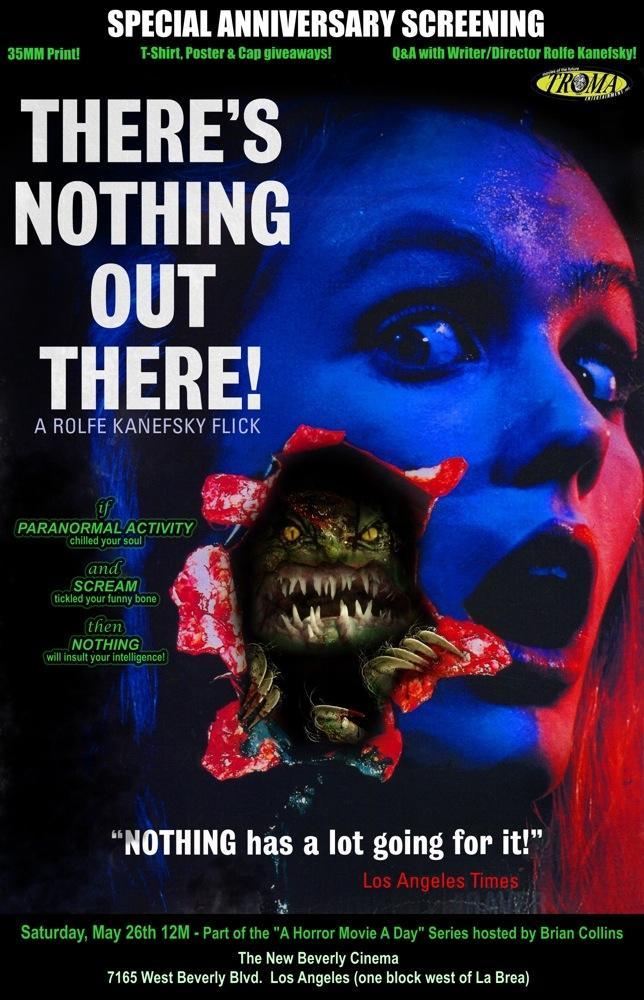
Writer and director Rolfe Kanefsky appeared at New Beverly Cinema where Brian Collins of the Horror Movie a Day website presented a special midnight screening of his directorial debut, “There’s Nothing Out There.” Joining him for this screening were two of the film’s crew members, still photographer Dave Shelton and assistant director Michael Berily. It tells the story of a group of teenagers, one of them a horror movie fan, spending spring break at a cabin in the woods, and it pre-dates Wes Craven’s “Scream” in making fun of the clichés horror movies always deal with.

Kanefsky spoke with audiences about what got him into movie making, and of what spurred the idea for this particular film of his:

Role Kanefsky: I’ve wanted to make movies since I was four years old. As I got older, I watched every horror movie that was ever made which got me to thinking about why people keep making the same mistakes in this genre over and over again. I wrote the script when I was in high school, but no one really liked it.

Kanefsky then went to college where he wrote several scripts, but then he came back to the one he wrote for “There’s Nothing Out There” after he graduated. It was 1988 when he started looking for the money to make it, and he was able to get a few private investors to help him out. He even told the audience his parents helped by selling their house, and after that he had a budget of around $150,000. One audience member asked him if his parents ever got to buy their house back with the profits and he responded:

Rolfe Kanefsky: You don’t get into movies to make money. You get into them because you love to make them.

When asked about the house used in the film, Kanefsky said a friend of his from college found it for him. It was located right near the border of New York and New Jersey, and he described what it was like filming in and around the house:

Rolfe Kanefsky: It was owned by two women who were a couple, and one of them was a sound artist which came in very handy for us. We did, however, have to use three different houses for the interior, and this forced us to cheat certain shots so that everything matched up in the end.

When it came to specific influences, Kanefsky looked mostly to 1950’s monster films, and he made several nods to them throughout. But he was also looking to make fun of the overused clichés in horror movies like the one where a cat jumps out at characters from nowhere, and of how one person warns of the danger ahead while everyone else ignores their advice. Kanefsky did, however, make one thing very clear to us:

Rolfe Kanefsky: It was never my intention to mock the (horror) genre, but instead the lazy filmmaking that has overwhelmed it.

One unique thing about “There’s Nothing Out There,” when compared to other horror movies of the time, is that what’s stalking the characters is not a deranged serial killer, but instead a monster from another planet. Keep in mind, this film was made long before the advent of CGI effects, so there was a lot of puppeteering involved in bringing this creature to life. Kanefsky was specific in what he was looking for:

Rolfe Kanefsky: I didn’t want a guy in a suit for the creature because I wanted to do something different. The way I saw it, the creature was half alligator and half octopus. I also intentionally made it a dumb creature, and you can tell it was not the smartest as there was a big learning curve going on with it. We ended up having to use crowbars just to move its tentacles around.

Kanefsky then invited his fellow crew members to share their experiences of making “There’s Nothing Out There.” Dave Shelton still has very vivid memories of how it all started:

Dave Shelton: I was working at Nickelodeon at the time and there weren’t many things being shot in New Jersey back then. When I met with Rolfe and he talked about his script, I knew right away what his vision was. He also said that no one is getting paid to make this movie and knew it was going to be good as a result. We got a lot of family and friends to be extras in the movie and we improvised a lot of stuff. Not everything worked, but we did the best with what we had. This was such a fun project to be a part of.

Michael Berily was originally hired to be the second assistant director on the set, but things changed for him very quickly:

Michael Berily: The first AD left three days into shooting, so I took over and spent a lot of time yelling and screaming at people because I didn’t know what I was doing. Still, it was an incredible experience working on it, especially when it came to raising the money. Rolfe was very ambitious then as he does a lot of set ups in one day.

Kanefsky attributed his working style of numerous set-ups a day, far more than what most Hollywood productions are able to accomplish, as he and his crew had a twenty-four-day shooting schedule. He has since made over twenty movies since “There’s Nothing Out There,” and to date it still has the longest shooting schedule of any movie he has made.

Horror Movie A Day’s screening of “There’s Nothing Out There” at New Beverly Cinema was certainly a historic one as it marked the first time a 35mm print of the movie had been shown in twenty years. Kanefsky said there were a number of reasons why this was the case:

Rolfe Kanefsky: When we showed it to studios and critics, they were all ambivalent about supporting it because they saw it as too funny to be scary and too scary to be funny. The movie ended up getting a small theatrical release back in 1992, and we managed to get some good reviews from newspapers like the Los Angeles Times. After that it began building up more and more of an audience through midnight screenings… and then the L.A. Riots (following the Rodney King verdicts) happened, and that destroyed us because no one went to the movies for a long time after that.

Kanefsky has attributed its ongoing success to cable and video and now sees this movie as an underground film which people found over the years. The studio which released “There’s Nothing Out There” never really got behind it, he said, and it really found its audience through word of mouth.

Before the evening ended, audience members asked Kanefsky if there would ever be a sequel or a Blu-ray release:

Rolfe Kanefsky: Blu-ray? Maybe, but right now it doesn’t make financial sense to do that and neither does the sequel. We do have the capabilities and original elements to remaster the movie in high definition, but the special edition DVD hasn’t sold enough copies to justify us doing that.

He does however have a title for the sequel:

Rolfe Kanefsky: There’s Still Nothing Out There.’ The tagline for it is, ‘if you were afraid of nothing before, its back!’

Well, hopefully we will get to see a Blu-ray release and a sequel become a reality. There is no doubt “There’s Nothing Out There” was a passion project for Kanefsky and his crew when they made it, and it is clear everyone involved in it worked really hard to make it a reality. That people are still talking about it twenty years later makes it a triumphant motion picture which survived in a marketplace where many other horror movies get swept under the rug, never ever making it to the silver screen.

Roddy Piper Revisits John Carpenter’s ‘They Live’ at New Beverly Cinema

RODDY-PIPER-THEY-LIVE-10

It was a huge shock to hear of the sudden passing of “Rowdy” Roddy Piper who died on July 31, 2015 from a heart attack at the age of 61. Many of us remember him from his wrestling days with the World Wrestling Federation (WWF, now WWE) where he battled Hulk Hogan and Mr. T in the ring, and for also making Cyndi Lauper’s life (in her music videos anyway) a living hell.

But for me, I’m always going to remember him best for his performance in John Carpenter’s “They Live” in which he played a nameless drifter who discovers that the earth has been taken over by aliens disguised as rich people. While he may have seemed an unusual choice for a movie role, Carpenter said he cast Piper because he had life written all over his face, and that’s a quality that not enough people in Hollywood pay attention to these days.

The following is an article I wrote after I attended a special screening of one of Carpenter’s best movies.

They Live movie poster

Former wrestler and actor Roddy Piper visited New Beverly Cinema on June 10, 2012 to talk about his role in John Carpenter’s “They Live.” Once the film ended, Piper made his way to the front and leapt onstage and yelled out for all to hear:

“I HAVE COME HERE TO CHEW BUBBLE GUM AND KICK ASS!!! AND I AM ALL OUT OF BUBBLE GUM!!!”

This screening was put together by the horror convention Days of The Dead, and moderating the Q&A was Brian W. Collins from the website Horror Movie a Day. During the time he spent with the audience, Piper looked so incredibly happy to be there.

When Brian asked him how he got cast in “They Live,” Piper said he was doing Wrestlemania III and got asked out to dinner by Carpenter afterwards. Piper had, as he said, “been on the road since he was 15 years old,” and he admitted to the audience he “had no idea of who John Carpenter was.” But once he realized he was a movie director offering him the lead role in a motion picture, Piper was eager to work with him.

In talking about filming the destruction of the shantytown, Piper pointed out how many people in that scene were actually homeless and not your average Hollywood extras. He also said the filmmakers had to pay two gangs off so that, when they left at night, the trailers would still be there in the morning. Piper said he also knew the president of each gang, and that really helped.

Then there was the discussion about the “bubble gum” line which Brian heard was improvised by Piper. Piper confirmed it was his idea and jokingly described it as “lame,” and it came about when Carpenter told him just before the cameras started rolling:

“Roddy, you know you’re going into a bank, you got bullets on, you got a shotgun, you got sunglasses. You gotta say something because you’re not robbing it. Action!”

Piper said the line, and then Carpenter yelled cut and immediately said, “Lunch!”

One audience member asked Piper if he did his own stunts in “They Live,” and he admitted he did all of them except for when Meg Foster pushes him out the window. Piper, however, also said if it was the last shot of the movie, then they would’ve let him do it. Speaking of Foster, he confessed he did indeed trip out over her eyes because they are so beautiful. Looking back, he marveled at how she brings you right in with those eyes.

We never do learn Piper’s character’s real name, and he is called Nada in the end credits which in Spanish means nothing. In describing Nada, Piper said, “You don’t know where he came from, you don’t know why he’s doing what he’s doing, you don’t know why he’s wearing a wedding ring. You know nothing about him.” Carpenter told him the thought behind this was if you don’t know anything about him, it makes him more intriguing to where you want to watch more.

Piper ended the evening by speaking profoundly about his role:

“Nada is you, he is every one of you, not blue collar or white collar. He’s you and that’s why you know nothing about him because it depends on if it’s you, then that’s what’s about him. He’s supposed to represent everybody, not just America, but everybody in the world. And that’s kind of why you as an audience fill in the nothing with whatever ethics and morals you’re fighting for at the time.”

Upon hearing of Piper’s death, Carpenter said he was “devastated to hear the news of my friend Roddy Piper’s passing today. He was a great wrestler, a masterful entertainer and a good friend.”

RIP “Rowdy” Roddy Piper.

Sandy King Revisits ‘John Carpenter’s Vampires’ at New Beverly Cinema

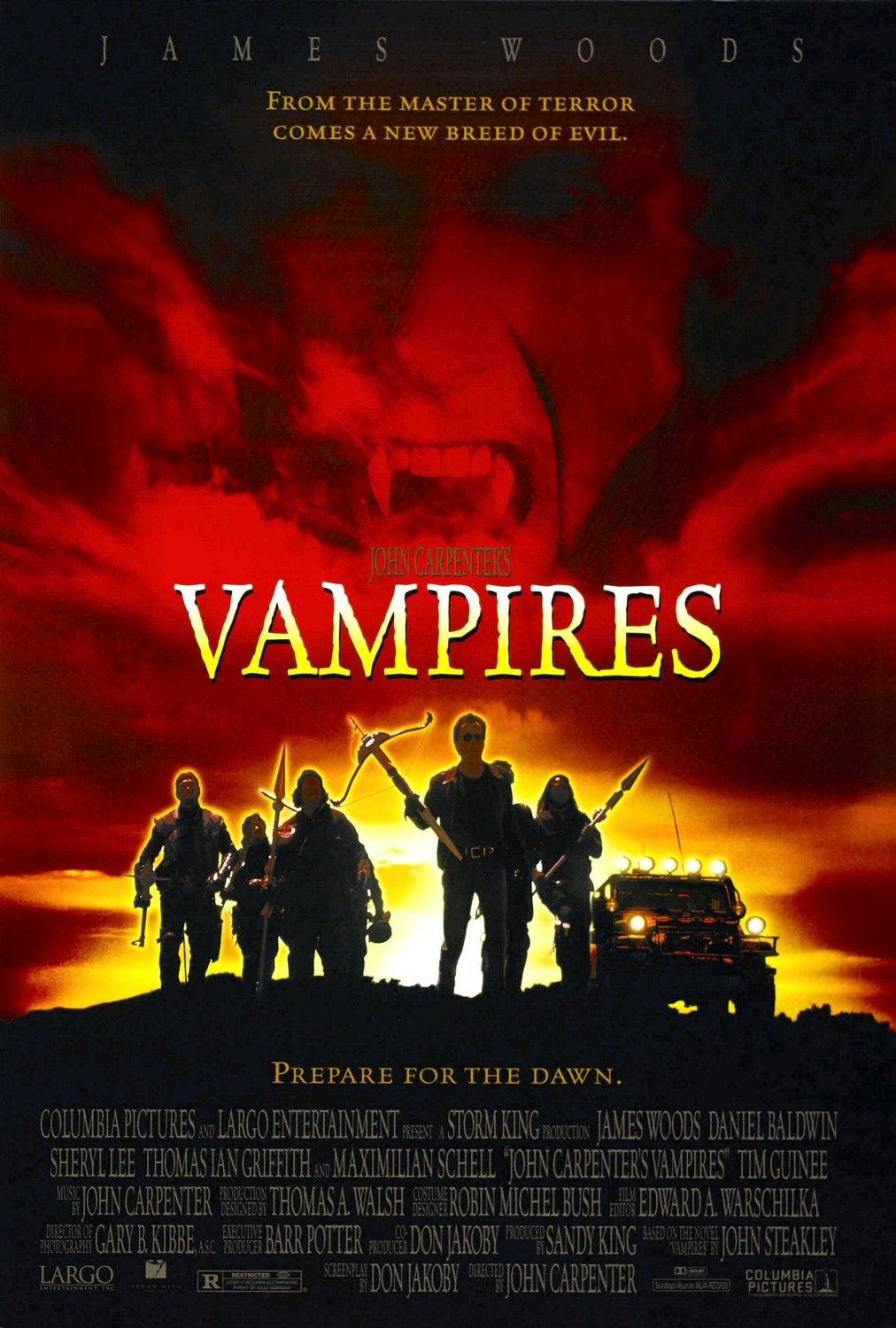
Vampires movie poster

Movie producer Sandy King dropped by New Beverly Cinema on November 19, 2011 to talk about her husband John Carpenter’s movie “Vampires.” The website Horror Movie a Day hosted the midnight screening which brought out a small but dedicated crowd who yearned to see it on the big screen again. Carpenter once said he originally became a filmmaker to make westerns, and this movie, based on the novel “Vampire$” by John Steakley, is the closest he has ever come to making one.

King said the project came to her and Carpenter after she bailed out a producer who was working on a Largo Entertainment show. Largo Entertainment was the sales engine behind this feature, and while she and Carpenter were used to putting their own projects together, King stated they were “more for hire” when it came to “Vampires.”

Casting “Vampires” was Reuben Cannon who brought actors from all over the world to his casting office. There were even midget actors, King said, who were about 4 feet tall. Many who did get cast as blood suckers were stunt people as they had to perform the movie’s most dangerous stunts. The scene where vampires climb out of the dirt proved to be the roughest stunt of them all.

Thomas Ian Griffith was cast as the imposing master vampire, Valek. King was standing outside Cannon’s office when she noticed a shadow looming over her. It turned out to be Griffith who is actually 6’ 6” tall, and his height gave her the strong impression of a vampire. King also said on top of Griffith being tall and athletic, he could also act which made him a perfect choice for the role.

When it came to describing James Woods, who plays Jack Crow in the film, King said bluntly, “He’s nuts!” It turned out King and Woods shared the same publicist, and Carpenter was looking for a really good actor to play Jack Crow. While Woods proved difficult to cast as the studio didn’t want him in the lead, Carpenter was intent on working with him despite the actor’s reputation of being difficult to work with. The role, however, turned out to be a real physical challenge for Woods as he was not really an athletic actor at the time, something which is hard to believe after watching “Vampires.” Stunt coordinator Jeff Imada ended up helping him look as tough as he does onscreen, but King stressed Wood’s role was really about acting more than anything else.

As for the rest of the cast, King described them as “great” and “really good people.” She said Sheryl Lee, who played the prostitute Katrina, is “the most unspoiled actress ever.” Daniel Baldwin, who played Montoya and is better known for his legal problems, was not a problem according to her. In fact, when a wave of bronchial flu ended up infecting the cast and crew, she said Baldwin ended up bringing soup for everyone.

While receiving a rather middling reception when it debuted domestically, “John Carpenter’s Vampires” is a better movie than people generally give it credit for. Like many of the “Halloween” director’s films, it has gained a strong cult following years after its release, and I still find it to be wildly entertaining to this very day.