‘Twister’ Movie and 4K Review

The following review was written by Ultimate Rabbit correspondent, Tony Farinella.

Twister” is a film that is currently celebrating its 28th anniversary.  It raises two important questions—where has time gone, and when did I become old?  Watching “Twister for the first-time since its release, it is clear this is a quintessential 1990’s action flick—you have your movie stars, your big budget, and your special effects.  If you are able to shut off your brain and sit back and enjoy the ride, there is plenty to like here. If you are looking for logic or a complex story, you have come to the wrong movie.  Your enjoyment level of this movie is solely dependent on your ability to suspend your disbelief when it comes to flying cows and off-the-wall tornadoes.

In the opening scene, we see a young woman named Jo Harding who unfortunately loses her father in an F5 tornado. This has stayed with her well until her adult life, as she is now entrenched in the world of tornadoes as a professional storm chaser.  She is going through a divorce with her weatherman husband named Bill, played by the late Bill Paxton.  He is hoping she will sign the rest of their divorce papers, so he can finally marry Dr. Melissa Reeves, a reproductive therapist, played by Jami Gertz. Jo (Helen Hunt), however, is dragging her feet as she still has feelings for Bill.  They soon find themselves in a situation where they need to work together in order to survive because a massive tornado is coming their way.
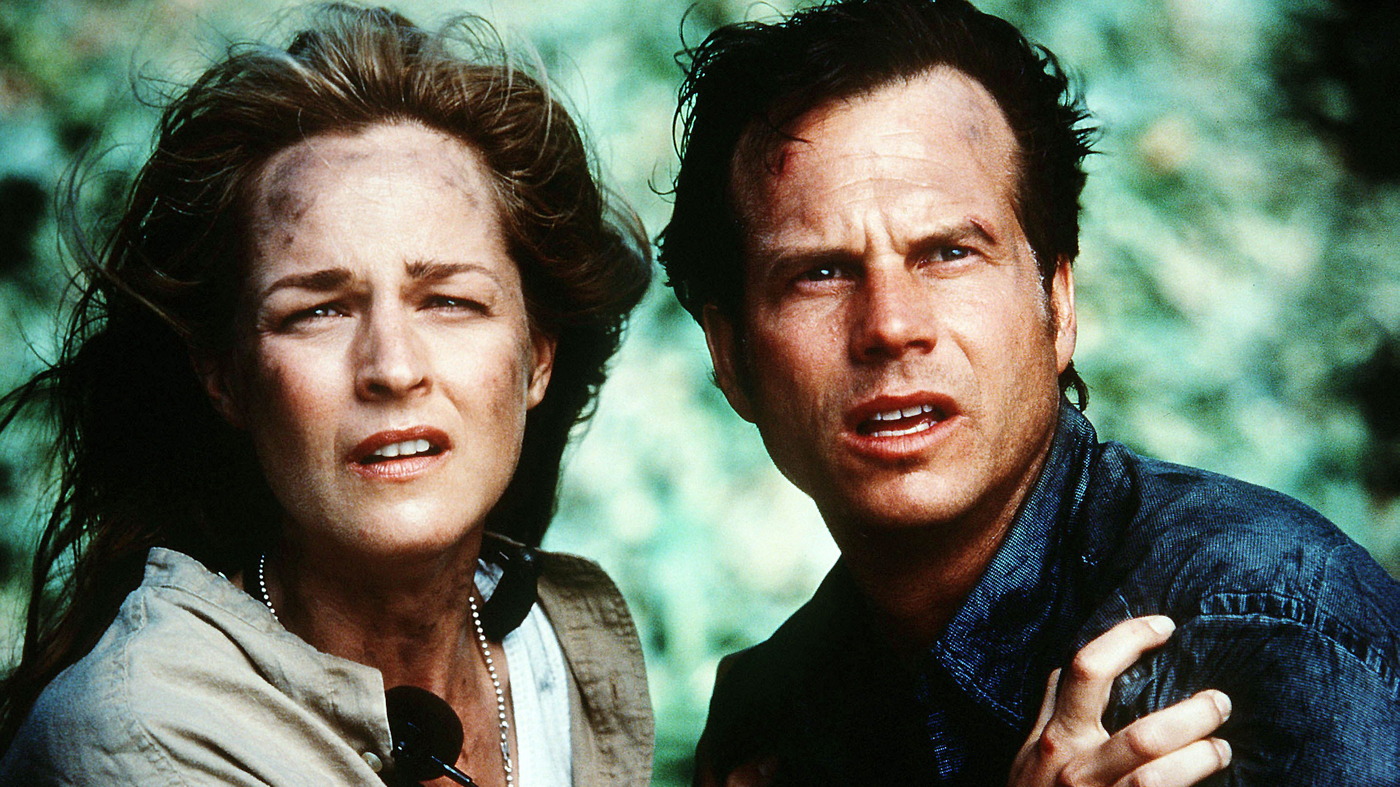
Helen Hunt and Bill Paxton star in Twister.

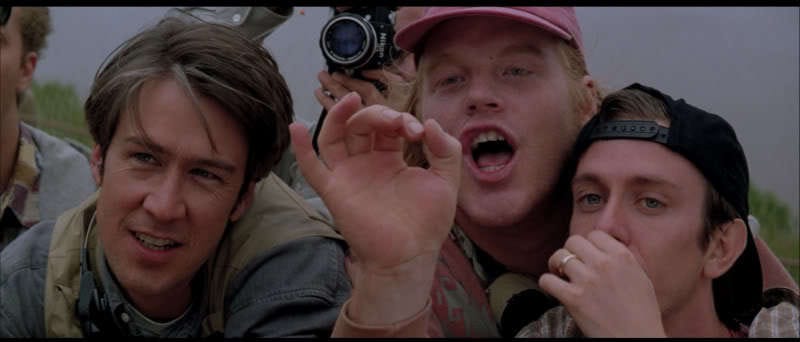
Jo and Bill have created a storm-device called Dorothy, which can predict if a storm is happening fifteen minutes ahead of time as opposed to the usual three minutes. This will give people more time to prepare for a tornado and make sure they find a safe haven for them and their loved ones.  It needs to get close to a tornado in order for the sensors inside of it to track any weather data. Jo has also assembled a talented team which includes Dustin Davis (Philip Seymour Hoffman) and Rabbit (Alan Ruck). The scene stealer here is Philip Seymour Hoffman. I would describe him as Jeff Spicoli if he ever pursued a career as a storm-chaser, and he steals every scene he’s in throughout.  He’s hilarious, charming and off-the-wall.

“Twister” is an incredibly entertaining action picture that works because of the jaw-dropping special effects and its likable cast. Helen Hunt, in particular, is great as a strongly written female character dealing with grief and trauma by trying to make sure no one ever experiences what she went through as a child. Bill Paxton is a cheesy goofball who doesn’t see what’s right in front of him and the fact he’s better off with Jo. Jami Gertz takes a thankless role as the “other woman” and makes it work to where the audience still likes her, even though we’d rather see Jo and Bill together. 
The special effects and tornado scenes are expected to deliver in a film like “Twister,” and they do not disappoint.  The film is wise to take some time to have the characters interact with one another, so that when the storm scenes kick up a notch, we care about what happens to the participants. They also build up the storm scenes so when they happen, we are waiting for them and are emotionally invested.  “Twister” was directed by Jan de Bont, who had previously directed 1993’s “Speed.” He knows how to blend the action scenes in with the character scenes in an effortless way, and he hits the right balance throughout.  After not seeing the film for over two decades, one of my concerns was it would be too action heavy.  I’m glad to see he strikes the right chord with his direction. It helps that the film was co-written by Michael Crichton, the smart and talented author and screenwriter.

“Twister”is about fifteen minutes too long, and sometimes there are too many characters here, some of which I did not mention.  It’s not a perfect film by any stretch of the imagination. However, for a big-budget action flick, it’s exactly what it needs to be and then some.  As mentioned earlier, there is a build-up to the storm scenes, which are bonkers and over-the-top.  It’s about making the little scenes and the big scenes matter and co-exist together in harmony.  It’s also about having fun.  There is a lot of fun to be had with “Twister” even in 2024.  It’s an entertaining action film with some big laughs and even bigger explosions.

* * * ½ out of * * * *

4K Info: “Twister” is released on a single disc 4K from Warner Brothers Home Entertainment. The film has a running time of 117 minutes and is rated PG-13 for intense depiction of very bad weather. This release also comes with a digital copy of the film along with a really cool looking slipcover.

4K Video:  This is one of my favorite 4K releases of the year from a visual standpoint.  It looks gorgeous, clear, and vivid. When I think of this movie, I think of the colors.  The colors really pop here, especially when the sky outside is green.  It’s a tremendous looking 4K and it’s an early candidate for one of the best 4K releases of the year.

Audio Info:  The Dolby Atmos soundtrack is a fantastic touch here, as this is a big screen movie that is being brought right into your home theater.  This film was made for 4K.  The big scenes feel big with this Dolby Atmos track.  It sounded perfect.  It wasn’t too boisterous or in-your-face, but it gets the point across in an effective manner.  They did a great job here, too.

Special Features:

The Legacy of Twister – Taken by the Wind (NEW)

Chasing the Storm: Twister Revisited

Anatomy of a Twister

The Making of Twister

Van Halen Music Video – “Humans Being”

Commentary by director Jan de Bont and visual effects supervisor Stefen Fangmeier

Should You Buy It?

HECK YES! If you enjoy a good action flick in 4K, “Twister”is exactly why they made this format in the first place. It’s the movie you show your friends and family when you are trying to convince them to switch from Blu-ray to 4K.  It also comes with a brand-new special feature, which is rare on catalog titles from studios. You also have the previously released Blu-ray special features, so you can keep the 4K and have everything that came with the Blu-ray as well.  It’s the best of both worlds.  Even though this film looks and feels like a 1990’s summer blockbuster, I found it to be a blast because it holds up well while also being a good nostalgia piece as well.  If I were you, I’d buy this film on day one of its release. It comes highly recommended.

**Disclaimer** I received a copy of this film from Warner Brothers to review for free.  The opinions and statements in the review are mine and mine alone.

Helen Hunt on Portraying a Sex Surrogate in ‘The Sessions’

WRITER’S NOTE: This article was written in 2012.

Ever since her Oscar win for “As Good as It Gets,” it seems like Helen Hunt has been keeping a markedly low profile. She has kept busy with other projects and even took the time to make her directorial debut with “Then She Found Me,” but we do not hear about her as much these days as we did back in the 1990s during her “Mad About You” heyday. But now she is back in a big way with her critically acclaimed performance as sex surrogate Cheryl Cohen Greene in Ben Lewin’s “The Sessions,” and it serves as a reminder of how great she can be when given the right material.

“The Sessions” is based on the true story of poet Mark O’Brien (played by John Hawkes) who hired Greene to help him lose his virginity at the age of 38. O’Brien had spent the majority of his life in an iron lung and was paralyzed from the neck down due to getting polio as a child. However, a certain part of his body below the waist still works, and Greene became the person he hired to help him exercise it.

Now playing a real-life person has its challenges because you want to honor the individual without impersonating them. For Hunt, however, the challenge became understanding Greene’s job of being a sex surrogate as she was never aware a job like this existed before. Talking with Greene opened Hunt up to how she could respectfully portray such a person onscreen.

“She used the term ‘sex positive,’ ” Hunt said of Greene. “And I went: ‘Wow, I want to be sex-positive. I want to be part of a movie that is that; I’ve never seen that.’ So, it was more her vibe about her positive, enthusiastic, nonjudgmental way of talking about this topic that is usually laden with weirdness.”

Hunt ended up doing 90% of her research for the role with Greene, and it was Greene’s enthusiasm and frankness about everything which made Hunt ever so excited to portray her in “The Sessions.”

“She (Greene) has a sense of adventure about her grandkids growing up, helping someone have an orgasm, making this movie, meeting me and my boyfriend, chocolate from the raw restaurant I took her to,” Hunt said. “All of those things light her up. I thought, ‘What if I could be like that about sex in a movie?’ That would be amazing.”

Greene also made it very clear to Hunt how her job as a sex surrogate differs greatly from being a prostitute.

“The prostitute wants your return business, and she (the sex surrogate) doesn’t. She wants you to learn what you need to learn, so you can go off and have a relationship. That’s a substantial difference,” Hunt said of Greene’s description of her work.

Director Lewin went even further in describing Greene as being “a middle-class soccer mom who has sex with strangers.” As a result, the role Hunt plays in “The Sessions” proved to be more complex than the one Hawkes plays.

“Her preoccupation was in achieving the emotional journey,” Lewin said of Hunt. “I got a real buzz talking with her because there were aspects of the character I hadn’t thought through that she had. She’s a frighteningly intelligent actor.”

The sex scenes between Hunt and Hawkes have a wonderfully awkward feel to them as his character gets to experience sexual intimacy for the very first time. Hunt said neither she nor Hawkes ever did a full read-thru of the script or even rehearsed together much. Instead, Hunt spent a lot of time on her own writing down her own feelings about sex, and what she ended up saying about the act really shows up in the film.

“Sex is never perfectly elegant: The light isn’t just right, and the underwear doesn’t fall on the floor perfectly, and the hands don’t clutch, and you don’t come at the same time. It’s all bullshit, basically,” Hunt said. “And the disability of this character renders all of that impossible, so you’re left with something much more like your own experience as a nondisabled person, which is that you’re human and that it’s good and it’s bad and it’s weird that it’s silly, and it’s embarrassing that it’s scary, so I think that the disability is just a way to get to what it’s actually like.”

Like her co-star Hawkes, Helen Hunt deserves all the accolades she has been getting for her performance in “The Sessions.” You believe her when she says that parts like this one don’t come around often enough, and you can sense her sheer excitement in playing Greene in this movie.

“She was someone who radiated this unabashedly humanistic view of what the human body is capable of,” Hunt said of Greene. “As an actress, I was hungry to play someone like that. As a person, I’m hungry to live that way.”

SOURCES:

Jordan Zakarin, “Helen Hunt, Star of ‘The Sessions,’ Wants to Be Sex Positive,” The Hollywood Reporter, October 19, 2012.

Julie Miller, “Helen Hunt on Overcoming Inhibitions for The Sessions, the Difficulty of Playing a Real Person, and ‘the Sexiest Quality There Is,'” Vanity Fair, October 18, 2012.

Marshall Fine, “Helen Hunt says intense emotional journey of sexual surrogate made ‘The Sessions’ a can’t-miss role,” NY Daily News, October 18, 2012.

John Horn, “Helen Hunt fully invests in ‘The Sessions,’” Los Angeles Times, August 31, 2012.

John Hawkes on Playing Mark O’Brien in ‘The Sessions

WRITER’S NOTE: This article was written back in 2012.

The Sessions” and John Hawkes’ performance in it as journalist and poet Mark O’Brien have earned some of the most rapturous praise of any movie in 2012. The film tells the story of how O’Brien, who was confined to an iron lung due to being stricken by polio as a child, hired sex surrogate Cheryl Cohen Greene (Helen Hunt) to help him lose his virginity at the age of 38. Hawkes, who earned an Oscar nomination for his performance in “Winter’s Bone,” has talked extensively about his concerns about taking on the role as well as the physical challenges he faced in playing O’Brien.

Hawkes’ biggest concern was whether or not it might be better for a disabled actor to play O’Brien instead of him. As a result, he’s still waiting for some sort of backlash to hit him. Ben Lewin, who directed “The Sessions” and is himself a Polio survivor, did take the time to find a disabled actor to play Mark, but he eventually became convinced Hawkes was the man for the job.

“Of course, that was my first question: Why not a disabled actor? They are a uniquely qualified group of people for this role, who are undervalued and underused,” Hawkes said. “I’ve had a lot of disabled actors come to me after screenings, and they told me to get over it.”

“It is the 800-pound gorilla in the room in a way,” Hawkes continued, “but it’s something that, Ben (Lewin) being a polio survivor himself, and the fact that he put the time in to look for disabled actors, he felt like, would it be politically correct to hire a slightly disabled actor to play a severely disabled actor? He ultimately just hadn’t found his guy. We met, and he felt like I could do it.”

Once cast, Hawkes became determined to mirror the physical condition O’Brien was stuck in for the majority of his life. To that extent, he and the props department created what was described as a “torture ball;” a soccer ball-sized foam pad that he tucked under the left side of his back to force his body to curve dramatically. In addition, he also used a mouth stick which was much like the one O’Brien used to turn the pages of a book or dial a telephone. It was this “torture ball,” however, which threatened to leave Hawkes with permanent physical damage to his body.

“Finding that position was difficult and did hurt. I’ve got a guy that I’ve been seeing for years, who is a combination massage therapist and chiropractor. I’d have 15 minutes with him, two or three times a week, or half an hour, if I was lucky. He told me that I wasn’t doing very good things to my body, but it was my choice. I’m not a martyr or masochist, but when the script says that your spine is horribly curved, you can’t just lie flat on your back and pretend,” Hawkes said.

But ultimately what makes Hawkes’ performance so good is that he doesn’t turn him into just another pity case. Filmmakers are typically expected to give us an emotionally manipulative experience when it comes to portraying physically disabled characters, making us feel sorry for them and of what they are unable to accomplish because of their limitations. Hawkes and Lewin, however, were determined not to go down this route.

“A character like that had every reason to wallow, but that’s just not interesting to watch on screen,” Hawkes said. “I’ve played a lot of underdogs and I like people who aren’t equipped to solve their problems but just keep trying anyway. There’s something really noble and interesting about watching someone keep banging their head against the wall.”

One of the other things which helped Hawkes was watching the documentary “Breathing Lessons: The Life and Work of Mark O’Brien” which won its director Jessica Yu the Oscar for Best Documentary Short Subject in 1997.

“There was Mark’s body, and there was his voice,” Hawkes said, referring to the documentary. “And so, I didn’t invent a lot. I just tried to really take as much of the Mark that I saw and tried to make it my own, to embody him.”

The effect Hawkes’ performance has had on those who were very close to O’Brien has been profound. Just ask Cheryl Cohen Greene, the sex surrogate whom Hunt’s character is based on.

“The first time I heard John I got chills,” said Greene. “I’m sitting there on the set with headphones thinking, that’s Mark. It’s scaring me. John got him completely.”

John Hawkes’ performance as Mark O’Brien looks very likely to earn him an Academy Award nomination for Best Actor, and many will agree that he deserves the recognition for his work. It marks another memorable role for this actor who first came to Hollywood over a decade ago, and he has many more great performances ahead of him.

SOURCES:

Jordan Zakarin, “John Hawkes: Hopeful, but Ready for Backlash and (Maybe) Permanent Back Pain,” The Hollywood Reporter, October 22, 2012.

Christina Radish, “John Hawkes Talks THE SESSIONS, Conveying His Performance Using Only His Face, Being Confined in an Iron Lung, and More,” Collider, October 16, 2012.

Rebecca Keegan, “John Hawkes enters virgin territory in ‘The Sessions,’” Los Angeles Times, October 11, 2012.

Oliver Gettell, “‘The Sessions’: John Hawkes and Helen Hunt on playing real people,” Los Angeles Times, October 29, 2012.