‘Deep Water’ – Neither Erotic Nor Mysterious Enough For Your Enjoyment

With “Deep Water,” I could not help but feel a certain level of excitement at its arrival. With erotic thrillers, it feels like we have been in a drought of them at our local cinema. Sure, there was the “Fifty Shades of Grey” trilogy, but those movies were far more laughable than they ever were truly entertaining. This one also marks the return of Adrian Lyne to the director’s chair for the first time in 20 years, and he is known for specializing in erotic films such as “9 ½ Weeks,” “Fatal Attraction” and “Unfaithful.” And yes, the trailer in which we get to gaze at Ana de Armas’ lovely body as Ben Affleck gazes at her from a distance proved to be ever so alluring. Oh, I almost forgot to mention, it is based on the novel of the same name by Patricia Highsmith, the same author who wrote “The Talented Mr. Ripley” and “Strangers from a Train?” This should have been the first I pointed out here.

Seriously, all these elements were in place for a great motion picture for us to take in, but despite an interesting start, “Deep Water” ends up faltering long before it ends as secrets are revealed far too soon to where the suspense is completely destroyed for no good reason. Also, the film is nowhere as erotic as you may hope it will be. Moreover, Disney, which bought 20th Century Fox and since renamed it 20th Century Studios, decided to dump it on Hulu as even Mickey Mouse was saying, “Even Minnie wouldn’t show me that much skin!” Well, some only get so lucky,

Ben Affleck and Ana de Armas star as Vic and Melinda Van Allen, a married couple living in the small town of Little Wesley, Louisiana who appear to have it all: an affluent lifestyle, a gorgeous home where they host many parties for their equally affluent friends, a beautiful daughter named Trixie (Grace Jenkins) who keeps telling Alexa to play “Old McDonald Had a Farm” to her mother’s infinite annoyance, and anyone outside of their lifestyle must be looking at them with either envy or tremendous resentment. Their marriage, however, appears to be a loveless one as Melinda seems far more interested in flirting with the many incredibly handsome men around her as Vic looks on, wondering what she is up to. On one hand, Vic seems content with her being with other men as he is willing to accept her for who she is, but the more you look into his eyes, the more you see how frustrated he is with this situation to where he might actually become emotional. This frustration becomes even more pronounced once some of the men Melinda is seen with are found dead. Were they murdered? What’s really going on with this couple?

Lyne tantalizes us with these questions in the first half of “Deep Water” as, while he used to show us a lot of wild sex in his previous films, only hints at what is going on here. Vic may be convinced Melinda is sleeping with other men, but he only sees so much of what she is up to. In the meantime, he tells her potential suitors that he murdered a man who was once her boyfriend. Is he being serious? It’s hard to say as Affleck is quick to remind us what a gifted poker player he can be, and that’s even if he has been banned for life from a casino or two.

Indeed, this film works best when the screenplay does not reveal all its cards to the audience. Affleck seems to revel in getting under the skin of others to where you wonder just how much his character enjoys in doing so. The same goes with de Armas who appears to revel in her husband’s inability to obtain her in the ways a husband can. As Vic and Melinda circle around one another like bloodthirsty sharks, I began to wonder if their continued relationship was strengthened by their endless strife with one another. While divorce might make more sense for these two, the conflicts between them seem to invigorate them to where a normal life is completely out of the question for them. It even reminded of a season six episode of “Homicide: Life on the Street” entitled “Strangled, Not Stirred” in which we see a couple achieve supreme intimacy through murder. I figured things here would go in this direction with these characters, but no such luck.

When “Deep Water” reaches its midway point, it completely implodes as it reveals its cards to where the suspense is killed. In fact, things become increasingly laughable as the story barrels towards a conclusion that is unforgivably abrupt and unsatisfying. Like I said, this one comes from the director of “Fatal Attraction” which had one of the most divisive endings in cinematic history, but at least its ending had a catharsis which it demanded despite what others thought. This one, however, leaves far too many story threads to where I have to wonder if there’s a director’s cut just waiting for us to check out.

In retrospect, “Deep Water” might have been far more interesting if Lyne had focused more on the characters played by Affleck and Tracy Letts who plays Don Wilson. Don is immediately suspicious of Vic, especially after he playfully admits to murder, and seeing these two together in one scene to the next is especially fulfilling as we are watching actors who enjoy not just facing against one another, but are also eager to turn their characters into anything but mere cliches this genre often employs to a detrimental extent.

Considering the talent involved, I could not help but have high expectations for “Deep Water” as it arrives at a time when superhero/comic book movies continue to dominate our local multiplexes to where we wonder if variety is still a thing. Moreover, movies for adults are a thing I have been deprived of for far too long. Even with it going straight to streaming, I figured there was much more in store for the audience. That it falls short of greatness is frustrating as it may be a long time before we get another motion picture of its ilk.

In my research, I did learn this particular Highsmith novel is a favorite of Gillian Flynn’s who deeply admired how it showed the in-your-face warfare between a husband and wife. I believed this novel inspired her to write “Gone Girl” which became a bestseller and was later adapted into the twisted cinematic masterpiece directed by David Fincher. Whether or not “Deep Water” aspired to be on the same level as “Gone Girl,” it came up far too short.

When all is said and done, Lyne’s movie makes me want to pick up a copy of Highsmith’s novel even though I have so many books on my shelf to where it looks like a Jenga piece on the verge of collapsing. I am convinced a great movie can be made out of this novel, but we have yet to see it.

* * out of * * * *

‘Nightcrawler’ is a Brilliantly and Insanely Twisted Motion Picture

nightcrawler movie poster

WRITER’S NOTE: This review was written in 2014.

Just when I thought I wouldn’t see a 2014 movie as twisted as “Gone Girl,” along comes “Nightcrawler.” Delving into the underground world of Los Angeles freelance crime journalism, this is a thriller which feels like a cross between “Taxi Driver” and “Network” as it follows characters who do not hesitate to cross over any and all ethical or moral considerations in order to survive another day in an infinitely cruel and competitive world. You will find yourself laughing at things you would normally never laugh at, but that’s because it serves as a way to deal with the increasingly insane scenarios which will leave you staring at the screen with your mouth open.

Jake Gyllenhaal stars as Louis Bloom, an alienated young man struggling to find work anywhere and everywhere. The movie starts off with him stealing materials from a construction site which he then attempts to sell at a scrap yard with little success. His attempts to find a job or even an unpaid internship prove to be utterly fruitless despite his best efforts and conniving ways, and he is a symbol of how many Americans who are having the toughest time finding work. Then one night while he’s driving on the freeway, he comes across a nasty car accident and, like many, he is tempted to take a closer look. This is when a camera crew led by Joe Loder (Bill Paxton) drops by to film whatever footage he can get to sell to the local news station. Instantly intrigued, Louis goes out and buys a cheap video camera and starts filming crime scenes and human carnage which eventually catches the eye of veteran news producer, Nina (Rene Russo).

“Nightcrawler” marks the directorial debut of screenwriter Dan Gilroy whose writing credits include “Freejack,” “Two for the Money” and “The Bourne Legacy.” With a limited budget, he succeeds in creating a crazy version of the American success story, proving it can be achieved but at a soul sucking price. Gyllenhaal, with a stare which cuts through the audience like a laser beam, gives us a character beyond determined to rise to the top of the TV news food chain. In many ways Louis is enigmatic as we don’t get to know too much about him, but no one can deny he is a full blown sociopath who has finally found something he can make a career at.

Gyllenhaal does some of his best work yet in “Nightcrawler,” and I’m not just saying this because he lost 20 to 30 pounds to play Louis. His focus as an actor is never in doubt as he makes Louis as compelling a human being as he is an insane one. Even as Louis throws all reason out the window, we cannot help but be mesmerized as Gyllenhaal makes him a highly unlikely antihero.

It’s also great to see Russo here as well as she brings Nina to a life in a way which showcases how vulnerable her character can be despite how hardened life has made her. This is a character clinging on to her job for dear life in a business prepared to chew her up and spit her out without a second thought. It should not be a surprise she crosses countless journalistic guidelines to get the bloody violent footage her audience is craving for. Whether or not she believes it is the right thing to do is beside the point because her survival in an unforgiving economy is foremost on her mind. You can chastise Nina and Louis all you want for the choices they make in life, but like anyone else, they are driven to survive by any means necessary.

I loved the scenes between Gyllenhaal and Russo as they constantly size each other up to where they firmly believe they have the other person figured out. As Louis gets more and more successful at capturing footage others could only dream of getting, and this eventually leads to him getting better equipment and a super cool car which goes super-fast, their relationship gets increasingly tense as he makes it clear to Nina who’s in charge. Nina observes Louis with both utter fascination and disgust as he stares right through her to where she can’t help but be taken in by him.

As “Nightcrawler” hurtles towards its wonderfully insane conclusion, Louis becomes a magician of sorts as he manipulates events to where he creates news he greatly profits from. We should despise him for what he does, but Gilroy has the audience firmly in his grip to where we can’t help but admire him for the devious things he has accomplished, and that’s regardless of what happens to others in his path.

Gyllenhaal was born to play Louis just as Russo was born to portray Nina, and both actors are well served by a supporting cast which matches them from scene for scene. The always reliable Bill Paxton plays Louis’ chief competitor, Joe Loder, and he is a hoot to watch as he tries to gain the upper hand only to see things blow up in his face. Also terrific is Riz Ahmed who plays Louis’ partner in crime footage coverage, Rick, a nice guy who hasn’t lost his moral bearings but is constantly forced to go against his better judgment in order to keep his job. Ahmed does great work as he makes us sympathize with Rick even as he gets into situations he can’t quite pull himself out of.

With “Nightcrawler,” Gilroy has given us a wonderfully twisted tale which shows how the American success story can become a reality if you’re willing to lose yourself in the process. What’s brilliant about the movie is it’s filled with characters molded by the world they live in. We can berate them all we want, but their actions speak more about what society has turned them into. In a time where employment opportunities are not as plentiful as they should be, it’s a little hard to blame these characters for what they do. But when we are forced to do the same, hopefully we can do it in a way that is nowhere as life threatening. Of course, that might just be wishful thinking.

I have to end this review with this piece of dialogue Louis Bloom has as it sums up the state of the world today perfectly:

“I know that today’s work culture no longer caters to the job loyalty that could be promised to earlier generations. What I believe, sir, is that good things come to those that work their asses off, and that good people such as yourself, who reach the top of the mountain, didn’t just fall there. My motto is: if you want to win the lottery, you have to make the money to buy a ticket.”

* * * * out of * * * *

Please check out the interview I did with Gyllenhaal and Russo on “Nightcrawler” which I conducted on behalf of We Got This Covered down below.

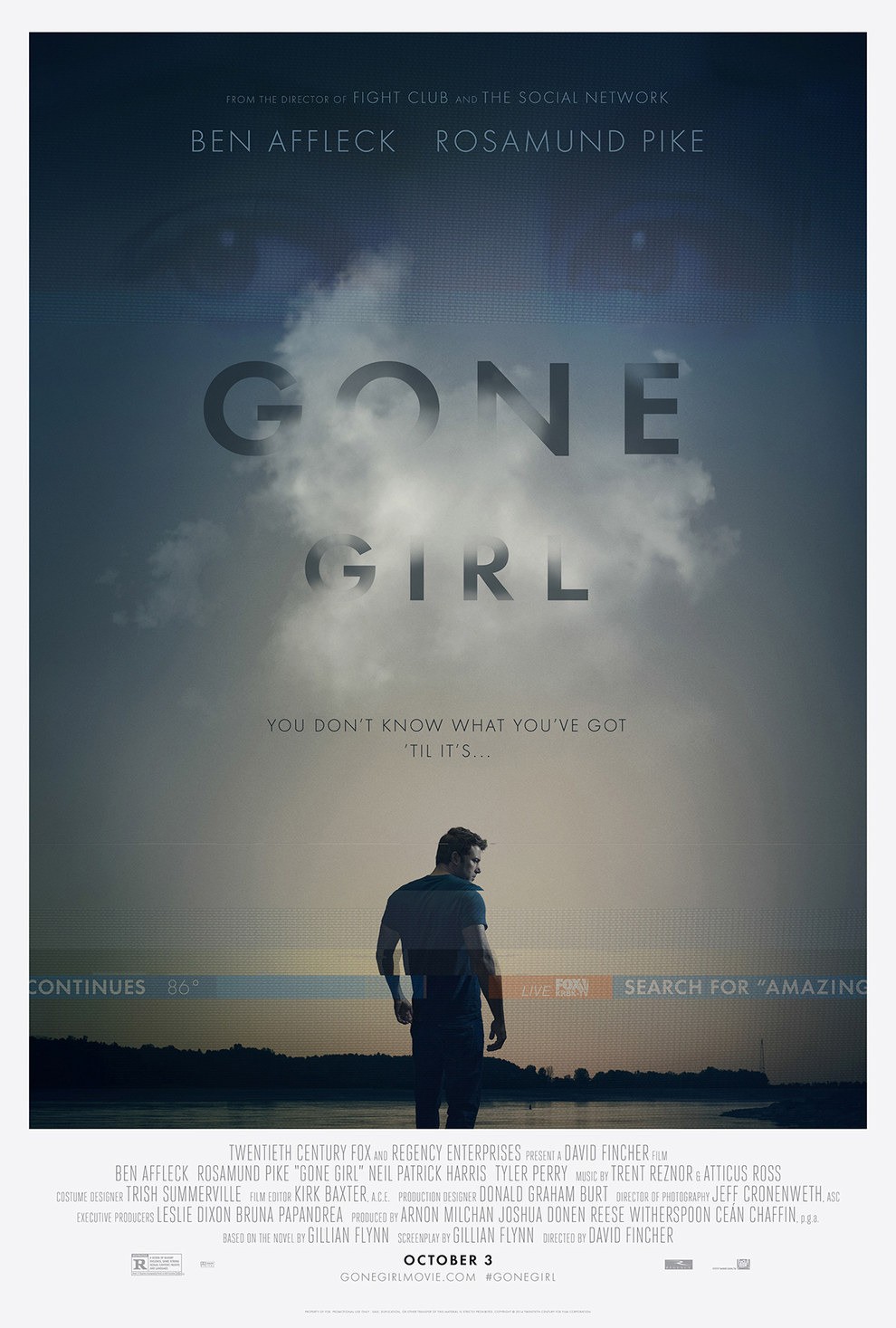
‘Gone Girl’ is a Deliciously Twisted Masterpiece

Gone Girl movie poster

David Fincher’s “Gone Girl” is a deliciously twisted masterpiece, a shocking and at times darkly comic look at marriage. I had an insanely good time watching it and I can’t wait to see it again, and that’s even if it’s just to watch the audience react so strongly to it. There’s no way you can come out of this movie and say you weren’t the least bit enthralled by the nasty journey Fincher takes us on. Just when you think “Gone Girl” couldn’t get any more twisted, it does. Based on Gillian Flynn’s best-selling novel (she also wrote the screenplay), he succeeds in getting away with a number of things in this movie just as he has with his past work.

“Gone Girl” opens on Nick Dunne (Ben Affleck), a frustrated writer who drops in one morning at the bar he owns (which is literally called “The Bar”) where he talks with his sister Margo (Carrie Coon) about the state of his marriage to Amy (Rosamund Pike). It happens to be their fifth wedding anniversary, and Nick celebrates it with a couple of glasses of bourbon which should give you an idea of how messed up things are between them. But then Nick comes home to find Amy gone and smashed furniture and glass scattered all over the floor, a sure sign something bad happened while he was gone. Suspecting Amy has been kidnapped, Nick calls the police and from there the search is on to find her before she disappears forever.

Now “Gone Girl” is a movie with an insane number of twists which makes it hard to talk about because it’s not worth spoiling any of them. But what I really loved is how it works on a number of different levels. Many movies can be boiled down to one sentence, but not this one. “Gone Girl” is a critique of a marriage that started off passionately but which has since been devoured by bitterness and resentment, and it makes you wonder why we tend to hurt the ones we love most. It takes a number of jabs at social media and people consumed with exploiting the trials and tribulations of others for the sake of ratings while the truth threatens to get lost in all the hoopla. It also serves as an indictment of a society quick to believe what they are told instead of recognizing a person is innocent until proven guilty. But at the heart of the movie is this question; how well do we know the person we choose to spend the rest of our lives with?

We see people reaching out to Nick Dunne in sympathy, but they just as quickly turn on him when evidence suggests he may have murdered his wife. From there, it becomes a constant game of media manipulation as the characters work furiously to get the upper hand on those who have deceived them and to sway public opinion in their favor. We live in a world of sound bites where information comes to us quickly and not always in an accurate manner. By the time we get to the truth, it may already be too late to view it objectively.

Over the years, many have described Ben Affleck as being this horrible actor who never had any business working in movies, but I’ve never agreed with this assessment. Yes, he has given some bad performances in “Pearl Harbor” and “Gigli,” but then again “Gigli” didn’t do anyone any favors. In “Gone Girl,” Affleck succeeds in giving one of his best and most naturalistic performances to date as he gives us a character who is not altogether likable, but who is still a complex individual caught up in a situation beyond his control. Nick is a complicated character who we are quick to make assumptions about, but what we think of him ends up saying more about us. I love how Affleck makes Nick a deeply mercurial character whose motives you can’t help but be suspicious of, and a scene where he sways the public back to his side during an on-camera interview with shows him at his conniving best.

I remember Pike from her early appearance as a Bond woman in “Die Another Day,” and she has gone on to give unforgettable performances in “An Education,” “Barney’s Version” and “The World’s End.” But when it comes to describing her work in “Gone Girl,” a flurry of adjectives cross my mind to where I have to be careful of what I say. What I can say is she is endlessly mesmerizing in a role which has her exploring every single facet of her character to where she surprises us in such an unnerving fashion. It’s a truly fearless performance you won’t soon forget after you leave the theater, and Pike doesn’t hold anything back.

“Gone Girl” also has a great supporting cast, and each actor sinks their teeth into their roles with relish. Kim Dickens is a delight as the cynical and yet slightly mischievous Detective Rhonda Boney, and she is blessed with a lot of great dialogue throughout. Patrick Fugit, almost completely unrecognizable from his “Almost Famous” days, is a snarky delight as Rhonda’s partner Detective Jim Gilpin. Neil Patrick Harris gives a charming and yet enigmatic performance as Desi Collings, Amy’s ex-boyfriend who looks like he can be trusted, but there’s a certain creepiness about him to where you wonder what’s really going on in his head.

Even Tyler Perry shows up in a very non-Medea-like role as Tanner Bolt, a somewhat devious attorney far more interested in winning the most impossible to win cases in court and playing the media like a piano to his clients’ benefit. Knowing how Perry caters mostly to the church going audience, I’ll be interested to see what they make of his time in Fincher’s dark world. I got a kick out of watching Perry here as he keeps his cool even as Nick’s case spins out of control.

You also have Missi Pyle on board as Ellen Abbott, a character clearly designed to remind you of Nancy Grace and of how annoyingly abrasive television hosts like her can be. Acting so entitled to her point of view even if the truth is not in her favor, Pyle makes her into a shameless individual who doesn’t apologize for anything even when she’s proved wrong.

But one supporting performance I really got a huge kick out of in “Gone Girl” was Carrie Coon’s as Margo. Coon is sarcasm incarnate right from the first moment she appears onscreen, and her scenes with Affleck are filled with love and devotion as well as a lot of anger at his foolish mistakes. I’m not too familiar with Coon’s work as she has appeared mostly in television and made a name for herself in various productions of the famed Steppenwolf Theatre Company, but I hope to see more of her in the future. She makes Margo a strong and fiercely independent character in a movie filled with so many morally clueless ones who get away with far too much.

The movie also marks Fincher’s third collaboration with composers Trent Reznor and Atticus Ross, and the two succeed in putting together another unforgettably creepy film score. What’s fascinating about their music here is it starts off sounding nice and inviting, but soon it becomes overcome by discordant sounds which imply there is something seriously disturbing going on in this quiet suburban neighborhood. Just when you think you can pull yourself away from the nasty voyage Fincher is taking you on, Reznor and Ross’ atmospheric score sucks you right back in and refuses to let you go.

Fincher’s “Gone Girl” is definitely a movie for these crazy times we live in now, and it is likely to make many out there think twice about getting married. Heck, even eloping sounds like a bad idea after watching this. But amid this tale of deeply flawed individuals and industry types more interested in their own celebrity than anything else, it makes one wonder whether we can ever really know someone completely. We’d like to think we know everything about our significant other, but can we really? This movie seems to imply we can’t, and Fincher makes you see this is one of the most frightening truths of all.

Fincher is a guy who never plays it safe, and “Gone Girl” is the latest example of that fact. Seriously, this is the most subversive and darkly funny take on marriage since Danny DeVito’s “War of the Roses.” I have not yet read Gillian Flynn’s book, but I really want to now. A woman sitting next to me at the screening confirmed the book is a great read and that she was very satisfied with Fincher’s adaptation of it. I’m fairly certain she is not the only one who feels this way.

* * * * out of * * * *