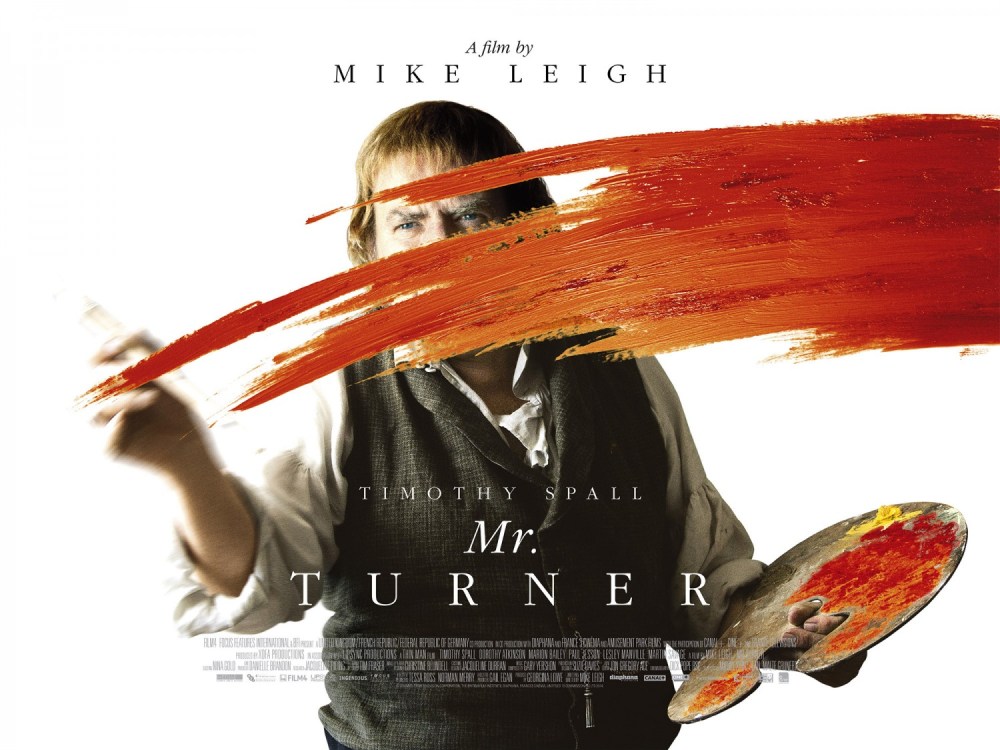
English filmmaker Mike Leigh, the man behind such masterpieces as “Secrets & Lies” and “Naked,” takes a stroll back in time with “Mr. Turner.” It stars Timothy Spall who gives one of the very best performances of 2014 as J. M. W. Turner, the landscape painter who became famous for his work in the 1800’s during the Romantic period. But as brilliant an artist as Turner was, he was also a controversial figure due to his eccentric behavior. He was full of great passion and could be very generous, but he was also quite selfish and anarchic. Leigh’s movie looks at the different aspects of Turner’s personality and how it came to inform the paintings which he became remembered for.
One of the things which really struck me about “Mr. Turner” was how fully Leigh sucked us into the time period of the 1800’s to where it felt like we were really there. From start to finish, it never felt like I was watching a movie but experiencing something very unique. Now there have been many period movies in the past few years but watching “Mr. Turner” made me realize how artificial many of them have been. They take you back in time, but there’s something very modern about their presentation which reminds you that you’re just watching a movie. This made me wonder how Leigh had succeeded in taking us back in time so effectively with this film.
I got the chance to ask Leigh about that while he was at the Four Seasons Hotel in Los Angeles, California. In describing how he perfectly captured the period “Mr. Turner” takes place in, he pointed out why authenticity is missing in so many other movies these days.
Mike Leigh: Well to be honest with you, apart from anything else, this is a function of strong views I have about period films. You get any number of period films where they say, let’s not have period language. The audience can’t deal with that. Let’s make it contemporary then the audience can access it. Let’s not make the women wear corsets because it’s not sexy, etc., etc., etc. Now the principle here with this film and with “Topsy-Turvy” and with “Vera Drake” which was also period but here not least is we said okay, let’s do everything we can in every aspect from the performance to the language to the frocks, to the props, to the places, to everything and to make it really possible for the audience to feel they have got into a time machine and have gone back and experienced it. Okay, there’ll be things people say that’s strange and you don’t quite get (what they’re saying), but that doesn’t stop people getting what that means. In fact, that smell of antiquity in some way makes it all the more plausible. I can imagine Hollywood executives being pretty twitchy about the pig’s head being eaten, but that’s what they did.
I keep thinking about “L.A. Confidential” which took place 1950’s Los Angeles but of how its director, Curtis Hanson, didn’t let the actors be governed by the period it took place in. Granted, the contemporary feel didn’t take away from that movie, but that’s the exception. With “Mr. Turner,” Mike Leigh shows us we don’t have to give every period movie a contemporary feel, and this is what makes it such a brilliantly vivid movie to watch. You come out of it feeling like you lived through part of the 19th century, and very few filmmakers can pull off such a feat these days even with the biggest of budgets.
“Mr. Turner” is now available to own and rent on DVD, Blu-ray and Digital.
WRITER’S NOTE: This review was written back in 2014. I am posting it here out of respect for Stephen Hawking who just passed away in March 2018 at the age of 76. Once diagnosed with ALS, he was expected to live only a few years more, but he succeeded in living on despite what the disease did to his body, and he lived one hell of a life. RIP Stephen.
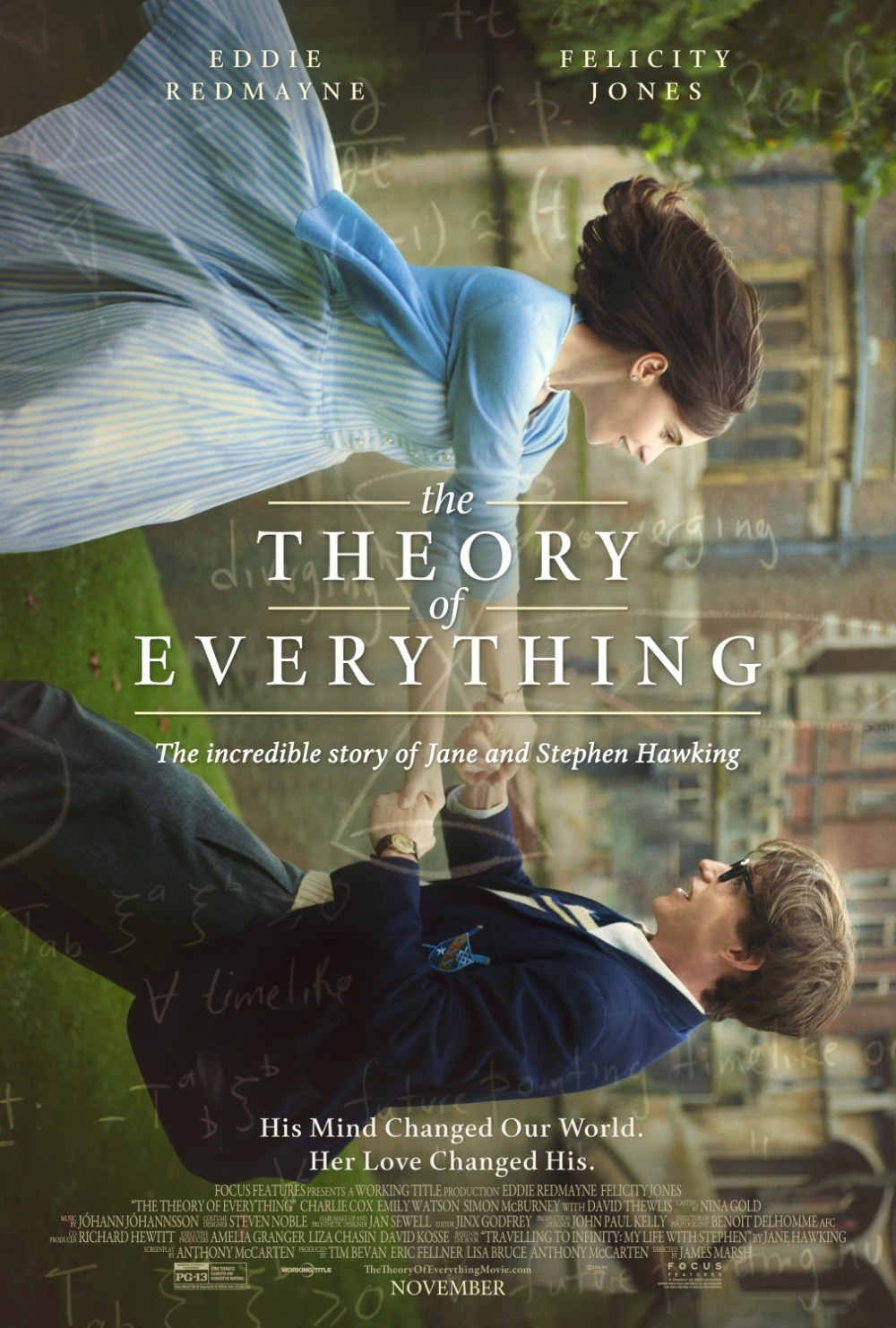
It is shocking to see Stephen Hawking, as played by Eddie Redmayne, riding around recklessly on his bicycle at the beginning of “The Theory of Everything.” We have long since gotten used to seeing him in his motorized wheelchair as ALS robbed him years ago of the ability to move around on his own, and we all know the sound of his computerized voice which has provided us with an insight to his brilliant mind and allowed him to provide lyrics to Pink Floyd songs. But this movie reminds us he was not always like this, and that there was someone in particular who saved his life in more ways than one.
“The Theory of Everything” is based on the memoir “Travelling to Infinity: My Life with Stephen” which was written by his first wife, Jane Wilde Hawking, and it focuses on their courtship which took place during their time as students at Cambridge University. Stephen looks like a perfectly dressed nerd who has the appearance of someone destined never to have any luck with women, and yet he still manages to catch the eye of the beautiful Jane (may we all be this lucky). At first it looks like an ill-suited coupling as Stephen is a student of physics while Jane’s main studies are in romantic languages. She believes in God, but Stephen’s love of science appears to imply he does not. We watch as they come to love and understand how the other thinks, and the way it is presented to us is both lovely and very believable.
But of course, we all know what will happen to Stephen eventually, and it is shown here in excruciating detail as he suddenly trips and falls down right on his head (ouch). Upon discovering he has ALS and told he has only a couple of years to live, Stephen finds himself shying away from everyone around him including fellow students, professors and even Jane as he desperately doesn’t want to be a pity case for anyone. But Jane has fallen deeply in love with Stephen, and she is not about to give up on him because there is too much to lose.
It’s hard not to think of movies like “A Beautiful Mind” while watching “The Theory of Everything” as both feature strong female characters determined to save their afflicted husbands from the diseases which appear all but fatal. For a time, it looks like this film will be no different in the way it portrays the strained relationship Stephen and Jane as they sacrifice so much to make things work between them. But as the movie goes on, it defies conventions and shows us a relationship which does suffer, but any impediments thrown into their path do nothing to tear apart the infinite respect they have for one another.
The eyes of the world are on Eddie Redmayne right now who as his performance here is utterly astonishing. I would love to ask about how he went about portraying Stephen’s bodily deterioration because he achieves doing so in a way which feels painfully real, and it’s amazing what he’s able to convey when Stephen is no longer able to communicate vocally (at least, until he gets that computerized voice). We always talk about how certain performances are more about imitation when it comes to playing characters based on real people, but Redmayne inhabits Stephen to such an amazing effect to where I found it impossible to label his performance as being one of mere imitation. Even as ALS continues to ravage his body, Redmayne makes the case for why Stephen remains such a respected individual to this very day as well as one who continues to fight the odds.
And let’s not forget the fantastic performance by Felicity Jones who portrays Jane Hawking as the lovely and strong-willed woman she is. While it may look like she has the easier role to play, Jones has an equally challenging role as she shows the unending struggles and sacrifices Jane went through to keep Stephen alive. It’s painful to watch Jane as she uses an alphabet sign to communicate with Stephen after his tracheotomy, and Jones makes you feel her pain as she wonders if she has suddenly taken too much away from him.
“The Theory of Everything” was directed by James Marsh who previously made “Man on Wire,” the Oscar-winning documentary about Philippe Petit’s tightrope walk between the two World Trade Center buildings in New York. Marsh does excellent work in keeping all his actors in check to where they never go for scene-hogging moments of an embarrassingly dramatic nature. Truthfully, it is the ordinary moments of these characters lives which are the most fascinating to watch, and Marsh succeeds in taking us back in time to a most romantic period in these couple’s lives.
The other great thing is how Marsh and screenwriter Anthony McCarten, who spent ten years trying to get this movie made, refused to let the audience look at Stephen Hawking as if he’s a complete invalid. Despite the damage ALS has done to his body, Stephen still managed to live a full life which has included two wives and three children, and it didn’t stop him from doing his work which eventually led to the publication of his novel “A Brief History of Time.” Heck, he even got to guest star opposite Data on “Star Trek: The Next Generation.” What more could someone ask for?
“The Theory of Everything,” is by no means a movie which falls victim to conventions or clichés. It presents us with a marvelous story about two people who come to love one another for their thoughts and minds, and of how their love helped them through various struggles which would have worn anyone else out in less than a year. It also contains some of the best performances of 2014 from Redmayne and Jones who are as brave as they are daring. Portraying real-life people onscreen is always a challenge, but they both took roles based on very well-known individuals and succeeded in making them their own.
Seriously, “The Theory of Everything” is one of the best movies of 2014 that I have seen and it is deserving of many of the accolades it has received.
It’s interesting how the spy world in John le Carré’s novels differs sharply from the one in Ian Fleming’s. Whereas James Bond was a dashing playboy of a spy and the good and bad guys were easy to tell apart, the spies in Carré’s world exist in a morally gray area, and their lives prove to be anything but glamorous. No one is innocent, and everyone has something to hide from others or perhaps even themselves. Here, there are no gunfights or explosions but instead conflicts both internal and external. Even the people we look up to in Carré’s novels are deeply flawed, and you can quickly see why no one can truly trust one another.
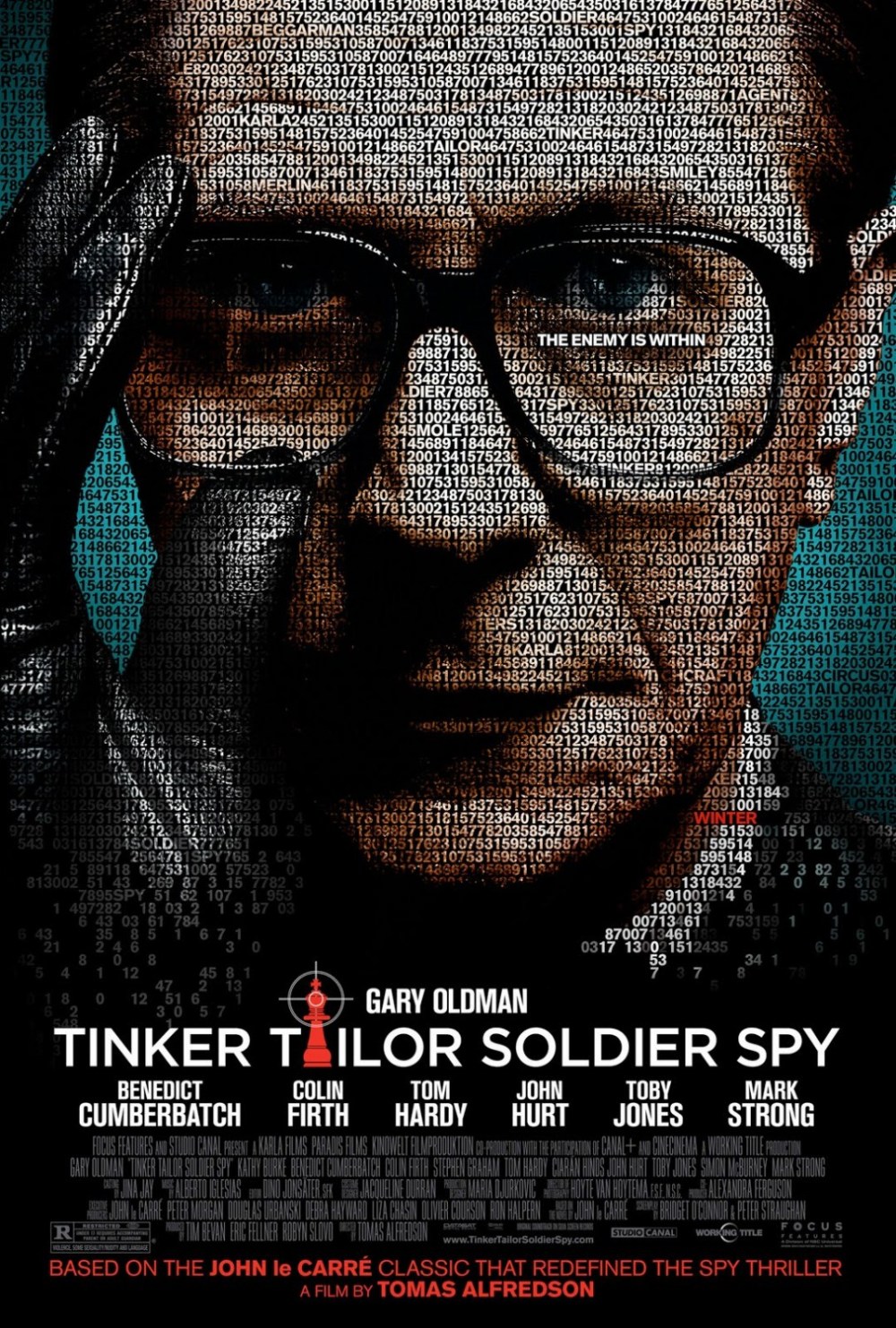
No book in Carré’s vast library of work exemplifies this more than “Tinker Tailor Soldier Spy” which features his most famous fictional character, George Smiley. Originally turned into a brilliant BBC miniseries back in 1979 with Sir Alec Guinness as Smiley, it has now been made into a motion picture with Gary Oldman in the lead role. Whereas the miniseries had more time to develop the story and characters, this movie does an excellent job of doing the same in a shorter span of time. Granted, much has been left out from the novel, but those unfamiliar with the miniseries are unlikely to notice.
The movie hovers around the goings on in The Circus, the codename for British Intelligence. After one operation goes wrong and an agent is killed, the head of Intelligence, Control (John Hurt), is forced to resign along with his right-hand man, Smiley. Smiley, however, is brought back into service when it becomes apparent there is a mole in British Intelligence. Moreover, it’s a mole which has been in The Circus for a long time, and he is a senior member with access to all sorts of secret information. Smiley, in his own way, seeks out the mole before the British become completely compromised in world affairs, and what results is a game of chess more than a battle of wits.
Casting Oldman as George Smiley at first seems like a surprising choice. Oldman made his film debut as Sid Vicious in “Sid & Nancy,” and his performance as the doomed punk rocker reminds us of how over the top he can be as an actor, and I always looked forward to seeing him play the villain in movies like “The Professional” and “Air Force One.” We revel in his emotionally unhinged performances which have made him stand out prominently among other actors of his ilk, and he has rarely, if ever, let us down.
As Smiley, however, Oldman is forced to dial back on the manic energy he became famous for. George Smiley is a character who never loses his cool and conveys so much even through the simplest of gestures. With even an ever so slight movement, we can see Smiley’s thought process at work and are never in doubt of how powerful a character he is. Each movement Oldman takes as Smiley is one which has been deliberately thought out, and even he knows he doesn’t have to bounce off the wall as this famous spy because this one goes into the room knowing all he needs to know.
In recent years, Oldman has gotten to stretch a bit with roles like Sirius Black in the “Harry Potter” movie franchise. While Black is first seen as a bad guy, it turns out he is a good one who cares deeply about Harry’s well-being. Then there is his role as James Gordon in Christopher Nolan’s “Batman” movies where he makes the good guy seem very cool without being such a square. What makes George Smiley an especially interesting character is he is neither a good or bad guy, but instead someone who is forced to navigate the dirty waters which he cannot help but get submerged in from time to time.
This is one of those roles which drive most actors crazy because it can become ever so easy to become utterly self-conscious about every single scene they are in. Being an actor myself, I often wonder if I am doing enough or perhaps too much in one performance to the next. While acting on the stage makes this easier to answer, acting in a movie or television is not only different but far more intimate. In the latter, you have to be more natural to where the camera never catches you emoting, and this can be difficult to say the least. But it’s those subtleties which can provide amazing results with the right director watching over you.
“Tinker Tailor Soldier Spy” also has a cast of brilliant British actors like John Hurt, Colin Firth, and Toby Jones, all of whom do their best in playing characters who have long since accepted the fact that they are morally compromised. You also have Tom Hardy, who succeeded in doing so much with just his eyes as Bane in “The Dark Knight Rises,” as a British agent who is only beginning to become morally compromised. None of these intelligence officers are easy to decipher on the surface, and a lot of this is thanks to their excellent performances.
Directing this adaptation is Tomas Alfredson who directed the great film “Let the Right One In.” Alfredson handles the intricacies of a story which could easily have become convoluted in terrific fashion, and he keeps us enthralled throughout. Even if we can’t follow the story, he succeeds in keeping us on the edge of our seat all the way to the end. Furthermore, he generates an intense and exciting climax without the use of gunplay or explosions, and there is something to be said about that.
Describing all which goes on in “Tinker Tailor Soldier Spy” is not easy, but it is not an impossible story to follow. Watching this movie for a second time will help give you a chance to examine the subplots more closely. While the spy world of Carré may seem nowhere as exciting as the one Fleming created for 007, it deals with the real world more directly as the line between right and wrong is forever blurred. What’s fascinating is how these people survive in it even as they continue losing pieces of themselves in a world and time which is prepared to beat them down on a regular basis. Everyone involved deserves a lot of credit for making what might seem ordinary and unglamorous seem so relentlessly thrilling.
Sofia Coppola’s “The Beguiled” is a movie I would describe as being wonderfully unnerving. Coppola takes her precious time setting up the story to where, when the situation worsens, we are left wondering how the characters can resolve it without anyone getting hurt. In the process, as the situation everyone is involved becomes increasingly chaotic, I couldn’t help but laugh. In a drama, this can be bad as a serious story which becomes laughable means the filmmakers failed in some way, but the laughs here serve as a release because the intensity of the story reaches a fever pitch to where we are unsure of how else to react. Plus, these are the kind of laughs which stick in your throat, and this means you would not laugh at what is going on here were this any other situation.
The word beguiled means being captivated, charmed, delighted, enthralled or entranced, and we see all of this on display right from the start. The movie is based on the novel “A Painted Devil” by Thomas P. Cullinan which in turn was made into a movie in 1971 directed by Don Siegel and starring Clint Eastwood and Geraldine Page. But while Hollywood has been remake happy for far too long, we know Coppola is going to take this material and make it her own. Plus, unlike other remakes, this one does not serve as a setup for a franchise desperate to match Marvel’s Cinematic Universe.
“The Beguiled” takes us back to the year 1864, three years into the Civil War, in Virginia. While picking mushrooms in the woods, a young girl comes across a wounded soldier, John McBurney (Colin Farrell), and takes him back to the boarding school she is staying at. It is a Southern girls’ boarding school which still has a few students hanging around even as many others have since gone back home, and they live a secluded lifestyle which keeps them from the front lines. Regardless, we can all hear the gunshots and explosions going off in the distance which remind us that while the danger might be far away, it could always spill over to their location at any given moment.
As John recuperates from his injuries, he gets to know the girls at the school much better. They include the headmaster Martha Farnsworth (Nicole Kidman), the rather quiet Edwina Dabney (Kirsten Dunst), and the teasingly playful Alicia (Elle Fanning). Time goes on, and John begins to slowly insinuate himself into the girls’ lives as he senses their needs and desires, some of which have long since been repressed. Sexual tension is definitely in the air as the ladies look longingly at John, and Edwina in particular is looking for a way to escape the secluded existence she has been trapped in, but we can all sense from the start that things will not culminate in a satisfactory solution for anyone.
What is brilliant about Coppola’s direction is how she hints at the longings of each character just from a look in their eyes. Furthermore, she is not quick to pass judgment on any of the characters to where we are left to make up our own opinions about them and their actions. Of course, how we view them ends up saying more about ourselves than it does about anyone else. Whereas Siegel’s take on “The Beguiled” may have been quick to cast John McBurney as a villain, Coppola’s version leaves you to decide this for yourself as Farrell gives us a man who is thankful for the help he has received and also unable to keep his libido in check (that’s what I think anyway).
“The Beguiled” reunites Coppola with actresses she has worked with previously. Dunst starred in her films “The Virgin Suicides” and “Marie Antoinette,” and Fanning co-starred in “Somewhere” when she was just 11 years old. Here, they both get to act against type in a way which makes us appreciate their talents in a way we should have already. Dunst, who has played extroverts in a beautifully gleeful way, gives us a repressed and longing performance as Edwina, and it makes us question whether the perspiration on her face is the result of humidity or her strong desires she can only hide for so long. As for Fanning, she gets to portray a young woman entering her sexually aware phase in life, and she clearly relishes in playing someone ever so eager to explore her sexuality with a man, any man.
Coppola also gets to work with Kidman who plays someone religiously stern, but even John can see the longing in heart for something different. Kidman has always been a brilliant actress, and she has not lost any of her power as this movie shows. In her scenes with Farrell, she exhibits a desire she never has to spell out for the audience, and the scene where they are face to face is a wonderfully tense scene as you wonder if they will or they won’t. And as the movie reaches its unnerving climax, it is a gas to see her the devilish look on her face as she calculates how to best deal with the school’s unwanted guest.
After all these years, Farrell remains an infinitely charismatic actor, and he seduces not just the ladies in the movie but the audience as well with what seems like relative ease. While the rest of us men struggle to attract the opposite sex, he succeeds in doing so in a way we can’t help but be infinitely resentful of. Farrell insinuates his character of John McBurney into a situation he thinks he can control, but this is a movie told from a female perspective, and it makes his predicament all the more entertaining as he attempts to gain a hold on a living situation which is far beyond his grasp.
Along with cinematographer Philippe Le Sourd and the fact she shot this on 35mm film, Coppola gives “The Beguiled” a smoky and beautiful look few other filmmakers could have pulled off. The ladies in their costumes look those women from Peter Weir’s “Picnic at Hanging Rock” to where the attention to detail meshes perfectly with a dreamlike quality. The soundtrack is mostly insects and birds making noises in the humid wilderness, but it is eventually punctuated by the subtle but powerful hum of the music by Phoenix which more than hints at the tension, sexual or otherwise, which is bubbling just below the surface.
There should be no doubt by now that Sofia Coppola is a born director, and I am not just saying this because her father gave us “The Godfather” trilogy (and yes, I like the third one). She has a signature style all her own, and she pays sharp attention to both the visuals and her cast with equal measure. Taking this into account, it should be no surprise she picked up the Best Director Award at this year’s Cannes Film Festival.
In a summer which seems beleaguered by franchise fatigue, “The Beguiled” is a nice and unnerving surprise as the suspense builds to where characters, who at once seemed a peaceful bunch, seize on their animalistic nature for the sake of survival.
* * * * out of * * * *
NOTE: “The Beguiled” has been the subject of controversy recently as Coppola decided to exclude the character of Hallie, a black slave, who was featured in the 1971 movie. As a result, she has been accused of whitewashing the story and of downplaying the role slaves had in the Civil War. Coppola has explained she did not want to present slavery in a lighthearted way and was concerned she would not be able to give the subject the attention it deserved. This seems like a sane response as it shows her sensitivity to the issue of slavery, and it would be hard to see how she could balance that out with the story of the women in a successful way here. I don’t think she is whitewashing this story in the slightest. Besides, with all the unrest in the world of American politics right now, Coppola is the last person we should be accusing of whitewashing anything.
“I used to think the worst thing in life was to end up all alone. It’s not. The worst thing in life is ending up with people who make you feel all alone.”
-Robin Williams from “World’s Greatest Dad”
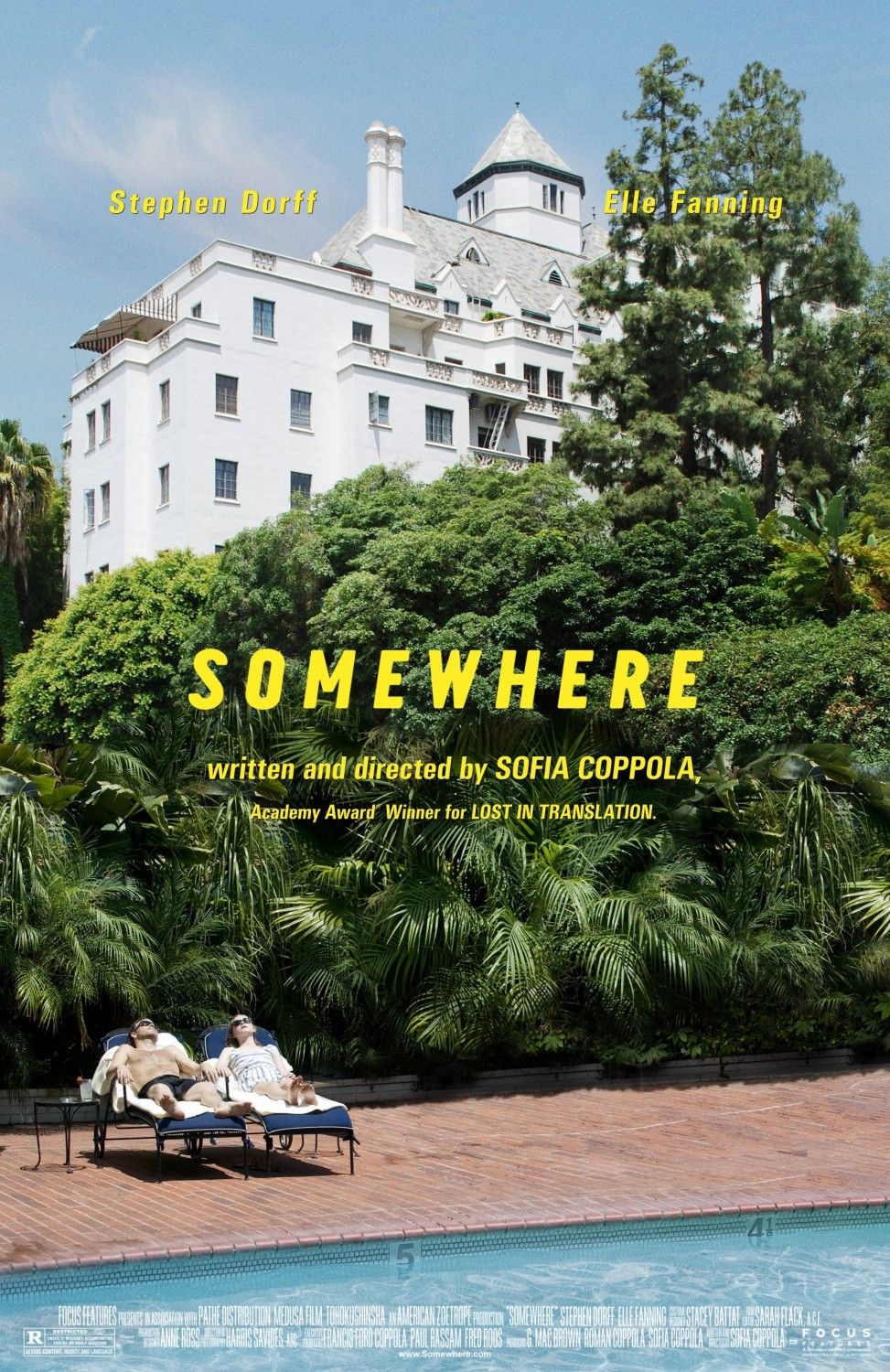
“Somewhere” opens with Stephen Dorff’s character of Johnny Marco driving his Ferrari around in circles in some far-off place. It goes on for a while to the point where some in the audience might say, “ENOUGH ALREADY!!!” However, the length of the scene defines the state Johnny’s life. He’s a movie star with adoring fans, and getting women to sleep with him is easy as cake. But aside from being a successful actor, he looks completely lost compared to everyone else around him. Johnny has no direction in life, and emotion looks like a luxury he can’t afford. Even those beautiful female twins pole dancing in his hotel room at the Chateau Marmont can’t excite or arouse him, and they succeed in making him fall asleep more than anything else. We see him surrounded by so many people who profess to adore him, but all they do is make him feel more isolated from anyone and everybody.
But then one morning Johnny wakes up to find his 11-year old daughter Cleo signing the cast on his arm. From there, we see him come alive as he gets to spend time with the one person who loves him in a way no one else can. With his daughter, he gains some idea of adult responsibility, and a better sense of who he is and what he wants.
Now this may make “Somewhere” sound like a sitcom more than a movie as the story features a father getting closer to his daughter which changes his perspective and all, but it is anything but that. This is Sofia Coppola’s first movie since “Marie Antoinette,” and she makes this one anything but sentimental and manipulative. It’s more like she captures moments between Johnny and Cleo more than she films then, and it makes “Somewhere” feel all the more real.
Many have said “Somewhere” feels like a European film in how slowly it moves, and it is never in a rush to get to the next moment. This is correct, but I like the fact it takes its time. Today’s movies are always rushing from one moment to the next to where we never have enough time to digest everything we witnessed. That Sofia Coppola goes against this trend is very welcome, and it makes for a far more involving movie.
Seeing Cleo accompany her father to Italy for a movie premiere could have been clichéd and corny as hell, but seeing them together makes it feel intimate and far more original than any other filmmaker could have captured. Some will say this is autobiographical, but I believe Sofia when she says that it isn’t. Granted, she definitely has an insider’s view of show business being the daughter of Oscar winning director Francis Ford Coppola, but this story feels removed from her own life. Her parents never divorced, and she appears to come from a very loving family. Cleo, on the other hand, is a child of divorce, and we know she will suffer more from it that her parents will.
As played by Elle Fanning, Cleo comes across as far more adult than her father and it’s a kick to see her prepare breakfast for him, showing she is easily more mature. She also makes what looks like a sumptuous Eggs Benedict, and anyone who knows me best is aware I order it whenever my parents are in town and take me out to breakfast. Of course, I’m on a diet now, but seeing her cook it so successfully makes me want to head out to the nearest restaurant which serves breakfast all day.
Fanning has been in the shadow of her older sister Dakota who has given strong performances in movies like Steven Spielberg’s “War of The Worlds” and “The Runaways.” I haven’t seen her in anything since “The Door in The Floor” where she acted opposite Jeff Bridges and Kim Basinger, but she really comes into her own here with this character who is ever so charming. You never catch her acting here. She just inhabits her character with what seems like relative ease, and watching her come to life as Cleo is a joy.
Dorff is an interesting choice to play Johnny Marco. Best known for his roles in “Backbeat,” “Blade,” and “Cecil B. Demented” among other movies, Dorff does seem to have the “bad boy” image, though not necessarily to Charlie Sheen’s level. In “Somewhere,” he manages to find the right balance between being a nice guy and a thoughtless prick to where we empathize with him more than decry his irresponsibly selfish ways. Like Fanning, Dorff becomes his character more than plays him, and he keeps him from becoming a caricature of a movie star. We find ourselves wanting him to do right by his daughter even if he doesn’t always do so.
The other big character in “Somewhere” is the Chateau Marmont, a hotel on Sunset Boulevard in Los Angeles. It has a lot of history involving movie and rock stars, many of whom have lived here for a time. John Belushi famously died of a drug overdose at the hotel, and his death still haunts all those who were the closest to him. The history of the Chateau Marmont hangs over Johnny Marco’s head as we can’t help but wonder if the hotel will suck him up whole.
Granted, this film does share similarities to Sofia’s “Lost in Translation” as it also involves a movie star who seems emotionally dried up and a young girl who is quickly maturing into a woman. But Bill Murray’s character looks lost because he is in a different country. Johnny Marco, however, looks lost in the country he was born in, so imagine how he feels when he travels overseas. His situation feels especially dire because there doesn’t seem to be a place anymore he can truly call home. Directors in general deal with similar themes throughout all their movies, and Sofia is no exception to that. At least with this one, she has a different way of exploring it than before.
If there is anything which bothered me about “Somewhere,” it’s the conclusion is a little too open-ended. I left the theater with questions over what happened from there, and while change is coming for the characters, it’s not entirely clear what direction that change is going to take. Then again, there’s a lot going on we don’t have all the details to. We never learn why Johnny split with Cleo’s mother, and we are only left with an idea of how it happened. Looking into Cleo’s eyes, she may have a better idea than anybody else of what went down.
Regardless, “Somewhere” is a well thought out film which shows Sofia Coppola to be an excellent director confident in her abilities behind the camera. Looking back, I think it will have more of an effect long after you’ve seen it as it’s not the kind of movie which leaves your consciousness all that quickly.
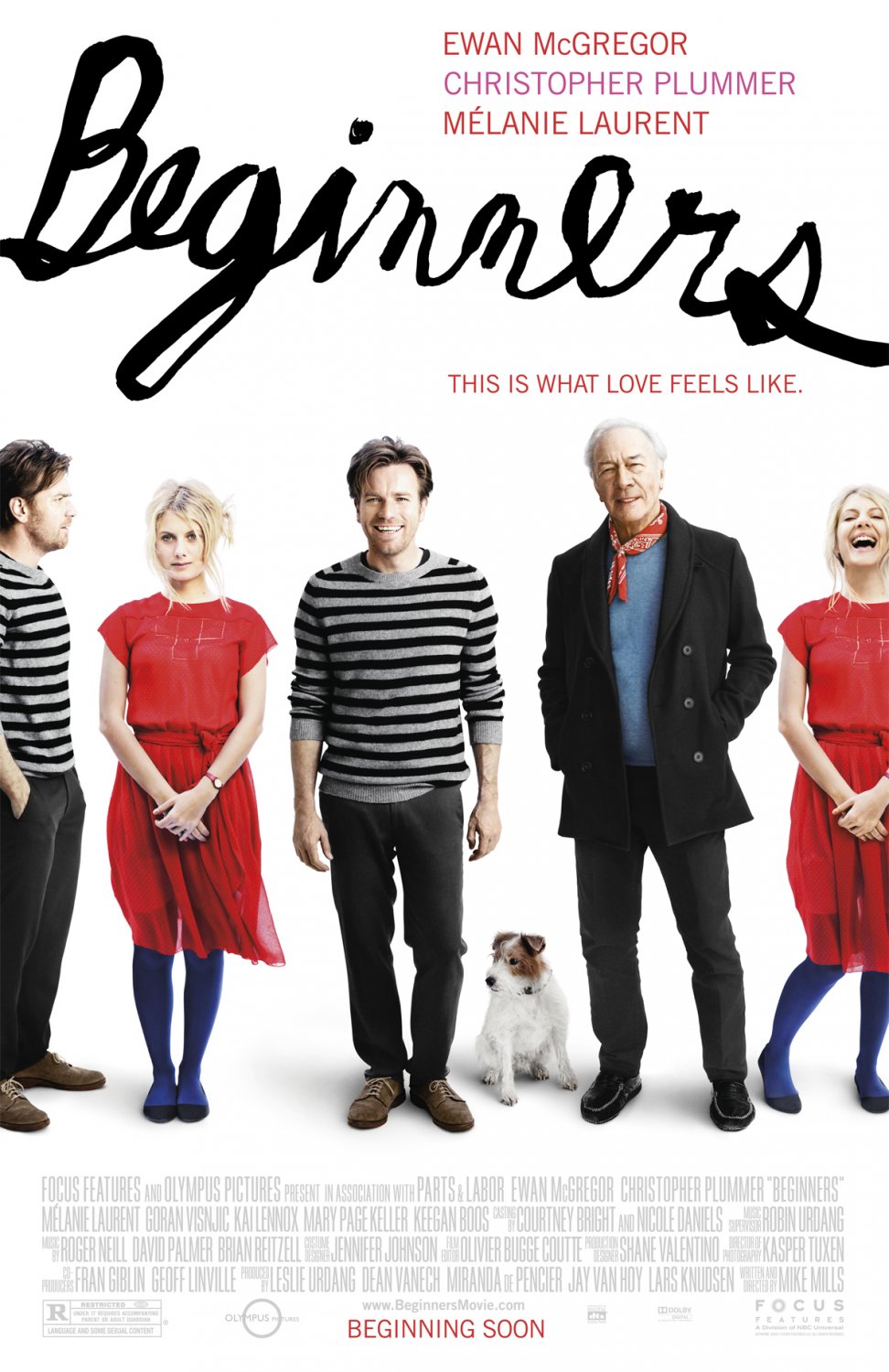
Mike Mills’ “Beginners” looked like the kind of movie I live to avoid. The son caring for his father who has a terminal disease, them making amends with each other before time runs out the relationship his son is currently involved in, etc. This has been the formula for an endless number of manipulative movies which bring out the cynical bastard in all of us. But there was something about this movie’s trailer that made it look like something more unique and heartfelt, and I’m not just talking about that Jack Russell terrier speaking in subtitles (thank god this is not another “Look Who’s Talking” sequel!).
Listening to Mike Mills’ interview on “Fresh Air” with Terry Gross informed me that “Beginners” is largely autobiographical; although I’m sure the names have been changed to protect the innocent. The story centers on Oliver (Ewan McGregor), a graphic artist with many failed relationships behind him. Upon the passing of his mother, his father Hal (Christopher Plummer) announces to him that he’s gay, and soon discovers that he is suffering from terminal cancer. In the meantime, Oliver gets involved with the very free-spirited Anna (Melanie Laurent) and finds himself exhilarated by her, but frightened at the things that could easily tear their relationship apart.
“Beginners” is told in a non-linear format with the story jumping back and forth between Oliver’s time with his dad, and the time he spends with Anna. Many people find this filmmaking technique annoying and too artsy-fartsy, but it serves this movie well and was never jarring. It moves from one part of the story to another effortlessly, and Mills never condescends to his audience in filming this way. Besides, when it comes to memories like these, we don’t remember everything that happened in the order it took place.
I was actually surprised at how emotional “Beginners” was. From the trailer, it kind of looks like a light comedy bordering on becoming a dramedy. But there is a deep sadness at its core as the revelations brought about mean different things for each character. For Oliver, it makes him look back at the time he spent with mom and wonder if she was always the unhappy wife to his father. For Hal, it is a bittersweet journey embracing his true sexuality while wishing he had more time on earth to enjoy it.
The reasons for Hal coming out now never feel contrived when he explains it to his son. He makes it clear he always loved his wife even when they both knew he was homosexual. Plus, he wanted the married life and the things which came with it: the house, the family, everything he couldn’t have had if people knew he was gay. Christopher Plummer delivers this speech simply and in a matter of fact way, never having to act it out for the benefit of the audience.
There’s no doubt this is a very personal film for Mills who previously made a movie I still need to see, “Thumbsucker.” While the end credits indicate the places and characters used are fictitious and any similarity to those living or dead is coincidental, it doesn’t change the fact Mills went through the same thing with his own dad. This is what makes “Beginners” such a good movie; it comes from an honest place and not one of simple manipulation. Its themes of love are universal and profound as relationships of all kinds need constant work to keep them strong.
This is one of the best roles Ewan McGregor has had in some time. As Oliver, he inhabits the character with a knowingness of what life has put him through, and the things he wants scare him the most. His eyes speak of a strong sadness he has trouble reconciling within himself, and you want to see him be a happier person. McGregor becomes the character right in front of us and gives a perfectly unforced performance which reminds us he’s still a terrific actor.
I really enjoyed watching Melanie Laurent here as Oliver’s girlfriend, Anna, and this is the first movie I’ve seen her in since “Inglourious Basterds.” She portrays the kind of free spirit us guys would all love to fall in love with. The chemistry she shares with McGregor is very strong, and their interactions make for some of the film’s most gleeful moments. Her demeanor, though, hides a dark spot in her life which is hinted at but never fully explained.
As for Plummer, he is simply magnificent as Hal. Seeing him embrace his sexuality is great fun as he makes new discoveries about life and “house music” among other things. Plummer is also heartbreaking as we find him experiencing joy just as his life is on the verge of expiring. For the last decade or so, he has been playing detestable villains in movies, and it’s a favorite role of his. But seeing him portray Hal reminds us of what we already should know, he’s one of the best actors working today.
But to be honest, all these great actors get completely upstaged by Cosmo who plays the Jack Russell terrier Arthur. Whether he’s with Plummer or McGregor, he’s such an adorable presence and even his eyes seem to speak words no other dog can easily speak. This may be the best performance I’ve seen by a dog since Mike the dog tossed away his dog food in “Down and Out in Beverly Hills.” Watching him makes you want to rush out to the nearest pet store and get your own Jack Russell terrier. Unfortunately, or perhaps fortunately, my apartment building doesn’t allow pets. Well, I’m better off with stuffed animals anyway.
“Beginners” shows us no matter how much experience we’ve had with relationships, we are always starting over again when it comes to a new one. It doesn’t matter what our age or sexual orientation is, relationships are an ongoing process we need to work at. We need to be open to risks and letting ourselves be vulnerable to the people we care the most about. And when all is said and done, we need to live through pain in order to experience pleasure.
“The widespread use of drugs is a symptom of a sick society. The war on drugs is bullshit. Especially since the CIA is one of the biggest dealers around.”
-David Byrne in 1992
I don’t think it’s any secret our government, let alone any government in the world, was at one time or another complicit in drug dealing. It’s not like we don’t treat as if it’s no big thing, it’s just that we have gotten so used to it to where many don’t bother to acknowledge or do anything about it. But one man, Gary Webb, did not hesitate to expose the CIA for its involvement in drug smuggling back in the 1980’s, and he ended up paying the ultimate price for telling the truth.
“Kill the Messenger” is one of many movies which is “based on a true story” or “inspired by actual events,” but it deals with a story which needs to be told. Gary Webb was a reporter for the San Jose Mercury News, a newspaper not known for doing international stories until he came along. We watch as he stumbles across a story dealing with the shady origins of the crack epidemic which spread throughout the nation’s inner cities, particularly in South Central Los Angeles. His investigation into the matter led him to discover how, in order to raise money for the fight against the Nicaraguan Sandinista Government, the CIA supported the cocaine smuggling of top members of Nicaraguan Contra Rebel organizations. When Webb published his articles on this story, which later became the basis for his book “Dark Alliance,” he won a lot of praise for his work, but then the roof caved in.
It’s no surprise the CIA came down hard on Webb as they began to conduct a vicious smear campaign on him which included veiled threats against his life. But what really stunned me was how rival newspapers went after him with a vengeance as he broke the story before they ever had a chance to investigate it. The Washington Post in particular hated how Webb broke the story as they were known for being first to report stories on the United States government, and their attacks on his credibility became more about protecting their own integrity as opposed to pursuing the truth. Taking this into account, it gives the audience an idea of just how cutthroat the newspaper business can be. As for myself, it makes me wonder if there is any business on this planet which is not cutthroat.
Playing Webb in “Kill the Messenger” is Jeremy Renner, and his performance here ranks among his best. He doesn’t try to make Webb a heroic character but instead a regular, ordinary man who does the job he is hired to do, and he does it really well. Renner makes us revel in Webb’s victories and feel for him when the whole world, even his own newspaper, suddenly turns against him. Not once does the actor overplay his role, and that he is able to keep Webb so grounded here is one of the things which makes “Kill the Messenger” work as well as it does.
Rosemarie DeWitt also shines as Webb’s wife, Susan. This could have been a throwaway role with DeWitt being left with little to do other than beg her husband to stop pursuing this story, but the actress makes Susan into the conscience Gary desperately needs through the toughest of times. Like Renner, DeWitt keeps the character grounded in a reality we can all relate to as she tries to make sense of a situation spiraling out of her husband’s control.
Directing “Kill the Messenger” is Michael Cuesta who also directed the powerful “L.I.E.” which the MPAA just had to give an NC-17 rating to for the most inexplicable of reasons. Could he have gone deeper with the subject matter that inspired this movie? Perhaps, but he makes a very good case for why we should be infuriated over why people were more interested in burying Gary Webb than they were in confronting how our government knew about and participated in the drug dealing being conducted on American soil.
Is this movie historically accurate to what actually happened in real life? I don’t know and I don’t care. Most movies based on true stories take liberties with the truth for dramatic purposes, and I doubt “Kill the Messenger” is an exception to that. What matters to me is this movie tells a compelling story which keeps you involved from start to finish, and Cuesta has given us just that. For those interested in getting to the absolute truth, try reading Webb’s “Dark Alliance” and Nick Schou’s book of the same name. This movie was based on both of those books.
“Kill the Messenger” joins the company of movies like “The Insider” and “Good Night and Good Luck” which are about people who decide to tell the truth and get punished for it in varying degrees. These days it seems like there are larger numbers of people who are more interested in their own monetary gain than they are in exposing wrongdoings. Webb’s story is one which deserves to be told as it is about a man whose job was to get to the truth of things, and the fact he was dragged through the coals because of that is one of the many unnecessary reminders of how unfair life can be. But in the end, he was vindicated, and this movie stands as a strong tribute to what he accomplished.
* * * ½ out of * * * *
Check out the video below where I interviewed Jeremy Renner and Rosemarie DeWitt.
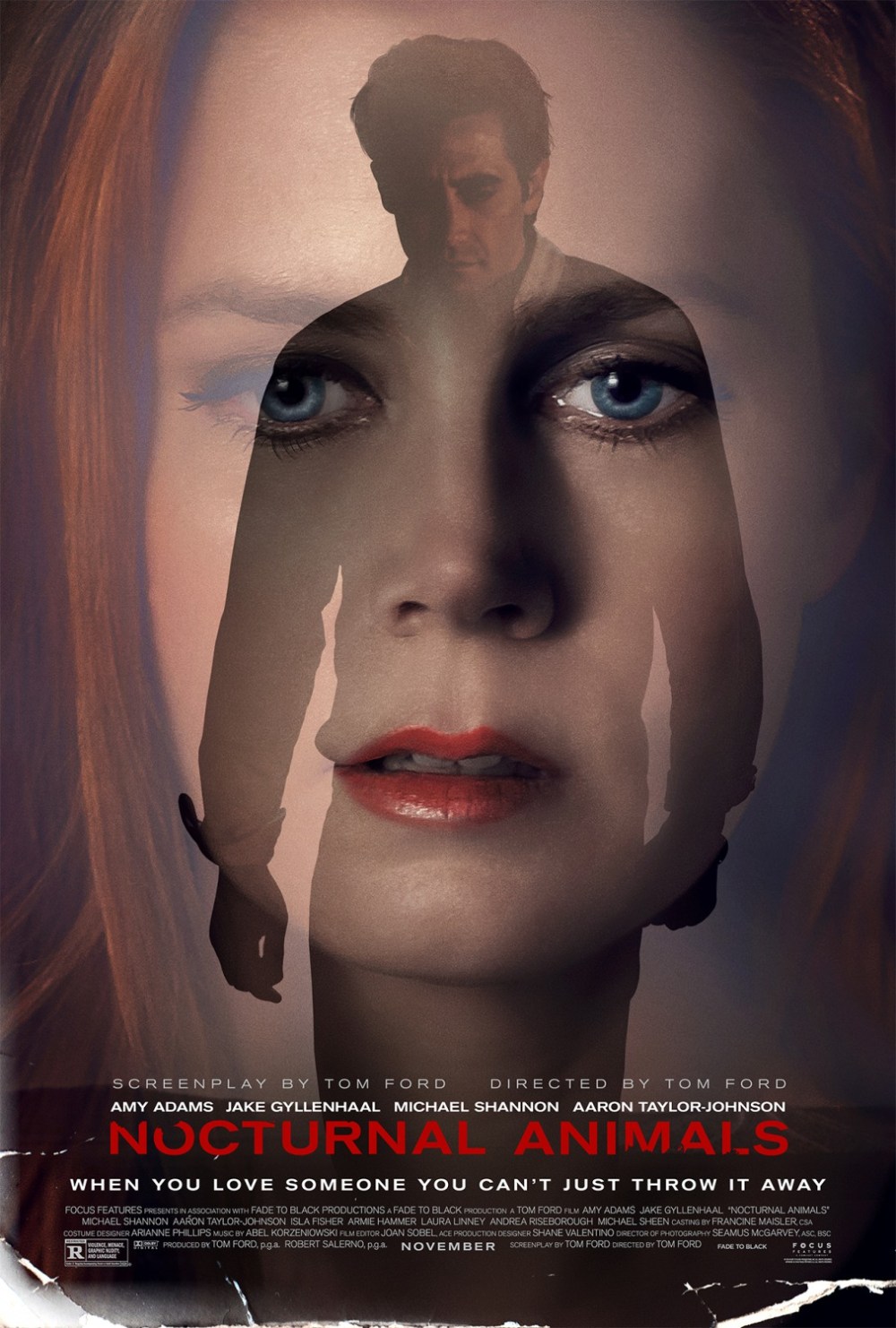
“Nocturnal Animals” is a movie which will stay with me long after I have seen it. Based on Austin Wright’s novel “Tony and Susan,” it follows a non-linear path and combines stories which deal with the real world and a fictional one to where, after a while, it’s almost hard to tell the two apart. Either that or you will leave wondering which story is the most emotionally exhausting. Judging from the movie’s first images of an art exhibit created to challenge our perceptions of what is beautiful or acceptable, director Tom Ford is quick to take us on a cinematic ride, and the kind we are not often accustomed to taking.
We meet Los Angeles art gallery owner Susan Morrow (Amy Adams) who appears to have it all: a handsome husband, a fabulous house and an income we would all envy. But we can tell from the start she is a lonely soul wandering through the superficial world she inhabits, and it doesn’t help that her husband Hutton (Armie Hammer) has been distant and may very well be cheating on her. Clearly, we are about to see why she is the damaged individual she is, and it will not be a pleasant trip whether it’s through reality or fiction.
One day, Susan receives a manuscript of a novel written by her ex-husband Edward Sheffield (Jake Gyllenhaal) named “Nocturnal Animals,” a nickname he gave her upon realizing she stays up late at night because she has trouble sleeping. Edward has dedicated his novel to her, and it tells a very bleak tale of love and tragedy as we watch Tony Hastings (also Gyllenhaal) suffer the utter humiliation of seeing his wife and daughter kidnapped by three troublemakers who later kill them. From there, Tony teams up with Texas Detective Bobby Andes (Michael Shannon) to bring the three men to justice, but the justice these two seek may not be one which is altogether legal.
Ford has the movie weaving in and out of its real world and fictional storylines to where you can’t quite tell where things are heading, and he does it in a way which is quite inspired. A story like this can be tricky to pull off as you can jump from one storyline to another at the worst possible moment to where we are desperate to see the movie get back to where it once was. But Ford has managed to weave all these storylines seamlessly to where everything feels in balance and not out of place.
At its heart, I think “Nocturnal Animals” is about the transformative power of art more than anything else. Whether it’s Susan’s art gallery or Edward’s novel, both of these characters use their individual artistry to channel emotions they couldn’t quite get to the surface in their relationship. The fact it takes Edwards years to reach this artistic jump in his writing abilities through his tragic novel shows how artists are not so much born as they are molded through years of life experiences.
Amy Adams gives her second great performance in 2016, her other being in Denis Villeneuve’s “Arrival.” She makes Susan a sympathetically tragic character as we watch her go from youthful promise to insomniac surrender as her life has become defined by isolation from everyone and anyone around her. Even when she has too much eyeliner makeup on, and her makeup is a distraction at times, Adams delves deep into her character’s complexity to deliver a performance of piercing sensitivity.
Gyllenhaal is riveting as both Edward and Tony, characters who suffer the indignities of life and love to where all that’s left is revenge. While the actor still seems a bit young to play the father of a teenage daughter, he is fearless in exploring a character who suffers a fate worse than death. Kudos also goes out to Isla Fisher who plays Tony’s wife, Laura, as she has to reach an emotional fever pitch and keep it high whenever she appears onscreen.
This movie is also proof of how there are no small roles, only small actors, and no actor here should be mistaken as small. Andrea Riseborough, completely unrecognizable here, steals some scenes as Alessia Holt, a person who has found happiness in a space filled with obliviousness and fake promises. Michael Sheen also shows up as Alessia’s husband, Carlos, who is actually gay, and she gives Susan some advice worth following. Ellie Bamber gives us a convincingly down to earth teenager in India Hastings who ends up coming face to face with her worse fears. Laura Linney has some strong moments as Susan’s mother, Anne, whose words hang over Susan throughout the rest of the movie. Karl Glusman and Robert Aramayo portray two gang members whose intimidation knows no bounds, and even the audience has yet to see how far they will go. And it’s always great to see Jena Malone, and she gives a wonderfully quirky performance as art gallery worker and new mother Sage Ross.
But there are two performances in “Nocturnal Animals” which stood out to me in particular. The first is Michael Shannon’s as Bobby Andes, a man of the law who looks to play it by the book, but who is slowly losing his moral bearings along with his body to the cancer eating away at it. Shannon doesn’t act but instead inhabits his character to where we don’t see him performing but becoming this sheriff, and he becomes increasingly frightening to where the anticipation of him letting go of a bullet is almost too much to bear. Seeing him bear down on a suspect with his piercing eyes and gruff voice makes him even scarier, and you have to admire the person who doesn’t need to do much to instill dread into another with such relative ease.
Then there’s Aaron Taylor-Johnson, a long way from his “Kick-Ass” days, as Ray Marcus, a lethal and disgusting bully of a character who revels in emasculating and humiliating Tony in front of his wife and daughter. Johnson’s performance reminds of you of those people in life who robbed you of your worth and self-respect and didn’t show the least bit of remorse about it. You want to smack Johnson in the face after watching him in “Nocturnal Animals,” and that is a compliment.
This is only Ford’s second movie as a director, his first being “A Single Man” with Colin Firth, a movie my parents are still begging me to watch. He is primarily known as a fashion designer whose clothes have made some of the most beautiful celebrities look even more beautiful. With “Nocturnal Animals,” he proves to be as gifted behind the camera as he is with clothes, and he gives this movie a striking look with the help of cinematographer Seamus McGarvey. This could have been a movie dominated by style more than anything else, but Ford gets terrific performances out of his infinitely talented cast, showing his attention is on the story and characters more than anything else.
It should also be noted how Ford has not put anything from his own clothing line on display here, so this movie should in no way be mistaken as a commercial for his fashions. He wisely removed this conflict of interest from “Nocturnal Animals,” so those hoping for a glimpse at his latest fashion line will have to look elsewhere.
“Nocturnal Animals” ends on an ambiguous note regarding Susan and Edward. This will probably annoy some viewers who demand concrete answers to their relationship or the state of their lives and where they will go from here. But Ford is wise to know this is a question he cannot answer himself as the fate of these characters has to be open up to interpretation. Some relationships are meant to be repaired, others are better left broken. When it comes to Susan and Edward, we can only wonder if they can or even should rediscover what made their love spark so passionately.
“Nocturnal Animals” is a movie meant to stay with you for a long time after the end credits have finished, and boy does it ever.
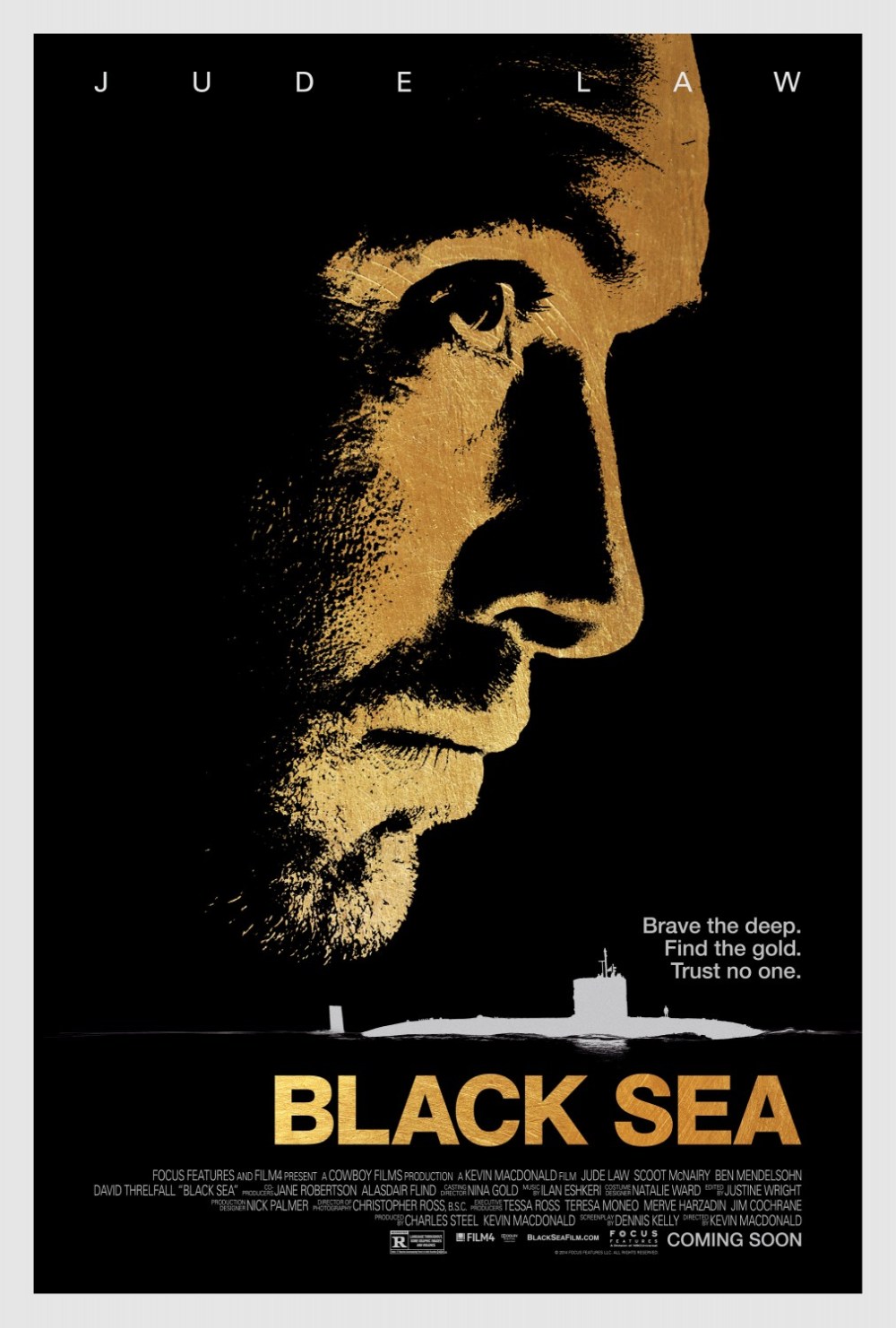
When it comes to submarine movies, I feel the genre peaked early on with Wolfgang Petersen’s “Das Boot” which proved to be as claustrophobic as movies get. Others have come close to equaling its visceral power, but there’s no topping it. I went into “Black Sea” knowing this would be the case, and that helped a lot because this movie proved to be a lot more intense and nail-biting than I expected it to be. It doesn’t break any new ground, but it is a gritty thriller which doesn’t let up.
Jude Law stars as submarine Captain Robinson who, as the movie starts, has been laid off from his salvage job which leaves him with few prospects for future employment. It turns out he’s not the only one as his friends and colleagues have been kicked out of their jobs as well, and it serves as an annoying reminder of how companies spend more time firing employees than they do hiring them.
But Robinson soon gets offered a job by a shadowy backer who tells him about a World War II submarine that has sunk to the bottom of the sea and which contains an enormous wealth of gold. Seeing how it offers him and his colleagues more than enough to quit any day job they can hope to get, he commandeers an old and fairly decrepit submarine from the Cold War days to get at the gold hidden miles below the surface. But in addition to avoiding detection from the Soviets as he travels below their radar, he has to contend with the fragile relations between the crew members as they come from different places and don’t have enough trust in each other to make this mission run smoothly.
What makes “Black Sea” an especially effective thriller is that the depths of the ocean prove to be every bit as threatening as the twisted psychology of the submarine’s passengers. Everyone on board has their own selfish motives, and those motives have to contend with the dangers they have to endure on a ship way past its prime. It doesn’t take long before you start to wonder what’s going to kill these men first; the crushing depths or their own paranoia.
“Black Sea” was directed by Kevin Macdonald, a filmmaker who has gone from making documentaries like “Touching the Void” and “Marley” to unforgettable dramas like “The Last King of Scotland” and 2013’s underrated “How I Live Now.” He doesn’t have much to work with in terms of originality, but he makes effective use of the claustrophobic setting to where our nerves are effectively fried throughout. Macdonald also gives equal attention to the human element as the characters drive the action more than you might think. Even though some of the characters’ decisions become rather silly towards the end, he makes you empathize with them to a certain extent. These days, who can’t relate to being laid off or jumping at the opportunity to make a fortune? People will do anything to survive these days.
It’s interesting to see Jude Law in a role like this where he portrays a hard scrabble worker who looks like he needs a good long shower on a regular basis. I’ve gotten so used to seeing him as this handsome man onscreen to where it threatened to make me forget what a great actor he is. While his Scottish brogue gets a little too thick at times, he fully inhabits his role of a man who is more in love with the sea than he is with his own family. Law is also surrounded by a terrific cast which includes Ben Mendelsohn (terrific in the criminally overlooked “Starred Up”), Scoot McNairy, David Threlfall and Konstantin Khabensky who each imbue their roles with a lot of grit and desperation. It helps to have actors this good in a movie which on the surface might seem run of the mill.
At this point, I don’t think it’s even possible to reinvent the submarine movie genre. Where else can you go with it after movies like “Das Boot,” “The Hunt for Red October” and “Beneath” to name a few? All you can hope for is that it can be done well and keep you on the edge of your seat, and “Black Sea” manages to do that more than you might expect. Sometimes that’s all you need a movie to do.



 The Ultimate Rabbit