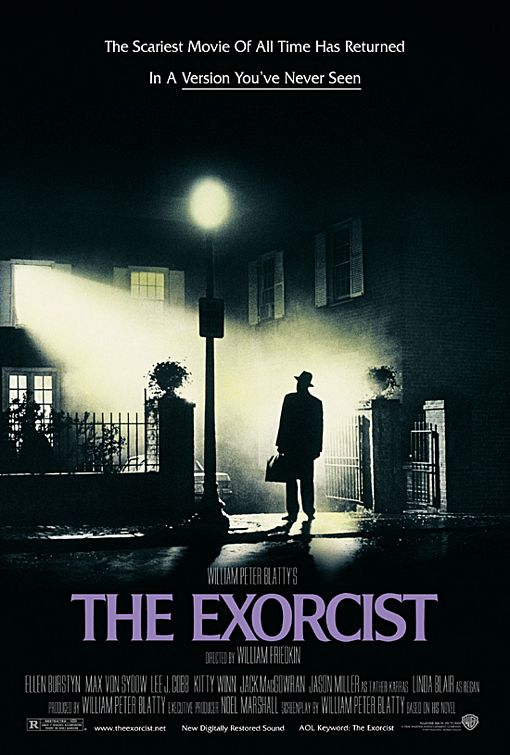
There are several trailers out there for William Friedkin’s “The Exorcist” which are very memorable, but the one which stands out for me is the one made for its rerelease back in the year 2000. In some ways, it is a huge surprise that this trailer was not treated like a red band trailer as the film remains ever so shocking after all these years. Regardless, it does a great job of reminding audiences, old and new, of what an incredibly unnerving and unforgettable experience this 1973 film was when it first came out, and how it remains so all these years later. Even if there was no new footage made for this release, this trailer made seeming it back on the silver screen an offer no movie buff could ever refuse.
I have to tell you, seeing this version on “The Exorcist” at a celebrated movie theater in Westwood, California provided me with one of the best cinematic experiences I ever had. On top of this film never having lost any of its power, as it contains scenes no studio would allow any filmmaker to capture on film today, the theater had the most extraordinary sound system which made watching it all the more adrenaline-inducing, exhilarating and enthralling to sit through. This trailer gave me such a great reason to check it out on the biggest silver screen in my neighborhood.
To date, there has yet to be an “Exorcist” sequel or prequel which can at the very least equal Friedkin gave us half a century ago.
Please check out the re-release trailer down below.
William Friedkin’s “The Exorcist” was such a singular cinematic experience, let alone a singular horror film like few others, that making a sequel to it had to seem like a truly insane prospect. “The Exorcist II: The Heretic” proved to be as hideous piece of celluloid as the original was a brilliant one, “The Exorcist III” was undone by needless studio interference which made it look pitiful for no good reason, and the attempts to make a prequel got so messed up to where two versions of it were made, both of which proved to be quite flawed. Looking at this franchise, one which is quite accidental, it seems like one driven by profit more than anything else. Granted, sequels are generally made because the original was a big box office hit, but not all of them exist simply because of financial benefits for everyone involved.
Now we have “The Exorcist: Believer” which comes to us from David Gordon Green and his fellow filmmakers who gave us the recent “Halloween” trilogy which proved to be worthy sequels to a celebrated classic. And yes, I do include “Halloween Ends” which many despised. Like those films, this “Exorcist” installment serves as a direct sequel to Friedkin’s original, it completely ignores the other sequels to create its own cinematic path. What results is a motion picture which is not terrible, and I went into it refusing to expect it to be any equal to the original, but it still proves to be inconsequential and unnecessary as Friedkin’s film continues to be extremely difficult to make a sequel to.
We are introduced to professional photographer Victor Fielding (Leslie Odom Jr.) who is raising his daughter, Angela (Lidya Jewett), as a single parent following the tragic death of his wife. One day, Angela asks her dad if she can go over to her friend Katherine’s (Olivia O’Neill) to study. That’s okay, Victor says, but she needs to be prompt about returning home for dinner. When Angela fails to do so, and she and Katherine go missing, the whole town goes looking for them. Eventually, they are found alive 30 miles away from their home addresses, but both are convinced they were only gone for a few hours.
As you can expect, both Angela and Katherine turn out to be possessed, and Victor turns to others to help the girls before any more lasting damage can be inflicted. Among them are Ann (Ann Dowd), a nurse at a local hospital and a fallen Catholic, and Chris MacNeil (Ellen Burstyn), an actress turned exorcism researcher who has since become renowned for her studies and her best-selling book on the subject. From there, we know we are in store for an exorcism, albeit one which cannot possibly be as intense as the one Friedkin gave audiences half a century ago.
Now you cannot go into “The Exorcist: Believer” expecting something along the lines of Friedkin’s original film as that is asking to be severely disappointed in the process. None of the sequels or prequels could touch it as the 1973 film is a cinematic experience not easily duplicated. But even with reserved expectations, “The Exorcist: Believer” just doesn’t work. It has some strong performances from Odom Jr. and Dowd, and there are some clever jump scares, but there is not enough to justify this as a significant follow-up to a celebrated classic.
The big news with this one is that Ellen Burstyn returns as Chris MacNeil for the first time since the first “Exorcist” film. But while Jamie Lee Curtis’ character of Laurie Strode was a major component of the recent “Halloween” trilogy, Chris MacNeil’s presence in “The Exorcist: Believer” feels like an afterthought, and while Burstyn is great as always, the character does not feel especially necessary to this installment. While it may give this film some legitimacy, Burstyn is barely in this film and does not get a lot to do.
When it comes to the climactic exorcism which the film’s title and its trailers have promised us, it is no surprise to find it utterly lacking in tension. Sure, there is some suspense as the adult characters are forced to make a choice no one wants to make, but it all feels lacking in the long run. As much as I wanted to view this film on its own instead of in comparison to the classic original, I could not help but be reminded of how intense and unnerving Friedkin’s film was. I wanted this exorcism to have the extreme intensity of what came before, and I knew that was not going to be the case which made this direct sequel all the more frustrating.
David Gordon Green is a terrific filmmaker. In addition to his “Halloween” trilogy, he has also directed films in various genres. He has given us “George Washington,” “Pineapple Express,” “All the Real Girls,” and “Joe” which features not only one of Nicolas Cage’s best performances, but also one of his most subtle, and that is saying a lot. I cannot help but wonder what made him, Scott Teems, Danny McBride, Jason Blum and all of Blumhouse were hoping to accomplish here. Were they hoping to make something which could stand alongside the original proudly, or at least be considered its equal?
For a moment, I thought Green might have some luck as the opening scenes in Haiti do have a documentary feel to them like the original did. But after a bit, it just felt like I was watching a movie. This is the biggest problem with “The Exorcist: Believer;” you watch it more than you experience it. You can see how the screws go in, and it does not help that the CGI effects utilized here are not all that great. Then again, I have long since been spoiled by the visual wonders of “Avatar: The Way of Water,” so nothing else can possibly compare.
Making a sequel or any kind of follow-up to “The Exorcist” is no different than anyone trying to make one to “The Texas Chainsaw Massacre.” Both those horror classics gave audiences a cinematic experience like few others, and they still remain enthralling and greatly unnerving so many years later. And yet, there are those who have turned these movies into franchises which may succeed financially, but never critically. They will forever be shadowed by a predecessor which can only make the best efforts look ever so pale in comparison, and yet people keep trying futilely to give us something worth watching. The fact that no one has succeeded in doing so should not come as a surprise.
Nevertheless, another “Exorcist” movie is set to be released in 2025, and the best way to look at this situation is to say Green and company have nowhere to go from here but up. Perhaps if they played around with the formula, they could audiences something more original which will stand on its own. Until then, I wonder if the ghost of William Friedkin will haunt Green just like he promised.
The following review was written by Ultimate Rabbit correspondent, Tony Farinella.
It’s crazy to me to know “The Exorcist” is now celebrating its 50th anniversary. Unfortunately, we lost its legendary director recently in William Friedkin, a trailblazer who was not afraid to push the envelope and do things his own way in films such as “Cruising,” “The French Connection,” and “To Live and Die in L.A.” He was an outspoken and passionate filmmaker who never backed down from his vision and his principles. I think it’s safe to say his most talked about film of all-time is “The Exorcist” which recently got a 4K upgrade from Warner Brothers Home Entertainment. Even to this day, people go to their local theater to watch it on the big screen, or they revisit it on home video when it’s spooky season.
There is quite an infamous backstory to the making of this film and getting it off the ground. It’s a legitimate miracle the film was able to be made considering all of the roadblocks and obstacles the director and his crew had in making it. I could go into detail here, but it’s best to Google it, as it’s lengthy and strange. I’ll just say this–many thought the film itself was cursed because of all the odd occurrences which happened to this production. People would also heavily protest the film, and many filmgoers would faint and get sick while watching it. The film has certainly developed quite a reputation over the years for a variety of reasons.
“The Exorcist” is set in Georgetown, Washington, D.C. and introduces the audience to actress Chris MacNeil (Ellen Burstyn) and her twelve-year-old daughter Regan (Linda Blair). They are renting a house while Chris works on a film directed by Burke Dennings (Jack MacGowran), someone she considers a close friend. We are also introduced to Father Damien Karras (Jason Miller), a psychiatrist at Georgetown University who works with fellow priests. Father Karras is struggling with guilt as he wishes he was spending more time with his mother, who is elderly, frail and unwell. He is also having a crisis of faith as well. At a party Chris is hosting, she notices some unusual behavior from Regan, and Regan is also talking about strange and weird noises in the attic.
From here, things only get worse for Regan as she starts to become vulgar, aggressive and develop facial sores. She has baffled modern science as they can’t understand what is wrong with her. They think it has something to do with her brain, but it still doesn’t explain her actions or her superhuman strength. Once Regan becomes a danger to herself and others, they decide the only solution is to tie her to her bed and perform an exorcism. There is a lot of hesitation on the part of Father Karras, as he doesn’t think it will turn out well and might only further damage young Regan. However, if a more experienced priest helps him, he will do it. This is where Father Merrin (Max von Sydow) comes in to help Father Karras with the exorcism that will hopefully save the child.
I’ve seen “The Exorcist” three times now, and I’ve really, really wanted to fall in love with it, but for whatever reason, it is a film I respect and admire but don’t love. I can see the great acting on display from Jason Miller, Ellen Burstyn, and Linda Blair. It’s impossible to ignore their range of emotions and their ability to sell this material and make it work. My issue is with the pacing of the film. I’m all about letting things breathe and building up to something, but this is very much an all-or-nothing film at times. At times, it’s moving a little too slowly without enough character build-up, and the plotting can be a little tedious. At other times, it’s in-your-face, intense, and really mind-blowing. There is really no middle ground with “The Exorcist.”
At fifty-years-old, “The Exorcist” is still an impactful horror film, without question. I just wonder if it’s more built on its reputation and folklore at this point. One might even argue if it’s a horror film or a thriller. It is a little bit of both, which I think most horror films are to some degree unless they are just flat-out horror with no plot. There is a plot here and a rhyme and reason to what unfolds, but it feels a little dated, in my opinion. All in all, I think “The Exorcist” should get its flowers for being a horror film that was ahead of its time and has really opened the door for a lot of the supernatural horror films we see today from “The Conjuring” and “Insidious” world. However, it’s a good yet flawed film, overall. As I stated earlier, I like it and it stays with me, which is a good thing, but I don’t love it and it doesn’t impact me, as much as I feel like it should, considering its place in film history.
* * * out of * * * *
4K Info: “The Exorcist” is released on a two-disc 4K release from Warner Brothers Home Entertainment. It comes with two different 4K versions of the film. One version is the theatrical cut, which is 122 minutes. The second disc is 132 minutes and features the extended director’s cut of the film in 4K.
Video/Audio Info: Warner Brothers did a pretty good job of cleaning up this film. However, they didn’t clean it up so much that you aren’t able to enjoy the dark and moody look of the film. I would say it’s a good but not great transfer of the film. I’ve seen better transfers of older films from Warner Brothers. It does come with a very, very good Dolby Atmos soundtrack for the film, though. I was really blown away by how good the film sounds. It also comes with subtitles in English, French, and Spanish.
Special Features: The theatrical version comes with the following special features: an introduction by William Friedkin, a commentary track by Friedkin, and a commentary track by William Peter Blatty, who wrote the novel and the screenplay for the film, with special sound effects. The unrated version of the film also comes with a commentary by Friedkin. These are all older commentary tracks and the introduction is much older as well. The big issue here is the fact they didn’t have a third disc with some of the special features from the previous Blu-ray release.
Should You Buy It?
This is a rather tricky one. I’ll say this–if you love “The Exorcist” and it’s one of your favorite films of all time, the transfer makes it worth the upgrade, even though I didn’t think it was a great transfer. It has its issues, as, at times, it can be a little unfocused and not super clear. If you own the Blu-ray, you should keep and not sell it because you will lose your special features with this 4K as it only has the commentary tracks and an introduction from the director. They really should have added a third disc just for the special features. Overall, “The Exorcist” is a film that has earned its place in horror film history based on it being released at the right time with the right director and the right cast and crew. It’s a good film. However, I don’t think it’s a great film in my personal opinion. If you love the film, I think you will be happy with what Warner Brothers has done with the transfer. It’s not a bad transfer by any means. It’s just not a transfer that is going to “wow” you. You will probably be very disappointed they didn’t port over the special features from the Blu-ray. However, if this is your favorite horror movie, you want to own it on the best format out there right now, which is 4K. If you are lukewarm on the film or think it’s merely good, you can keep your Blu-ray if you already own it.
**Disclaimer** I received a copy of this film from Warner Brothers to review for free. The opinions and statements in the review are mine and mine alone.
Christopher Nolan’s “Interstellar” is a film which demands to be seen on the biggest screen nearest you. Like “Gravity,” seeing at home on television will not have the same effect as seeing it in a darkened theater, and that’s even if certain people around you forget to turn off their cell phones (doesn’t anyone ever learn?). Whether or not you think “Interstellar” is Nolan’s best film, you can certainly say it is his riskiest and most ambitious to date as he combines elements from Stanley Kubrick’s “2001,” Phillip Kaufman’s “The Right Stuff,” and even Robert Zemeckis’ “Contact” to make a most enthralling space adventure for us to experience.
“Interstellar” takes place in a not too distant future when Earth is unable to sustain humanity as crops are constantly ravaged by blight, dust storms keep laying waste to towns everywhere, and teachers have changed school textbooks to make children believe the Apollo moon landings were faked (blasphemy). In the middle of all this is farmer, widower, and retired astronaut Joseph Cooper (Matthew McConaughey) who spends his days tending to his farm and raising his son and daughter with the help of his father-in-law Donald (the always dependable John Lithgow). Cooper keeps going about his business but still takes the time to indulge his daughter Murph (Mackenzie Foy) in her curiosities about outer space and the ghost she believes is haunting her bedroom.
One of those curiosities ends up leading Cooper and Murph to a secret NASA space installation out in the middle of nowhere where they meet Professor Brand (Sir Michael Caine) who informs them humanity will not survive for much longer. However, scientists have discovered a wormhole orbiting Saturn, and this presents the possibility of new planets for humans to inhabit. Cooper volunteers to pilot the experimental space shuttle Endurance into the wormhole, and he is joined by a crew of three as well as a couple of multi-purpose robots on a mission which will take several years to complete. But the mission also means Cooper must leave his family behind, and this ultimately devastates Murph who begs him not to go. Cooper promises Murph he will return once the mission is complete, but this may be a promise he might not be able to keep.
I don’t want to reveal much else of what happens in “Interstellar” as it is full of surprises, and it helps to come into this movie free of expectations and knowing only so much about it. We all love his “Dark Knight” films and have been following his work ever since he made his breakthrough with “Memento,” but this is really Nolan at his most emotionally open and, dare I say, sentimental. Almost nothing he has made previously compares to what he has given us here.
The movie does take a while to achieve liftoff (pun intended), and I know many have complained about the “sluggish” pacing in the first half. The way I see it, I admired how Nolan took his time with the story as many other filmmakers would have been pushing to get into outer space a lot sooner. These days we are in such a hurry to get everywhere and nowhere, and cable channels like IFC are content to speed through the end credits of a movie as if none of the hundreds of crew members who worked on it ever mattered. It’s nice we get to know these characters to where they have enough depth which makes us want to follow them on their journey to where no one has gone before.
I also liked how “Interstellar” deals with real science and doesn’t go out of its way to heedlessly disregard the laws of physics and gravity. Granted, there’s a lot of technobabble dialogue here which is at times hard to decipher and makes certain scenes a little confusing, but considering how much work Nolan and his fellow collaborators (which includes noted theoretical physicist Kip Thorne) put into researching space travel, this movie does have the feeling of plausibility throughout. We still may be years away from the kind of space travel presented here, but Nolan and company make you believe it will become a reality at some point.
Along with cinematographer Hoyte van Hoytema, Nolan captures some exceptionally beautiful images as Cooper and company seek out new life and new civilizations. Some of the shots are bound to remind viewers of “2001,” and Kubrick’s classic film is certainly a huge influence on the story. Still, Nolan takes us on a journey which feels surprisingly unique to others captured on celluloid recently and previously.
At this point, it should go without saying that McConaughey is on a roll. When he first made his breakthrough in “A Time to Kill,” many were heralding him as the next Paul Newman when they should have just let him be Matthew McConaughey. This led him to star in a number of dopey romantic comedies which were far beneath him and his fellow co-stars, and many quickly lost faith in him. However, the last few years have seen him turn in one remarkable performance after another in “Mud” and “Dallas Buyers Club.” His work in “Interstellar” is remarkable and heart wrenching as he watches videos of his children who are growing up without him, and he grieves over the things he has missed out on.
Anne Hathaway, who previously worked with Nolan on “The Dark Knight Rises,” turns in a strong performance as Amelia (as in Earhart?) Brand, an astronaut and scientist whose heart threatens to get in the way of her duties as a scientist when hard choices have to be made. David Gyasi is also very good as physicist Romilly, and time proves to be a real burden for him throughout the movie. As for Wes Bentley who plays geographer Doyle, he is underutilized here as he has little to do other than spout off a lot of technobabble, and his character never gets much in the way of development.
But one of the best performances to be found in “Interstellar” comes from Jessica Chastain who plays the older version of Murph. Still resentful of her father for leaving, she channels her anger into her own work with NASA as she works with Professor Brand to bring him back. Even as the film threatens to be a little ridiculous with answers that may have been better left to the imagination, Chastain keeps you hooked into her character’s quiet desperation to find her father and save the world to where you are begging for these two to reunite sooner than later.
Another collaborator of Nolan’s who really challenges himself here is composer Hans Zimmer who has given us some of the most exciting music scores in the last few years. With “Interstellar,” Zimmer abandons the usual thrilling bombast of “The Dark Knight” and “Inception” for something more spiritual and Phillip Glass-sounding. His music acts as a requiem for the wonders and perils of voyaging through space and of the solitude humans are forced to endure when stuck in another galaxy. You can usually notice the Zimmer sound in each film score he does, but his work here sounds so remarkably different from what he has done in the past.
This movie does have its flaws, and there are moments towards the end which strain credibility to where things threaten to become laughable, but its strengths eventually overcome its weaknesses by a large measure. Just when it looks like the plot will go off the rails in an M. Night Shyamalan way, it doesn’t, and it speaks to how deeply Nolan feels about the story and what it implies.
In the end, “Interstellar” is not another science fiction movie about astronauts looking for little green men (it would have been a disaster if it did). It’s about the power of love and how it can transcend both time and space no matter where you are. Regardless of the laws of physics and gravity, love carries on from one galaxy to the next and can never be easily conquered. I came out of this movie happy to know that, even in the deep, dark and silent void of outer space, love can remain constant.
For the record, I saw “Interstellar” at the historic Grauman’s Chinese Theatre in Hollywood in IMAX 70mm. I am more than convinced this is the best way to see it, and it also represents one of the last chances for all of us to see a movie projected on film. I’m sure it looks great in digital, but film still works best for Nolan.


 The Ultimate Rabbit