There are many movies out there about addiction issues and the rehabilitation which comes about when some finally can take no more pain and punishment. Those which come to mind include “Clean & Sober,” “When a Man Loves a Woman,“ “I Smile Back” and “The Way Back” to name a few. Now we have “Sweet Dreams” which stars “Jackass” alumnus Johnny Knoxville as Morris, a man who has finally hit rock bottom when it comes to drugs and alcohol, and we watch as he enters a sober living facility named Sweet Dreams where he meets others struggling with the same demons. While there, he gets recruited to coach the rehab center’s softball team which he is at first reluctant to do, but it gives his life a direction and purpose he was previously lacking.
“Sweet Dreams” was written and directed by Lije Sarki whose previous films include “Concrete Kids” and “Alphonso Bow,” and he was one of the producers of the indie hit “The Peanut Butter Falcon.” Like the characters here, he has also struggled with addiction issues but has since found his way past them and very much enjoys his sober lifestyle. With this film, he wanted to present the sober living, anonymous meetings and 12-step programs in a different way. Whereas most movies of this sort tend to be dark and depressing, he wanted “Sweet Dreams” to be more uplifting and to show how recovery can be fun and a joyous thing even after you have hit rock bottom. What results is a motion picture with a lot of heart, and you can see this in the writing and the performances, particularly Knoxville’s.
I got to speak with Lije recently about “Sweet Dreams,” and we talked about how the challenges he had in shooting this film (he only had 20 days), and of how he made this one stand out from so many other movies like it.
“Sweet Dreams” is now playing in theaters and is available to own and rent on digital platforms. Please check out the interview below as well as the trailer.
“Sweet Dreams” is one of those movies coming out underneath the radar, and it deserves more attention than it is currently getting. Johnny Knoxville stars as Morris, a music video director who, as the movie opens, has hit rock bottom and wakes up in a park almost completely nude and with a bloody face. Next day, he enrolls at Sweet Dreams, a recovery center which cannot be mistaken for Promises or the Betty Ford Center, where he meets up with a group of misfits struggling to maintain their sobriety. In the process, Morris becomes the coach of the center’s softball team, and he gets another chance at life as well as the opportunity to be the dad his daughter deserves.
I got to talk with two of the stars of “Sweet Dreams,” Bobby Lee and Davionte Ganter, better known professionally as GaTa. Both play fellow patients who quickly bond with Morris and share their pasts and philosophies on life to him. Bobby is a stand-up comedian, actor and podcaster who was a cast member of “MADtv” and co-hosts the podcasts “Bad Friends” and “TigerBelly.” GaTa is an actor and rapper best known for playing a fictional version of himself on the FXX series “Dave.”
I was especially interested in talking to Lee and GaTa about their own experiences with drug addiction and mental health issues and how they informed their roles as Cruise and Jake in this film. Lee was introduced to drugs when he was just 12 years old, and it took him several trips through drug rehab before he got sober. GaTa has been diagnosed with bipolar disorder, and he has become a big mental health advocate.
I really want to thank them for being so open about their struggles as it proves how “Sweet Dreams” has such a big heart, and that, for these two, doing this movie felt like an extension of the things they work hard for in life. Anyone with addiction issues may very well benefit from watching this movie.
“Sweet Dreams” opens in theaters on April 12, and will be available on digital platforms on April 16. Check out the interview below.
WRITER’S NOTE: This article was written back in 2012.
Robert Zemeckis’ “Flight” ended up surprising us all by being a riveting character driven film as opposed to your average Hollywood action movie. It is filled with a number of great performances from very talented actors, and one of the most notable is Kelly Reilly’s as former photographer Nicole Maggen. When we first meet Nicole, she is in the throes of a nasty heroin addiction that almost claims her life. While in the hospital, she meets airline pilot William “Whip” Whitaker (Denzel Washington) who is going through his own substance abuse issues and becomes a kindred spirit of sorts as they both look for ways to escape their demons.
For Reilly, “Flight” marks the first American movie she has appeared in. Before this, she was best known for playing Mary Watson in the “Sherlock Holmes” movies, and she starred opposite Michael Fassbender in the unnerving horror film “Eden Lake.” When it came to playing Nicole in “Flight,” she explained to Christopher Rosen of the Huffington Post how she goes about preparing for a role.
“If it’s there in the script it makes your life a lot easier,” Reilly said. “You’re not searching for something. You’re not trying to figure out how to make this character believable or real. You’re not trying to skirt around bad writing. This character, to me, just jumped out. I already felt a kinship to her; I wanted to play her. I knew that this sort of addiction that got hold of her so tightly was a symptom of this woman’s heartbreak. I knew there was somebody underneath worth fighting for. There are all these stereotypes of heroin addicts being junkies or dropouts or people who we shouldn’t care about. I just thought that can’t be true. They’re somebody’s son or daughter; they’re human beings. They’re just lost. That is something John Gatins got in his script. I really wanted to play that rather than the stereotype of the heroin addict.”
When it came to playing a heroin addict, Reilly explained to Rosen the amount of research she did to better understand her character. She spent a lot of time on Google learning about those addicted to this particular drug, but that only gave her so much information. But while I was at “Flight’s” press conference at the Montage Hotel in Beverly Hills, Reilly went more into depth about who gave her the answers she needed to know the most.
“I did consult a wonderful guy called Mitch in Atlanta who helped me understand the inner life of a heroin addict as much as one can without experiencing it, and he really did open up his story to me,” Reilly said. “There was a technical side of it as well as he taught me how to inject heroin without really injecting heroin. I wanted to honor the truth of somebody in that situation, and I think that was the most difficult part without ever having experienced that.”
But despite “Flight” gaining strong critical praise for its direction and performances, Reilly doesn’t see herself being nominated for an Academy Award. When it comes to the Oscars, they tend to honor the showiest performances above all others. Reilly’s performance as Nicole is powerful largely because it is an understated one which does not draw too much attention to itself. She explained this in more detail to Rosen.
“I know there is a lot of buzz around Denzel and the film. A few people have kind of suggested that it could be a possibility for me. I don’t see it myself,” Reilly said. “That’s just not me being humble or anything. I genuinely don’t imagine that to be the case. Mine is more of a quiet performance and I don’t think it’s an award winner. I still feel incredibly flattered to have people even suggest that. As much as it was never a dream of mine — a dream of mine would be to be on stage in New York — it would still be a mind-blowing thing to happen especially for something you feel proud of.”
Michael Caine once said that in the theater you play a character, but in television and film you are the character. Some of the greatest performances I see from actors in movies come from those who inhabit their characters more than play them, and Kelly Reilly’s performance in “Flight” is no exception. While we all love the showiest of performances, it is those subtle ones which deserve the most credit. My hope is that the Oscars will prove Reilly wrong and give her the credit she deserves for her work here. It’s one of the best portrayals of an addict I have seen ever since Michael Keaton played one in “Clean and Sober.”
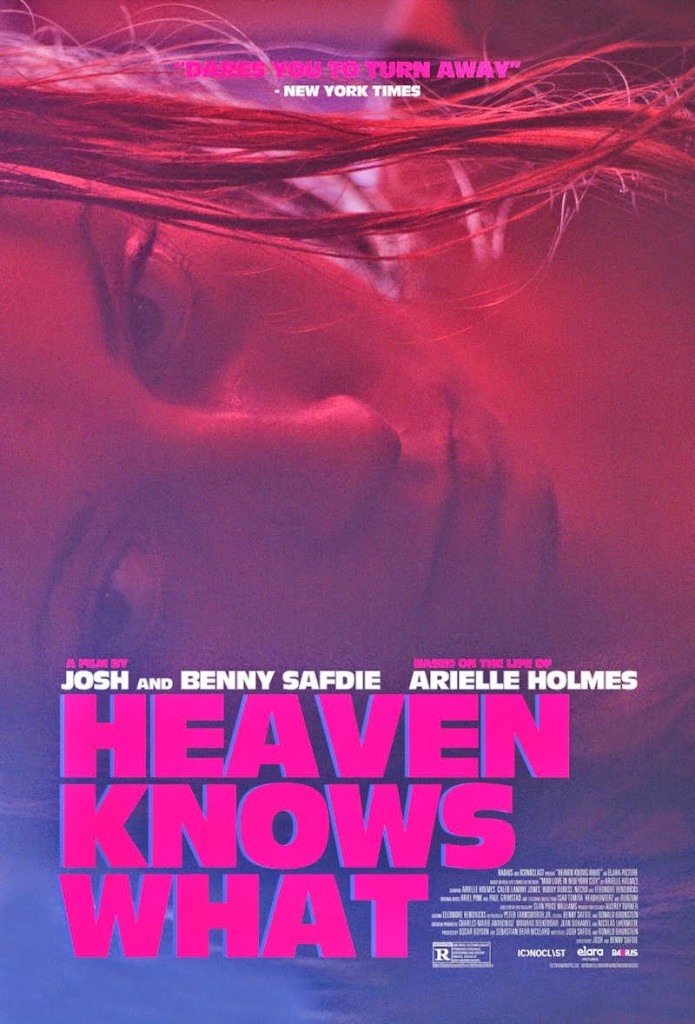
“Heaven Knows What” is a movie which takes us into a landscape alien to many of us: the world of a drug addict. Arielle Holmes stars in a riveting performance as Harley, a homeless addict on the streets of New York who has two passionate yet volatile loves in her life: her boyfriend Ilya and heroin. We watch as they struggle to survive one day after another on the mean streets of New York, struggling with addiction and each other as Harley attempts to prove her love to Ilya in the most passionate and dangerous way possible.
The movie was directed by brother filmmakers Josh and Ben Safdie whose previous credits include the comedy drama “Daddy Longlegs,” the documentary “Lenny Cooke,” and the crime-drama “Good Time” starring Robert Pattinson. I got to speak with them while they were in Los Angeles, and they described the various elements behind this movie’s making in great detail.
“Heaven Knows What” is based on the memoir “Mad Love in New York City” written by Holmes. I was eager to read it after watching the movie, but it hasn’t been published yet. Josh explained why.
Josh Safdie: She has a few publishers who want to do it, but she’s like rethinking about how she wants to release it now that she’s done these two other movies and is now in the responsible world.
Ben Safdie: There’s a beautiful rawness to it. If you were to read the pages, it really feels like you were right there sitting next to her all the time and it’s beautiful. That kind of immediacy is also what really attracted me to it because first you hear about, oh, homeless person addicted to drugs. We’ve heard that story a million times. How do you tell that story in a new and different way? Her voice was that new way.
I came into this movie not knowing anything about its backstory, and I honestly thought Holmes was a highly trained actress as her performance is brilliant and mesmerizing. This, however, is not the case as she is not all that far removed from the addict we see on screen. She was a homeless addict for years but has managed to get herself cleaned up, and her performance in “Heaven Knows What” has earned her attention from many who want to make her a star. Both Josh and Ben described what it was like working with her.
JS: Her performance is incredible. You have to remember when you live on the street you’re performing on an everyday level. Whether you’re hustling this person or trying to get this thing out of that person, it’s a performance and a performative life. She was also moonlighting as a dominatrix where she literally was performing as a different character.
BS: One of the most difficult performances you can give is as yourself because you need to be able to understand what makes you tick and then be able to put that out there without any inhibition. And then that’s how you build other performances because if you can get at your core in its ugliest form, or whatever its form, you can build from there.
JS: Acting is just painting your personality a different color. I really was amazed. When I watch the movie now, as I get more and more distance from it just in terms of just having filmed it with a sense of making it, I watch Ari’s performance and I’m really in shock about it. It would take like six or seven takes to get the performative level because it would often start out with her enthusiasm level and how enthused she was to do the scene. Sometimes she was really in it and she would give us this incredible performance. Other times it would take 12 takes to get it out of her. It’s really a beautiful performance from her. And the guy, Caleb (Landry Jones, who plays Ilya), is an actor in Hollywood movies. That’s like the craziest performance because people don’t even realize that it’s a performance and they learn his real story that he is a Texan and that he was in “X-Men: First Class,” he was in “Contraband,” he was in “Antiviral,” he lives in Los Angeles. This is not him at all. Maybe there are traces of him in Ilia, but no, that’s not him.
What’s fascinating about “Heaven Knows What” is how it combines fiction with a raw cinema verite. It’s essentially a fictionalized version of true events, and yet it feels like we’re watching real life unfold right before our eyes. I asked the directors what it was like balancing out the fictional elements with the real-life ones while making this movie.
BS: I think it was about putting them in a blender and not knowing where that line was because that was the only way to make it successful. We made a documentary before this, and that was a documentary. That was a real person and we were trying to tell his real story, but in order to tell his story most effectively we had to use techniques from fiction filmmaking, reenactment and changing the timeline. We were fictionalizing reality there to get the point across. So here we are making a fiction film with a kind of documentary base, and again we had to employ the same kind of tools. You have to make things up to really get at the true emotional core of things. (Werner) Herzog says it’s like the ecstatic truth once you get there.
The movie also features a brilliant electronic score which serves to illustrate just how alien the world drug addicts inhabit is to the rest of us. Along with movies like “The Guest,” “It Follows” and “Ex Machina,” electronic film scores are making a big comeback. Josh and Ben talked about the movie’s composers and why they chose that kind of music.
JS: There’s a bunch of things that are happening in music in the movie. For the most part, we feature the work of Isao Tomita and his renditions of Debussy. We really wanted to have a romantic score, but this movie is like a time squared, nighttime vibe. It’s like electrified and it’s kind of seedy, and it’s an alien landscape almost. We like to say the movie takes place on Mars which is where an addict’s brain goes in a weird way. Debussy music is some of the most romantic music ever composed, but when it’s done through this Japanese mind from the 70’s it’s different. It’s reinterpreted. It’s no longer really romantic but it has its core in romanticism.
BS: There’s other music that we use throughout the movie. There’s some original music by Paul Grimstad in the hospital sequence, and then there’s Ariel Pink who’s a Los Angeles guy who wrote a song for the movie called “I Need a Minute.” It’s electrified as well, and he wanted it to be a love song to the locked bathroom, being able to lock your own bathroom and needing another minute while people are banging on the door.
Watching “Heaven Knows What” brings to mind movies like “Kids” and “Requiem for a Dream” which dealt with lifestyles which were unnerving and at times horrifying to witness. We want to look away and these films dare us to, but in the end we can’t avoid the reality of what people do to each other and themselves.
“Heaven Knows What” is now available to own and rent on DVD, Blu-ray and Digital.



 The Ultimate Rabbit