Dinesh D’Souza’s ‘Death of a Nation’ is Political and Historical Garbage
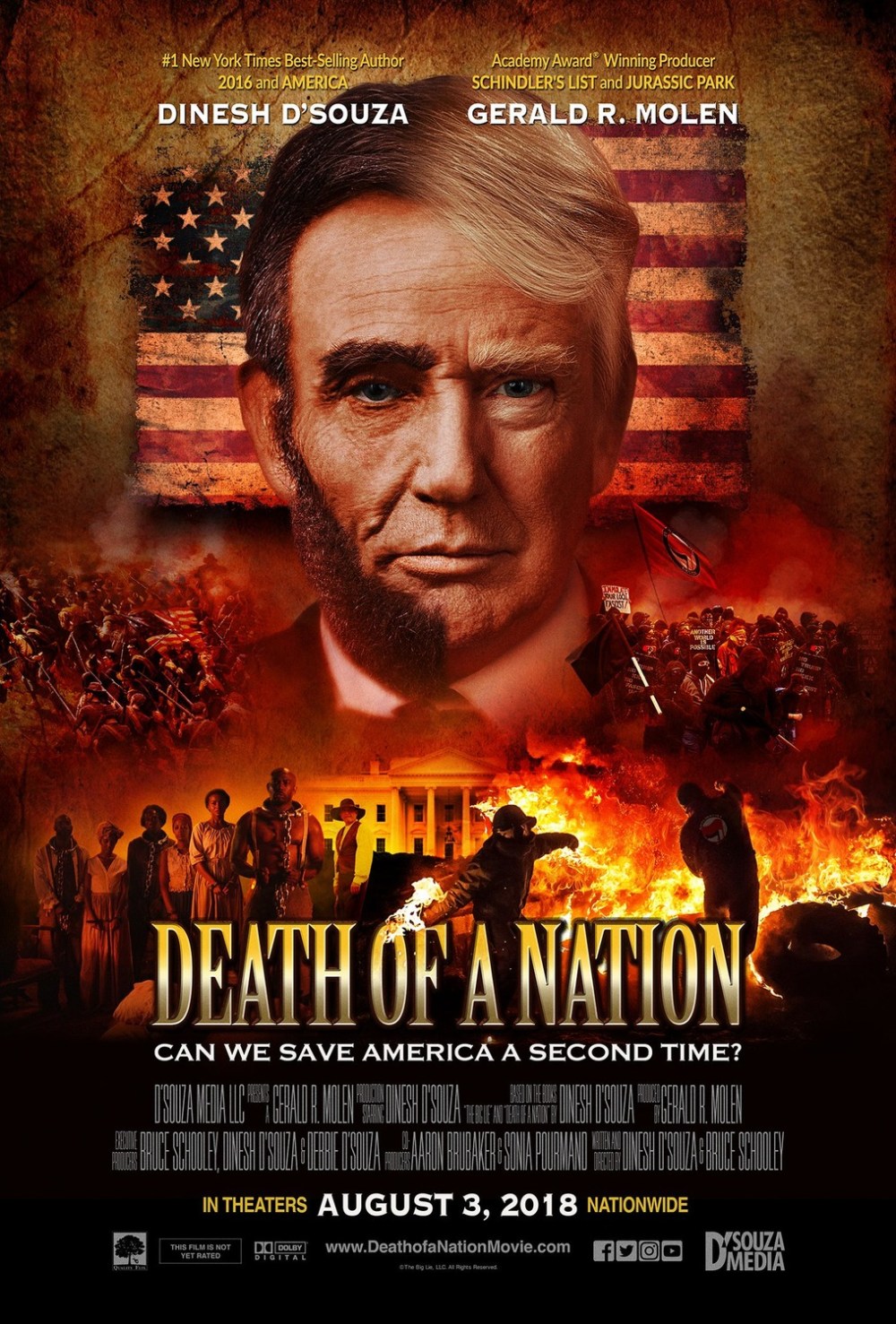
I couldn’t wait to see this movie. That’s right, I called it a movie, not a documentary. Dinesh D’Souza wants you to believe he’s giving you the god’s honest truth, but when it comes to his movies, he instead gives you a distorted vision of reality which he has put together by cherry-picking facts and presenting a thesis statement which any rational human being can easily disprove. As a result, I have come to enjoy D’Souza’s movies for reasons he did not intend as they prove to be both hilarious and infuriating, and whenever I am not bored to death by the ridiculous cases he lays out for us, the experience of watching them proves to be quite visceral.
D’Souza’s latest political screed is “Death of a Nation,” and it comes with the strange subtitle of, “Can We Save America a Second Time?” From the poster, I assumed the recently pardoned conservative political commentator was going to show us how Donald Trump is the contemporary equivalent of Abraham Lincoln, but he instead veers from this to show us in an ill-fated attempt how Nazis and Democrats were very similar in their economic and social policies. Along with co-director Bruce Schooley and producer Gerald R. Molen, D’Souza employs his usual tactics which include poorly acted and directed historical reenactments as well as scenes of him walking around and visiting locations which played a role in history. And yes, there are scenes of people (in particular, his wife Debbie) singing patriotic songs to an infinitely nauseating effect. What results is a veritable shit sandwich as D’Souza invites us to see history through his eyes as he begs the audience to see how Democrats are the real fascists, not the Republicans.
I can only imagine just how much glee D’Souza and his collaborators had in the editing room as we are shown scenes of well-known personalities like George Clooney saying out loud how there was no way in hell Donald Trump could ever be elected President of the United States. Indeed, I believed, as did many that Hillary Clinton would have an easy path to victory. So, it was a huge shock to the world at large when Trump scored one of the biggest political upsets in American history as he spent so much time giving us every reason not to vote for him. D’Souza presents videos of Americans sobbing at this victory as they believe nothing good will come from it, and you can sense him mocking them without any remorse. This whole montage really acts a porn for conservative who live to drink the tears of liberals.
D’Souza wants us to see the election of Trump as America rising up against liberal tyranny, and he smugly pats himself on the back by saying his movie “Hillary’s America” played a big role in Trump’s victory. Truth be told, Trump won the election by one of the lowest margins ever, Clinton got almost 3 million more votes in the popular election, and the day of his inauguration had one of the lowest turnouts ever. Of course, D’Souza doesn’t bring these facts up as they would easily take away from he sets out to prove and instead shows us images of Americans howling in agony over the host of “The Apprentice” making his new home at the White House instead of Trump Tower.
As for “Hillary’s America,” it simply preached to an audience who never intended to vote for Hillary in the first place, and its biggest triumph came at the Golden Raspberry Awards where it won several accolades including Worst Picture. Please note, it is the first “documentary” to receive this award.
But following this, D’Souza puts his defense of Trump to the side and instead looks at Adolf Hitler and the history of the Nazi party in a hopelessly vain attempt to compare them to Democrats. As he lays out his pathetic case, I got lost in his convoluted logic to where I gave up trying to understand much of what he was trying to get across. The audience I saw it with was small, and an older guy sitting one row ahead of me began to snore quite loudly. What does that tell you?
The actors here are badly directed to say the least, and the one playing Adolf Hitler (Pavel Kriz) barely even looks like the infamous fascist dictator. I guess Martin Wuttke, who played a far more convincing Hitler in Quentin Tarantino’s “Inglourious Basterds” was unavailable, or perhaps he looked at what D’Souza hoped to accomplish with “Death of a Nation” and told him “bitch, please.” Other actors play famous Democrats to where they stare directly into the camera as if to say they know just how evil they are, and it got to where I expected them to sing “Damn it Feels Good to Be a Gangsta” by The Geto Boys.
Some scenes end up playing like something out of a sitcom as the actors playing Nazis keep screaming out their lines in an overwrought fashion. But nothing compares to the scene where Nazis break into the apartment of a “brown shirt” Nazi and catch him in bed with another man, highlighting the party’s position against homosexuality. After he is arrested and hauled away, the Nazis look under his bed to find yet another man in the apartment. This threatened to be as hilarious as anything in “Deadpool 2,” and I could barely contain myself while watching this scene as this discovery is presented in such an inescapably absurd fashion.
D’Souza does take the time to interview people like political scientist Robert Paxton, Civil War historian Allen C. Guelzo, sociology professor Stefan Kuhl, and syndicated columnist and investigative journalist Edwin Black to name a few. The interesting thing about these interviews is how the majority of them are shot to where we never see D’Souza and his subject together in the same frame. Seeing this, I cannot help but wonder if D’Souza and his accomplices took the words of his subjects out of context in an effort to add weight to a deeply flawed thesis. This makes me want to know how his subjects thought about how they were portrayed after sat through “Death of a Nation.” There is just too much doubt in the way these interviews are presented which cannot be easily dismissed. At least Michael Moore is smart enough to not make this same mistake in his own movies.
Then there is the interview between D’Souza and white supremacist (or white nationalist if you will) Richard Spencer. As D’Souza fumbles about in his attempts to expose Spencer as a progressive, he discusses how the founders saw government as being the enemy of the people. This is one of “Death of a Nation’s” most jaw-dropping moments as anyone with knowledge of American history will be quick to point out how our founding fathers created a government of, for and by the people. We see Spencer quickly disagreeing with D’Souza over this assessment as even he believes the founding fathers did not see the government as the enemy, and it doesn’t help D’Souza when he gets owned by a White Supremacist.
As “Death of a Nation” rolls on, D’Souza comes to repeat many claims he made in his previous movies. Among them is his assertion that Democrats never switched their political views in the past, and he made this same claim in “Hillary’s America.” When he presented us with this false information originally, we could barely make out the faces of the politicians on the silver screen, and we needed the Hubble telescope to make any of them out. In “Death of a Nation,” we get a better look at those democrats D’Souza was talking about, but it doesn’t change how Democrats or Republicans are no longer the same parties they once were.
When D’Souza finally gets around to defending Trump, he does so by presenting us with scenes of President Lincoln (played by Don Taylor) speaking eloquently and then tells the audience how Trump has the same integrity Lincoln had all those years ago. But considering how Trump has been proven to be very temperamental, has broken many promises he made on the campaign trail, cheated on his wife Melania with Stormy Daniels, has a history of stiffing people he was supposed to pay and, most unforgivably, valued the word of Russian President Vladimir Putin over America’s own intelligence community, one has to wonder if D’Souza even knows the meaning of the word integrity. Once again, D’Souza does not acknowledge any of this, and it should not be hard at all to understand why.
D’Souza’s last bit of business is to show how Trump is not a racist, and he does so by showing him at a State of the Union address where he says, “African-American unemployment stands at the lowest rate ever recorded, and Hispanic-American unemployment has also reached the lowest levels in history.” To this, D’Souza replies, would a racist talk like this? Well, there is a slight problem here. While what Trump says is technically true, the fact is unemployment rates for African-Americans and Hispanics have been decreasing steadily for years, so for him to take credit for this is deliberately misleading. For D’Souza to use this as evidence of Trump not being a racist is just hilarious, and he instead falls into a trap he would have been smart not to set for himself.
Look, I have no doubt D’Souza loves America, but for him to show this love through a manipulation of history and facts is beyond deplorable. These days, it is more about who controls the narrative than it is about verifying facts, and D’Souza seizes on this national weakness in a completely shameless way. “Death of a Nation” is a failure from the get go as it is impossible to put liberalism and fascism into the same category. Just ask historians Adam Tooze and John Broich who have gone out of their way to discredit “Death of a Nation.” Broich himself pointed out how fascism is essentially “anti-leftism,” and he quotes scholar Robert Paxton who said fascism is “dictatorship against the Left amidst popular enthusiasm.” Unlike D’Souza, these guys know what they are talking about.
“Death of a Nation” still has a score of 0% on Rotten Tomatoes, and it does not look to escape this rotten rating any time soon. D’Souza has blamed this rating on “leftist” critics as he is determined to stand by his movie no matter what, and he is daring the Golden Raspberry Awards to shower it with every “Worst of” accolade possible. Look, it’s one thing to criticize the Democratic Party, and D’Souza has the right to do so, but to sell the public on comparisons to the Nazi party which are blatantly fale is truly pathetic. Explaining to D’Souza just how wrong he got history in this or any of his other movies is pointless as he will be quick to put his hands over his ears and spin around in circles saying, “There’s no place like the Ronald Reagan Library! There’s no place like the Ronald Reagan Library!”
How will D’Souza react to my review, assuming any he ever bothers to read it? I imagine he will dismiss me as another leftist critic or something along those lines. Anyone who wants an idea of where my political beliefs are can check out my Facebook page. All that matters is this movie is anti-intellectual as well as political and historical garbage. Yes, I enjoy watching D’Souza’s movies, but mainly for the opportunity to analyze everything that’s wrong with them. When I get past the unintentionally hilarity they provide me, what I am left with is pure nonsense which is truly infuriating. If you choose to see “Death of a Nation,” see it as an example of how NOT to make a documentary and of how people will go out of their way to manipulate history to their own ends.
For those of you who are still willing to believe in D’Souza’s political and historical garbage, I have a used Yugo for sale which goes from zero to 60 miles an hour in five seconds. Please message me privately if you would like to know more.
ZERO out of * * * *
Please check out the following articles in which writers lay waste to the connections D’Souza makes in this movie:
“There is Nothing Liberal about Fascism” by John Broich
“Donald Trump Jr. Compares Democrats’ Policies to Those of the Nazis” by Andrew Buncome
“The Apotheosis of Dinesh D’Souza” by
Kevin Kruse’s Recapitualation of Dinesh D’Souza’s View of American history

 The Ultimate Rabbit