No, I Haven’t Seen It Until Now: ‘Cujo’
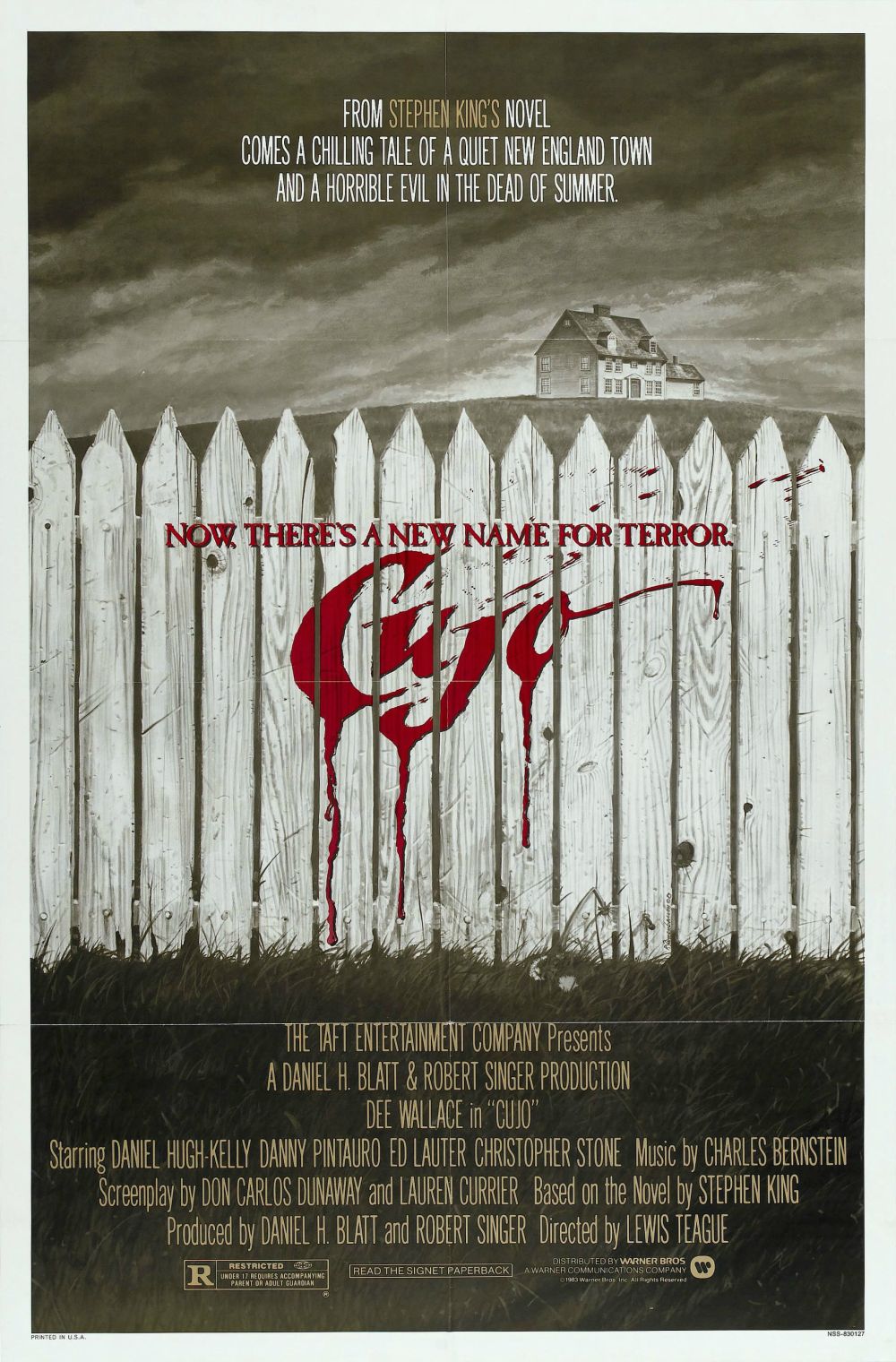
It took Cinematic Void putting together a Stephen King film festival at the Egyptian Theatre in Hollywood to give me a reason to finally check out the cinematic adaptation of “Cujo.” It was a movie I have heard a lot about, and I remember the book’s original artwork with those growling teeth which indicated this particular dog was looking for more than puppy chow and snausages. Moreover, the word Cujo has long since been burned into my consciousness, and it seems to exist as a description of a dog who has gone mad and cannot be mistaken for man’s best friend. In “Fletch,” it made perfect sense when Chevy Chase said “Cujo” as he wandered through a seemingly abandoned house in Utah. Considering he was attacked by a Doberman Pinscher earlier in the film, his fear of being attacked again was completely understandable.
“Cujo” was released in 1983 during a decade when adaptations of King’s work were plentiful and varied in quality. While some were exceptional (“Stand by Me,” “The Shining,” and “The Dead Zone”), others like “Maximum Overdrive” just didn’t work. “Cujo,” however, proves to be an above average adaptation of his work as well as one of the more unusual. While many of his books deal with the supernatural, this one deals more with the horrors of real life instead of just monsters.
I’m sure you all know the story to “Cujo” by now. In case you don’t, it involves a beautiful St. Bernard who, at the movie’s start, chases a rabbit through the woods. In the process, he gets his head stuck in a cave filled with bats, one of which bites him on the nose. From there, he goes from being a lovable household pet to an infinitely vicious one as he attacks any and every human being in his sight.
From the outside, “Cujo” seems to have a very straightforward plot which indicates to the viewer it will be one of those animal attack movies we have seen time and time again. But what really surprised me most is how it focused more on the human element to where I realized the dog was really a supporting character more than anything else.
You have Vic and Donna Trenton (Daniel Hugh Kelly and Dee Wallace), a married couple and the proud parents of a highly imaginative boy named Tad (Danny Pintauro). But while they appear to be leading the perfect life in Castle Rock, Maine, there are cracks beneath the surface which will inevitably become visible to everyone. Vic is increasingly concerned with economic security, something even more understandable these days. Donna is having an affair with Steve Kemp (Christopher Stone), her ex-boyfriend from high school, as she is terrified of being trapped in a small town for the rest of her life. And Tad, he is still at an age where it’s far too easy to believe monsters are hiding in the closet and waiting to jump out at him. Seriously, seeing Tad race to his bed after turning off the light and hiding under the covers brings back a lot of memories.
Taking the fears of each character into account, it serves as a reminder of how brilliant King is at examining not just horrors of the unknown, but also the ones we are forced to experience in the real world. This makes “Cujo” especially effective as the obstacles these characters are forced to deal with feel almost as scary as the thought of this dog tearing their flesh apart.
“Cujo” was directed by Lewis Teague who also helmed the Stephen King anthology film “Cat’s Eye” as well as the cult classic “Alligator” and “The Jewel of the Nile.” Teague was lucky he got to make “Cujo” back in the 80’s, a decade where filmmakers had the opportunity to build up to a furious climax instead of being forced to rush straight to one. These days, studio executives would have begged, if not ordered, him to rush right into the sequences where the dog attacks the hapless humans and increase the blood and gore horror fans are expecting. Instead, Teague got to take his precious time introducing us to characters who are not mere stereotypes and whose struggles will soon pale in comparison to the dog whose appearance becomes increasingly dirty and slimy.
This movie’s major set piece comes when Donna and Tad become trapped in a Ford Pinto as Cujo thrashes away at it, trying to get inside. From there, “Cujo” becomes a major exercise in sheer intensity as we watch Donna do what she can to save herself and her son before the dog makes chop suey out of them both. But if the dog doesn’t get to them, the sweltering summer heat may do them in instead. Suffice to say, they cannot stay in the car forever.
It’s interesting King chose a St. Bernard as the type of dog instead of another like a Doberman Pinscher. Of course, casting a Doberman might have seemed like typecasting as they have always been the villains of dogs. St. Bernard dogs seem more like comic relief, and this was made clear back in the 1990’s with those “Beethoven” movies starring Charles Grodin. Therefore, choosing a St. Bernard as a dog is an inspired choice as it shows how easily a dog, any dog, can turn deadly after being bitten by a bat. When we first see Cujo, he is a beautifully groomed dog you just want to hug. But he soon becomes a dog in desperate need of a shower as he looks disgustingly slimy and has what looks like an abundance of snot sliding off his face. Eventually he becomes an evil force to be reckoned with, and it’s easy to understand how no one could have prepared for him.
But while this dog looks to be the main star of “Cujo,” he is not. The real star is instead Dee Wallace who, just as she did in “E.T. The Extra Terrestrial,” gives us a mother who cannot be mistaken for the average movie mother. I love talking about when actors inhabit roles more than play them, and it is certainly the case with Wallace here as she gives a performance best described as emotionally blistering. She makes us feel Donna Trenton’s frantic struggles as well as her mental and physical exhaustion in dealing with a crumbling marriage, an affair, her son and, of course, the dog. Also, she makes us feel every single bead of sweat coming off of her body as she and Tad are trapped not just in the car, but in the sweltering summer heat as well.
There also moments where Donna loses her patience with Tad, and this makes Wallace’s performance feel all the more real. Just as “Cujo” was being released, some associated with its production were keen to cut a scene where Donna snaps at her son as she grows tired of his crying out for daddy. This, however, would have been mistake as all parents lose their patience with their children. Seriously, just as my mom. I’m sure she has tons of stories she would love to share with you.
While I’m at it, let’s not leave out Danny Pintauro whose performance as Tad feels unbearably real at times. Seeing him weep and panic when the dog tries to get at him and his mother makes an already intense motion picture even more intense.
Teague and his collaborators which include composer Charles Bernstein, director of photography Jan De Bont, and editor Neil Travis clearly had more on their mind than giving us the average horror film with “Cujo.” While there is a conventional feel to much of what we see here, the filmmakers were more invested in the human element than the animal one. Lord only knows how this movie would look if it were made today, and I’m stunned it has not been remade yet. As this cinematic adaptation shows, horror movies can’t thrive unless we are emotionally invested in the characters to where they are not just stock or filler. This film may not be a masterpiece, but it proved to be far more effective than I ever could have expected it to be.

 The Ultimate Rabbit