‘Homicide: Life on the Street’ Commentary on ‘A Shot in the Dark’
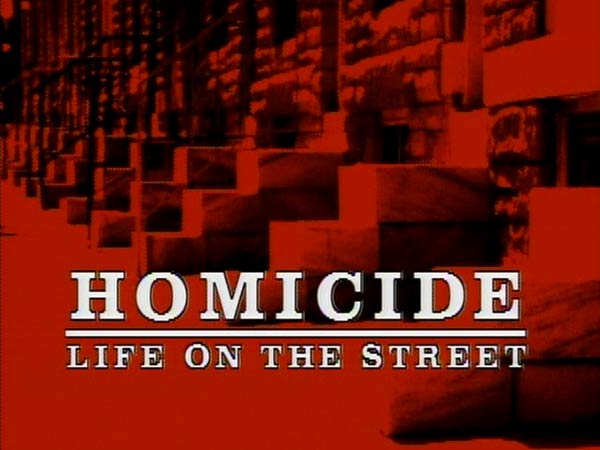
Recently, “Homicide: Life on the Street” has undergone a major renaissance of sorts. The show is now finally available to stream on Peacock, and we have two new podcasts dedicated to the acclaimed series. First, there is “Homicide: Life on the Set” which is hosted by filmmaker and podcaster Chris Carr and Susan C. Ingram who worked as a union camera assistant on “Homicide,” and they have interviewed actors, writers, directors and technicians who worked behind the scenes and have made unforgettable stories to tell. Then there is “Homicide: Life on Repeat” which has actors Reed Diamond and Kyle Secor reviewing each episode of the show from start to finish, and that’s regardless of whether they are in said episode or not. With all this going on, “Homicide” looks to be gaining a new generation of fans and may even become a bigger hit with viewers than ever before.

With this “Homicide” commentary, I focus on the fifth episode of the first season entitled “A Shot in the Dark.” Directed by Bruce Paltrow and written by Jorge Zamacona, it follows multiple plot threads back when the show could get away with that. Stanley Bolander (Ned Beatty) and John Munch investigate the double shooting of a drug dealer, Frank Pembleton (Andre Braugher) and Beau Felton (Daniel Baldwin) join forces reluctantly to look into a theory regarding Adena Watson’s murder, Tim Bayliss remains convinced that the arabber Risley Tucker murdered Adena and wants to bring him in for questioning, and Steve Crosetti (Jon Polito) and Clark Johnson continue to look into the shooting of Chris Thormann (Lee Tergesen) who has miraculously survived his nearly fatal wounds. It’s amazing just how much the writers got into one single episode!

In the midst of all this, Bolander seems unable to deal with the aftermath of his date with Dr. Blythe (Wendy Hughes), Felton and Pembleton battle with one another over how they see things, and Bayliss gets revenge at Captain Barnfather for releasing information he shouldn’t have released. Of course, Bayliss still pays a price for going after a superior officer. And Munch? Well, let’s just say he steals the show at the very end.

Please check out the commentary below. “Homicide: Life on the Street” is now available to stream on Peacock, and the entire show is still available on DVD through Shout Factory.
‘Homicide: Life on the Street’ Commentary on ‘Son of a Gun’

It has been a bit, but I am now back with another “Homicide: Life on the Street” commentary track. This time it is for “Son of a Gun,” the fourth episode of the first season. This episode contains several plot threads as the detectives furiously investigate the shooting of Officer Chris Thormann (Lee Tergesen), Tim Bayliss (Kyle Secor) and Frank Pembleton (Andre Braugher) continue to investigate the murder of Adena Watson, Stanley Bolander (Ned Beatty) goes out on a date with Doctor Carol Blythe (Wendy Hughes), and there is also the case of Calpurnia Church (Mary Jefferson) who has murdered many people for the insurance money. This is a lot for any hour-long drama to handle, but everyone involved seems to find the right balance to where nothing feels superfluous.

“Son of a Gun” was directed by Nick Gomez who helmed a couple of indie crime dramas back in the 1990’s: “Laws of Gravity” and “New Jersey Drive.” It marked the first appearances of Sean Whitesell who portrays Dr. Eli Devilbiss, Edie Falco who portrays Chris Thormann’s wife, Eva, and Walt McPherson who plays an patrolman who may or may not be Roger Gaffney, the most odious and bitter character in the “Homicide” series.

This episode was the first thing I ever saw Edie Falco in, and she previously appeared in Gomez’s “Laws of Gravity.” From here, Falco would go on to play a role in Tom Fontana’s HBO prison drama “Oz,” and she would eventually make her breakthrough a few years later on “The Sopranos.”

There are also other memorable performances to be found in this episode. The great Luis Guzman appears as Bolander’s next door neighbor, Lorenzo “Larry” Molera, who has quite the love for wood. Then there is the late Wendy Hughes who plays a potential girlfriend to Bolander in Carol Blythe, and seeing her and Beatty together provides this episode with the series’ more intimate moments.

Check out the commentary below. The complete series of “Homicide: Life on the Street” is currently available to purchase from Shout Factory. To this date, it is still not available to stream on any service. This is likely due to music rights.

‘Homicide: Life on the Street’ Commentary on ‘Night of the Dead Living’

I am back with my latest audio commentary on an episode of “Homicide: Life on the Street,” and the one on display here is “Night of the Dead Living,” a nice little play on words on the title of the classic horror film, “Night of the Living Dead.” It was directed by Michael Lehmann who gave us one of the greatest black comedies ever made, “Heathers” which starred Christian Slater and Winona Ryder. Lehmann also directed “Hudson Hawk” which starred Bruce Willis and proved to be a critical and commercial bomb, but has since become a cult classic of sorts. The teleplay was written by Frank Pugliese who won a WGA Award for his work on this episode. Pugliese is a writer and playwright, and his plays include “Aven’U Boys” which an Obie Award, and he wrote the screenplay for the 2006 film “Infamous.”

“Night of Dead Living” was the third episode of “Homicide’s” first season, but NBC decided to air it as the season finale due to its slow pace and the fact they were trying hard to “woo” more viewers for this show which was already suffering a decline in ratings. For me and many others, the airing of this episode in this order was confusing as hell as it looked as though Tim Bayliss and Frank Pembleton had another chance at closing the Adena Watson case. Watching it now, it feels like the cruelest of teases.

What I love about this particular episode is how unusual it is for “Homicide” let alone any other police drama as it is one without any murders or crimes committed. The detectives are working the night shift during a hot summer night, and Lieutenant Al Giardello is furious because the air conditioning is off in the office and everyone is sweating like crazy to where they are taking off their ties. That is, except for Frank Pembleton who remains as cool as can be despite the heat.

Please check out the commentary track below and let me know what you think about this episode.

‘Homicide: Life on the Street’ Commentary on ‘Ghost of a Chance’

So here I am with another commentary track for an episode of “Homicide: Life on the Street.” This one is titled “Ghost of a Chance,” and it is the second episode of the first season. The story is by Tom Fontana, the teleplay was written by Noel Behn, and the episode was directed by Martin Campbell. Campbell would later go on to direct to James Bond films, “Goldeneye” and “Casino Royale.” After the brilliance of “Gone for Goode,” I wasn’t sure the next episode would be anywhere as good. Thankfully, it was.

“Ghost of a Chance” starts off with the murder of Adena Watson, the first case for rookie detective Tim Bayliss (Kyle Secor), and the one case which would haunt him the most throughout this series. There are also some other plotlines explored here. John Munch (Richard Belzer) and Stanley Bolander (Ned Beatty) investigate the death of Thomas Doohen whose widow, Jessie (Gwen Verdon), cannot wait to be rid of him, Kay Howard (Melissa Leo) and Beau Felton (Daniel Baldwin) work to find much-needed evidence in a murder case, and Bolander develops a crush on Carol Blythe (Wendy Hughes) which has him acting rather awkwardly.

We are also introduced to Officer Chris Thormann (Lee Tergesen), a character who will become especially important in later episodes.

Please check out the commentary below.

‘Homicide: Life on the Street’ Commentary on ‘Gone For Goode’

So here I am with another commentary track after the one I did for “Pump Up The Volume.” But this time, it is for an episode of one of my favorite television shows of all time, let alone of the 1990’s, “Homicide: Life on the Street.” Specifically, the commentary is on this show’s very first episode, “Gone For Goode,” which did a brilliant job of introducing us to various Homicide detectives, and also showed how it was not going to be your usual cop show. Instead, it was initially designed to be one without onscreen violence, something which executive producer and showrunner Tom Fontana thought was crazy, and he quickly signed up with the show as a result.

What hooked me onto this show was the fact it was being developed by Barry Levinson, the Oscar winning filmmaker of “Rain Man.” He also directed the “Gone For Goode” episode and introduced its cinematic style which no other director could direct their way out of.

With this commentary track, I express my thoughts on this episode and the show at large. Upon watching “Gone For Goode,” I was immediately hooked into what this groundbreaking series had to offer, and I did my best to provide as much trivia about its making as I could. I’m not sure there will ever be a perfect commentary track to anything unless it is done by Martin Scorsese or Bruce Campbell, but I would like to think this one comes close. If you say it does, it will do wonders for my fragile ego.

Please feel free to listen to the commentary track below as you watch this episode on your DVD player. At this time, “Homicide: Life on the Street” is not available to stream, most likely due to music rights, but you can purchase the complete series on DVD from Shout Factory. It was previously available in a box set from A&E Home Video, but it has long since gone out of print.

Sandy King Carpenter on the Failure of ‘Vampires: Los Muertos’


Vampires Los Muertos movie poster

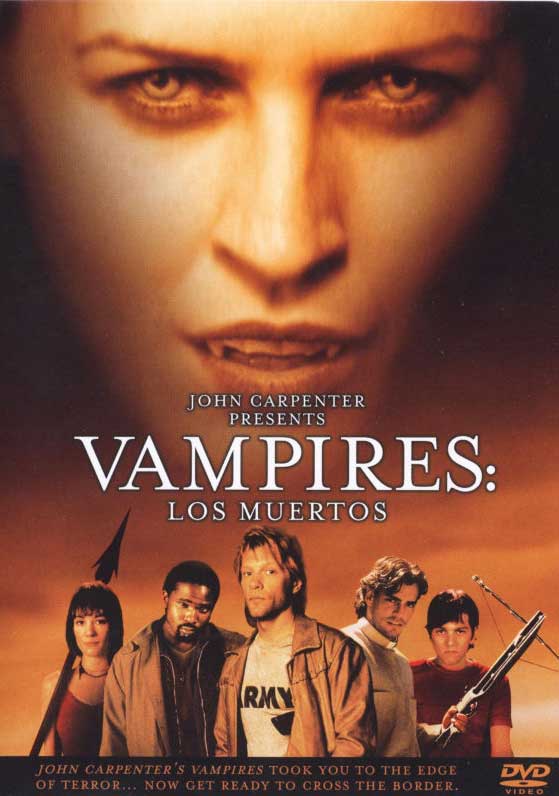
While at New Beverly Cinema on November 19, 2011 to talk about her husband John Carpenter’s movie “Vampires,” producer Sandy King also took the time to discuss its sequel “Vampires: Los Muertos.” Not many know about this one, but this is largely because it went straight to video and features none of the cast from the original. King went into detail about its making, and she summed up Screen Gems handling of it by saying, “They fucked it up!”

The original storyline for “Vampires: Los Muertos” had all the original slayers dead which necessitated that a new team be put together. Tim Guinee was set to return as Father Adam as his character was intended to be the through line for both films. Sheryl Lee was also expected to return as Katrina who had since become queen of the vampires. King never mentioned if Daniel Baldwin would be back, but I’m assuming this was not a real possibility.

The problem with this sequel, King said, was the studio thought they got the movie, but really did not. This was quickly proved when they introduced some changes during the film’s production. Guinee ended up not being brought back, and we see Father Adam’s grave at the movie’s start. Instead, they ended up casting a Mexican soap opera star named Cristián de la Fuente as a completely different character named Father Rodrigo. King was also perplexed as to why they cast rocker Jon Bon Jovi as the lead vampire hunter, Derek Bliss. Granted, Jovi is not a bad actor, but King best described him as looking like a “New Jersey surfer.”

At one point, the studio called both King and Carpenter and asked them, “Can you tell us how to fix this?” To this, King replied quite bluntly, “No.”

In the end, King made clear how the studio’s interference is what messed everything up. She said if you don’t understand the myths and legends involved in the original “Vampires” movie, then “you’re going to fuck it up.” Also, if your main villain of a female vampire is not the hottest lady, then the story won’t make a lick of sense. All of this, in her opinion, showed a lack of respect not just for the audience, but also for the genre as well.

In all fairness, “Vampires: Los Muertos” is an okay movie if you expect nothing more than a decently entertaining B-movie. Even King said director Tommy Lee Wallace, who had directed another sequel to a John Carpenter movie with “Halloween III: Season of The Witch,” did a lot of neat things which were fun to watch. I myself loved the kick ass rock and roll score by Brian Tyler who has since gone on to compose the music for “Rambo” and several of the “Fast & Furious” movies. But when all is said and done, this sequel was a missed opportunity, and it serves as yet another example of why studio executives would do best not to interfere too much, if at all, in the moviemaking process.


Sandy King Revisits ‘John Carpenter’s Vampires’ at New Beverly Cinema

Vampires movie poster

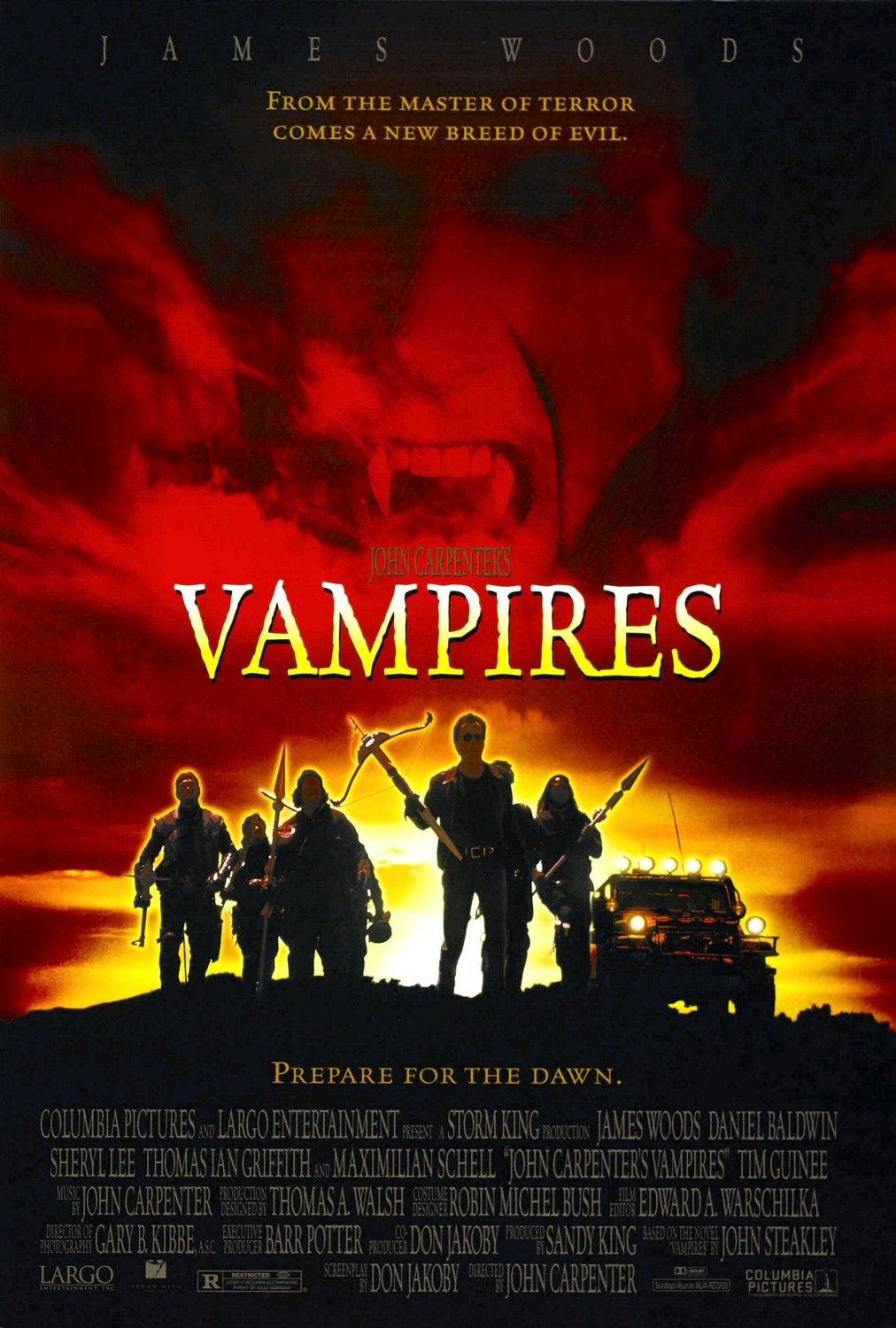
Movie producer Sandy King dropped by New Beverly Cinema on November 19, 2011 to talk about her husband John Carpenter’s movie “Vampires.” The website Horror Movie a Day hosted the midnight screening which brought out a small but dedicated crowd who yearned to see it on the big screen again. Carpenter once said he originally became a filmmaker to make westerns, and this movie, based on the novel “Vampire$” by John Steakley, is the closest he has ever come to making one.

King said the project came to her and Carpenter after she bailed out a producer who was working on a Largo Entertainment show. Largo Entertainment was the sales engine behind this feature, and while she and Carpenter were used to putting their own projects together, King stated they were “more for hire” when it came to “Vampires.”

Casting “Vampires” was Reuben Cannon who brought actors from all over the world to his casting office. There were even midget actors, King said, who were about 4 feet tall. Many who did get cast as blood suckers were stunt people as they had to perform the movie’s most dangerous stunts. The scene where vampires climb out of the dirt proved to be the roughest stunt of them all.

Thomas Ian Griffith was cast as the imposing master vampire, Valek. King was standing outside Cannon’s office when she noticed a shadow looming over her. It turned out to be Griffith who is actually 6’ 6” tall, and his height gave her the strong impression of a vampire. King also said on top of Griffith being tall and athletic, he could also act which made him a perfect choice for the role.

When it came to describing James Woods, who plays Jack Crow in the film, King said bluntly, “He’s nuts!” It turned out King and Woods shared the same publicist, and Carpenter was looking for a really good actor to play Jack Crow. While Woods proved difficult to cast as the studio didn’t want him in the lead, Carpenter was intent on working with him despite the actor’s reputation of being difficult to work with. The role, however, turned out to be a real physical challenge for Woods as he was not really an athletic actor at the time, something which is hard to believe after watching “Vampires.” Stunt coordinator Jeff Imada ended up helping him look as tough as he does onscreen, but King stressed Wood’s role was really about acting more than anything else.

As for the rest of the cast, King described them as “great” and “really good people.” She said Sheryl Lee, who played the prostitute Katrina, is “the most unspoiled actress ever.” Daniel Baldwin, who played Montoya and is better known for his legal problems, was not a problem according to her. In fact, when a wave of bronchial flu ended up infecting the cast and crew, she said Baldwin ended up bringing soup for everyone.

While receiving a rather middling reception when it debuted domestically, “John Carpenter’s Vampires” is a better movie than people generally give it credit for. Like many of the “Halloween” director’s films, it has gained a strong cult following years after its release, and I still find it to be wildly entertaining to this very day.