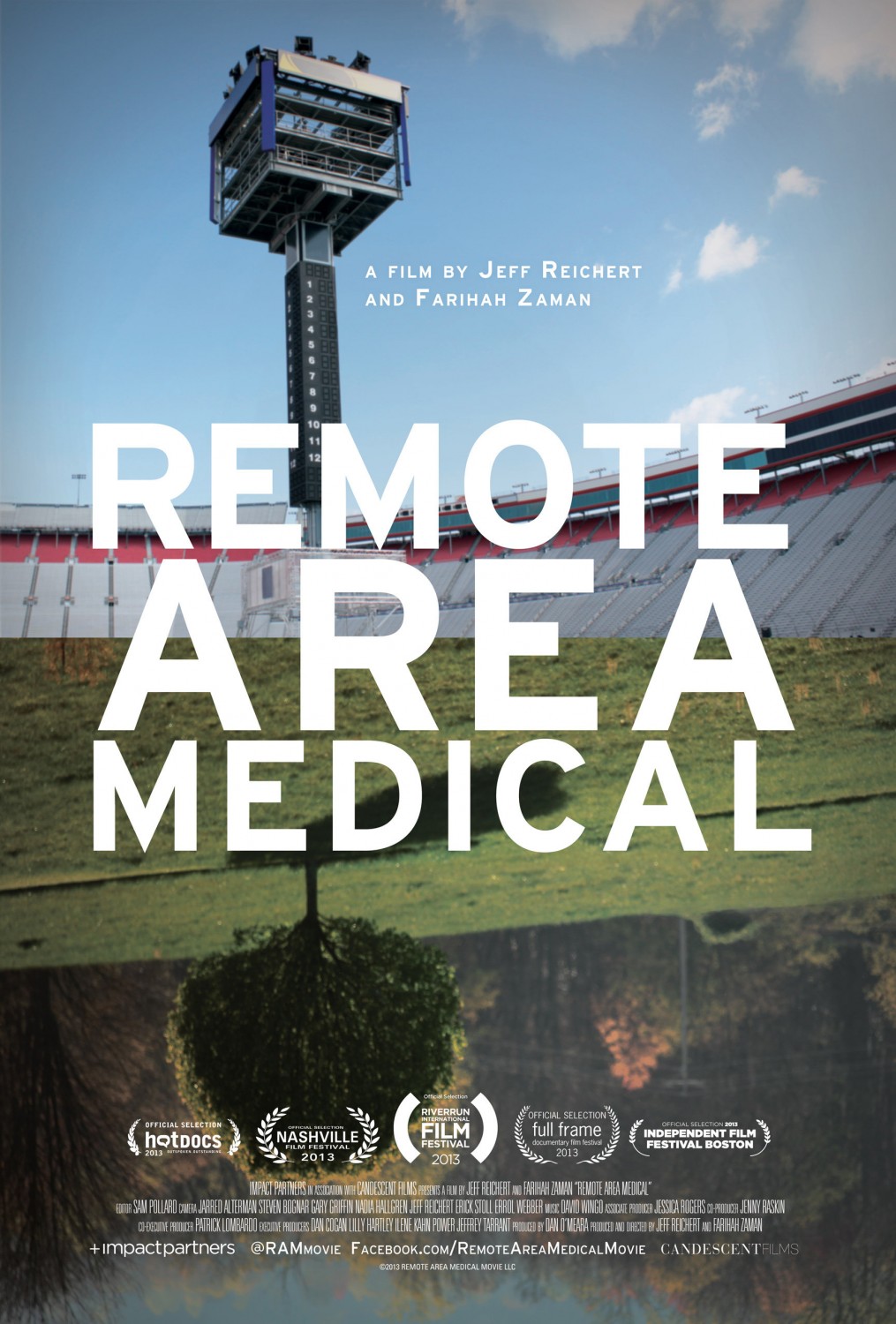
“Remote Area Medical” focuses on the non-profit medical provider of the same name, better known as RAM, when they opened a three-day clinic held at the Bristol Motor Speedway in Tennessee, and we watch as hundreds wait by their cars in the hopes of getting the kind of health care they never have any easy access to. While there has been an endless debate in the United States about how to handle health care, this documentary chooses to focus on people instead of policy. We get a close up look at how this clinic starts off with a 3:30 a.m. ticket distribution which determines who will get seen for routine check-ups, and the patients tell us about themselves through stories which prove to be both vivid and heartbreaking. In addition, we also get to meet those who volunteer their time at the clinic like the organization’s founder, Stan Brock, a doctor who happens to drive a refurbished 18-wheeler truck, and a denture maker who also works as a jeweler. From start to finish, “Remote Area Medical” puts a human face on what it means to not have access to health care, and it makes for one of the most unforgettable documentaries of 2014.
I got the opportunity to speak with its directors, Jeff Reichert and Farihah Zaman, while they were in Los Angeles back in 2014. They are married to each other and actually volunteered at a RAM clinic back in Pikesville, Kentucky in 2011 where they were overwhelmed by stories they heard of patients in need and volunteer doctors working overtime to provide care. Reichert and Zaman also directed the documentaries “Gerrymandering” and “This Time Next Year.” They discussed what stunned them most as volunteers at RAM, what they learned about people who live in the Appalachian community, and they talked more about the conversations they had with Stan Brock.
Please check out the exclusive interview down below, and I have also included a trailer for “Remote Area Medical” as well for you to check out. This documentary is now available to own and rent on DVD, Blu-ray and Digital.
To learn more about Remote Area Medical (RAM), please feel free to visit their website at ramusa.org.
Recently, I was listening to an episode of Mick Garris’ podcast “Post Mortem” in which he talked with those involved in the horror genre who are currently walking the picket lines for the Writers Guild of America strike. In his conversations with Leigh Whannell, Darren Lynn Bousman and “Fright Night” director Tom Holland, I came to see how those who make scary movies are the nicest and most kind in the business as they constantly wish the best for one another. In any other part of Hollywood, jealousy typically rears its ugly head to an infinite degree as insecurity remains a constant.
I was reminded of this while watching the documentary “Hollywood Dreams & Nightmares: The Robert Englund Story” as it brings together a plethora of horror actors and filmmakers such as Eli Roth, Tony Todd, Lance Henriksen, Adam Green and Lin Shaye among many others. But regardless of their love of horror films, they are mainly here to talk about the actor who originated the role Freddy Krueger in Wes Craven’s “A Nightmare on Elm Street.” What results is a documentary which delves deeply into Englund’s career and ponders whether is best to be known for portraying one character or many.
Directors Christopher Griffiths and Gary Smart take their sweet time looking over Englund’s acting career, and it is great to look at when he started as this is something I have not seen enough about, His parents were not keen on him becoming an actor as they felt he was destined to become a lawyer. Hearing this, it kind of sounds like he had Kurtwood Smith’s character from “Dead Poets Society” as a father (“You’re going to Harvard, and you’re going to be a doctor”). Nevertheless, he idolized Steve Allen, and the acting bug bit him really hard.
While he was determined to become a stage actor, thinking it would be a fair business (no business ever is), he eventually made his way to Hollywood where he made his film debut in “Buster and Billie.” It was interesting to learn that he was typecast for years as a southern redneck for years, and his breakthrough role turned out not be as Freddy, but instead as resistance leader Willie. This brought him worldwide fame, playing one of the nicest aliens in a show filled with devious ones. And then came the child murderer who haunted and killed the younglings on Elm Street. From there, audiences around the world would quickly forget he ever placed nice guys.
Back in the 1980’s, there was no escaping Freddy Krueger as he was literally everywhere. On top of appearing in “A Nightmare on Elm Street” and its many sequels, there was also the television series “Freddy’s Nightmares,” and I believe there was even a rap album. I mean, let’s face it, everyone had a rap album back in the 80’s. Whether it was a good rap album or a horrifically awful one is open to debate.
This is the part of the documentary I was especially interested in because, while Englund never lacked for work in the 80’s, I wondered how he felt about being known for this character more than any other he has ever portrayed. As actors, we yearn to have a career like the ones Meryl Streep and Robert De Niro have as they continue to have the fortune to portray a sublime variety of characters to where it appeared as though they could play anyone and anything. But being typecast seems like a lifelong prison sentence to where no one will let you get paroled in this lifetime.
While I hoped Griffiths and Smart would have dug deeper into Englund’s typecasting as it clearly had an effect on the work he was able to do outside of Elm Street. He makes clear at one point about how he was forced to turn down several roles because of his involvement in the franchise which built up New Line Cinema, and that must have wounded him more than we see here.
An example of this typecasting comes when Englund and others talk about his role in “The Phantom of the Opera” in which he plays another horribly disfigured character, but one who is madly in love with a soprano singer and kills others to steal their skin and apply it to his mangled face.. And yet, when this particular film was being released, its American poster featured a picture of him as Freddy taking a mask off. While Englund was trying to do something a little different, Hollywood still played it safe by reminding audiences he was Freddy.
But the real surprise and satisfaction I had with “Hollywood Dreams & Nightmares” was seeing how Englund looks at his fame as a “happy accident.” Whereas some actors have been desperate to escape the horror genre, Englund has found a wealth of opportunities within it which he may not have gotten elsewhere. Even in movies like “The Mangler,” “Wishmaster,” “Urban Legend,” “2001 Maniacs,” “Hatchet,” “Zombie Strippers” and “Behind the Mask: The Rise of Leslie Vernon,” he has had the good fortune to portray a variety of characters to where you have to envy what he has accomplished in his long career.
Also, this documentary makes it very clear how nice a guy Englund is in real life. This shows in the way he talks and acts around others, and from the various participants who are interviewed throughout. While he may have a dark side, and everyone does by the way, it’s usually the nicest people who end up portraying the most devilish of characters. Some may disagree, but judge not lest ye be judged.
And again, the horror community on display here seems like a great group of people as everyone speaks warmly of one another. Considering how maligned a genre it has been made out to be by many critics and the touchiest of individuals, we see how it deserves to be taken much more seriously. Whether you like horror films or not, the majority of them are not crap or easily disposable.
While this is not a groundbreaking documentary in any way, shape or form, “Hollywood Dreams & Nightmares: The Robert Englund” gives us a memorable portrait of an actor who never set out to be a horror icon but became one out of sheer luck and with the help of engine oil he put into his hair for his Freddy audition. Watching Englund here reminds me of how actors can never really prepare their careers as they may end up in a far different place than they ever dreamed. Like the Rolling Stones said, you can’t always get what you want, but if you try sometime, you just might find you get what you need.
One more thing, I do hope Englund gets to play Freddy Krueger one more time. His appearance on “The Goldbergs” should not be the character’s swan song. Maybe they could do something along the lines of “Logan” where we see an old age Freddy. Hey, maybe even a musical would work. Just get Baz Luhrmann to direct it and it will be spectacular! I can see it now:
Oscar-winning actress Anne Hathaway stars in “Song One,” a drama where she plays a young archaeologist named Franny. At the movie’s start, her brother Henry (Ben Rosenfield) is hit by a car and goes into a coma, and she flies back to New York to be at his side. In the process of going through Henry’s notebooks, she comes into contact with James Forester (Johnny Flynn), a favorite musician of Henry’s. James has had some success in music but is also a shy and private man suffering from writer’s block. From there a romantic relationship between the two begins, and they soon help each other find their way through the darkest of times.
“Song One” was written and directed by Kate Barker-Froyland who had worked as a director’s assistant on one of Hathaway’s biggest hits, “The Devil Wears Prada.” One of her main intentions with this film was to capture the lively music scene of her Brooklyn neighborhood. Indeed, it is a lot of fun listening to the music as you can tell these musicians are playing and singing out of their love for music as opposed to just chasing a record deal (although I’m fairly certain they wouldn’t mind that either). Watching it made me want to take a vacation to Brooklyn just to see this music scene up close.
I got to speak with Hathaway during a “Song One” roundtable interview held at the SLS Hotel in Beverly Hills, California, and I told her how much I enjoyed watching and hearing the musicians featured in the movie. These were musicians playing with all their heart and soul, and I was curious how she and the filmmakers gathered up so many talented ones for this project. It turns out a lot of that was due to the participation of Jonathan Rice and Jenny Lewis who have had tremendous success together on the music scene, but Hathaway said getting the both of them on board was a little tricky.
Anne Hathaway: My husband (Adam Shulman) and I were friends with Jenny Lewis and Jonathan Rice, and when we initially ready the screenplay back in 2011 we just kind of had one of those like dream musicians for this and we both said them. And then we kind of laughed at our audacity and decided that could never possibly happen because we couldn’t get them, and also they were friends and we would have felt awkward. We were worried about it bordering on being opportunistic, so we spent a while pursuing other avenues trying to come up with better ideas. Then Kate came up with a draft that had focused on the James character and we asked Jonathan if we had hit the right tone with the character. He asked who’s doing the music and we were like half-jokingly, ‘Well you if you want to.’ He was like, ‘Okay let me give it to Jenny,’ and she read it and they were open to the process of meeting Kate, and then they met and they really liked each other. The next morning, we opened up our emails and there was this song (from Jonathan and Jenny) and it was Little Yellow Dress and it was incredible. And then Jonathan Demme, our producer, came out. Jonathan Demme has one of the deepest and most beautiful encyclopedias of music in his head, and to watch him and Jenny and Jonathan just kind of talk music and talk about the sound and who James Forrester was, it was a thing of beauty. From then on they were in the movie, and a lot of the musicians wound up being contacts that they knew. They were so integral to the sound of the film.
To read about “Song One’s” making is to see it was a movie made by friends who brought everything they had to this project. In addition, they brought with them a lot of great music which feels authentic to the locales it takes place in, and it’s the kind of music that fills up your spirits when you’re feeling low.
“Song One” is now available to own and rent on Blu-ray, DVD, and Digital.


 The Ultimate Rabbit