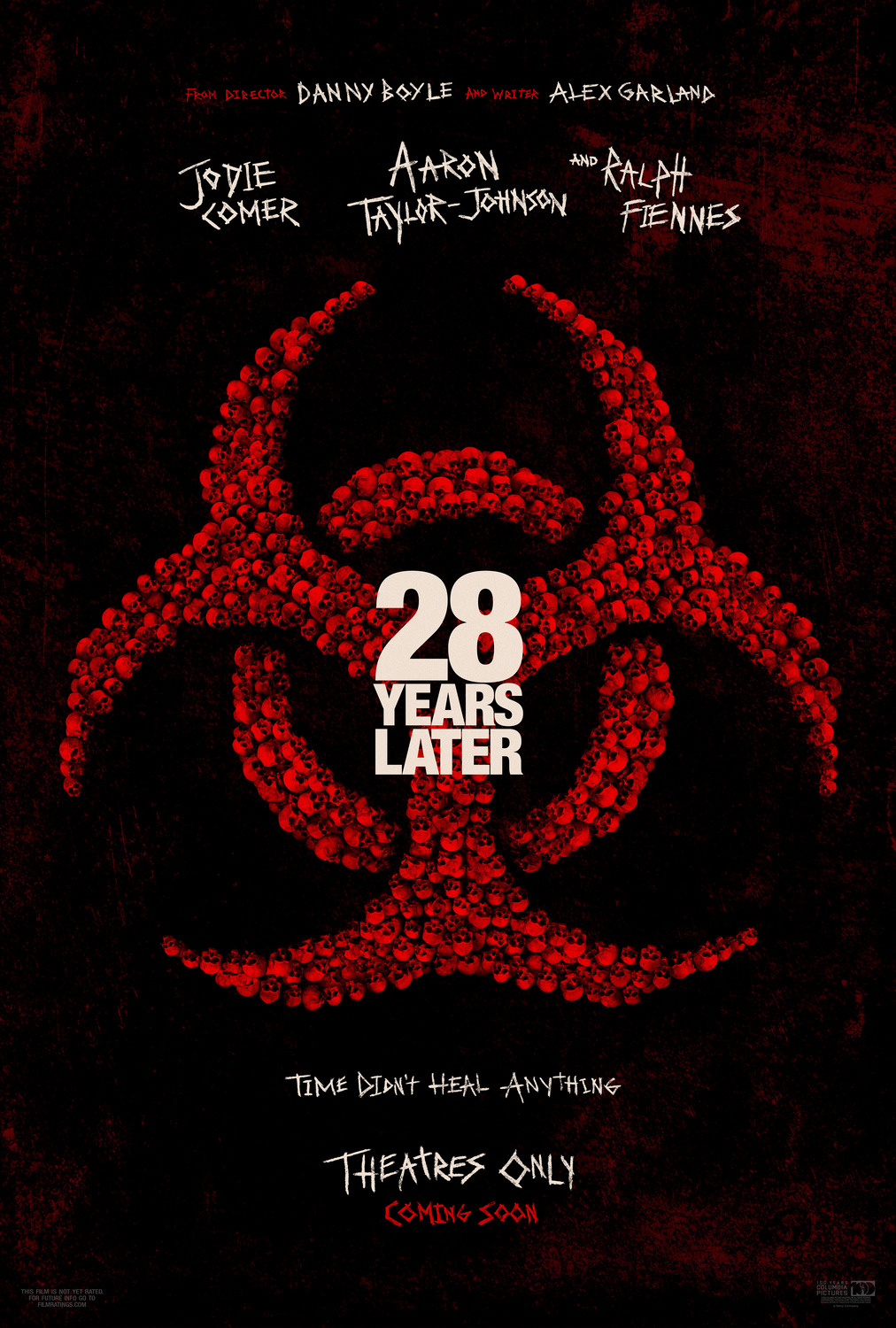
And so, it has finally arrived: the first trailer for the long-awaited sequel, “28 Years Later.” Like another sequel, “Beetlejuice Beetlejuice,” it was stuck in the deep, dark and despairing pit known as development hell. But like said sequel, this one finally emerged from its depressing depths and looks to promise us another round of infected zombies running way too fast and devouring everything in their path, and it looks to be a creative reinvigoration for Danny Boyle, the Oscar winning director of “Slumdog Millionaire.”
The story so far indicates that almost thirty years have passed since the Rage Virus was unleashed upon the world after a group of animal rights activists naively released an infected chimpanzee from its cage (the road to hell is always paved with good intentions). After what looks like a prologue in which a harried parent locks a group of children into a room where they watch the Teletubbies before blood starts flying everywhere, we are taken to an island where humans can find peace as they are surrounded by water which acts as a much-needed border between them and the infected. Like those characters from the “Dawn of the Dead” remake, they think this island will offer them a safe haven, but we all know this will not last very long.
This first “28 Years Later” trailer promises an especially visceral and bleak time at the movies as humanity still struggles in a post-Rage Virus world. But then again, remembering how “28 Weeks Later” ended with dozens of infected running towards the Eiffel Tower, we could not have expected things to get much better. And keep in mind, the tagline for this sequel states, “Time didn’t change anything.” With Boyle returning to this franchise as a director for the first time since “28 Days Later,” and Alex Garland returning as screenwriter, it will be interesting to see how life has evolved (or perhaps devolved) for the characters we see here and the virus.
Movie trailers for the longest time have been using special remixes of popular songs to get the audience’s adrenaline pumping as excitement is always promised for eager film buffs, and the hopes of a huge first weekend opening at the box office is always in the air. With “28 Years Later,” we instead get an old recording of Rudyard Kipling’s war poem “Boots” read by Taylor Holmes. Holmes’ increasing the intensity of Kipling’s words makes the images thrust at us here all the more horrifying, and it makes this one of the best and most memorable movie trailers I have seen in some time.
The big question I have, however, is this; where is Cillian Murphy? After winning the Best Actor Oscar for his role in “Oppenheimer,” it was said he would be reprising his role of Jim and also be serving as an executive producer on this sequel. While actors such as James Bond front-runner Aaron Taylor Johnson, Jodie Comer and an especially beat up Ralph Fiennes dominate this trailer to where no infected person could easily upstage them, I kept waiting to see Murphy somewhere in here. Rumor is, there is a corpse which rises up from the grass that looks a lot like him, and it makes me wonder what will become of Jim this time around.
“28 Years Later” is said to be the first of a trilogy, and the next film, “28 Years Later II: The Bone Temple” is currently being shot with “Candyman” director Nia DaCosta at the helm. Boyle’s sequel, which said to have been shot mostly on an iPhone 15 Pro Max, will be released on June 20, 2025.
I had to watch Christopher Nolan’s “Oppenheimer” twice before I could sit myself down and write a review about it. There is so much going on here in front of us to where it is impossible to take everything in right away, and I kept waiting for J. Robert Oppenheimer’s head to explode before the atomic bomb did. Upon a second viewing, I came to better appreciate and understand all of what Nolan was doing here, and I continue to marvel at the brilliant editing job he and Jennifer Lame pulled off. What results is not only one of the best films of 2023, but perhaps of all time.
Like “Memento,” Nolan has constructed this biopic in a defiantly non-linear fashion as he gives us two parallel storylines which are destined to crash into one another. We have the typical biographical story of how J. Robert Oppenheimer began studying science when he was young, and of how his worldview evolved as he went about constructing the bomb which would eventually succeed in ending World War II. Then the story shifts to a few years later when Lewis Strauss (Robert Downey Jr.), one of the original members of the U.S. Atomic Energy Commission (AEC) is enduring a Senate confirmation hearing to be appointed as Secretary of Commerce. Strauss is the one who put Oppenheimer in a special position of power, and now he wants to crush Oppenheimer in a way which hurts worse than death.
I love biopics like “Oppenheimer” as they breathe life and complexity into human beings most of us have only read about in books. People like him seem so one-dimensional from a distance, but Nolan fleshes him out fully as a man who was a brilliant mind and a loving husband and father, but also a womanizer and quite the chain smoker. Nolan is also aided by a career best performance from Cillian Murphy who succeeds in embodying this historic individual both physically and emotionally.
Not for a second does this film hide away from the politics and implications of the atomic bomb. Oppenheimer and everyone working closely with him knew they were working to build a weapon of mass genocide, and this weighs heavily on everyone’s conscience. The problem, however, is that if they do not build the bomb, someone else will, and the results could have been disastrous had the Nazis beat them to it. Regardless of the intentions, the invention of the atomic bomb and the arrival of the Nuclear Age was inevitable, and nothing would ever be the same.
And, of course, Oppenheimer was turned into a hero for the world to see, and we know what happens to heroes; they are broken down and their images coldly shattered for all the world to see. Seeing him try to regulate nuclear energy in the wake of the Trinity test and the bombing of Hiroshima and Nagasaki was understandable as this was a power which needed to be reigned in and controlled. But like Dustin Hoffman said in “Outbreak” when he learned the military was still going to bomb a small town despite the doctors having a much-needed vaccine, “they want their weapon.”
Seeing Strauss and others take down Oppenheimer serves as a reminder that even decades ago, it was never about the truth as much as it was controlling the narrative. Linking Oppenheimer to communist causes, even though he never was a Communist, reeks of being guilty by association, and all you need is just a little glaring flaw to get the masses pissed at you. At one point he says, “Is anyone ever going to tell the truth about what’s happening here?” Indeed, truth is often a casualty in the realms of power, and it never is revealed right away, maybe even for decades.
There are many memorable images and moments to be found throughout this film. The explosion of the bomb is certainly a highlight as it demonstrates just how triumphant and horrifying this process of discovery was. It also reminded me of a demonstration a science teacher did one day outside of the classroom. He had a student take a pair of books with them and walk far off into a field. Once in position, he had the student slap them together, and the sound of them coming together did not happen until a second afterwards. It remains one of the most memorable science lessons I have ever witnessed, and I was reminded of this when the bomb exploded onscreen here. All you hear at first is silence as those witnessing this historical event can only hear their own baited breath. But when the sound of the explosion arrives, it proves to be quite deafening as it shakes everyone up as much as it does the theater you happen to be watching this cinematic opus in.
The other moments which stand out include those when Oppenheimer discusses theories and life in general with Albert Einstein (the remarkable Tom Conti), and the first meeting we see these two have hangs over the film throughout as we wonder what is said and why Einstein walked away looking so grim. The answer is eventually revealed to us all, and it speaks to how the more things change, the more they stay the same.
Seriously, there is not single weak performance to be found here. Even the smallest of roles carry a lot of weight throughout the film’s three-hour running time. Whether it is Casey Affleck, Jason Clarke, David Krumholtz,Kenneth Branagh, Tony Goldwin or James Remar, every cast member inhabits their roles with tremendous energy as each character has a very strong reason for being featured here. None of them should ever be accused of doing a mere cameo, and this includes the actor who portrays President Harry S. Truman.
Some performances worth singling out however include Robert Downey Jr.’s as Lewis Strauss, and it is truly one of his best ever as he plays this man as someone very knowledgeable about politics and power, but who eventually is undone by his lack of understanding as to what is really going on. Emily Blunt is at her most blunt ever (pun intended) as Oppenheimer’s wife, Katherine, who urges him to take a stand against those out to humiliate and discredit him. Florence Pugh remains an actress willing to go to emotionally raw lengths for a role, and her work here as Jean Tatlock, one of Oppenheimer’s lovers who gets swallowed up anxiety and depression is never less than impressive. And there is no leaving out Matt Damon who makes General Leslie Groves much more than the average military figure we often see in films like these.
But perhaps the real scene stealer is Alden Ehrenreich who portrays a Senate aide to Strauss. At one point he looks to be a hopelessly naïve idealist who has a lot to learn about politics, but then Ehrenreich makes this character into someone more confident and smarter than we are led to believe at first sight. More importantly, his last scene has him telling Strauss exactly what he needs to hear, and it is such a stinging moment to where I almost found myself applauding it.
Like “Goodfellas,” “Oppenheimer” proves to be many cinematic things to me: it is scary, thrilling, an important look into history, a study about the morality of the deadliest weapons mankind has ever invented, of how the narrative is often more important than the truth, and there are some laughs to be had here and there in the process. I live for motion pictures like these. Hopefully the Academy will not snub Nolan and company here when Oscar season comes around as they have in the past. “Oppenheimer” is a monumental cinematic achievement, and one which needs to be seen on the biggest screen in your neighborhood. More importantly, seeing it once will never be enough. I believe this is a film which will be studied endlessly throughout the years, and not just because of the brilliant editing job.
Oppenheimer brought us into the atomic age which eventually evolved into the Cold War involving nuclear weapons. We never really left the Cold War now, did we?
-from “All I Have To Do Is Dream” by the Everly Brothers
“It’s too bad that all these things
Can only happen in my dreams”
-from “In Dreams” by Roy Orbison
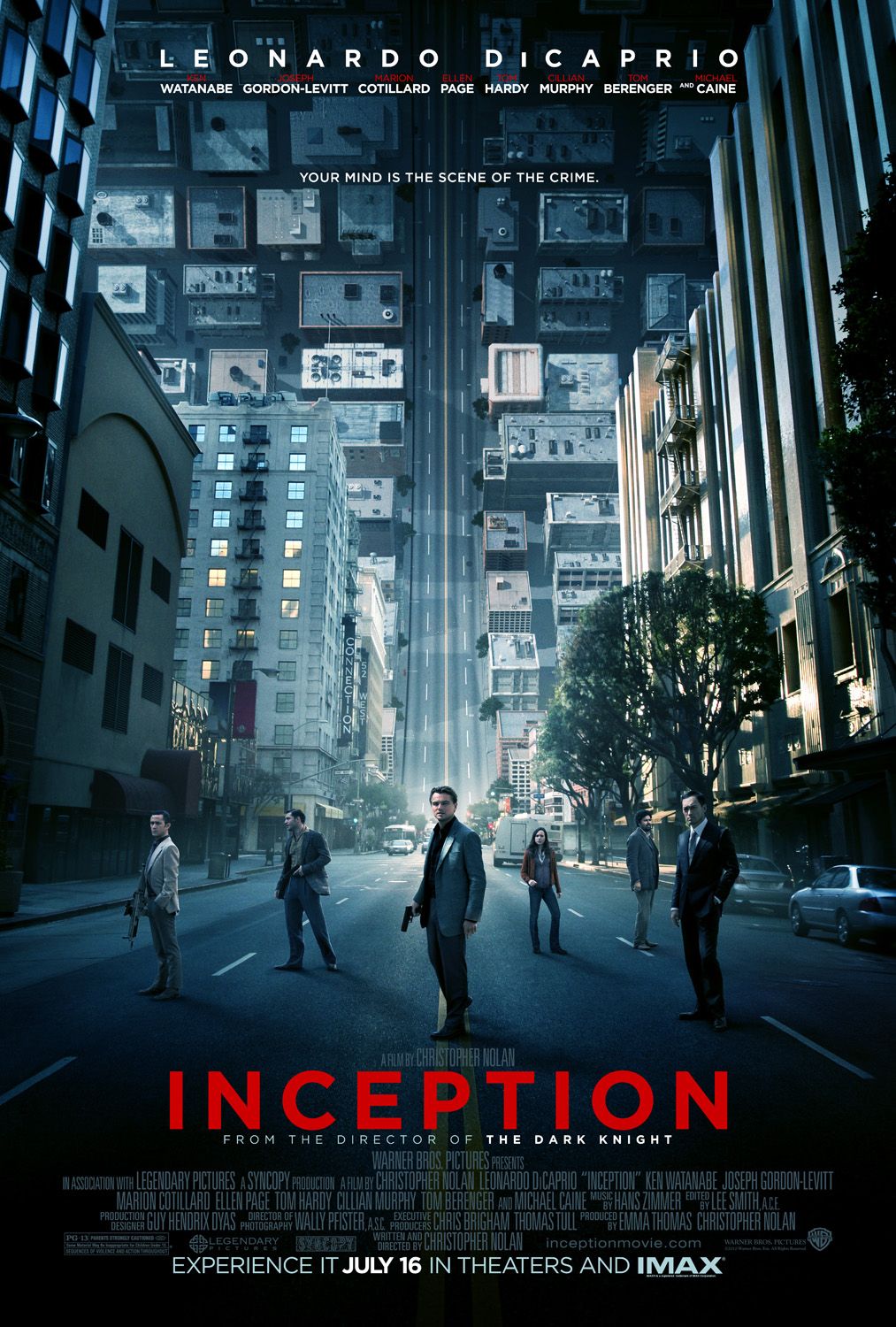
My reaction upon seeing “Inception” was pretty much the same one I had after I saw Christopher Nolan’s last movie “The Dark Knight:” BRILLIANT!!! In a summer movie season which has been largely bland and seriously lacking in excitement, Nolan once again stimulates the imagination by giving us a very well thought out story with complex characters. This is all in addition to the slam bang entertainment we expect from a summer blockbuster, and Nolan delivers on both fronts. Seriously, this movie feels like a godsend in a time where studio executives are way too risk adverse. Even if “Inception” borrows from movies like “Blade Runner” and “The Matrix,” Nolan still makes it all his own. I’ve already seen “Inception” twice in one week, and there is just as much to discover about it the second time around as much as the first.
Nolan has actually been working on this screenplay for over a decade, and it is an intricate puzzle of a flick which might seem difficult to follow, but not really. Leonardo DiCaprio stars as Dominic Cobb, a highly experienced dream infiltrator who works at extracting precious information from his targets. Basically, he steals ideas from his clients before they even realize it, and they are very valuable ideas which will put him and his crew on easy street for a time. Working with him is his partner Arthur (Joseph Gordon-Levitt) whose job is to research the clients’ history and see if they have any mental defenses built up which could hinder their mission. As we first see them in “Inception,” they have seemingly failed a mission, but they soon find out it was actually an audition.
Their target, Saito (Ken Watanabe), a wealthy businessman, offers a job which will have them doing the opposite of their job description. This brings us to the movie’s title which means planting an idea in the mind of their target’s subconscious. Although thought to be impossible, Cobb says it can be done because he has succeeded in doing it before. “Inception” then takes Cobb and his team on an adventure which will go into a dream, and then into another dream within that dream. Just when you think they couldn’t go any deeper, they do. It sounds confusing, but it was easier to follow than I thought. You want a tough movie to follow? Check out the first “Mission Impossible” movie which Brian DePalma directed. After all these years, I still can’t figure out what it was about (the stunts were cool though).
The concept of entering a person’s dream is fascinating because it gives the story infinite possibilities to explore, and all sorts of directions to take it in. Dreams themselves still fascinate us as we still have no clear idea what generates them. They can be very unpredictable and go from one place to another before we know it. Dreams could be our subconscious minds trying unburden itself of all the baggage we bury down into its recesses in the hopes of forgetting the most painful things in life. Looking back at the dreams I have had which have stayed with me, be it good or bad, they continually astonish me with their vividness and how our brains and imaginations can conjure up such amazing images as we slumber away in beds which are hopefully kind to your back. You’d think after all these years we would be able to be consciously aware of when we are in a dream and control it to our advantage, but no such luck. When you’re deep into one, the difference between what is real and what is not becomes irrelevant.
That’s the other thing I loved about “Inception;” you are always questioning whether you’re in a dream or wide awake. Even if you already know how the movie ends, it couldn’t possibly spoil the experience for you when you witness it. As in “Total Recall,” reality is always in question and open to interpretation, and it’s unlikely everyone will come to the same conclusion. I was also reminded of David Cronenberg’s “eXistenZ” which ended on a note of sheer ambiguity as the line between what’s real and what is not becomes permanently blurred. “Inception” all but starts out this way, and the theories behind the action and what’s really going on continue to abound. How cool it is to have a movie of this size and scope which really gets you to think!
For a moment, I thought DiCaprio was going to portray the same character he played in Martin Scorsese’s “Shutter Island,” Teddy Williams. Both characters have inescapable similarities; they are tortured by memories and actions they cannot repair, they are married to beautiful women whose current state of mind is in question, and they are both really moody guys who are not a barrel of laughs to be around. Oh yeah, both are also struggling with the reality of everything happening around them. I guess what Cobb has over Teddy is his grip on reality is much firmer, but even Cobb’s sanity comes into question throughout “Inception.”
DiCaprio continues to prove he is not only one of the very best actors working, but also one of the few stars who genuinely take risks. Not content with being forever imprisoned as a movie star, he nails the complexities of Cobb to where we see the various dimensions of his character. In essence, Cobb is a thief after the big score, and he shuts himself off to other people. But DiCaprio really gets at what is beneath his character’s guilt and shame, and he makes us want to join him in his dream exploits. For him, it is never about just making the character a likable one.
It’s also great to see Levitt here as well. Having been the indie darling for a few years, turning in one great performance after another, and he more than holds his own here. When everyone else is in a state of uncontrollable panic, Arthur always keeps his focus clear which allows him to stay on top of things. His method of preparing his team members for “the kick” in one dream is ingenious. Watching Levitt here almost makes me forget he was on “3rd Rock from The Sun” all those years ago.
Then you have the beautiful Marion Cotillard, plays Cobb’s late wife, Mal. While Mal may be short for Mallorie, in Latin it means “evil,” and she exists only within Cobb’s dreamscape as he has buried her deep in his memories. However, his control over her continues to erode as Mal continues to intrude in different dreams he has as she gets the upper hand and continually threatens to ruin anything and everything. Cotillard plays Mal with a cold detachment as well as a deeply wounded person who feels betrayed by her husband. As the movie goes on, you begin to wonder if she is truly dead or alive.
At first, having Ellen Page in this movie might seem weird as we all still identify her with her character from “Juno.” It’s been easy to forget what a wide range she can have as an actress, but this is not the case here as she acts as the guide for the audience in the world of dreams. Her character of Ariadne is the architect, the one who constructs the world of the dream which the team will enter into. She also acts as the conscience Cobb needs as he continues to be drawn by Mal into a state of limbo which he may never return from. As a result, Ariadne is the strongest, most objective and levelheaded in the group because she sees what consumes Cobb and how it can endanger everyone. She becomes the voice of reason Cobb must listen to if he hopes not to drown in his own guilt. It feels like it has been too long since I have seen Page in anything, and she once again proves to be another fantastic actress of her generation.
Tom Hardy, who plays the forger Eames, is fun to watch here as he approaches the role with a touch of irresistible sarcasm as he gleefully plays around with the other team members and their self-consuming seriousness. Eames gets an especially big kick in getting a rise out of Arthur who takes his work perhaps more seriously than most. Throughout the movie, Hardy’s presence proves to be one of the film’s most entertaining, and his star continues to rise.
Nolan also brings some of his “Dark Knight” cast members along for the dream ride including Sir Michael Caine and Cillian Murphy. Both are terrific in any role given to them, and the performances they both give in “Inception” are no exception. Another supporting actor worth noting here is Dileep Rao who plays Yusuf, the chemist who formulates the sedatives which put the group and the target under so they can complete their mission. I think he deserves to be mentioned in the same breath with all the other actors whose names appear on the posters.
But the big surprise in “Inception” is the appearance of Tom Berenger, a well-known actor who has for far too long been relegated to the realm of straight to DVD movies. It’s so nice to see him here in something other than a “Sniper” sequel (how many have there been anyway?), and he hasn’t missed a step as an actor after all these years.
With movies like “Inception,” we have come to expect directors will spend more time on the visual element to where they inadvertently forget the other important ones like dialogue and acting. Having made several movies already, Nolan proves to be one of the best directors working today as he handles each part of a movie with the same amount of attention, something increasingly rare among filmmakers.
Nolan fills the movies with such inventive images as Arthur fights off armed men while the dream he is in is thrown out of balance as it spins him from the floor to the ceiling. Levitt really sells the scene by showing his character struggling to maintain control as he is forced to crawl over the place when gravity no longer works in his favor. Then there is the final scene, which I won’t dare to give away, but taking in the audience’s strong reaction showed just how successful Nolan was in holding us firmly within his grasp. I loved the inescapable ambiguity of the film’s conclusion and how it drove some audience members crazy.
Plus, Nolan once again employs Hans Zimmer to do the score, and what he brings us is not another rehash of the Caped Crusader’s music. Zimmer gives a strong score dominated by electronics, drums, and brass instruments which are primed to blow out the speakers at a theater near you. Capturing the scope of the visuals in “Inception” which are quite immense, Zimmer once again gives great power to Nolan’s amazing concepts which Warner Brothers was smart enough to let the director run wild with instead of just containing his imagination in fear of releasing something which might seem “uncommercial.”
In a sea of endless remakes, questionable reboots, and half-assed concepts which somehow got a green light from studio executives, “Inception” is a rare breed of film which is as thought provoking as it is entertaining. It also makes clear Nolan is a genius filmmaker who has set the bar high for summer tent pole movies just like he did with “The Dark Knight.”
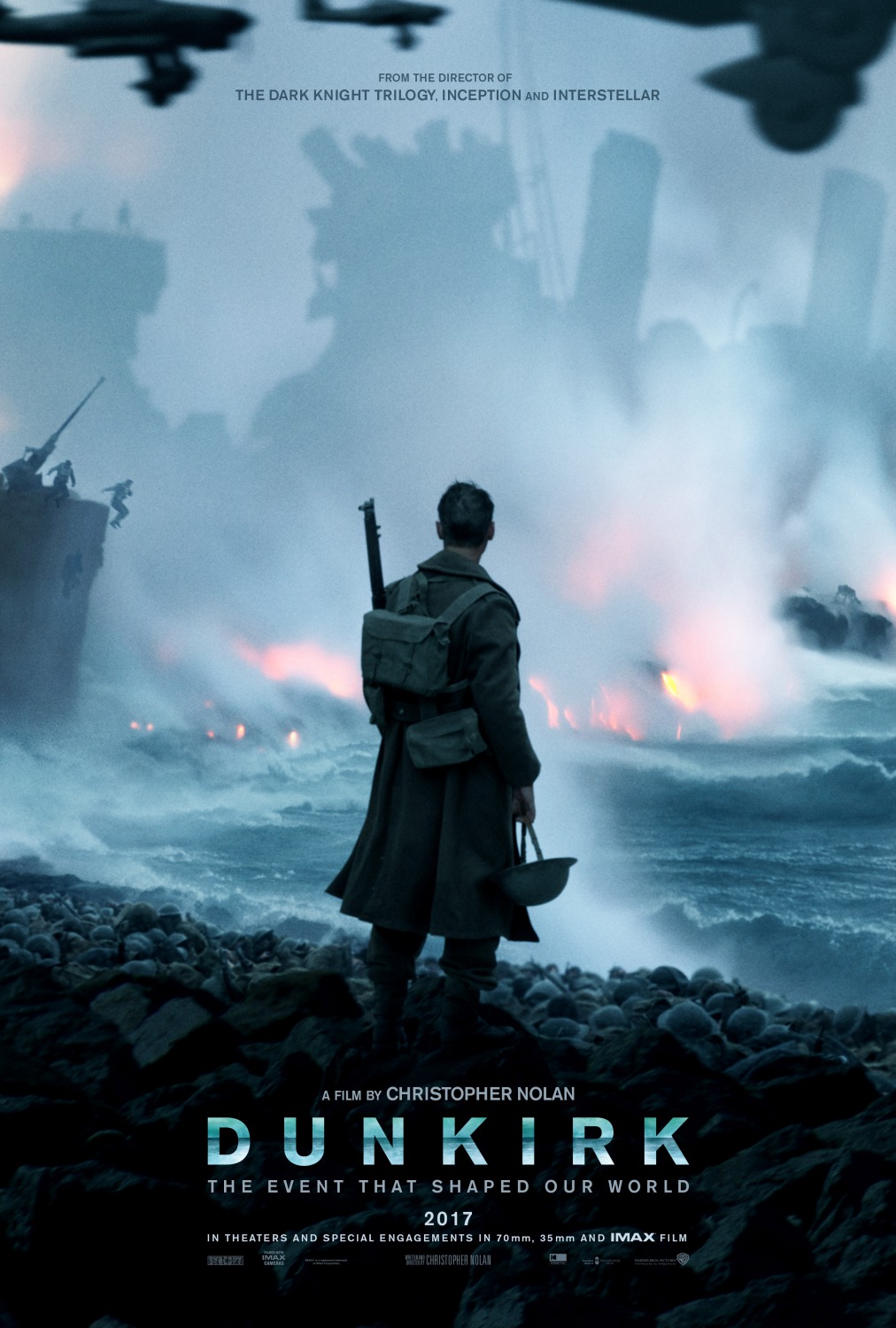
“Dunkirk” is the first Christopher Nolan film since “Insomnia” where you see the movie’s title on the screen at the beginning instead of at the end. This surprised me as Nolan always seems determined to suck you right into the movie instead of having you think about its title until the screen fades to black. When it comes to “Dunkirk,” however, I imagine he wanted audiences to have this title firmly implanted in their brains as this particular World War II story is one of character and bravery in the face of such agonizing defeat.
The title refers to the beaches and harbor of Dunkirk, France where thousands of allied soldiers were trapped like sitting ducks as the German army closed in on them during the Battle of France. Now World War II has been a historical event which filmmakers have visited as often as they have the Vietnam War, but “Dunkirk” has a different angle than other films of its genre. There are no American troops to be found here, we never see Germans but feel them closing in on the allies throughout, and the allies are at a complete loss in terms of being able to fight back. What happened at Dunkirk was not at all about victory, but about survival, and sometimes surviving a war is all a solider needs to do.
Nolan, who also wrote “Dunkirk’s” screenplay, tells the movie from three different perspectives: the land, the sea, and the air. On land, we meet British Army Private Tommy (Fionn Whitehead) who barely escapes a German ambush and arrives at the beach of Dunkirk where he befriends Gibson (Aneurin Barnard), another young soldier with whom he desperately tries to escape Dunkirk with on any boat that will take them. On the sea, Mr. Dawson (Mark Rylance) sails his boat out to Dunkirk in an effort to bring stranded soldiers back home, and he is joined by his son Peter (Tom Glynn-Carney) and Peter’s friend George (Barry Keoghan) who is curious to see the war up close. And in the air, Royal Air Force Pilot Farrier (Tom Hardy) and two other Spitfire pilots battle enemy fighters in the sky who are determined to destroy any boat going away from Dunkirk. Everyone is busy as can be as they fight to keep their fellow allies out of harm’s way, and this is even though the situation is growing increasingly dire.
What’s fascinating is how Nolan ends up using very little dialogue throughout a good portion of the film. These characters are too shell-shocked to speak in full sentences after all they have been through, and Tommy and Gibson end up connecting in a way not only wordless but also totally believable. As “Dunkirk” goes on, more dialogue is featured, but Nolan has already managed to set up the atmosphere to where no one needs to say much because their faces and eyes say so much more than words ever could.
Watching all the soldiers on the beach, waiting for a boat, any boat, to take them, I was reminded of Tom Sizemore’s dialogue from “Saving Private Ryan” when he said, “I want plenty of feet between men. Five men is a juicy opportunity. One man is a waste of ammo.” These soldiers are stuck together in bunches, desperate to escape Dunkirk at the earliest opportunity. I felt horrible for them as they all just sitting ducks for German bombers who can pick them off ever so easily. All these soldiers can do, other than shoot back, is to play dead in the sand, but even this may not be enough to save them.
Much of the movie is focused on the endless ordeals of Tommy, Gibson, and another young soldier named Alex (Harry Styles) as they get on different boats to escape from Dunkirk. However, their successes are often thwarted by attacks which sink the ships they are on, and they soon find themselves in even worse situations. Like Adrien Brody in “The Pianist,” these characters are caught up in unthinkable circumstances and are just trying to survive by any means. Many will consider them cowards for trying to flee, but considering the dire situation they are trapped in, it’s hard to hold much of a grudge against them.
With Mr. Dawson and his two young companions sailing out to sea, we see the need these men have to help those in harm’s way. While Dawson is supposed to give his ship over to ship over to the Navy as they are commandeering private boats to help in the Dunkirk evacuation, he simply sails off as he feels it is his duty to rescue as many soldiers as he can since it was his generation who decided to send young men out into the battlefield. As for the two boys, both want to do something noteworthy in this war instead of just staying on the sidelines. In wartime, it doesn’t matter if you are a soldier or not because everyone is involved in one way or another.
For me, the moments in the air were among the most fascinating, and not just because of Hoyte van Hoytema’s beautiful cinematography. Once those pilots and their planes came up on the screen, I figured it would all play into the clichés of war movies or be something like “Top Gun” with characters infinitely eager to be seen as heroes and taking giddy pleasure in shooting the enemy down. But this is not the case in “Dunkirk” as these pilots are simply men doing their job without any fanfare, and they are well aware of the risks and of what could happen if the enemy wins. Farrier, in particular, has even a bigger risk to consider as his fuel gauge is cracked to where he can’t tell how much fuel he has left. He should turn back, but with the allies having little to defend themselves with, his concern for their well-being overrules any thoughts he has for his own safety.
With these three divergent plot points, Nolan has the Dunkirk evacuation surrounded brilliantly. This is not a story about victory in the slightest, but instead one of character and of what people will do in a most precarious situation. Some stand around as others suffer helplessly because they can’t save them, others are desperate to escape by any means as the miracle they pray for doesn’t look to be delivered to them any time soon, and there are those who sail out to the most dangerous place not because they want to, but because they have to. Like I said, “Dunkirk” is a movie about the character of a person and how that character is tested in wartime.
Nolan also ratchets up the intensity throughout as the situation these characters are in becomes increasingly dire as the Germans close in on them. This is especially the case when Tommy, Alex and Gibson join a group of Scottish soldiers who have discovered an abandoned boat in the intertidal zone which they plan to use for their escape when the tide rises. The Germans, however, have already begin using it for target practice, and the holes they put in the boat soon have water coming through them. To stay on the sinking ship is suicide as they will certainly drown, but to go out into the open is no different as they will be shot once they are out in the open. But Nolan squeezes even more intensity out of this scene as it is suddenly revealed one of the soldiers on board might be a German spy, and it becomes a question of not who will survive, but who will die first.
There’s not a weak performance to be found here as every single actor in “Dunkirk” brings their A game to the table. Mark Rylance remains an impeccable actor, and he makes Mr. Dawson into a man determined to do his national duty not just out of necessity, but out of guilt as well. I’m not familiar with Fionn Whitehead, but his work here is exemplary as he doesn’t have much dialogue and instead has to spend most of his performance showing the turmoil Tommy endures through his eyes and actions. Cillian Murphy also gives a strong supporting turn as a soldier who has seen the worst war has to offer, and it becomes clear he will never again be the man he once was. Harry Styles, whom many thought would stand out like a sore thumb, fits perfectly into this ensemble of actors without ever overshadowing them. Even the great Kenneth Branagh shows up as Commander Bolton who oversees the evacuation of soldiers, and the moment where his eyes water up at the sight of those private boats sailing towards the soldiers is a moment of beauty as I wanted to cry with him. To quote the movie’s tagline, these soldiers couldn’t get home, so home came for them.
But one performance I want to point out in particular is Tom Hardy’s as Farrier. Watching the actor here reminded me of his work in “Locke” as, like the character in that movie, Farrier spends the majority of the time in a moving vehicle with only his fellow pilots and his own sense of duty to keep him company. Not once does Hardy try to portray Farrier as some hotshot pilot like Maverick in “Top Gun” or Captain Steve Hiller in “Independence Day,” but instead as a soldier like any other. Even with his face covered by an oxygen mask, Hardy deftly shows the stoicism and determination of his character as he continues to battle his foes in the sky even as his gasoline supply continues to dwindle, and he makes Farrier into the hero this movie very much deserves.
Another big character in “Dunkirk” is the music of Nolan’s frequent collaborator, Hans Zimmer. The German film composer has given us some of the most thrilling music scores of the past couple of decades, and his music here helps to make an intense motion picture experience even more intense than it already is. It essentially acts as a ticking clock, reminding the audience of how time is running out for the allied soldiers as the German forces get closer and closer to their location. Even in its more hopeful moments, Zimmer provides ominous sounds reminding us how the danger is always around the corner, ready to strike without much warning. When Zimmer’s music breaks into a cue scoring the arrival of boats to take the soldiers home, I could help but let out a sigh of relief as he finally had a reason to slow things down a bit and revel in the heroics of those who came to rescue the stranded men.
Does “Dunkirk” stand as one of the greatest war movies, let alone World War II movies, ever made? You bet. Nolan continues to give us one brilliant cinematic masterpiece after another, and whether or not you think this film is his best, it is certainly the most important he has made to date. The story of the Dunkirk evacuation is one the British people were raised on, and the world needs to be reminded again of how important a story this is. On one hand it is a story about military defeat, but it is also about a nation’s character and of how citizens stood up in the face of disaster to help those trapped. All the characters featured here endure different fates, but what they endure says more about them than words ever can. And the movie also reminds us sometimes all you need to do in a war is survive. You may come out of a war not feeling like the hero everyone makes you out to be, but surviving really is more than enough. At the very least, it gives you a reason to carry the story on to the next generation so the sacrifices made by so many will never be lost in the backroom of history.
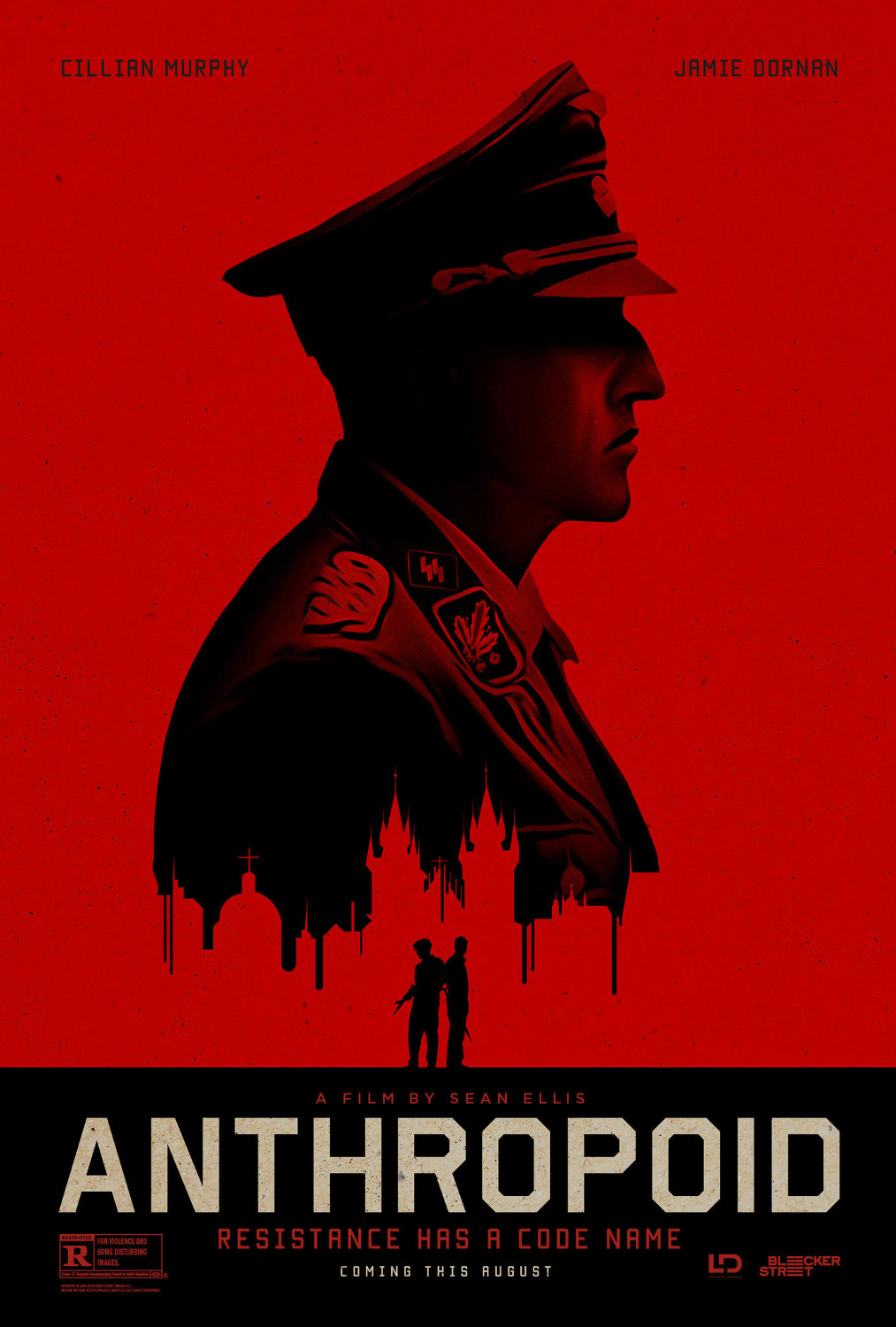
“Anthropoid” is kind of like a cousin to “Valkyrie,” another movie about soldiers looking to take out a high ranking Nazi. Like “Valkyrie,” it will not go down as one of the most memorable World War II movies ever made, but it is an entertaining film which engages us with noble characters, interesting questions about the price of war and a furious climax where resistance fighters make their last stand. More importantly, it deals with a true life event (yes, it is “based on a true story”) many probably don’t know about but should.
The movie starts in 1941 with two Czechoslovak exile soldiers, Jozef Gabčík (Cillian Murphy) and Jan Kubiš (Jamie Dornan), parachuting into their occupied homeland. Upon meeting the resistance fighters and their leader, “Uncle” Jan Zelenka-Hajský (Toby Jones), in Prague, they reveal that they are here to execute Operation Anthropoid which involves the assassination of Reinhard Heydrich, a high ranking Nazi who was one of the architects of the Holocaust and whom Adolf Hitler described as “the man with the iron heart.” Do they succeed in their mission? You’ll have to watch the movie to find out.
“Anthropoid” gets off to a bit of a slow start as Jozef and Jan try to settle in and not stand out among everyone else in town. They even recruit two lovely ladies, Marie Kovárníkovasá (Charlotte Le Bon) and Lenka Fafková (Anna Geislerová), to help them carry out their mission, and they are more than willing to help. Just watch as Lenka makes clear to the men how she can handle a gun.
There’s a subplot where Jan ends up getting engaged to Marie, and it just comes out of nowhere to where this section feels rather awkward. A number of characters are not developed fully enough to where “Anthropoid” threatens to feel like a missed opportunity. But what elevates the material are the performances which are very strong.
You can never go wrong with Cillian Murphy as he has yet to give a bad performance in any film he appears in. As Jozef, Murphy’s steely eyes stare into others with an intensity which wipes the smiles off their faces as he makes clear this is no ordinary mission. He also makes Jozef a most determined soldier who is infinitely determined to carry out this operation, but even he can only take so much before he falls apart emotionally.
Jamie Dornan shows more life here than he ever could have in the dreadful “Fifty Shades of Grey.” This is especially the case when his character suffers a brutal panic attack which has Jozef desperately trying to calm him down from. It’s way too easy to look like a fool when portraying such an emotional moment as the camera never lies, and it says a lot about Dornan that he was able to make this panic attack such a genuinely anxiety ridden moment.
There are also a number of other terrific performances to be found in “Anthropoid” like the one from Toby Jones. Then again, seeing him in a World War II movie these days instantly reminds us of his “Hail Hydra” character from the “Captain America” movies.
“Anthropoid” really kicks into high gear when an assassination attempt is taken and the Nazis come down hard on a particular group of people to where sympathy isn’t much of an option. It gets to where everyone wonders if killing one Nazi will have any effect on the war. With the world closing in on the main characters, the intensity keeps building and building all the way to the very end.
The last half of “Anthropoid” has the protagonists holing up in a church, and they are discovered by the Nazis to where a violent standoff ensues. Director Sean Ellis, who helmed the Oscar nominated short film “Cashback,” stages an impressive standoff which has us completely riveted. While the first half feels routine, the last half really does keep us on the edge of our seats. With “Valkyrie” we had a very good idea of things would turn out, but with “Anthropoid” we don’t. Bullets fly all over the place and emotions are shattered to where we can’t look away, and this is aided by a pounding music score composed by Guy Farley and Robin Foster.
Parts of “Anthropoid” may not stay in the conscious mind long after you have seen it, but the parts which do make it worth the price of admission. Many made tremendous sacrifices which can no longer be swept under the rug, and this movie gives those soldiers the respect they have deserved for the longest time. It also looks at the many costs of war and of how soldiers can only keep their cool for so long until they break under the pressure. It’s a bleak movie in many ways, but it also shows just how far the resistance fighters were determined to end Hitler’s genocidal reign.

 The Ultimate Rabbit