Kelly Reilly on Portraying the Ravages of Addiction in ‘Flight’
WRITER’S NOTE: This article was written back in 2012.

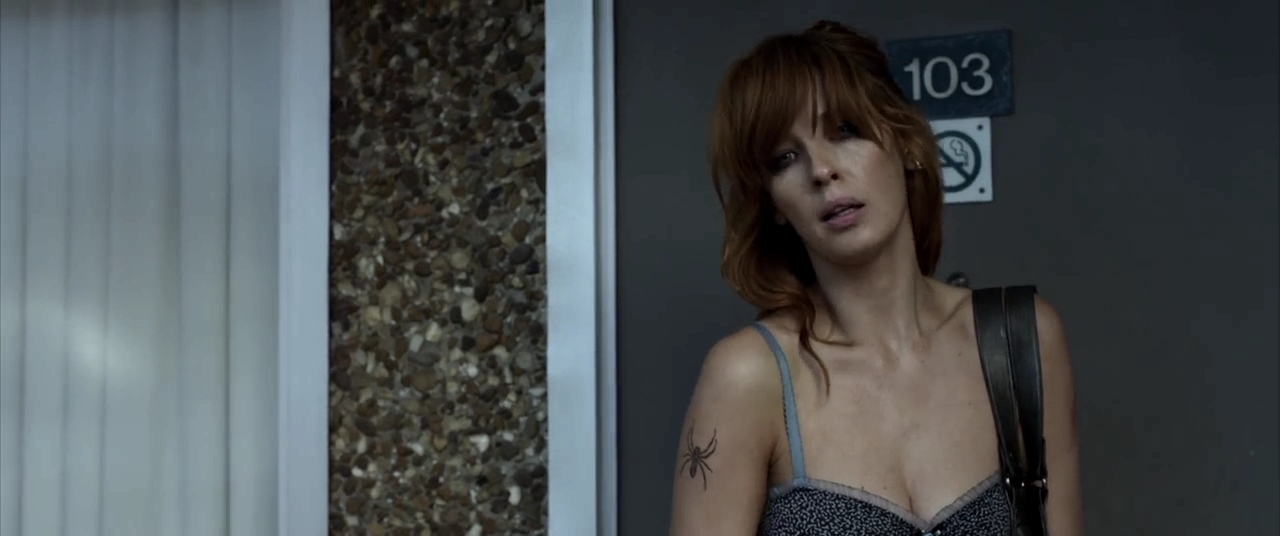
Robert Zemeckis’ “Flight” ended up surprising us all by being a riveting character driven film as opposed to your average Hollywood action movie. It is filled with a number of great performances from very talented actors, and one of the most notable is Kelly Reilly’s as former photographer Nicole Maggen. When we first meet Nicole, she is in the throes of a nasty heroin addiction that almost claims her life. While in the hospital, she meets airline pilot William “Whip” Whitaker (Denzel Washington) who is going through his own substance abuse issues and becomes a kindred spirit of sorts as they both look for ways to escape their demons.

For Reilly, “Flight” marks the first American movie she has appeared in. Before this, she was best known for playing Mary Watson in the “Sherlock Holmes” movies, and she starred opposite Michael Fassbender in the unnerving horror film “Eden Lake.” When it came to playing Nicole in “Flight,” she explained to Christopher Rosen of the Huffington Post how she goes about preparing for a role.

“If it’s there in the script it makes your life a lot easier,” Reilly said. “You’re not searching for something. You’re not trying to figure out how to make this character believable or real. You’re not trying to skirt around bad writing. This character, to me, just jumped out. I already felt a kinship to her; I wanted to play her. I knew that this sort of addiction that got hold of her so tightly was a symptom of this woman’s heartbreak. I knew there was somebody underneath worth fighting for. There are all these stereotypes of heroin addicts being junkies or dropouts or people who we shouldn’t care about. I just thought that can’t be true. They’re somebody’s son or daughter; they’re human beings. They’re just lost. That is something John Gatins got in his script. I really wanted to play that rather than the stereotype of the heroin addict.”

When it came to playing a heroin addict, Reilly explained to Rosen the amount of research she did to better understand her character. She spent a lot of time on Google learning about those addicted to this particular drug, but that only gave her so much information. But while I was at “Flight’s” press conference at the Montage Hotel in Beverly Hills, Reilly went more into depth about who gave her the answers she needed to know the most.

“I did consult a wonderful guy called Mitch in Atlanta who helped me understand the inner life of a heroin addict as much as one can without experiencing it, and he really did open up his story to me,” Reilly said. “There was a technical side of it as well as he taught me how to inject heroin without really injecting heroin. I wanted to honor the truth of somebody in that situation, and I think that was the most difficult part without ever having experienced that.”

But despite “Flight” gaining strong critical praise for its direction and performances, Reilly doesn’t see herself being nominated for an Academy Award. When it comes to the Oscars, they tend to honor the showiest performances above all others. Reilly’s performance as Nicole is powerful largely because it is an understated one which does not draw too much attention to itself. She explained this in more detail to Rosen.

“I know there is a lot of buzz around Denzel and the film. A few people have kind of suggested that it could be a possibility for me. I don’t see it myself,” Reilly said. “That’s just not me being humble or anything. I genuinely don’t imagine that to be the case. Mine is more of a quiet performance and I don’t think it’s an award winner. I still feel incredibly flattered to have people even suggest that. As much as it was never a dream of mine — a dream of mine would be to be on stage in New York — it would still be a mind-blowing thing to happen especially for something you feel proud of.”

Michael Caine once said that in the theater you play a character, but in television and film you are the character. Some of the greatest performances I see from actors in movies come from those who inhabit their characters more than play them, and Kelly Reilly’s performance in “Flight” is no exception. While we all love the showiest of performances, it is those subtle ones which deserve the most credit. My hope is that the Oscars will prove Reilly wrong and give her the credit she deserves for her work here. It’s one of the best portrayals of an addict I have seen ever since Michael Keaton played one in “Clean and Sober.”

SOURCES:

Christopher Rosen, “Kelly Reilly, ‘Flight’ Star, On Why She Probably Won’t Win an Oscar,” The Huffington Post, November 26, 2012.

Ben Kenber, “Interview with The Cast and Crew of Flight,” We Got This Covered, October 30, 2012.

Elizabeth Olsen on Playing Zibby in ‘Liberal Arts’

WRITER’S NOTE: This article was written back in 2012.

After playing an escapee from an abusive cult in “Martha Marcy May Marlene” and a young woman terrorized at her vacation home in “Silent House,” actress Elizabeth Olsen finally gets to lighten up a bit in the comedy drama “Liberal Arts.” In the movie, she plays Zibby, a 19-year-old college student who ends up falling for 35-year-old college admissions officer Jesse Fisher (Josh Radnor, who also wrote and directed it) over their love of literature. Critics have called Olsen’s performance in “Liberal Arts” enchanting, radiant and luminous.

Having seen Radnor’s last directorial effort “Happythankyoumoreplease” which she really enjoyed; Olsen was very interested in working with him on “Liberal Arts.” Her audition for him consisted of reading through every single scene their characters had together in the movie. She recalled it being a lot of fun to β€œjust sit on the floor and read through the scenes with him,” and she really liked the way he wrote Zibby’s dialogue.

For Olsen, the role of Zibby offered a nice change of pace as she had just finished her third psychological thriller. In this movie, she got to play a character who is wise beyond her years and excited about being alive. It also gave her the opportunity to play someone whom she felt was closer to who she was.

“I just always wanted to rush things, grow up sooner, couldn’t understand why someone older couldn’t make a change,” said Olsen. “There’s something really honest and great about her. Also, I wanted to say those words really badly. The words on the page were so much fun to say out loud. That’s a really simple thing to say about wanting to do a script, but I feel like that rarely happens.”

Olsen herself is still a college student at New York University, and she still has a couple of more classes to go before she graduates. Like Zibby she shares a love of learning, and this love came to inform her character deeply. To hear her talk, Olsen has always enjoyed reading literature like Zibby does.

“I went to a really great high school and I took a few AP classes in literature and language and things like that,” Olsen said. “The only type of writing I like to do or enjoy doing is academic writing, so I’m already inherently that type of person. I’ll still remember that my senior year of high school I wrote an essay on Joseph Conrad’s ‘Heart of Darkness’ that I’m still proud of to this day, so I’m already kind of a nerd when it comes to literature and theory. I wish I could have more of that in life, but I don’t because I’m always reading scripts or things to prepare for movies when I’m reading.”

Elizabeth Olsen not only has college graduation to look forward to in the near future, but she also has some exciting movies in store for her including Spike Lee’s remake of “Oldboy.” She has given us a number of wonderful performances so far and, after watching “Liberal Arts,” it is clear she still has many more to give.

SOURCES:

Matt Joseph, “Interview with Elizabeth Olsen on Liberal Arts,” We Got This Covered, September 13, 2012.

Christopher Rosen, “Josh Radnor & Elizabeth Olsen on ‘Liberal Arts’ & Why Being Earnest Is OK,” Huffington Post, September 12, 2012.

Adam Chitwood, “Elizabeth Olsen Talks LIBERAL ARTS, Reading as Entertainment vs. Enrichment, and More; Reveals Spike Lee’s OLDBOY Starts Filming Next Month,” Collider, September 11, 2012.

Mary Elizabeth Winstead on Playing a Recovering Alcoholic in ‘Smashed’

Mary Elizabeth Winstead in Smashed

WRITER’S NOTE: This article was originally written back in 2012.

She charmed us in “Death Proof,” “Live Free or Die Hard” and “Scott Pilgrim vs. The World,” but now Mary Elizabeth Winstead gets the most complex role of her character to date in “Smashed.” In the movie she plays Kate Hannah, an elementary school teacher who is also a raging alcoholic. After one night where she even goes as far as to smoke crack, Kate finds she needs to turn her life around really quick. Her path to sobriety is not an easy one as it makes her question the relationships in her life, especially the one she has with her husband Charlie (“Breaking Bad’s” Aaron Paul) which appears to revolve around their mutual love of getting drunk.

Winstead did a lot to prepare for this role as she visited many Alcoholic Anonymous group meetings and talked to the people there. She was also aided by one of the movie’s writers and a co-producer who were in recovery themselves, and they made her feel like she was not coming into this project dishonestly. Hearing Winstead talk about her research ends up illustrating the diversity of one particular city in California.

“L.A. is a great place to do it, because it’s such a big city, and every neighborhood is very specific as far as the different types of people who live there,” Winstead said. “So, every meeting I went to was completely different. I went to one that was like six people, and they were all men in their 60’s, totally working class, totally not L.A. Then I went to one in West Hollywood that was a lot of industry people, and I went to a huge women’s meeting where everyone was hugging and laughing. And it was great just seeing people share and talk about themselves and talking about their darkest moments in front of bunch of people and having it be totally accepted. It was an honor for me to be a part of that and to see that and it was a big first step for me into realizing how much I related to their struggle, and how much of a universal struggle it is.”

Among the most challenging scenes for Winstead comes when her character is drunk. Now playing drunk may look easy for an actor to do, but it is actually quite the opposite. The trick is to make the act of drunkenness believable to the audience you are presenting it to, but it can be easily overdone to where you can look utterly foolish. Winstead admitted she had never played drunk onscreen before, and she was terrified that she would look terrible doing it. She and James Ponsoldt (the director of “Smashed”) ended up consulting an acting coach in order to get it down right.

“Together we found this coach named Ivana Chubbuck who has this book called ‘The Power of the Actor’ and she has a chapter specifically dedicated to playing drunk,” Winstead said. “We sat in a couple of classes, and we did one of the scenes in her class as well, so we used her method a lot for that. And that was really helpful because we just didn’t want it to feel like acting. How do you not act drunk, but not really be drunk? That’s a difficult thing to pull off.”

One thing which makes “Smashed” really unique in the annals of addiction movies is how Kate is not the usual face of onscreen addiction. Winstead described Kate as being a full character and one she could really relate to despite her ongoing problems.

“What was great about it was that this was one of the only roles that I have ever read in a script where the female lead character is such a full person. You get to see so many sides of her personality,” Winstead said. “For me, I can be all of those types of people. I have a lot of different traits to my personality, depending on who I’m around, and what the dynamic in the situation is. So, to get to play a character where you get to see every single shade of who she is, is very rare. That was really exciting to me. So, I always felt as though I was her, just different sides of her.”

What also aided Winstead in this role was how Ponsoldt made the actors feel very free on set to where it almost seems like they are not even working with a script. Winstead made clear how much of what we see in “Smashed” is in fact scripted, but there were some unscripted moments which did make it into the final cut.

“I think part of the reason it feels so real is that it felt like the camera was always rolling,” Winstead said. “We were always in character and we were always going off script and back on and off and back on. So, it never felt like: ‘Cut! We’re ourselves now.’ It didn’t have that break: ‘We’re going to go back to our trailer, see you later.’ It was never like that. We were always on set, we were always in character, and we were always working toward making it authentic.”

Mary Elizabeth Winstead admits she has struggled long and hard to find roles which are as good as the one she plays in “Smashed.” Coming out of it, she wonders if she will ever find a role like this ever again, and this is very understandable considering what a highly competitive arena show business is. Her performance as Kate Hannah, however, earned her serious Oscar buzz ever since the movie was shown at the Sundance Film Festival, and it is highly unlikely people will forget Winstead’s revelatory turn once they have left the theater.

SOURCES:

Kevin Jagernauth, “‘Smashed’ Star Mary Elizabeth Winstead On How She Learned To Play Drunk, The Emotional Rollercoaster Of The Role & More,” Indiewire, October 11, 2012.

Karen Benardello, “Interview with Mary Elizabeth Winstead on ‘Smashed,’” We Got This Covered, October 9, 2012.

Christopher Rosen, “Mary Elizabeth Winstead, ‘Smashed’ Star, On The Lack Of Female Roles In Hollywood & ‘Die Hard 5,’” Huffington Post, October 10, 2012.