‘Dunkirk’ is Yet Another Brilliant Masterpiece from Christopher Nolan
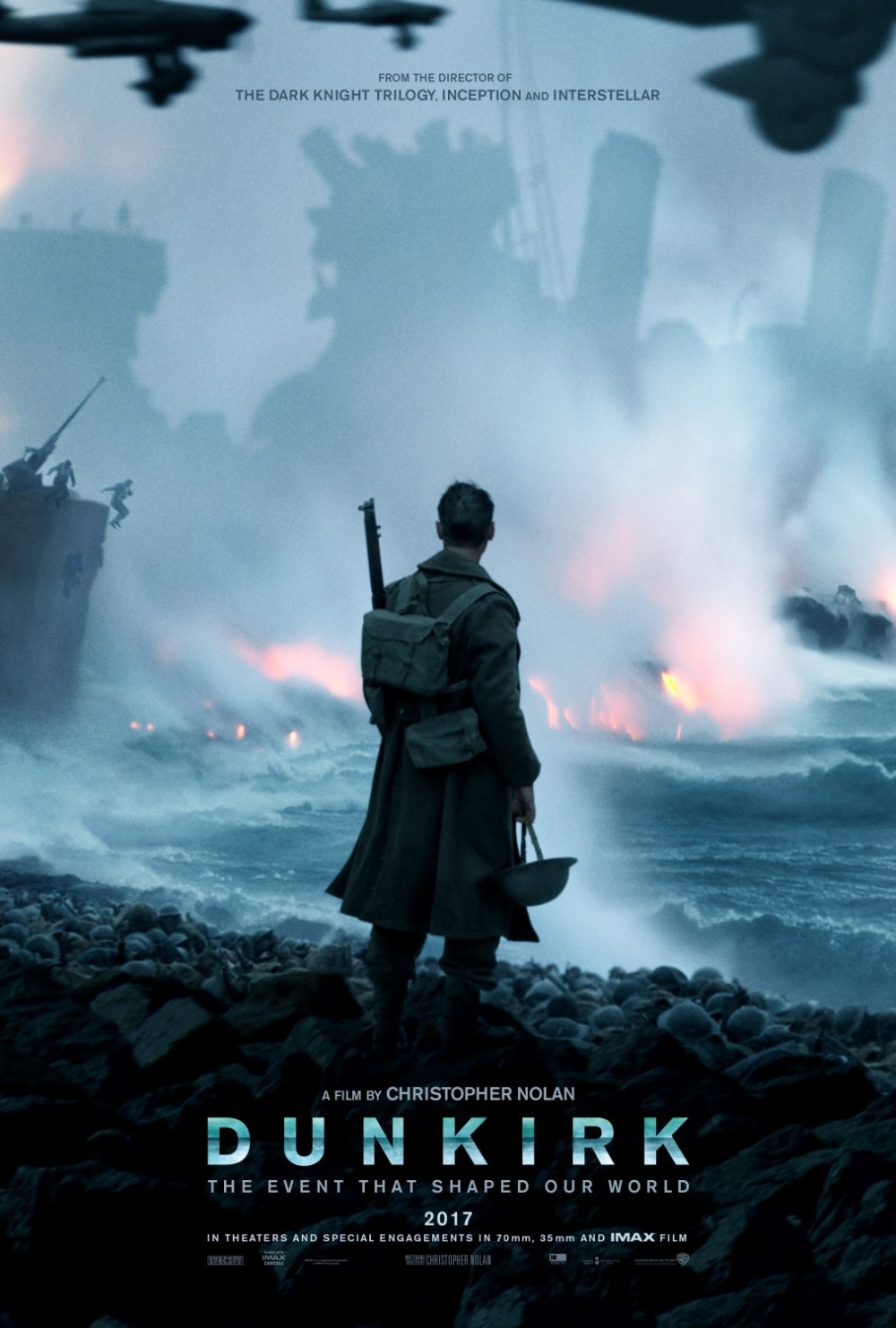
Dunkirk movie poster

Dunkirk” is the first Christopher Nolan film since “Insomnia” where you see the movie’s title on the screen at the beginning instead of at the end. This surprised me as Nolan always seems determined to suck you right into the movie instead of having you think about its title until the screen fades to black. When it comes to “Dunkirk,” however, I imagine he wanted audiences to have this title firmly implanted in their brains as this particular World War II story is one of character and bravery in the face of such agonizing defeat.

The title refers to the beaches and harbor of Dunkirk, France where thousands of allied soldiers were trapped like sitting ducks as the German army closed in on them during the Battle of France. Now World War II has been a historical event which filmmakers have visited as often as they have the Vietnam War, but “Dunkirk” has a different angle than other films of its genre. There are no American troops to be found here, we never see Germans but feel them closing in on the allies throughout, and the allies are at a complete loss in terms of being able to fight back. What happened at Dunkirk was not at all about victory, but about survival, and sometimes surviving a war is all a solider needs to do.

Nolan, who also wrote “Dunkirk’s” screenplay, tells the movie from three different perspectives: the land, the sea, and the air. On land, we meet British Army Private Tommy (Fionn Whitehead) who barely escapes a German ambush and arrives at the beach of Dunkirk where he befriends Gibson (Aneurin Barnard), another young soldier with whom he desperately tries to escape Dunkirk with on any boat that will take them. On the sea, Mr. Dawson (Mark Rylance) sails his boat out to Dunkirk in an effort to bring stranded soldiers back home, and he is joined by his son Peter (Tom Glynn-Carney) and Peter’s friend George (Barry Keoghan) who is curious to see the war up close. And in the air, Royal Air Force Pilot Farrier (Tom Hardy) and two other Spitfire pilots battle enemy fighters in the sky who are determined to destroy any boat going away from Dunkirk. Everyone is busy as can be as they fight to keep their fellow allies out of harm’s way, and this is even though the situation is growing increasingly dire.

What’s fascinating is how Nolan ends up using very little dialogue throughout a good portion of the film. These characters are too shell-shocked to speak in full sentences after all they have been through, and Tommy and Gibson end up connecting in a way not only wordless but also totally believable. As “Dunkirk” goes on, more dialogue is featured, but Nolan has already managed to set up the atmosphere to where no one needs to say much because their faces and eyes say so much more than words ever could.

Watching all the soldiers on the beach, waiting for a boat, any boat, to take them, I was reminded of Tom Sizemore’s dialogue from “Saving Private Ryan” when he said, “I want plenty of feet between men. Five men is a juicy opportunity. One man is a waste of ammo.” These soldiers are stuck together in bunches, desperate to escape Dunkirk at the earliest opportunity. I felt horrible for them as they all just sitting ducks for German bombers who can pick them off ever so easily. All these soldiers can do, other than shoot back, is to play dead in the sand, but even this may not be enough to save them.

Much of the movie is focused on the endless ordeals of Tommy, Gibson, and another young soldier named Alex (Harry Styles) as they get on different boats to escape from Dunkirk. However, their successes are often thwarted by attacks which sink the ships they are on, and they soon find themselves in even worse situations. Like Adrien Brody in “The Pianist,” these characters are caught up in unthinkable circumstances and are just trying to survive by any means. Many will consider them cowards for trying to flee, but considering the dire situation they are trapped in, it’s hard to hold much of a grudge against them.

With Mr. Dawson and his two young companions sailing out to sea, we see the need these men have to help those in harm’s way. While Dawson is supposed to give his ship over to ship over to the Navy as they are commandeering private boats to help in the Dunkirk evacuation, he simply sails off as he feels it is his duty to rescue as many soldiers as he can since it was his generation who decided to send young men out into the battlefield. As for the two boys, both want to do something noteworthy in this war instead of just staying on the sidelines. In wartime, it doesn’t matter if you are a soldier or not because everyone is involved in one way or another.

For me, the moments in the air were among the most fascinating, and not just because of Hoyte van Hoytema’s beautiful cinematography. Once those pilots and their planes came up on the screen, I figured it would all play into the clichés of war movies or be something like “Top Gun” with characters infinitely eager to be seen as heroes and taking giddy pleasure in shooting the enemy down. But this is not the case in “Dunkirk” as these pilots are simply men doing their job without any fanfare, and they are well aware of the risks and of what could happen if the enemy wins. Farrier, in particular, has even a bigger risk to consider as his fuel gauge is cracked to where he can’t tell how much fuel he has left. He should turn back, but with the allies having little to defend themselves with, his concern for their well-being overrules any thoughts he has for his own safety.

With these three divergent plot points, Nolan has the Dunkirk evacuation surrounded brilliantly. This is not a story about victory in the slightest, but instead one of character and of what people will do in a most precarious situation. Some stand around as others suffer helplessly because they can’t save them, others are desperate to escape by any means as the miracle they pray for doesn’t look to be delivered to them any time soon, and there are those who sail out to the most dangerous place not because they want to, but because they have to. Like I said, “Dunkirk” is a movie about the character of a person and how that character is tested in wartime.

Nolan also ratchets up the intensity throughout as the situation these characters are in becomes increasingly dire as the Germans close in on them. This is especially the case when Tommy, Alex and Gibson join a group of Scottish soldiers who have discovered an abandoned boat in the intertidal zone which they plan to use for their escape when the tide rises. The Germans, however, have already begin using it for target practice, and the holes they put in the boat soon have water coming through them. To stay on the sinking ship is suicide as they will certainly drown, but to go out into the open is no different as they will be shot once they are out in the open. But Nolan squeezes even more intensity out of this scene as it is suddenly revealed one of the soldiers on board might be a German spy, and it becomes a question of not who will survive, but who will die first.

There’s not a weak performance to be found here as every single actor in “Dunkirk” brings their A game to the table. Mark Rylance remains an impeccable actor, and he makes Mr. Dawson into a man determined to do his national duty not just out of necessity, but out of guilt as well. I’m not familiar with Fionn Whitehead, but his work here is exemplary as he doesn’t have much dialogue and instead has to spend most of his performance showing the turmoil Tommy endures through his eyes and actions. Cillian Murphy also gives a strong supporting turn as a soldier who has seen the worst war has to offer, and it becomes clear he will never again be the man he once was. Harry Styles, whom many thought would stand out like a sore thumb, fits perfectly into this ensemble of actors without ever overshadowing them. Even the great Kenneth Branagh shows up as Commander Bolton who oversees the evacuation of soldiers, and the moment where his eyes water up at the sight of those private boats sailing towards the soldiers is a moment of beauty as I wanted to cry with him. To quote the movie’s tagline, these soldiers couldn’t get home, so home came for them.

But one performance I want to point out in particular is Tom Hardy’s as Farrier. Watching the actor here reminded me of his work in “Locke” as, like the character in that movie, Farrier spends the majority of the time in a moving vehicle with only his fellow pilots and his own sense of duty to keep him company. Not once does Hardy try to portray Farrier as some hotshot pilot like Maverick in “Top Gun” or Captain Steve Hiller in “Independence Day,” but instead as a soldier like any other. Even with his face covered by an oxygen mask, Hardy deftly shows the stoicism and determination of his character as he continues to battle his foes in the sky even as his gasoline supply continues to dwindle, and he makes Farrier into the hero this movie very much deserves.

Another big character in “Dunkirk” is the music of Nolan’s frequent collaborator, Hans Zimmer. The German film composer has given us some of the most thrilling music scores of the past couple of decades, and his music here helps to make an intense motion picture experience even more intense than it already is. It essentially acts as a ticking clock, reminding the audience of how time is running out for the allied soldiers as the German forces get closer and closer to their location. Even in its more hopeful moments, Zimmer provides ominous sounds reminding us how the danger is always around the corner, ready to strike without much warning. When Zimmer’s music breaks into a cue scoring the arrival of boats to take the soldiers home, I could help but let out a sigh of relief as he finally had a reason to slow things down a bit and revel in the heroics of those who came to rescue the stranded men.

Does “Dunkirk” stand as one of the greatest war movies, let alone World War II movies, ever made? You bet. Nolan continues to give us one brilliant cinematic masterpiece after another, and whether or not you think this film is his best, it is certainly the most important he has made to date. The story of the Dunkirk evacuation is one the British people were raised on, and the world needs to be reminded again of how important a story this is. On one hand it is a story about military defeat, but it is also about a nation’s character and of how citizens stood up in the face of disaster to help those trapped. All the characters featured here endure different fates, but what they endure says more about them than words ever can. And the movie also reminds us sometimes all you need to do in a war is survive. You may come out of a war not feeling like the hero everyone makes you out to be, but surviving really is more than enough. At the very least, it gives you a reason to carry the story on to the next generation so the sacrifices made by so many will never be lost in the backroom of history.

* * * * out of * * * *

‘Interstellar’ Takes Us on an Outer Space Journey Like Few Others Can

Interstellar movie poster

Christopher Nolan’s “Interstellar” is a film which demands to be seen on the biggest screen nearest you. Like “Gravity,” seeing at home on television will not have the same effect as seeing it in a darkened theater, and that’s even if certain people around you forget to turn off their cell phones (doesn’t anyone ever learn?). Whether or not you think “Interstellar” is Nolan’s best film, you can certainly say it is his riskiest and most ambitious to date as he combines elements from Stanley Kubrick’s “2001,” Phillip Kaufman’s “The Right Stuff,” and even Robert Zemeckis’ “Contact” to make a most enthralling space adventure for us to experience.

“Interstellar” takes place in a not too distant future when Earth is unable to sustain humanity as crops are constantly ravaged by blight, dust storms keep laying waste to towns everywhere, and teachers have changed school textbooks to make children believe the Apollo moon landings were faked (blasphemy). In the middle of all this is farmer, widower, and retired astronaut Joseph Cooper (Matthew McConaughey) who spends his days tending to his farm and raising his son and daughter with the help of his father-in-law Donald (the always dependable John Lithgow). Cooper keeps going about his business but still takes the time to indulge his daughter Murph (Mackenzie Foy) in her curiosities about outer space and the ghost she believes is haunting her bedroom.

One of those curiosities ends up leading Cooper and Murph to a secret NASA space installation out in the middle of nowhere where they meet Professor Brand (Sir Michael Caine) who informs them humanity will not survive for much longer. However, scientists have discovered a wormhole orbiting Saturn, and this presents the possibility of new planets for humans to inhabit. Cooper volunteers to pilot the experimental space shuttle Endurance into the wormhole, and he is joined by a crew of three as well as a couple of multi-purpose robots on a mission which will take several years to complete. But the mission also means Cooper must leave his family behind, and this ultimately devastates Murph who begs him not to go. Cooper promises Murph he will return once the mission is complete, but this may be a promise he might not be able to keep.

I don’t want to reveal much else of what happens in “Interstellar” as it is full of surprises, and it helps to come into this movie free of expectations and knowing only so much about it. We all love his “Dark Knight” films and have been following his work ever since he made his breakthrough with “Memento,” but this is really Nolan at his most emotionally open and, dare I say, sentimental. Almost nothing he has made previously compares to what he has given us here.

The movie does take a while to achieve liftoff (pun intended), and I know many have complained about the “sluggish” pacing in the first half. The way I see it, I admired how Nolan took his time with the story as many other filmmakers would have been pushing to get into outer space a lot sooner. These days we are in such a hurry to get everywhere and nowhere, and cable channels like IFC are content to speed through the end credits of a movie as if none of the hundreds of crew members who worked on it ever mattered. It’s nice we get to know these characters to where they have enough depth which makes us want to follow them on their journey to where no one has gone before.

I also liked how “Interstellar” deals with real science and doesn’t go out of its way to heedlessly disregard the laws of physics and gravity. Granted, there’s a lot of technobabble dialogue here which is at times hard to decipher and makes certain scenes a little confusing, but considering how much work Nolan and his fellow collaborators (which includes noted theoretical physicist Kip Thorne) put into researching space travel, this movie does have the feeling of plausibility throughout. We still may be years away from the kind of space travel presented here, but Nolan and company make you believe it will become a reality at some point.

Along with cinematographer Hoyte van Hoytema, Nolan captures some exceptionally beautiful images as Cooper and company seek out new life and new civilizations. Some of the shots are bound to remind viewers of “2001,” and Kubrick’s classic film is certainly a huge influence on the story. Still, Nolan takes us on a journey which feels surprisingly unique to others captured on celluloid recently and previously.

At this point, it should go without saying that McConaughey is on a roll. When he first made his breakthrough in “A Time to Kill,” many were heralding him as the next Paul Newman when they should have just let him be Matthew McConaughey. This led him to star in a number of dopey romantic comedies which were far beneath him and his fellow co-stars, and many quickly lost faith in him. However, the last few years have seen him turn in one remarkable performance after another in “Mud” and “Dallas Buyers Club.” His work in “Interstellar” is remarkable and heart wrenching as he watches videos of his children who are growing up without him, and he grieves over the things he has missed out on.

Anne Hathaway, who previously worked with Nolan on “The Dark Knight Rises,” turns in a strong performance as Amelia (as in Earhart?) Brand, an astronaut and scientist whose heart threatens to get in the way of her duties as a scientist when hard choices have to be made. David Gyasi is also very good as physicist Romilly, and time proves to be a real burden for him throughout the movie. As for Wes Bentley who plays geographer Doyle, he is underutilized here as he has little to do other than spout off a lot of technobabble, and his character never gets much in the way of development.

But one of the best performances to be found in “Interstellar” comes from Jessica Chastain who plays the older version of Murph. Still resentful of her father for leaving, she channels her anger into her own work with NASA as she works with Professor Brand to bring him back. Even as the film threatens to be a little ridiculous with answers that may have been better left to the imagination, Chastain keeps you hooked into her character’s quiet desperation to find her father and save the world to where you are begging for these two to reunite sooner than later.

Another collaborator of Nolan’s who really challenges himself here is composer Hans Zimmer who has given us some of the most exciting music scores in the last few years. With “Interstellar,” Zimmer abandons the usual thrilling bombast of “The Dark Knight” and “Inception” for something more spiritual and Phillip Glass-sounding. His music acts as a requiem for the wonders and perils of voyaging through space and of the solitude humans are forced to endure when stuck in another galaxy. You can usually notice the Zimmer sound in each film score he does, but his work here sounds so remarkably different from what he has done in the past.

This movie does have its flaws, and there are moments towards the end which strain credibility to where things threaten to become laughable, but its strengths eventually overcome its weaknesses by a large measure. Just when it looks like the plot will go off the rails in an M. Night Shyamalan way, it doesn’t, and it speaks to how deeply Nolan feels about the story and what it implies.

In the end, “Interstellar” is not another science fiction movie about astronauts looking for little green men (it would have been a disaster if it did). It’s about the power of love and how it can transcend both time and space no matter where you are. Regardless of the laws of physics and gravity, love carries on from one galaxy to the next and can never be easily conquered. I came out of this movie happy to know that, even in the deep, dark and silent void of outer space, love can remain constant.

For the record, I saw “Interstellar” at the historic Grauman’s Chinese Theatre in Hollywood in IMAX 70mm. I am more than convinced this is the best way to see it, and it also represents one of the last chances for all of us to see a movie projected on film. I’m sure it looks great in digital, but film still works best for Nolan.

* * * * out of * * * *

‘Batman Begins’ Revisited

Batman Begins poster

Before “The Dark Knight Rises” was released, I took the time to revisit director Christopher Nolan’s first stab at the Batman. I remember seeing “Batman Begins” at Grauman’s Chinese Theater when it first came out and thought it was very good, but I don’t remember thinking it was a masterpiece the way I thought “The Dark Knight” was. But now having watched it again, I have a better appreciation of “Batman Begins” and agree it has earned its place among the best comic book movies ever made.

The real difference here is, unlike the Tim Burton and Joel Schumacher “Batman” movies, Bruce Wayne and his alter ego are not upstaged by the villains. In fact, Bruce Wayne is a much bigger character this time around and also far more complex. This is a credit to both the screenwriters (Nolan co-wrote the screenplay with David S. Goyer) and actor Christian Bale who more than makes this iconic role his own.

We first see Bruce as an 8-year-old (played by Gus Lewis) running around his parents’ garden when he accidentally falls down into a well. It is there he is met by dozens of angry bats, giving him a serious phobia of the creatures. From there, the movie establishes its main theme of fear and how Bruce works to overcome it as well the fears he has about himself.

Now a lot of times when we get a backstory to a character, it ends up taking away their mystery by telling us more than we need to know. Burton’s “Batman” and “Batman Returns” never fully explored how Bruce became this crime fighter, and this proved to be a positive and a negative. While it made Michael Keaton’s portrayal more intriguing, it also made his Bruce Wayne/Batman a lot less complex. But a good portion of “Batman Begins” is dedicated to discovering how Bruce developed his fighting skills, and we get to see different sides of him throughout.

Tortured by the memory of his parents being shot to death in front of him, Bruce yearns for justice. His journey for it takes him from the criminal underworld in South Asia to the temple of the League of Shadows led by Ra’s al Ghul (Ken Watanabe). With the help of Henri Ducard (Liam Neeson), Bruce is trained as a ninja and vows to fight the crime and corruption which is engulfing his hometown of Gotham.

When it comes to origin stories, I get seriously impatient with them as they take too much time to set up a character, and they can simply feel like a commercial for the sequel we know will eventually follow. I have had that issue with many comic book movies like “Blade” to where I feel the movie is nothing more than a setup for a potential franchise. But I never felt this way with “Batman Begins” and was utterly enthralled by Bruce Wayne’s transformation from a man obsessed with vengeance to one determined to not become as bad as the criminals threatening Gotham. Seeing Bruce become this instrument of justice makes him a compelling character you want to keep on watching.

In the past, the “Batman” movies have been dominated by their villains. In “Batman Begins,” the villains come in different shapes and sizes. There’s mob boss Carmine Falcone (Tom Wilkinson), corrupt police detective Arnold Flass (Mark Boone Junior), the greedy CEO William Earle (Rutger Hauer), and the twisted psychopharmacologist Dr. Jonathan Crane (Cillian Murphy) who becomes better known by his alter ego of The Scarecrow. Of all these villains, The Scarecrow proves to be Batman’s most vicious threat here as his fear-inducing toxins devour the human mind into an almost permanent state of psychosis. Murphy, best known for his performance in “28 Days Later,” casts a spell on the viewer as he lets you look deep into his bright blue eyes to where you wonder how nasty the monster inside of him truly is.

Actually, the great thing about “Batman Begins” is how the good guys prove to be far more interesting than the villains. Until this movie came along, who would have ever thought this would be the case in a “Batman” movie?

Bale came to own the role of Bruce Wayne/Batman in a way only Keaton did before him. After Keaton left the franchise, the role basically became interchangeable to where it didn’t matter who played him. But Bale is lucky as he gets to play all the different parts of Bruce here; the vengeful son, the arrogant playboy, and the injustice-fighting warrior who likes to dress as a bat. Bale brilliantly captures each facet of Bruce to where you wish the character was this charismatic in the previous films.

Then there’s Gary Oldman, an actor who has given us some of the most intense and scariest villains in cinematic history, playing the role of Sgt. James Gordon. It would seem almost unthinkable for Oldman to play a good cop, but then again this may show how our respect for him as an actor may not have been as high as we thought. Some of the best actors can go from playing good guys/gals to bad ones with relative ease, and Oldman proves here he can do just this by making Gordon genuine in his intentions and a real cool dude overall.

As Henri Ducard, Neeson does kind of a variation of his Jedi master role from “Star Wars: The Phantom Menace,” and I think we all came out of “Batman Begins” wishing that Qui-Gon Jinn was as cool as Ducard. A man with fighting skills and the confidence to match them, Neeson is perfect in the role as his character trains Bruce without restraint and who ends up going in a different direction than we expect him to.

Katie Holmes plays Rachel Dawes, a character not in the original comic book series. When “Batman Begins” was first released, Holmes was in the midst of her whirlwind romance with Tom Cruise, and the way their relationship was perceived ending up spilling over to how people saw her in this movie. The general feeling at the time was that Holmes was miscast in the role, and many thought she was too young to be playing an assistant district attorney. Looking back though, Holmes was much better than we gave her credit for at the time. Either that, or her brilliantly staged divorce from Cruise gave me a new respect for her I didn’t have previously. Whatever the case, she gives her character a strong intelligence and a beautiful empathy that shines in various scenes, and that’s especially the case in her last scene with Bale.

As for Sir Michael Caine and Morgan Freeman, they are two veteran character actors you can never go wrong with. Caine gives Alfred a tremendous humanity in overseeing not just Bruce but the legacy his parents left behind. And Freeman makes Lucius a really fun character to be around as well as one who deserves the upper hand he eventually gets. Other great performances come from Tom Wilkinson, Linus Roache, and Rutger Hauer.

Watching “Batman Begins” again, I am amazed with what Nolan got away with. Each “Batman” movie he has done has him dealing with a large number of characters to where he should have too many to deal with. But here, each character plays a big part in the overall story, and none of them feel extraneous to it. There was a lot of thought put into this reimagining of the caped crusader, and it paid off big time.

Nolan’s other masterstroke in making “Batman Begins” stand out from its predecessors was in giving it a contemporary realism and humanity. Gone were the gothic qualities of Burton’s movies and the overly campy qualities which waylaid the Schumacher films, and in their place we got a Bruce Wayne we could actually relate to. No longer was this a character we watched from a distance, but one we could get up close and personal with. Bruce, after all, is not an alien from another planet, but a flesh and blood human being with a lot of wealth and emotional problems he needs to overcome. He was never designed to be your average superhero.

“Batman Begins,” when looked at on closer inspection, gave this DC Comics character the respect which eluded him on a cinematic level for far too long. Sure, the Burton movies were great in bringing the character back to the darker realm he originally inhabited, but Nolan was the first director to devote more attention to him as a character over the villains surrounding him. His achievement here has made him one of the best filmmakers working today, and this movie marked the start of one of the greatest movie trilogies ever.

Bring on the Bat!

* * * * out of * * * *