Underseen Movie: John McNaughton’s ‘The Harvest’
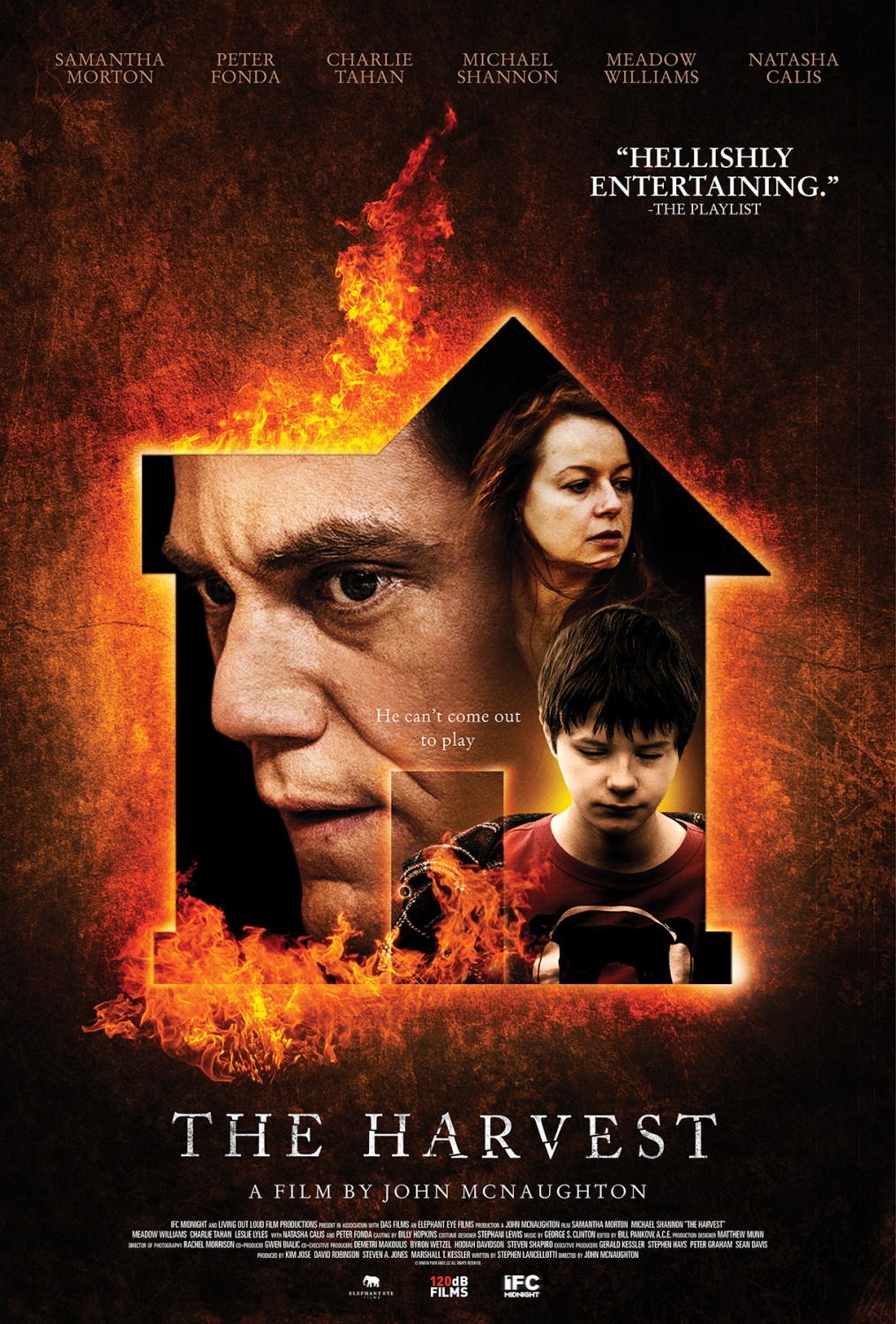
The Harvest” is one of those movies which completely took me off guard to where I had no real idea of where it was going. This is a very rare experience for me when watching movies these days as I typically have a pretty good idea of where the story is going to end up, so that makes this particular film from John McNaughton, which represents his first directorial effort in a decade by the way, all the more effective.

The prologue of “The Harvest” is designed to mess with your head a bit, so I prefer to let audiences witness it for themselves. Past this, we come to meet Maryann (Natasha Calis), a young girl who has just moved into her grandparents’ house following the death of her parents. This causes her great discomfort because, aside from losing her mom and dad, she is forced to start all over again in a new town where she is forced to make new friends again. Having been uprooted myself at such a young age, I can confirm this is a real inconvenience.

Eventually however, Maryann does make a new friend in Andy (Charlie Tahan), a very sick young boy who is confined to his home twenty-four hours and seven days a week, and he cannot move around without a wheelchair. Andy is constantly looked after by his parents, Katherine (Samantha Morton) and Richard (Michael Shannon), who are both constantly in conflict over how to best take care of him. Katherine is a doctor who constantly keeps Andy in a medicated state, and Richard constantly urges her to ease up and not overdo it. Suffice to say, these two people do not have the same relationship they had when they first wed.

Now that is all I want to tell you about the plot. What I can say tell you from here is that Maryann comes to make certain discoveries which turn hers and Andy’s life completely upside down. Watching a movie like “The Harvest” is la lot ice peeling away at an onion; you keep going through various layers in order to get to the center of things, and McNaughton and screenwriter Stephen Lancellotti reveal only so much as they keep stringing us along to the very end. Before we get to the revelation at the story’s core, we dare not take our eyes off the screen for a single second.

It was really great to see Samantha Morton here as she gives “The Harvest” its best performance. As Katherine, she gives a very multi-layered performance as we watch her go from being understanding and caring to becoming very uptight and furiously angry. When Morton stares down Calis in one scene, it makes for an incredibly tense moment as Morton looks like a snake just waiting to strike. Her’s is a very impressive performance as well as the kind which is not always found in horror movies. You are never sure whether to empathize with Katherine or fear her presence, and this proves to be a reminder of how powerful an actress Morton can be.

Michael Shannon is one of the best character actors working today and, as Richard, he has to play an emotionally muted character of sorts. At first, it seems like Shannon is doing too little onscreen, but the reason for Richard’s emotional numbness does become clear as the movie goes on. This is the kind of role where most actors get self-conscious and feel like they are not acting enough. Shannon, however, does not make this mistake, and it makes for another one of the many compelling performances we have come to expect from him.

McNaughton is the same filmmaker who gave us the feel-good movie of 1990, “Henry: Portrait of a Serial Killer.” Trust me when I say I am not even going to bother comparing “The Harvest” to it because the one which famously starred Michael Rooker is a one-of-a-kind horror film which is hard to top in terms of bleak realism. “The Harvest,” in comparison, is more of a dark fairy tale that gets darker as it goes on, and it shows how gifted McNaughton is at creating suspense and maintaining it throughout a feature film.

Seriously, when you look at McNaughton’s resume, his work has never been merely confined to the one genre. He gave us the comedy-drama “Mad Dog and Glory” which had Robert De Niro, Bill Murray and Uma Thurman giving some of their most underrated performances ever, the erotic thriller “Wild Things” which did not even try to hide how gleefully trashy it was any more than it hid Kevin Bacon’s penis on the silver screen , the concert film of Eric Bogosian’s “Sex, Drugs, Rock & Roll,” and the crime drama “Lansky” which starred Richard Dreyfuss as the famous gangster of the same name. While it may be understandable how many are unable to get past “Henry” as that film left a gaping psychological scar on those who sat all the way through it, McNaughton has managed to go from one genre to the next in a way audiences do not easily recognize. This makes him quite an underrated filmmaker.

Now “The Harvest” does have its flaws, some of which come from it being an understandably low budget production. The pacing could have been strengthened, and we just have to get that one scene where a child tells the truth of what is going on and quickly get rebuffed for no sane reason. It is always infuriating to me when adults quickly dismiss their children’s explanations as hooey because, from one generation to the next, the young ones still see right through their parents’ hypocrisy. Also, this movie ends on a note which leaves too many questions unanswered. Granted, I am all for ambiguous endings in movies, but the one “The Harvest” gives us does not provide much in the way of benefits.

All the same, I admired what McNaughton was able to pull off with here, and “The Harvest” kept my attention from start to finish. It always seems difficult to pull off such a suspenseful thriller these days, but he does accomplish his task here. There is also no forgetting Morton’s complex and frightening performance as a mother desperate to protect her child. Whatever you think of this movie, her work will stay with you for a time once the end credits have finished.

* * * out of * * * *

Exclusive Interview with Ira Sachs about ‘Love is Strange’

Ira Sachs photo

Ira Sachs’ previous films have dealt with the dangers of being in love and how it can feel like an illusion, but his latest film “Love is Strange” has him dealing with love in a more positive fashion. It focuses on a gay couple, George and Ben (played by Alfred Molina and John Lithgow), who have been together for over 30 years. When gay marriage is made legal in New York, they finally get married and are super excited about starting a new chapter in their lives together. But things quickly change for them quite drastically when the Catholic school where George teaches decides to terminate his employment upon discovering he married Ben, and this forces them to spend time apart for the first time in years as they search for cheaper housing.

I very much enjoyed talking with Sachs over the phone while he was doing press for “Love is Strange.” The movie not only chronicles the challenges these newlyweds face, but of the impact that their situation has on the family and friends closest to them. During our interview, I asked Sachs how he goes about keeping his characters in the movie down to earth, why he decided not to get political considering the issues involved, and why he decided this time to make a different movie about love than he had previously.

Love is Strange movie poster

Ben Kenber: This movie has such a wonderfully organic feel to it. How do you go about keeping the characters in the story feeling so down to earth?

Ira Sachs: That’s a nice question. I try to be as open as possible to my collaborators and to the city and to the situations that are in front of me. I think of directing as not so different to acting in a way in that my job is to listen and respond organically and authentically, and you have to do that 1000 times a day when you make a film. But if you situate yourself in a place which is most open and attentive, you have to be very observant as well. I think it creates something that has the organic feeling you’re describing.

BK: John Lithgow and Alfred Molina are both brilliant in this film, and they have been friends for a long time. The rapport they have together onscreen feels just wonderfully natural. Did you have to do a lot of directing with them, or did you just let them loose?

IS: We made a pact, the three of us, that we were going to create a certain kind of texture for their relationship that was going to be different than what either actor had been asked to do in a long time. There was a level of realism and naturalism and simplicity that the roles called for. These are really modest man, Ben and George, but they maintain a confidence as individuals that I felt was very much what I witnessed in John and Alfred, and I wanted the film to share that confidence. So we had this kind of agreement that everything would be kept to a very delicate tone, and both actors are known for their larger qualities in terms of performance. What I wanted to do was rein that in, and I think that allowed for some new things to appear.

BK: What I really admired about “Love is Strange” is it could have been a polemic about intolerance and that, even with gay marriage now a reality in many states like New York, we still have a way to go for achieving equality in life. But this movie is more humane and very objective in how it views the different forces which threaten to tear these two characters apart.

IS: My interest as a director is to depict the intricacies of relationships and of intimacy, and that includes romantic relationships as well as family and community. In this case it also includes the city of New York. I set out to make a romantic film about New York. I’m also as a director at bit of a historian meaning that my job is to be accurate about the time that I live as well as my characters, so the kind of pulled from the headlines quality just gives the film shape in a certain way. I like to think of myself as a neo realist, someone who is interested in making the ordinary of everyday lives extraordinary. For me that should in addition also include some amount of documentation of the details of these characters’ lives in a way that’s very specific.

BK: One performance in particular I really wanted to point out was Charlie Tahan’s who plays the temperamental teenager Joey. It’s always great when you get an exceptional performance from a child actor because they are not always easy to get, and the character has a nice arc throughout the movie. What was it like working with Charlie?

IS: Well, to me he is the revelation of the film because we don’t know him, and what we’re actually discovering is the birth of a great, great actor. I felt like there was conversation when we were shooting the film about Leonardo DiCaprio in (“What’s Eating) Gilbert Grape;” it’s that kind of performance. It’s so open and so honest and so raw and so easy. There’s just this ease and I think that was something that impressed all of us, more experienced filmmakers and actors on set, about Charlie was how naturally it came. He is an experienced child actor. He’d been in “Charlie St. Cloud” with Zac Efron. He was the voice of the kid in “Frankenweenie” so he worked with Tim Burton. He wasn’t plucked from nowhere, but he came in and gave an audition that was breathtaking.

BK: Charlie said you really knew how to write for kids and that you really understood them and what they went through. Did Charlie stay close to the script and was there anything specifically that he added to it during shooting?

IS: Well the script is a blueprint for the emotions you hope to reveal, so actors add everything. I’m quite specific about the script and it is a very written film and it’s constructed through the screenplay, and yet I search for a kind of emotional improvisation on set that has to be very, very fresh and real. So I don’t rehearse my actors before we start shooting. We talk, we spend some time with each other, but I’ve never heard the line said nor have the other actors. What it gives the movie is a kind of freshness. I think two words that should be banned from the set are “subtext” and “motivation” because when you’re speaking to those things, you’re trying to pin down the impossibly ineffable of any one moment.

BK: Another performance I really loved in this movie was Marisa Tomei’s. Not only does she bring a naturalness to her role, but she’s also able to communicate so much without saying a word. What was it like watching her pull that off?

IS: She’s like this quiet storm because she’s so focused as an actress. There’s a scene where she has no dialogue and she’s in bed with her husband and she’s got a lot on her mind, and as a director you just watch and you think, “She’s writing paragraphs for me.” She thinks so much while doing so little. I think what was exciting about this role for Marisa, and I think what makes people connect to it, is that she was allowed to play a woman of her experience and her intelligence, and she wasn’t asked to do anything other. In this case, Marisa is the fulcrum of the story; she’s the generation in the middle. The film is really about these multiple generations: the older couple, Marisa and her husband (played by) Darren Burrows who were very much in the middle of their lives, and Charlie Tahan who’s playing in adolescent learning about love for the first time. But it all kind of centers on Marisa and she is in a way a stand-in for me, the artist who is watching these things and trying to figure out how to act.

BK: Your previous films “Delta” and “Keep the Lights On” tend to deal with love as an impossibility or an illusion among other things, but “Love is Strange” sees it in a much different light. What made you decide to do a story on love in this particular way?

IS: I think I’ve changed a lot in the last 10 years. My previous films were all about characters trying to understand themselves, and they were films of self-discovery. I think it was very much what I personally was involved in, trying to understand who I am and become comfortable with who I am, and that took a long time. In my 40’s things have been different and I feel much more at ease, and I think that has created the possibility of new kinds of relationships. I’m married and my husband and I are raising children, but it’s not just the kind of signifiers that imply change. It’s something much more internal, and I think the film is about the internal qualities of love which are so distinct for each of us.

BK: Since this is a low budget independent movie, I imagine you had very little time in which to shoot it in. How did this affect you overall as a filmmaker?

IS: I’m a producer on all my films as well as the writer and director, and I always create the situation where I have the economic means to create the aesthetic objects that I need so my sets are very calm. I’ve made films that cost $200,000 and I’ve made ones that cost multi-million dollars, and the experience is not too different. If you’re doing your job right as a filmmaker, you have what you need.

BK: Regarding Alfred Molina’s character of George, it’s interesting because the Catholic school he teaches at doesn’t seem to mind his relationship with Ben much until the two of them get married. Later on in the movie, George has a great line where he says, “Life has its obstacles, but I’ve learned early on that they will always be lessened if faced with honesty.” What inspired that line?

IS: I think it speaks to the heart of the film. The film is in some ways about education with a small e. What do we teach each other? What is our responsibility? How as a culture do we carry on our values? What do we share in relationships and as parts of family? Also, the film speaks to how loss impacts individuals not just in terms of rights but in terms of experience. You can imagine George as a teacher being somewhat, to me, like what Alfred Molina is as a person which is you want to be your best self around him, and those are the kinds of people that I have known whether it be my parents or… I was very close to a sculptor who was 99 when he died, and at 98 he began his last work which was of a teenager with his backpack, and to me the idea that he was reaching for creative opportunities at that age was something I could learn a lot from. I feel that the film talks about those kinds of educations, and I think that when you’re young you don’t realize that your parents are people and that your grandparents are also. I think this film is about perspective and how we begin to recognize that people in our family are actually human beings with their own stories.

I want to thank Ira Sachs for taking the time to talk with me. “Love is Strange” is now available to own and rent on DVD, Blu-ray, and Digital.

Photo courtesy of the New York Times. Poster courtesy of Sony Pictures Classics.