‘North by Northwest’ Movie and 4K Review

The following review was written by Ultimate Rabbit correspondent, Tony Farinella.

“North by Northwest” is my favorite Alfred Hitchcock film of all time, which is no small feat and it’s not hyperbole.  It is my favorite film from the director because it is his most ambitious.  It has a running time of over two hours, and it is never boring, not even for a second.  It is wall-to-wall suspense, excitement and intrigue. The acting is also top-of-the-line.  Cary Grant has given a lot of great performances in his storied career, but he’s at his best in “North by Northwest” because he’s asked to juggle a lot and he’s also on screen for basically the entire movie. He goes from being cool, calm and calculated to being overwhelmed, frantic and verklempt.  He also has a terrific screen partner in Eva Marie Saint, who recently turned 100-years-old!  She’s a living legend.

Grant plays Roger Thornhill, an advertising executive who is about to have his world turned upside down when he is mistaken for a man by the name of George Kaplan. A group of thugs grab him and throw him into the home of Lester Townsend, who is really Phillip Vandamm (James Mason), a foreign spy who is into importing and exporting government secrets. They set up an elaborate ploy to frame Roger by getting him drunk and putting him behind the wheel of a car, causing him to have a drunk-driving accident.  In this situation, his own mother doesn’t even believe him, as it sounds made up.  It’s all true, and it’s up to Roger to clear his good name and put the pieces back together in this intricate puzzle.
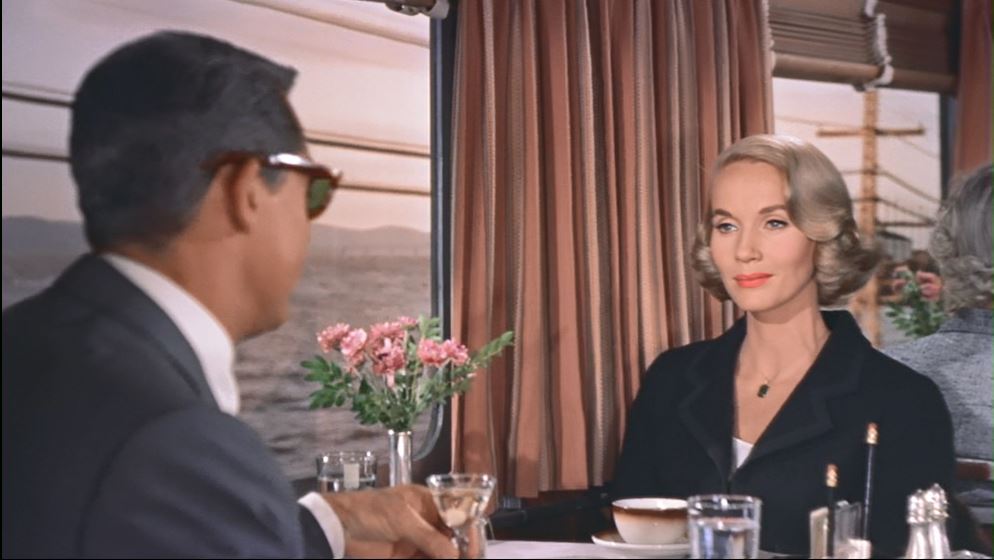
In his travels, he runs into a young woman by the name of Eve Kendall (Eva Marie Saint), who takes a liking to Roger, even though his picture is all over the paper for a murder he didn’t commit.  Things have only gone from bad to worse for Roger at this point.  She is willing to help him out and they become romantically involved.  There’s more to her than meets the eye.  That is the beauty of “North by Northwest;” everyone is not who they appear to be upon first glance.  It keeps the audience guessing and it keeps the characters in the film guessing as well.  Hitchcock made a very smart film here which is occupied with very smart people.

Even though there is a lot going on in “North by Northwest,” it never feels complicated or overly convoluted. The film doesn’t need to explain every little thing to the audience, as it trusts that the audience is smart and able to keep up with everything happening on screen. It also doesn’t hurt when you have the legendary Cary Grant on screen, who is so effortlessly charming and fascinating.  He really rolls with the punches here, as Hitchcock puts him in all types of unique and challenging settings, including the crop-dusting scene and a near-death experience on Mount Rushmore.  Hitchcock, who was notoriously tough on actors, has said his favorite actor to work with was Grant.  It’s easy to see why as they made movie magic on screen together.
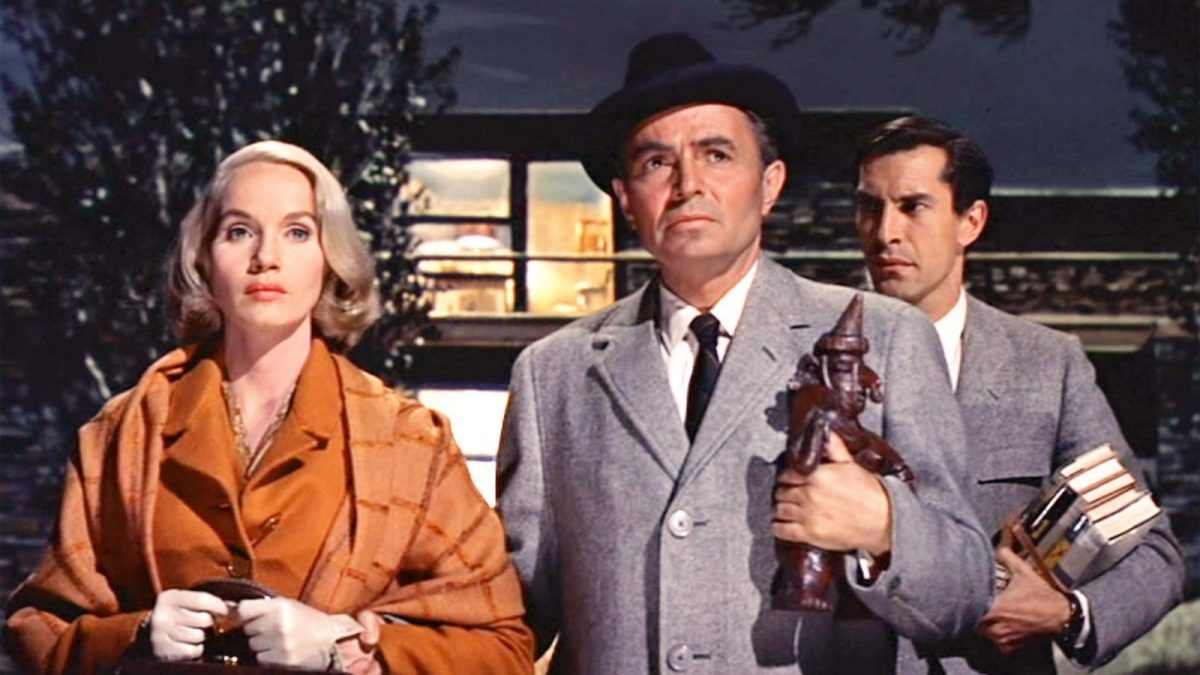
Saint is sizzling on screen with her sex appeal, confidence and charisma.  She more than holds her own in her scenes with Grant. They go tit for tat with one another, and she smolders on screen.  Whenever they are on-screen together, it’s impossible to ignore their charisma and chemistry. They play off each other so well. James Mason is a great bad guy with depth and complexity and he doesn’t overplay it and is never cheesy or silly.  Mason knows less is more, and he knows how to read his lines in a way where he’s cooler than the other side of the pillow.  He is too good of an actor to just play this role as a typical movie bad guy, and he gives this character sophistication and elegance.

“North by Northwest” is one of those rare movies where you never want it to end.  As soon as it starts, it grabs you and never lets you go.  I didn’t want to get up to use the bathroom during this movie, as I didn’t want to miss anything happening on screen. There is no wasted movement in this film.  Everything adds up to something and means something.  Every single character has a purpose, whether it is to enhance the story or the tension.  I don’t like to use the word “perfect” too often, but when it comes to a movie like this one, it is absolutely perfect from start to finish.  It’s one of my favorite films of all time.

* * * * out of * * * *

4K Info: “North by Northwest” is released on a single 4K disc from Warner Brothers Home Entertainment. It also comes with a digital copy of the film as well. The film has a running time of 135 minutes and is unrated.  It comes with either a 4K slipcover or a 4K steelbook.

4K Video Info: This is not only one of my favorite films, but also one of my favorite 4K discs of 2024. The picture quality is stunning and breathtaking.  The HDR brings out all of the beautiful colors on display. Warner Brothers has done an incredible job of making this film look vivid and colorful.  Wow! It is all about the details here, and they left no stone unturned in making sure “North by Northwest” was brought to life.

4K Audio Info: The Dolby Atmos soundtrack also adds the right amount of suspense and excitement to the proceedings.  It’s a great audio track which really makes you feel like you are in the film.  Subtitles are included in English, Spanish and French.

Special Features:

Audio Commentary featuring screenwriter Earnest Lehman

North By Northwest: Cinematography, Score and the Art of the Edit Destination Hitchcock: The Making of North by Northwest

The Master’s Touch: Hitchcock’s Signature Style

North By Northwest: One for the Ages

A Guided Tour with Alfred Hitchcock

Should You Buy It?

HELL YES! This is a film that needs to be bought immediately and, lucky for you, there are two ways to own it—the standard 4K slipcover or the impressive looking 4K steelbook. Even though the special features have been ported over from the Blu-ray, these are lengthy and informative, and they add a lot of context and insight into the film.  If you loved this movie, you want to know as much about it as possible. As far as the audio and the visuals of the 4K, this is why I love 4K and why I champion this format so much as a movie lover.  My wife and I watched this together on a Friday night and we were transfixed by the film, the mesmerizing visuals and the incredible audio.  Warner Brothers knocked it out of the park with this release. This release gets my highest level of recommendation.

**Disclaimer** I received a copy of this film from Warner Brothers to review for free.  The opinions and statements in the review are mine and mine alone.

Alfred Hitchcock’s ‘Psycho’ – 60 Years Later and Shower Curtain Sales Have Still Not Recovered

I did not become aware of Alfred Hitchcock’s “Psycho” until its first sequel, “Psycho II,” was released back in 1983, 23 years after the original. Of course, I didn’t watch this sequel at the time as I was just a kid, but I do remember its movie trailers and the title cracking up on the big screen as it played before the feature presentation of “Return of the Jedi.” This image really freaked me out, and it was just as well I didn’t see the classic film which inspired it until many years later. When I rented and watched it on VHS with my older brother, we did not  see what the big deal was as we had long since been spoiled by the “Friday the 13th” and “Nightmare on Elm Street” movies with all the blood and gore a hormonal teenager could ever want or endure.

Well, it turns out watching it once was not nearly enough. Whether or not you think “Psycho” is Hitchcock’s best movie ever, it is often the one he is remembered best for making. After 60 years, it remains a great study of how a director can maintain suspense throughout the entire running time of a movie, and of a master playing the audience all the way up to the last frame. This becomes even more apparent when you watch it for a second and third time. Hitchcock puts you into the mindset of Marion Crane as she drives out of town after embezzling some money, and then he completely changes the dynamic of the story once Norman Bates arrives.

With “Psycho” now at its 60th Anniversary, we have another chance to go behind the scenes to see how this horror classic was made. It also represents another opportunity for Universal Pictures to release a new digital edition of the movie so they can fleece a few more dollars from our wallets. There has already been a Blu-ray release which made it look exquisite, and there has got to be a 4K Ultra HD version at some point. Anyway, looking back at the history of this classic proved to be one of the most interesting research projects I have taken on in years as there is much to be said about what went on behind the scenes.

“Psycho” originated as a novel written by Robert Bloch which itself was based on Wisconsin serial killer Ed Gein, a man whose horrific exploits would inspire many horror movies to come. Hitchcock acquired the film rights through his agent for $9,000, and he chose to film it after two projects he was working on for Paramount Pictures, “Flamingo Feather” and “No Bail for The Judge,” fell through. But Paramount did not want to help Hitchcock out on this one either as they were quoted as saying they found Bloch’s novel “too repulsive” and “impossible for films.” The executives refused to finance the production, and they even went as far as telling Hitchcock their soundstages were unavailable because they were being used for other projects. Of course, this proved to be a bold-faced lie as their production schedule was already in a slump at the time.

Undaunted, Hitchcock was still determined to bring “Psycho” to the silver screen, and he even offered to defer his normal director’s fee of $250,000 in exchange for 60% ownership of the movie’s negative. Still, executives would not grant him the financing he desired, so he continued to go through several different cost-cutting measures before getting a budget of no more than $1 million to make the movie his own way. Hitchcock had planned to make the film fast and cheap anyway, and he employed the crew members of his television series “Alfred Hitchcock Presents” who were already skilled at doing the same. He also succeeded in casting proven stars Janet Leigh and Anthony Perkins at a quarter of their usual salaries.

Bringing down the budget also meant shooting the film in black and white, but this was fine with Hitchcock as he wanted to film it that way as to make the shower scene come across as less gory, and he was also a big fan of “Les Diabolique” which was also shot in black and white.

Like “Psycho,” “Les Diabolique” was remade many years later. Unlike the originals, both were filmed in color. Even more unlike the originals, they received mercilessly scathing reviews upon their separate releases.

In filming “Psycho,” Hitchcock started off by making it as objective an experience as possible, and we feel what Marion goes through as the voices in her head fill her with guilt and doubt over what she has done. To help emphasize this effect, Hitchcock shot much of the movie with 50 mm lenses on 35 mm cameras. By doing this, the camera was said to mimic normal human vision. As a result, you are not just watching the movie, you are experiencing it. This even goes on after Marion has gone and the story turns its focus to Norman Bates. When he pushes her car into a nearby swamp, you share in his anxiety when it does not completely sink. That’s the thing; like Norman, you want the car to sink, and it makes one feel like a voyeur just as Hitchcock intended.

Then, of course, you have the famous shower scene, and after all these years it remains one of the most talked about and heavily dissected moments in cinema history. I am sure you all know the details regarding it: it was shot over six days from 77 different camera angles, and the scene features around 50 cuts in the three minutes which it lasts. Not much is shown as you never see the knife penetrating Marion’s flesh, and there is no gore other than the blood (chocolate syrup was used) going down the drain along with the water. Indeed, it is what you do not see which makes the scene feel so violent. Like Spielberg later did with “Jaws,” Hitchcock dared the audience to use their imagination in regards to what they thought they saw here. This is one of many reasons why this scene has stood the test of time, and it was also the first time a director killed off his leading lady in the middle of a movie. Back in 1960, audience members could not help but wonder where things could possibly go from there, and shower curtain sales have never been the same since.

I also cannot go on without mentioning the infamous score composed by the great Bernard Herrmann, and it remains one of the scariest pieces of music ever applied to a motion picture. Throughout his career, Hermann proved brilliant in composing film scores which really captured the psychology of the characters. This proves to be as true about “Psycho’s” score as it was with Hermann’s work on “Cape Fear” and “Taxi Driver.” It was a surprise to learn how this score almost didn’t come about as Herrmann balked at Hitchcock’s request to take the job on a reduced salary. Somehow though, Herrmann agreed to the terms and ended up writing music for a string orchestra as opposed to a full symphony which would have included brass and woodwind instruments. This is now clearly seen as a masterstroke on his part as the screeching of violins captures the sheer terror which overtakes Marion and the audience during the infamous shower scene.

Although “Psycho” is now recognized today as a classic, it actually received mixed reviews upon its release. Some admired the buildup of tension, but others questioned the psychological elements as being less effective. It even made one critic, C. A. Lejeune, so offended to where she walked out of the movie before it was even over, and she soon after resigned from her position as film critic for The Observer. Looks like Norman’s mother did not just claim victims onscreen!

When you look at the history of cinema, it is important to keep in mind how movies we see these days as classic were not necessarily treated this way upon their original release. It is over the passing of time where movies get re-evaluated or seen in a different light, and none can ever truly be perfect (although some do come very close to it). “Psycho” was a game changer as it came about during the Motion Picture Production Code which was heavy in its censorship of violence and sex in American films. With “Psycho,” Hitchcock flirted with showing nudity as well as gore, and this later opened up doors for filmmakers to exploit these elements with far more detail. Without “Psycho,” there may never have been a “Halloween” which by itself inadvertently sparked a whole wave of slasher movies. And without “Halloween,” there certainly would not have been a “Friday the 13th” as Jason Voorhees, like Norman Bates, also had serious mommy issues.

The cultural impact of “Psycho” lasts on to this very day. There are only so many movies which could have a sequel made to it several decades later. “Psycho III” followed a few years later, and a prequel came about because some just thought it would be a good idea to show how Norman Bates got to be the shy psycho we know him to be. There was even a failed television pilot called “Bates Motel” which starred Bud Cort as Alex West, an asylum inmate who befriends Norman and later inherits the motel and the house where mother lived (Anthony Perkins wanted nothing to do with that one). It also inspired a shot-for-shot remake by Gus Van Sant which seemed almost every bit as odd as Norman himself. The only purpose of it seemed to be proof of how remakes will never be able to recapture what made the original so good. But if they make money, the studios will clearly not mind the critical bashing even if it proves to be justified.

Television would later take another shot at the “Psycho” franchise with another version of “Bates Motel,” and this one starred Freddie Highmore as Norman Bates and Vera Farmiga as his mother. This version ended up lasting five seasons and proved to be very compelling as our fascination with the dark side of human nature is always stronger than we ever bother to realize. While some may have said enough already with “Psycho,” this show proved there was more life to it than we cared to initially realized.

Even today, you cannot hear screeching violins and not think of “Psycho.” Filmmakers reference it today like Wes Craven did in “Scream,” and there are dozens of movies out there which have done the same. That shower scene has been spoofed lord only knows how many times, my favorite being on “The Simpsons” where Maggie ended up attacking Homer with a mallet after watching one Itchy & Scratchy cartoon. Another great one came about during one of Billy Crystal’s Oscar montages where he was in the shower and ends up getting accosted by Kevin Spacey who plays his “American Beauty” character of Lester Burnham. Turns out it was not the same shower Marion got stabbed in, but instead the one where Lester often experienced the highlight of his day.

Leigh never looked at taking showers the same way again, and it would be ages before she ever took one. Perkins would forever be typecast in roles similar to Norman Bates, but he said he would still have done “Psycho” even if he knew this would be the case. Many filmmakers (Brian DePalma especially) have tried to use the tricks Hitchcock employed in this and his other films to varying degrees of success. Still, there is no topping what Hitchcock did with this classic 1960 movie, and it remains the one so many other suspense and horror movies are judged by. Hitchcock’s powers of manipulation remain very hard to duplicate after all these years, and this illustrates what he meant when he was quoted as saying, “I enjoy playing the audience like a piano.”

Cla