‘Big Eyes’ Marks a Return to Form for Tim Burton

Big Eyes movie poster

Tim Burton’s unique talents as a filmmaker have floundered in recent years with his abysmal remakes of “Planet of the Apes” and “Alice in Wonderland” which was lacking in wonder. But with “Big Eyes,” he gives us his best and most human movie in a long time as he examines the life of American artist Margaret Keane whose paintings of children with oversized, doe-like eyes became very popular in the 1950’s. It reunites Burton with his “Ed Wood” screenwriters Scott Alexander and Larry Karaszewski who have provided us with some of the most unique biopics in recent memory like “The People vs. Larry Flynt” and “Man on The Moon.” Yes, it is based on a true story, but for once it helps to know this as the movie is a tale which proves there are things much stranger than fiction.

“Big Eyes” starts with a narrator saying the 1950’s was a good time if you were a man. This certainly seems to be the case with Margaret Keane (Amy Adams) as she is in the process of leaving her husband and drive herself and her daughter Jane out to San Francisco to start all over again. This decade had women relegated to the role of housewife, and they could do very little else as feminism had yet to become a movement. Margaret has trouble finding work until she gets a job at a furniture company painting baby cribs. At the same time, she is quite the painter who paints pictures of children, most of which resemble her daughter, that stand out because of the big eyes she gives her subjects.

While at an art sale, Margaret meets Walter (Christoph Waltz), a fellow painter who quickly becomes enamored of her and her paintings, and he quickly begins to encourage her not to sell herself short. They soon fall for one another and get married, and they become determined to sell their art to the masses. When their attempts to get their work hung up at art houses fails, Walter resorts to renting the walls at The Hungry I club owned by Enrico Banducci (Jon Polito). It is there the paintings begin to gain notice, but patrons are far more interested in Margaret’s work than they are in Walter’s. In the process, Walter starts to take credit for his wife’s paintings, and this is where things take a rather interesting turn.

Margaret is repulsed at first by the idea of Walter taking credit for her work, but she finds herself giving in to him as he promises to give her everything she ever wanted in life like a big house to live in. But as the popularity of the paintings grows, a rift forms between them as Margaret ends up residing in the background while Walter takes center stage at various talk shows and public engagements. Soon, Margaret goes from being timid to becoming a very determined person as she aims to reclaim the art she created.

What happened between Margaret and Walter Keane became the story of one of the most epic art frauds in history, and I have to admit I was not aware of this piece of history before I saw “Big Eyes.” If this story were presented to me as fiction, I’m fairly certain I would not have bought it as this story would have been far too bizarre to be the least bit believable. But these events did happen, and Burton’s strong affection for Margaret’s work is definitely on display here.

I’m so glad Alexander and Karaszewski are still getting away with making these renegade biopics about individuals who might otherwise not get cinematic treatment. The fact they brought this particular story to the big screen is extraordinary as it involves an act of plagiarism which didn’t take place in Hollywood. It sounds like a typical good guy/bad guy story, but the way the story develops shows this to not be the case.

Adams is her usually remarkable self as she takes Margaret Keane from the depths of isolation and bitterness to the heights of confidence and self-assertion. She also presents Margaret to us with flaws and all to where we respect her deeply even if some say she put herself in the position of having her work stolen. The 1950’s may have not been the best time for women, but the victory Margaret achieved opened doors for them to where they would never ever be held back by the role society expected them to play.

Waltz won his two Oscars for good reasons as he portrayed his characters in Quentin Tarantino’s “Inglourious Basterds” and “Django Unchained” with such relish. His performance in “Big Eyes” proves to be equally wonderful as he makes Walter into such a charismatic figure to where it’s no wonder Margaret falls under his spell. While his character is essentially the bad guy of this piece, Waltz does give Walter some empathy as his actions result from a rather unconscious need for approval in a world which has deemed him a fair artist at best. While we can’t condone his actions, we can certainly understand where his motivations come from.

For Burton, “Big Eyes” is a return to the low budget roots he started out in. While it may not feel like the typical Burton movie along the lines of “Beetlejuice,” “Edward Scissorhands” or even “Batman,” it’s certainly his most heartfelt movie in a long time. He recreates the San Francisco many of us know from the 1950’s and 1960’s, and he shows us how Walter succeeded in commercializing art to where it became available at all the local supermarkets. But at the heart of it all, “Big Eyes” fits in with the kind of stories Burton loves to tell; of outsiders who are seen as far too different to succeed in popular culture.

“Big Eyes” falters a little towards the end as Walter starts to come across as less complex and more of a one-dimensional bad guy the audience understandably wants to see go down. Part of me wanted to see Burton delve a little deeper into his psychology as making him the typical bad guy in this movie seemed much too easy. Still, it makes for a very entertaining courtroom scene where both he and Margaret fight for the right to Margaret’s work like never before.

It’s heartening to see Burton give us such a heartfelt motion picture like “Big Eyes” as his last few movies kept taking away from his distinct talent as a director. Even with a lower budget than what he is used to working with, he still gives us a wondrous if roughened up look at an artist caught up in a real-life situation which threatens to rob her of the work she created. Here’s hoping we see more movies like this from Burton in the near future.
* * * ½ out of * * * *

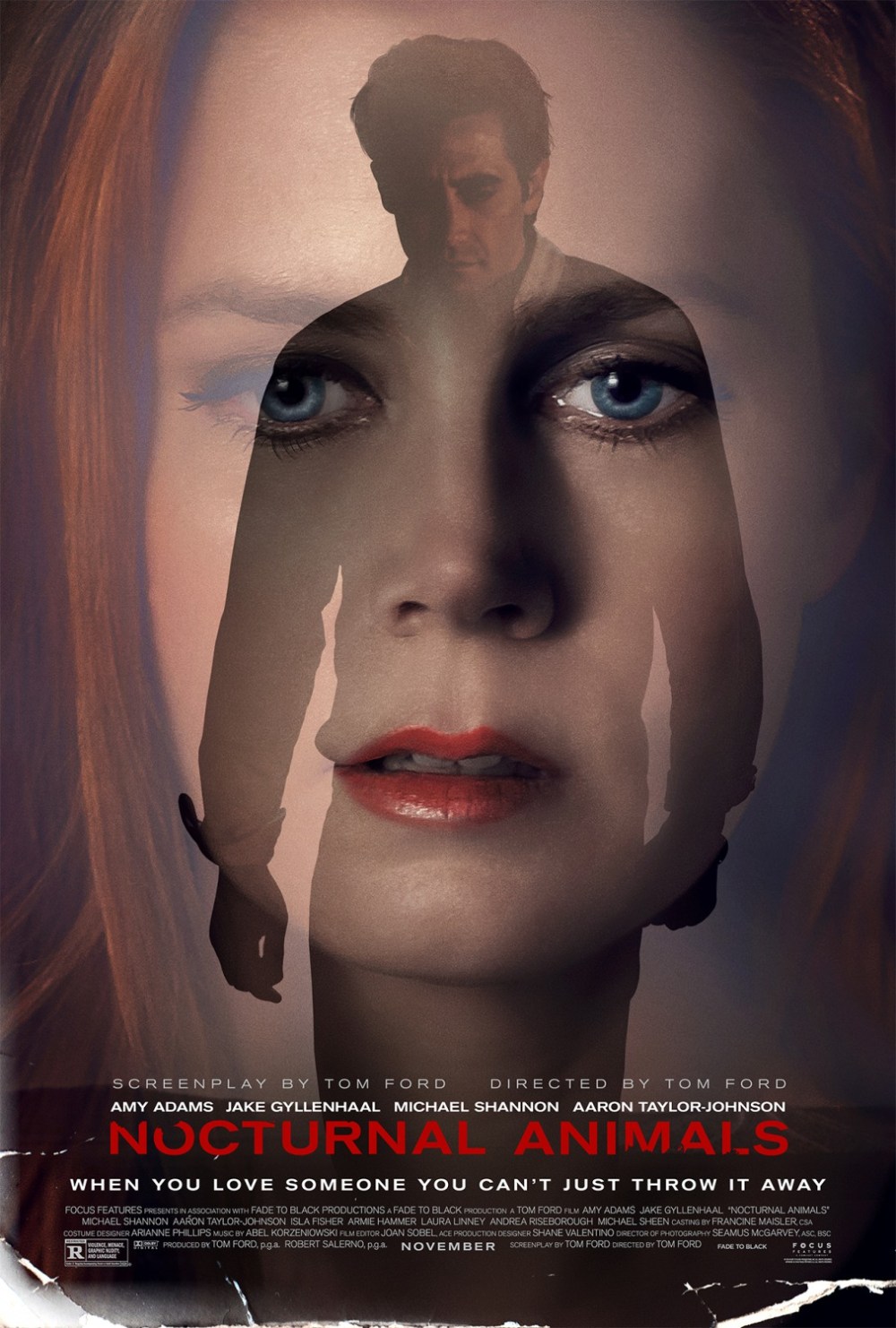
Nocturnal Animals

nocturnal-animals-poster

Nocturnal Animals” is a movie which will stay with me long after I have seen it. Based on Austin Wright’s novel “Tony and Susan,” it follows a non-linear path and combines stories which deal with the real world and a fictional one to where, after a while, it’s almost hard to tell the two apart. Either that or you will leave wondering which story is the most emotionally exhausting. Judging from the movie’s first images of an art exhibit created to challenge our perceptions of what is beautiful or acceptable, director Tom Ford is quick to take us on a cinematic ride, and the kind we are not often accustomed to taking.

We meet Los Angeles art gallery owner Susan Morrow (Amy Adams) who appears to have it all: a handsome husband, a fabulous house and an income we would all envy. But we can tell from the start she is a lonely soul wandering through the superficial world she inhabits, and it doesn’t help that her husband Hutton (Armie Hammer) has been distant and may very well be cheating on her. Clearly, we are about to see why she is the damaged individual she is, and it will not be a pleasant trip whether it’s through reality or fiction.

One day, Susan receives a manuscript of a novel written by her ex-husband Edward Sheffield (Jake Gyllenhaal) named “Nocturnal Animals,” a nickname he gave her upon realizing she stays up late at night because she has trouble sleeping. Edward has dedicated his novel to her, and it tells a very bleak tale of love and tragedy as we watch Tony Hastings (also Gyllenhaal) suffer the utter humiliation of seeing his wife and daughter kidnapped by three troublemakers who later kill them. From there, Tony teams up with Texas Detective Bobby Andes (Michael Shannon) to bring the three men to justice, but the justice these two seek may not be one which is altogether legal.

Ford has the movie weaving in and out of its real world and fictional storylines to where you can’t quite tell where things are heading, and he does it in a way which is quite inspired. A story like this can be tricky to pull off as you can jump from one storyline to another at the worst possible moment to where we are desperate to see the movie get back to where it once was. But Ford has managed to weave all these storylines seamlessly to where everything feels in balance and not out of place.

At its heart, I think “Nocturnal Animals” is about the transformative power of art more than anything else. Whether it’s Susan’s art gallery or Edward’s novel, both of these characters use their individual artistry to channel emotions they couldn’t quite get to the surface in their relationship. The fact it takes Edwards years to reach this artistic jump in his writing abilities through his tragic novel shows how artists are not so much born as they are molded through years of life experiences.

Amy Adams gives her second great performance in 2016, her other being in Denis Villeneuve’s “Arrival.” She makes Susan a sympathetically tragic character as we watch her go from youthful promise to insomniac surrender as her life has become defined by isolation from everyone and anyone around her. Even when she has too much eyeliner makeup on, and her makeup is a distraction at times, Adams delves deep into her character’s complexity to deliver a performance of piercing sensitivity.

Gyllenhaal is riveting as both Edward and Tony, characters who suffer the indignities of life and love to where all that’s left is revenge. While the actor still seems a bit young to play the father of a teenage daughter, he is fearless in exploring a character who suffers a fate worse than death. Kudos also goes out to Isla Fisher who plays Tony’s wife, Laura, as she has to reach an emotional fever pitch and keep it high whenever she appears onscreen.

This movie is also proof of how there are no small roles, only small actors, and no actor here should be mistaken as small. Andrea Riseborough, completely unrecognizable here, steals some scenes as Alessia Holt, a person who has found happiness in a space filled with obliviousness and fake promises. Michael Sheen also shows up as Alessia’s husband, Carlos, who is actually gay, and she gives Susan some advice worth following. Ellie Bamber gives us a convincingly down to earth teenager in India Hastings who ends up coming face to face with her worse fears. Laura Linney has some strong moments as Susan’s mother, Anne, whose words hang over Susan throughout the rest of the movie. Karl Glusman and Robert Aramayo portray two gang members whose intimidation knows no bounds, and even the audience has yet to see how far they will go. And it’s always great to see Jena Malone, and she gives a wonderfully quirky performance as art gallery worker and new mother Sage Ross.

But there are two performances in “Nocturnal Animals” which stood out to me in particular. The first is Michael Shannon’s as Bobby Andes, a man of the law who looks to play it by the book, but who is slowly losing his moral bearings along with his body to the cancer eating away at it. Shannon doesn’t act but instead inhabits his character to where we don’t see him performing but becoming this sheriff, and he becomes increasingly frightening to where the anticipation of him letting go of a bullet is almost too much to bear. Seeing him bear down on a suspect with his piercing eyes and gruff voice makes him even scarier, and you have to admire the person who doesn’t need to do much to instill dread into another with such relative ease.

Then there’s Aaron Taylor-Johnson, a long way from his “Kick-Ass” days, as Ray Marcus, a lethal and disgusting bully of a character who revels in emasculating and humiliating Tony in front of his wife and daughter. Johnson’s performance reminds of you of those people in life who robbed you of your worth and self-respect and didn’t show the least bit of remorse about it. You want to smack Johnson in the face after watching him in “Nocturnal Animals,” and that is a compliment.

This is only Ford’s second movie as a director, his first being “A Single Man” with Colin Firth, a movie my parents are still begging me to watch. He is primarily known as a fashion designer whose clothes have made some of the most beautiful celebrities look even more beautiful. With “Nocturnal Animals,” he proves to be as gifted behind the camera as he is with clothes, and he gives this movie a striking look with the help of cinematographer Seamus McGarvey. This could have been a movie dominated by style more than anything else, but Ford gets terrific performances out of his infinitely talented cast, showing his attention is on the story and characters more than anything else.

It should also be noted how Ford has not put anything from his own clothing line on display here, so this movie should in no way be mistaken as a commercial for his fashions. He wisely removed this conflict of interest from “Nocturnal Animals,” so those hoping for a glimpse at his latest fashion line will have to look elsewhere.

“Nocturnal Animals” ends on an ambiguous note regarding Susan and Edward. This will probably annoy some viewers who demand concrete answers to their relationship or the state of their lives and where they will go from here. But Ford is wise to know this is a question he cannot answer himself as the fate of these characters has to be open up to interpretation. Some relationships are meant to be repaired, others are better left broken. When it comes to Susan and Edward, we can only wonder if they can or even should rediscover what made their love spark so passionately.

“Nocturnal Animals” is a movie meant to stay with you for a long time after the end credits have finished, and boy does it ever.

* * * * out of * * * *